
The Fascinating History of Headwear
You're probably doing something practical right now, not historical. Maybe you're choosing hats for a brewery launch, a landscaping crew, a school fundraiser, or a streetwear drop. You open a catalog and start bouncing between styles. Trucker hat or dad hat? Beanie or snapback? Structured crown or relaxed fit? Rope hat or classic baseball cap?
That choice feels simple until you realize every hat already says something before your logo ever gets stitched on.
A beanie suggests utility, warmth, and a stripped-down look. A dad hat feels easygoing and familiar. A trucker cap leans casual, outdoorsy, and a little louder. None of that happened by accident. The history of headwear shaped those meanings over a very long time, and those meanings still affect what customers, staff, fans, and clients think when they put your hat on.
I love this part of the business because it feels like working in two worlds at once. One world is the museum gallery, where every hat carries a story about protection, class, labor, religion, sport, or rebellion. The other is modern e-commerce, where someone needs to choose a hat that will sell, fit the audience, and hold embroidery cleanly.
If you understand where a hat came from, you make better branding choices today. You stop asking only, “What looks good?” and start asking better questions. What feels trustworthy? What feels premium? What feels relaxed? What feels team-oriented? What fits the setting where people will wear it?
More Than Just a Hat
A coffee roaster ordering merch for the first time usually starts with color. Black sells. Cream looks premium. Forest green feels outdoorsy. Then the next question hits: what style?
That's where people get stuck, because hat choice isn't only about taste. It's about message. A snug beanie and a foam-front trucker hat can carry the same logo, but they tell very different stories about the brand behind it.
The story starts before the logo
Headwear has always done two jobs at once. It protects the wearer, and it signals identity. That basic truth runs from the oldest known head coverings to the hats stacked in a wholesale warehouse today.
When a business owner ignores that, they often choose a hat that looks fine on a screen but feels wrong in real life. A polished hospitality brand might choose a stiff streetwear-style cap and wonder why it doesn't fit the mood. A skate shop might order a soft unstructured cap and realize it doesn't match the sharpness of the rest of the line.
Practical rule: Pick the hat style first for its built-in personality. Then match thread color, placement, and decoration method to that personality.
Why history helps with buying decisions
You don't need to become a costume historian to use the history of headwear well. You just need to notice a few patterns:
- Protective origins matter: Hats that began as practical gear often still feel authentic in workwear, outdoor, and team settings.
- Status history lingers: Some shapes still carry signals of authority, polish, or formality, even when people can't explain why.
- Mass culture changes meaning: Sports, music, and film turned certain hats into everyday symbols.
- Cultural context matters: Not every head covering is a blank canvas for branding. Some carry deep religious or communal meaning and deserve care.
Once you start looking at hats this way, the catalog gets easier to read. It stops being a pile of products and starts becoming a set of brand signals.
From Protection to Power in Ancient Headwear
A buyer for a golf resort and a buyer for a brewery can both order “custom hats” and still need completely different answers. That difference starts far earlier than fashion. The first headwear solved physical problems. Soon after, it began solving social ones too.
Archaeologists have long pointed to very early human figures as evidence that head coverings appeared near the beginning of adornment, not as a late luxury. The famous Venus of Willendorf figurine is often discussed in that context by the Encyclopaedia Britannica entry on Venus of Willendorf. Even if scholars debate whether the figure shows a cap, braids, or a woven covering, the bigger point is clear. Covering the head is ancient, practical, and deeply human.
Protection came first
In early societies, a head covering worked like shelter you could carry. Sun, dust, heat, and cold do not care about style trends. They force design decisions.
Ancient Egypt is a useful example because daily life made sun protection unavoidable. People working outdoors needed relief from exposure, and head coverings answered that need. That old logic still shapes modern buying better than many first-time merch buyers realize.
If your customers stand outside for hours, comfort is not a bonus feature. It is the product.

That is why resort groups, golf events, and outdoor hospitality brands often care so much about brim width, crown height, and trim details. Those choices affect both wearability and setting. A useful guide on how to choose country club hats shows how a hat can still signal whether it belongs on a course, at a clubhouse lunch, or during a member tournament.
For a modern catalog, this ancient “protection first” mindset usually points in three different directions:
| Ancient need | What it required | Modern custom hat parallel |
|---|---|---|
| Sun relief | Shade and breathability | Trucker hats for outdoor events and warm-weather staff use |
| Warmth | Soft insulation close to the head | Beanies for winter crews, ski shops, and cold-weather promotions |
| All-purpose daily wear | Easy, repeatable comfort | Dad hats for casual retail, cafes, and low-pressure brand visibility |
Power and identity came next
Once a society uses headwear to mark role, rank, or ritual, the hat becomes more than equipment. Ancient Rome makes that shift easy to see. Military helmets, civic headwear, and ceremonial crowns all signaled who a person was before he spoke. Museums such as the Metropolitan Museum of Art's collection on Roman art help show how strongly public identity and dress were tied together in the ancient world.
That same habit survives in modern branding. People still read hats quickly. A soft beanie suggests approachability. A mesh-back trucker hat feels active and practical. A dad hat usually reads relaxed and familiar. A rope hat, especially a style such as the Imperial rope hat, often feels polished, club-minded, and slightly ceremonial without tipping into formal wear.
Here is the useful lesson for a business owner:
| Ancient role | What headwear communicated | Modern branding decision |
|---|---|---|
| Worker or traveler | Readiness and function | Pick a style customers will actually wear in real conditions |
| Soldier or official | Order and authority | Use structured caps for staff uniforms or event teams |
| Elite or ceremonial figure | Prestige and distinction | Add rope details, premium fabrics, or refined embroidery when the setting calls for status |
A logo does not erase those signals. It rides on top of them.
Why this still matters in a product catalog
Confusion usually starts when buyers treat all hats as blank surfaces for decoration. They are not. Each silhouette arrives with centuries of baggage, in the best sense of the word. Shape carries memory.
That is why the wrong hat can make good branding feel off. A luxury-adjacent hospitality brand may look better on a rope hat or clean dad hat than on a loud foam trucker. A construction supplier may get better long-term wear from trucker hats or knit beanies than from a softer, more fashion-forward option.
Ancient headwear teaches a simple rule. Start with the job the hat needs to do. Then choose the social signal you want it to send. Only after that should you place the logo.
When Hats Defined Status and Industry
Walk into a busy nineteenth-century city street and a hat worked almost like a business card above the eyes. Before anyone heard your name, they could read your trade, your ambitions, and sometimes your income from the shape on your head.
That is what makes this era so useful for a modern brand owner. The eighteenth and nineteenth centuries tied headwear to class, work, and mass production so tightly that many of those visual signals still cling to hats now.
The clearest example is the top hat.
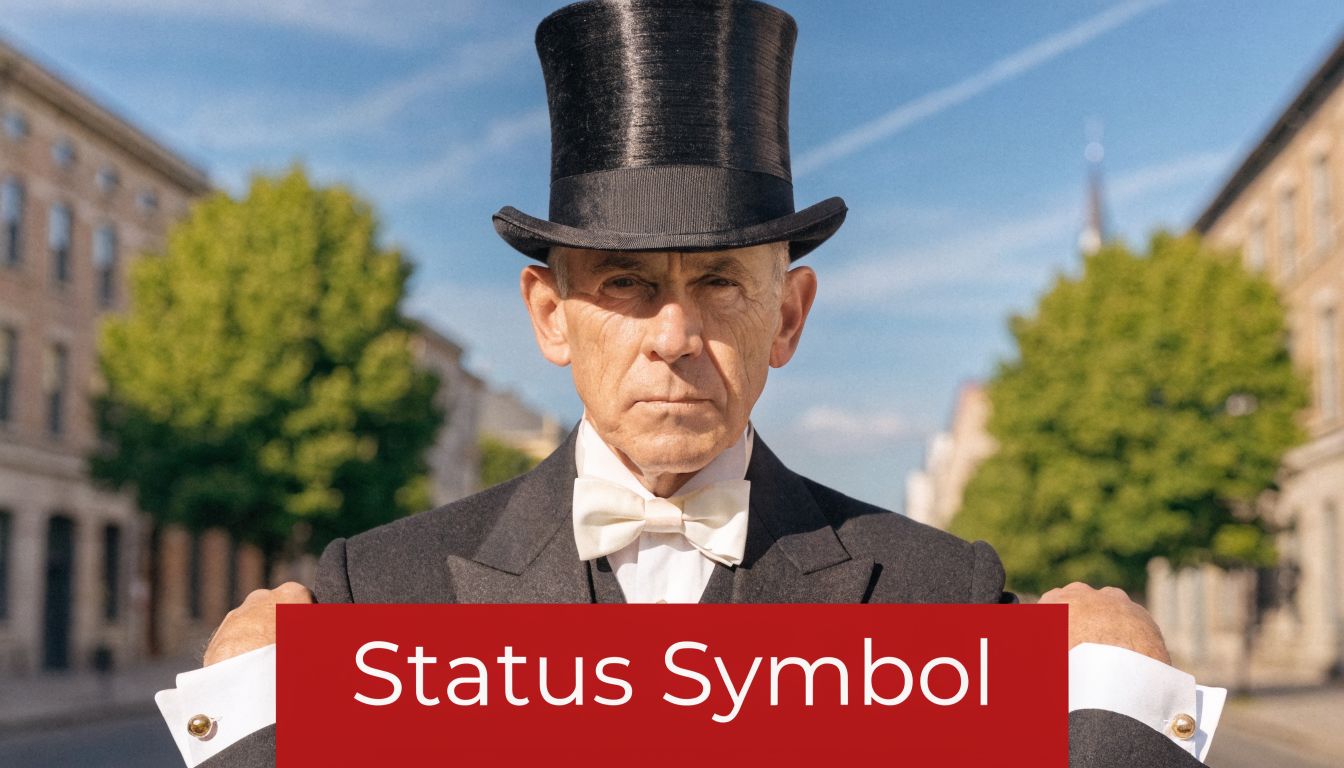
The top hat as social shorthand
The Victoria and Albert Museum notes that the top hat emerged in the late eighteenth century and became a standard part of respectable male dress in the nineteenth, especially in urban professional life, according to the V&A's overview of the top hat. In plain terms, this was not casual headwear. It signaled discipline, money, and belonging in public life.
Modern caps still carry that same logic, even though the forms changed. A structured crown works like a jacket with a defined form. A softer cap works more like a broken-in chore coat. Both can look good, but they do different jobs.
That distinction matters when you choose custom headwear for a company, event, or staff uniform.
- Firm crowns and defined front panels usually feel organized and official.
- Clean structure helps embroidery sit straighter and read from farther away.
- Softer, lower-profile shapes tend to feel familiar, personal, and less ceremonial.
If you want a current example of that more deliberate, athletic structure, a fitted silhouette such as the New Era 39THIRTY stretch-fit cap carries a polished, shaped look that reads very differently from a relaxed dad hat.
The ugly side of the hat trade
This period also shows what happens when headwear becomes an industry at scale. The phrase “mad as a hatter” is commonly linked to mercury poisoning among felt hat makers, and the U.S. National Park Service explains that mercury nitrate was used in felt production and could cause severe neurological harm among workers in the trade, as described by the National Park Service history of hat making and mercury exposure.
That history adds an important layer for anyone buying hats today. A hat is never only a style choice. It is also the result of materials, labor, machinery, and decoration methods.
Buying insight: Choosing between a beanie, trucker hat, and dad hat also means choosing how the product behaves in production. Knit beanies handle winter utility and texture well. Trucker hats offer breathability and bold front-panel logos. Dad hats give you a softer, more casual tone, but the unstructured shape changes how embroidery sits and how formal the finished piece feels.
A short visual break helps bring that era into focus:
Why this era still affects modern branding
By this point in history, hats had become social equipment. They helped people sort one another quickly in crowded streets, offices, factories, and clubs. That habit never fully disappeared.
You can still see the echo in a product catalog. A trucker hat often suggests work, motion, and practicality. A dad hat suggests ease and approachability. A beanie suggests function first, with style close behind. Those signals are not random. They grew out of centuries when headwear marked occupation, setting, and status before a logo ever entered the picture.
For a business owner, the lesson is simple. Start by asking what role the hat should play in the customer's life. Staff uniform. Premium merch. Outdoor giveaway. Retail add-on. Then choose the silhouette whose inherited signal matches that job. Your logo will look better because the hat is already saying the right thing.
The Twentieth Century Hat Revolution
The twentieth century changed hats by changing daily life. Sport expanded. Film spread visual trends faster. Work and leisure began to blend in new ways. People still wore hats, but the rules loosened, and headwear moved closer to identity, entertainment, and routine personal style.
That shift is why modern custom headwear feels so broad. We inherited not one hat tradition from the twentieth century, but several at once.
The cap moves from field to daily life
The baseball cap is one of the most useful examples because its roots are so concrete. The Brooklyn Excelsiors introduced a baseball cap in 1860, and its 6-panel wool construction and rigid bill helped define structured cap design, according to this history of caps and hats. That design later scaled through industrial manufacturing, with production costs dropping 70% by 1900, paving the way for mass-market caps, as the same source notes.
That's a huge turning point in the history of headwear. A hat built for sun protection and team identity became the ancestor of many of the hats businesses customize now.
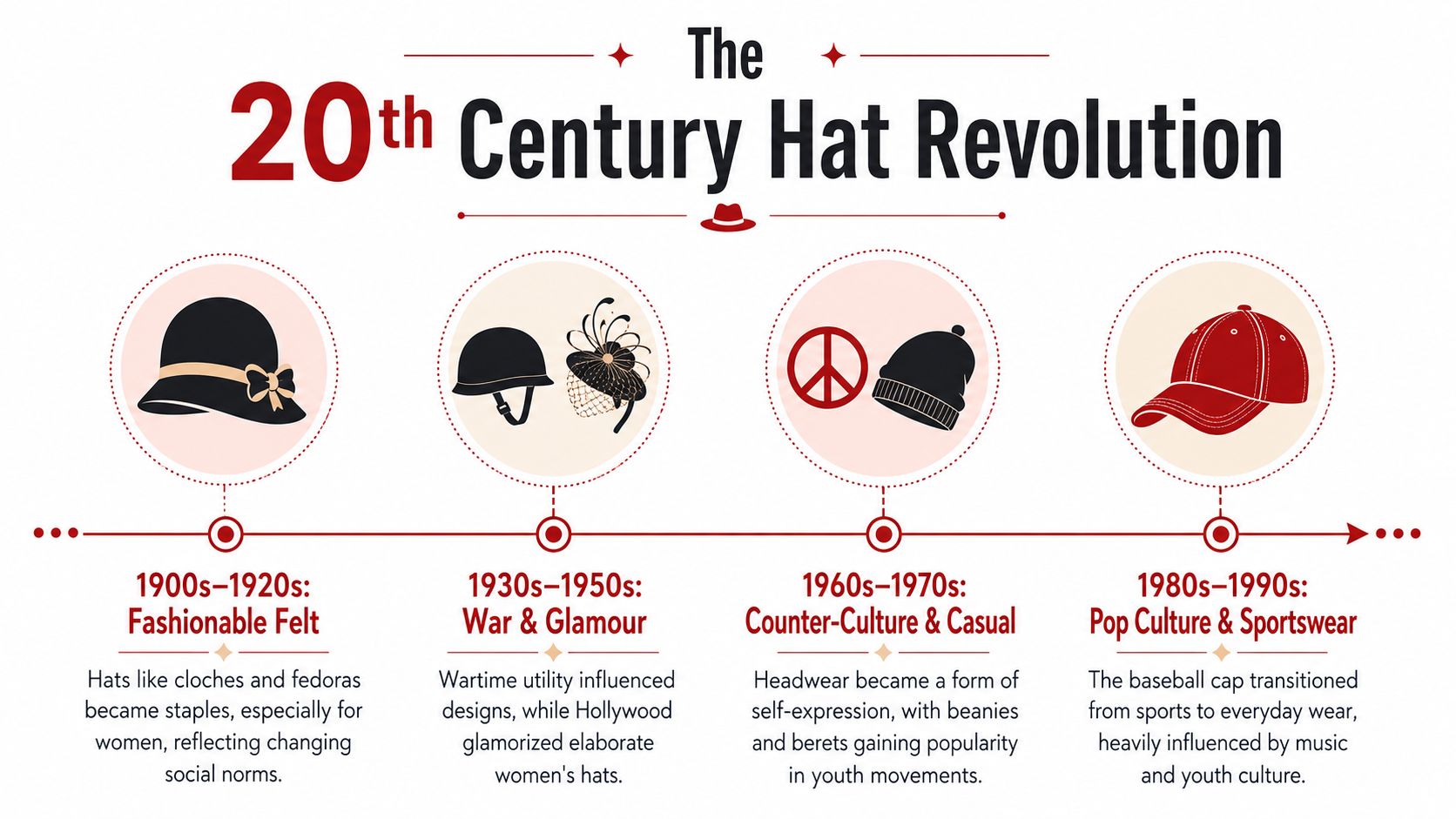
More than one hat story at once
The century didn't produce one dominant look. It produced multiple lanes:
| Style lane | What it represented | What it still suggests today |
|---|---|---|
| Fashion hats like cloches and fedoras | Style, city life, changing social norms | Taste, heritage, polish |
| Military-influenced headwear | Utility, service, discipline | Function and toughness |
| Casual caps from sport | Team identity and everyday wear | Accessibility and broad appeal |
| Youth and counterculture styles | Self-expression | Personality and subculture awareness |
This is why choosing a cap for branding can get surprisingly nuanced. A hat can feel sporty, nostalgic, clean, rebellious, uniform, or fashion-forward depending on shape and context.
Why fit systems became part of the story
Once baseball caps became everyday wear, people started caring about fit in a different way. Not just whether a hat looked right, but whether it felt right over a full day. Stretch-fit silhouettes answer that need well, especially when you want a neater profile than a snap closure. A model like the New Era 39THIRTY fits into that legacy because it carries the visual line of the baseball cap while feeling more customized than a lot of casual adjustable options.
Some hats ask to be displayed. The baseball cap asks to be lived in. That difference is why it became such a durable branding canvas.
The twentieth century made one thing clear. Headwear no longer belonged only to elites, uniforms, or ceremonies. It belonged to everybody, and that opened the door to the custom hat market businesses rely on now.
Headwear Traditions Around the World
A lot of online writing about the history of headwear tells a narrow story. It jumps from European fashion to American sports and acts like that's the full map. It isn't.
Many of the most meaningful forms of headwear sit outside that Western timeline, and if you ignore them, you miss both history and good judgment.
The Western timeline is incomplete
According to Hatbox's discussion of gaps in hat history coverage, many historical accounts overlook the global significance of headwear. The same source notes that Sikh turbans, or dastar, have been mandated since 1699 for over 25 million wearers, symbolizing equality, while Islamic turbans evolved from seventh-century Arabian traditions. It also notes rising search interest in cultural hat history.
That matters because not all headwear is just style. Some forms are tied to religion, duty, identity, and community memory.
A business owner should understand that difference. There's a gap between being inspired by world traditions and flattening sacred or culturally specific forms into generic merch.
What global context changes for modern buyers
When people buy custom hats today, they're often trying to reach diverse audiences. A school district, nonprofit, restaurant group, or apparel brand may serve people with very different relationships to headwear.
That means your choices should reflect a few basic principles:
- Know when a style is symbolic: Some forms of head covering carry meanings that go far beyond fashion.
- Separate inspiration from imitation: Color, texture, craftsmanship, and silhouette can inspire design without copying sacred or identity-specific items.
- Use plain respect: If a campaign references cultural tradition, consult people who belong to that tradition.
Better design starts with better awareness
This wider view also helps creatively. Once you stop treating hat history as only a European fashion timeline, you see more clearly why headwear is such a powerful branding category. Across societies, people have used it to express belonging.
That's the key lesson. Hats aren't just accessories that happened to survive. They survived because they sit at the intersection of visibility and identity. You wear them at eye level. Other people read them instantly. That makes them powerful in commerce, but it also means businesses should choose with care.
Respect is part of good design. If a style has deep cultural or religious meaning, treat it as context to learn from, not a blank product template.
How History Shapes Your Custom Hat Choices Today
Most buyers don't need a lecture on archaeology. They need to know why one hat style sells out and another sits in a box. In this context, the history of headwear is a practical buying tool.
Modern hat categories carry old meanings into new settings. If you know those meanings, you can pick styles with more confidence and fewer expensive mistakes.

What popular styles are really saying
Historical timelines often stop too early. They miss the commercial shift that matters to small businesses. A source on modern hat evolution notes that many timelines skip the 2010s snapback boom, which saw New Era sales surge 300%, and also miss the post-2020 rise in low-minimum embroidery, now preferred by 60% of small businesses for promotional headwear, according to this overview of the modern hat market shift.
Those numbers help explain why today's hat choices are so tied to branding strategy rather than simple utility.
Here's how I'd decode the most common options.
Dad hat
Soft crown. Curved brim. Familiar shape. The dad hat descends from the casualization of the baseball cap and carries a lived-in, approachable mood.
It works well for:
- cafes
- nonprofits
- campus merch
- local service businesses
- brands that want to feel friendly rather than sharp
The risk is using it where you need stronger visual punch. A detailed logo can lose force on a softer front.
Trucker hat
The trucker hat combines visibility with informality. Mesh backs and taller fronts make it feel more extroverted than a dad hat. It's useful for outdoor brands, trades, events, and merch lines that want a little swagger.
Good trucker design usually keeps the message simple. Bold patch. Clean text. Strong contrast.
Beanie
The beanie still carries its practical roots. Warmth first, style second. That's why it often feels authentic on crews, winter events, ski brands, workwear labels, and minimalist retail programs.
A beanie can be excellent for embroidery or patches, but the mood is different. It says utility, seasonality, and ease.
Structured snapback
This style speaks in a newer accent. It's connected to streetwear, music, team energy, and sharper logo presentation. If your brand identity is confident and graphic, a structured snapback often gives you the cleanest billboard.
Matching brand goal to hat type
A quick decision table can save a lot of second-guessing:
| If your brand feels like | Start with | Why |
|---|---|---|
| Relaxed and local | Dad hat | Soft profile supports casual branding |
| Bold and youth-driven | Snapback | Structured shape makes logos read clearly |
| Outdoor and event-friendly | Trucker hat | Breathable build and visible front panel |
| Seasonal or workwear-oriented | Beanie | Practical roots reinforce real use |
If you're developing a logo hat program, a service like design your own baseball caps is useful because it lets you test how the same brand mark behaves across different cap structures before committing to a larger run.
There's also a production side to this. Decoration changes how a hat reads. A patch can feel rugged or heritage-driven. Flat embroidery looks clean and classic. Puff embroidery adds height and makes certain logos feel more assertive. If you want a deeper look at how equipment and decoration workflow can affect a custom hat business transformation, that topic is worth studying before you finalize your lineup.
A simple rule for buyers
Don't choose a hat because it's popular in the abstract. Choose it because its history aligns with your setting, your audience, and the way your logo needs to live on the product.
That's the difference between ordering hats and building a headwear program.
Putting a Lid on It Your Brand Story
The long history of headwear tells a surprisingly modern story. People first covered their heads for protection. Civilizations turned headwear into a marker of rank and role. Industry made hats more available. Sport made them democratic. Popular culture gave them attitude. Business turned them into one of the most flexible branded products you can buy.
That's why a hat is never neutral.
A beanie still carries utility. A dad hat still feels easy and familiar. A trucker cap still feels open, visible, and casual. A structured snapback still brings edge and graphic clarity. When you choose among them, you're not just picking inventory. You're choosing the tone of your brand in a form people can wear in public.
If readers get one thing from the history of headwear, I hope it's this: the right custom hat is the one whose built-in story helps your logo make sense.
A few closing questions make that decision easier:
- Where will people wear it most often
- Should the hat feel polished, relaxed, rugged, or bold
- Does your logo need a firm front panel or a softer surface
- Is this for staff uniforming, retail merch, team identity, or an event giveaway
- Will people keep wearing it after the event ends
Those are practical questions, but they come from historical thinking. Every era taught us that headwear succeeds when function and identity line up.
That's still true in modern merchandising. The best branded hats don't just display a logo. They feel right the moment someone puts them on.
If you're ready to turn that history into a real product decision, Dirt Cheap Headwear offers blank and custom-decorated hats across styles like beanies, dad hats, trucker caps, rope hats, and more, with low minimums and in-house embroidery options that make it easier to test the right fit for your brand story.
Pingback: Plaid Baseball Caps: Styles & Customization Guide | Dirt Cheap Headwear
Pingback: What Is a Trucker Hat? a Complete Explainer Guide | Dirt Cheap Headwear
Pingback: Mastering the Brooklyn Dodgers Hat Black Look for 2026 | Dirt Cheap Headwear