
Mastering the Brooklyn Dodgers Hat Black Look for 2026
You're probably staring at two competing goals right now. You want a black Brooklyn Dodgers-style hat that feels iconic enough to sell, wear, or hand out with pride. At the same time, you need the order to make sense on the business side, which means the right blank, the right decoration method, and a process that won't fall apart once you move from one sample to a full run.
That's where most first-time buyers get stuck. They focus on the front logo and color, then realize too late that crown shape, fabric, stitch density, and sizing decisions do most of the heavy lifting. A clean Brooklyn Dodgers hat black program works when the product looks right on day one and still looks right after shipping, shelving, and repeated wear.
The Enduring Legacy of the Brooklyn Dodgers Hat
A lot of hats sell because they're current. The Brooklyn Dodgers hat sells because it already carries meaning before you add a single stitch.
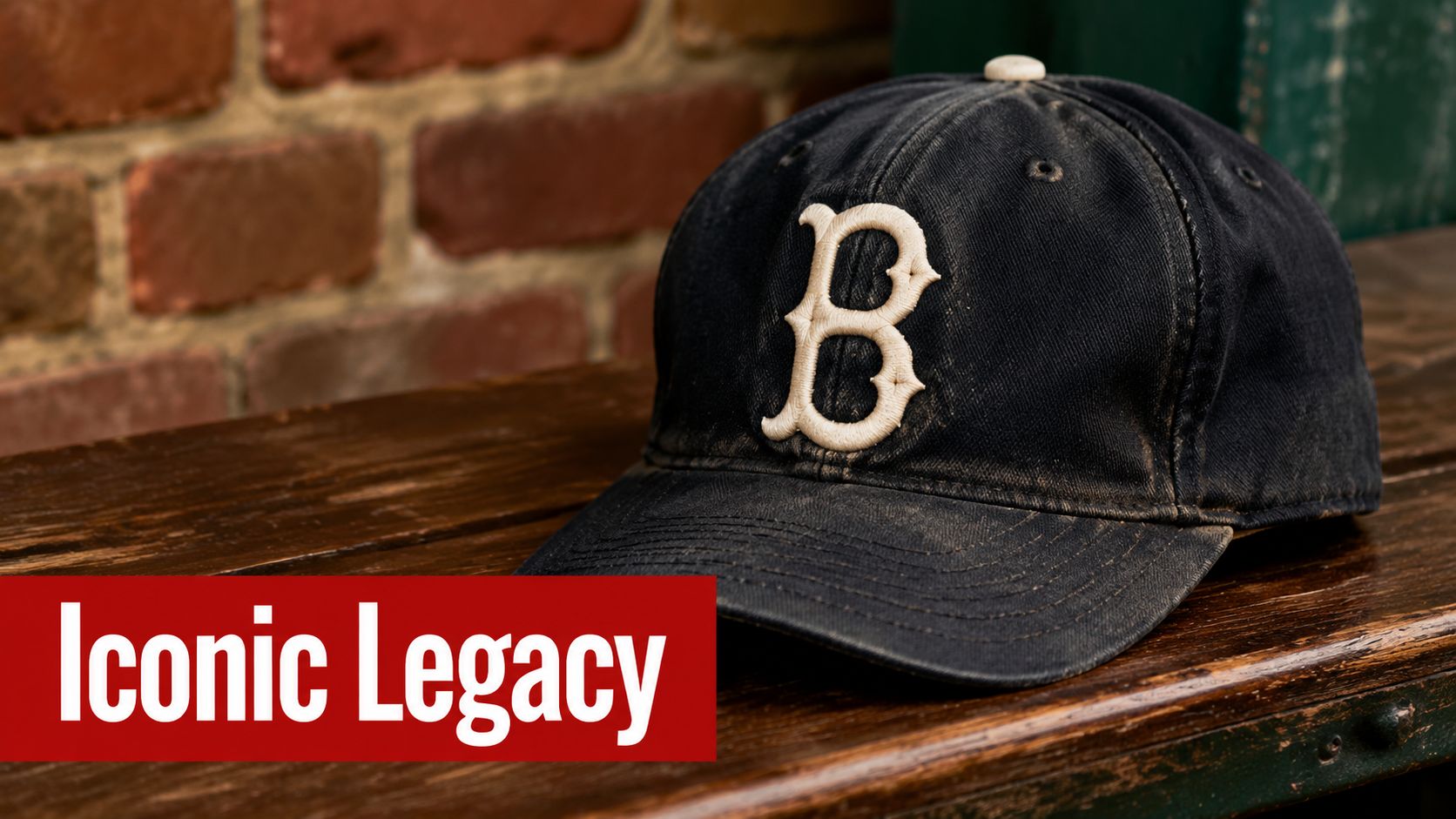
For businesses, teams, and merch brands, that matters. You're not starting from zero. The old-school Brooklyn “B” does something modern logos often struggle to do. It feels established, recognizable, and emotionally loaded without looking overbuilt. If you're developing a merch piece that needs to feel premium fast, that's an advantage.
Why the B matters in a commercial product
The strongest version of this style usually centers on the “B” insignia, not because it's trendy, but because it ties directly to Brooklyn and the Jackie Robinson legacy. That mark symbolizes Brooklyn, and hats featuring it have shown a 22% higher resale value in collectible headwear sectors due to their historical authenticity, according to Yahoo Sports' reporting on why Dodgers hats sometimes feature the B.
If you run a merch line, that doesn't mean every customer is a collector. It means the market already reads this silhouette and logo family as more authentic. In practical terms, buyers are often more willing to treat the hat like a piece worth keeping, not just a throw-in accessory.
A hat with built-in story usually needs less explanation at the point of sale.
That's a big difference in B2B ordering. When a coffee brand, barbershop, brewery, alumni group, or streetwear label chooses a black Brooklyn Dodgers-inspired build, they're borrowing from a visual language people already trust. The hat starts with heritage, then your decoration and packaging decide whether it lands as a souvenir, a uniform piece, or a retail product.
Why black works so well
Black shifts the mood of the cap. Royal and white feel traditional. Black and white feel sharper, cleaner, and easier to drop into modern retail.
That's why I often see black used when a buyer wants one hat to do several jobs at once:
- Retail first: It sits comfortably next to hoodies, tees, and outerwear.
- Team use: It hides wear better than lighter colors.
- Corporate merch: It feels less sporty and more polished.
- Event distribution: It's easier to fit into mixed-audience branding.
There's also a production reason to like it. Black crowns tend to make contrast embroidery look crisp, which helps when the front logo needs to carry the whole piece.
If you want a quick grounding in how classic cap styles evolved into modern branded headwear, the overview at the history of headwear is useful context. It helps explain why some shapes and logo treatments still outperform newer ideas.
Choosing the Right Blank Hat for Your Brand
A good custom hat starts with the blank, not the artwork. If the base cap is wrong, no embroidery shop can rescue it.
The easiest way to think about it is this. The blank is the chassis. Your logo is the paint and trim. If you put premium decoration on a weak chassis, the finished product still feels cheap in the hand.
Start with fabric before style
For a black Brooklyn Dodgers-style cap, fabric choice affects more than comfort. It changes how the crown holds shape, how the visor settles, and how clean your stitching looks.
A strong benchmark for wholesale programs is the 100% polyester Jackie Robinson Black Edition, which is noted for durability, shape retention, moisture resistance, and cleaner high-definition stitching, including 3D puff embroidery, because the fabric reduces deformation risk and bleed during embroidery on the product listing for the Jackie Robinson Black Edition fitted hat.
That matters in the shop. Polyester usually gives decorators a more stable surface when the design has sharp edges, layered satin fills, or raised foam.
Cotton and cotton blends can still work. They often feel softer and more broken-in. But if your order depends on a structured front logo that has to repeat cleanly across a full run, polyester gives you fewer headaches.
Match the profile to the audience
Not every buyer wants the same crown.
Here's how I'd sort the main options for a B2B order:
- High profile: Best for bold streetwear looks, larger front logos, and 3D puff. It gives the “B” room to stand up.
- Mid profile: The safest middle ground for most team and merch orders. It wears easily on more head shapes.
- Low profile: Better when you want a relaxed feel, but it's usually less ideal for that classic fitted heritage look.
Structured crowns usually outperform unstructured ones for this style. The Brooklyn Dodgers look depends on presence. A floppy front panel can make even good embroidery look flat.
Practical rule: If the front mark is the hero, pick a blank with enough structure to support it before you worry about side details.
Fitted, snapback, or flex
In this situation, brand intent matters more than personal preference.
A fitted cap feels the most authentic to the original on-field and collectible vibe. It's the right move if your audience cares about silhouette, crown height, and that true finished look. The downside is inventory complexity. You have to carry size ranges, and that can slow reorders or leave you with odd leftover sizes.
A snapback is easier for events, staff kits, and online stores that want fewer SKUs. It's less traditional, but more forgiving in bulk programs.
A stretch-fit or flex style sits in the middle. It can work for uniforms and team use, though some fashion-focused buyers still prefer the cleaner fitted back.
For a broader look at available cap styles before you lock the order, browse wholesale blank baseball caps. It's easier to make good sourcing decisions when you compare crown shape, panel count, and closure style side by side.
A simple blank-selection checklist
Before approving the base cap, confirm these points:
- Front panel firmness for the decoration you want.
- Fabric content based on wear, moisture exposure, and stitch detail.
- Closure strategy based on your sales channel.
- Color consistency across all units if you expect repeat orders.
- Reorder availability so the first run doesn't become a one-off.
That last point gets ignored a lot. A beautiful first run isn't enough. If the blank disappears, your second order becomes a redesign.
Mastering Custom Decoration Options
Once the blank is right, decoration decides whether the hat looks like a promo item or a product people actively want.
The good news is that a black Brooklyn Dodgers-style hat gives you room to work. The bad news is that people often choose a decoration method based only on budget, then wonder why the final cap feels off. Different methods create different personalities.
What each method actually does well
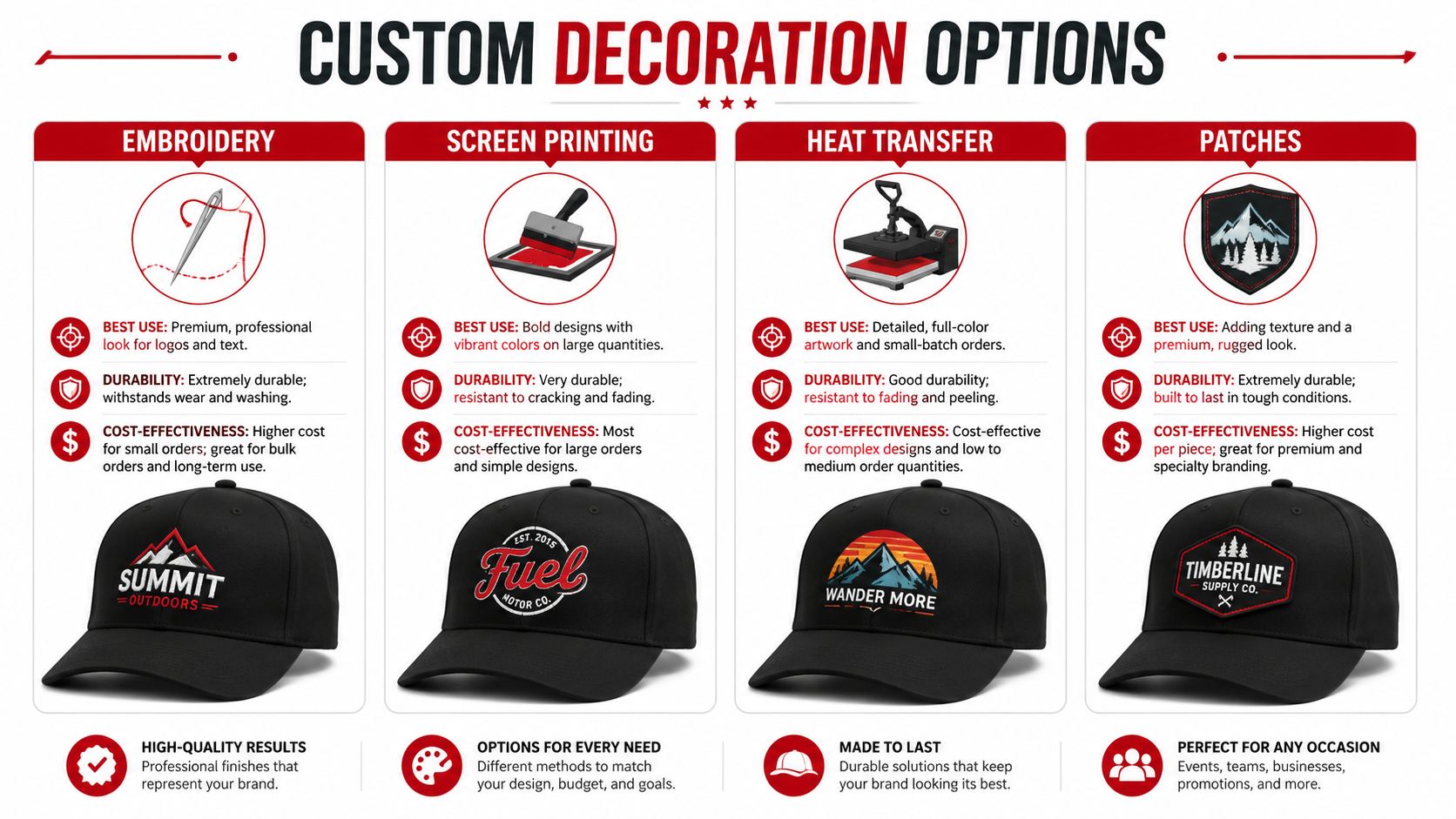
A black cap with a white or cream “B” usually leans best into embroidery. That's the standard for a reason. It looks native to the product.
But not all embroidery choices behave the same way:
| Hat Decoration Methods Compared | Best For | Cost | Visual Effect |
|---|---|---|---|
| Embroidery | Front logos, side hits, durable everyday branding | Moderate | Clean, classic, stitched texture |
| Screen Printing | Simple graphics on panels where printing is suitable | Lower to moderate | Flat graphic look |
| Heat Transfer | Small runs, detailed art, complex color transitions | Moderate | Smooth surface, more graphic than stitched |
| Patches | Heritage looks, badge-style branding, layered designs | Moderate to premium | Dimensional, vintage, collectible feel |
Flat embroidery versus puff versus patches
Flat embroidery is the safest choice for most first runs. It handles traditional letterforms well, works across structured caps, and gives you a finish that reads premium without pushing the design too hard.
3D puff embroidery works best when the front logo is bold and simple. A standalone “B” can look excellent in puff because the shape is clean and readable. Where buyers get into trouble is trying to force small script, thin outlines, or dense secondary text into raised foam. That usually leads to distortion.
Patches are strong when you want the hat to feel like a special release rather than a standard logo cap. Woven, embroidered, or faux leather patch applications can push the look into heritage retail, especially if the front mark isn't an exact sports-style embroidery.
A lot of branding decisions get easier once you've spent time crafting a strong brand identity. Not because every hat needs a deep brand system, but because caps expose weak logo decisions quickly. If the mark is too busy, too thin, or too dependent on tiny details, headwear reveals it fast.
What works for novelty colorways
There's also room to use this style for niche drops. Fans have actively discussed demand for a black-and-orange Brooklyn Dodgers hat, and no major brand has released one in the last 12 months, which points to an opening for custom creators serving ignored niche demand, as seen in this Reddit discussion about black-and-orange Brooklyn Dodgers hats.
That's useful for merch brands. Large brands often stay conservative. Smaller programs can move faster with limited-run color stories, local tie-ins, or event-specific versions.
Here's a good visual walk-through of cap decoration in action:
A practical selection guide
Choose your method based on the role of the hat:
- Uniform or staff use: Flat embroidery keeps cost and durability balanced.
- Streetwear drop: 3D puff on a structured crown gives the strongest shelf presence.
- Heritage capsule: Patches can create a more curated, collectible feel.
- Short-run testing: Heat transfer or simpler embroidery can help validate the concept before a bigger order.
If you're comparing production methods for a live project, printing and embroidery options for headwear can help narrow the field based on artwork and intended use.
Navigating Bulk Orders and Pricing
Bulk hat orders don't go wrong because people have bad taste. They go wrong because nobody pinned down the production details before approval.
Most buyers ask about price first. That's understandable, but the better first question is what has to stay consistent from cap to cap. Once that's clear, pricing gets easier to understand because you know what you're protecting.
What usually drives cost
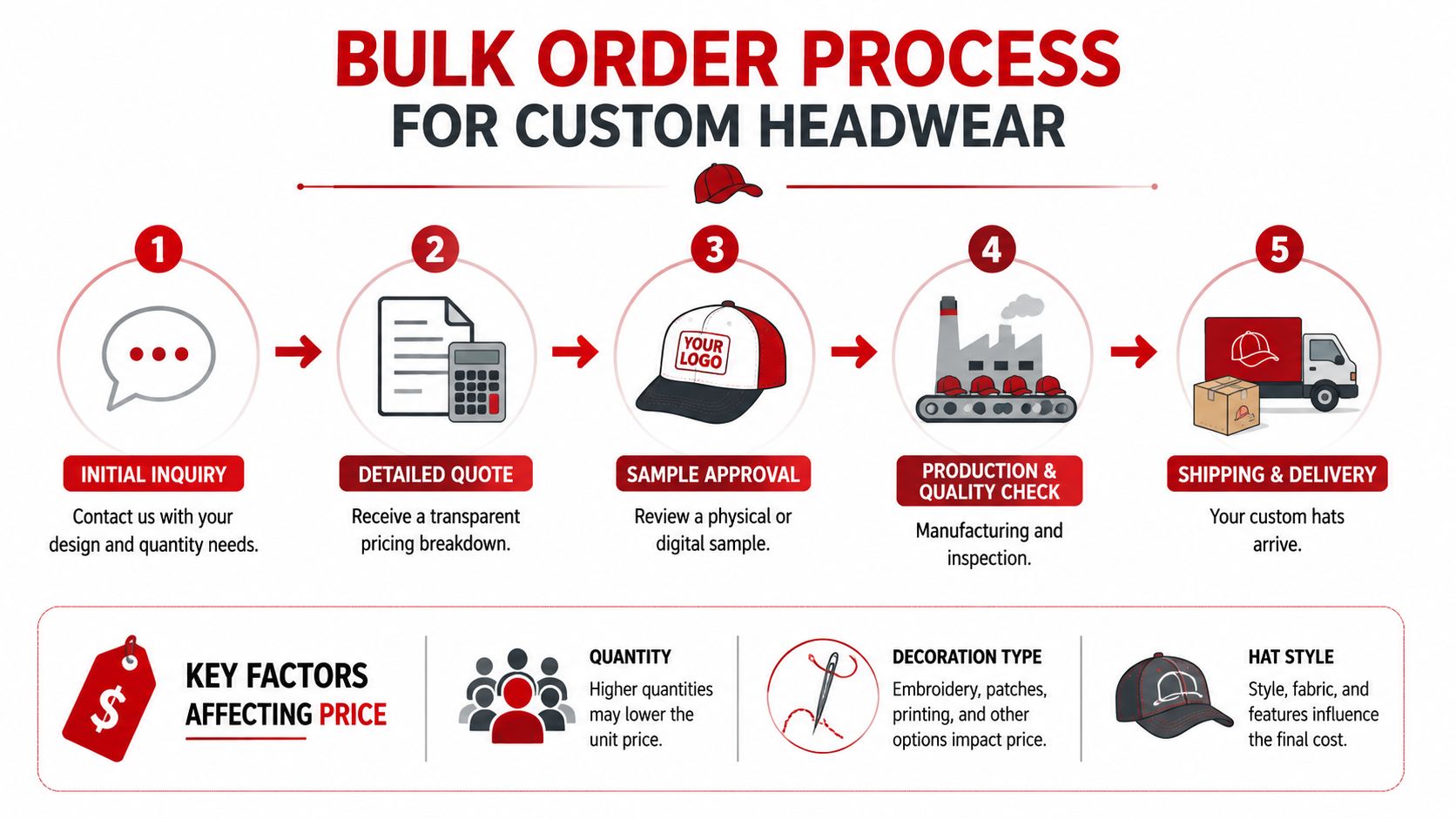
For a Brooklyn Dodgers hat black order, the biggest cost levers are usually straightforward:
- Quantity: More units generally improve your per-hat cost.
- Hat style: Fitted caps can create more inventory complexity than adjustable styles.
- Decoration method: Puff, patches, and multi-location embroidery usually cost more than a single flat front logo.
- Logo complexity: Fine detail and multiple thread changes can slow production.
- Packaging needs: Individual bagging, relabeling, or retail presentation adds labor.
None of that means you should strip the project down. It means you should spend where the buyer will notice it. For this style, that's almost always the crown shape, front decoration quality, and thread contrast.
Why minimums exist
Minimum order quantities frustrate new buyers because they can feel arbitrary. In practice, they exist because production has setup time.
Digitizing, hooping, thread setup, sample review, and quality control all happen before the run scales. A shop has to account for that labor whether you order a handful of hats or a larger program.
If you're trying to hit a minimum, consolidate colorways before you cut decoration quality.
That approach works better than splitting a modest order into too many versions. A clean single-color release usually sells better than a scattered run with too many choices and inconsistent trim decisions.
The proof is where good orders are saved
Digital proofs and sew-out approvals protect both sides. They allow you to confirm logo size, placement, thread color, side embroidery, back hits, and overall balance on the cap.
What I tell new buyers is simple. Don't just check spelling. Check proportion.
A front “B” can be technically correct and still feel wrong if it sits too high, too wide, or too low on the crown. The proof stage is also where you catch common issues like:
- Undersized front logos that disappear from a distance.
- Overbuilt side embroidery that crowds the profile.
- Thread colors that looked fine on screen but get lost against black fabric.
- Mixed closure choices that don't align with the intended market.
How to keep the order manageable
If this is your first larger run, keep the process simple.
Use one hero style. Limit decoration locations. Approve one clear proof path. Order early if the hats are tied to a launch, fundraiser, tournament, or seasonal drop. The best custom programs don't feel complicated because somebody made disciplined choices before production started.
How to Style and Sell Your Custom Hats
A strong custom cap can still sit on the shelf if you market it like a generic accessory. This style needs presentation that matches its weight.
The black Brooklyn Dodgers-inspired look already carries heritage. Your job is to frame that heritage in a way that fits your audience. For some brands, that means old ballpark energy. For others, it means clean streetwear, local pride, or premium everyday uniform wear.
Style the product like it belongs somewhere
A lot of hat listings fail because the photos feel isolated. The cap floats on a white background, and the buyer has to imagine the rest. That's too much work.
Sell the setting, not just the hat:
- For retail drops: Pair it with heavyweight tees, varsity jackets, or workwear.
- For hospitality or staff programs: Shoot it with aprons, overshirts, or storefront textures.
- For local brands: Use neighborhood backdrops, brick, concrete, wood, or vintage signage.
- For premium merch: Keep the scene stripped down and let the materials speak.
A black cap usually benefits from directional lighting and texture-rich backgrounds. You want the stitch, crown shape, and visor curve to show up clearly. If the whole image is dark, the hat loses impact.
Write the product page like a merch operator
Good product copy should answer three buyer questions fast. Why this hat. Why this color. Why this version.
That's where story does real work. You don't need to oversell the history. You need to connect the silhouette, front mark, and finish to the type of buyer you want. Mention the structured build, the decoration choice, and the intended feel. Keep the writing specific.
“Classic” isn't enough. Buyers respond better when you explain what makes this version feel clean, sharp, or collectible.
If you're refining launch messaging, merchandising flow, or conversion points, it helps to study e-commerce customer journey insights. A hat buyer usually doesn't need a long pitch, but they do need the right sequence of images, copy, and trust signals.
Think beyond sports buyers
This style reaches further than baseball nostalgia.
A few buyer groups often respond well to a cap in this lane:
- Streetwear customers who want a strong silhouette and simple front branding
- Local-history shoppers who care about Brooklyn references and heritage design
- Corporate gift buyers looking for a cleaner branded hat that doesn't scream promo
- Music and event merch teams that want an instantly recognizable cap shape
- Hospitality brands building uniforms that still look retail-worthy
The best sellers don't treat the hat like filler. They give it a role in the brand, then build imagery and copy around that role.
Your Next Step to Creating the Perfect Hat
A good black Brooklyn Dodgers-style cap doesn't come together by accident. It's the result of a few smart decisions made in the right order.
First, choose the style because it carries real visual weight. The heritage is already there, which gives your merch, team gear, or branded apparel line a head start. Then choose the blank carefully. Fabric, structure, profile, and closure all affect whether the final piece feels substantial or forgettable.
Keep the decision path tight
Most successful orders follow a disciplined path:
- Pick one core silhouette.
- Match the fabric to the decoration method.
- Use a front logo that fits the crown shape.
- Resist adding too many side and back details on the first run.
- Treat the proof process seriously.
That last point saves money and frustration. Buyers usually regret rushed approvals more than they regret taking an extra day to check size, placement, and thread contrast.
Build for repeatability, not just for launch day
The smartest B2B hat programs aren't focused only on the first batch. They're built so the second and third runs are easy.
That means choosing a blank you can reorder, keeping logo execution consistent, and avoiding custom decisions that are hard to reproduce. A hat that sells once is nice. A hat you can restock without reinventing the whole spec is where the business value shows up.
If you're ordering for a team, a small brand, a retail shop, or an event program, don't chase every possible option. Start with a version that has a clear identity, strong wearability, and decoration that suits the cap instead of fighting it.
A Brooklyn Dodgers hat black concept works best when it feels intentional. Not crowded. Not overdesigned. Just solid from the blank to the stitch.
If you're ready to turn the idea into an actual order, Dirt Cheap Headwear is a practical place to start. They handle wholesale blanks and custom decoration, including low-minimum runs and bulk orders, which makes them a strong fit whether you're testing your first merch drop or building a larger headwear program.