
Plaid Baseball Caps: Styles & Customization Guide
You're probably looking at plaid baseball caps for one of three reasons.
You want merch that feels more distinctive than another plain black dad hat. You're trying to build a staff uniform that looks intentional instead of generic. Or you saw a plaid cap that looked sharp on someone else and now you're wondering if it will work for your brand, your team, or your event without feeling too seasonal.
That's the question with plaid. Not “Is it trendy?” but “Will it still look right once my logo goes on it?”
Plaid can absolutely work. But it only works when the pattern, fabric, cap shape, and decoration method all agree with each other. If one piece is off, the finished hat looks busy fast. A lot of buyers make the mistake of choosing the plaid first and thinking about customization later. In practice, that's backwards.
Why Plaid Caps Are More Than Just a Fall Trend
A lot of buyers still treat plaid baseball caps like a novelty item for autumn promotions. That's too narrow. If your brand already leans heritage, outdoor, Americana, retro, utility, or workwear, plaid isn't a gimmick. It's a visual shorthand.
Buyers keep asking whether plaid baseball caps are still in style beyond a short seasonal window. That question makes sense. The better answer is that plaid fits a broader interest in retro and outdoor aesthetics, and fashion reporting has kept heritage and utility-driven styling visible across recent seasons, which supports accessories with classic patterns like plaid (heritage-inspired plaid cap listing).
Where plaid makes sense all year
If you run a coffee shop, brewery, outfitter, campus store, golf event, or lifestyle brand, plaid can read as established and intentional instead of temporary. The key is choosing the right plaid.
- Buffalo check feels bold and rustic.
- Tartan feels traditional and premium.
- Tonal plaid feels quieter and easier to wear outside one season.
A subtle plaid cap can live year-round if the colors aren't screaming “holiday” or “lumberjack costume.” Earth tones, charcoal checks, navy-based plaids, and muted olive combinations usually hold up better across longer selling windows.
Practical rule: If the cap has to work in April and October, avoid plaid patterns that rely on high-contrast red and black unless that look is central to your brand.
There's also a reason patterned caps feel normal now. Baseball caps didn't stay locked inside sports. Their identity broadened over time, and the category has a long style history beyond uniforms. If you want background on how headwear kept evolving into everyday wear, this quick history of headwear is a useful reference point.
Your Guide to Plaid Patterns and Cap Fabrics
Choosing plaid baseball caps starts with two decisions. First, what message the pattern sends. Second, whether the fabric supports the way you'll use the cap.
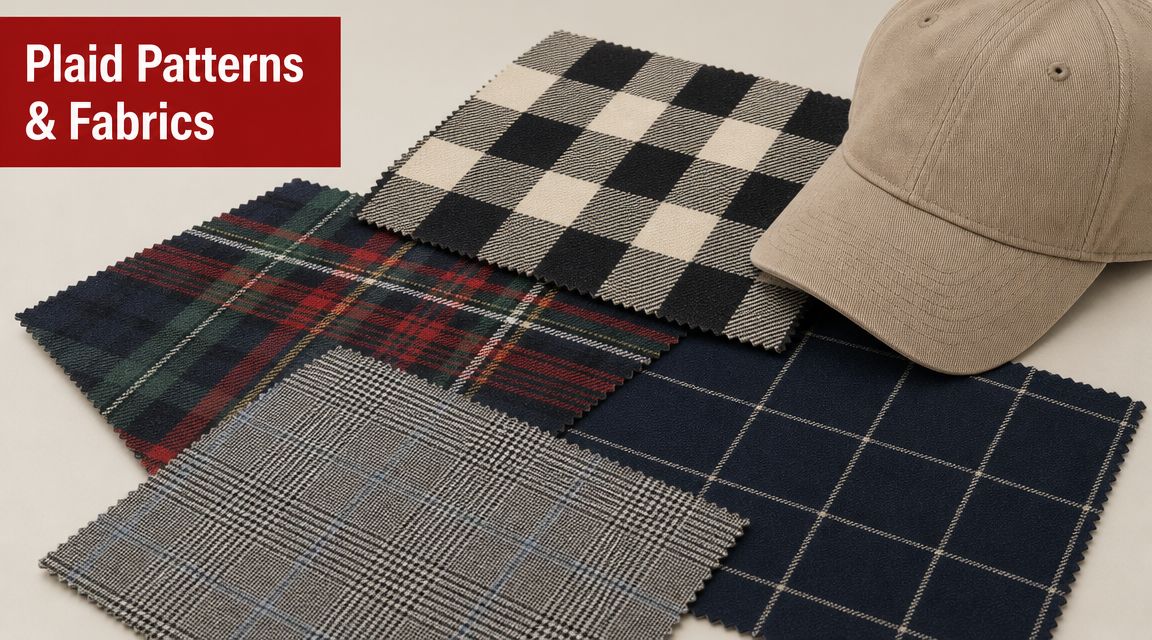
Plaid patterns don't all say the same thing
A lot of buyers talk about plaid like it's one category. It isn't. The visual personality changes a lot depending on scale, contrast, and line thickness.
Buffalo check is the easiest to identify from a distance. It's bold, blocky, and casual. This works well for outdoor brands, seasonal retail, hunting properties, fall events, and rustic hospitality businesses. It's less forgiving when you add a small front logo.
Tartan carries more tradition. It often looks stronger on premium merch, private clubs, school stores, golf events, and brands that want a heritage feel. Depending on the color story, tartan can look classic or loud.
Glen plaid and windowpane-style checks usually feel cleaner and more restrained. They're the safer route when you want plaid without making the cap the loudest part of the outfit.
A simple way to decide:
- Use bold plaid when the cap itself is the statement item.
- Use subtle plaid when the logo or patch needs to lead.
- Use tonal plaid when you want broader wearability across seasons.
Fabric changes the performance
Material choice is the biggest performance split in plaid baseball caps. Examples on the market show plaid done in wool, wool-polyviscose, cotton twill, polyester, and mixed constructions. Wool and wool blends generally give better structure and a more premium hand-feel for fall and winter. Cotton or polyester blends usually lower cost and can improve breathability or weight (wool plaid baseball cap material notes).
That matters more than most buyers expect.
A wool plaid cap usually looks richer and holds its shape better on the shelf. A cotton twill or polyester-blend cap is often easier for broader giveaways, warmer weather use, and price-sensitive promotions. If you're comparing options, plain cotton twill baseball caps are a helpful baseline because they show how much fabric alone can change feel and structure.
Softer fabric isn't always the safer choice. If the front panel collapses too easily, your decoration can suffer even when the cap feels good in hand.
Match the fabric to the job
For practical buying, this is the filter I use:
| Fabric or blend | Usually works best for | Watch out for |
|---|---|---|
| Wool or wool blend | Premium merch, cool-weather retail, club-style caps | Heavier hand, more seasonal feel |
| Cotton twill plaid | Casual brand merch, everyday wear, moderate pricing | May need more structure for clean front embroidery |
| Polyester or blended fabric | Large runs, lighter wear, budget-conscious programs | Can feel less elevated if the pattern looks flat |
For embroidery, a firmer front panel and stabilized visor usually behave better because they reduce puckering and help the logo hold shape. If you want a softer strapback for retail, that can still work. Just don't pair a floppy front with a dense, highly detailed design and expect a clean result.
Styling Plaid Caps for Your Brand or Team
Plaid baseball caps work best when they support a brand story people can recognize quickly. If the rest of your presentation is polished, rustic, vintage, outdoorsy, campus-inspired, or workwear-adjacent, plaid feels intentional. If your whole look is ultra-minimal and technical, plaid can feel bolted on.

Baseball caps only became flexible enough for this kind of styling because they moved beyond sports. Cap history notes that baseball caps shifted from sports gear into mainstream fashion in the late 1960s and 1970s, which opened the door for non-team designs and patterns like plaid to become part of everyday style rather than just athletic identity (history of the baseball cap in mainstream fashion).
Three strong use cases
A coffee shop can make plaid work if the rest of the uniform is soft and grounded. Think canvas apron, neutral tee, dark denim, and a muted buffalo or tonal plaid cap with a simple patch. That reads warm and familiar.
A golf or member-based program can use tartan better than most. On that kind of merch, plaid already feels connected to tradition. A tartan cap with restrained branding often lands better as a premium add-on than a loud front-and-center embroidered logo.
A brewery or seasonal merch drop can lean into plaid for storytelling. A richer wool-blend cap or mixed-fabric construction can then create a small-batch feel. Limited-run merch often benefits from having a stronger personality than everyday staff uniform pieces.
What usually doesn't work
Some combinations almost always fight each other:
- Loud plaid plus busy logo creates visual clutter.
- Very seasonal plaid plus evergreen branding shortens the usable selling window.
- Dressy tartan plus cheap-looking decoration makes the cap feel mismatched.
- Over-customized caps with front, side, and back decoration can tip from branded to souvenir-shop fast.
The cap should support the brand, not compete with it.
If you're outfitting a staff or team, think about the full uniform, not just the hat. Plaid tends to look strongest when one other item in the system is simple and solid. That gives the eye somewhere to rest.
A Guide to Customizing Plaid Baseball Caps
Customization is where plaid baseball caps either come together or fall apart. The background already has movement. Your decoration has to create order.
Start with this comparison before you choose a method.
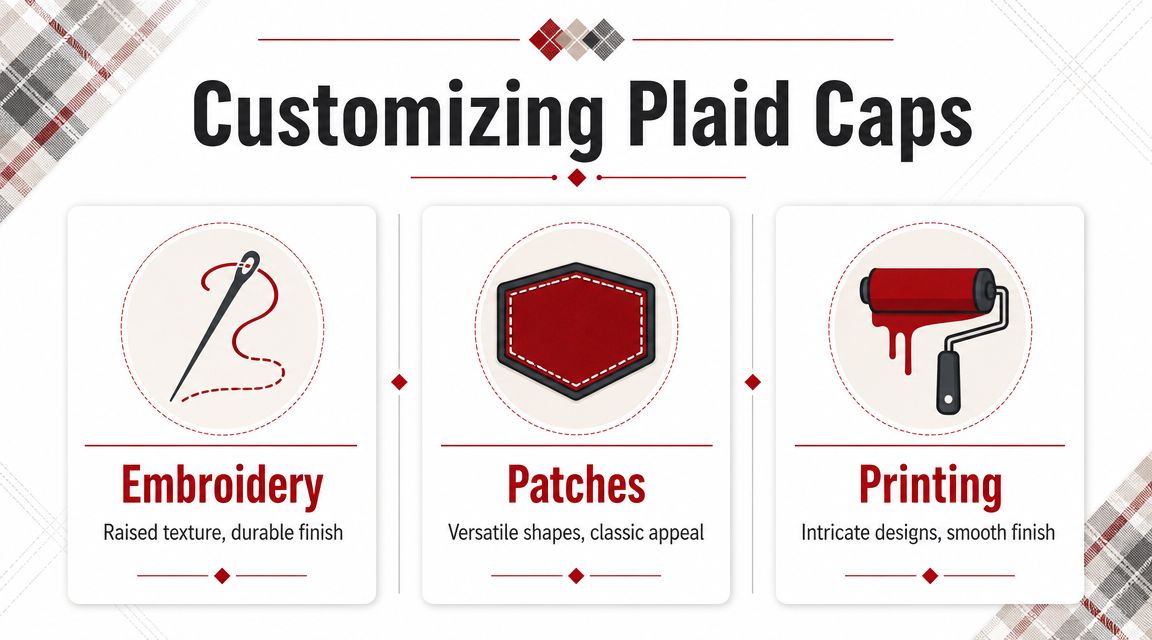
Plaid patterns can make small or detailed logos look visually noisy when embroidered directly, and the background can overpower the mark unless the design is simplified or separated with a solid patch (plaid cap embroidery visibility guidance).
Embroidery on plaid
Embroidery gives you the most classic cap finish. It's durable, tactile, and familiar. On plaid, though, it only looks clean when the design has enough contrast and enough open space.
Small serif text, thin line art, and intricate badges usually struggle on active plaid backgrounds. The stitching may be technically correct, but the eye won't read it quickly.
Embroidery works best when you use:
- Simple icon marks instead of detailed crests
- Bold lettering with strong stroke weight
- Limited thread colors that clearly separate from the fabric
- Larger decoration areas rather than tiny center-front marks
If the plaid is bold, side embroidery can be smarter than front embroidery.
Patches often solve the noise problem
Patches create a clean field between the logo and the plaid. That's a huge advantage.
Leather-look, woven, printed, or embroidered patches can all work depending on the cap style. A patch also lets you preserve more logo detail without fighting the background directly. For a lot of branded plaid baseball caps, patches are the safest route because they control contrast in a way direct embroidery can't.
If you need fine-detail stitching, custom patch programs and embroidery services such as custom stitching on hats can be part of the conversation, but the design still has to respect the fabric and pattern underneath.
Printing has a narrower lane
Printing can work on some plaid caps, but it's usually the least forgiving option for this category. The texture of the fabric, especially on wool blends or structured fronts, can interfere with crisp results. Printing makes more sense when the cap fabric is smoother and the aesthetic calls for a flatter graphic finish.
For most business buyers, printing is not the first choice on plaid. It can work, but it needs more careful matching between fabric and artwork.
Here's the side-by-side view.
| Method | Best For | Look & Feel | Plaid-Specific Tip |
|---|---|---|---|
| Embroidery | Simple logos, monograms, bold wordmarks | Raised texture, traditional finish | Keep artwork simple and use strong contrast |
| Patches | Detailed logos, heritage branding, merch drops | Layered, badge-like, controlled presentation | Use the patch to create a visual break from the plaid |
| Printing | Smooth graphics on suitable fabrics | Flat surface, less texture | Test carefully because plaid and fabric texture can reduce clarity |
A quick visual demo helps if you're deciding between decoration styles.
Shop-floor advice: If you have to ask whether the logo is too detailed for a plaid front, it probably is.
The cleanest plaid cap programs usually make one good decision early. They choose whether the hero is the fabric or the logo. Trying to make both the hero rarely ends well.
Ordering Wholesale Plaid Caps A Step-by-Step Guide
Ordering plaid baseball caps in bulk is less complicated than people expect. The biggest mistake is focusing on the pattern before you lock down the cap build. Plaid is a textile decision. The cap still has to function like a cap.
A standard baseball cap keeps the same basic geometry, meaning a rounded crown and stiff front bill. The plaid doesn't change that structure. For buying and customization, panel construction and closure type matter more for wearability and decoration area than the pattern itself (baseball cap geometry overview).
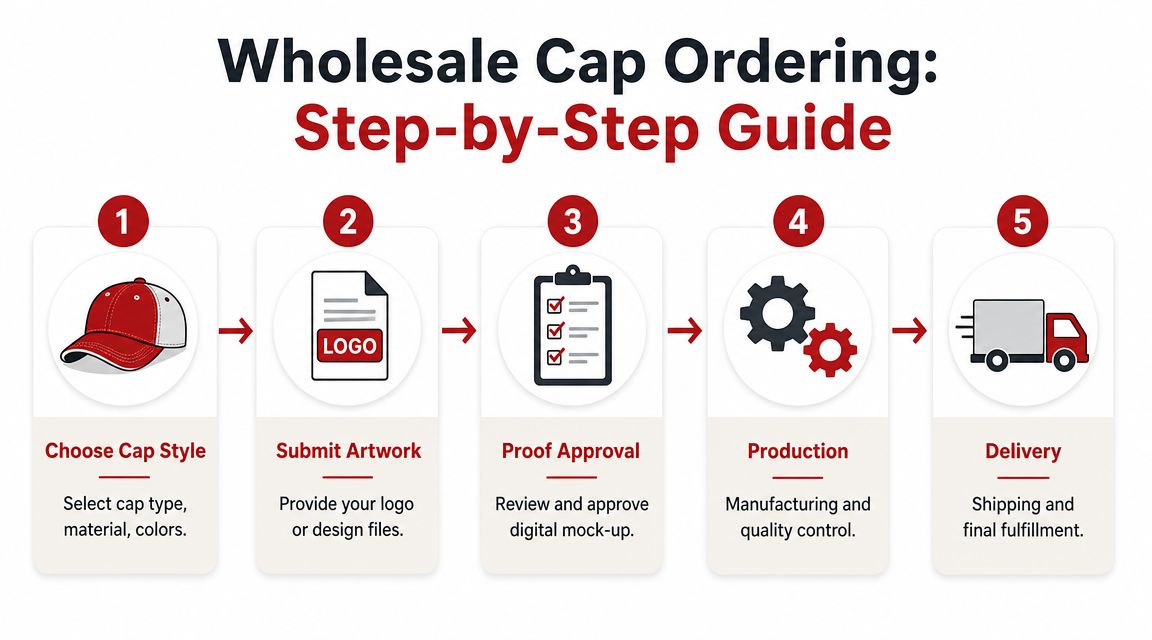
Step 1 Pick the cap build before the pattern
Don't start by saying “I want plaid.” Start by answering these:
- Will people wear it as a uniform piece, retail merch, or event giveaway?
- Do you want a structured front or a softer, lower-profile fit?
- Is the closure better as a snapback, strapback, buckle, or fitted style?
A structured front usually gives you a better decoration platform. A softer cap may feel more casual and wearable, but it can limit what the artwork can do.
Step 2 Submit artwork that matches the cap
Often, a lot of first-time buyers lose time. They submit a logo built for print, not for hats.
Good cap artwork usually has cleaner lines, fewer tiny details, and a clear understanding of stitch limits or patch boundaries. If you're ordering for a team or small business, ask for a proof that shows the design on the actual plaid option, not just on a blank mockup silhouette.
Approving artwork without seeing it on the chosen plaid is risky. Pattern contrast changes how logos read.
Step 3 Review proof and decoration placement
On plaid caps, placement matters more than buyers think. Front-center is the obvious choice, but not always the best one. If the pattern is active, a side panel, back hit, or front patch may produce a cleaner result.
Check these before approving:
- Logo readability against the plaid
- Thread or patch edge contrast
- Panel seams that might cut through artwork
- Closure style and whether it matches the intended audience
Step 4 Confirm practical order details
In this context, terms like minimums and lead times are important. Every supplier handles them differently, so ask directly instead of guessing.
Useful questions include:
- What's the minimum by logo or design?
- Can mixed sizes or closures be combined?
- Is the plaid in stock now or sourced to order?
- Will the same artwork look consistent across colorways?
Dirt Cheap Headwear is one example of a supplier that handles blank hats and in-house decoration, including low-minimum custom orders starting at six pieces per logo, which can help if you want to test a plaid style before committing to a larger run.
Step 5 Order a test run if the plaid is unfamiliar
If this is your first plaid program, a smaller initial order is often the smart move. Plaid is more subjective than a solid-color cap. You're not just testing fit and finish. You're testing whether your audience wears the pattern the way you expected.
That first run usually answers the questions that matter most. Does the logo stay clear? Does the color read right indoors and outdoors? Does the cap feel like a branded piece or a costume piece?
How to Care for Your Plaid Baseball Caps
Plaid baseball caps last longer when people treat them like shaped accessories, not gym towels. Most damage comes from over-washing, crushing the crown, or storing the cap while it's damp.
Cleaning by material
Wool and wool-blend plaid caps usually respond best to spot cleaning. Use a soft cloth, mild soap, and light pressure. Don't soak the cap unless the maker specifically says it can handle that treatment, because too much water can affect shape and surface texture.
Cotton or lighter blended caps are often easier to clean gently, but I still wouldn't throw a decorated plaid cap straight into a rough wash cycle unless the manufacturer clearly allows it. Decoration, brim shape, and panel backing all matter.
A safe routine is:
- Brush first to remove dust and lint
- Spot clean stains instead of washing the whole cap
- Blot, don't scrub on decorated areas
- Air dry on a rounded form so the crown keeps its shape
Storage and shape retention
Don't flatten plaid caps under heavier items. Store them on a shelf, hook, or cap form where the front panel can stay supported. If the brim gets bent out of shape, reshape it gradually by hand instead of forcing it.
Let the cap dry fully before you put it back into storage. Trapped moisture can distort shape and dull the fabric over time.
If you're giving plaid caps away as merch or staff uniform pieces, include a short care card. That small step helps the cap keep looking good longer, which reflects back on your brand.
Plaid Baseball Cap FAQs
Are plaid baseball caps a good fit for staff uniforms
They can be, but only when the brand already supports the look. Hospitality, coffee, brewery, campus retail, outdoor, and heritage-style businesses usually have an easier lane. For a uniform, I'd lean subtle plaid or a patch application over a loud tartan with detailed front embroidery.
Which plaid patterns are easiest to customize cleanly
Subtle and tonal plaids are usually the easiest. They give your logo room to read. Bold buffalo check and high-contrast tartans can still work, but they need simpler artwork, stronger contrast, and often benefit from patches instead of direct front embroidery.
Should I choose embroidery or a patch for plaid baseball caps
If the logo is simple and bold, embroidery can look excellent. If the logo has fine detail, small text, or a badge shape, a patch is often the cleaner answer. On plaid backgrounds, patches solve a lot of readability problems before they start.
Are plaid baseball caps only good for fall
No. Some plaid color stories are strongly seasonal, but others aren't. Tonal plaids, navy-based checks, charcoal patterns, and muted earth-tone plaids can work across much more of the year than holiday-style red-heavy patterns.
What cap shape works best with plaid
That depends on the audience, but the usual decision is between a structured crown for cleaner decoration and a softer crown for a more relaxed retail fit. If the cap needs a front logo and the plaid is active, structure usually makes the decorating process easier.
Can I mix plaid styles in one order
Sometimes, but you need to ask your supplier how they handle minimums by style, fabric, and decoration setup. Mixing plaids can work for retail assortments or team leadership tiers, but it can also create inconsistency if the logo treatment isn't adjusted to each pattern.
What's the biggest mistake buyers make with plaid baseball caps
They fall in love with the pattern before checking whether their logo can survive on it. On a solid hat, decoration usually carries the design. On plaid, fabric and decoration share the job. If those two elements fight each other, the cap looks messy no matter how nice the materials are.
If you're comparing plaid baseball caps for merch, uniforms, or event use, Dirt Cheap Headwear offers wholesale hat styles plus custom decoration options, which can make it easier to test a pattern, review a proof, and choose a logo treatment that stays clear on plaid.