
Custom Stitching on Hats a Complete 2026 Guide
Want to make your brand look legit? Put your logo on a hat. Want to make your brand look unforgettable? Stitch it on.
Custom stitching, or embroidery, takes a simple hat and turns it into a piece of premium gear. It's the difference between a flimsy business card and a high-quality, heavy-stock one. The thread creates a textured, durable design that just feels more professional and trustworthy than a printed logo ever could. It’s an instant upgrade for your brand’s image.
Why Custom Hat Stitching Is a Game Changer
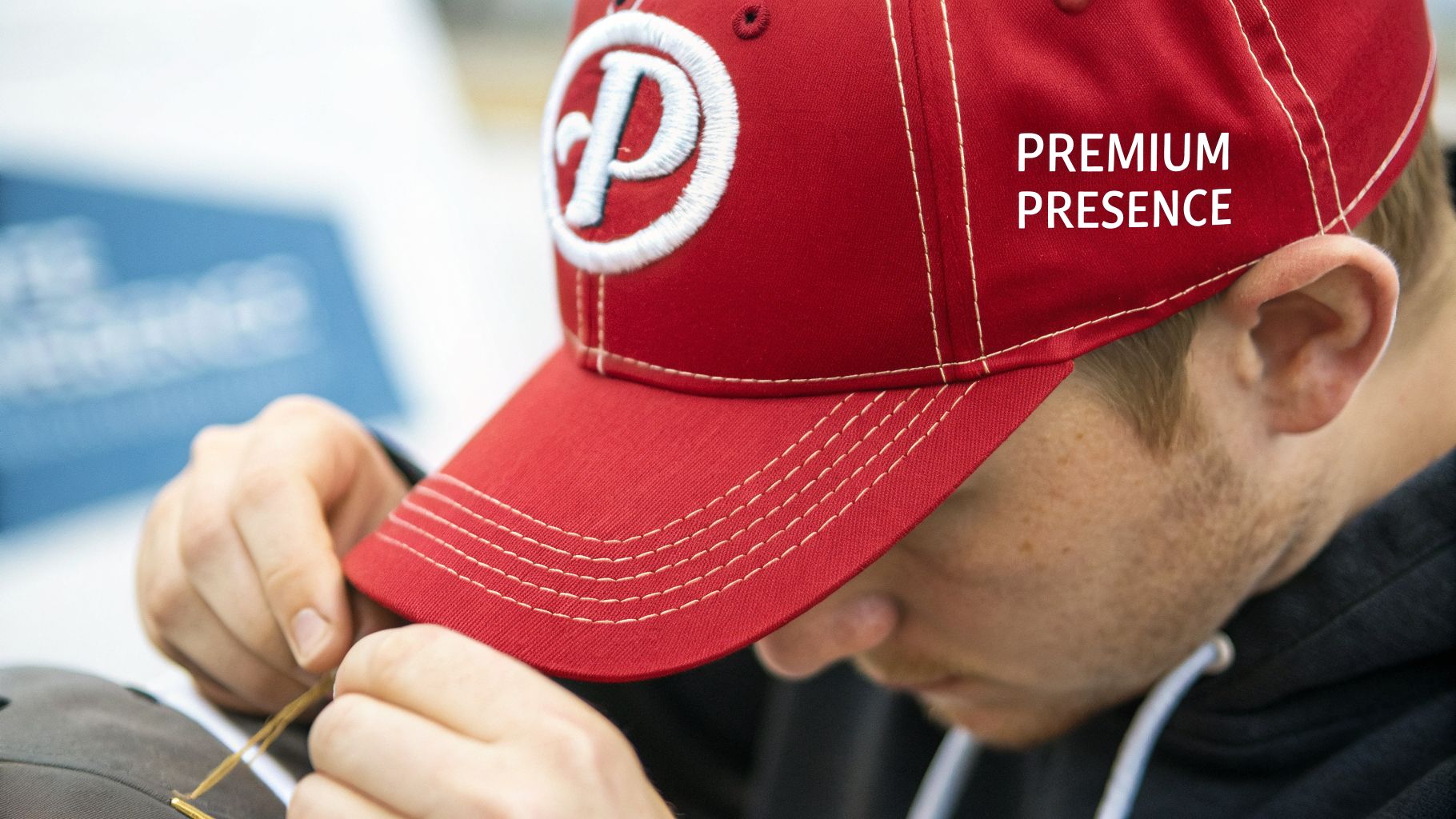
Think of a well-stitched logo on a quality cap like a firm handshake—it signals confidence and quality without a single word. In a world full of digital noise, something you can actually hold and wear, like a great embroidered hat, creates a real connection. It stops being just merchandise and becomes a walking billboard that shows you care about the small stuff.
That feeling of quality isn't just in your head; it has a real impact. When your customers, your team, or event attendees rock your custom-stitched hat, they’re giving your brand a personal endorsement. The raised, textured feel of embroidery automatically seems more valuable than a flat print, which boosts how people see both the hat and the brand behind it.
A Mark of Professionalism and Trust
For a new startup, outfitting the team in professionally embroidered hats can make a small crew look like a major player. For a big company, it’s just the standard for creating awesome swag that people are actually excited to wear. The difference between a printed and a stitched logo is often the difference between a hat that gets shoved in a closet and one that becomes someone's go-to favorite.
Here’s why custom stitching is almost always the right call for building your brand:
- It Lasts (Basically) Forever: Prints can crack, peel, or fade away in the sun. Embroidery is stitched into the fabric. Your logo will stay sharp and vibrant for the life of the hat.
- A High-End Look and Feel: The texture and depth you get from stitching have a sophisticated look that printing just can't match. That premium finish makes your whole brand look better.
- Works on Almost Anything: From tough-as-nails cotton twill to breathable performance fabrics, embroidery is a reliable choice that looks great on nearly any hat style you can think of.
When you invest in quality stitching, you’re not just decorating a hat. You're creating a tangible piece of your brand that builds identity and brings people together.
Getting a handle on how this all works is the first step to creating headwear that gets worn, respected, and shown off. When you're ready to get started, checking out in-house hat embroidery services will connect you with the experts who can nail the final product.
A Quick Trip Through the History of Hat Embroidery
When you see a really sharp, custom-stitched hat, you're looking at the result of a craft that's been perfected for thousands of years. It’s not just a logo on a hat; it’s the modern-day version of an ancient art form.
Believe it or not, the story of embroidery goes way, way back. Archaeologists have found embroidered animal hides in Siberian tombs from around 30,000 B.C.! Back then, stitching wasn't just for looks—it literally held things together and made them last longer. You can dive deeper into some of these fun facts on custom embroidery if you're curious.
For most of history, every single stitch was done by hand. This made embroidered clothing incredibly expensive and time-consuming to produce, turning it into a clear symbol of wealth and power. That high-end feel has stuck around, which is why even today, a stitched logo just feels more premium and permanent than a printed one.
The Machine Age Kicks Things into High Gear
Everything changed with the Industrial Revolution in the 1800s. Suddenly, new machines could do the work of many hands, but faster and cheaper. This was the moment decorative stitching started becoming accessible to everyone, not just the rich.
Two inventions, in particular, really set the stage for the embroidery we know and love today:
- 1829 Hand-Loom Machine: A French inventor named Joshua Heilmann figured out how to use a frame to move fabric under a needle. It was still powered by hand, but it was a massive leap in efficiency and showed what was possible.
- 1863 Schiffli Machine: Then, Swiss innovator Isaak Groebli took it to the next level. His machine used a shuttle and a continuous thread, which made it possible to mass-produce detailed patterns. This was the true beginning of commercial embroidery.
These clunky, early machines were the great-grandparents of the high-tech equipment we use today. They started the ball rolling on turning an exclusive craft into an industry.
From Manual Work to Digital Magic
Fast forward to the late 20th century, when computers entered the picture. This was the biggest leap of all. Today's embroidery machines are absolute workhorses—super-fast, multi-needle beasts that run on digital instructions.
We take a customer's digital logo and run it through a special process called "digitizing." This essentially creates a stitch-by-stitch map for the machine to follow with perfect accuracy, every single time.
This is the secret sauce. Modern technology lets us combine the classic, high-quality appeal of embroidery with the speed and consistency needed for branding in today's world.
That long journey—from ancient survival stitching to today’s pixel-perfect digital process—is what gives embroidery its legacy of quality. Technology just made that quality available to all of us, transforming a luxury art form into a go-to for businesses, teams, and anyone looking to make a great impression.
Choosing Your Embroidery Stitch Type
Let's get into what really makes a custom hat sing: the stitch type. This is probably the biggest decision you'll make, because it completely defines the final look and feel of your design.
Think of it like an artist choosing their paint. You wouldn't grab watercolors to create a big, bold mural, right? And you wouldn't use thick, gloppy paint for a delicate drawing. It’s all about matching the tool to the job, and that's exactly what we're doing here. Getting this right is the secret to a hat that looks sharp and professional.
The Foundation: Flat Embroidery
First up is flat embroidery. This is the bread and butter of the custom hat world, and for good reason. It’s the technique you see most often, where the design is stitched directly and smoothly onto the hat's fabric.
The result is a clean, crisp, two-dimensional look that's perfect for showing off fine details, sharp lettering, and complex logos. If clarity is what you're after, flat embroidery delivers every time. Because it sits flush against the hat, it’s also super durable and won’t snag easily.
Standing Out with 3D Puff
Now, if flat embroidery is a classic movie, 3D Puff embroidery is the blockbuster 3D experience. This technique makes your design literally pop right off the hat. It’s an awesome way to give your logo a bold, dynamic feel that grabs attention immediately.
So, how does it work? We actually place a small piece of foam on the hat and then stitch right over it with a whole lot of thread. The stitching squashes the foam down and gives it that raised, three-dimensional shape.
3D Puff is best used for simpler, bolder elements like single letters, thick fonts, or basic geometric shapes. It's not suited for fine details, as the process can obscure small lines and intricate patterns.
This high-impact style adds a premium, tactile quality that people notice. If you're looking to make a big statement, this is the way to do it. We've seen firsthand how well this works, and you can learn more about what makes custom puff embroidery hats so effective.
Creating Texture with Appliqué
Appliqué is a totally different beast, bringing a cool, layered, almost handcrafted vibe to a hat. Imagine creating a collage, but with fabric. We cut a piece of material—like felt or twill—into the shape of your design, then stitch it onto the hat, usually finishing it off with a clean border stitch.
This technique is a fan favorite for a few reasons:
- Creates a Vintage Vibe: The layered fabric gives off a great retro or old-school collegiate feel. It's perfect for brands going for a classic, timeless look.
- Reduces Stitch Count: For big, solid-colored logos, using a fabric patch instead of thousands of tiny stitches can actually be better for the hat. It prevents the fabric from puckering and can sometimes be more cost-effective.
- Adds Unique Texture: You can get creative by using different materials for the appliqué itself, which adds another layer of touch and feel to your design.
To give you an idea of how we got here, check out how the technology has changed over the years.
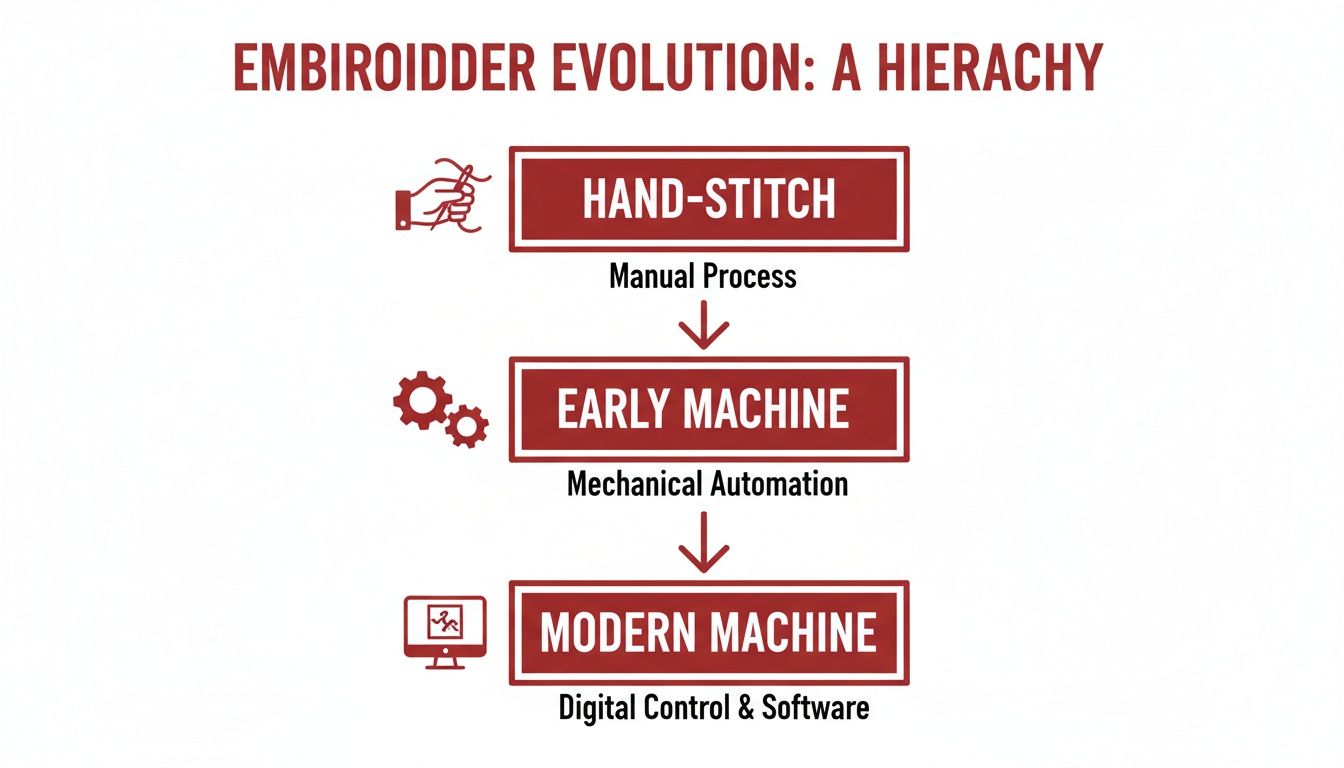
This jump from hand-stitching to today’s incredibly precise digital machines is what allows for all these amazing, high-quality options. It gives us the ability to perfectly execute whatever look you're dreaming up.
Finding the Perfect Hat for Your Design
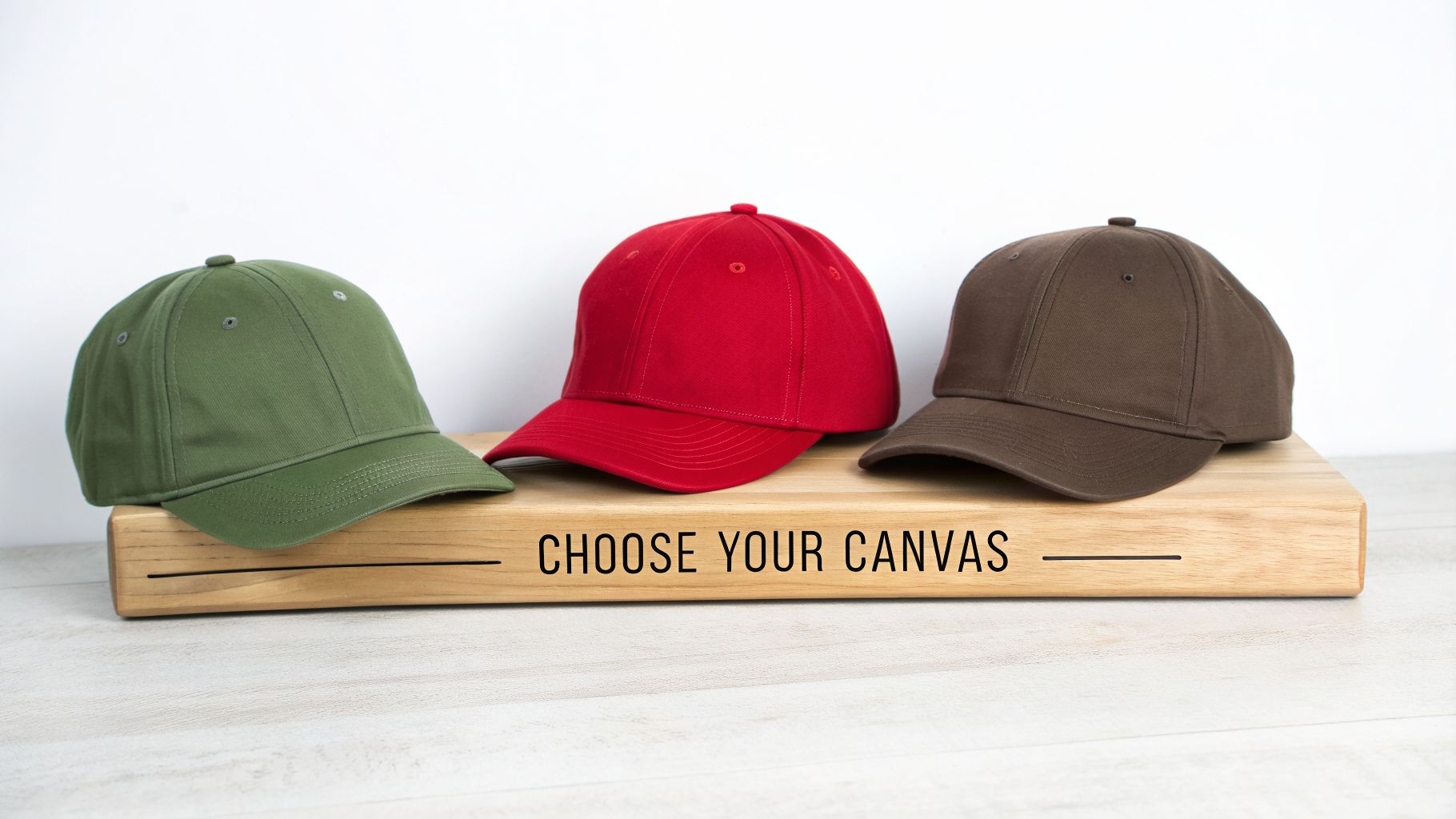
While the stitch type gets all the creative glory, the hat itself is the foundation your entire design is built on. Honestly, picking the right hat is just as crucial as the logo you're stitching. The style, structure, and fabric all have a huge say in how that final embroidery will look and feel.
It’s a lot like painting—you wouldn't choose a flimsy, loose piece of fabric if you wanted crisp, clean lines, right? You'd go for a smooth, stretched canvas. The same exact principle applies here; the right base makes all the difference for a killer finished product.
Structured vs. Unstructured Hats
Your first big fork in the road is choosing between a structured and an unstructured hat. This one decision has a massive impact on the embroidery process and what's possible with your design.
A structured hat has a stiff lining, called buckram, behind the front two panels. This is what gives hats like snapbacks and many trucker hats their classic, crisp shape that holds up even when they’re sitting on a shelf. This firm, reinforced surface is the perfect canvas for embroidery.
Because the fabric is held perfectly taut, the embroidery needle can punch in and out to create incredibly precise, clean stitches. This is non-negotiable for intricate logos, super-fine text, and especially 3D Puff, all of which need that stable foundation to really pop.
An unstructured hat, on the other hand, is what you probably think of as a classic "dad hat." It's made from softer materials without that rigid inner lining, giving it that comfortable, relaxed fit and casual vibe.
Now, embroidering on this softer surface is a bit more of a challenge. Without that internal support, the fabric has a tendency to move or "pucker" under the tension of the stitches. It's definitely doable, but it takes more skill and a few extra tricks—like using a heavy-duty stabilizer backing—to keep the design from warping.
The bottom line is pretty simple: For the sharpest, most detailed custom stitching on hats, a structured cap gives you the most reliable and forgiving canvas. An unstructured hat is awesome for a laid-back feel but plays best with simpler, less dense designs.
How Fabric Affects Your Stitching
Beyond the hat's skeleton, the material itself is a major player. Different fabrics behave differently when a needle and thread come at them. Some are a dream to work with, while others need a little extra finesse.
Here’s a quick rundown of the most common materials you'll run into:
Cotton Twill: This is the undisputed workhorse of the hat world, and for good reason. Its tight, durable weave creates a smooth, stable surface that’s perfect for just about any embroidery style, from tiny details to bold 3D Puff.
Performance Fabrics (Polyester/Nylon): Found on most athletic and outdoor hats, these lightweight, moisture-wicking materials are great for activewear. Their thinner, stretchier nature means they absolutely require careful stabilization to stop puckering. We usually recommend a lower stitch density for these.
Mesh (Trucker Hats): You obviously can't embroider the mesh back of a trucker hat, but the front panels are fair game! These are typically made of cotton or foam, and those foam fronts are especially great for making bold, colorful designs stand out.
Canvas: This is your heavy-duty, rugged option. Its thickness provides a super-stable base for embroidery, but it can be tough on needles. Sometimes, we have to use a specific type of needle just to get a clean stitch without putting too much stress on the fabric.
Ultimately, choosing the right hat isn't about finding the "best" one, but the best one for your specific design. When you think about both the hat's structure and its fabric from the get-go, you're setting your project up for success before a single stitch is even made.
Getting Your Artwork Ready for Stitching
Ever wonder how your logo goes from a file on your computer to a killer stitched design on a hat? It’s not magic—it's a process called digitizing, and honestly, it's the most critical step to get right.
Think of it like this: your design file is a song, but the embroidery machine is a musician who can't read sheet music. A digitizer acts as the composer, translating your artwork into a detailed, stitch-by-stitch map the machine can actually follow. Every single stitch is planned out to make sure the final performance is perfect.
Start with a Strong Foundation: Vector Files
For us to create the best possible "sheet music" for your design, we need a high-quality file to start with. When it comes to embroidery, vector files are the absolute gold standard. We're talking about formats like .AI, .EPS, and .PDF.
So, why vector? A vector file is made of mathematical paths, not pixels. That means you can stretch it to the size of a billboard or shrink it to the size of a postage stamp, and it will stay perfectly crisp. A pixel-based file (like a .JPG or .PNG) gets blurry and jagged when you resize it, making it nearly impossible to create clean, sharp stitch lines.
What Looks Good on Screen vs. What Works in Thread
Embroidery is a physical art form, and that means thread has its own set of rules. Some things that look incredible on a bright screen just don't play well with a needle and thread. Knowing these limitations ahead of time will save you a lot of back-and-forth and guarantee you love the final hat.
Here are a few design elements that are notoriously tricky for embroidery:
- Super Fine Lines: Thread has a real, physical thickness. If a line in your design is too thin, it will either get lost completely or come out looking choppy and inconsistent.
- Color Gradients: That beautiful, smooth fade from one color to another? It’s basically impossible to replicate with thread. Digitizers have to try and fake it with complex blending, which often ends up looking muddy and nothing like your original art.
- Tiny, Tiny Text: For letters to be readable, they need to be a certain size. We generally tell people that a minimum height of 0.25 inches is the sweet spot for clarity. Anything smaller turns into an unreadable little blob of thread.
The best advice we can give? Keep it simple. The most impactful and professional-looking embroidered hats almost always feature bold, clean designs with solid colors and distinct shapes.
Want to get really nerdy about it? Our team put together a deep dive that explains how to digitize a logo for embroidery and what makes a design work.
Sizing and Placement: A Hat Isn't a T-Shirt
Where you put your design—and how big it is—matters just as much as the artwork itself. A hat isn’t a flat canvas; it's a curved object with panels, seams, and specific areas where we can and can't stitch.
The most popular spots for embroidery have some pretty firm size limits you'll need to work with.
Typical Hat Embroidery Dimensions
| Placement Area | Maximum Height | Maximum Width | Our Hot Take |
|---|---|---|---|
| Front | 2.25 inches | 5.5 inches | This is your prime real estate. Put your main logo here. |
| Side | 1 inch | 2.5 inches | Perfect for a website, small icon, or a player number. |
| Back (Strap) | 1 inch | 3.5 inches | Great for a slogan or brand name, often stitched in an arch. |
These numbers aren't random. They're determined by the physical hoops that hold the hat in the machine and the hat’s own construction. That 2.25-inch height limit on the front, for example, is because the machine physically can't stitch any closer to the brim without causing problems. Trying to push these boundaries just leads to a distorted, poor-quality stitch-out.
By keeping these artwork tips in mind from the get-go, you're setting your project up for a win. An "embroidery-friendly" design makes the whole process smoother and ensures the hat you get looks clean, professional, and exactly how you pictured it.
Placing Your Custom Stitching Order
So, you're ready to bring your idea to life? Awesome. Turning a design into a great-looking custom hat is a simple process, and we’re here to walk you through every step so you know exactly what’s happening.
It all starts when you pick out the perfect hat style and color from our collection. Once you’ve got your canvas, you'll upload your artwork. That's when our team jumps in to take a close look at your design and make sure it's good to go for embroidery.
Approving Your Digital Proof
Before we even thread a needle, we'll send you a digital proof. Some folks call this a "sew-out," but it’s basically a digital mock-up showing exactly how your artwork will look stitched onto your hat. This is your chance to be the boss and check everything—colors, spelling, size, and where it sits on the hat.
Think of the proof as the final game plan. Once you say "looks good," our production team gets the green light. Double-checking it now means no surprises later, and you get the exact hat you pictured.
After you give us the thumbs-up, your order officially hits the production queue. This is the fun part, where our high-tech embroidery machines start working their magic, turning that digital design into a real, tangible stitch on every single hat.
Understanding Pricing and Minimums
When it comes to pricing, two things really matter: stitch count and order quantity. The stitch count is just what it sounds like—the total number of stitches needed for your design. Bigger, more detailed logos need more stitches, which costs a little more per hat. But here's the good news: the more hats you order, the lower the price per hat gets.
This approach makes getting custom hats super achievable, even for small businesses or local sports teams. Modern embroidery has come a long way since the 1800s, and today's efficiency means we can handle orders with low minimums—often as few as six pieces. You can test out a new design without having to make a huge financial leap. To see how custom apparel can really pull a brand together, you can learn about crafting connections with custom gear.
The desire for personalized stuff is bigger than ever, going way beyond hats to things like custom text window decals for cars and shops. We keep our process clear and simple so you can order what you need, whether it's a small batch for your startup or a massive order for your next big event.
Common Questions About Custom Hat Stitching
We get a lot of questions about custom stitching, and we want you to feel totally confident before you order. Here are some straightforward answers to the things people ask us most.
Embroidery vs. Screen Printing: What’s the Difference?
Think of it this way: embroidery uses thread to stitch your design directly into the fabric of the hat. It creates a rich, textured look that feels premium and is incredibly durable. Screen printing, on the other hand, just lays a layer of ink on top of the material.
While screen printing works just fine for t-shirts, it doesn't hold up well on the tougher, curved surfaces of a hat. For headwear that looks professional and is built to last, custom stitching is almost always the way to go.
Can Any Logo Be Embroidered on a Hat?
Most of the time, yes! But there are a few things to keep in mind. Designs with super fine details, tiny text, or smooth color gradients can be tricky to translate into thread. For embroidery, simpler is often better.
Our digitizing pros are experts at converting your design into a stitch-ready file. If we think a small tweak—like making a line a bit thicker or bumping up the text size—will make your logo pop, we'll suggest it. You'll always get a digital proof to approve before we sew a single stitch, so you know exactly what you’re getting.
Remember, the goal is to create a stitched logo that's clean, sharp, and instantly recognizable. Sometimes, a slight tweak to the original art is the secret to a perfect embroidered hat.
It's all part of the process to make sure the final hat looks amazing and lives up to our quality standards.
What Is 3D Puff Embroidery?
3D Puff is a really cool technique that makes your design literally stand out. We place a piece of foam on the hat and then stitch over it, creating a raised, three-dimensional effect that you can see and feel. It’s perfect for making bold, simple parts of a logo—like a single letter or a basic shape—jump off the cap.
This method works best with thick, blocky fonts. It's not the right choice for anything with intricate details, because the puffiness can swallow up small lines. If you want your hat to have a high-impact, truly memorable look, 3D Puff is a fantastic option.
How Much Does Custom Stitching Cost?
The price really comes down to two main things: the stitch count and your order quantity. Stitch count is just a measure of how complex your design is—a bigger, more detailed logo requires more stitches, which costs a bit more per hat.
The good news is, the price per hat drops quite a bit the more you order. Ever since the early 2010s, we've seen a huge surge in demand for custom hats, especially for businesses that want a high-value item to resell. It’s a huge hit in industries like construction and for general promotions, and our low minimums make it easy for anyone to test out a run of branded dad hats or bucket hats without a huge investment. You can read more about how custom hats build brands to see just how powerful they can be.
Ready to create some headwear that people will actually want to wear? At Dirt Cheap Headwear, we make it simple with low minimums, expert in-house embroidery, and a massive selection of brands you know and love. Get started on your custom hat order today at https://dirtcheapheadwear.com.
Pingback: Stocking Cap Knit: A Buyer's & Customization Guide | Dirt Cheap Headwear
Pingback: Digital Marketing Agency Logo: A Guide to First Impressions – MD TECH TEAM | Web Design, SEO, Hosting & Digital Solutions for Small Businesses
Pingback: What Is a 5 Panel Hat and Why It Beats a 6 Panel | Dirt Cheap Headwear