
Polyester Baseball Caps: A Complete Buyer’s Guide
The most common advice about polyester baseball caps is also the least useful: polyester is durable and dries quickly, so it must be the right choice. Not necessarily. A fiber label doesn't tell you whether a cap will breathe, shade the wearer, hold an embroidered logo cleanly, or make sense at the end of its life.
Buyers should judge the fiber, construction, decoration, and intended use together. Polyester can be an excellent choice for team gear, outdoor work, and event orders, but the details matter more than the word on the hangtag.
Why Polyester Has Become the Default Cap Fabric
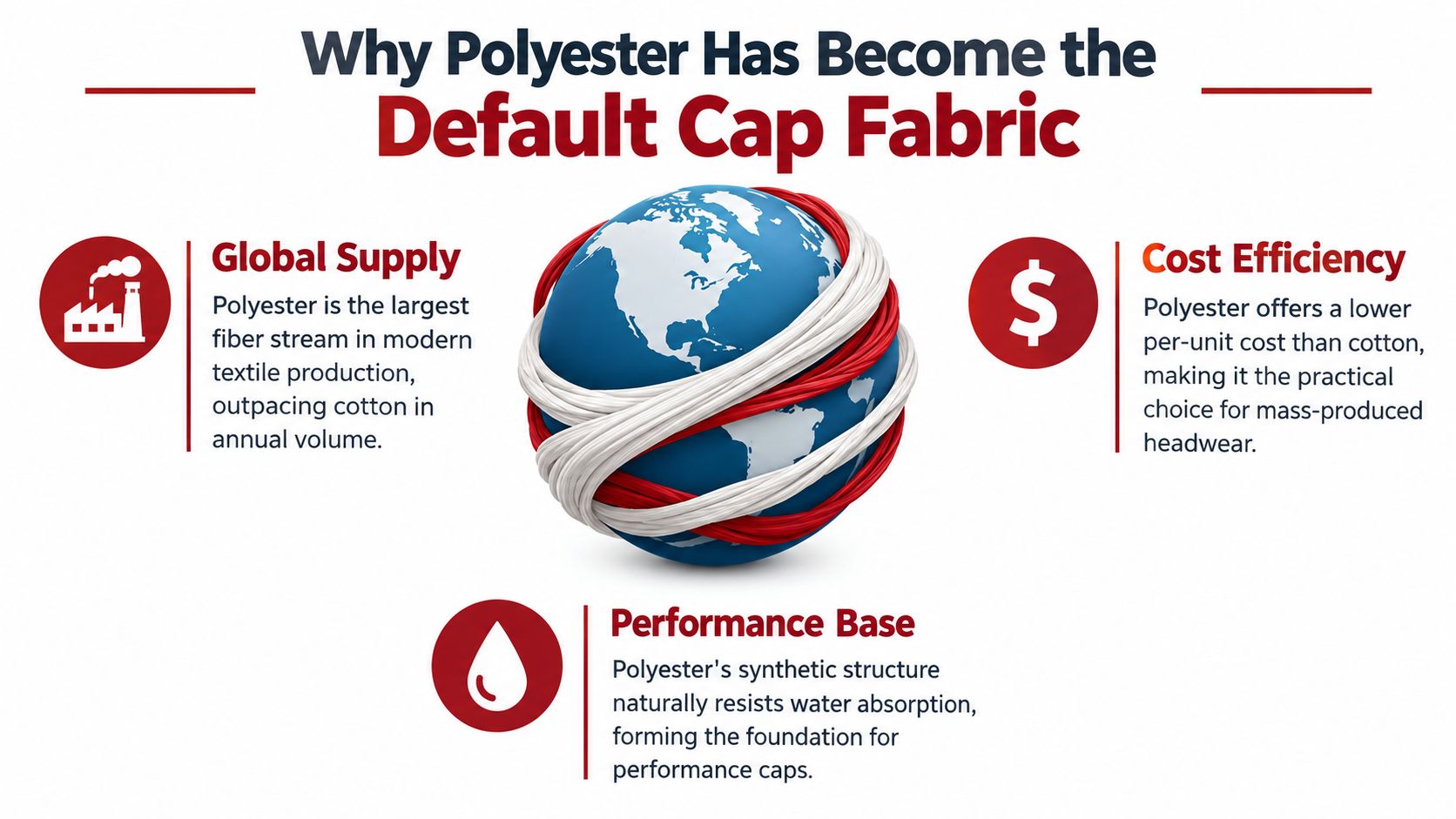
Polyester's place in cap production comes down to supply and adaptability. Manufacturers can source it widely, and the fiber can be engineered for different fabric weights, yarn structures, and uses. For buyers, that makes polyester a practical starting point, not proof that a cap will perform well. Construction still decides whether the finished product suits the job.
The industry's growth explains why polyester is so widely available. Global demand rose from approximately 5.2 million metric tons in 1980 to 19.2 million in 2000 and 46.1 million in 2014. Polyester accounted for about 73.4% of total fiber-demand growth from 1980 to 2014, and its demand surpassed cotton in 2002. These figures describe a broad shift in textile production, not a verdict on which fabric belongs in every cap. (Textile World's account of polyester's growth and geography)
Scale is a sourcing advantage, not a performance guarantee
Production is concentrated in major manufacturing markets. In 2014, China accounted for roughly 69% of global polyester-fiber production, while China, India, and Southeast Asia together represented approximately 86%. That concentration helps explain polyester's broad presence across factories and product categories. It does not ensure a supplier has your required color, fabric construction, or stock available. Confirm those details before placing a large order.
The material's scale has continued to grow. Global fiber production reached approximately 116 million metric tons in 2022, with polyester making up 54%, or about 63 million tons. In 2023, production was roughly 124 million tons, and polyester's share reached 57%, or approximately 71 million tons. (Textile Exchange's Materials Market Report 2025) These totals give buyers useful context for repeat-order planning, but they cannot tell you whether an individual cap's yarn, panels, or finishing meet your requirements.
Treat polyester's prevalence as a sourcing advantage, not a reason to skip inspection. Choose it when the actual cap construction fits the program, and ask the supplier about yarn and panel details rather than relying on the fiber label alone. For a practical comparison of hat fabric materials, use the material guide alongside your product specifications.
Performance Traits That Actually Show Up on the Field
A polyester cap doesn't wick sweat by magic. Moisture management depends on how the yarn and fabric move liquid, how much air can pass through the panels, and what the sweatband does against the wearer's forehead.
Ask about the fabric, not just the fiber
Research comparing polyester fiber cross-sections found that non-circular profiles can improve liquid-water wicking and air and moisture-vapor permeability. Grooves in those profiles create more capillary paths for moisture to travel. The same study found that increasing fiber linear density increased through-fabric wicking but slowed the visible spread of an individual water drop, while air and vapor permeability correlated positively with fiber decitex. (Research on polyester fiber shape and moisture transfer)
That distinction matters at the order stage. Ask for fabric weight, mesh construction, sweatband material, and moisture-management test data. Lightweight mesh panels or engineered yarns may help move perspiration away from the head, but a tightly woven crown or a non-breathable foam layer can work against that benefit. If you want a broader reference point for performance styles, find moisture-wicking golf hats. Compare the construction, not just the marketing language.
Treat sun protection as a tested specification
Polyester fabrics generally provide stronger inherent UV protection than many lightweight natural-fiber alternatives, but the finished cap's coverage and construction matter. A clinical review reported that polyester fabrics usually provide sufficient protection at UPF 30 or higher, while cotton, linen, and viscose frequently provide poorer protection. Separate fabric research found that moisture increased UV transmission, and that fabric shape and air permeability also influenced shielding. (Clinical review of fabric and UV protection)
If sun protection is a selling point, request certified UPF test results for the cap fabric. Don't treat a polyester label as certification. A tightly woven crown and brim can offer more coverage than ventilated mesh, so decide whether your priority is shade or airflow instead of assuming one construction can maximize both.
For outdoor team orders, durability and color retention still need a sample check. Inspect the seams, closure, brim, and decorated area after normal wear and cleaning. A material description can't tell you whether the finished cap holds its shape or whether the logo looks sharp on that particular panel.
Before committing to a bulk order, review the construction in motion and in use.
Panels, Crowns, and Closures Explained
Choose the silhouette before you settle on a decoration method. Panel seams, crown structure, and the closure all change how a cap looks on the wearer and how much usable space the logo gets.
Match the front panel to the artwork
A six-panel cap has a center seam at the front on many common styles. That classic shape suits familiar baseball-cap branding, but a seam can interrupt a large design placed across the middle. A five-panel cap typically offers a broad front panel without that center seam, which can give a bold logo or larger graphic a cleaner canvas. Neither profile is universally better. Match the panel layout to the artwork, then have the decorator confirm where the logo can sit.
Crown structure changes the presentation. A structured crown uses backing to keep its shape, giving the cap a crisp profile on a retail shelf and a stable front for many logos. An unstructured crown feels softer and more broken-in, which can suit casual merchandise or buyers who prefer a relaxed fit. If you want to see how a structured profile looks in a specific product, compare this structured twill cap for the course.
Choose the closure for the wearer
Snapbacks are easy to adjust and work well for group orders with varied head sizes. A hook-and-loop strap is straightforward for youth teams and practical uniforms. A fitted cap gives a cleaner, less adjustable finish, while stretch-fit designs use flexible materials to accommodate a range of wearers without a visible strap.
| Silhouette | Best Fit For |
|---|---|
| Six-panel structured cap | Classic team logos and retail presentation |
| Five-panel cap | Bold front artwork or a cleaner uninterrupted logo area |
| Unstructured cap | Casual brands and relaxed everyday wear |
| Snapback | Event giveaways and groups needing easy adjustment |
| Hook-and-loop closure | Youth leagues and practical staff uniforms |
| Fitted or stretch-fit | Wearers who prefer a clean back profile |
Don't select a closure based only on what's easiest to buy. Think about who will wear the cap, whether one size needs to fit a broad group, and how the finished logo looks on the chosen front panel. If you're unsure, approve a sample before you order the whole run.
Decoration Methods and Polyester Behavior
Polyester is a canvas, not a decoration guarantee. The right method depends on the logo's detail, the panel's thickness, the cap's intended use, and the finished look you want. Ask for a proof on the actual style, because a design that looks clean on a flat screen can behave differently on a curved crown.
Flat embroidery suits logos with clear shapes and lettering. It holds up well on many caps, but tiny text can fill in when stitched, so simplify fine details before production. Three-dimensional puff embroidery adds height to bold lettering and simple marks. It needs designs with enough open space to keep the raised stitching readable, and it isn't a good fix for intricate artwork.
Heat transfer can reproduce detailed, multicolor graphics without stitching through the design. Ask the supplier how the transfer is applied to that fabric and whether the cap's construction can take the process. Screen printing can make sense for suitable panels and artwork, but a curved, shaped cap is less forgiving than a flat garment panel. A sew-on patch gives the logo its own defined surface and can help distinguish a brand program, though the patch and its stitching add another construction element.
Buyer's rule: Approve the decoration at actual size on the actual cap. A digital proof confirms placement and artwork, but it can't fully show texture, stitch height, or how a logo sits across a seam.
Set the proof and production expectations early
Tell the decorator what matters most: fine detail, a raised look, color reproduction, or a durable finish for frequent wear. Confirm the approved thread or transfer colors, logo dimensions, placement, and any limits around seams or panel curves. Decoration choices can affect setup requirements and order minimums, so ask for those details before you set a budget or promise a delivery date.
For a practical overview of how printing and embroidery options differ, compare methods against your artwork rather than picking by habit. Then get a physical sample or approved production proof when color and placement are critical. That's cheaper than discovering after delivery that the logo is too small to read or the thread color clashes with the cap.
Care and Cleaning Without Ruining the Cap
A polyester cap is forgiving, but it isn't indestructible. Frequent washing and rough handling can wear the decoration, change the shape, and increase microfiber release. Clean the cap when it needs it, not automatically after every wear.
Start with the least aggressive cleaning
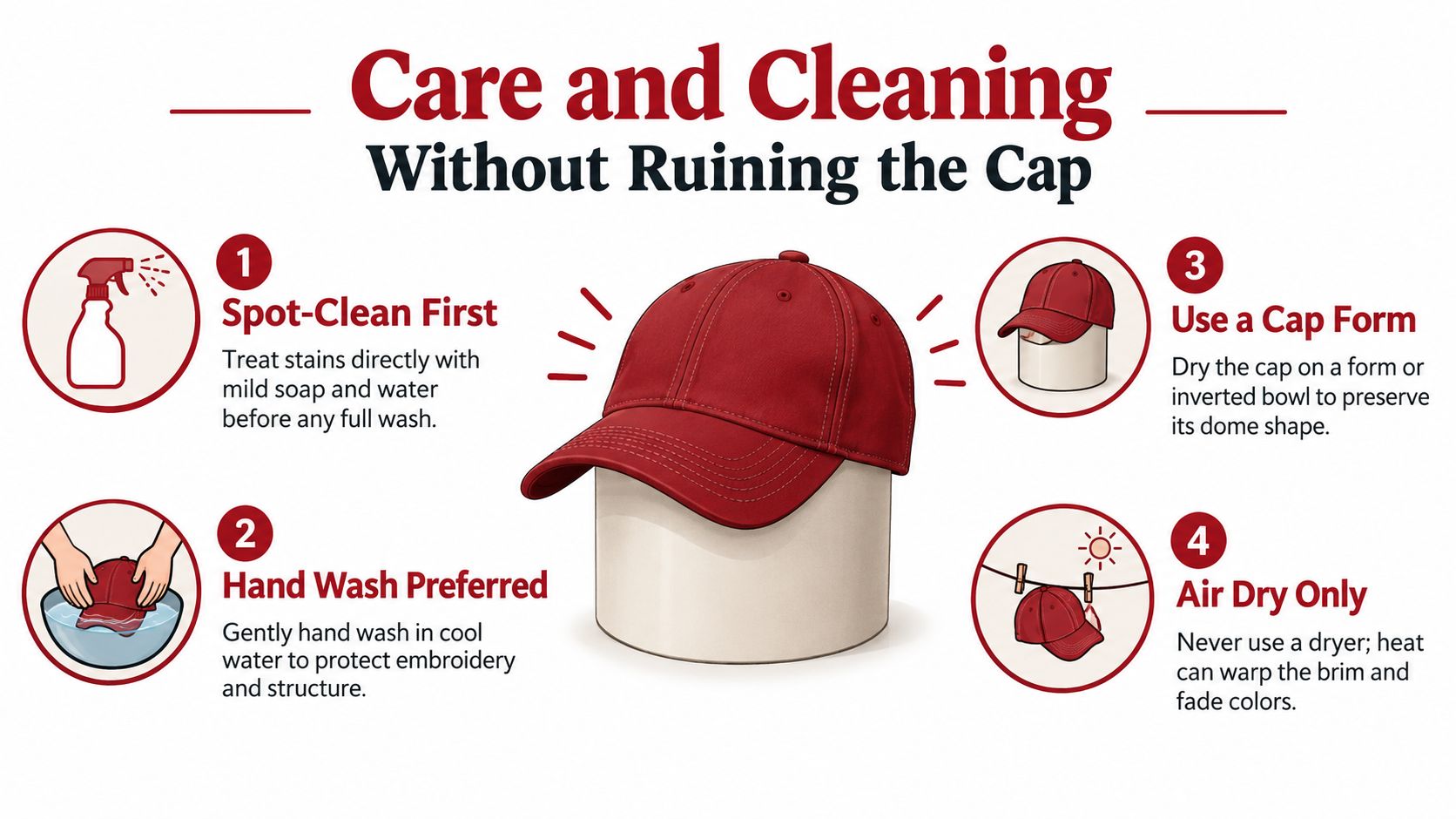
For sweat marks or a small spot, use a clean cloth, cool water, and mild soap. Dab instead of scrubbing hard, especially across embroidery or a printed logo. Treat a grass mark promptly, but test your cleaning method on a discreet area first. Sunscreen can leave oily residue, so work gently rather than soaking the whole cap in a strong cleaner.
If spot-cleaning isn't enough, hand washing is the safer default for a decorated cap. Use cool water and mild soap, rinse without twisting, and support the crown while you clean. A machine cycle can knock the cap against other items and distort its shape, while heat can affect the brim, adhesives, and decoration.
Keep its shape while it dries
Set the cap on a cap form or an inverted bowl that supports the crown without stretching it. Let it air dry away from direct heat, including a hot dashboard or a dryer. Check the brim and crown while damp, and gently restore their shape by hand instead of pressing or bending them aggressively.
Pass those instructions on with team and event orders. Wearers often reach for a washing machine because it seems convenient, but a little spot care can spare the cap unnecessary agitation. For heavily worn caps, tell people to follow any product-specific care guidance from the supplier, especially if the decoration includes a patch or heat-applied element.
Sustainability, Microfibers, and the Honest Trade-Offs
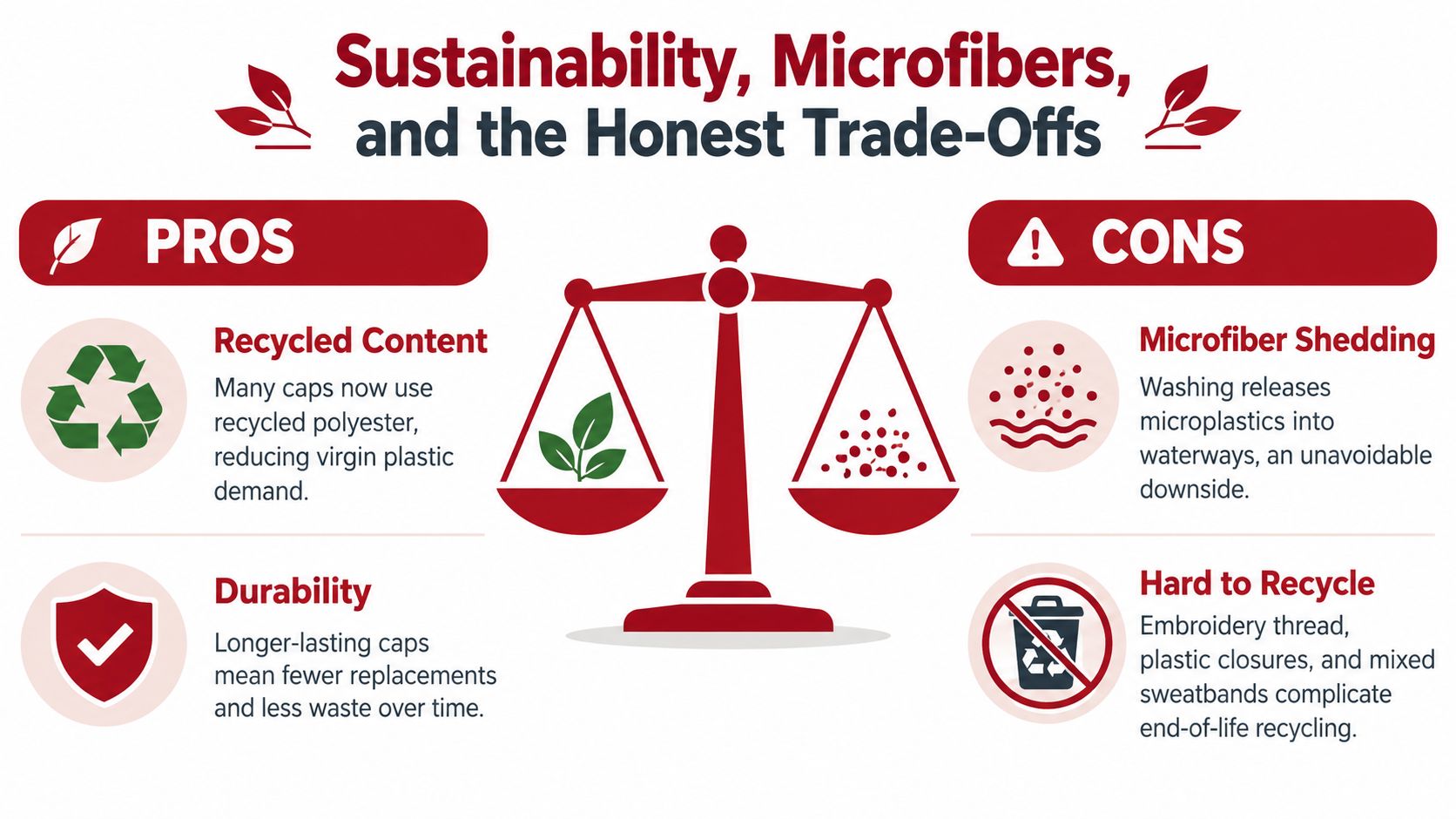
Recycled content is not the same as recyclability. A cap can use recycled polyester and still have no practical route into an ordinary recycling stream once it combines embroidery, backing, adhesives, a plastic closure, a sweatband, and metal hardware. The right question isn't just what the fabric is made from. It's what happens to the finished, decorated cap after use.
A 2025 European textile-recycling report identified a cost gap between textile-to-textile recycled polyester and virgin polyester and argued that policy intervention is needed to scale recycling. That highlights the difference between sourcing a recycled material and building a product that can be recovered at end-of-life. Ask suppliers for documentation supporting recycled-content claims, and avoid promising that a cap is recyclable unless the whole product and its disposal route justify the claim. (SYSTEMIQ report on textile recycling)
Construction and care affect microfiber shedding
Textiles can release microfibers through laundering and everyday wear. A 2025 review found that woven polyester released about 27 ± 14 mg of fibrous microplastics per wash, while fleece and jersey structures released substantially more. It also found that recycled polyester didn't automatically shed less: some recycled compositions produced longer particles even when total shedding was lower. (Review of microfiber release from polyester textiles)
For a cap program, that means construction matters. A tightly woven panel isn't interchangeable with a brushed or fleece-like surface, and recycled content alone doesn't predict shedding. Wash caps less often, avoid unnecessary abrasion, and consider hand washing where appropriate. Don't claim that a particular cap sheds less unless the product has been tested.
Buy for useful life, then plan what comes next
A durable cap that stays in use is a more credible choice than a sustainability claim unsupported by product details. Choose a construction people will want to keep wearing, and consider repair or reuse before disposal. For branded programs, a take-back collection can help you gather caps for reuse or explore appropriate recovery routes, but don't present collection as a guarantee that every component will be recycled.
Ask for clear documentation on recycled content, construction, and care. If the supplier can't verify a claim, don't put it on the product page or event materials. Honest material information is more useful than calling a decorated, mixed-component cap circular without a workable end-of-life path.
Buying Polyester Caps Wholesale With Confidence
A wholesale quote is only useful if the cap you receive matches the sample, artwork, and delivery window you approved. Check blank-stock availability and decorated production timing separately, and don't assume a popular color will stay in stock until your reorder.
Use a buyer's checklist before you commit
- Confirm the spec: Get the fabric content, panel layout, crown structure, closure, and sweatband details in writing.
- Check the sample: Try the cap on, inspect the seams and brim, and review how the logo sits on the actual panel.
- Approve color and artwork: Match the cap and decoration colors before production, especially when your brand depends on a consistent look.
- Verify stock and timing: Ask what is available now, what could be substituted, and when the order needs to ship for your event or season.
- Plan for replenishment: Confirm whether the style and color are likely to be available again, and keep a record of the approved specifications.
If you're comparing blanks for a team or brand, start with a focused look at wholesale blank baseball caps. For another reference point when evaluating sports styles, browse sports caps at Kilts4Less. Compare the product details and ask each supplier the same questions so you're judging comparable options.
Dirt Cheap Headwear offers blank caps and decorated headwear, including in-house embroidery and custom options, for business, team, and event orders. Share your logo, intended use, preferred construction, and deadline with Dirt Cheap Headwear to discuss a cap program that fits the job.
Before placing your order, send Dirt Cheap Headwear your logo and the cap style you have in mind, then ask for a proof and stock check. A sample-first decision gives you a chance to confirm the fit, fabric, and decoration before you commit to the full run.