
Canvas Trucker Hat: Style, Construction, and Customization
The most common advice about a canvas trucker hat is also the least reliable: “Canvas is breathable, rugged, and eco-friendly.” The word canvas alone doesn't guarantee any of those things. Fabric weight, weave, coating, fiber blend, mesh construction, and brim size all affect how the hat performs.
If you're sourcing custom hats in bulk, start by looking past the product name. Check how the cap is built, how it'll feel during a full day of wear, and whether its front panel suits your logo. Those details are what distinguish a useful work or event hat from a sample that only looks right on screen.
What a Canvas Trucker Hat Actually Is
A buyer scrolling through a supplier's catalog can find foam-front truckers, soft dad caps, snapbacks, and canvas truckers that look almost identical in small product photos. The easiest way to tell them apart is to start with the front panel. A canvas trucker hat has a structured front made from woven canvas, paired with a mesh back, a firm bill, and an adjustable closure.
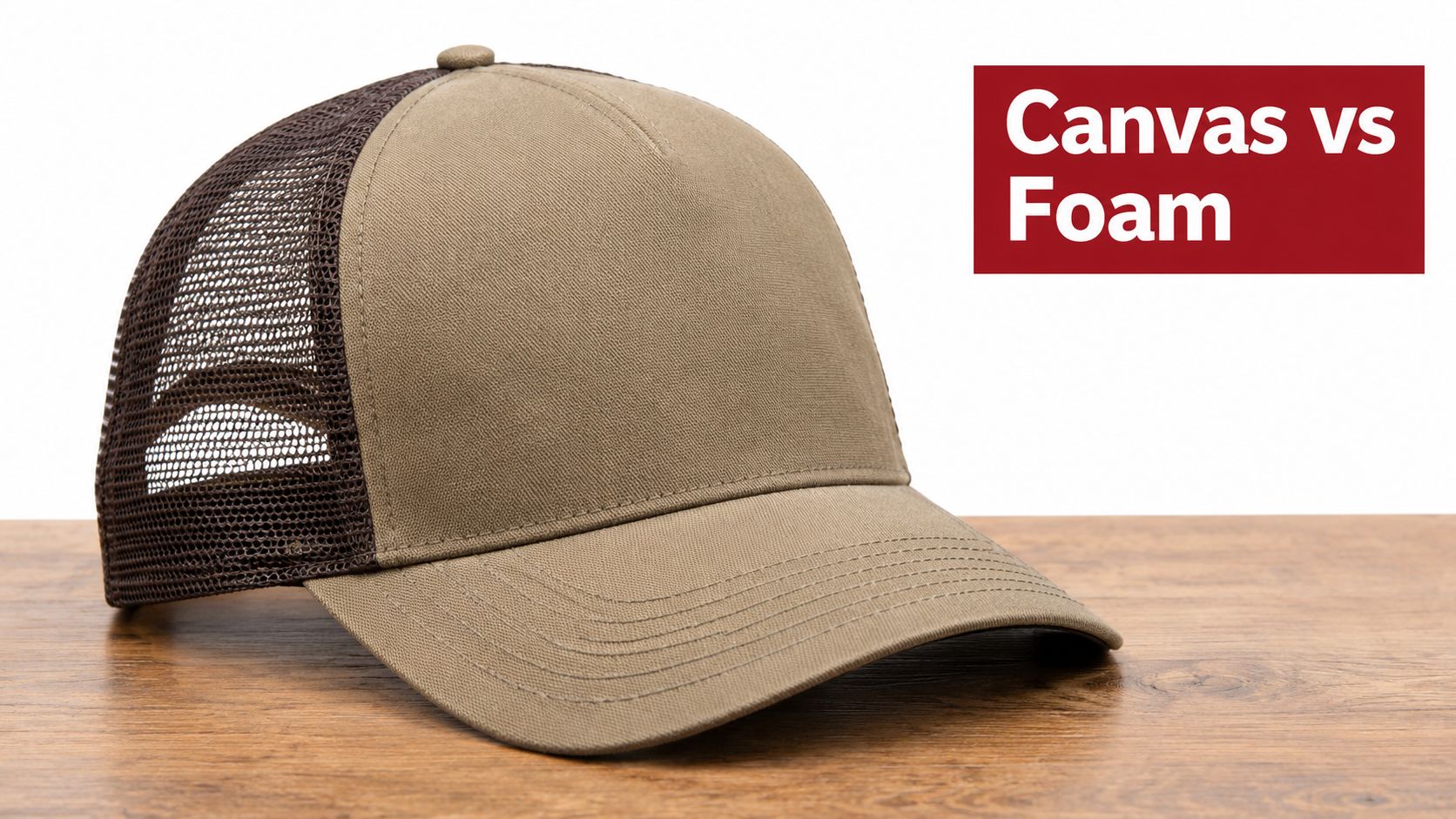
The mesh back and adjustable fit are familiar trucker-cap features. The difference is the front: instead of the foam commonly used on promotional truckers, the cap uses woven fabric. That gives it a more textile-forward appearance and a less shiny, less overtly sporty look. A dad cap, by contrast, usually has a softer, less structured crown and a relaxed shape. “Snapback” describes a closure, not a fabric or a particular cap category, so a trucker can also be a snapback.
The style's history explains why it works for both businesses and everyday wear. Its roots are tied to American workwear and agricultural promotion. Earlier workers often wore peaked mechanic's caps, while the recognizable mesh-backed trucker style emerged as a promotional giveaway from U.S. feed and farming-supply companies. Its structured front, mesh back, stiff bill, and adjustable closure suited outdoor work and gave businesses a visible place for their logos. By the early 2000s, the cap had also moved into mainstream fashion and youth subcultures. The trucker hat's history traces that shift from practical giveaway to fashion item.
For a buyer, the canvas front is the quick visual cue and a practical branding surface. It looks more like cloth than foam, and it can take embroidery or a patch that suits a workwear, outdoor, or retail identity. If you're weighing branded caps for staff or clients, headwear ideas for corporate gifts can help you compare how different styles fit a company's image.
The Canvas Front and Mesh Back Explained
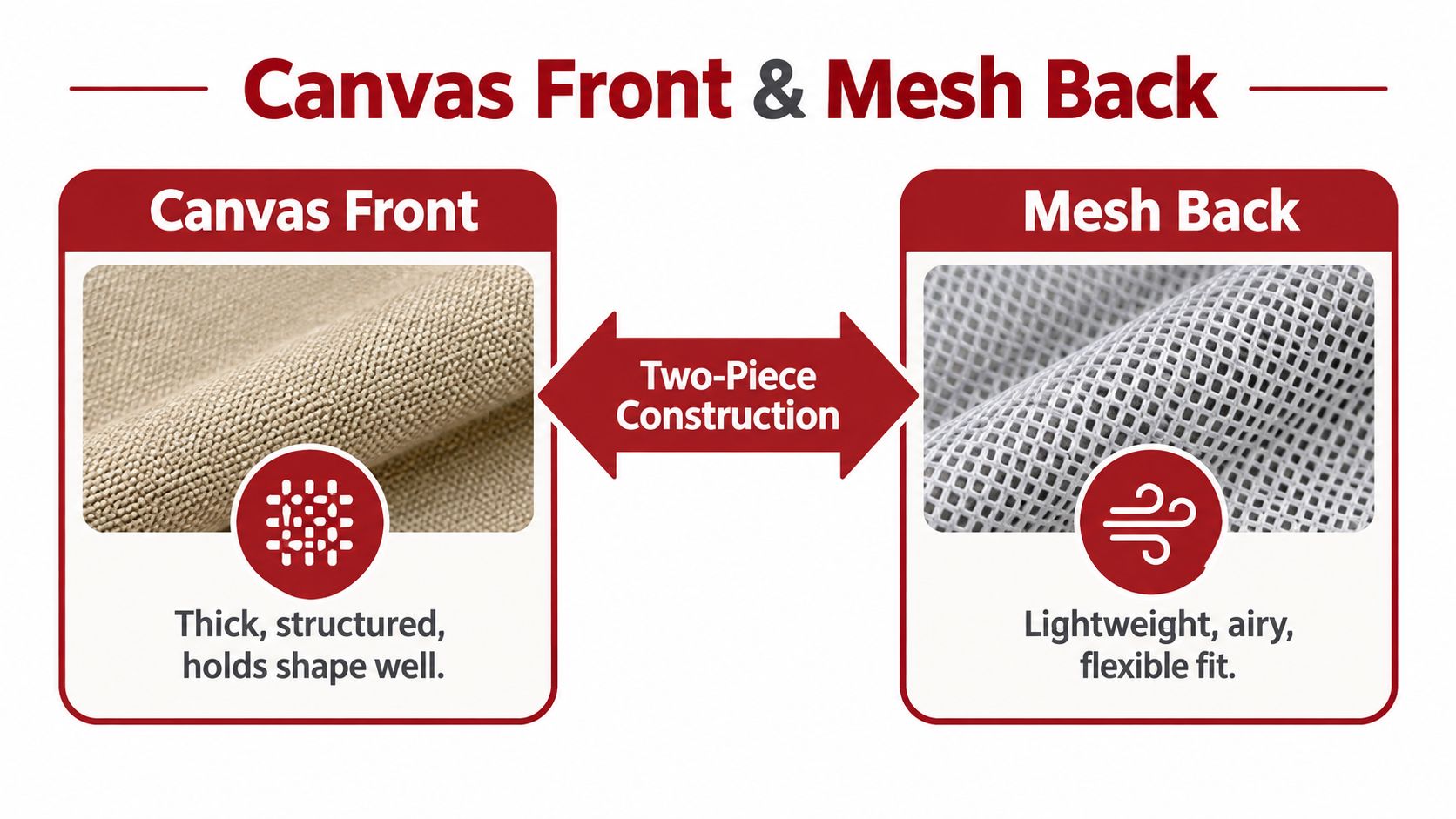
A canvas trucker works as a two-part system. The canvas front gives the crown its structure and carries the decoration; the mesh back keeps the rear lighter and more flexible. Buyers sometimes assume the entire cap is canvas, but the panels don't serve the same purpose.
Canvas is a dense woven fabric with a long history in products that need strength and abrasion resistance. Canadian government industrial statistics from 1977 classified canvas manufacturing within an industry producing items such as awnings, tents, sails, tarpaulins, canopies, and bags. That industrial background helps explain why canvas fronts feel more substantial than lightweight fashion fabrics. It doesn't mean every canvas hat is built for heavy-duty use, but it does mean the material has long been used where wear and handling matter.
Textile guidance gives a sense of how strongly construction can affect performance. It reports that 10-ounce plain-weave canvas can reach approximately 280 lbf of warp tensile strength and 250 lbf of weft tensile strength under ASTM D5034-style testing. Heavier 16-ounce duck canvas with a wax finish has exceeded 30,000 Martindale abrasion cycles under ISO 12947 testing. These figures describe specific fabrics and test conditions, not every hat labeled canvas. For a buyer, the useful lesson is to ask about the actual fabric weight, weave, and finish rather than relying on the name. The canvas textile guidance explains why those details matter.
Each half has a different job
The front needs enough body to hold its shape and present a logo cleanly. The mesh rear provides airflow and flexibility, so it shouldn't be treated as though it offers the same abrasion resistance or structure as the canvas crown. If a supplier describes a cap as “canvas,” ask which panels use canvas and which use other materials.
Canvas also sits within a broad industrial textile supply chain, from apparel and luggage to outdoor and commercial goods. Industry estimates put the global canvas market at approximately USD 4.52 billion in 2026, with a projection of USD 7.39 billion by 2035; the same analysis estimates that plain-canvas production exceeded 4.8 million metric tons in 2023. Those figures cover canvas broadly, not hat production, but they show that the material is established well beyond headwear. See the canvas market analysis for the underlying estimates.
Fit, Closure, and How It Actually Wears
A canvas trucker usually wears more upright than a soft dad cap. Its structured crown resists collapsing, and its firmer front gives the hat a more defined silhouette. That's helpful when you want a logo to stay visible, but it can feel less relaxed than a soft cap that breaks in around the wearer's head.
Panel count and crown shape also affect the look. Five-panel and six-panel designs are both common, and the seam layout changes the size and shape of the front area available for branding. A taller crown tends to read as bolder, while a lower profile can feel more understated. Don't choose by panel count alone. Ask for a photo of the actual blank from the front and side, especially if your logo is wide or needs to sit clear of seams.
Match the closure to the order
A snapback is straightforward for group orders because wearers can adjust it themselves. Velcro closures are also adjustable, while a buckle can create a more finished appearance. Each option changes the feel at the back of the head, so check the closure on a sample rather than assuming all adjustable caps wear the same.
For many team, staff, and event orders, an adjustable cap makes distribution simpler. A retail program may put more weight on the look and finish of the closure, or explore fitted sizing if it suits the product range. Think about who'll wear the hats and how they'll receive them before selecting a style.
Fit check: Wear the sample for a while, not just long enough to look in a mirror. Check whether the crown feels too tall, the bill sits comfortably, and the closure adjusts without pulling the mesh awkwardly.
The bill matters, too. A pre-curved bill follows the familiar trucker-cap shape, while a flatter bill gives the cap a more contemporary, sharper profile. Either can work with canvas, but the curve and stiffness affect how the hat sits and how it looks on different wearers. Before ordering in bulk, confirm the profile, bill shape, closure, and front-panel dimensions on the actual style you plan to decorate.
Decoration Methods That Work on Canvas
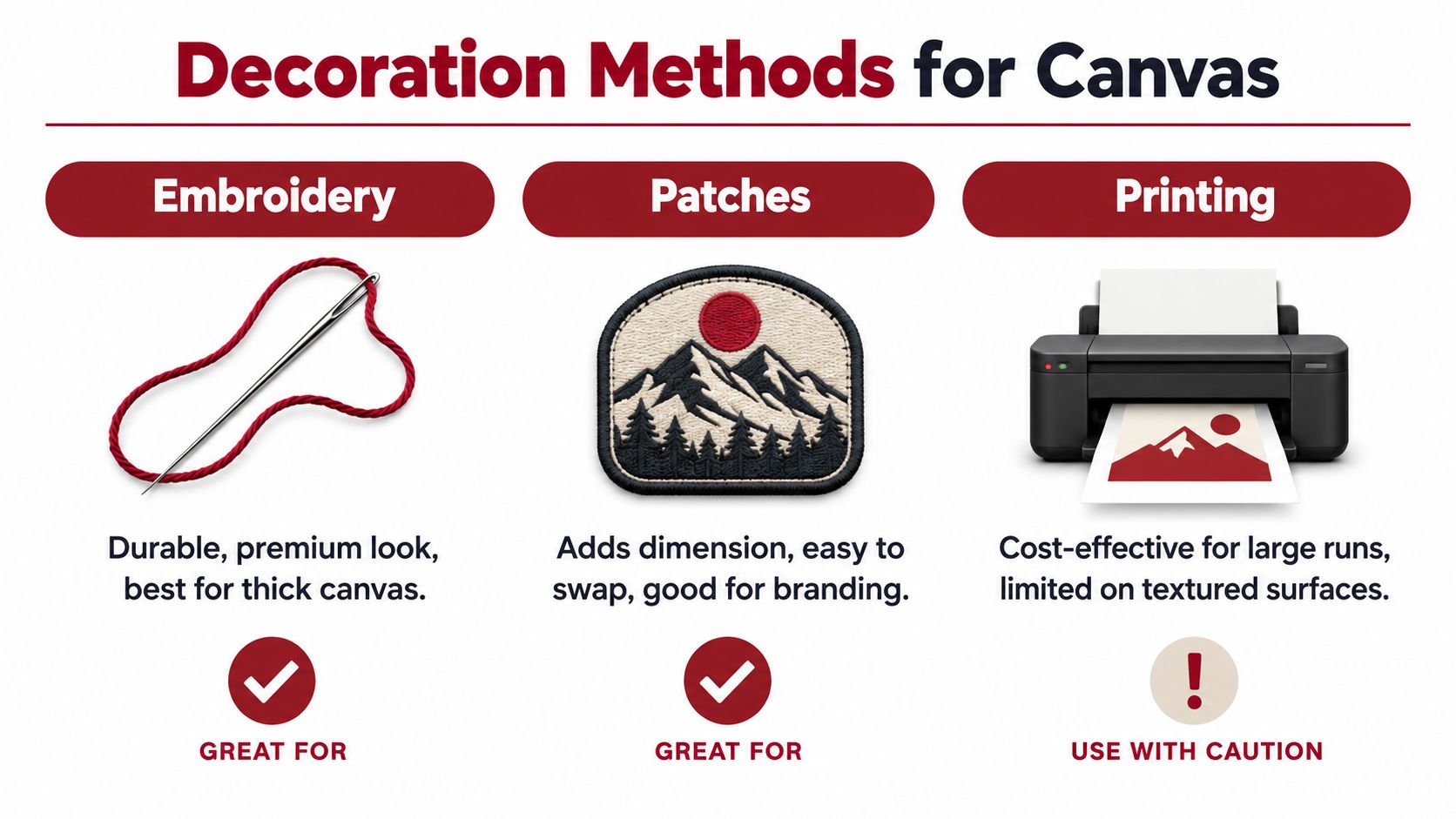
Canvas gives decorators a firm surface, but it isn't the same as stitching onto a flat garment. Its thickness and stiffness affect needle movement and how the finished logo sits. Embroidery, patches, and printing can all work, but the right choice depends on the artwork and the effect you want.
Embroidery needs a cap-specific file
Embroidery is a natural fit for a structured canvas front, especially for a simple wordmark or bold icon. But don't assume a file prepared for a shirt will work unchanged. Cap-embroidery guidance recommends lighter, crossed or diagonal underlay and automatic density control to prevent too many stitches from collecting in one area. It gives spacing guidance of 0.45–0.55 mm for cap fill, 0.45–0.50 mm for satin columns, and approximately 0.40–0.45 mm for small text. These are technical settings to discuss with your decorator, not a promise that every design will stitch well at those values. The cap embroidery guidance explains the role of underlay and density.
Too many stitches can drag against stiff canvas, creating heat, puckering, distortion, or lettering that's hard to read. A moderate-size logo with simplified small text is often a safer starting point than a densely filled design. Ask the decorator to test the actual cap blank with the intended thread colors and artwork, and review how the design sits on the curved front.
Patches and printing solve different problems
A patch can preserve fine detail that would become muddled in thread. It also adds dimension and gives a brand more options for a heritage or outdoor look. Confirm how the patch attaches and whether its size and edge placement suit the curve of the front panel.
Printing keeps the decoration flatter, which may suit bold, simple artwork or designs that rely on more color than embroidery can comfortably reproduce. Texture can make printed edges or fine details less crisp, so request a sample or proof that reflects the actual canvas surface. For an overview of printing and embroidery options for hats, compare methods with your artwork and chosen blank in mind.
This video offers a visual look at hat decoration:
Breathability, Sun Protection, and the Sustainability Trade-Offs
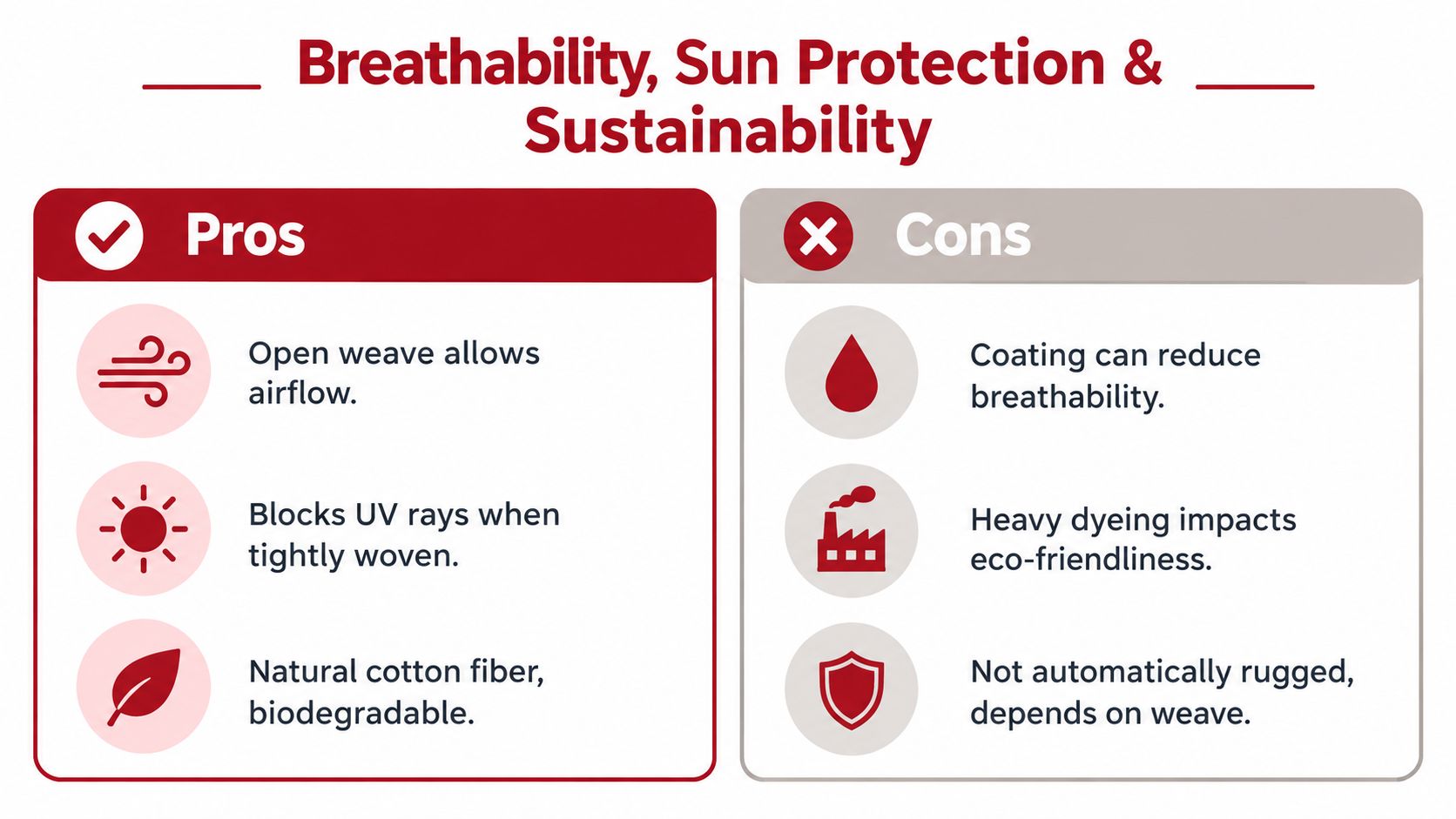
A canvas trucker can be a poor choice for hot conditions if its canvas is tightly woven, coated, laminated, or made with a fiber blend that limits airflow. An open, uncoated cotton canvas may allow more air exchange, but “canvas” isn't a breathability rating. Moisture absorption also isn't the same as moisture wicking, so don't assume that a cotton front will actively move sweat away from the wearer.
Check airflow and brim coverage separately
The mesh back can help ventilate the rear of the head, but it doesn't make the canvas front airy. For outdoor staff, festival crews, or sports groups, ask about the canvas weight, weave openness, coating, and fiber blend. Then check the mesh and sweatband as separate components.
Brim size is another detail marketing copy can gloss over. Evidence summarized by Canada's National Collaborating Centre for Environmental Health indicates that a small brim provides negligible protection beyond the forehead, while a brim of at least 7.5 cm is needed for reasonable protection of the nose and cheeks. Ventilation is also recommended for heat management. The environmental health guidance on sun protection helps put the trade-off in perspective: a cap's brim and ventilation both matter, and a trucker bill shouldn't be mistaken for broad face coverage.
Natural fiber doesn't mean impact-free
Cotton is a natural fiber, but that alone doesn't make a finished hat automatically sustainable. Dyeing, coatings, blends, product lifespan, and disposal all affect its overall impact. Fiber shedding is another reason to avoid simplistic claims: a 2024 ACS study found natural textile fibers represented 93.8% of textile fibers measured across 223 river samples, and a 2025 review reported that natural, man-made, and blended fabrics can all release fibers during washing. The review also reported that woven fabrics generally release fewer fibers than knitted fabrics.
That evidence doesn't tell you the impact of a specific hat, but it does challenge the idea that natural fiber means zero pollution. Choose a cap for its actual use, care for it as instructed, and consider whether the quality and decoration will encourage people to wear it for a long time. If you're looking into textile reuse or disposal, Chicago textile recycling information offers a practical place to start. For material comparisons, review the options in hat materials guidance.
Who Orders Canvas Trucker Hats and Why
A small business ordering staff hats usually wants a cap that looks polished without feeling too formal. A mid-weight canvas front, adjustable closure, and straightforward embroidered logo can give the team a consistent look for customer visits, outdoor work, or local events. The owner should still check the sample's weight and finish, since those details decide whether the hat feels suitable for a full shift.
A sports team or league may care more about color consistency and a decoration that can handle regular wear. A structured front can present the team mark clearly, while a patch can suit a detailed crest that would be difficult to stitch cleanly at a small size. Coaches ordering for a mixed group should confirm the closure and fit with the people who'll wear the hats, rather than relying on a catalog photo.
Event planners, schools, and nonprofits often need a design that stays legible across a group order. A simplified logo and a decoration method suited to the canvas can help keep the cap readable without trying to reproduce every detail in a small space. Before choosing the style, ask whether the hats are intended for volunteers, participants, or sale as merchandise. The intended use changes what matters most: comfort, price, retail appearance, or repeat availability.
Match the hat to the buyer's job
Resellers and decorators may be choosing blanks for a different reason. They need a style and color range that can support their own customer orders, plus clear stock information so they can manage reorders. For them, undecorated inventory and consistent product specifications may matter more than choosing a single finished logo treatment.
Across all these use cases, the order shape should follow the wearer's needs. A cap for an occasional giveaway doesn't have the same demands as headwear worn repeatedly by an outdoor crew. Ask who'll wear it, where they'll use it, and what the logo needs to communicate. Those answers help narrow the fabric, fit, and decoration before you compare prices.
A Wholesale Ordering Checklist Before You Commit
A clear order starts with the sample, not the product name. Check the canvas weight, weave, coating, fiber blend, mesh, closure, and brim. If you're ordering a style you haven't handled before, request a physical sample so you can judge the structure and decoration surface directly.
Then confirm the artwork and production details. Ask for a proof showing logo size and placement on the actual cap shape. Check thread colors, small-text legibility, stitch density, patch attachment, or print suitability before approving production. A proof can show placement, but it can't replace a sample when fabric feel and finish are central to your choice.
Use this checklist before you place the order:
- Minimums: Ask whether the minimum applies per style, color, or logo. For example, Dirt Cheap Headwear lists custom embroidery minimums starting at six pieces per logo; confirm that the current terms fit your order.
- Timing: Request the production and shipping timeline, and leave room for proof approval and any artwork changes.
- Decoration: Decide whether you need finished hats or blanks for later decoration. A wholesale blank-hat buying guide can help you think through that choice.
- Inventory: Confirm stock for the color and style you want, and ask how the supplier handles updates if availability changes.
- Repeat orders: Ask how the supplier will keep the product, logo placement, and thread colors consistent when you reorder.
Once you have those answers, compare the finished sample with the job the hat needs to do. Don't approve a bulk run based on “canvas” alone. Approve a specific construction, a specific decoration, and a proof you're comfortable putting in front of your team or customers.
Dirt Cheap Headwear offers blank trucker caps and custom decoration, including embroidery, patches, and printing, with in-house embroidery minimums starting at six pieces per logo. Compare styles and decoration options, then request a proof through Dirt Cheap Headwear before committing to your canvas trucker order.