
You're probably in a familiar spot. You need hats for a launch, staff uniform, client giveaway, school event, or resale drop. You want them to look legitimate, not like the leftover promo caps people toss in a trunk and forget about.
You also want the product to say something about your brand before anyone reads the hangtag. That's where an organic cotton hat starts to make sense. It gives you a cleaner materials story, and particularly for a buyer, it provides a more thoughtful base product to customize.
The trick is that buying sustainable merch gets messy fast when you move from idea to order. “Organic” on a product page doesn't always tell you what was certified, how the hat is built, whether your logo will stitch well, or whether your timeline is realistic. If you need 100 hats by next month, the environmental angle matters, but execution matters more.
Why Choose an Organic Cotton Hat
You need 100 hats in hand by next month. They have to fit your staff or customers, carry your logo cleanly, and still feel like something people would choose to wear after the event. That is where an organic cotton hat usually earns its place.
For a first merch order, hats solve a practical problem. They are easier to size than apparel, they stay visible in daily use, and they can work across retail, uniforms, giveaways, and fundraiser programs. If you are comparing options across wholesale blank baseball caps, organic cotton gives you a stronger starting point when your materials story and your brand presentation need to line up.
It also tends to photograph and wear better than many cheap promo caps. A softer hand feel, a more relaxed shape, and a less disposable look all help. Buyers notice that, even if they never ask what fiber was used.
Where it works especially well
A coffee shop can use it for staff headwear that does not look too corporate. A wellness or skincare brand can sell it without sending mixed signals about the product line. A school, nonprofit, or community event can offer a useful item instead of one more giveaway that ends up in a drawer.
The hat becomes part of how people read your business. If the cap feels good, fits well, and holds the logo in the right spot, it does more than advertise. It supports the standard you are trying to show.
A good merch order should do two jobs at once. It should carry your logo and reinforce what your brand stands for.
Here is the trade-off I tell new buyers to watch. Organic cotton can be the right material choice and still be the wrong product choice if the cap body is weak, the crown shape does not suit your audience, or the decoration method fights the fabric. A six-panel structured cap with heavy embroidery will behave differently from a soft unstructured dad hat with a small stitched mark. The material gets attention. The build and decoration decide whether the order succeeds.
What buyers usually get right and wrong
What works: choosing the wearer first. Start with who will use the hat, how often, and in what setting. Then match the profile, closure, and decoration method.
What goes wrong: treating “organic” like the full buying decision. New buyers skip over fabric weight, crown depth, visor shape, sweatband quality, and minimums for custom decoration.
That is why organic cotton hats are a solid choice for many brands. They give you a better brand story, but they also give you a versatile blank for customization, provided the fit, construction, and production timing are handled properly.
What Makes an Organic Cotton Hat Different
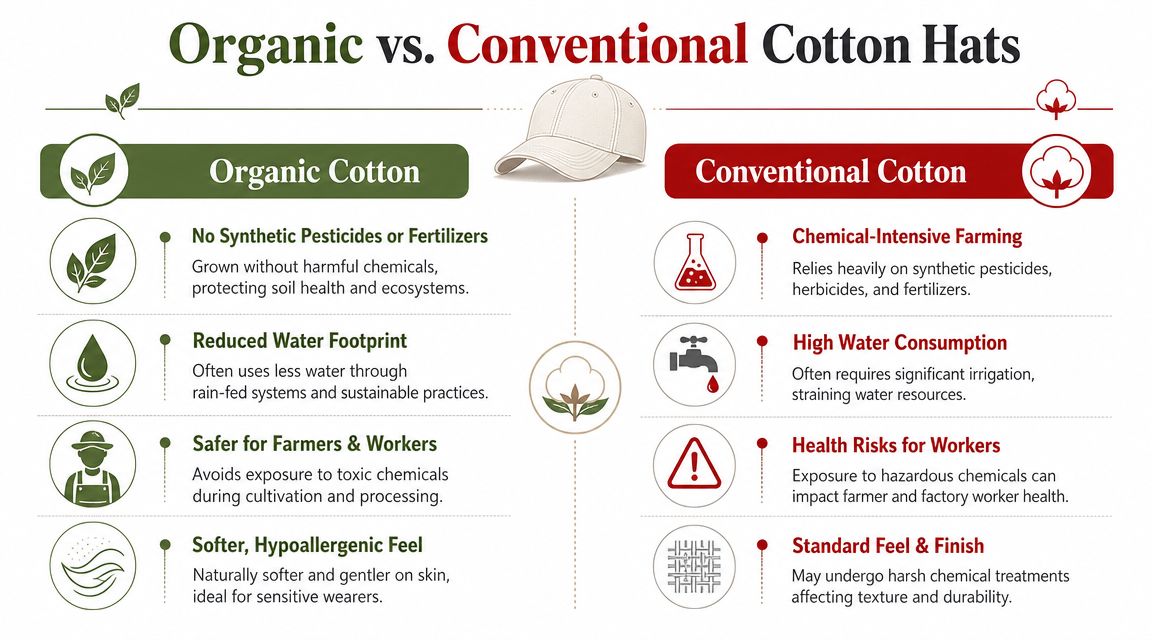
A buyer often sees two caps that look almost identical in a product grid, then gets stuck on what the organic label changes. For a custom order, the answer starts upstream. Organic cotton follows a different farming and certification path before it ever becomes a hat body, and that affects how you vet the product claim.
From a sourcing standpoint, organic cotton refers to cotton grown without synthetic pesticides, synthetic fertilizers, or GMOs under recognized standards. The finished cap can still look like any other twill hat on the shelf. The difference sits in the raw material history, the paperwork behind it, and the claims you can make once your logo goes on it.
Where the difference shows up for a business buyer
The easiest way to evaluate an organic cotton hat is to separate three questions. What fiber is in the cap. How was that fiber produced. Can the supplier support the claim with documents.
That distinction is important because two hats can stitch, embroider, and wear in very similar ways while making very different material claims. If you are reviewing cotton twill baseball caps, do not stop at the fabric name. Check whether the listing identifies certified organic cotton, a blended fabric, or a general cotton twill with no sourcing detail.
For branded orders, this changes a few practical decisions:
- How you describe the product: your sales team, event staff, or customers will ask what makes the hat organic.
- How you approve samples: a clean-looking sample does not confirm the fiber claim. The spec sheet and supporting documents do that.
- How you compare quotes: one supplier may price a standard cotton blank and another may price an organic-certified blank that looks similar in photos.
Buyers get in trouble when they treat “organic” as a style term. It's a sourcing term first.
What changes and what does not
Organic cotton does not guarantee a better cap on its own. A poorly built organic hat is still a poor hat. The crown can collapse, the visor can feel thin, and the sweatband can underperform just like it would on any weak blank.
What usually stays familiar is the decoration process. In many cases, an organic cotton twill cap will take embroidery or printing in a way that feels close to a conventional cotton version with a similar weight and weave. What changes is the standard behind the material and the level of scrutiny you should apply before placing a bulk order.
I tell first-time buyers to inspect organic hats as two separate purchases combined into one product. First, you are buying a hat that needs to fit your audience, hold your logo well, and arrive on time. Second, you are buying a verified materials claim that may support your brand story, resale positioning, or internal purchasing standards.
A better way to judge the difference
Use a simple checklist during sourcing. Ask what percentage of the cap is organic cotton. Ask whether the supplier can show certification for the product or material. Ask whether trims, sweatbands, closures, and dyes are part of the claim or outside it.
That approach keeps you out of a common trap. New buyers see “organic cotton hat” in a title, assume the whole item meets the same standard, and approve artwork before checking the underlying documentation.
Construction still decides whether the order performs in practice. Organic fiber changes the sourcing conversation. It does not replace the usual buying work on fabric weight, panel structure, closure quality, decoration compatibility, and delivery timing.
Decoding Sustainability Claims and Certifications
A lot of first-time buyers get stuck here. The sample looks good, the price works, the logo mockup is approved, then the product page starts throwing around words like eco, conscious, and responsible with no clear proof behind them.
For a bulk order, that is a risk. If you plan to put a sustainability claim on a product page, hangtag, event display, or reseller sheet, you need language your team can defend after one follow-up question.
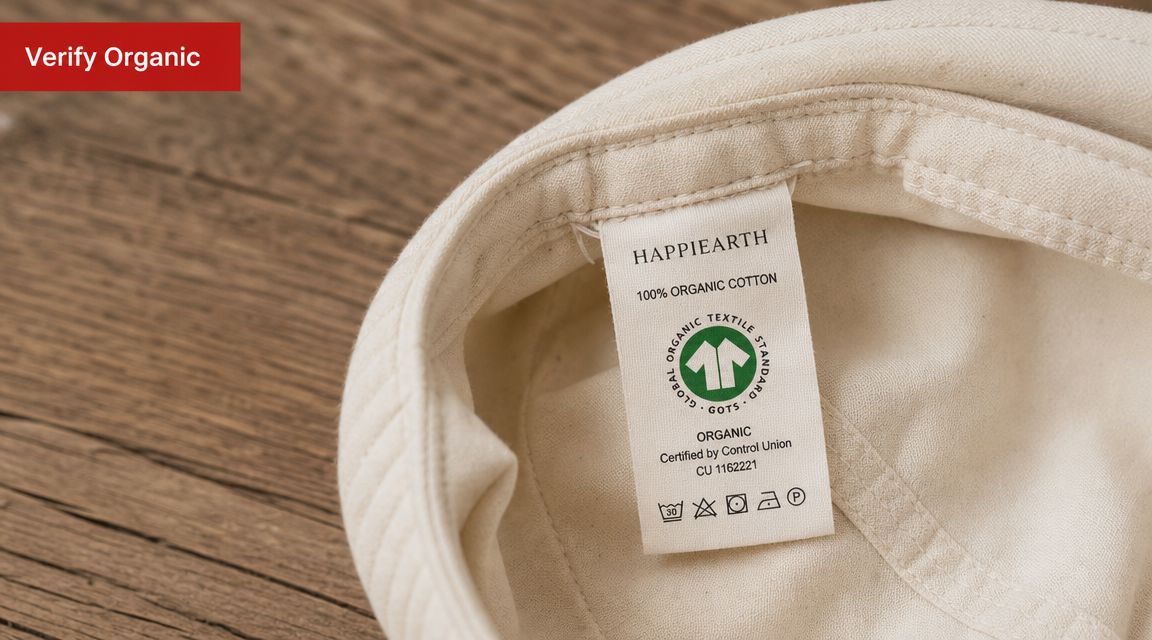
The certification buyers ask about most often in this category is GOTS, short for the Global Organic Textile Standard.
Why GOTS carries weight
GOTS is widely used as a benchmark for organic textiles because it applies beyond the farm level. In practical buying terms, that helps separate a finished hat with documented standards behind it from a listing that only mentions organic fiber in broad marketing copy.
That difference shows up fast once you start requesting paperwork. A seller with a real certification trail can usually explain what is covered, what is not covered, and how the claim should be written. A seller leaning on vague green language often cannot.
For custom orders, that clarity saves time. You do not want to finalize 100 stitched caps, then discover the supplier can support "contains organic cotton" but not the stronger claim your sales team already put into a launch email.
What to check before you approve a hat
Use a short verification list before you place the PO:
Is the finished hat certified, or only the fabric input?
Those are not the same claim. A listing can mention organic cotton while leaving trims, dyeing, sewing, or final product certification unclear.Can the supplier show current documentation?
Ask for the certificate number or supporting paperwork before deposit, not after production starts.What parts of the hat fall outside the claim?
Closures, sweatbands, buckram, labels, and eyelets are common weak spots. If your brand plans to market the cap as a sustainability-led item, these details matter.How should the claim appear in your own marketing?
Good suppliers usually give approved wording or at least tell you what not to say.
Practical rule: If the claim gets blurry once you ask for documentation, remove it from your sales copy until the supplier clears it up.
Greenwashing usually shows up in small details
It usually looks ordinary. A product page says "eco-friendly cap," but gives no certification status, no scope of the claim, and no explanation of whether the wording applies to the whole hat or only one material.
That does not automatically mean the hat is poor quality. It means your marketing team needs restraint.
I tell new brand owners to treat certification language the same way they treat sizing, fabric weight, and stitch count. It belongs in the spec review. If you would not approve crown height based on vague wording, do not approve sustainability claims that way either.
Why careful wording matters in a busy category
Headwear is a large product category with plenty of buyers, decorators, and resellers all making similar claims at the same time. Clear standards help you compare blanks, write accurate product copy, and avoid awkward corrections after launch.
The safest approach is simple. Match your claim to the paperwork, keep the wording narrow, and save screenshots or certificates with the order file. That extra admin work is minor compared with reprinting packaging or rewriting a wholesale sheet after the fact.
Popular Organic Cotton Hat Styles for Your Brand
The fastest way to narrow your order is to stop asking, “What hat is popular?” and start asking, “Where will this hat be worn?” Style choice gets easier when you tie it to use.
Some brands need a retail-friendly cap that feels broken-in on day one. Others need a cleaner staff hat that won't fight with uniforms. Organic cotton options can cover both, but the build matters.

The relaxed dad hat
This is the style most small brands start with, and for good reason. A mainstream blank organic cap spec commonly uses 100% organic cotton twill at about 8 oz/yd² (271 g/m²) in an unstructured 6-panel build with sewn eyelets and a self-fabric closure, according to the Printful product specification for an organic baseball cap.
In practical terms, that means a few things:
- The twill weight helps the cap hold up better than very light woven options.
- The unstructured crown keeps the fit casual, which works for coffee shops, lifestyle brands, breweries, and campus merch.
- Embroidery usually sits well on this build, as long as the logo isn't too dense.
If your logo is small, text-based, or badge-shaped, this is often the safest first order.
The beanie for seasonal programs
Beanies make sense when your audience already lives in them. Outdoor businesses, winter events, mountain towns, and holiday merch programs usually get better wear from a beanie than a baseball cap in colder months.
This style also gives you more flexibility with simpler embroidered marks, woven labels, or folded cuff branding. The caution is fit preference. Some buyers want a snug cuffed look, others want a taller, looser silhouette. Don't assume one beanie shape fits every audience.
The workhorse cap for uniforms and events
Not every brand wants soft and slouchy. Some need a cleaner front, easier color matching, and a shape that looks consistent across a staff team.
In that case, look for an organic cotton hat with:
- A moderate profile that doesn't sit too low on every head shape
- A closure your staff can adjust quickly
- A front panel that suits your logo size
- Colorways that won't expose sweat, dust, or repeated wear too quickly
The best style is usually the one your least hat-friendly customer will still wear without thinking about it.
A quick style guide
| Use case | Good style choice | Watch for |
|---|---|---|
| Retail merch drop | Unstructured dad hat | Oversized logos on soft crowns |
| Staff uniform | Cleaner low-profile cap | Colors that show wear too fast |
| Outdoor winter promo | Beanie | Fit preference and cuff height |
| Fundraiser or event | Easy-fit casual cap | Decoration that's too detailed |
A lot of first orders go sideways because the buyer falls in love with a silhouette and forgets the logo application. Pick the style with your decoration method in mind, not after it.
A Business Guide to Buying Organic Cotton Hats in Bulk
You have an event in four weeks, a logo that looked fine on a screen, and a target of 100 hats. That order can go smoothly, or it can turn into a stack of avoidable fixes if the blank, artwork, and timeline are handled in the wrong sequence.
Start with the hat itself.
Step one is always the blank
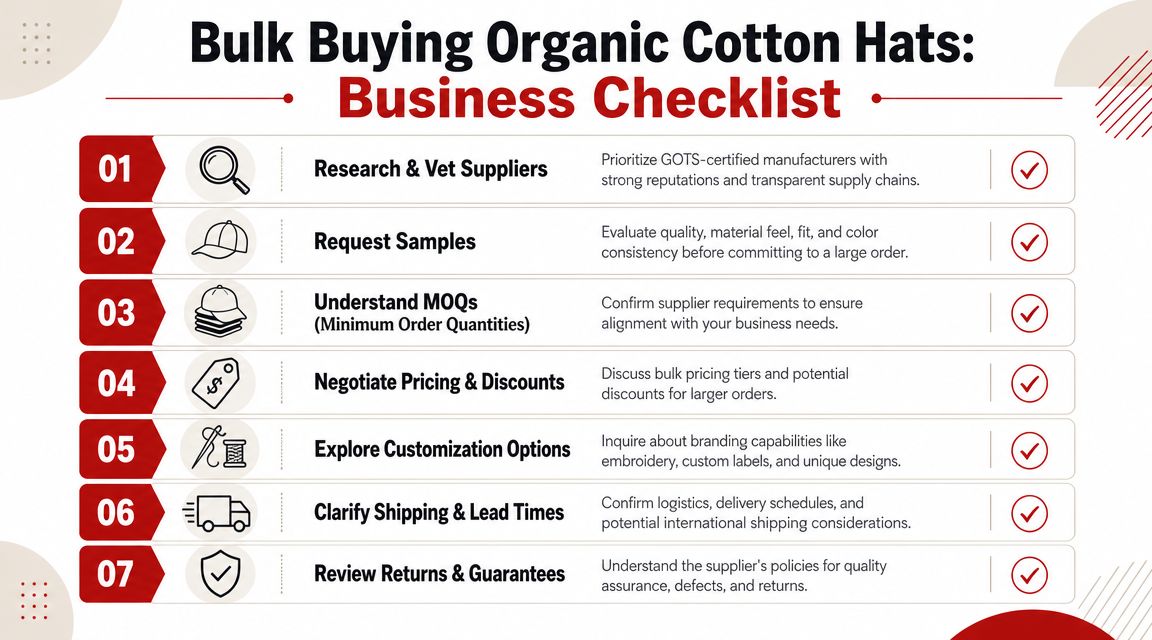
Do not approve decoration before you choose the actual cap. Organic cotton hats can look nearly identical in product photos, yet differ in crown height, fabric weight, closure quality, and how the front panels hold stitching.
If this is your first order, review a practical guide on how to buy blank hats in bulk before you spend money on digitizing and proofs. It helps narrow the field faster and cuts down on expensive revisions later.
A pre-production sample is often money well spent, especially for launches, staff programs, and event deadlines. One sample can reveal problems with fit, fabric color, or logo placement before you commit to the full run.
Where pricing usually changes
Unit cost moves with several production decisions, not just the price of the blank cap.
- Decoration method: embroidery, patches, and print each carry different setup time and labor.
- Logo complexity: clean marks run faster than artwork with fine outlines and dense fills.
- Thread colors: extra color changes can slow embroidery.
- Order quantity: larger orders often improve pricing, but the break points vary by supplier.
- Timeline: rush production usually costs more and may limit style choices.
For resale, build margin for replacements, spoilage, and art edits. For uniforms or team wear, consistency usually matters more than squeezing in a complicated design.
A simpler logo usually scales better across a larger run.
Embroidery on organic cotton twill
Organic cotton twill is generally friendly to embroidery, which is one reason it shows up so often in branded dad hats and casual uniform caps. Even so, every logo needs to be checked against the cap shape and the stitch area.
These designs usually translate well:
- Simple wordmarks
- Badge-style logos
- Artwork with open negative space
- Moderate stitch density
These often need adjustment before approval:
- Tiny lettering
- Thin outlines
- Large solid fill areas
- Tall artwork on low-profile caps
New buyers often lose time; the original logo file may be brand-correct, but thread has limits. Simplifying the art for embroidery is standard production work, and it often produces a cleaner result on the finished hat.
This short walkthrough is worth watching before you place a custom order:
Timeline planning that keeps you out of trouble
Decorated hats take longer than blank hats because there are more checkpoints. Stock has to be confirmed. Artwork has to be cleaned up. A proof has to be approved. Then production and shipping still need buffer time.
A workable order flow looks like this:
- Choose the style and color
- Confirm stock availability
- Send usable artwork
- Review the proof carefully
- Approve size and placement
- Leave buffer time for freight or parcel delays
If you are comparing vendors, Dirt Cheap Headwear is one supplier that offers blank hats and custom embroidery with low minimums, which can be useful for testing a design before placing a larger order.
Why the sustainability side still matters in bulk
In bulk buying, sustainability still affects the decision, but it should be weighed alongside decoration quality, delivery timing, and repeatability. An organic cotton hat only adds value to your program if people wear it, the branding holds up, and the reorder process is manageable.
That is the practical standard. Get the blank right, keep the artwork production-friendly, and give yourself enough time to approve the job properly.
Care and Longevity Tips for Your Organic Hats
The most sustainable hat is the one people keep wearing. That's why care matters. If you're giving hats to staff or selling them to customers, include a few simple instructions with the order confirmation, hangtag, or product page.
The easiest cleaning routine
Start with spot cleaning. Warm water, mild soap, and a soft brush usually handle the sweatband, forehead marks, and surface dirt without putting the whole hat through unnecessary stress.
If the hat has embroidery, avoid aggressive scrubbing directly over the stitched area. Clean around it first, then use light pressure if needed. The goal is to remove grime without roughing up the thread or bending the crown out of shape.
What to avoid
A few habits shorten the life of any cap fast:
- Don't crush it in a packed bag if you want the brim and crown to keep their shape.
- Don't soak it by default when a local clean will do the job.
- Don't use harsh cleaning chemicals that can affect fabric color or thread.
- Don't store it damp after cleaning.
Store hats dry, let them keep their shape, and clean the dirty spot instead of over-washing the whole cap.
Good care advice for customers and staff
If you're passing along care guidance, keep it simple and realistic:
- For daily wear: brush off dust and lint before it settles in.
- After sweaty use: let the hat air out before putting it on a shelf or in a drawer.
- For embroidered styles: handle the front panel gently so the logo area doesn't crease.
- For storage: keep hats on a shelf, hook, or open bin where the crown isn't being flattened.
Complicated care instructions are generally disregarded. Simple, sensible advice, however, is followed. Better care means fewer replacements, better-looking staff uniforms, and merch that stays in rotation longer.
FAQs for Businesses and Resellers
Is an organic cotton hat durable enough for regular wear
Yes, if the construction matches the use case. A casual retail hat, a staff cap, and a rugged outdoor work cap don't all need the same build. Check the fabric weight, crown structure, and closure quality before you assume one organic option fits every job.
Is organic cotton always softer
Not always. Softness depends on the fabric, finish, and construction, not just the organic claim. Some organic cotton hats feel immediately broken-in, while others feel more structured because of the twill and build.
Can I embroider my logo on an organic cotton hat
Usually, yes. Organic cotton twill is commonly used for embroidered caps, especially low-profile dad hats. The actual question isn't whether embroidery is possible. It's whether your logo has been adjusted for hat embroidery so small text, thin lines, and dense fill areas don't cause problems.
Should I sample before placing a larger order
If the order matters to your business, yes. A sample helps you check fit, color, fabric feel, closure style, and how the blank looks in person. That's especially important if this is your first order in a new silhouette or if multiple people on your team need to approve it.
Will an organic cotton hat cost more than a standard cotton cap
Often, yes. The better question is whether the difference supports your brand positioning and resale strategy. If you're selling the hat, the material story may justify the choice. If you're buying for a one-day giveaway, you may decide the budget works better elsewhere.
What's the biggest mistake first-time buyers make
They focus on the blank and forget the finished product. The blank matters, but the final outcome depends on art setup, decoration method, proof approval, and lead time. A decent hat with well-managed embroidery usually beats a premium blank with rushed artwork.
How should I talk about sustainability without overclaiming
Stick to what you can verify. If the product is certified, say that clearly. If the listing only confirms organic fiber content, say that and stop there. Precise, modest language builds more trust than inflated claims.
What style is safest for a first order
For most brands, a low-profile unstructured cap is the easiest place to start because it fits a wide range of casual use cases and usually handles simple embroidery well. But “safest” still depends on your audience. Staff uniforms, school groups, retail merch, and outdoor events all reward different choices.
If you need help narrowing down style, decoration, or ordering logistics, Dirt Cheap Headwear offers wholesale blanks and custom headwear services for businesses, teams, events, and resellers. If you already know the style you want, they can help with the practical side of getting from blank hat to finished order without overcomplicating the process.