
You place a custom hat order for your staff, team, or event. The logo looks sharp in the proof, the boxes arrive on time, and then the fitting starts. A few hats sit too high, a few pinch at the temples, and a few never make it out of the box because nobody wants to wear them.
That's the part generic size charts miss. A hat sizing chart helps, but bulk headwear orders don't fail because people can't read a table. They fail because different hat styles fit differently, group orders always include in-between sizes, and most buyers don't get clean measurements before they place the order.
In a custom embroidery shop, that shows up fast. The hats that get worn are the ones that feel right the first time. The hats that don't fit become leftover inventory, awkward giveaway items, or expensive reminders that “one size fits most” isn't the same as “one size fits our group.”
Why Getting the Right Hat Size Matters
A bad fit doesn't just annoy the person wearing the hat. It weakens the whole reason you ordered custom headwear in the first place.
For a business, a promo hat only works if people wear it. For a team, the hat has to feel good enough for long practices, travel days, and weekends. For a school or event, you need a size plan that won't leave half the group adjusting straps all day or passing hats around trying to find one that works.
What goes wrong in real orders
The most common problem isn't that every hat is wrong. It's that part of the order is wrong.
That's what makes sizing mistakes expensive. A shirt that runs a little big can still get worn. A hat that presses on the forehead or rides up because the crown shape is off usually gets abandoned fast. In custom orders, that means the embroidery may be perfect while the product still underperforms.
Typical trouble spots look like this:
- Fitted caps ordered from assumptions: Someone guesses they're a medium because that's what they wear in shirts. Hats don't work that way.
- Group orders built only around S, M, L: That might be fine for some stretch styles, but it's weak planning for structured caps and mixed head shapes.
- Style changes made late: A team approves a fitted cap at first, then swaps to a trucker or rope hat without revisiting size logic.
- No plan for outlier sizes: One or two people in every group often need something outside the middle of the size run.
Practical rule: If the hat has to represent your brand, it also has to earn repeat wear. Fit decides that.
The hidden business cost
Poor sizing creates waste in ways buyers don't always count upfront.
You may need replacements. You may end up with leftover decorated inventory that can't be repurposed. You may also train your team to think of company hats as “the stuff from the last order that never fit right.” That's a branding problem, not just a sizing problem.
A solid hat sizing chart matters because it gives you a starting point. But for custom work, the bigger win comes from pairing the chart with smart style selection and a better ordering process.
How to Measure Your Head the Right Way
Before you compare sizes, get one thing right first. Measure head circumference, not what you think your size should be.
According to American Hat Makers' sizing guide, a reliable hat-sizing workflow starts with circumference-based measurement. The tape should sit where the hat will rest, usually about 1 inch (2.5 cm) above the eyebrows or about 1/4 to 1/2 inch above the ear, and it should be snug rather than tight. That matters because a 1 cm error can move someone into the next fitted size since many charts use size steps of about 1/8 inch or 1 cm.
A simple visual makes the process easier to follow.
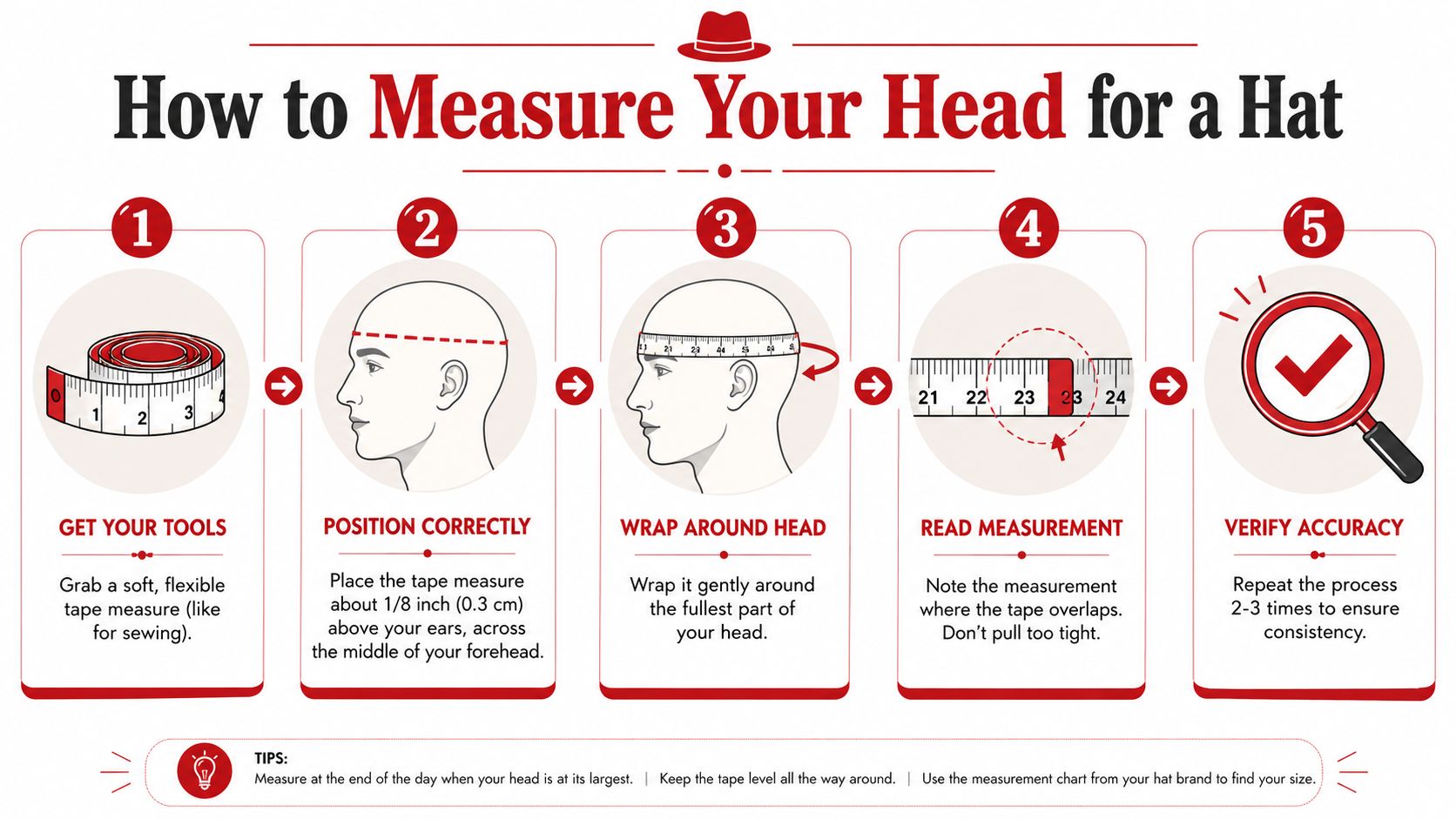
The clean way to measure
Use a soft sewing tape if you have one. If you don't, use a string and then measure the string against a ruler.
Follow this process:
Start where the hat sits
Place the tape around your head above the eyebrows and above the ears, not across the top of the forehead and not low over the ears.Keep the tape level
If the tape angles up in the back or dips in front, the number won't reflect how the hat will fit.Pull snug, not tight
You're not measuring for compression. The tape should touch the head comfortably without digging in.Read the number in centimeters if possible
Centimeters make it easier to compare precise measurements across brand charts.Measure again
Take the measurement at least one more time. If the numbers don't match, do it again until they do.
A quick walkthrough can help if you're measuring a whole group and need everyone following the same method.
The mistakes that throw orders off
Most bad measurements come from small errors, not big ones. That's why hat orders get messy fast.
Watch for these:
- Measuring too high: This usually gives a smaller number and leads to tight hats.
- Pulling the tape hard: People do this without realizing it. Then they order a cap that feels fine for ten seconds and uncomfortable after an hour.
- Measuring over bulky hair styles: Measure how the hat will be worn.
- Using alpha sizes too early: Don't jump straight to “I'm usually a large.” Get the circumference first.
Borderline measurements should be treated as fit-risk orders, not exact matches.
That's especially true in bulk buying. If someone lands right between sizes, don't force certainty where there isn't any. Mark that person for follow-up, especially if you're ordering a fitted or structured style.
The Ultimate Hat Sizing and Conversion Chart
A common desire is for one chart that solves everything. In practice, the chart is only useful if you understand what it's converting.
Hat sizing is built on circumference, then translated across systems. Bullard reports that the average men's size is 7 3/8 U.S., equal to 58 cm in European sizing and 7 1/8 UK sizing, while the average women's size is 7 1/4 U.S.. Bullard also notes that head sizes can differ by country, and Lock & Co. describes common size ranges of 6.5 to 8 in imperial sizing and 53 to 65 cm in European sizing. Baruch College's chart maps actual measurements, including 22 5/8 inches = 7 1/4 = 58 cm and 23 inches = 7 3/8 = 59 cm, with the chart running from 6 5/8 (53 cm) up to 8 (64 cm) in practical adult sizing ranges, as summarized in Bullard's hat sizing overview.
Hat size conversion chart for adults
| Inches | Centimeters (cm) | US Fitted Size | UK Fitted Size | Alpha Size |
|---|---|---|---|---|
| 20 7/8 | 53 | 6 5/8 | 6 3/8 | XS |
| 21 1/4 | 54 | 6 3/4 | 6 1/2 | XS |
| 21 5/8 | 55 | 6 7/8 | 6 5/8 | S |
| 22 | 56 | 7 | 6 3/4 | S |
| 22 3/8 | 57 | 7 1/8 | 6 7/8 | M |
| 22 5/8 | 58 | 7 1/4 | 7 | M |
| 23 | 59 | 7 3/8 | 7 1/8 | L |
| 23 1/2 | 60 | 7 1/2 | 7 1/4 | L |
| 23 7/8 | 61 | 7 5/8 | 7 3/8 | XL |
| 24 1/4 | 62 | 7 3/4 | 7 1/2 | XL |
| 24 5/8 | 63 | 7 7/8 | 7 5/8 | XXL |
| 25 | 64 | 8 | 7 3/4 | XXL |
How to use the chart without overthinking it
Start with your circumference. Don't start with the brand tag, don't start with your shirt size, and don't start with what you wore in one cap five years ago.
If someone measures 22 5/8 inches, that converts to 58 cm and lines up with 7 1/4 U.S. in the chart above. If someone measures 23 inches, that lines up with 59 cm and 7 3/8 U.S.. Those steps are tight, which is why small measuring mistakes create real fit problems.
Here's the practical reading order:
- First find the head measurement
- Then find the fitted size
- Then check whether the hat style uses fitted, alpha, or adjustable sizing
- Then confirm the brand's own chart before ordering
If you're buying stretch-fit styles, brand-specific charts matter even more because alpha sizing isn't perfectly consistent from one cap line to another. A brand-level reference like the Flexfit hat size chart is useful when you're narrowing down stretch-fit options for a group order.
The chart gives you the language of hat sizing. The style decides how strict that language needs to be.
That's the part shoppers often miss. A fitted cap treats the chart like a hard boundary. An adjustable cap treats it more like a fit zone.
Matching Hat Style to a Perfect Fit
Two hats can share the same listed size and still feel completely different on the head. That's normal.
This is the blind spot in most hat sizing chart pages. As noted in Entripy's guide to how hat sizing works, many charts explain how to measure but don't answer the harder question of what size to choose when a measurement falls between sizes or when the hat style fits differently. Some guides suggest sizing up when you're between sizes, but that advice is inconsistent and often depends on the specific style.
This comparison helps buyers think like a decorator or headwear buyer instead of just a shopper.
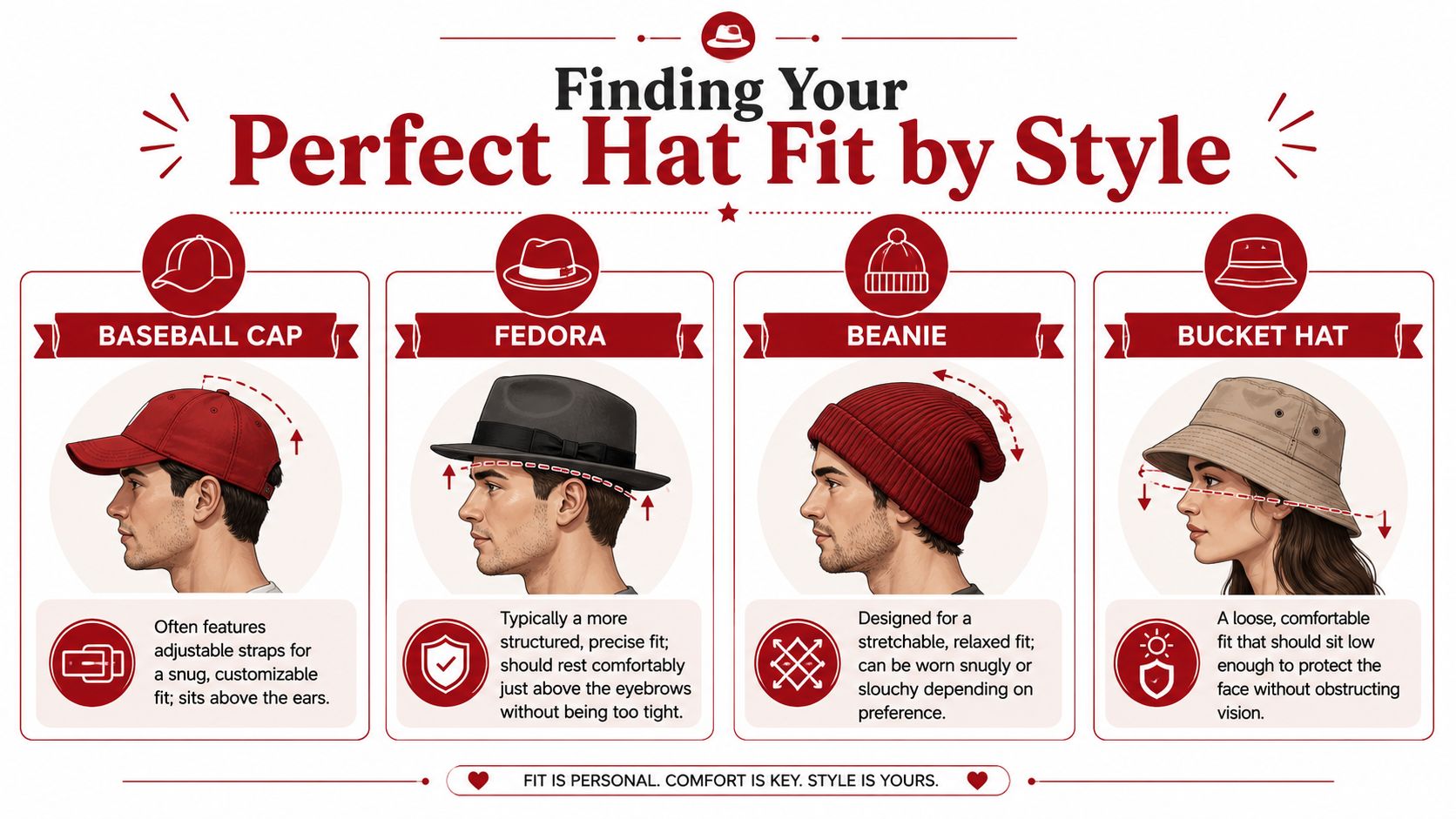
Structured fitted caps
A structured fitted cap has the least forgiveness. If you're ordering something in the mold of a true fitted profile, the size has to be close and the head shape has to cooperate.
These caps hold their shape, which is part of why embroidery looks so good on them. But that same structure makes sizing mistakes more obvious. If the wearer is between sizes, this is usually the style where they feel it first.
Good fit signs:
- The band sits evenly
- No pressure at the temples
- The crown doesn't pop upward
- The hat stays in place without leaving a deep mark
Stretch-fit and Flexfit-style caps
Stretch-fit caps are more forgiving, but not magic. They help when you need a cleaner look than a snapback and more flexibility than a true fitted cap.
Buyers can get lazy, and that creates its own problems. A stretch band can handle some variation, but if the cap is already at the edge of its range, the wearer will notice. It may feel fine at first and become fatiguing later in the day.
For a closer look at crown shape, depth, and profile differences that affect comfort, this hat profiles and fits guide is a useful reference.
Adjustable snapbacks, strapbacks, and truckers
These are the easiest hats to order for mixed groups. They're forgiving, easy to hand out, and usually the safest choice for events, promotions, and broad staff distributions.
That doesn't mean every adjustable hat fits everybody equally well. The closure handles circumference. It does not fix crown depth, front-panel stiffness, or how the hat sits on different head shapes.
A few practical notes:
- Snapbacks work well for broad adult groups
- Strapbacks often feel more casual and less rigid
- Trucker caps add ventilation but can sit taller because of the foam or mesh build
- Shallow crowns can bother larger or rounder head shapes even if the strap closes fine
If the order is for a mixed crowd and nobody has measured, adjustable styles are usually the safest starting point.
Beanies and soft casual styles
Beanies follow a different logic. Stretch matters more than exact circumference, and personal preference matters more than strict fit.
Some people want a snug cuffed fit. Others want slouch. The challenge in custom orders isn't usually circumference alone. It's choosing the beanie shape and knit feel that matches how the group wears them.
Bucket hats and unstructured casual hats also sit differently from baseball caps. They don't grip the head the same way, so buyers often prefer a bit more room rather than a precision fit.
A Guide to Kids and Youth Hat Sizing
Ordering youth hats is where adult assumptions usually break down. Parents guess. Coaches estimate by age. Schools try to keep ordering simple. Then one child swims in the hat while another can barely pull it on.
A better approach is to separate youth sizing from adult sizing from the start. Measure when you can. Use age as a rough guide only when you have no other option.

Keep youth orders simple
Kids' hats are often sold by age band, adjustable range, or youth alpha size. The problem is that age doesn't tell you much about head shape or preferred fit.
For schools, rec leagues, and camps, adjustable youth caps are usually the easiest route. For travel ball, retail merch, or decorated team kits where presentation matters more, youth fitted or youth flex styles may make sense, but only if measurements are collected cleanly.
A simple planning chart looks like this:
| Age Group | Head Circumference | Recommended Youth Size |
|---|---|---|
| Infant | Measure individually | Infant |
| Toddler | Measure individually | Toddler |
| Young child | Measure individually | Youth S/M |
| Older child | Measure individually | Youth M/L |
| Pre-teen | Measure individually | Youth L/XL or Adult Small |
Where youth orders usually go off track
The biggest issue is the transition point. Some older kids fit youth large comfortably. Others are already better in an adult small, especially in adjustable or lower-profile styles.
Use this logic when ordering for a group:
- For very young kids: Stick with age-specific youth styles from the brand.
- For elementary groups: Adjustable youth caps reduce exchange headaches.
- For middle school and up: Expect overlap with smaller adult sizes.
- For mixed-age programs: Don't force one cap across every age if appearance and comfort matter.
Youth orders also need extra attention on decoration size. A logo that looks balanced on an adult 6-panel cap can feel oversized on a youth crown. Fit and decoration have to be planned together.
Fixing Common Hat Sizing Issues
Even when the measurement is right, the fit can still be off. That's not always a chart problem. Often it's a combination of head shape, crown depth, sweatband feel, and fabric behavior.
The goal isn't perfect theory. It's getting a wearable result.
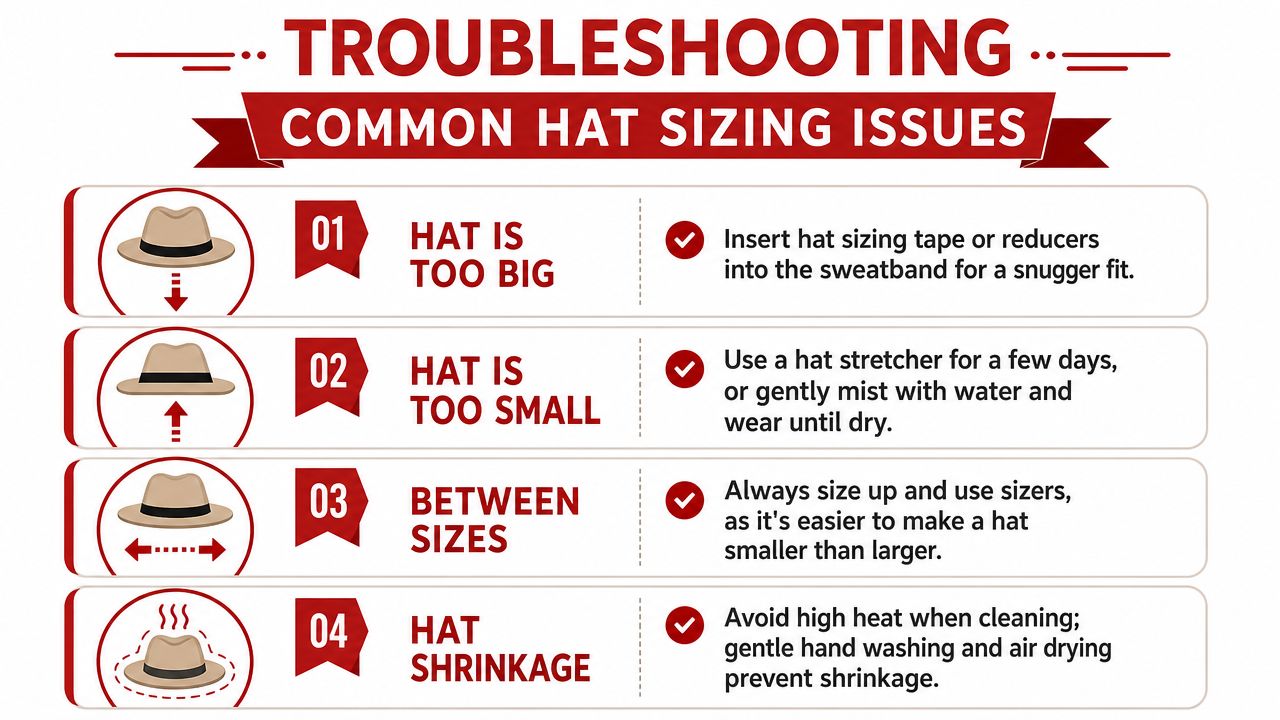
When the hat feels too big
This is the easier problem to solve.
If the hat is slightly loose, use sizing tape or fit reducers inside the sweatband. Place them where the looseness shows up, often at the back or sides, instead of stuffing padding all the way around and changing the feel of the whole band.
Try this first:
- Adjustable cap: Tighten the closure and test the position before adding anything else.
- Fitted cap: Add thin sizing strips under the sweatband.
- Bucket or casual hat: Check whether the issue is true circumference or just a style that sits lower and looser.
When the hat feels too small
A hat that is slightly snug may relax, depending on the material and build. A hat that is clearly too small usually won't become a great fit through wishful thinking.
If it's only a little tight, a hat stretcher can help. Some wearers also lightly mist the band area and wear the hat until it settles, but that should be done carefully because not all materials react the same way. Avoid aggressive heat.
When someone is between sizes
At this point, most group orders need real judgment.
For fitted hats, sizing up is usually safer because it's easier to fine-tune a slightly roomy fit than to rescue a cap that pinches. For adjustable hats, stay within the intended range and focus on crown shape and closure position instead of chasing the next size category.
A hat that's a touch roomy can usually be corrected. A hat that causes pressure points usually won't get worn.
When the pressure is only in one spot
If the hat is tight at the temples but loose elsewhere, head shape is likely the issue. Some people are more oval front to back. Others are rounder. The same circumference can fit very differently depending on the crown design.
That's why a pure chart answer sometimes fails. If one employee says every cap in a certain brand feels wrong while another brand feels perfect at the same size, believe them. They're not being picky. They're reacting to shape.
Smart Sizing for Custom and Bulk Hat Orders
Bulk orders need a sizing plan, not just a chart. The bigger the group, the more important it is to decide whether you want precision, flexibility, or a mix of both.
One practical gap in the market is larger and less-common sizing. As noted in Sungrubbies' hat sizing article, many consumer guides focus on mainstream adult sizes, while only some charts extend into larger ranges such as 63 to 67 cm or 8 to 8 3/8. That matters for inclusive sizing and for wholesale buyers trying to build broader size runs.
What works for group orders
For most staff, promo, and event orders, adjustable styles reduce risk. For retail programs, premium merch, and teams that want a cleaner silhouette, stretch-fit or fitted styles may be worth the extra planning.
A practical ordering process looks like this:
- Collect real measurements when fit matters: If the hats are part of a uniform, a merch drop, or a decorated retail item, ask each person for head circumference.
- Flag in-between measurements: Don't bury those names in the spreadsheet. They're the people most likely to need style-specific decisions.
- Ask for sample sizing when the order is substantial: A sample size run often saves more trouble than it creates.
- Plan for larger sizes on purpose: Don't assume every adult group centers neatly in the middle.
- Choose the style before the size spread: Sizing logic changes once you move from snapbacks to fitted or from low-profile dad hats to taller truckers.
If you need a practical reference built around wholesale purchasing, the blank hat size guide for bulk buyers is one useful checkpoint while planning a mixed order.
For custom embroidery work, one smart move is limiting the number of fit variables at once. If the logo is detailed and the delivery date is tight, don't also gamble on an unfamiliar fitted style for a group that hasn't measured.
If you're sourcing blank hats or planning a decorated order, Dirt Cheap Headwear offers wholesale headwear, brand-name styles, and in-house embroidery for small runs and larger bulk orders. It's a practical option when you need to compare hat styles, review size-related fit considerations before decorating, and keep the buying process in one place.
Pingback: Ultimate Hat Fit Guide: Find Your Perfect Size | Dirt Cheap Headwear
Pingback: Youth Camo Hats Buying Guide for Fit and Style | Dirt Cheap Headwear