
Wholesale Knit Beanies: A Buyer’s Guide to Styles, Sourcing
You've got a winter order sitting on your desk, and the deadline is closer than you'd like to admit. Maybe it's a small brand preparing its first fifty shipments, a coach outfitting a team, or a nonprofit distributing warm gear at a seasonal event. The catalog makes the decision look easy. Pick a color, add a logo, enter a quantity.
That approach is how buyers end up with beanies that fit unevenly, distort under embroidery, or leave behind expensive colors nobody wants. Wholesale knit beanies are an inventory and decoration decision, not just a style purchase. The right result depends on four connected choices: silhouette, yarn and knit construction, decoration method, and order size.
Why Wholesale Knit Beanies Deserve a Real Sourcing Plan
A beanie sits close to the face, so wearers notice its hand feel, stretch, weight, and logo placement immediately. A weak blank can make a good brand look careless. A well-selected blank can work as team gear, retail merchandise, staff apparel, or a practical event item without needing a complicated design.
The market context supports treating the category seriously. The global headwear market was estimated at $37.0 billion in 2025, with a projection of $39.4 billion in 2026 and $62.8 billion by 2033, representing a projected 6.9% compound annual growth rate from 2026 through 2033, according to Grand View Research's headwear market analysis. That estimate covers headwear broadly, not wholesale beanies alone, but it shows that beanies compete inside a mature supply chain serving fashion, outdoor, sports, uniforms, promotional apparel, and branded merchandise.
The four decisions that control the order
- Style: A cuffed beanie behaves differently from a slouch or pom-pom style in fit, logo placement, and perceived value.
- Construction: Fiber percentages don't tell you everything. Knit density, thickness, loop structure, and lining affect warmth and breathability.
- Decoration: A small embroidered mark, woven label, and leather patch each suit a different surface and budget.
- Quantity: The lowest unit price can become the highest program cost if the fit is wrong or the color won't reorder.
U.S. customs data also shows why supplier reliability matters. Imports under HS heading 6505, a category that includes knitted or crocheted hats, beanies, caps, and other textile headgear, were valued at approximately $2.16 billion in 2025, representing 71.7% of U.S. Chapter 65 headgear imports, according to the HS 6505 industry overview. That category is broader than beanies, but the scale indicates that buyers have access to established sourcing networks and recurring blank inventory.
Account-manager advice: Don't ask only, “What's your cheapest beanie?” Ask, “Which construction, decoration method, and reorder path will keep this program usable after the first shipment?”
A consistent visual identity matters after the order leaves your warehouse too. If customers, staff, or teams will feature the beanies in short-form video, a resource on consistent video branding tips can help keep colors, logo treatment, and presentation aligned across the campaign. Source the product with that same consistency in mind.
Beanie Styles That Actually Move in Wholesale
The four styles below cover most practical wholesale programs. Don't stock every silhouette just because a supplier offers it. Match the shape to the wearer, the decoration, and the way the product will be sold.
Cuffed beanies are the workhorse
A cuffed knit beanie gives you a stable band for a logo and a familiar winter profile. It works especially well for teams, employee programs, school groups, and promotional orders because the folded cuff creates a defined decoration zone and gives the hat a structured appearance.
The cuff can hide part of a logo if the decoration is placed too low, so approve the actual decorated sample rather than a flat digital mockup. A smaller mark placed centrally usually looks cleaner than trying to fill the whole band.
Slouch beanies sell a more fashion-led look
Slouch styles have extra fabric at the crown and often appeal to lifestyle retailers, creative brands, and casual merchandise programs. They can flatter a broader range of head shapes, but the relaxed volume makes logo placement less predictable.
A large embroidered design may curve or shift as the crown collapses. For slouch blanks, use a compact mark, a label, or a patch that can sit naturally without forcing the fabric into a rigid shape.
Pom-pom styles pull toward gifts and youth programs
Pom-pom beanies communicate playfulness and seasonal appeal before the buyer sees the logo. They fit youth groups, holiday merchandise, winter drives, and gift-oriented retail better than most corporate uniform programs.
Check the pom attachment carefully. It should be secure, proportionate to the crown, and consistent across the order. A pom-pom also adds visual height, so confirm that the packed product still suits your shipping cartons and display fixtures.
Fleece-lined styles serve utility buyers
Fleece lining is the practical choice when warmth and comfort matter more than a lightweight fashion profile. Outdoor crews, winter event staff, and cold-weather work programs should consider it, but they must test the lining against the expected head size and decoration area.
A thick lining can change the way the knit stretches and can make a one-size claim less reliable. Treat “one size fits most” as a question to test, not a reason to skip sampling. For a wider category view and bulk purchasing options, review beanie hats in bulk.
| Style | Best For | Decoration Fit | Typical Price Band |
|---|---|---|---|
| Cuffed | Teams, uniforms, promotions | Strong for small embroidery and patches | Entry to mid |
| Slouch | Lifestyle retail and fashion merchandise | Best with compact marks or labels | Mid |
| Pom-pom | Youth programs, gifts, winter events | Works with simple embroidery or patches | Entry to mid |
| Fleece-lined | Outdoor work and cold-weather utility | Check lining and stretch before decorating | Mid to premium |
Don't treat the table as a substitute for a sample. The same style name can hide major differences in cuff depth, knit density, crown length, and recovery.
Yarn and Knit Construction Choices That Matter
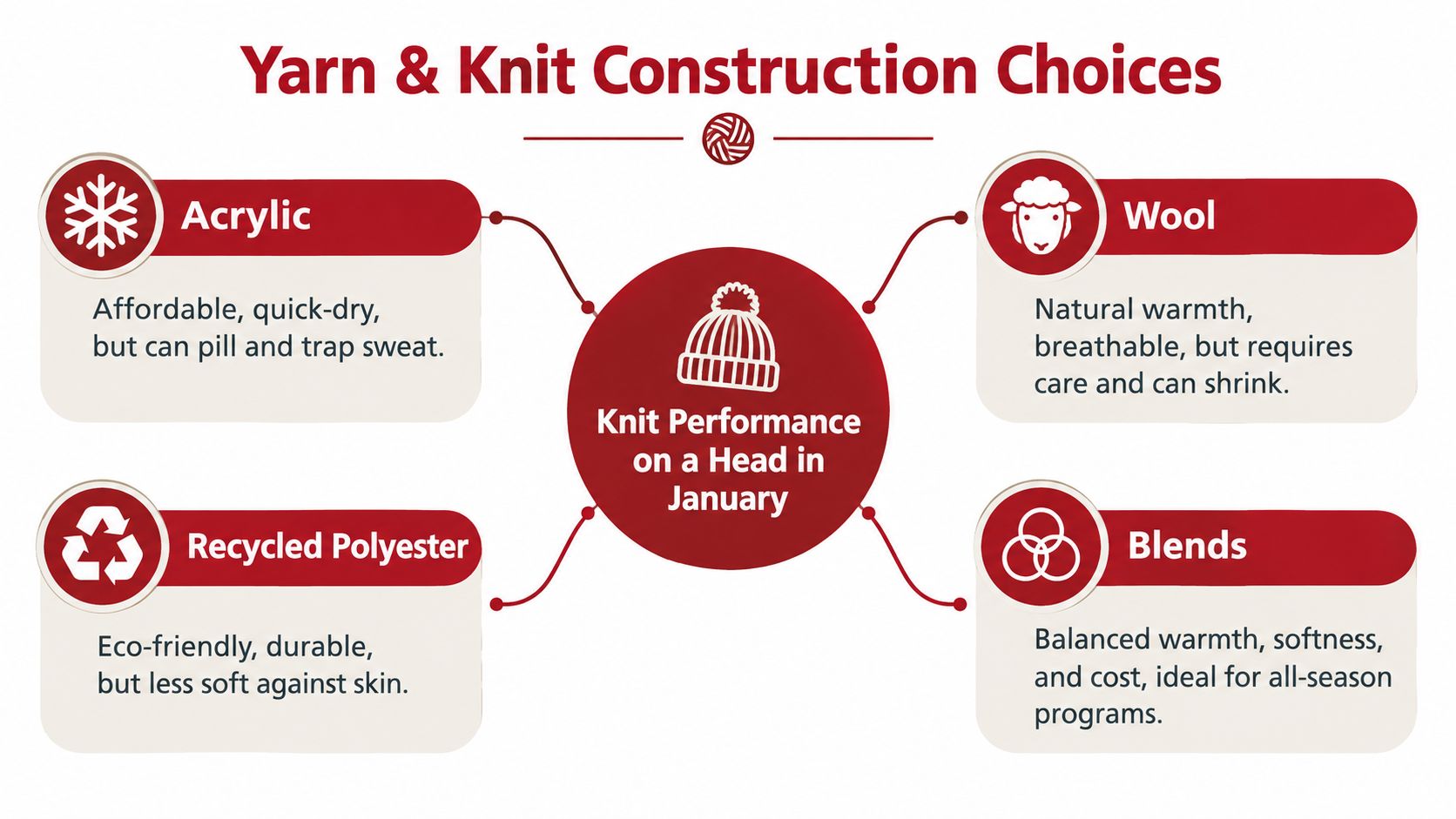
Acrylic is popular because it's affordable, easy to source, and straightforward to color-match. It can work well for team orders and promotional programs, but some acrylic knits can pill or hold sweat. Wool offers natural warmth and breathability, yet it may require more careful laundering and can shrink if the care process is wrong. Recycled polyester can provide durability and a sustainability story, but you still need to verify the material claim and assess the hand feel.
Blends often make the most practical compromise. A blend can balance warmth, softness, recovery, and cost, but the label alone won't tell you how the finished beanie performs. Compare the actual fabric, not just the fiber percentages.
Construction changes the wearing experience
Thermal performance depends on yarn linear density, fabric mass, thickness, hairiness, and loop structure. Still air trapped inside the knit helps insulation because air conducts heat less readily than textile fibers. A denser or double-layer beanie can retain more warmth, but increasing thickness generally reduces air permeability and breathability, creating a trade-off documented in research on textile thermal resistance and air permeability.
A 2×2 rib construction is a strong default for many wholesale programs. Research on acrylic winter fabrics identifies it as a favorable balance of thermoregulation, breathability, and comfort, while its stretch and recovery can support a broader one-size program, as discussed in the study of acrylic fabric structures. For a wool-focused assortment, compare available wool knit beanies by lining, gauge, care instructions, and decoration area rather than fiber name alone.
Ask the supplier these questions
- What is the knit construction, such as 2×2 rib, single jersey, waffle, or double-layer?
- What are the finished measurements before stretching?
- How does the cuff recover after laundering?
- What are the thickness, lining, and care instructions?
- Can the supplier provide a physical sample in the final color?
- Which decoration method has been tested on this exact blank?
A supplier who can answer those questions gives you useful buying information. A supplier who sends only a fiber percentage and a product photo hasn't given you enough to compare two beanies.
MOQs, Pricing Tiers, and Lead Times Without the Runaround
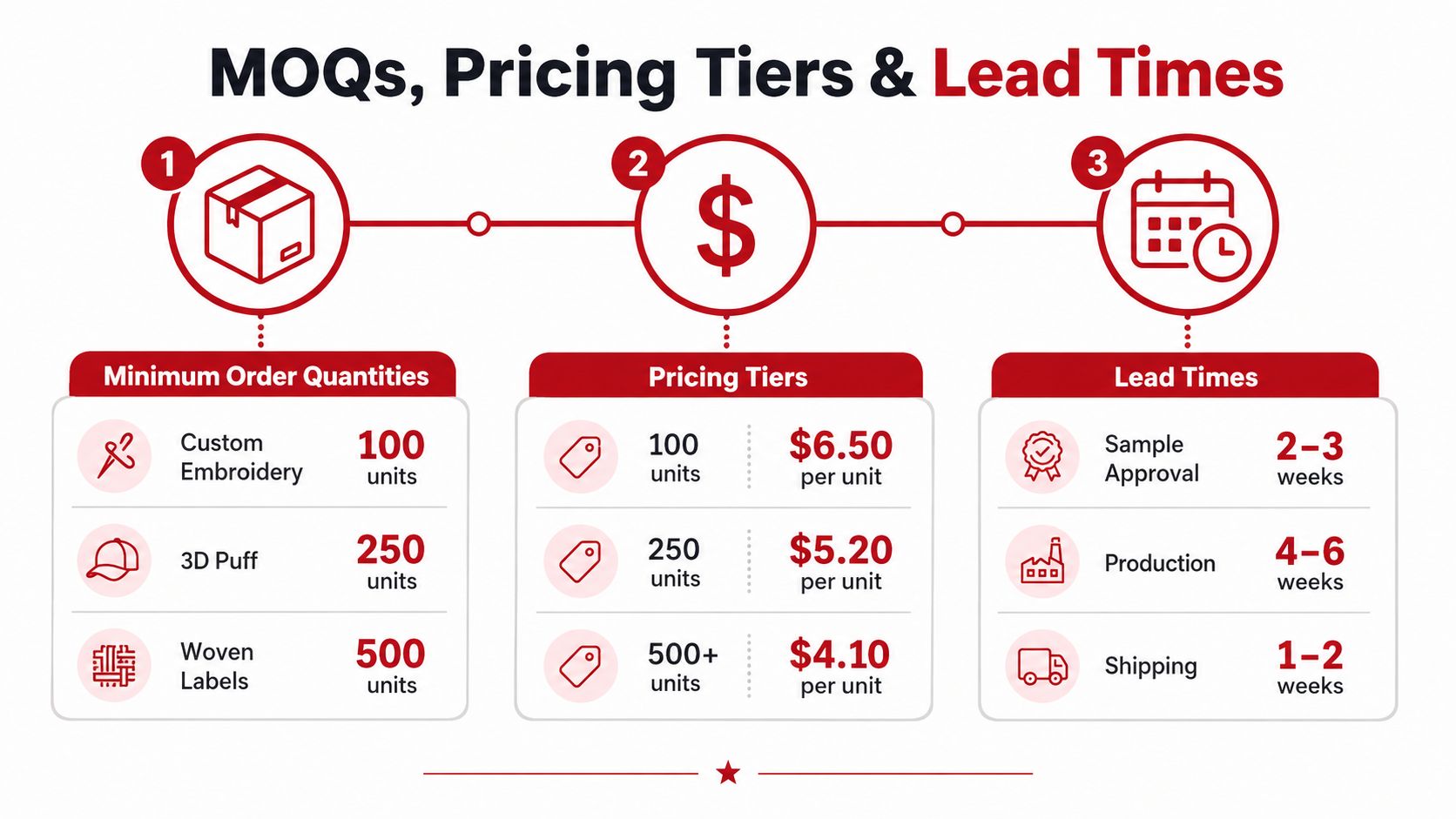
Price breaks matter, but they only matter after you know what quantity you can sell or distribute. A blank order may qualify for a better unit price at higher volume, while decoration introduces its own minimums, setup requirements, and production queue. Ask for the complete landed quote, not just the blank price.
Some wholesale programs use volume thresholds such as 24, 72, and 144 units, but those breaks vary by supplier and style. Treat them as quote points to request, not universal industry rules. A decorated order may follow a different schedule from a blank order, especially when embroidery, patches, labels, folding, and packaging are handled separately.
Build the quote around your ship-by date
Start with the date the beanies must arrive, then work backward through decoration approval, blank availability, production, quality control, and freight. Winter demand can tighten inventory and production schedules, so a supplier's normal lead time may not apply during your busiest season.
Your quote request should show:
- Blank quantity: Separate confirmed demand from speculative stock.
- Decoration quantity: State whether every beanie gets the same logo or whether colors and marks differ.
- Proof requirement: Request a digital proof and, for important programs, a physical decorated sample.
- Freight terms: Ask how the shipment will be packed and whether partial delivery is possible.
- Reorder timing: Confirm whether the blank and color can be replenished consistently.
A low-minimum embroidery program can help you test a design without committing to a large decorated run. For example, Dirt Cheap Headwear states that its in-house embroidery can start at six pieces per logo, according to the publisher information provided for its custom service. That kind of low minimum is useful for a pilot, but it doesn't remove the need to verify stock and decoration quality.
Use this video as a visual reference for how a custom headwear program may move from design approval into production:
Never approve rush work based on a verbal promise alone. Get the revised production date, shipping method, added charge, and responsibility for delays in writing.
Decoration Methods and How They Behave on Knit
Decoration fails when buyers choose the logo method before considering the fabric. Knit stretches, compresses, and changes shape as it moves over a head. The best decoration is the one that respects that movement.
Direct embroidery
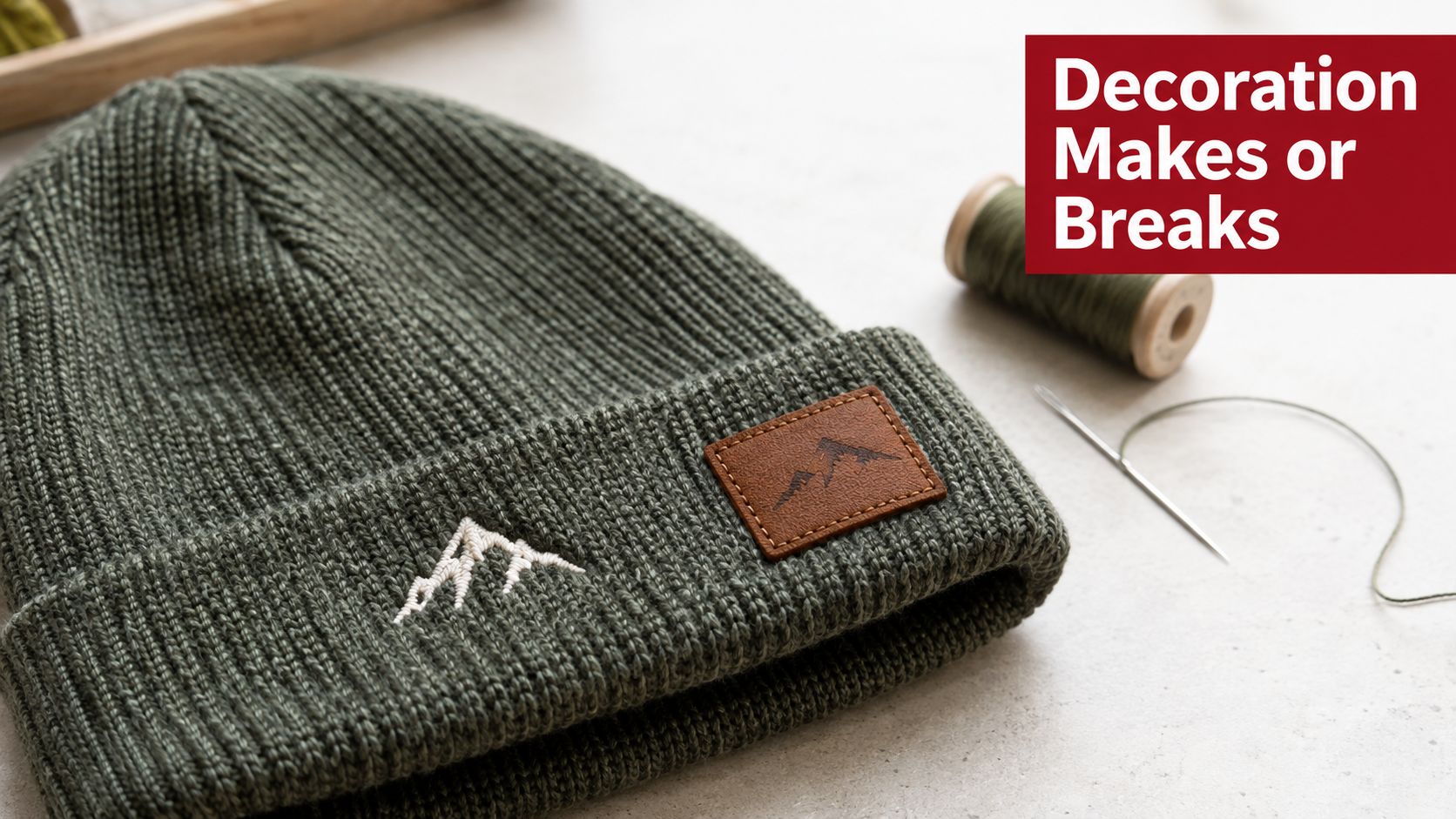
Flat embroidery gives a classic branded finish and works best when the logo is compact, bold, and placed on a stable cuff or smooth knit area. On elastic rib, oversized or densely filled artwork can distort the fabric, reduce stretch, and create puckering.
Use a smaller stitch field, appropriate backing, and simplified artwork. Tiny lettering and fine details often lose clarity once translated into thread, especially on a textured surface.
3D puff embroidery
Puff embroidery adds height and a more pronounced streetwear look. It needs clean, uncomplicated artwork because the foam layer reduces tolerance for fine lines and tightly packed details. It also creates a heavier, more rigid decoration area, so test it on the actual knit before approving a large run.
Woven labels and leather patches
Patches create a stable decoration surface that protects detailed artwork from the movement of the knit. Woven labels suit text, fine lines, and small logos. Leather or faux-leather patches offer a premium, tactile appearance and can work particularly well on waffle or ribbed constructions where direct stitching would follow the texture unevenly.
The trade-off is attachment. A patch must be securely sewn or otherwise fixed, and its edges should remain comfortable against the wearer. Ask how the patch will be attached and whether the finished product can be laundered without curling.
Printed transfers
Transfers can reproduce color and artwork differently from embroidery, making them useful for particular promotional or retail designs. They need a surface and application process compatible with the knit's stretch, and you should test cracking, peeling, and wash durability before scaling.
Practical rule: If the beanie stretches substantially in the decoration zone, choose a compact stitch design or a flexible patch before you choose a larger embroidered field.
For a broader look at service options and embroidered beanie applications, review beanie embroidery. Then request a sample decorated with the final artwork, thread colors, backing, and placement. A digital proof can't show puckering or lost stretch.
Use Cases That Drive Different Buying Decisions
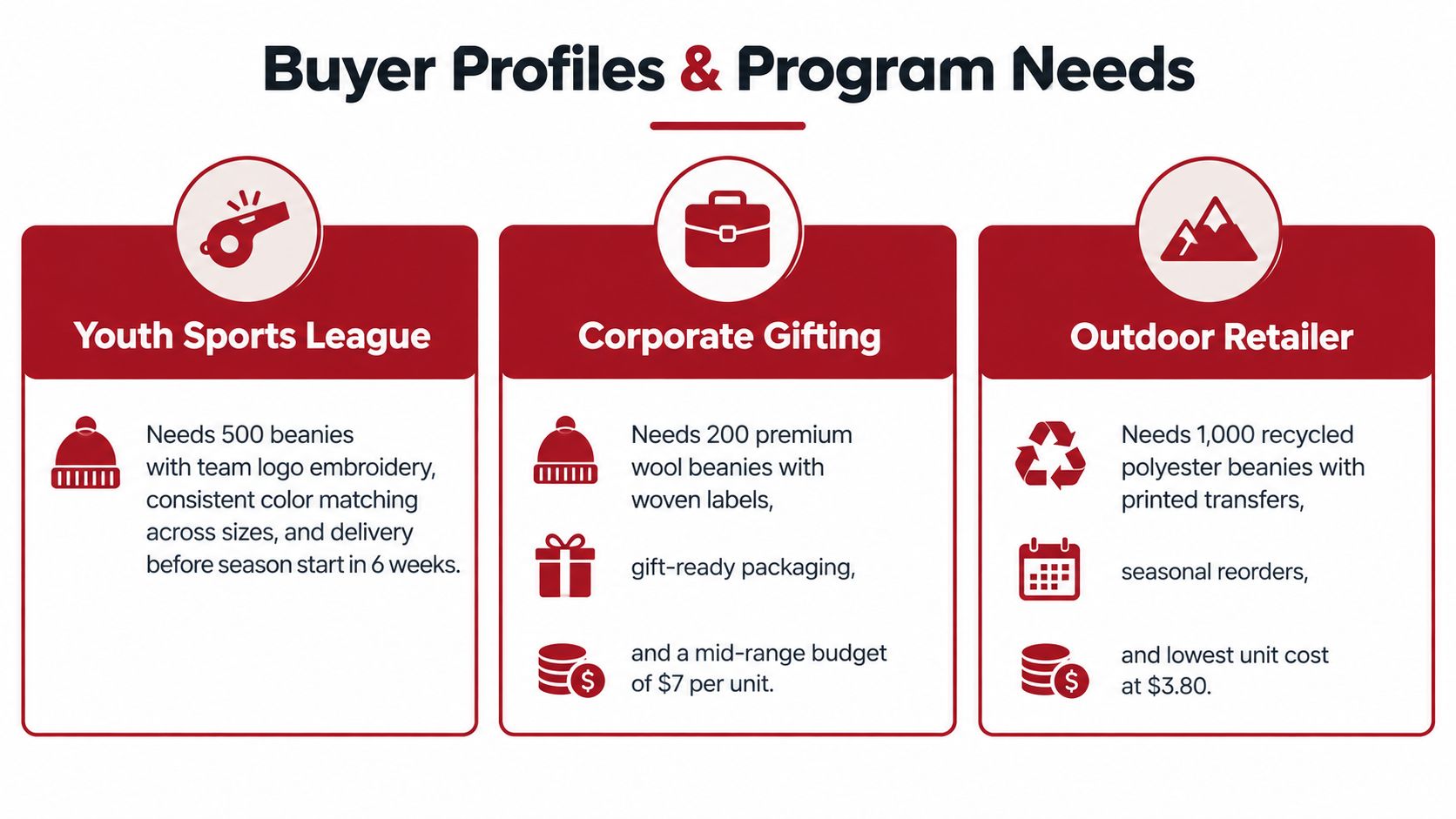
The same blank can solve three very different buying problems. A team needs consistency. A retailer needs sell-through and visual variety. A nonprofit needs practical warmth and simple distribution.
The youth sports league
A league ordering for players and families should start with fit consistency and decoration durability. A cuffed 2×2 rib beanie usually gives the logo a predictable band and enough stretch to accommodate a mixed group, but the league should still test the smallest and largest expected wearers.
Ask for the same color lot where possible, approve one decorated sample, and confirm how the logo holds after repeated laundering. Avoid placing a large logo across the crown if players will wear the beanies under helmets or other equipment.
The boutique retailer
A boutique buyer should think in color stories, texture, and reorderability. A slouch silhouette can support a fashion-led assortment, while waffle or ribbed textures create differentiation without requiring a complex graphic.
Don't open with a deep buy across every available color. Choose a focused palette that fits the store, then identify which colors the supplier can replenish consistently. Retail customers judge the hand feel and finish before they judge the decoration, so sample unbranded blanks as well as finished pieces.
The nonprofit winter drive
A nonprofit needs warmth, easy handling, and predictable distribution. Dense double-layer or fleece-lined constructions may suit colder conditions, but they can be less forgiving on fit and packing. Confirm the size range in practice, especially if volunteers will hand out the beanies without a fitting process.
Prioritize a small number of practical colors, clear labeling, and simple decoration. A compact patch or one-color mark may be easier to inspect and distribute than a large design with multiple thread or print variables.
Buying decision: Choose the program first, then the blank. A retail beanie that looks distinctive may be the wrong choice for a uniform order, while a dependable team style may feel too plain for a fashion assortment.
Ordering Tips That Save Money Without Cheapening the Hat
The usual advice is to order as much as possible for the lowest unit price. That only works when demand, fit, color preference, and decoration are already proven. For a first order, a sample is an inventory-control tool, not an avoidable expense.
Fit-test the actual blank on more than one wearer. Check the cuff recovery, crown length, pressure around the head, and behavior after laundering. If the product is labeled one-size, test that claim against the target audience rather than trusting the product page.
Then decorate a representative sample. The logo may look perfect on a flat proof and too dense once the rib stretches. A small test can reveal puckering, weak contrast, uncomfortable patch edges, or a logo that disappears under the cuff.
Use a staged order
- Test run: Buy enough to evaluate fit, decoration, packaging, and early demand across the main color options.
- Steady-state reorder: Replenish the proven style and colors after you know what people choose.
- Reorder trigger: Set a stock threshold before inventory becomes urgent, especially for seasonal programs.
A low per-unit price doesn't protect you from dead stock, replacement orders, rush freight, or inconsistent restocking. Fit uncertainty also has a real environmental and financial cost. U.S. e-commerce apparel returns attributed to fit have been estimated to create roughly 168,337 tons of landfill waste and 1,043,481 tons of CO₂ annually, according to Bold Metrics' analysis of sizing and returns.
Plan freight as part of the quote. Consolidating compatible items, avoiding rushed partial shipments, and comparing service levels can support a lower courier costs strategy without cutting product quality.
Ask every supplier: What happens if the color sells faster than expected? Can the same blank be reordered? What is included in the decoration price? Who pays if the approved placement isn't followed? Those answers matter more than a small discount on the first invoice.
Your Wholesale Knit Beanie Buying Checklist
Take this list into your next quote call and don't approve the order until each item has a clear answer.
- Style: Select cuffed, slouch, pom-pom, fleece-lined, or another silhouette based on the program, not the product photo.
- Fit: Measure the actual blank, test multiple head sizes, and check cuff recovery after laundering.
- Construction: Record the knit type, thickness, lining, stretch, and care instructions.
- Yarn: Verify fiber content, hand feel, pilling risk, and whether the material supports your intended use.
- Decoration: Match embroidery, puff, woven label, patch, or transfer to the surface and logo complexity.
- Proof: Approve placement, dimensions, thread or print colors, backing, and a physical sample when the order matters.
- Quantity: Separate confirmed demand from speculative inventory and request every applicable price tier.
- Timing: Work backward from the arrival date, including approval, production, quality control, and freight.
- Reorder: Confirm stock depth, color continuity, reorder timing, and whether the same blank will remain available.
- Sustainability: Request recycled content percentage, certification, source material, and end-of-life information. “Recycled” can refer to bottles rather than discarded textiles, so don't accept generic eco-friendly wording. In 2025, approximately 97% of recycled polyester globally came from plastic bottles, while textile-to-textile recycling across all fibers remained around 1% of total fiber production, according to Texdata's recycled fiber reporting.
A defensible order has a tested fit, an approved decoration, a written schedule, and a realistic reorder plan. Price comes after those controls.
Dirt Cheap Headwear offers wholesale blank knit beanies, including cuffed, pom-pom, and waffle-knit styles, along with in-house embroidery and custom decoration. Visit Dirt Cheap Headwear to compare blanks, request a decorated test run, and build a beanie order around your actual quantity and ship-by date.