
Wholesale Beanies with Pom: Your Complete Sourcing Guide
You've got a winter event on the calendar, a logo ready to use, and a browser full of beanies that look almost identical. Then the questions start: Is the cheaper yarn warm enough? Will the logo fit? Does the minimum apply to the whole order or each color?
Buying wholesale beanies with pom gets easier when you separate the product decision from the decoration and ordering decisions. Start with what people will wear, then build an order you can afford to test, distribute, and replenish.
Why Wholesale Beanies with Pom Are a Smart Buy
A café owner might want matching headwear for staff working an outdoor pickup window. A school organizer might need fundraiser merchandise. An apparel seller might want a winter accessory that fits alongside an existing collection.
Those buyers can start with the same general product, but they shouldn't automatically order the same beanie. The café needs a manageable care routine, the school needs an accessible purchase price, and the apparel seller needs a look customers will choose without being asked to support a cause.
Buy for a job, not just a logo
A pom beanie gives you several visible design choices: the body, cuff, pom, and decoration. Treat those as parts of a coordinated product, rather than opportunities to add every brand color.
For a restrained staff uniform, consider a solid body with a matching pom and a clear cuff logo. For team merchandise, a contrasting pom can carry a secondary color without crowding the decoration area. These are design starting points, not evidence that either version will sell better.
The style also has historical depth. The documented history of pom-decorated headwear connects rounded Scandinavian headwear ornaments, cautiously interpreted archaeological evidence, and later European military and maritime dress. That history doesn't establish that modern knitted pom beanies existed in their current form centuries ago.
Buying principle: Choose a beanie people would want to wear without the logo. Decoration should make a suitable product yours, not rescue an unsuitable blank.
Give the order a clear purpose
Before browsing colors, finish this sentence: These beanies are for people who need…
- Staff uniforms: Define the working conditions and who handles laundering.
- Retail inventory: Decide how the product fits your existing assortment and intended customer.
- Promotional distribution: Establish how recipients will receive and use it.
- Teamwear: Ask whether players, spectators, or both are the intended wearers.
Wholesale purchasing makes sense when you have a credible distribution plan. A lower unit price isn't useful if you're buying colors nobody requested or merchandise with nowhere to go.
Choosing Materials and Fit for Your Beanie Program
A beanie ordered for an outdoor registration desk and one ordered for a heated warehouse can look identical on a product page. Whether each one gets worn comes down to fiber and fit, and neither shows up in a photo.
Specify the use conditions before the fiber. Ask about exposure time, activity level, washing frequency, and whether the beanie has to sit under a hood. Then compare physical samples, since two knits sold under the same fiber name can behave differently.
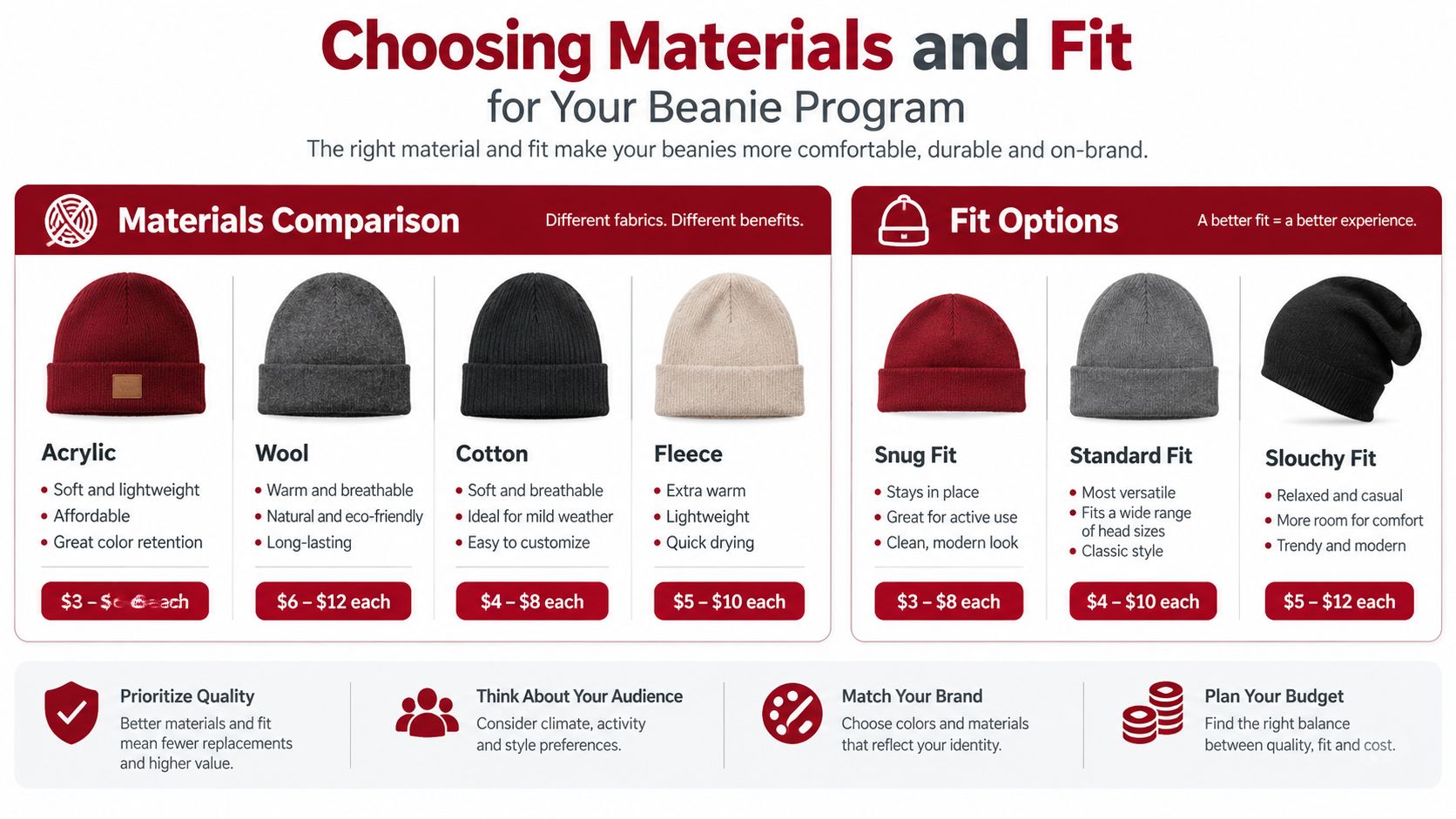
Compare fiber directions on warmth, moisture, and care together
The textile research on thermal resistance and moisture absorption describes the core trade-offs: wool's crimped fibers trap insulating air, cotton absorbs moisture more readily than acrylic, and the wool/cotton blends tested delivered the highest thermal resistance among the constructions examined. Translate that into a buying decision:
| Fiber direction | Strength | Trade-off to check |
|---|---|---|
| Wool and wool-rich blends | Strong insulation from crimped fiber structure | Care label limits; usually priced above acrylic |
| Wool/cotton blends | Highest thermal resistance of the constructions tested | Confirm which fiber touches the skin |
| Acrylic-heavy knits | Lower cost; takes up less moisture than cotton | Feel and warmth vary widely with knit density |
| Cotton-heavy knits | Familiar, easy feel | Absorbs moisture readily, weaker in damp cold |
For a warmth-focused program, put wool knit beanies and wool-rich blends on the sample list. For a cost-sensitive one, compare acrylic-heavy options, and expect performance to vary with knit density and lining. Ask the supplier to break out shell composition, lining composition, knit construction, and care instructions separately, and treat the care label as a purchasing requirement. If the organization needs a particular washing method, disqualify incompatible blanks before artwork approval.
Fit-check the sample on a moving wearer
A cuffed silhouette gives you a defined area to evaluate; a slouch silhouette changes the outline entirely. Judge it on the intended audience rather than a flat product photo.
Put samples on the people who will wear them, doing the work they do. Ask four things: coverage (ears stay covered without constant adjustment), pressure (the cuff stays comfortable through a full shift), proportion (the crown sits cleanly instead of gathering), and compatibility (a usual hood still clears the pom).
Record the preferred cuff fold and photograph the approved sample on a wearer. "Fits well" is too vague to guide a reorder. Note the worn cuff height too, since it sets the usable decoration space on the front and changes every time the fold changes.
Pom Styles and Decoration Placement That Actually Work
Choose the pom and logo placement together. A pom changes the top of the silhouette, while decoration changes how the front looks and feels.
Compare the overall proportions before concentrating on the artwork.
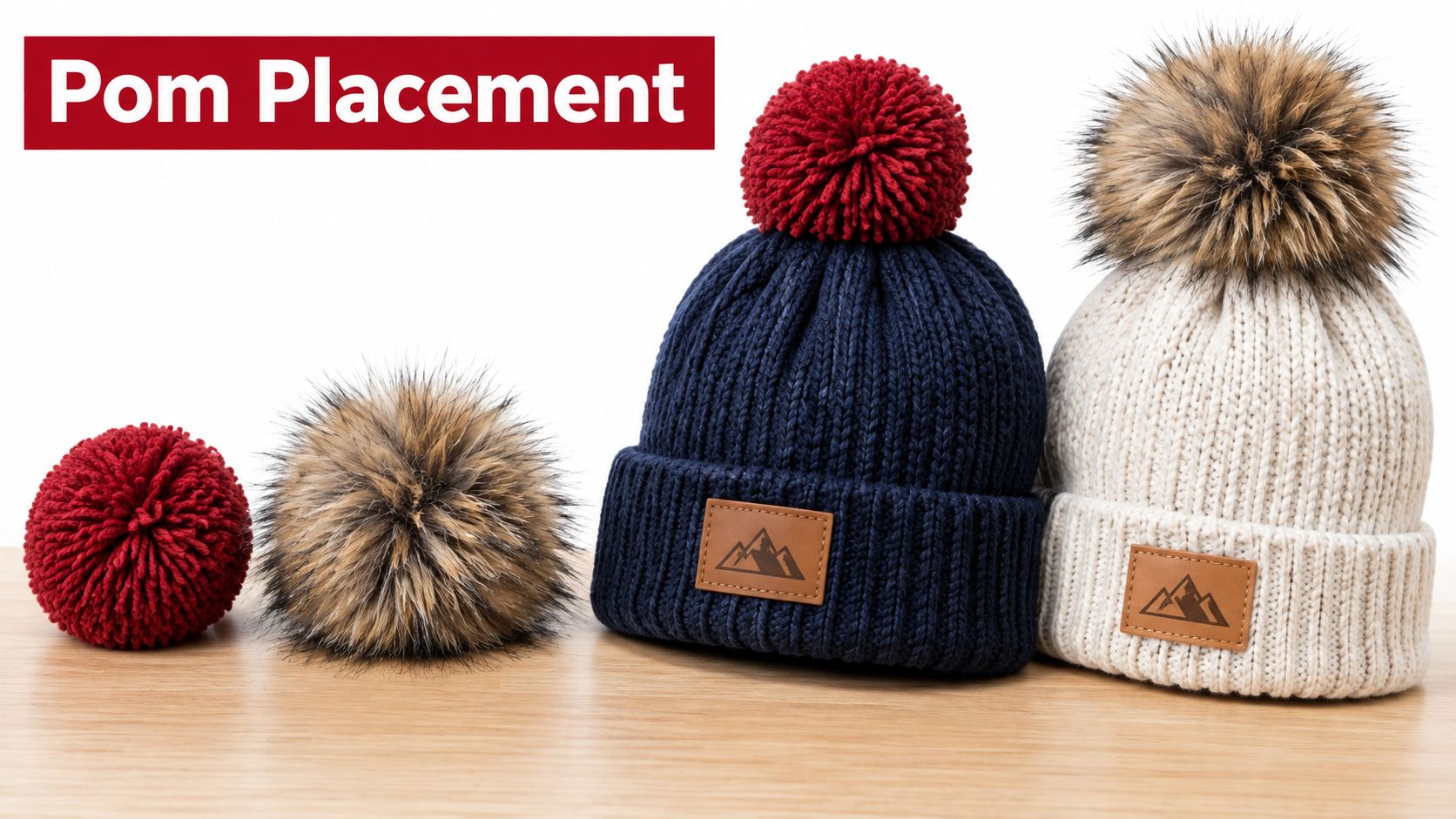
Judge the whole silhouette
A round yarn pom and a faux-fur pom offer different visual directions. Request the actual construction you're considering, then check its size, attachment, and balance on the worn beanie.
Don't approve a pom because it looks full in a close-up. Look at the complete product from the front and side. Ask whether the attachment is permanent or removable and what care instructions apply to the finished item.
Give the logo room to work
A knit beanie isn't a rigid cap panel. The crown curves and stretches, and the pom occupies its upper structural and visual area. Keep detailed artwork away from a placement that only looks flat when the beanie is empty.
A practical starting specification is a compact mark, simplified shapes, limited thread colors, and lettering proportionate to the knit. Oversized embroidery, dense detail, and bulky backing are approval risks to inspect, not problems to assume a digital proof has solved.
The textile study on fabric density, thermal resistance, and moisture transmission%20410-414.pdf) establishes a related construction trade-off: greater fabric density increased thermal resistance while reducing moisture-vapor transmission. That finding concerns fabric performance, not a guarantee that a heavier blank will embroider better.
Discuss beanie embroidery options with the decorator using the exact blank and artwork. Reserve three-dimensional puff embroidery for bold, low-detail marks, and compare it against standard embroidery or a sewn patch rather than choosing raised stitching by default.
Watch the video alongside your sample review, but use the physical result as your approval reference.
Before production, inspect the decorated sample stretched as worn and after laundering according to its care instructions.
- Readability: Can you recognize the mark without pulling the fabric flat?
- Comfort: Does internal stitching or backing bother the wearer?
- Recovery: Does the decorated area return to an acceptable shape?
- Placement: Is the logo centered on the intended cuff fold?
Approve the decoration on the beanie, not just the artwork on a screen.
Minimum Order Quantities Pricing and Turnaround Explained
Ask what the minimum applies to before comparing quotes. A minimum might concern the blank style, decoration setup, logo, or another order grouping. Get the supplier's interpretation in writing rather than assuming different colors can be combined.
For your first purchase, start with confirmed demand and a replenishment plan. Don't let the next price break determine your inventory level.
Compare complete orders
Request an itemized quote that separates blanks, decoration, setup, samples, shipping, and any applicable destination charges. Then compare suppliers using the same specification and delivery destination.
Ask for custom-headwear minimum order requirements before paying for artwork preparation. If you're considering several designs, find out whether each requires a separate setup or minimum.
Wholesale Beanie Order Planning at a Glance
| Factor | What to Know | Why It Matters |
|---|---|---|
| Minimum order | Confirm how styles, colors, and logos are grouped | Prevents an unexpectedly larger commitment |
| Quantity pricing | Request complete quotes at feasible order sizes | Keeps discounts tied to realistic demand |
| Decoration | Identify setup, application, and sample charges | Makes quotes comparable |
| Blank availability | Verify the chosen style and colors | Separates stocked goods from items awaiting supply |
| Approval | Establish who signs off and what they approve | Prevents avoidable production holds |
| Delivery | Separate production completion from arrival | Helps you plan around the actual event date |
Work backward from arrival
Tell the supplier when the beanies must be in your hands, not merely when you'd like them shipped. Ask which stages depend on payment, stock confirmation, artwork approval, and sample approval.
For an event, build your internal schedule around receiving and inspecting the shipment before distribution. If timing is tight, ask what can change: the blank, color assortment, decoration method, or delivery service.
In-house decoration can be useful when you want a direct conversation about the blank and stitching, but don't treat it as a delivery guarantee. Ask who owns the order, when they're available, and how they communicate problems.
Inventory check: If the extra beanies have no named audience or credible sales plan, the larger order needs more justification than a cheaper unit price.
A manageable first run gives you room to learn. Keep the approved specifications so a successful test can become a controlled reorder rather than a fresh sourcing exercise.
Building a Branded Beanie Program That Lasts
A brewery sells through 200 pom beanies at a winter launch and reorders the same style a year later. The replacement run arrives with a shallower cuff, and the logo that sat centered now rides low on the fold. Nothing about the product name changed. The program failed because nobody recorded what "the same" meant.
A lasting program is a written spec plus the habit of checking it. "Black pom beanie with our logo" leaves the wearer, warmth, care, and approval unresolved. Fiber choice alone changes the answers: acrylic tolerates machine washing, while wool holds more warmth but demands gentler care, and buyers will blame you for a shrunken beanie. Crown geometry matters too, since cuff depth and panel shape decide where embroidery can sit and how tall a logo can run.
Whoever buys for you, weight the spec to the audience. An apparel brand should check that silhouette and color sit naturally beside its existing line. A team should let the people expected to wear the beanie judge its fit. An event organizer should decide early who receives the beanies and who owns the leftovers.
Write the spec once, then enforce it
One page is enough: blank style, color reference, fiber content, care instructions, artwork version, decoration placement, packaging, and arrival date. Name who approves artwork, who reviews the sample, and who inspects the delivery. When anything changes between runs, flag it and get a fresh sign-off.
Keep one approved sample filed with the order record. On every reorder, compare the new product against that reference and ask the supplier to disclose substitutions. Product names get reused across runs; the spec and the sample are what keep a reorder consistent.
End-of-Life Planning for Your Pom Beanies
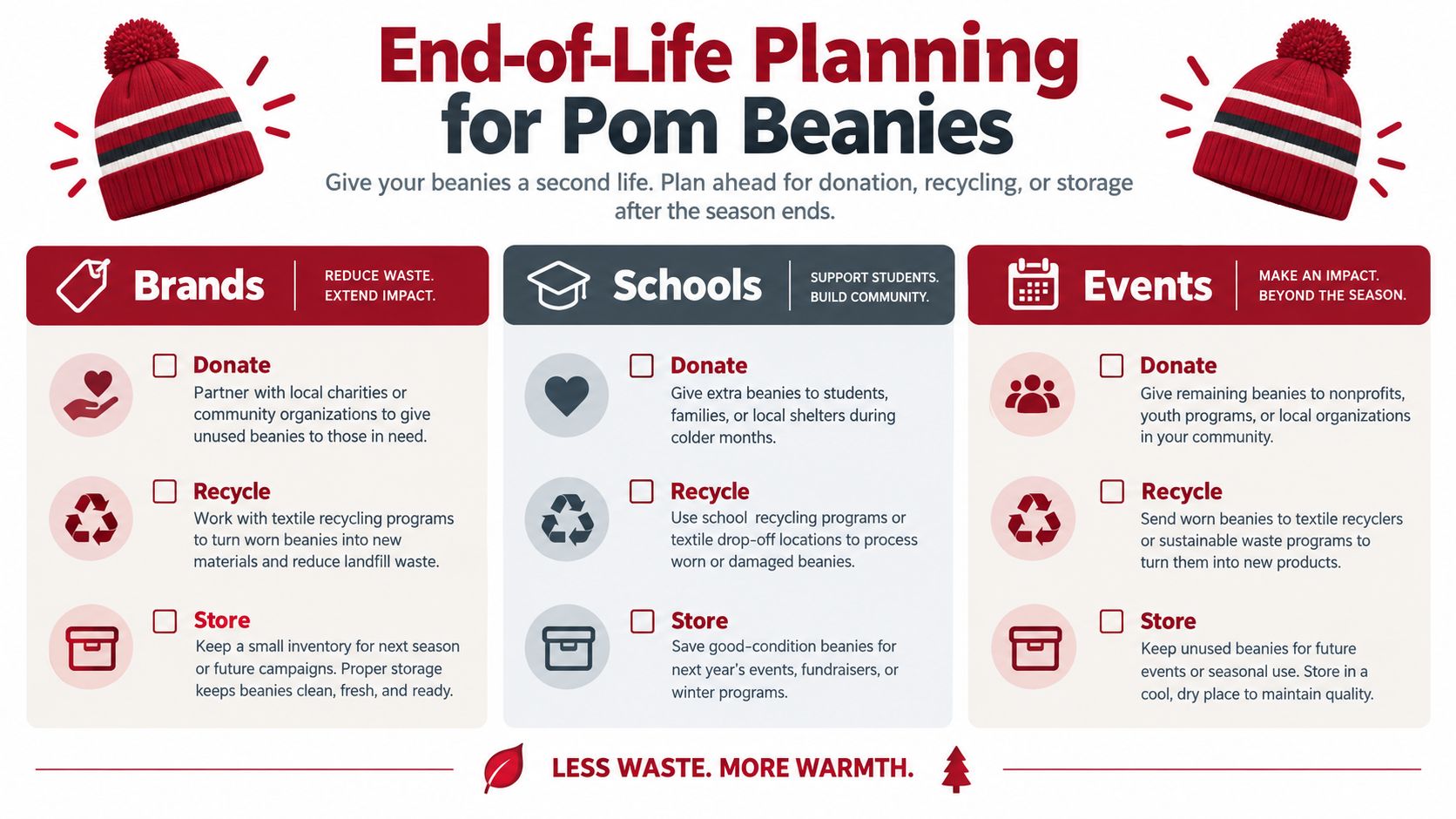
The season ends and the leftovers sit in a stockroom: two cartons in a colorway nobody reordered, a few samples carrying last year's logo, a box of returns with detached poms. What happens to that pile was decided months earlier, at the spec stage. Fiber choice, sewn-on components, and decoration set the recovery routes a finished beanie has.
Start with honest expectations. The Baltic secondhand textile desk-research report places used-clothing collection for reuse or recycling at about 30–35%, with approximately 1% recycled into a new garment. Those figures describe the clothing system as a whole rather than pom beanies specifically, and they show how narrow the recovery route runs even before decoration enters the picture.
Mixed fibers, sewn-on poms, embroidery, and patches complicate sorting further. Before you count on recycling, ask a prospective operator whether it accepts the complete decorated product and whether any components need separating. A recycled-yarn claim describes what went into the beanie. It says nothing about where the beanie can go after use.

Work down the ladder, not straight to the bin
Reuse beats recycling on cost and effort, so rank destinations by condition. Clean and inspect first, following the care instructions on the spec, and pull damaged pieces aside. Repair what is practical, since a loose pom or a popped seam is often a ten-minute fix. Store clean overruns that still fit a future program, and offer the rest for resale or donation after confirming the recipient wants branded goods. Only unusable stock goes to a collection operator, and only after you have shared the material details and confirmed acceptance.
Messaging matters at this stage too. If your supplier documents recycled yarn, say exactly that: "made with recycled polyester yarn." Stretching it into a claim that the whole beanie is circular or universally recyclable invites complaints you cannot defend.
Assign someone to own the leftovers. An unassigned box of merchandise isn't a reuse strategy, even when the original purchase carried a sustainability claim.
Regulatory Considerations for International Wholesale Buyers
A reseller in Ohio takes an order for branded pom beanies bound for a retail customer in Germany. Freight is quoted, the artwork is approved, and the deposit clears. Then the freight forwarder asks who the importer of record will be, and the goods sit in a warehouse for two weeks while both sides work out labeling and registration duties.
Questions like that stall cross-border orders far more often than stitching or color issues do. Before quoting an inclusive delivered price, settle who sells the goods, who imports them, and who carries responsibility in the market where they land.
The Global Fashion Agenda's textile extended-producer-responsibility mapping records the EU's separate textile-waste collection requirement beginning January 1, 2025, discusses broader producer-responsibility proposals, and identifies the Netherlands' target of preparing 75% of textiles placed on its market for reuse or recycling by 2030. That last figure is a policy target, meaning it has not been measured as an outcome.
Match obligations to the role you actually play
A mapping document is a snapshot. Proposals it describes may have passed, stalled, or changed scope since publication, so treat it as a starting point and verify current national rules for each destination you ship to.
Obligations also hinge on who you are in the transaction. Applicability can depend on the destination, your role as seller or importer, the product itself, and volume thresholds. A qualified adviser or the destination-market authority can confirm your position, and that confirmation costs little compared with a held shipment. Resolve it before you promise a delivered price, because assuming the customer handles compliance on arrival is a guess.
Build the documentation file while the order is in production. A pom beanie is a multi-component product, and the record should reflect that: the blank description and supplier details, material disclosure covering shell, lining, pom, and decoration, origin and packaging documents, evidence behind any recycled-content wording, and a written assignment of who handles import, labeling, and destination-market checks.
One last habit pays off. Single-fiber construction makes material identification easier, though a faux-fur pom, a woven label, and a sewn patch still carry their own disclosure weight. Keep product-listing language just as disciplined: a narrow statement you can substantiate beats a broad "eco-friendly" claim every time.
Your Next Steps for Ordering Wholesale Beanies
Start with a short purchasing brief, not a large cart. Write down the wearer, intended conditions, preferred silhouette, available budget, and required arrival date.
Then gather the artwork and decide which decisions remain open. A supplier can give more useful guidance when you explain whether you're flexible on color, material, decoration, or timing.
Send a quote request suppliers can answer
Include these essentials:
- Intended use: Staff wear, retail, team merchandise, or event distribution.
- Product direction: Your preferred style and acceptable alternatives.
- Artwork: The current logo file and any simplified version.
- Quantity: Confirmed demand plus a clearly justified reserve.
- Approval requirements: Whether you need a blank sample, decorated sample, or both.
- Destination: Delivery location and the date you need to receive the goods.
Compare the responses for completeness as well as cost. An inexpensive quote that leaves stock, decoration, or delivery unresolved isn't ready for approval.
Choose a wholesale distributor, a local decorator, or an integrated supplier according to the support your order needs. The useful partner is one that answers your specific questions and documents the agreed product.
Your first order doesn't need to include every color or decoration option. It needs a clear purpose, a product you've evaluated, and an approval record you can use again. That's a practical foundation for deciding whether to replenish, revise, or expand.
Dirt Cheap Headwear offers wholesale blank and decorated headwear, in-house embroidery, and worldwide shipping for branded beanie programs. Bring your logo, preferred pom-beanie style, intended quantity, and delivery date to request a quote and confirm available stock, decoration options, and current turnaround before ordering.