
Flat Brim Cap vs Curved Brim: Which Style Wins
The usual advice says to pick the brim that matches your personal style. That's fine when you're buying one cap for yourself. It's weak advice when you're ordering custom headwear for a team, staff, or retail line, because the cap has to suit the people who'll wear it, the decoration you'll add, and the job it needs to do.
Flat brim cap vs curved isn't a universal style contest. A flat brim gives a structured, fashion-led look and a broad, steady face for certain kinds of artwork. A curved brim feels closer to traditional baseball and can provide more practical side shading when angled down. But brim shape alone doesn't determine sun protection: available UV research evaluates hat size, angle, and coverage rather than directly comparing flat and curved baseball brims, so a precise protection advantage for curvature isn't established. The dermatological research on hat brims points buyers toward coverage and angle, not a simple style verdict.
Why the Flat vs Curved Question Is the Wrong Way to Choose a Cap
A cap that looks right in a product photo can still be the wrong choice for the people who'll wear it. Before you place a custom order, decide who the audience is, where they'll use the hats, what the front decoration needs, and whether the silhouette needs to hold its shape through shipping and display.
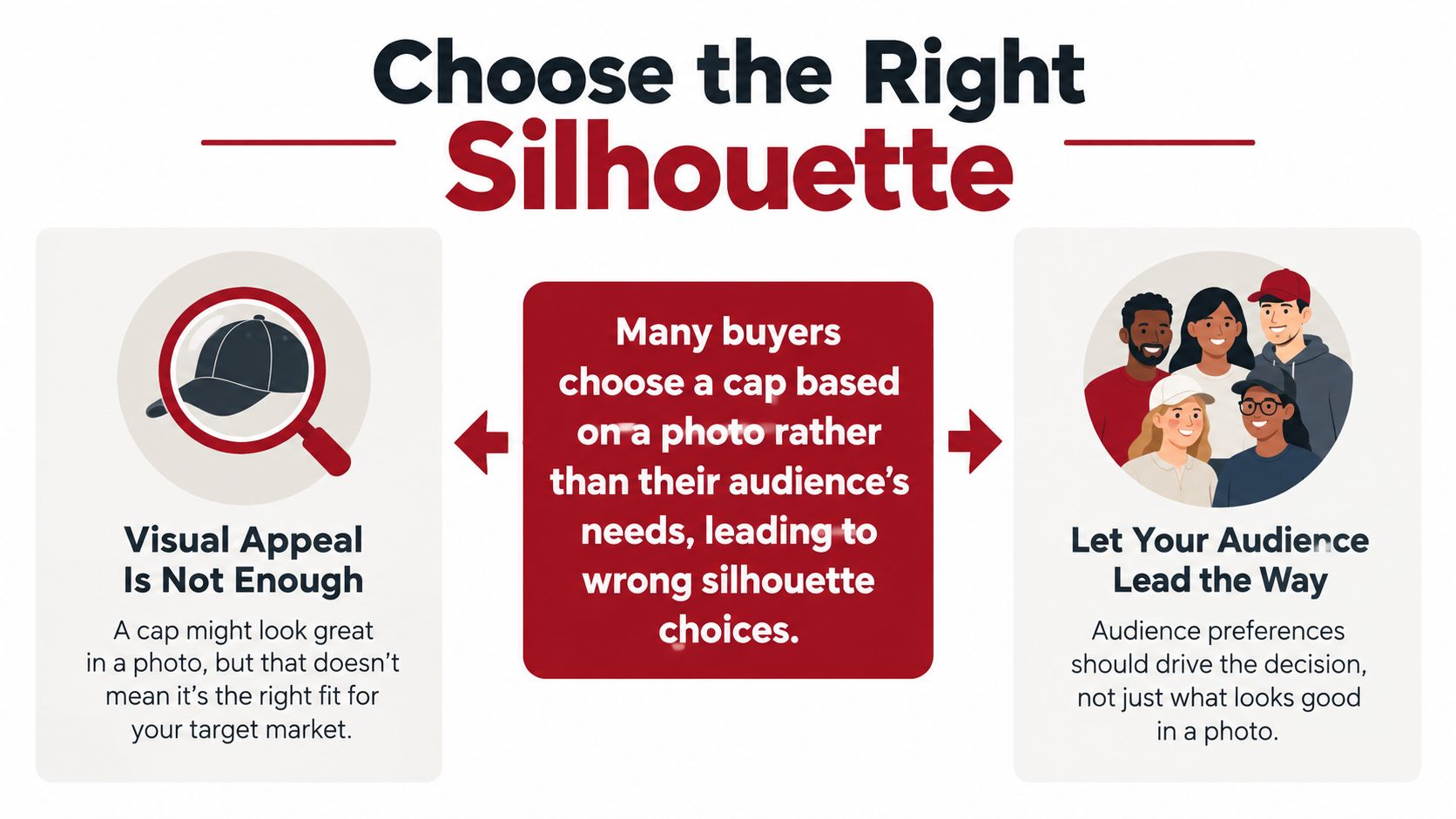
The mistake is treating brim shape as the whole product. A flat bill can make a brand look sharper and more streetwear-led, but that doesn't mean a work crew or youth team will want to wear it. A curved bill fits traditional baseball uniforms and everyday promotional programs more naturally, but it won't deliver the rigid presentation some retail brands want.
Decoration matters, too. A structured flat-brim cap gives artwork a flatter, more stable presentation. A curved crown and brim can suit a smaller, less formal logo, but embroidery near seams may need design adjustments. Choose the cap and the logo together, not one first and the other as an afterthought.
Buyer's rule: Choose for the wearer and the order's purpose, not the photo that caught your eye.
For outdoor use, don't treat either profile as full-face sun protection. A downward-angled curved bill may shade the sides more practically than a similar flat bill, but neither standard baseball-cap shape fully protects the cheeks, ears, and neck. For prolonged exposure, consider greater coverage and pair the cap with sunscreen or neck protection.
A Short History of Why Both Brim Shapes Still Exist
The curved baseball brim wasn't invented as a casual styling option. It grew out of the practical needs of the sport, especially shading players' eyes while keeping the cap wearable. That origin is why a curved-brim cap still reads as a natural choice for traditional team uniforms and established workwear.
By the late 1850s, photographs showed baseball-style caps with crowns and bills projecting in one direction. In 1860, the Brooklyn Excelsiors helped popularize a recognizable version with a rounded crown, longer brim, and top button. The cap's construction continued to change, too: the eight-panel format gradually evolved into the six-panel design common today. The history of the baseball cap helps explain why both profiles still share familiar front-panel decoration possibilities.
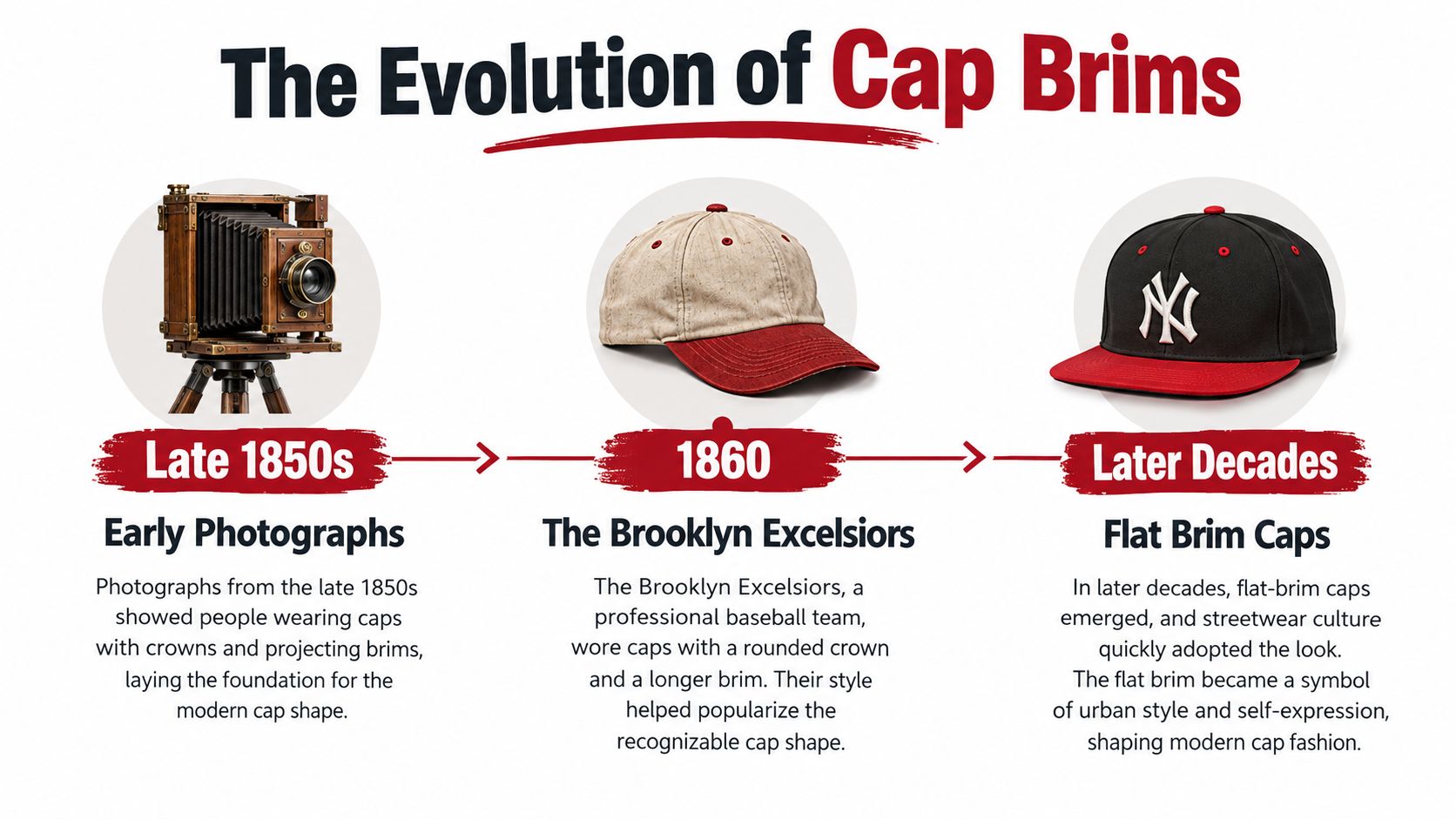
During the early 1900s, the eight-panel construction gradually gave way to six panels, while brim designs became more durable. Brims lengthened during the 1920s and 1930s, and manufacturers incorporated latex and rubber to improve their structure and resilience. The flat-brim fashion associated with fitted streetwear came later. It's best understood as a reinterpretation of baseball's older cap shape, not the original standard.
That history gives buyers a useful way to think about visual identity. Curved brims signal continuity with traditional baseball and uniform design. Flat brims signal a more contemporary, fashion-led identity. Neither is more authentic or more professional by default. They communicate different things, so pick the one that fits the organization or brand.
Fit, Structure, and the Panels Under the Brim
Brim shape and cap construction are separate choices. You can find different combinations of crown structure, panel count, closure, and profile, so don't assume that every flat brim is a snapback or every curved brim is a soft dad hat.
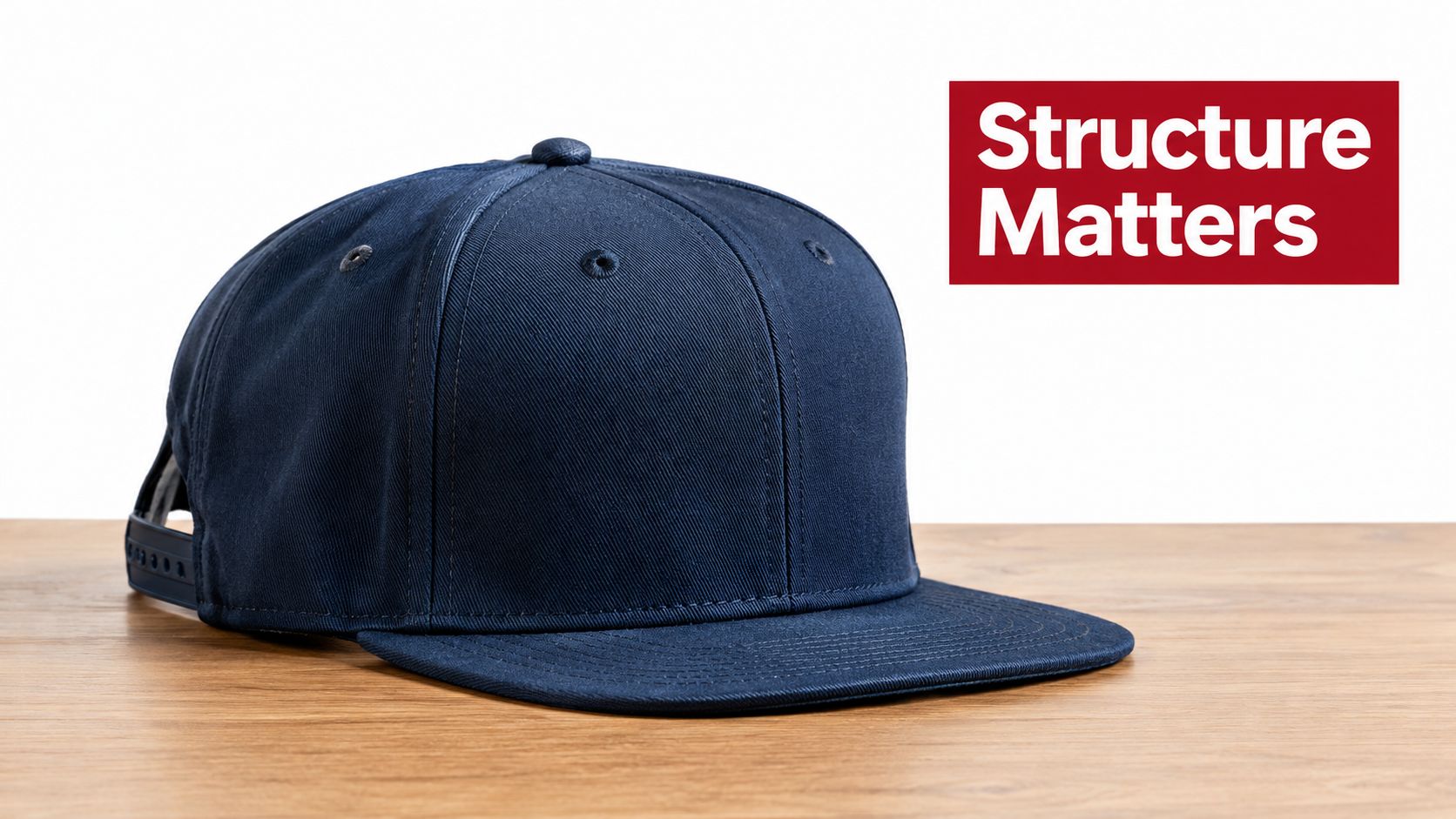
A structured crown holds a defined shape when it's off the wearer's head. That's useful for retail presentation and bold front decoration. An unstructured crown sits softer and follows the head more closely. A curved bill often appears on relaxed, unstructured caps, but curved-brim styles also come with structured crowns for teams and workwear.
Start with the crown and closure
Snapback closures are adjustable and suit orders intended for a broad mix of wearers. Strapbacks offer an adjustable alternative with a different finish. Fitted caps avoid an adjustable opening, so the order needs sizing decisions that match the audience and distribution plan.
Don't select a closure by brim shape alone. A structured cap with an adjustable closure may be a practical fit for an event, while a fitted version can suit a retail product with a more specific sizing plan.
Treat panel count as a decoration decision
Five-panel caps and six-panel caps both come in varied silhouettes. Panel count affects the layout of the front, the crown's shape, and the available uninterrupted area for decoration. A six-panel front commonly has a center seam, which can affect where a logo sits; a five-panel front may offer a different uninterrupted surface. Ask your decorator how the actual cap's seams and front structure interact with the design.
For a custom order, specify the crown profile, structure, closure, panel layout, and brim shape together. If you're comparing firm fronts with relaxed ones, this guide to structured and unstructured hats can help you narrow the build before you approve decoration.
Side-by-Side Comparison of Flat and Curved Brims
Use this table as a buying reference, but don't let it replace a decision about the wearer and the decoration. The best choice is the one that matches the cap's real job.
| Criterion | Flat Brim | Curved Brim |
|---|---|---|
| Visual signal | Sharp, rigid, fashion-led presentation | Traditional baseball and uniform appearance |
| Brim position | Projects horizontally | Wraps downward toward the sides |
| Fit impression | Often paired with a structured, defined crown | Can conform more naturally to the wearer, especially when angled down |
| Glare and shading | Can block high-angle forward glare | Can offer more practical side shading when worn down |
| Decoration surface | Planar presentation suits crisp geometric artwork and patches | Rounded crown can favor smaller, simpler designs |
| Common buyer fit | Streetwear brands, fashion programs, and retail displays | Active teams, outdoor staff, and promotional programs |
| Best reason to choose it | Shape retention and logo visibility | Wearable fit and traditional uniform cues |
A flat bill gives the cap a consistent, rigid profile. That makes it useful for a fashion program where the cap needs to look deliberate on a shelf or in product photography. It can also present geometric artwork cleanly, provided the front panel and decoration method suit the design.
A curved brim follows a different logic. The downward shape can improve side shading and reduce the need for the wearer to tilt their head when sunlight comes from an angle. That makes it a sensible option for active teams and outdoor staff, but it doesn't turn a standard baseball cap into full-face sun protection.
The dividing line isn't “better” versus “worse.” Choose flat when the order depends on a structured look and an even visual presentation. Choose curved when wearability, outdoor use, or familiar baseball styling is more important. If sun protection is a requirement, assess brim width, angle, fabric, and coverage instead of assuming one profile wins on its own.
Decoration Tips for Front Panels, Embroidery, and Patches
Start with the logo, then choose the cap that can carry it well. A large, angular mark and a small script logo place different demands on the front panel. The brim affects the overall look, but the crown's structure, seam placement, and available decoration area often matter more to the stitchout.
Match the decoration to the surface
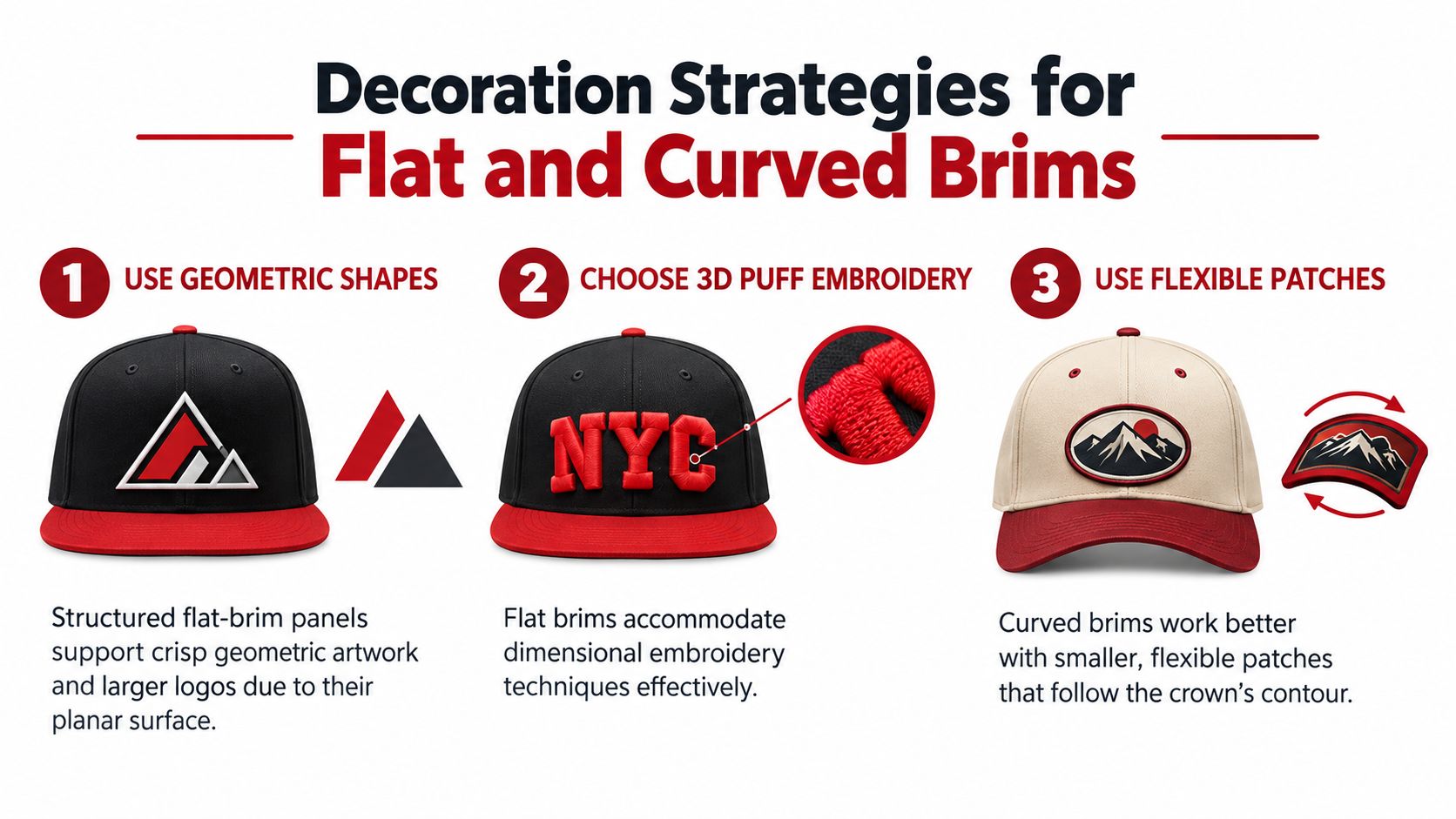
A structured flat-brim front supports a planar presentation, so it's a strong fit for crisp geometric artwork and larger logos. Dimensional embroidery can also work on a firm front when the design has enough space to read clearly. Don't add 3D puff just because it's available. If the design is delicate or crowded, raised stitching can make the details harder to distinguish.
A curved crown has a rounder surface and may bring seams closer to the artwork. Keep the design simpler and ask the decorator to account for the cap's contour and panel construction. Fine details may need to be enlarged or simplified so they remain legible after stitching.
Decide between stitching and patches
Embroidery gives a direct, stitched finish and can suit both profiles. Patches offer another option when the artwork has complicated shapes or a different material finish. Compare the cap's front panel and logo dimensions before choosing a patch, particularly if the crown curves around the design.
If you're weighing a patch against direct embroidery, review the construction options in this guide to a baseball cap with a patch. For artwork that might also appear on labels, packaging, or other promotional materials, turn your logo into a sticker to create a separate asset for those uses. A sticker-ready file isn't automatically embroidery-ready, so have your decorator prepare the art for the chosen method.
Proof before production: Check logo size, placement, thread or patch colors, and seam clearance on the actual cap style. Approve the decoration on the selected silhouette, not on a generic mockup alone.
Matching Brim Style to Teams, Merch, and Retail Buyers
Order intent settles this faster than a style debate ever will. Ask two questions before picking a profile: who wears the cap, and what job does it do for the organization handing it out.
Sports teams and leagues: Start with a structured curved-brim cap if you want a traditional uniform profile. For sideline and field crews, ask the supplier for the measured brim width and crown depth of the actual style, since two caps labelled the same size can shade differently. For team-specific ordering considerations, review custom baseball hats for teams.
Apparel brands and merch creators: Choose a structured flat brim when the product relies on a firm silhouette and strong front-logo presentation. A curved brim still works for a relaxed lifestyle line, especially when a softer overall look matches the brand.
Small businesses ordering staff hats: Lean toward a curved profile when staff need a familiar cap for regular wear, outdoor tasks, or promotions. If the logo is large or the brand identity is deliberately fashion-led, a structured flat brim may fit better. Comfort and audience fit come first; a bigger-looking logo is a weak reason to pick a silhouette your crew won't wear.
Events, schools, and nonprofits: Decide whether the group should look like a team in uniform or like a trend-led merch audience. A curved brim usually fits traditional group branding. A flat brim can suit a younger or more fashion-oriented product concept. Judge the order by what recipients will keep wearing after the event, not by what looks coordinated on the day.
For sustained outdoor exposure, evaluate brim width, downward angle, fabric, and total coverage rather than assuming the brim profile does all the work. Ordering for a sun-exposed crew on measurements instead of labels gives you a cap that performs.
Resellers and decorators: Stock or source both profiles if your customers include teams, staff programs, and fashion brands. They solve different problems, and one silhouette won't serve every order. Ask for the logo, intended wearer, and use case before recommending a blank.
Ordering Recommendations and Common Mistakes to Avoid
Settle the design and the audience before you choose a production quantity. A sample or proof can reveal whether the cap's crown, panel seams, brim, and logo work together. Approving artwork on a different silhouette is a poor shortcut.
Use this checklist before placing the order:
- Confirm the wearer: Match the profile to the team, staff, customers, or event audience.
- Approve the actual style: Check the chosen crown structure, closure, panel layout, and brim.
- Review the decoration proof: Confirm the logo's size and position on the cap you intend to order.
- Check stock and timing: Make sure the selected color and style are available for the order schedule.
- Choose the stitch approach: Use dimensional embroidery only when the artwork can handle the added relief; keep fine-detail designs clear and legible.
Common missteps are predictable. A youth sports group may expect a curved uniform cap, then receive flat-brim snapbacks that don't match what players want to wear. A buyer may approve a large logo before checking how much front-panel space the selected cap provides. Another may skip a sample and discover too late that the crown's shape changes the design's appearance.
For custom orders, Dirt Cheap Headwear offers blank headwear and in-house embroidery, including fine-detail stitching and 3D puff, with minimums starting at six pieces per logo. Its ordering options also include custom patches and printing, so compare decoration methods against the cap and artwork before approving production.
The decision is simple: choose flat brim for fashion-led programs where logo visibility and shape retention lead; choose curved brim for active teams, outdoor staff, and promotions where a conforming fit and traditional uniform cues matter more. If outdoor coverage is the priority, evaluate brim width and angle rather than treating either silhouette as complete protection.
Share your logo, intended audience, and use case with Dirt Cheap Headwear, then compare cap profiles and decoration options before approving a custom order. Choose a structured flat brim for a sharper retail look or a curved brim for traditional team and staff wear, and request a proof on the style you plan to order.