
Moisture Wicking Baseball Cap: A Practical Buyer’s Guide
A coach is halfway through a long July practice, sweat has reached the browband, and the next drip is headed straight for the clipboard. The team's caps look branded and professional, but a few are already heavy, damp, and uncomfortable. That's the moment when a moisture wicking baseball cap either proves its value or exposes itself as a polyester hat with a marketing tag.
For a small business, team, or merch program, the outer fabric is only the starting point. The sweatband, ventilation, crown structure, closure, and decoration method determine whether the cap performs on a hot field and still looks presentable after repeated use. Here's the practical buying advice I'd give before approving a bulk order.
What a Moisture Wicking Baseball Cap Actually Does
A moisture wicking baseball cap is built to manage perspiration instead of absorbing it. Its crown fabric, inner sweatband, and sometimes its undervisor work together to pull moisture away from the forehead, spread it across a larger surface, and help it evaporate.
That distinction matters during a long practice. A traditional cotton twill cap absorbs sweat into the yarns and holds it close to the skin. As the cap becomes saturated, it can feel heavier, clammy, and less comfortable. A performance cap aims to move that moisture outward before it accumulates inside the hat.
The basic process is straightforward:
- The sweatband touches the skin. This is the first surface that needs to move moisture quickly.
- The inner layer spreads the liquid. Good fibers and construction create channels that distribute perspiration rather than leaving one wet spot above the brow.
- The outer surface releases moisture. Airflow, heat, and fabric structure help the liquid evaporate.
- Ventilation keeps the system working. Mesh panels, perforations, or a breathable undervisor can make a major difference.
This principle applies to several cap formats. A performance trucker may use mesh rear panels, a stretch-fit training cap may rely on a lightweight knit, and a structured six-panel cap may prioritize a firm front for decoration. The silhouette changes, but the practical goal stays the same: keep sweat from sitting against the wearer's forehead or dripping toward the face.
The professional sports market helped normalize this approach. In 2007, Major League Baseball replaced its traditional wool cap with a polyester-blend version designed to wick sweat and allow faster evaporation. ESPN described the change as the first major overhaul of the baseball cap since the current six-panel model was adopted in 1954, while earlier changes had included replacing leather sweatbands with cloth in the 1980s. The documented history of that performance-fabric redesign shows why moisture management became a mainstream expectation rather than a niche feature.
How the Wicking Fabric Technology Works
Think about a paper towel with one corner dipped into a glass of water. The liquid climbs through the sheet without anyone squeezing it. Textile wicking uses a related form of capillary action, where narrow spaces between fibers pull liquid away from the original wet point.
Manufacturers can improve that movement by shaping fibers with grooves, channels, or multi-lobal cross-sections. The fiber surface may also receive a treatment that discourages a large droplet from sitting in place, while the spaces between yarns help transport the liquid outward. The result isn't magic. It's a combination of fiber chemistry, yarn geometry, fabric density, and finishing.
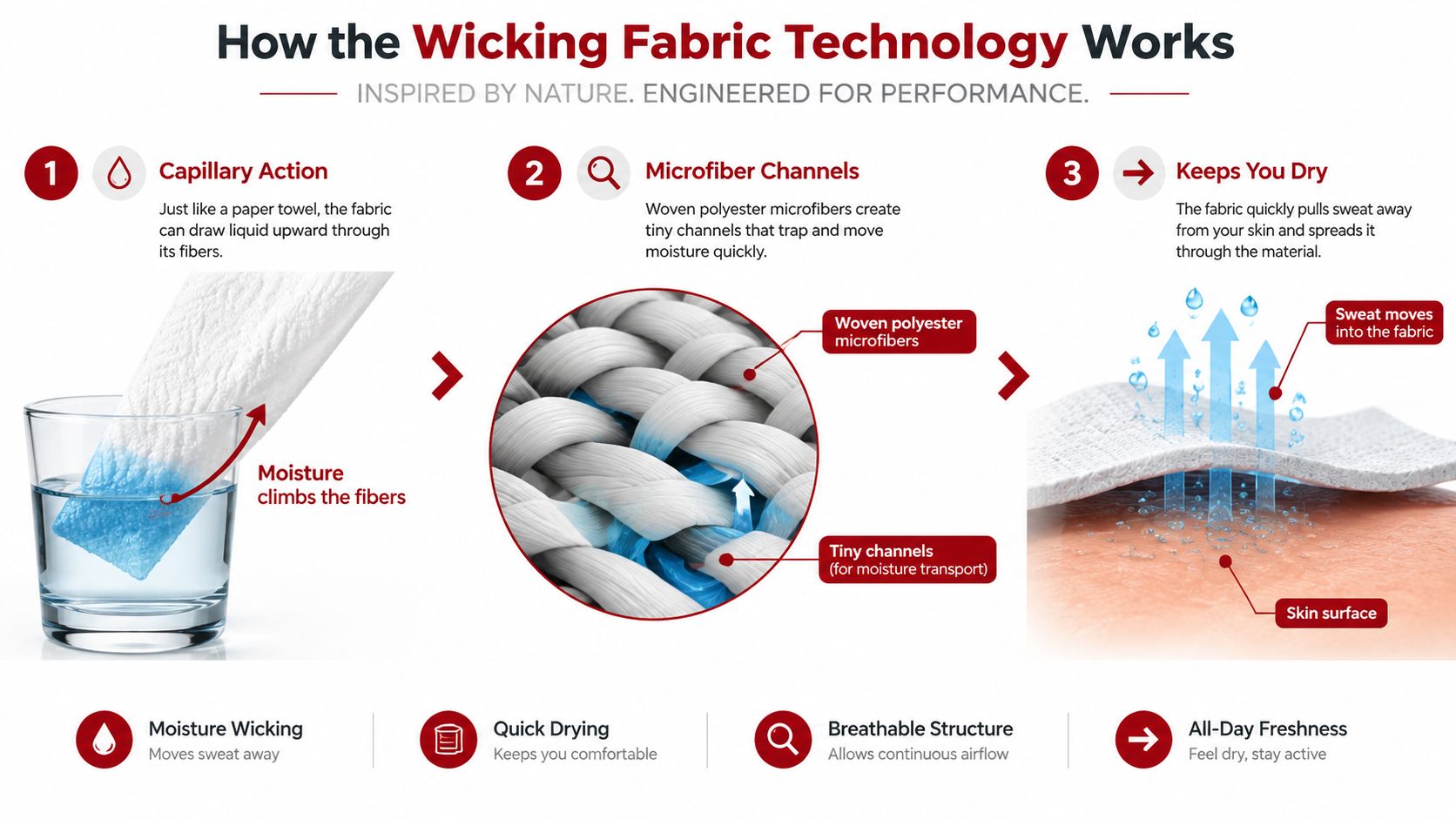
On a wholesaler's specification sheet, you'll usually see materials such as:
- Polyester microfiber: Lightweight, quick-drying, and commonly used for performance crowns and sweat-facing panels.
- Polyester-spandex blends: Adds stretch for training caps and flex-fit designs.
- Recycled PET knits: A recycled-polyester option, but still worth checking for airflow, drying behavior, and odor control in the finished cap.
- Interlock, jersey, or mock-mesh knits: These constructions can change stretch, airflow, softness, and shape retention.
- Woven polyester twill: More structured and embroidery-friendly, though it may breathe differently from a lightweight knit.
The important buying point is that moisture wicking is a fiber-and-finish system, not a single weave name. Research on synthetic apparel found that a fabric made from polyester and elastane retained less sweat and produced lower late-session rectal temperature than cotton during exercise-heat testing, which supports the value of fast moisture movement and evaporation for active wear. The underlying exercise-heat testing is about shirts, not caps, so apply the mechanism to the forehead rather than assuming an identical cap result.
For a broader material primer, this guide to the best moisture wicking fabric for golf is useful when comparing performance fibers. You can also use this performance hat fabric guide for bulk buyers before you start comparing supplier spec sheets.
The outer crown gets most of the marketing attention, but the inside sweatband is often the performance workhorse. If that band is a basic absorbent strip, a premium-looking polyester crown won't fully solve the problem.
A short visual explanation can help your staff or customers understand the mechanism:
Key Performance and Fit Features to Check
A cap can be labeled “performance” and still perform poorly. I inspect the construction in layers, starting at the forehead and working outward.
Start with the sweatband
The inner band should be a separate wicking panel, bonded terry, or stretch knit designed for contact with skin. A narrow strip made from the same fabric as the crown may look acceptable, but it often gives the cap less capacity to spread and dry perspiration.
Terry-cloth or engineered sweatbands can be especially useful for heavy sweaters, while cotton-heavy blends tend to hold moisture longer and may contribute to odor buildup after repeated use. Ask to see the inside of the cap, not just a front product photo.
Check the crown's job
A lightweight polyester microfiber knit usually favors breathability and flexibility. A structured woven front gives embroidery a flatter, cleaner foundation, but that stability can reduce airflow compared with a soft, open construction.
Don't automatically choose the lightest cap. A flimsy front may collapse under a dense logo, while a heavy twill can feel hot during field work. Match the crown to the use case, the decoration, and the amount of time people will wear it.
Look for actual ventilation
Possible ventilation features include:
- Laser-perforated side panels: Useful for airflow without the full visual effect of a trucker cap.
- Mesh rear panels: A practical choice for outdoor crews and recreational teams.
- Breathable undervisors: Can improve comfort around the face and bill area.
- Open knit zones: Helpful when the cap needs stretch and air movement.
Fit matters just as much. A snapback handles mixed team sizing efficiently, hook-and-loop closures offer quick adjustment, flex-fit designs give a cleaner athletic profile, and fitted caps provide a more custom feel but require tighter size planning.
One warning: don't accept “tested” as a complete answer. Ask which testing method the supplier used, such as AATCC 79 or an equivalent standard, and ask whether the finish was evaluated after laundering. The supplier may not have durability data, but the question separates a real specification from a sales phrase.
| Feature | Entry-Level Poly Cap | Mid-Tier Performance Cap | Premium Training Cap |
|---|---|---|---|
| Sweatband | Basic sewn band | Separate wicking panel | Engineered terry or stretch-knit band |
| Crown | Polyester woven or simple knit | Lightweight performance polyester | Fine, breathable technical knit |
| Ventilation | Standard eyelets | Mesh or targeted panels | Perforation and engineered airflow zones |
| Fit | Snapback or hook-and-loop | Snapback, stretch, or adjustable | Stretch-fit or refined adjustable system |
| Decoration | Simple front logo | Structured embroidery area | Decoration zones designed around stretch and airflow |
| Best use | Promotional giveaways | Teams and staff uniforms | Training, field work, and premium retail |
Research on two-zone fabric systems supports this layered approach. A 2024 study found that polyester on the inner side and cotton on the outer side produced very good overall moisture-management capacity, with grades between 0.6 and 0.8. The study also found that drying could be faster than in 100% polyester double-layered samples, and that increasing filament number reduced both moisture management and drying rate. Review the fabric study here. For a cap, that points toward a fine, carefully engineered sweat-facing layer rather than a generic thick polyester build.
Pros and Cons Buyers Rarely Hear About
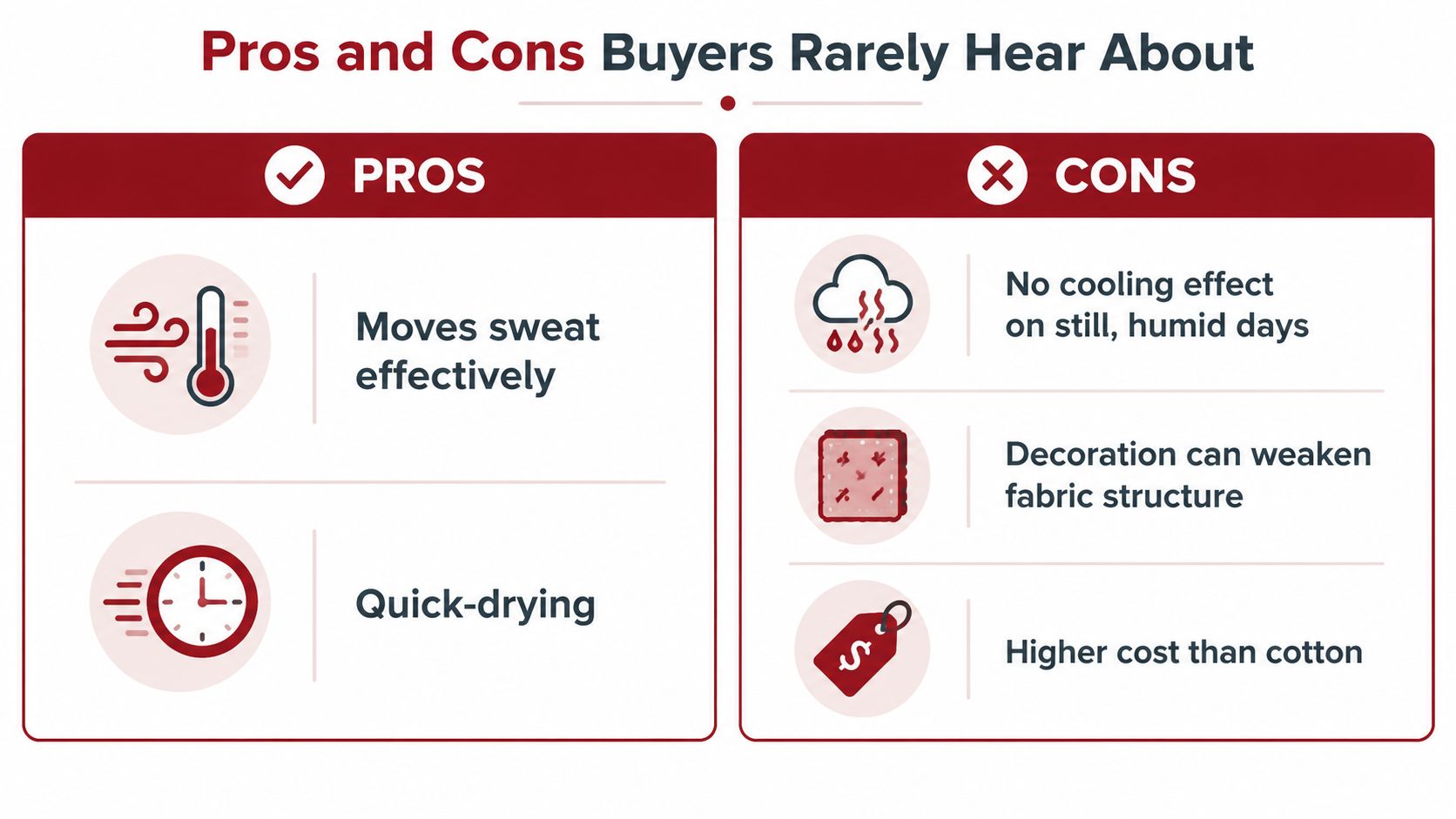
A moisture wicking cap solves one clear problem: it moves perspiration away from the skin and helps the cap dry faster. It doesn't automatically make the wearer cooler.
In still, humid weather, sweat may spread across the fabric without evaporating efficiently. The cap can feel drier to the touch while the wearer still feels hot. Independent testing research emphasizes the difference between wicking and evaporative cooling, and newer dynamic methods evaluate sweating and drying together because static fabric tests can miss what happens during real wear. This practical review of moisture-wicking cap performance is worth reading if your buyers work outdoors or play in hot climates.
What performance caps do well
- They move sweat effectively: A good sweat-facing layer reduces the wet feeling at the brow.
- They dry faster: Less retained moisture generally makes the cap more comfortable between uses.
- They weigh less when damp: Synthetic performance fabrics typically avoid the waterlogged feel of absorbent cotton.
- They fit active programs: Teams, field crews, golf staff, and event workers benefit when the cap stays presentable during movement.
Where the tradeoffs show up
- Cooling has limits: Wicking doesn't equal air conditioning, especially in humid, windless conditions.
- Odor can build: Polyester can retain body oils and odor-causing residue, so the sweatband finish and washing routine matter.
- Decoration changes the fabric: Dense embroidery adds perforations and can reduce flexibility or airflow at the logo area.
- Sun exposure takes a toll: UV can fade dyes and weaken some materials over time.
- Shape may suffer: A soft crown can lose memory after repeated sweat exposure, while an embroidered front can become stiff or puckered.
- Sizing can vary: Two caps sold under a similar style description may fit differently once closure, crown profile, or panel structure changes.
Cotton twill still has a place. It can feel familiar, offer a classic appearance, and work well for casual staff wear where heavy sweating isn't expected. For a hot field, though, I'd choose a properly engineered performance cap, then verify the sweatband and decoration instead of trusting the fiber label alone.
Embroidery and Decoration on Performance Caps
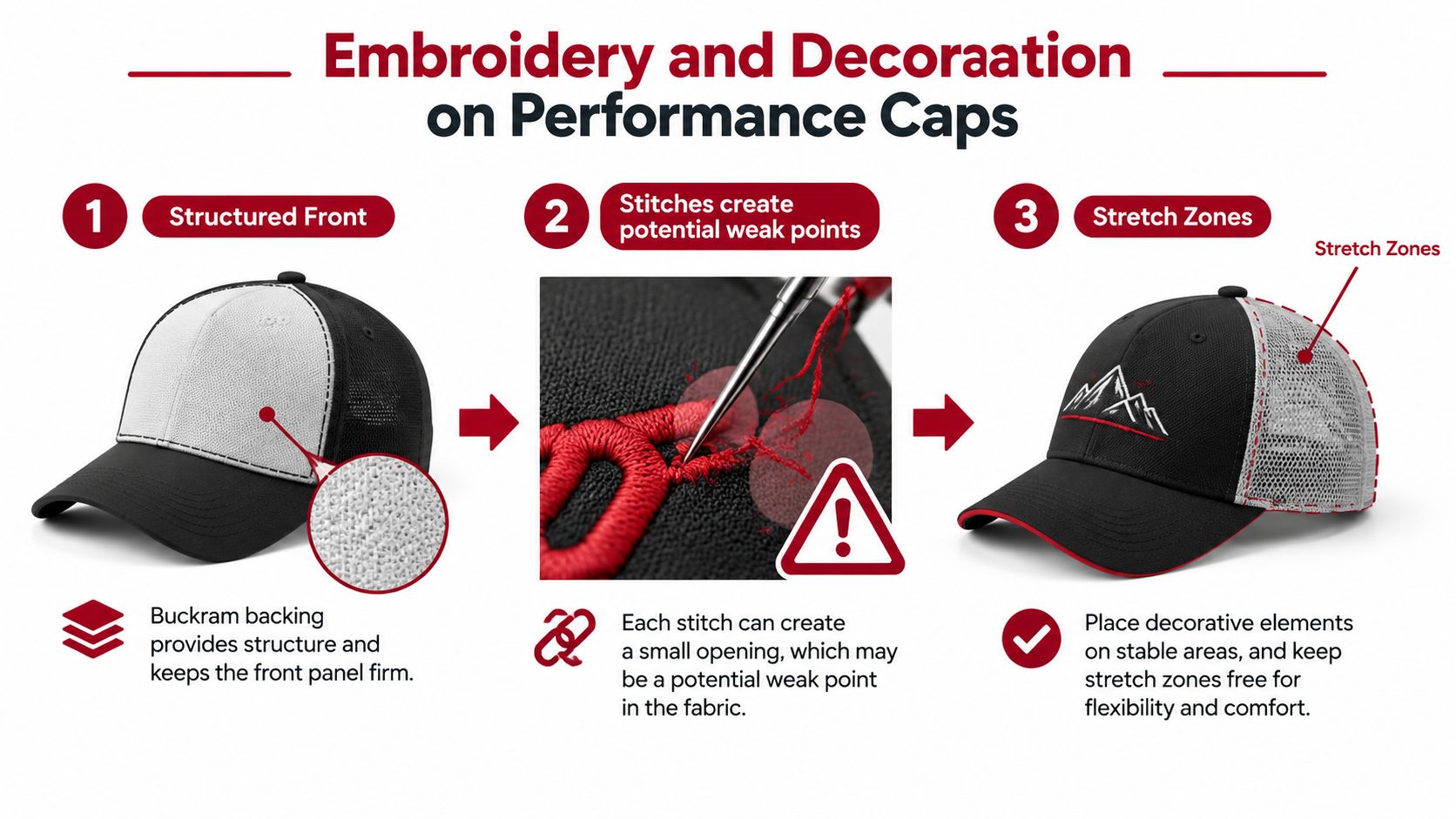
Performance fabric doesn't behave like cotton twill under a needle. Stretchy or lightweight material can shift, pucker, or develop weak points when the decoration is too dense. The safest route is to choose the decoration method after you understand the cap's structure.
A structured front with buckram backing gives embroidery a stable surface. It keeps the logo flatter and reduces distortion during stitching. A soft crown needs a different stabilizer approach, and the decorator should test the actual cap rather than relying on a factory photo.
Match the decoration to the cap
Polyester embroidery thread is the practical default for sweat-heavy use because it complements synthetic performance fabric and generally handles washing and fading better than rayon. Rayon offers a shinier appearance, but it's less forgiving through repeated sweat and wash cycles.
Keep stitch density under control. The plan notes for this order recommend capping stitch counts around 700, but that quantitative recommendation isn't supported by the verified research provided, so treat it as a supplier-specific starting point to confirm with your decorator rather than a universal performance standard. The core principle is simple: excessive stitches create more perforations, more stiffness, and more opportunities for moisture to pass through the front panel instead of traveling across it.
Avoid stitching directly through the sweatband whenever possible. Needle holes and compressed backing can seal or disrupt the pores that move moisture away from the forehead. Place the logo on the stable crown area and leave stretch zones, rear panels, and sweat-facing sections alone.
Compare the common options
- Flat embroidery: Best for structured fronts and straightforward logos.
- 3D puff embroidery: Creates dimension, but needs a stable front and simplified artwork.
- Heat transfer: Useful for flexible, lightweight graphics when stitching would overwork the fabric.
- Sublimation: A strong option for compatible polyester surfaces and detailed color work, though the blank must be approved for the process.
- Patches: Can preserve the crown fabric when applied correctly, but the patch backing and attachment method still affect flexibility.
Before placing a bulk order, request a sewn-out proof on the selected cap. Check the logo from the front and inside, inspect puckering around curves, and ask what stabilizer and thread the decorator will use. This custom printing and embroidery resource can help you compare decoration routes before approving production.
Buying and Care Checklist for Bulk Orders
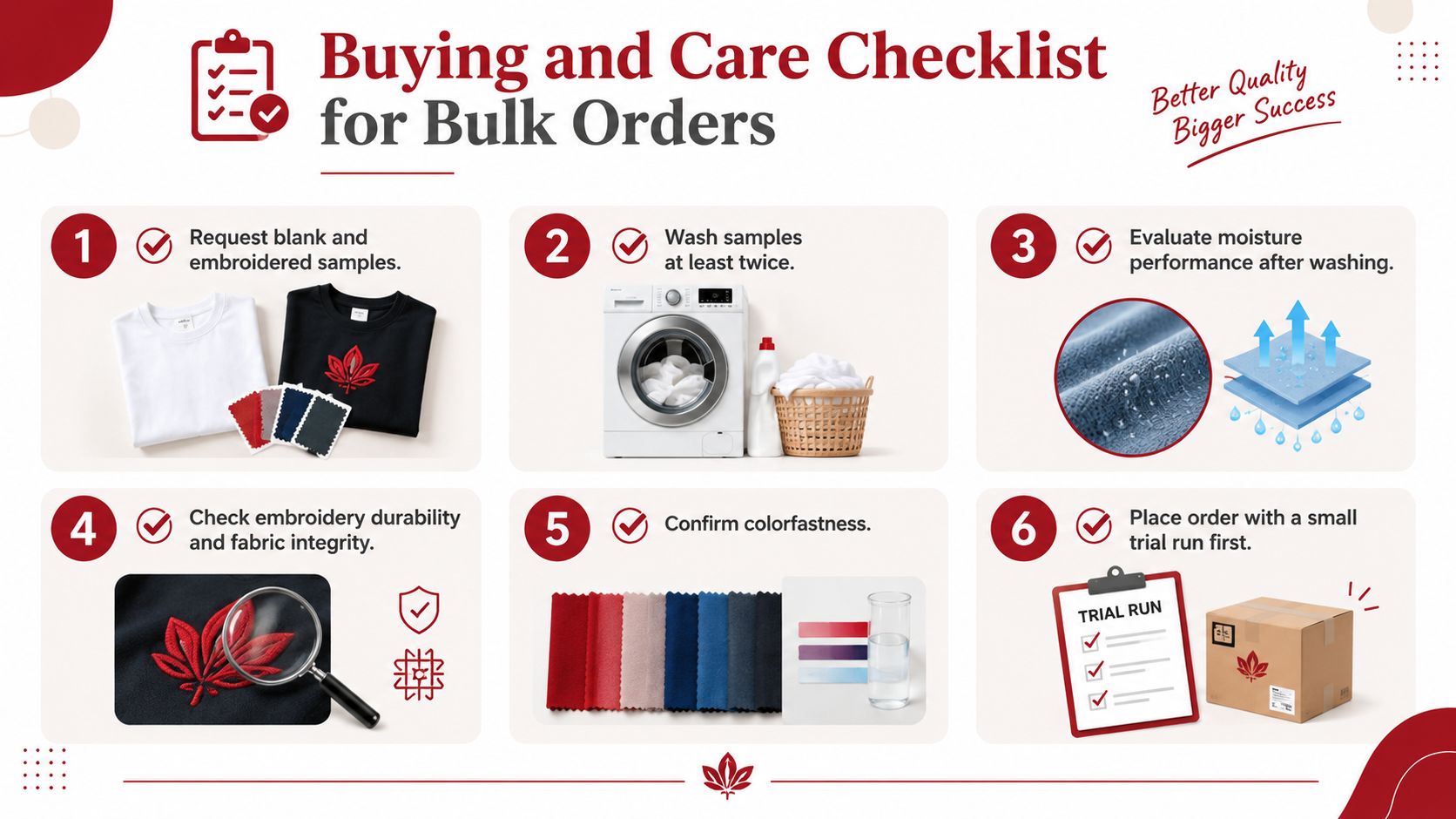
Bulk buyers shouldn't approve a moisture wicking baseball cap from a catalog image alone. Order physical samples, test the cap in the same conditions your customers will use it, and make the supplier answer questions in writing.
Before you place the purchase order
- Request both samples: Get a blank cap and an embroidered or decorated sample. The logo changes the feel, balance, and performance of the front.
- Wash the samples: Wash them at least twice using the intended care method. Check sweatband recovery, crown shape, thread tension, and color shift.
- Test the wet-weather behavior: Wear the cap during an actual practice, work shift, or outdoor event. A dry lab hand feel isn't enough.
- Inspect the inside: Look for a separate wicking band, clean seams, exposed backing, and areas where embroidery has blocked the sweatband.
- Ask about consistency: Confirm blank color consistency across dye lots, availability of replacement units, and how the supplier handles a short or misembroidered shipment.
- Confirm production details: Get minimum order quantities, decoration lead times, shipping windows, proof-approval deadlines, and reorder terms before paying.
Your artwork should arrive as a clean vector file when possible. Confirm thread colors against your brand palette, ask whether digitizing carries a fee, and set a clear proof-approval process. A logo that looks balanced on a screen may become too dense or too small once it reaches the curve of a cap.
Care that protects the finish
Wash performance caps in cold water and skip fabric softener. Softener can coat wicking fibers and interfere with the surface behavior that helps moisture spread. Hang drying is safer than high heat, and low heat should be used only when the care label permits it.
Rotate caps between uses so sweat salts and body oils don't remain concentrated in one sweatband. Don't leave a damp cap crushed in a gear bag. That encourages odor, weakens the shape, and makes the next wear less comfortable.
For sourcing, wholesale blank baseball caps give you a starting point for comparing crown types, closures, and decoration surfaces. If you're ordering for a team or startup, a small trial run is smarter than committing every unit to a style you haven't worn.
Putting It All Together Before You Order
Use three filters first. The cap needs a genuine wicking sweatband or terry equivalent, a crown that can hold the planned embroidery without collapsing, and a fiber construction that stays usable after repeated laundering.
Then follow the order:
- Ask the wholesaler for the fabric and construction specification.
- Request a physical blank sample.
- Approve a sewn-out embroidery proof on that exact cap.
- Lock the closure, crown profile, and size plan.
- Confirm quantities, decoration timing, and delivery dates only after the sample passes inspection.
Skipping the sample to save a week is a false economy. So is approving an unbranded factory photo that doesn't show the sweatband, rear construction, or underside of the decoration. The cap your buyer wears on a hot field won't behave like a polished product image.
For most small orders, the practical choice is a structured performance cap with a separate moisture-managing sweatband, enough ventilation for the climate, and a front panel that supports clean decoration. If the cap is for casual promotional use, you can accept fewer technical features. If it's for coaches, crews, or athletes, spend the attention on the inside of the cap rather than the marketing copy.
The remaining ordering questions usually come down to cooling, minimums, color, and washing. The answers below keep those decisions grounded in real use.
Moisture Wicking Baseball Cap Questions Answered
Does polyester actually keep the head cooler than cotton?
Not automatically. It usually moves and dries sweat more effectively, but cooling depends on evaporation, airflow, humidity, and construction.
How do minimum order quantities work for custom embroidery?
They vary by wholesaler, decorator, cap style, and logo setup. Ask for the minimum by style and logo before approving the proof.
Do dark colors reduce wicking effectiveness?
Color alone doesn't determine wicking. Fiber type, finish, sweatband construction, and fabric structure matter more, though dark dyes can make fading or salt marks easier to notice.
How should I wash the cap?
Use cold water, avoid fabric softener, and hang dry or use low heat only if the care label allows it. Rotate caps between uses so sweat residue doesn't stay concentrated in the band.
Dirt Cheap Headwear offers wholesale blank caps and custom embroidery for teams, small businesses, merch creators, and event programs, including performance-oriented styles and low-minimum decorated orders. Visit Dirt Cheap Headwear to compare cap constructions, request a practical starting point, and get your logo tested before committing to a larger run.