
Low Profile Cap: The Ultimate Guide for Your Brand
You’re probably doing what a lot of first-time hat buyers do. You’ve got a logo, a budget, and a reason to order hats, but the minute you start shopping, the category names get weird fast. Structured. Unstructured. Dad hat. Trucker. 5-panel. 6-panel. Low profile. Mid profile.
That confusion matters more than is commonly assumed.
A cap isn’t just a place to stick your logo. The shape of the hat changes how your brand reads from a few feet away. A cleaner, lower crown can make a logo feel understated and wearable. A taller crown can make the same art feel louder and more promotional. If you’re ordering for staff, resale, a booster club, or a startup launch, the wrong profile can make a good logo look out of place.
Choosing Your First Custom Hat Should Be Easy Right
A new business owner will often start with one simple question: “What’s the most popular hat?” That sounds practical, but it usually leads to the wrong first order.
The better question is, “What hat will people want to wear more than once?”
That’s where profile starts to matter. A lot of buyers assume all baseball caps fit roughly the same, and they don’t. Some sit high and boxy. Some hug the head. Some work better for a streetwear drop. Some make more sense for brewery staff, school merch, golf events, or a local landscaping crew.
The category is huge, so the choice carries more weight than it seems. Baseball caps hold 42% of the $37 billion global headwear industry, and low profile unstructured styles like dad hats saw a 25% surge in e-commerce sales post-2020, according to Drake’s guide to the baseball cap market. That tells you two things. First, hats are still one of the safest branded products you can buy. Second, the lower, easier-wearing shapes are getting a lot of attention.
Practical rule: If your customer or team member has to “learn how to wear” the hat, you picked the wrong style.
For most small businesses, the low profile cap ends up on the short list for a reason. It’s less bulky, easier to style, and more forgiving for people who don’t usually wear tall-crown hats. But there’s a catch. The same shape that makes it wearable also changes how embroidery behaves.
That’s the part many articles skip, and it’s the part that can save you from ordering a hat that looks right in the product photo but wrong once your logo hits the front panel.
What Exactly Is a Low Profile Cap
Think of hat profile like roof pitch. A steep roof rises up fast and stands taller. A shallow roof stays lower and closer to the structure underneath. A low profile cap works the same way. The crown doesn’t rise much above the head, so the whole hat looks closer, cleaner, and less top-heavy.
The formal definition is straightforward. Low profile caps have a shallow crown height of 2 to 3 inches, measured vertically from the top button to the earline. Mid profile caps fall in the 3 to 4 inch range, and high profile caps sit at more than 4 inches, based on Upper Park’s hat profile guide.
Hat profile comparison
| Feature | Low Profile | Mid Profile | High Profile |
|---|---|---|---|
| Crown height | 2 to 3 inches | 3 to 4 inches | More than 4 inches |
| Overall look | Closer to the head | Balanced | Taller and more pronounced |
| Fit feel | Snug, streamlined | Versatile | Roomier, more upright |
| Best for | Minimal branding, casual wear, lower crown preference | General-purpose team and promo use | Bold logos, taller front presentation |
That crown height changes the silhouette right away. A low profile cap usually looks more relaxed and less aggressive from the front. It also tends to sit better on people who dislike that “hat sitting on top of my head” feeling.
Structured versus unstructured
Profile and structure are related, but they’re not the same thing.
A structured low profile cap has support in the front panels, so it keeps more shape. A unstructured low profile cap folds and relaxes more naturally. If you hear someone say “dad hat,” they’re usually talking about an unstructured low profile cap with a curved visor and easy break-in feel.
That distinction matters for decoration. Structured versions usually give embroiderers a more stable front panel. Unstructured versions often wear more casually, but they can be less forgiving with logos that have tiny details or dense stitching.
A low profile cap is not automatically a dad hat. A dad hat is one common version of a low profile cap.
Why this shape has stuck around
This isn’t a trend that came out of nowhere. The baseball cap’s roots go back to the late nineteenth century, with major design milestones including the 1908 Philadelphia style brim and New Era’s 1934 production for the Cleveland Indians. Low profile versions grew out of that athletic lineage and became a dominant wholesale option by the 1970s and 1980s, as outlined in MLB’s baseball cap history timeline.
That history shows up in the product itself. Low profile caps weren’t invented to be flashy. They evolved because a closer fit works. That’s still why brands, teams, and event organizers keep coming back to them.
What beginners should notice first
Before you compare brands, notice these three things on any product page:
- Crown shape: Is the front panel shallow and close-fitting, or does it stand up?
- Panel structure: Does the cap keep its shape on its own?
- Logo space: Does your design need height, or can it live comfortably in a lower front panel?
If your logo is compact, clean, and horizontal, a low profile cap often works well. If your art is tall, stacked, or loaded with small text, you may already be pushing against the shape of the crown.
Finding Your Fit Who Should Wear a Low Profile Cap
A low profile cap usually works best when the goal is wearability first and volume second. If your audience wants a hat that feels broken-in, sits closer to the head, and doesn’t scream for attention, this shape makes sense.

That’s why low profile styles keep showing up in modern brand programs. Coffee shops, wellness brands, breweries, nonprofit merch tables, and startup teams often want something that feels natural with everyday clothes. A tall crown can look too promotional in those settings. A low profile cap usually blends in better.
Good fits for the style
Some buyers are almost always happier with a lower crown:
- People who dislike bulky hats: They want something that sits down on the head instead of floating above it.
- Brands with quieter logos: A small icon, wordmark, or patch often looks more intentional on a low crown.
- Teams needing broad wearability: If you’re outfitting a mixed group, lower-profile shapes can be easier for occasional hat wearers.
- Lifestyle merch programs: When the hat needs to sell on style, not just function, a low profile silhouette often helps.
If you’re defining the audience before you choose the product, it helps to sketch out who will wear the hat. Bruce and Eddy's guide to buyer personas is useful for that exercise because it pushes you to think beyond “everyone” and narrow in on real preferences.
When a low profile cap is the wrong call
Not every logo belongs on a lower crown. Some designs need more front-panel height to breathe. If you’ve got a tall badge, a stacked sports logo, or big 3D puff lettering, a high-profile snapback may present it better.
The same goes for brands that want a louder streetwear silhouette. A low profile cap can look too reserved if the whole point is boldness.
A second factor is construction. If you’re deciding between softer and more rigid builds, this breakdown of structured vs unstructured hats helps clarify why two caps with the same profile can still wear very differently.
Some hats are easy to decorate but hard to wear. Others are easy to wear but pickier about decoration. Low profile caps sit in that second group.
The personality match
The shape has an old sports lineage, but it reads very current. The baseball cap evolved through decades of uniform changes and manufacturing shifts, and low profile versions became a major wholesale format by the 1970s and 1980s. That background is part of why the style feels so adaptable. It can lean athletic, relaxed, retail-ready, or uniform-friendly without looking costume-y.
If your brand voice is clean, grounded, and everyday wearable, the low profile cap usually deserves a serious look.
Customizing Your Low Profile Cap Embroidery Best Practices
A lot of first-time buyers assume embroidery is simple. Upload the logo, pick the thread colors, and press approve.
That works fine until the logo meets a low crown.
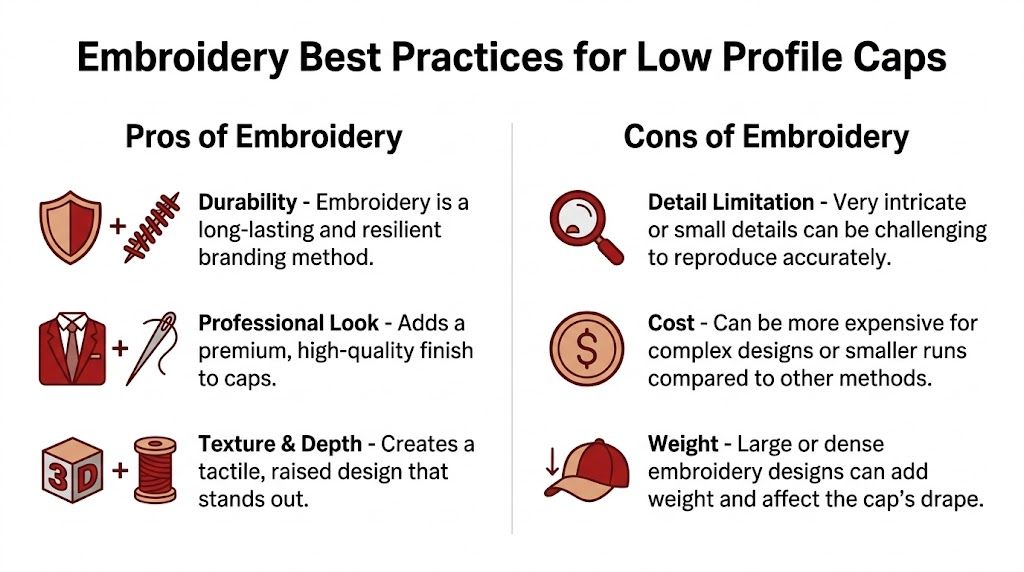
On a low profile cap, the front decoration area is shallower and more curved. That changes how the machine runs the design, how the stitches sit, and how the finished logo looks once the hat is on someone’s head. A 2025 hat customization survey found that 68% of resellers reported fit issues with low profile blanks during decoration, and one of the core reasons is that the lower crown limits stitch depth and can create puckering, according to this low profile customization reference.
What goes wrong on low crowns
The common problems are usually predictable.
- Tall logos get cramped: The design may technically fit, but it won’t breathe.
- Dense fills can pucker the panel: Too much stitch density on a shallow, curved surface can pull fabric inward.
- Small details blur together: Tiny text and fine internal lines often lose clarity.
- 3D puff gets risky fast: The lower crown gives you less vertical room, so raised foam effects can look forced.
This doesn’t mean low profile caps are bad for embroidery. It means they reward the right kind of art.
What usually works better
Compact logos almost always win on a low profile cap. Think clean wordmarks, simplified icons, monograms, short arched text, or patch-based decoration.
If a logo has a lot going on, simplify it before you stitch it. Pull out the smallest text. Reduce interior linework. Turn gradients into cleaner shapes. In many jobs, the fix isn’t choosing a different hat first. It’s choosing a better embroidery version of the logo.
Shop-floor advice: The question isn’t “Can this logo be embroidered?” The question is “Can this logo be embroidered well on this crown shape?”
Digitizing matters. A file prepared for a tee print is not automatically ready for a cap run. If you want a practical primer on what gets adjusted before thread ever touches fabric, this guide to digitizing a logo for embroidery is worth reviewing.
Placement matters more than people think
Front-center is the default, but it isn’t always the best move.
A low profile cap can look sharper with a smaller left-front logo, side embroidery, or a patch that uses shape to create a stronger visual block. If your logo is wide rather than tall, center front often works. If it’s awkwardly stacked, moving it or converting it to a patch may give you a cleaner result.
For many brands, the strongest low profile designs are not the biggest. They’re the most intentional.
Here’s a quick way to judge it before production:
| Logo trait | Usually better choice on a low profile cap |
|---|---|
| Small icon or short wordmark | Direct embroidery |
| Fine-detail seal or badge | Woven or stitched patch |
| Tall stacked logo | Consider different placement or different cap profile |
| Heavy raised look | Limited puff use, or switch to patch/applique |
A short walkthrough helps if you want to see cap embroidery in motion before you approve artwork:
The honest take on 3D puff
People love the look of puff embroidery, but low profile caps are not the easiest place to use it.
The lower crown leaves less room for height and less margin for error. If the lettering is too narrow, too detailed, or too tall for the panel, puff can buckle the shape or make the logo look crowded. Bold block lettering can work. Intricate marks usually don’t.
One reliable alternative is the patch route. Another is applique. The same 2025 customization reference notes that laser-etched appliques surged 35% in wholesale orders in early 2026. That makes sense in practice because flatter decoration methods can preserve the cleaner drape of a low profile cap when direct embroidery would overwork the panel.
What decorators adjust behind the scenes
Good results on a low profile cap often come from boring technical choices that buyers never see.
For example, lower thread tension can help reduce puckering on a shallow crown. A stable backing choice matters. Stitch path matters. Sequence matters. If a shop treats a low profile cap exactly like a taller structured snapback, the odds of distortion go up.
Dirt Cheap Headwear handles low-minimum custom embroidery and patch options on wholesale blanks, which is useful when you need to test a lower-crown style before scaling it. That small-run approach is often smarter than committing to a large order based on a mockup alone.
The best buyer habit
Ask for a recommendation based on your actual logo, not just the hat you like.
If your decorator says the logo should be simplified, reduced, moved, or patched, that’s usually a sign they’re protecting the final result. A low profile cap can look excellent with embroidery. It just needs art that respects the shape.
Ordering Wholesale Low Profile Caps for Your Business
Once the style is right, the next question is volume. At this stage, many buyers overcomplicate things. They think wholesale means huge commitments, confusing case packs, and a big leap of faith on a product they haven’t tested.
It doesn’t have to work that way.
For most business orders, low profile caps make sense because they scale well. You can start with a small branded run for staff or a local event, then reorder the same shape for retail, fundraising, or seasonal promo use if people wear it.
Why wholesale pricing matters
The biggest practical advantage is cost compression as the order grows. Low profile caps can drop from about $13.30 at 24-plus units to $10.73 at 576-plus units, based on the Cap America low profile pricing example. That kind of tiered pricing is one reason hats stay popular for businesses, teams, and nonprofit programs.
The point isn’t that every cap costs exactly that. The point is that this product category rewards scale.
If you’re comparing hats for a merch table or employee kit, lower unit cost changes your options. It may let you step up to a better blank, add a patch, or split your order across more than one color.
Blank first or decorated first
This is the decision that usually saves or wastes the most money.
- Blank sampling makes sense when fit is uncertain: If your audience hasn’t worn your hats before, test the shape first.
- Decorated sampling makes sense when the logo is complicated: A low profile cap can wear great and still fail once the embroidery goes on.
- Large bulk orders work best after both are confirmed: Shape and decoration need to be approved together.
That’s especially true with brands like Richardson, YP Classics/Flexfit, and Valucap, because each line can feel different even when the product description sounds similar. A low profile cap with a softer build may suit a coffee brand. A trucker variation may fit a landscaping company or tournament giveaway better.
MOQ and reorder thinking
Small businesses often get stuck because they think they need to launch with a giant order. They don’t.
A low minimum helps when you’re testing a look, validating demand, or dividing hats across departments or coaches. Once the style proves itself, the economics improve with larger runs. That’s a safer way to build a headwear program than ordering heavy on guesswork.
If you’re still comparing blanks across brands and constructions, this wholesale baseball cap collection is the kind of catalog worth reviewing because it lets you sort by the actual cap families you’ll end up choosing between.
Wholesale works best when you treat the first order as a fit-and-decoration test, not just a purchasing transaction.
A simple buying lens
A practical order usually comes down to three filters:
- Will people wear this cap voluntarily
- Will the logo reproduce cleanly on this crown
- Will the reorder still make financial sense when demand grows
If the answer is yes on all three, you’re in good shape.
Actionable Steps to Select the Perfect Cap
A low profile cap is a strong choice when the shape, logo, and audience line up. The easiest way to avoid a bad order is to stop thinking about hats as one decision. It’s really four smaller decisions tied together.
Start with the wearer
Ask who the hat is for, not what you personally like.
If the order is for staff uniforms, comfort and repeat wear matter more than trend appeal. If it’s for merch, you need a silhouette people already recognize as wearable. If it’s for a team, you need broad fit acceptance across a group with different preferences.
A low profile cap usually makes the most sense when you want the hat to disappear into someone’s wardrobe in a good way.
Then look at the logo honestly
Don’t judge the logo on a white screen. Judge it on the front of a curved, shallow crown.
Use a short checklist:
- Is the design tall or compact
- Does it rely on tiny text
- Will raised stitching improve it or hurt it
- Would a patch communicate it more cleanly
If your art needs more height than the cap gives you, switching hat profiles may be smarter than forcing the embroidery.
Match the cap to the job
Different use cases point toward different builds.
| Use case | Usually the better low profile direction |
|---|---|
| Casual brand merch | Unstructured or relaxed low profile |
| Staff uniforms | Clean structured low profile |
| Outdoor events | Low profile trucker or breathable option |
| Premium branded drop | Low profile with refined embroidery or patch |
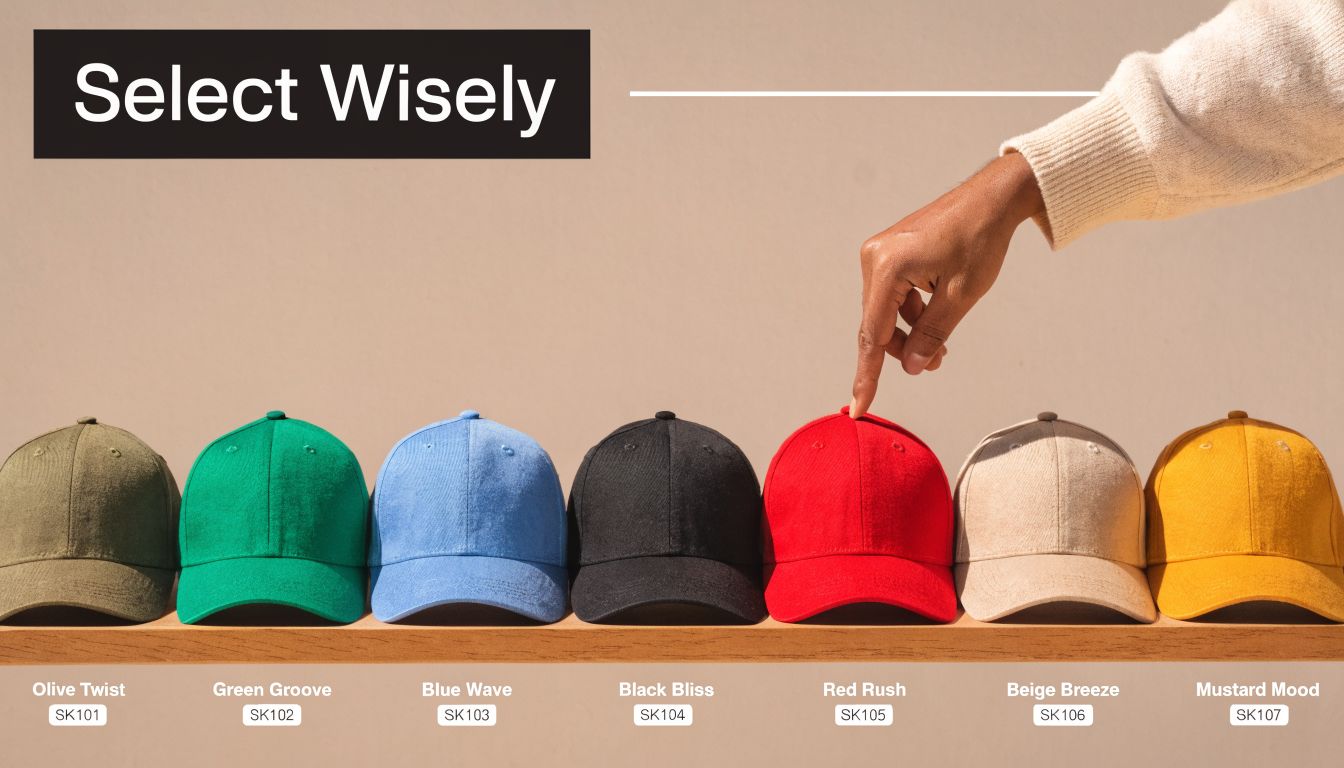
Buyers tend to improve quickly at this stage. Once you stop shopping by color first and start shopping by use case, the right style gets easier to spot.
Finish with a pre-order gut check
Before you approve anything, ask these questions out loud:
- Would I wear this if my logo weren’t on it
- Is the logo sized for the cap, not just for visibility
- Am I choosing this because it fits the audience, or because the product photo looks good
- If this order succeeds, can I reorder the same thing without changing the whole setup
The best custom hat orders feel obvious after the fact. The shape fits the brand, the logo fits the cap, and nobody has to explain why it works.
That’s the standard worth aiming for.
Frequently Asked Questions About Low Profile Caps
Is a low profile cap the same thing as a dad hat
Not exactly.
A dad hat is usually an unstructured low profile cap, but not every low profile cap is a dad hat. Some low profile styles are structured, some are truckers, and some are fitted. “Low profile” describes crown height. “Dad hat” usually describes a softer, more relaxed version of that shape.
Can you do 3D puff embroidery on a low profile cap
Sometimes, but it depends on the artwork.
Bold, simple lettering has a better chance than detailed logos. Low crowns give puff less room to work, so designs can crowd the front panel fast. If the artwork is intricate, a patch or flatter decoration method usually gives a cleaner finish.
What’s the best way to wash one
Be careful with water, heat, and drying method.
That matters even more with fitted versions because low profile fitted hats can shrink 15% to 20% faster post-wash, and eco-dye undervisors have been noted for reducing fading by 40%, based on the undervisor care discussion referenced here. In practical terms, spot cleaning is safer than a full wash. If the cap really needs more than that, use a gentle approach and let it air dry. Don’t throw it in with regular laundry and hope for the best.
Why do people care about the undervisor
Because it affects both appearance and lifespan.
The undervisor is one of those details buyers don’t notice until it starts bleeding, fading, or looking cheap. It also matters for resale and premium merch because inside details shape how finished the product feels when someone opens the package.
What is a low profile trucker hat
It’s a trucker cap with a shallower crown.
You still get the mesh back and the casual look of a trucker, but the front sits closer to the head than a tall foam-front version. That makes it a good middle ground for buyers who want airflow without the bigger, more upright trucker silhouette.
If you’re narrowing down styles and want a second set of eyes on fit, logo setup, or blank options, Dirt Cheap Headwear carries wholesale hats and custom decoration for small runs and larger orders. It’s a practical place to compare low profile caps, test embroidery or patch directions, and order without overcommitting on your first pass.