
Hat Boxes Wholesale: The Complete Buyer’s Guide for 2026
You're probably staring at a pallet quote, a stack of hats, and a packaging sample that looked fine online but feels flimsy in your hands. That's the trap with hat boxes wholesale. The cheap unit price gets attention, then freight, storage, damage, and repacking eat the margin you thought you'd protected.
If you buy headwear in volume, the box isn't a side item. It's part of the product, part of the shipping system, and part of the customer experience. The right call saves hats from arriving crushed, keeps displays clean, and stops you from paying twice, once for the box and again for the damage it couldn't prevent.
Why Hat Box Selection Makes or Breaks Your Wholesale Operation
A buyer can make one bad packaging decision and spend the next month fixing it. The hats arrive flattened. The brims lean. The crowns lose shape in transit. Then the team starts adding tissue, inserts, extra void fill, and apology replacements, which is just a longer way of saying the original box choice was wrong.
That risk gets bigger when the market is growing and more hats are moving through more channels. The broader global headwear market was valued at USD 37.01 billion in 2025 and is projected to reach USD 62.83 billion by 2033, a 6.9% CAGR from 2026 to 2033, according to Grand View Research's headwear market report. A separate market study estimates the global hats market at USD 11.04 billion in 2025, rising to USD 18.97 billion by 2034 at a 6.31% CAGR in the same report. More hats sold, stored, shipped, and displayed means more packaging decisions, and more ways to get those decisions wrong. Grand View Research headwear market report
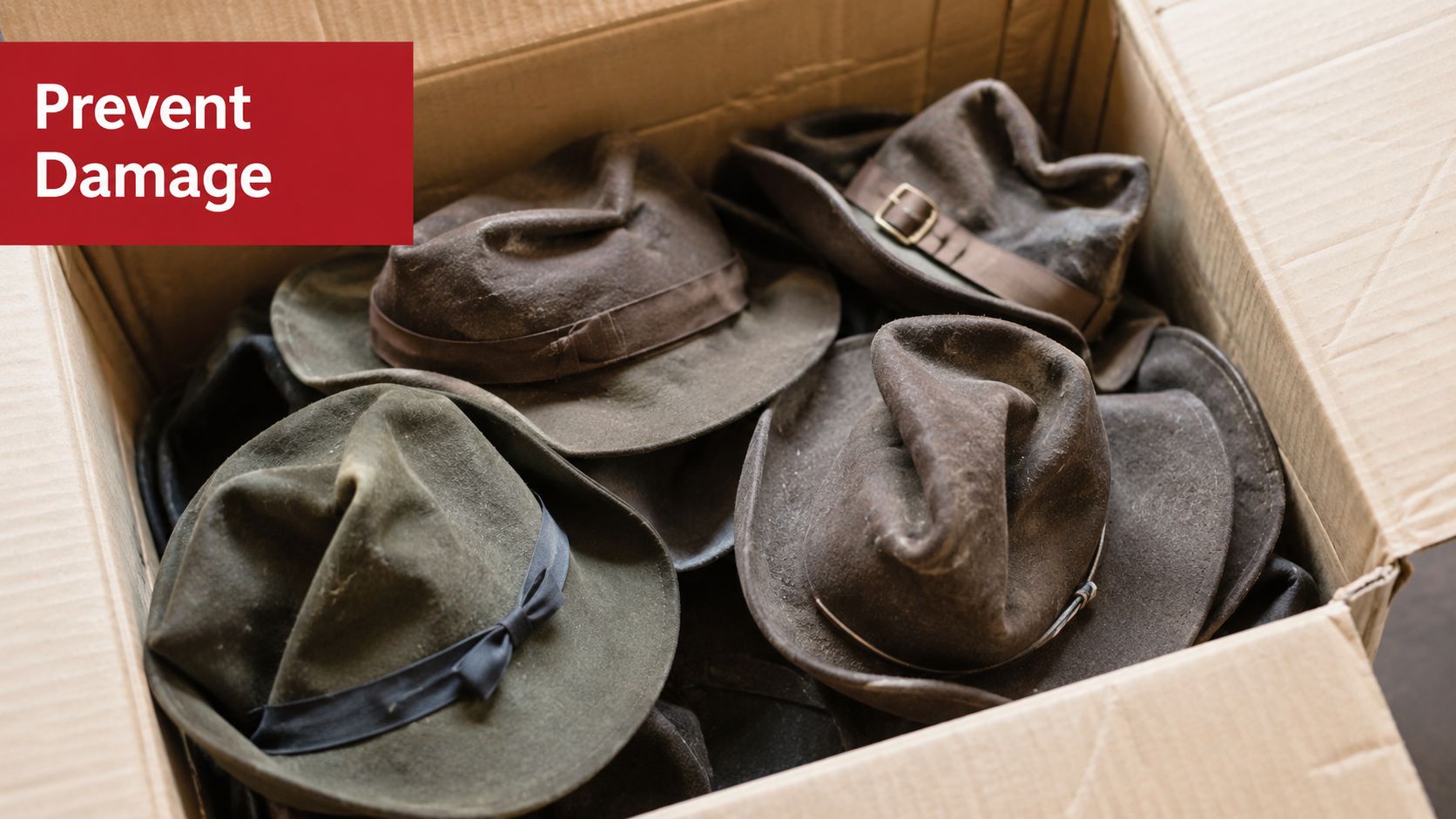
The box protects the sale, not just the hat
When a box fails, the damage isn't limited to the product. Retailers notice bad presentation, customers notice misshapen brims, and your warehouse notices extra handling. That's why smart buyers treat packaging as a performance spec, not a decorative choice.
A useful rule is simple, if the hat has structure, the box needs structure too. If the hat is soft, the box still needs enough geometry control to stop it from sliding around. A round rigid box, a square mailer, and a flat storage carton are not interchangeable just because they all close.
If you're also selling or photographing the product, packaging affects how the hat reads on camera. A clean box and tight presentation support better listing images, which is why a practical resource like the AI hat photography guide is worth keeping nearby when you're building a retail-ready program.
Practical rule: buy the box for the worst handling path, not the best one. If it survives parcel transit, pallet compression, and shelf handling, it'll usually survive everything else.
And if you're trying to wrap or re-pack units manually, start with a repeatable process instead of improvising on the fly. This internal guide on how to wrap a hat is a useful companion if your team needs cleaner packing consistency at the bench.
Wholesale buyers often underestimate the hidden cost of “good enough” packaging. A cheap box that creates even a modest damage problem is expensive the moment it triggers replacements, complaints, or repacking labor. In a wholesale operation, that's the math.
Understanding Hat Box Types and Materials
The cleanest way to choose among hat boxes wholesale options is to separate presentation boxes from shipping boxes. Presentation boxes are about appearance, branding, and shelf appeal. Shipping boxes are about resisting crush, keeping the hat centered, and surviving rough handling. Mixing those jobs usually pushes cost into the wrong place, either through overbuilt packaging or through avoidable damage.
Match the construction to the use case
Light paperboard works for gift presentation and light retail display. Freight-heavy fulfillment calls for a sturdier build than light paperboard can provide. Neutral packaging sources list stock options from 10 pt to 28 pt paperboard, E-flute corrugated, bux board, cardstock, and rigid-board builds, while conservation-grade hat boxes use MicroChamber or Silversafe corrugated board with metal corners and short 1.5-inch lids for added stability. That matters because thicker and corrugated builds handle pallet pressure and parcel abuse better, while lighter paperboard is easier on branding and cost but weaker under compression. Conservation Resources hat boxes
Here's the blunt version, don't pay for luxury finishes if the box is going into a warehouse cage and then a shipping lane. Pay for rigid or corrugated structure if the hat has shape memory, a wide brim, or any chance of being stacked.
| Hat Box Material Comparison | Protection Level | Best For | Relative Cost |
|---|---|---|---|
| 10 pt to 28 pt paperboard | Low to moderate | Retail presentation, lightweight gifting | Lower |
| Cardstock | Low | Decorative packs, light in-store use | Lower |
| E-flute corrugated | Moderate to strong | E-commerce, bulk shipment, moderate crush risk | Mid |
| Bux board | Strong | Freight-heavy wholesale, structured hats | Mid to higher |
| Rigid board | Strongest for presentation | Premium display, gift sets, brand-forward programs | Higher |
Round, square, and flat-pack choices
Round boxes make sense for wide-brim hats because the shape supports the brim instead of forcing it into corners. Square boxes stack better and usually waste less warehouse space. Flat-pack formats cut storage pain, but only if your team can assemble them quickly without damaging the box or slowing fulfillment.
Operational truth: if your warehouse team hates assembling the box, your “cheap” packaging probably isn't cheap.
Conservation and archival-style hat boxes show what premium protection looks like, but most wholesale buyers don't need museum-grade materials. They need the lightest construction that still prevents deformation during the actual journey their product takes. That is the standard to use, not the supplier's prettiest sample.
Getting the Sizing Right for Different Hat Styles
A hat box that is even a little too tight creates costly problems fast. It flattens a crown, pinches a brim, and leaves pressure marks that show up after the customer opens the carton. A box that is too large does the opposite, it wastes cube, raises freight cost, and lets the hat rattle around like loose stock in a damaged carton.
Size around the hat, not around the order
Start with the hat's maximum brim span and crown height, then add clearance. Independent packaging guidance points to about 1.25 to 2.5 cm of clearance, or 0.5 to 1 inch, on every side so the crown and brim do not get compressed. Common size bands run from roughly 10" × 10" × 6" for caps up to about 18" × 18" × 10" for large sunhats, with larger multi-hat packs needing more interior room. Alibaba hat shipping box size guidance
That sizing rule should follow the largest style in the line, not the number of units that look tidy on a pallet. One structured hat in the wrong box can ruin the whole carton. Soft caps often fit a smaller format, but once you add a stiff brim or a tall crown, the geometry changes completely.
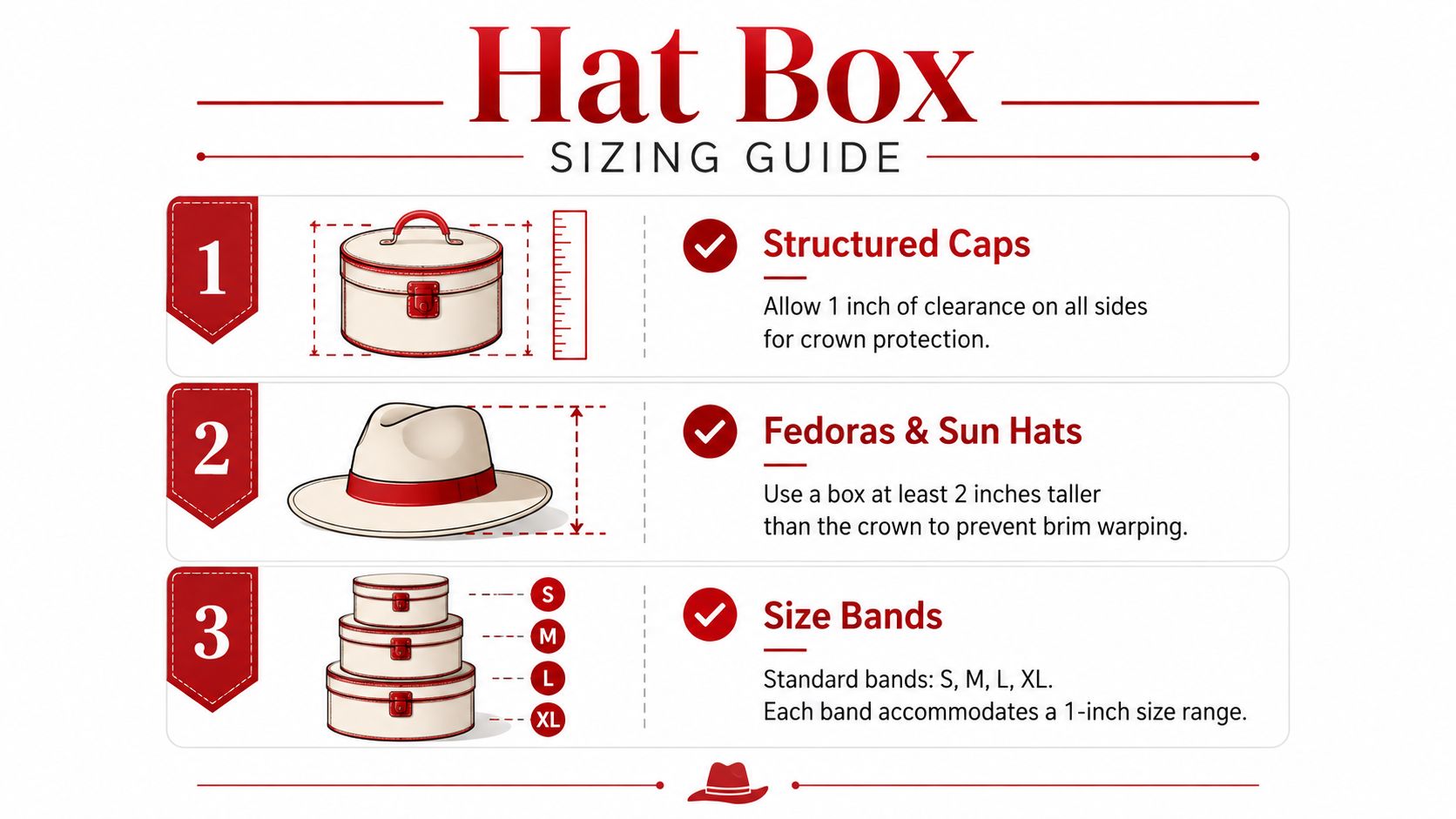
Inserts are not optional for structured styles
A rigid insert keeps the hat from drifting inside the box. That matters because movement is what turns a near-fit into a damaged item during transit. It also cuts down the need for heavy void fill, which can raise shipping cube and slow packing.
For structured caps, use a box that lets the crown sit without load. For fedoras and sun hats, round boxes or custom-cut square formats usually work better because corners can leave permanent shape distortion. If the brim needs to float instead of pressing against a wall, the box has to be built around that requirement.
For buyers building out multiple programs, our bulk packaging solutions guide is useful for keeping box choice aligned with fill rate, handling time, and freight exposure.
Measure the widest point first
Do not measure a hat by the label size and stop there. Measure across the widest brim span, then the tallest crown point, then decide whether the hat can tolerate a square profile or needs a round shell. That is how you avoid buying a box that works for one style and fails on the next.
Use the sizing chart in your sourcing file, not in your head. The internal reference at hat sizing chart keeps buyers aligned when different team members are sourcing different silhouettes. It also helps when you are comparing carton cost against the shipping cost that comes with a tighter or looser fit.
Customization and Printing Options That Actually Pay Off
Customization can make a box look expensive without making the whole program better. That's the mistake. Buyers get seduced by foil, embossing, spot UV, and complex print runs, then end up with packaging that looks good on a sample table and underperforms in storage and shipping.
Branding should match the channel
For retail display or gifting, a clean printed box can carry the brand well. For bulk shipping and warehouse storage, the best branding is often simpler, a sharp logo, readable text, and a finish that doesn't scuff easily. A full-color box only earns its keep if the box is visible to the customer and part of the buying moment.
Supplier pages often push every finish at once, but that's a sales tactic, not a buying strategy. Offset printing, digital printing, foil, lamination, and specialty coatings each have a place, but not every line needs all of them. The right choice depends on whether the box is being opened by a retail customer, a warehouse picker, or a gift recipient.
Buyer's test: if a finish doesn't improve sell-through, protection, or brand recognition, don't pay for it.
Keep the spec clean unless the market demands more
Simple logo placement on a stock box often beats expensive custom art when the product itself is the star. Stickers, sleeves, and labels can also do the job without locking you into a more complex production run. That's especially useful when you're testing a new hat style and don't want to gamble on a premium package before demand proves out.
The tradeoff is straightforward. More custom work usually means more setup time, more production complexity, and less flexibility when you need to change colors, seasons, or SKUs. Clean, professional packaging gives you room to move.
If your brand leans toward premium gift sets or retail displays, then a better finish can make sense. If the box is primarily a shipping vessel, keep the decoration restrained and spend the money on structure instead.
Pricing Benchmarks and Negotiation Strategies
Suppliers love to pitch hat boxes on unit price alone. That is a narrow view. Once you add setup fees, decoration charges, freight, storage, and the cost of damaged boxes that fail in transit, the true cost per usable box moves quickly.
Ask for the full landed quote
Start every quote request with the same spec sheet, box dimensions, material, finish, insert requirement, and expected order quantity. If suppliers are pricing different assumptions, the numbers do not compare cleanly. One vendor may be quoting a flat-pack paperboard box while another is pricing a rigid assembled box, and those quotes measure different things entirely.
Ask for the quote in separate line items for base unit cost, decoration cost, packaging of the boxes for shipment, and freight. If a supplier will not break those pieces out, margin is buried in the mix. You need the landed cost, not a headline number.
The broad wholesale trade channel is large enough to support packaging programs at scale. In the United States, the wholesale trade sector employed about 6.06 million workers in June 2026, with average hourly earnings of about $39.72 and 255,000 job openings in May 2026, according to the Bureau of Labor Statistics. In Canada, wholesale trade generated CAD 146.4 billion in operating revenue in 2023, with a 7.3% pre-tax profit margin and CAD 10.7 billion in net revenues. That scale is exactly why buyers need disciplined quoting. BLS NAICS 42 wholesale trade
Negotiate on repeatability, not drama
Buyers get better pricing when they look predictable. If you can commit to a reorder cadence, say so. If you can standardize one box family across several hat styles, say that too. Suppliers reward consistency more reliably than urgency.
A smart negotiation move is asking where price drops come from in the build, not just from order size. A simpler finish or a better nesting layout can save more than forcing a small volume discount. A lower MOQ only helps if it does not trap you in a box spec that costs too much to ship or store.
Rule of thumb: the best price is the one that still works after freight, storage, and reordering.
Do not let a supplier win on a low unit price for a box that arrives bulky, expensive, and hard to manage. If the total landed number fails the test, walk away.
Sample Evaluation and Quality Control Checklist
A sample box tells you more in ten minutes than a quote does in ten emails. You can feel whether the board is honest, see whether the print registration is clean, and tell immediately if the lid fit was designed by somebody who's never packed an actual hat.
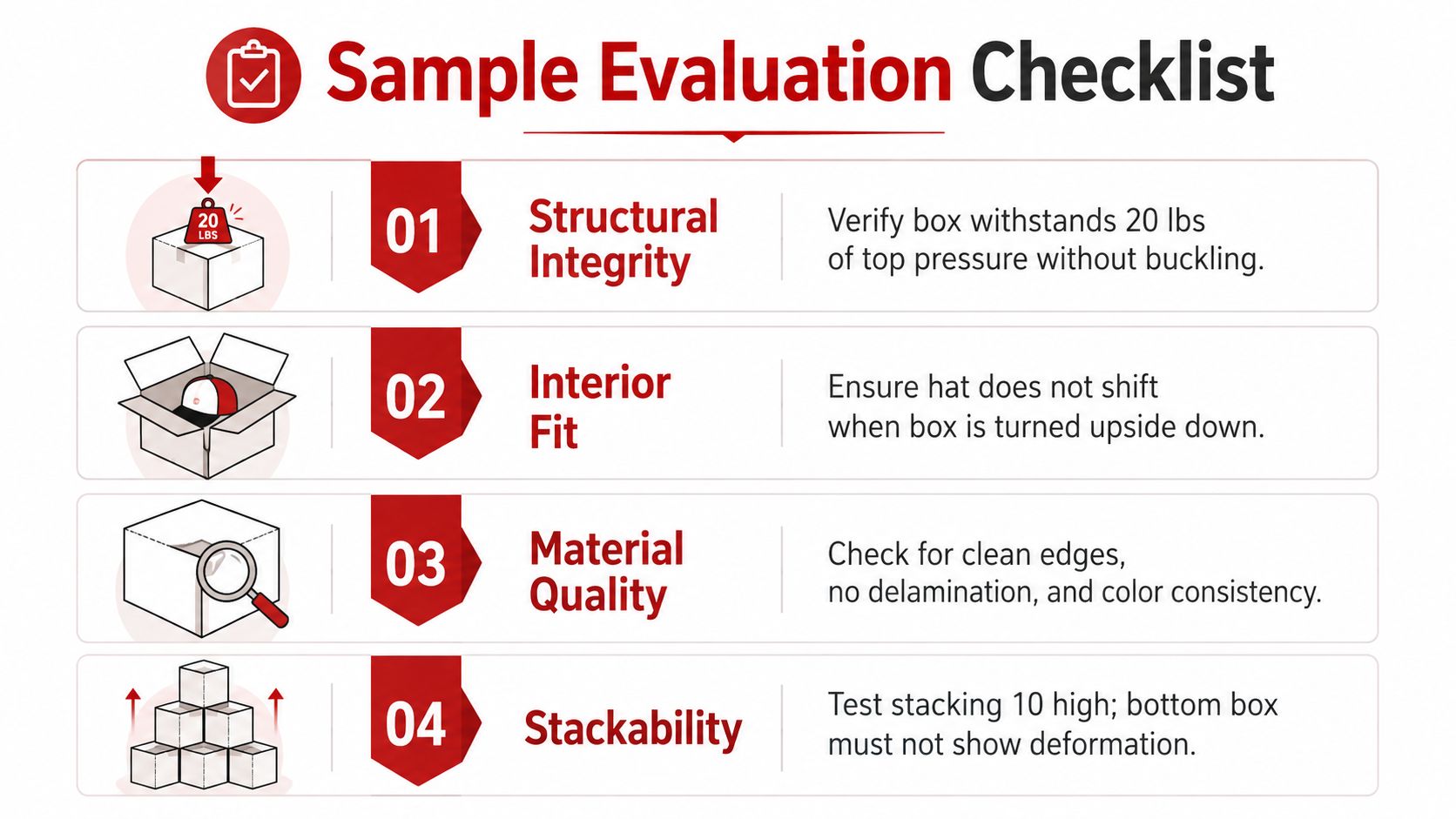
What to test before you place the order
- Structural integrity: Press on the top and sides, then check whether the box flexes too easily or rebounds poorly. A box that caves in under light pressure won't get better in a truck.
- Interior fit: Put the hat inside, close the lid, then turn the box upside down gently. If the hat shifts, the fit is too loose.
- Material quality: Look at corners, folds, glue lines, and printed surfaces. Clean edges matter more than flashy graphics.
- Stackability: Stack the samples and watch for deformation at the bottom. If the sample sags under normal stacking, don't assume bulk units will behave better.
These checks sound basic because they are, and basic failures are what cost money. Most packaging problems aren't mysterious. They're obvious in the sample if someone inspects the sample.
Reject weak samples early
If the supplier can't hold print consistency, lid alignment, or insert placement on the sample, the production run will be worse, not better. Don't let a polished mockup talk you into tolerating sloppy construction. A supplier who misses the sample spec usually misses the full order spec too.
Ask for a replacement sample if the first one fails. If the second one still misses the mark, move on. Your job isn't to rescue a weak factory, it's to protect inventory and margin.
Shipping, Storage, and Total Cost Considerations
The box price is the number suppliers want you to stare at. The number that matters is total landed cost, because freight, storage, and handling decide what lands in your margin. A cheap box that ships poorly or eats too much room is not cheap.
Cube and weight change the math
Box dimensions drive shipping cube, and material weight changes parcel rates. A bulky box that nests badly can cost more to move than a better-designed box with a slightly higher unit price. The same goes for storage, where larger boxes take more space per hundred units and slow down handling.
A standardized internal size of 37 × 36 × 16 cm with a 148 × 160 mm crush-protection insert and about 0.6 kg unit weight shows the tradeoff clearly. Protection and shipping mass pull in opposite directions. That build makes sense when protection matters more than compactness, but it is not the lowest-cost choice for every wholesale buyer.
Flat-pack versus pre-assembled
Flat-pack boxes save storage space and are easier to stage in bulk, but they add assembly time. Pre-assembled boxes cut bench labor, but they usually cost more to ship and store. The better choice depends on where your bottleneck sits, warehouse space, labor, or freight. For a closer look at how box format changes ordering and storage decisions, see our guide to bulk packaging solutions.
If your operation ships from a small backroom or a busy e-commerce floor, flat-pack designs often make more sense. If your team is already overloaded and box assembly slows orders, pre-assembled can be the smarter spend. Measure packing time and compare it to storage savings. Guessing is how buyers end up paying for labor twice.
Supplier pages talk about custom logos and shapes, but they rarely talk about total landed cost or warehouse footprint, even though those numbers decide whether the program works. That gap matters. Sarah's Hat Boxes wholesale page shows the problem clearly, it is product marketing first, operational guidance second.
Sustainability should be practical, not decorative
Buyers do care about recyclability, plastic-free construction, and damage reduction, but those claims need to be backed by the material choice, not just printed on the website. A recyclable box that crushes in transit is still a bad box. A sturdier paper-based build that avoids repeated replacements is usually the better environmental and financial move.
If you are sourcing for multiple markets, keep the packaging spec simple enough to comply across channels without forcing separate programs everywhere. Operational clarity beats green theater every time.