
Foam Trucker Hat Wholesale: A Complete Guide for 2026
USD 28.2 billion is the 2025 value of the global headwear market, and wholesale foam trucker hats make sense inside that bigger demand picture. A clean blank foam front is one of the cheapest ways to get a logo on a cap at scale, but only if you match the construction to the decoration method.
A first-time buyer usually finds this out the hard way. You need hats for a brewery launch, a youth league fundraiser, a merch drop, or staff uniforms, and every supplier page starts looking the same until the print method starts warping the foam, the quote jumps at a lower quantity, or the logo turns out too large for the front panel.
The smart move is simple. Buy the foam style that fits your artwork, order enough to hit a real pricing break, and ask the supplier how the hat will hold up under embroidery, puff, patches, or screen print.
Why Foam Trucker Hats Dominate Wholesale Orders
A brewery owner ordering hats for a taproom opening does not want a fashion project. She wants a cap that looks good on a bar stool, takes a logo cleanly, and stays within budget when the second run comes up. That is why foam trucker hat wholesale orders keep landing on the same shortlist as snapbacks and dad hats, especially for promotions, retail resale, team identity, and event merch.
The buying logic is simple. Foam truckers give decorators a front panel that reads well from a distance, and that front panel is what sells the hat before anyone notices the rest of the build. The style also sits comfortably inside the larger headwear market, which was valued at USD 28.2 billion in 2025 and is projected to reach USD 37.38 billion by 2030, with a 5.8% CAGR over that period, according to the market context in the provided data from Accio's trucker hat best-seller reference.
One customizable foam trucker listing in the same marketplace data shows 2,663 monthly sales at a wholesale price of $6.20. That kind of volume makes the point clearly. This is not a novelty item sitting on the edge of wholesale demand, it is a working SKU with enough turnover to matter for real buyers.
Why buyers keep choosing foam fronts
The foam front gives decorators a clean canvas, and that matters more than most supplier pages admit. A smooth foam panel lets artwork read fast, while the mesh back keeps the hat breathable and easy to wear. That mix is why the style keeps turning up in brewery orders, team programs, retail drops, and event merch.
Practical rule: if your logo needs to be seen fast, foam truckers beat busy fabrics and textured fronts every time.
The advantage is not just appearance. Foam fronts also give buyers more room to choose the right decoration method without changing the basic hat style. A team order can start as a small promotional run and later become a retail restock, which is why wholesalers keep them in the catalog next to structured cotton-twill truckers. Foam still wins when the buyer wants a bold front and a lower-risk decorating surface.
Before you quote anything, use the internal guide on what is a trucker hat as the basic frame for the style. For production planning, the better move is to think like a decorator, not just a shopper. The right front construction decides whether embroidery sits flat, puff stands up, patches bond cleanly, or screen print holds detail without fighting the surface.
Anatomy of a Foam Trucker Hat
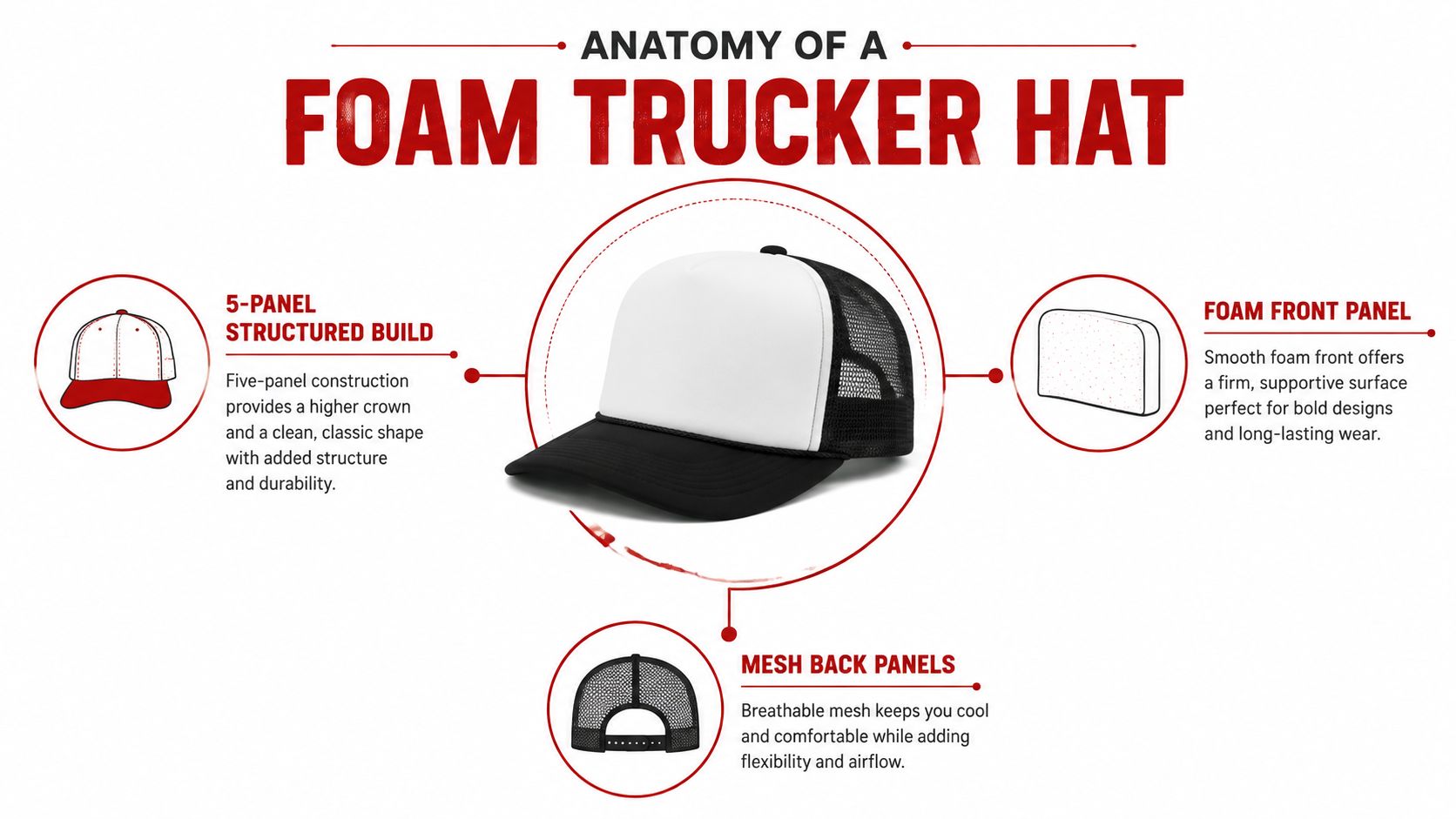
A foam trucker hat is usually a 5-panel, structured cap with a foam front panel and mesh back. For a broader hat-definition refresher, see our guide on what is a trucker hat. Common wholesale specs include a 3.5 to 4.0 inch crown, a pre-curved or curved visor, and a plastic snapback closure, which is why the style works as a one-size-fits-most option in adult assortments. Standard adult sizing is usually around 58 cm / OSFA in the supplier data from Foremost Hat's foam mesh trucker product page.
The front panel is the part that decides how the hat performs in production. On a foam trucker, the face is smoother and less seam-heavy than many other cap constructions, so logos sit cleanly on the front of the hat. That is why this style keeps showing up in custom programs for breweries, teams, and resale brands. If the front panel is wrong, the rest of the hat does not save the order.
What to check before you buy
- Panel count: A true 5-panel front gives you a larger uninterrupted decoration zone than a chopped-up front.
- Crown depth: A deeper crown gives more visual presence, which helps bold logos and larger artwork.
- Visor shape: Curved visors feel more traditional, while pre-curved options save finishing time.
- Closure type: Plastic snapback closures are the standard wholesale answer because they fit most adult buyers.
- Fit variants: Recent assortments also show low-profile foam options and women's foam trucker hats, which matter when fit and audience segmentation are part of the order.
Decoration method is where foam construction really matters. A foam front can hold embroidery cleanly when the design stays simple, while puff embroidery works better on styles with enough front structure to keep raised stitching from collapsing. Patches are the safest choice when you want a crisp logo on a foam face, and screen print works when the art is flat, bold, and not overloaded with fine detail. That is the part wholesale listings usually skip, even though it is the difference between a hat that sells and a hat that gets rejected on proof.
For buyers comparing hat formats, the main point is simple. A foam trucker is a specific construction built for easy decoration and broad fit, which is why it keeps getting pulled into bulk orders.
If you need help turning artwork into a production-ready file, how to make custom hats is a useful companion read because it shows how decoration decisions start before the press ever touches the cap.
Wholesale Pricing Tiers and What Drives the Breakpoints
Wholesale foam trucker pricing lives or dies on quantity. At 100 pieces, plain foam-front or cotton-twill-front trucker hats usually land around $4.80 to $7.20 per hat FOB. At 1,000 pieces, that commonly drops to $2.55 to $3.80 per hat. At 5,000 pieces, clean production runs can reach $1.85 to $2.95 per hat, according to the sourcing guidance in Crownsforge's wholesale trucker hat pricing overview.
That curve is the whole game. A small test run costs more because setup, handling, and decoration overhead get spread across fewer units. A bigger run turns the same production logic into a lower unit cost. That's why a buyer who wants retail margin or promo efficiency should think in volume, not just in sticker price.
Decoration method changes the quote
The same pricing guide lists average unit costs for bulk orders of 100 plus pieces at $2.50 to $4.00 for logo trucker hats and $3.00 to $5.50 for graphic trucker hats in the cited wholesale overview. That spread tells you what suppliers already know, simple logo work is easier to price than fuller graphic treatment. The more artwork complexity you add, the more you should expect the quote to move up.
There's also a useful real-world comparison in the provided data from the video-based wholesale reference. Blank foam-front trucker hats can fall from about $9.43 each at 24 units to $6.67 each at 1,200 plus units, which shows how hard quantity breaks can hit the final price. Buyers who stay at test-run levels are paying for convenience. Buyers who commit to scale are paying less per hat because the run gets more efficient.
Budget rule: if your first quote feels high, check the quantity before you blame the supplier.
The right question isn't “is this cheap?” It's “does this price match the size of the order and the decoration complexity?” If the quote is built like a retail order but you're buying wholesale, you're leaving margin on the table.
Matching Decoration Method to Foam Construction

Foam is not cotton twill. That's the first thing decorators need to respect. The foam front is more heat-sensitive than standard cotton twill, so the safe decoration zone is usually about 5.5 inches wide by 2.25 inches high, with an upper limit around 5.75 by 2.5 inches only when the operator is careful, based on the production guidance in the foam trucker decoration video reference.
Which method fits which job
Embroidery is solid when the artwork is simple and the stitch count stays controlled. It gives the cap a premium retail feel, but dense stitching can stress a foam front if the artwork is too large or too detailed.
3D puff embroidery is the premium move for branded foam fronts. It creates raised impact and pairs well with the hat's structured face. If you want the logo to pop on shelf and in photos, this is usually the strongest option.
Custom patches are the safest answer when you care most about protecting the foam. They sidestep the direct heat issue, which makes them a smart pick for textured logos, multi-layer artwork, or situations where you want less risk of warping.
Screen print can work, but it's the method most likely to punish sloppy setup. If the operator rushes the heat or presses too hard, foam can warp or crack. On a foam front, that's not a small defect, it's a product-killer.
Decoration rule: if the logo has to survive repeated wear and a rougher customer base, patches or puff embroidery are usually the better bet than direct print.
For supplier-level context on production options, the internal page on printing and embroidery is a useful reference point. In plain terms, choose the method that matches the foam, not the one that looks easiest on paper.
Minimums, Lead Times, Proofs, and Samples
First-time buyers waste time by skipping the operational questions. They send artwork, wait, and then discover the supplier has a minimum, a proof cycle, or a production queue that doesn't fit their deadline. For foam trucker hat wholesale orders, the cleanest path is to ask about minimums, sample availability, and proofing before you approve anything.
A serious distributor should tell you what the digital proof includes, not just say “we'll send a mockup.” You want placement, thread or print treatment, and artwork scale shown clearly. If the proof doesn't make those basics obvious, it's not ready for approval.
What to ask before you commit
- Minimum order rules: In the publisher data, in-house embroidery starts at just six pieces per logo, which is the kind of low barrier first-time buyers should look for.
- Sample path: Ask whether you can see a sample or a pre-production version before the full run.
- Revision process: Know how many proof rounds you get before delays start.
- Turnaround logic: Faster decoration is easier on simple orders, slower on complex ones.
- Communication window: A responsive team during business hours matters more than a flashy catalog when your deadline is real.
If a supplier decorates in-house, speed and control usually improve because the same team can handle review, setup, and production. Outsourced decoration often adds handoffs, and handoffs create delay. That's not a moral judgment, it's just how production lines work.
You should also expect clear timelines from artwork upload to shipment, not vague promises. A sample helps you catch placement issues early, which is cheaper than discovering a misread logo after cartons are packed.
Who Buys Foam Trucker Hats and How Each Group Customizes
A coffee shop owner and a merch seller might buy the same hat, but they are not solving the same problem. The coffee shop wants staff visibility and a giveaway that looks clean at the counter. The merch seller wants a product that can sit on a shelf and protect margin. Foam truckers work for both because the front panel gives each buyer a clean branding surface.
Different buyers, different priorities
Small businesses keep the artwork simple. A one-color logo on the front, maybe a staff phrase or small mark, is enough because the goal is recognition, not an overworked design.
Sports teams and leagues want louder visuals. They often ask for full-color artwork, player names, or numbers on the back, because the cap is part of the team identity kit rather than a basic promo item. On foam-front hats, embroidery works best when the art stays bold and the stitch count stays controlled. Puff embroidery can look sharp on thicker foam fronts, but only if the panel has enough structure to hold the raised effect without collapsing. Patches are the safer play for detailed logos because they let the foam front do less of the work.
Apparel brands and merch creators treat the hat as a resale SKU. They care about blank quality, decoration consistency, and whether the front panel looks retail-ready under photo lighting. Screen print can work here, but only on flatter foam panels with enough surface control. If the front is too soft or too textured, the print can look loose, and that hurts the retail read.
Event planners, schools, and nonprofits buy under time pressure. They need something that can move quickly through approval and still look good in a group setting. If the program is for a fundraiser or awareness campaign, the design needs to be readable from a distance, so clean patch work or simple print usually beats crowded artwork.
Resellers and decorators buy the deepest volume. They often mix blank stock with decorated inventory so they can fill orders at different price points without waiting for a new production cycle. They also care about the difference between branding and design because a hat can carry a clear message and still fail if the decoration method fights the foam construction.
One buyer may want a raised logo that feels premium. Another wants a flat mark that survives packing, shipping, and repeat wear. The foam front decides which option makes sense.
Choosing a Wholesale Supplier Without Getting Burned
A weak supplier will make a simple cap order feel complicated. A good one gives you real brand options, straightforward wholesale pricing, clear minimums, and proof files that match the product. That's the standard.
Start with assortment. A legitimate wholesale partner should carry recognized names like Richardson, YP Classics, New Era, Valucap, and Legacy, plus enough style variety to handle low-profile, structured, and trucker builds. Then check whether the pricing is everyday wholesale, not inflated retail with a fake discount overlay.
Supplier evaluation checklist
| Criterion | What to Look For | Red Flag |
|---|---|---|
| Brand assortment | Known headwear brands and multiple cap styles | One narrow style wall with no depth |
| Everyday wholesale pricing | Clear bulk pricing without retail markup games | “Sale” pricing that still looks high |
| Minimum order quantities | Simple, stated MOQs with no guessing | Hidden minimums until checkout |
| Sample availability | A sample or proof path before production | No sample policy at all |
For broader operational visibility, the supply chain visibility guide for growth is useful because it reinforces the value of knowing where your stock and deadlines stand before you commit. In hat buying, that visibility matters more than slick product copy.
Also check proof turnaround, photo galleries, and reviews. If a supplier can't show previous work, can't explain response windows during business hours, or won't state whether decoration is in-house, you're taking unnecessary risk. Foam trucker orders move fast when the process is clean, and they stall fast when the supplier is vague.
Placing Your First Wholesale Order With Confidence
The first order gets easier when you stop treating it like a guess. Match the decoration method to the foam front, aim for a real quantity break, ask for a sample, and work with a distributor that gives you clear proofs and in-house production. That sequence protects your margin and your timeline.
Use the order path that removes doubt. Pick the blank style, finalize the artwork, request a digital proof, approve a sample if needed, then place the production order. If you need a cleaner route into the buying process, the custom order form is the right place to start with a real spec instead of a loose email thread.
Foam trucker hats stay strong because they're simple to wear, easy to brand, and scalable from test run to bulk run. If you respect the foam front, the order usually comes out right.
Dirt Cheap Headwear supplies wholesale blank hats and custom-decorated headwear for businesses, teams, brands, and events, including foam truckers built for embroidery, puff, patches, and print. If you're ready to place a foam trucker hat wholesale order with clear proofing and low minimums, visit Dirt Cheap Headwear and start with the style that fits your artwork and budget.