You’re probably here because you need hats people will want to wear. Not hats that end up in a box under the signup table, and not hats that look good in a mockup but come out stiff, crooked, or cheap once the embroidery hits the front panel.
That’s where flat bill hats custom orders get interesting. They can look sharp, modern, team-ready, and retail-worthy. They can also go sideways fast if the blank is wrong, the artwork isn’t built for embroidery, or someone treats a flat bill like any other cap.
A lot of guides stop at “upload your logo and pick a color.” That’s not enough. Flat bills have their own rules, especially if you want 3D puff, clean small text, or a structured front that keeps its shape after real wear. If you’re placing your first serious order for staff, merch, a team, or an event, the details matter more than the trend.
From Idea to Iconic Headwear
A coffee shop owner wants staff merch that doesn’t look like staff merch. A softball coach wants hats players will wear off the field. A startup wants something that feels more like brand gear than giveaway swag. Those are the jobs where flat bills usually rise to the top.
The silhouette does a lot of work for you. A structured crown gives your logo presence. A snapback closure keeps sizing simple. The flat visor reads cleaner and more current than a basic promo cap, especially for streetwear, youth teams, breweries, gyms, and creator brands.
That demand isn’t niche anymore. The global baseball cap market was valued at $19.0 billion in 2024 and is projected to reach $35.0 billion by 2034 at a 6.3% CAGR, according to Market.us reporting on the baseball cap market. The same source notes that New Era generated $1 billion in 2022 revenue from headwear alone. That tells you something simple. Buyers don’t see caps as throwaway accessories. They see them as part of identity.
Custom headwear works best when the hat feels like something the wearer chose, not something they were handed.
The first good decision usually isn’t the logo. It’s choosing the right hat body and decoration method for how the hat will be used. A retail merch drop needs different priorities than a school fundraiser. A team hat has different needs than a bar staff uniform hat.
If you get those early choices right, the rest gets easier. The embroidery lands better. The proof process goes faster. The finished hat looks intentional instead of improvised.
Choosing Your Perfect Blank Hat
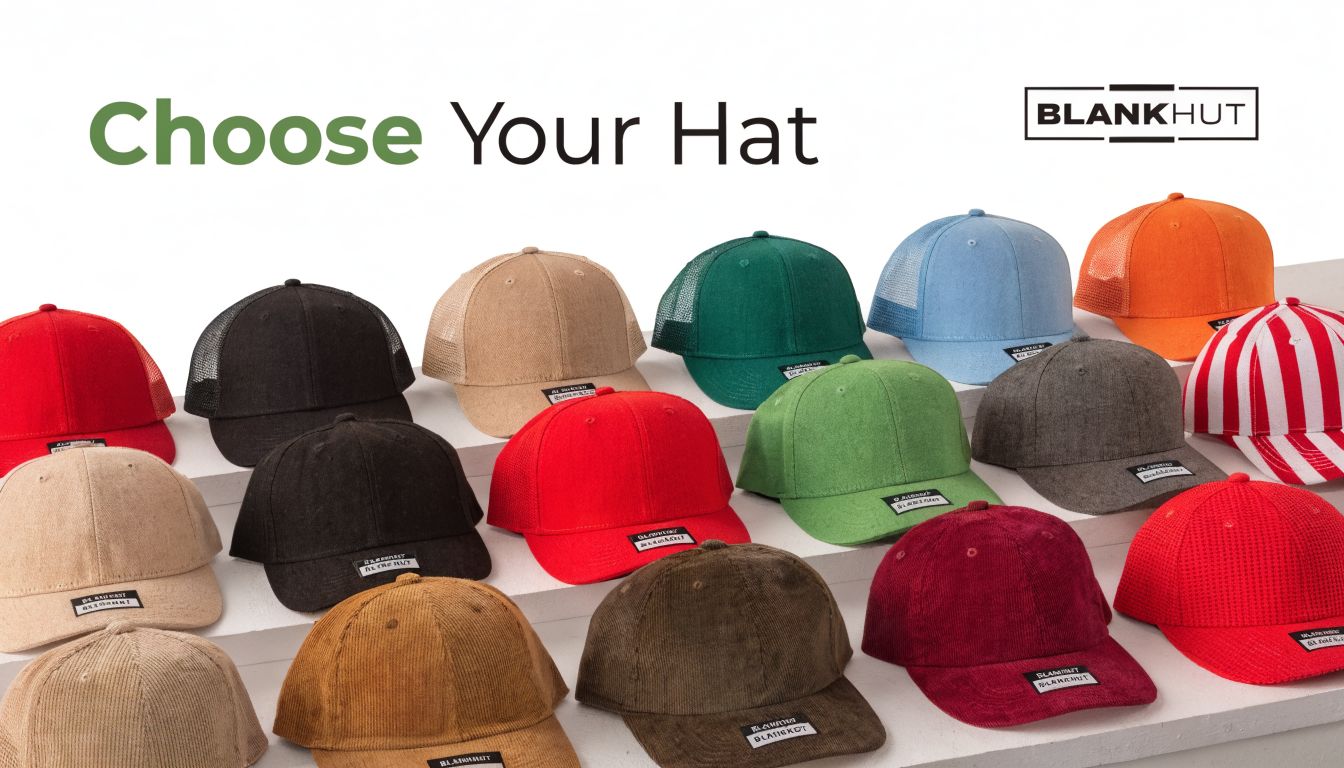
The blank matters more than most first-time buyers expect. Two hats can look similar online and sew out completely differently once a logo is stitched on the front.
The market gives you plenty of options because demand is real. The U.S. custom headwear market generates around $4.1 billion annually, and baseball caps and dad hats make up about 62% of that segment. The same market analysis notes that custom embroidered structured caps on Amazon can sell 280 to 420 units weekly per seller, which is a strong signal that buyers keep coming back to this category through Shelf Trend’s custom baseball hats market analysis.
Start with structure
If you want the classic flat bill look, most buyers end up choosing a structured hat. That front panel has reinforcement, so it holds shape and gives embroidery a firm surface.
Unstructured flat bills exist, and they can look great for softer lifestyle brands. But they’re less forgiving. If your logo is dense or your digitizing is heavy, the crown can pull or ripple.
For most first orders:
- Structured snapbacks work best for teams, staff uniforms, breweries, and merch tables.
- Unstructured styles fit brands chasing a more relaxed, fashion-forward look.
- Mid-profile shapes feel easier for a broad audience.
- High-profile crowns give bigger front-panel presence and usually suit bold logos better.
Pick the right panel layout
Panel count changes how your logo sits.
| Hat build | Best use | Watch for |
|---|---|---|
| 5-panel | Wide, simple logos and cleaner front branding | Taller art can feel cramped |
| 6-panel | Most logos, team marks, and standard embroidery layouts | Center seam can affect detailed designs |
A 5-panel flat bill gives you a smoother uninterrupted front. That’s nice for patches and clean wordmarks. A 6-panel is the workhorse. It’s what most buyers mean when they ask for a custom flat bill snapback.
Match material to the job
Material changes both look and sew quality.
- Cotton twill feels classic and takes embroidery well.
- Acrylic or wool blends hold shape nicely and fit traditional snapback styling.
- Poly blends are useful for active wear, staff uniforms, and warmer conditions.
- Mesh-back truckers breathe better and keep the front panel structured for decoration.
If you’re still comparing options, browsing a wholesale selection of blank baseball caps helps narrow the field quickly.
Brand names matter for consistency
Richardson, YP Classics/Flexfit, and New Era stay popular for a reason. Their fits are familiar, their color programs are dependable, and decorators know how they behave under embroidery.
That doesn’t mean you always need the most premium label. It means you should choose a blank that matches the role. Retail-style merch deserves one kind of hat. Event volume often calls for another.
Selecting the Right Decoration Method
Decoration is where good hats become memorable hats. It’s also where a lot of buyers accidentally overspend or choose the wrong method for their artwork.
Compare popular methods to find the perfect match for your design, budget, and desired look for flat bill hats.
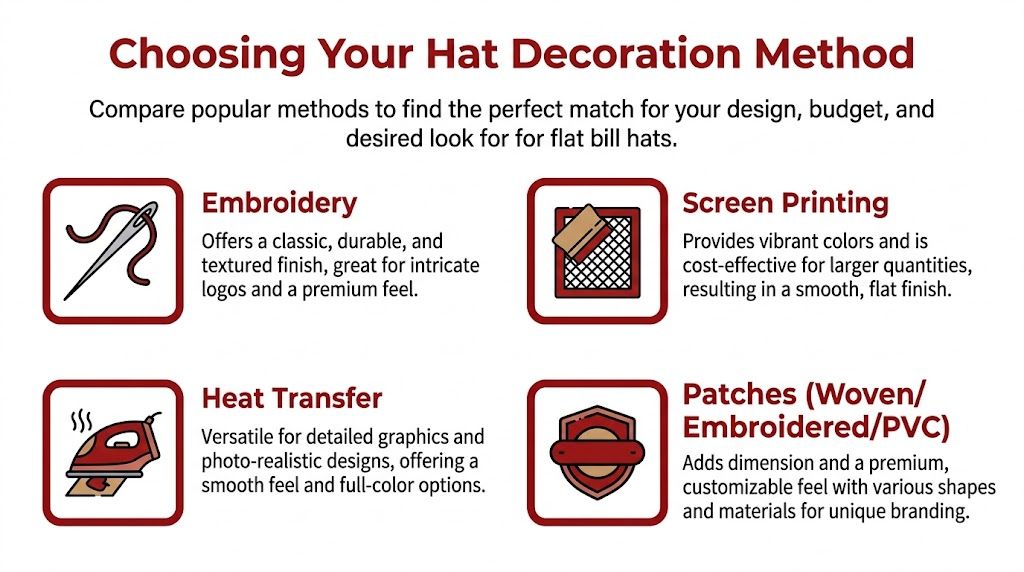
The quick comparison
| Method | Best for | What it looks like | What to avoid |
|---|---|---|---|
| Flat embroidery | Logos, initials, team names | Classic, textured, durable | Tiny details and very fine gradients |
| 3D puff embroidery | Bold lettering and simple icons | Raised, high-impact front logo | Thin strokes, small text, crowded art |
| Patches | Detailed logos, badge-style branding | Layered and premium | Poor patch sizing on small fronts |
| Screen printing or transfers | Larger graphics and full-color art | Smooth, flatter surface | Expecting deep texture like embroidery |
Flat embroidery
This is still the safest default for most flat bill hats custom projects. It looks clean, holds up well, and works across a wide range of blanks.
If your logo is a simple wordmark, monogram, mascot head, or bold icon, flat embroidery usually gives the best balance of price, durability, and readability. It’s also easier to keep consistent across repeat orders.
Good use cases:
- Team caps with initials
- Business logos with clear shapes
- Staff hats with straightforward branding
Less ideal:
- Fine-line illustrations
- Heavy shading
- Small text stacked into a tiny chest-logo style lockup
3D puff embroidery
This is the option people ask for when they want the logo to pop. On a structured flat bill, puff can look excellent. On the wrong design, it can look swollen, uneven, or messy.
Practical rule: Puff embroidery likes bold shapes, open spacing, and letters with enough width to support foam underneath.
Use it for:
- Block lettering
- Simple initials
- Minimal icons
- Streetwear-style front branding
Don’t use it for:
- Script fonts with skinny connectors
- Detailed crests
- Fine outlines around every letter
A lot of first-time buyers assume puff makes any logo cooler. It doesn’t. Puff makes the right logo cooler.
Here’s a useful cost reference if you’re also weighing apparel and decoration choices beyond hats: screen printing cost.
Patches
Patches solve problems embroidery can’t always solve cleanly. If your logo has a lot of detail, patch-based decoration can preserve shape better than direct stitching.
Different patch styles create different moods:
- Woven patches work better for finer detail.
- Embroidered patches feel traditional and textured.
- PVC patches skew modern and outdoorsy.
- Leather-style patches fit heritage, workwear, and lifestyle branding.
Patches also help when you want a custom shape instead of a standard stitched logo footprint.
Printing and transfers
Direct printing on flat bill hats is more situational, but it has a place. If your design depends on smooth gradients, photo detail, or multiple colors that embroidery would simplify too much, transfers or print methods can make more sense.
This video gives a useful visual look at decoration in action.
The method that usually wins
If the logo is simple and bold, go embroidery. If the art is detailed, consider a patch. If the graphic depends on color transitions or photo-like detail, look at transfer-based decoration.
What doesn’t work is forcing every design into one method just because it sounds premium.
Nailing Your Artwork and Design Specs
A strong hat starts with artwork that’s built for thread, not just for screens. At this stage, a lot of custom jobs get rescued or ruined.
Use files that can actually be produced
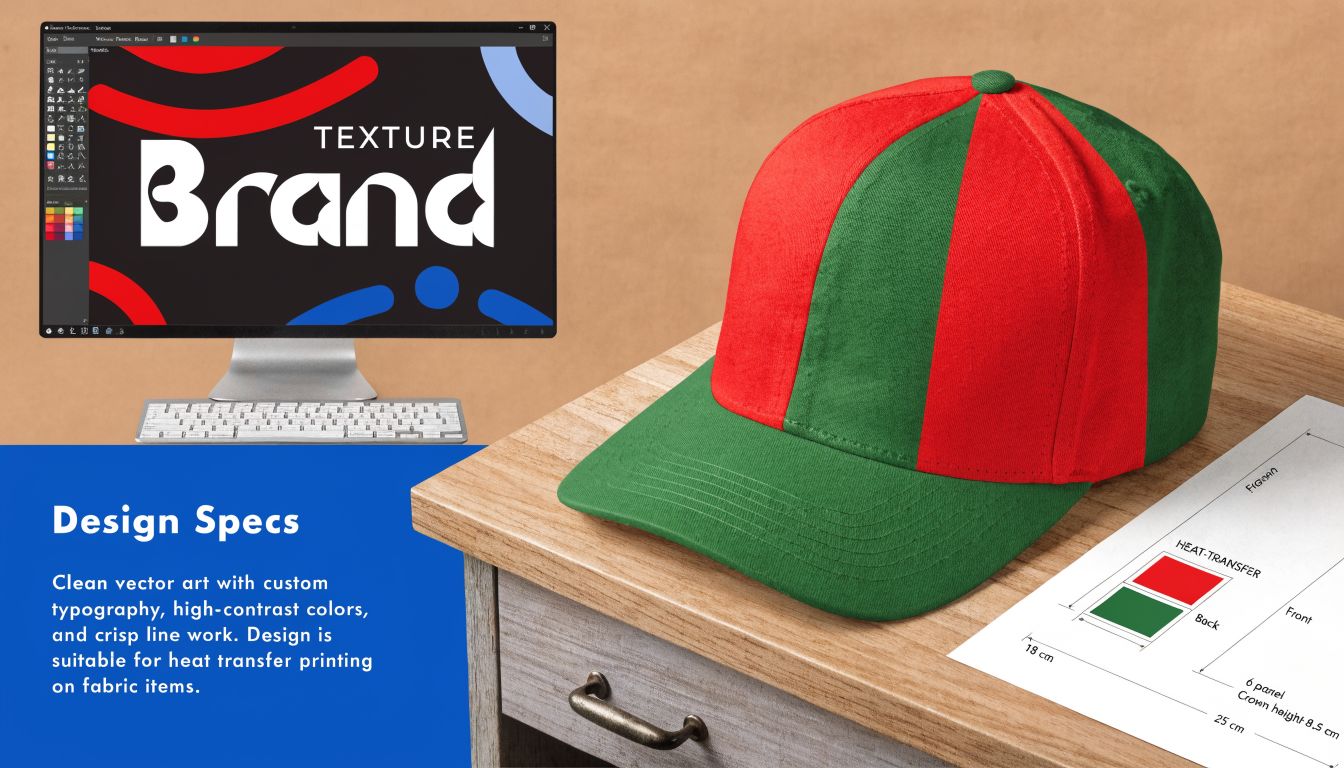
The cleanest starting point is vector art. AI, EPS, and clean PDF files are easier to scale, edit, and digitize accurately than low-resolution JPEGs or screenshots.
If all you have is a PNG, that’s not the end of the world. But expect cleanup. Jagged edges, faint outlines, and tiny text that looked acceptable on a phone screen often fall apart on a hat proof.
A few practical file rules help a lot:
- Send vector when possible. It gives the digitizer clear shapes to work from.
- Separate colors clearly. That helps with thread selection and proofing.
- Avoid tiny text. If it’s hard to read on your monitor at small size, it probably won’t improve in thread.
- Know your brand colors. If you care about consistency across signs, packaging, apparel, and headwear, building a cohesive brand look makes those decisions easier.
Flat bills have embroidery-specific challenges
A structured flat bill gives you a nice front canvas, but that doesn’t mean every logo belongs there at full complexity. Thick front panels, seam placement, and stiff construction change how stitches behave.
The embroidery process itself has technical limits. For high-quality flat bill embroidery, machines are typically calibrated to 600 to 800 stitches per minute, and Novae Apparel’s manufacturing overview notes that thread breaks can cause up to a 12% failure rate in high-density designs on uncalibrated machines. The same source says 40wt polyester thread with a 2 to 3mm foam underlay is standard for durable 3D puff effects.
That matters because many flat bill problems are really art problems in disguise.
What goes wrong most often
The common trouble spots are predictable:
- Overly dense fills pull the front panel and make the crown look puckered.
- Thin outlines disappear or get inconsistent.
- Small counters inside letters close up.
- Puff designs with narrow strokes don’t hold foam cleanly.
- Artwork placed too low can fight the cap seam or curve of the front.
On flat bills, the best-looking logo is rarely the most detailed version of your logo. It’s the version rebuilt for thread.
How to prep artwork that sews cleanly
Instead of asking whether the logo can fit, ask whether the logo can breathe.
For direct embroidery, simplify first. Remove tiny trademark text if it won’t read. Thicken fragile lines. Open up letter spacing. If your logo has a stacked lockup, consider using just the icon on the front and moving the full name to the side or back.
For puff, simplify even harder. Puff rewards bold shapes and punishes clutter.
A digitizer should translate your art into a stitch path, not just trace it. Underlay, pull compensation, direction changes, and stitch density all affect how the finished front looks. If you want a better sense of that process, this guide on how to digitize a logo for embroidery is worth reviewing before you approve art.
A smarter approval mindset
Don’t only ask, “Does this mockup look right?”
Ask:
- Is the text still readable at actual hat size?
- Does the logo feel centered on this crown shape?
- Are we using puff because it helps the design, or just because it sounds cool?
- Would a patch preserve more detail?
That one pause before approval saves a lot of regret.
Navigating the Custom Order Process
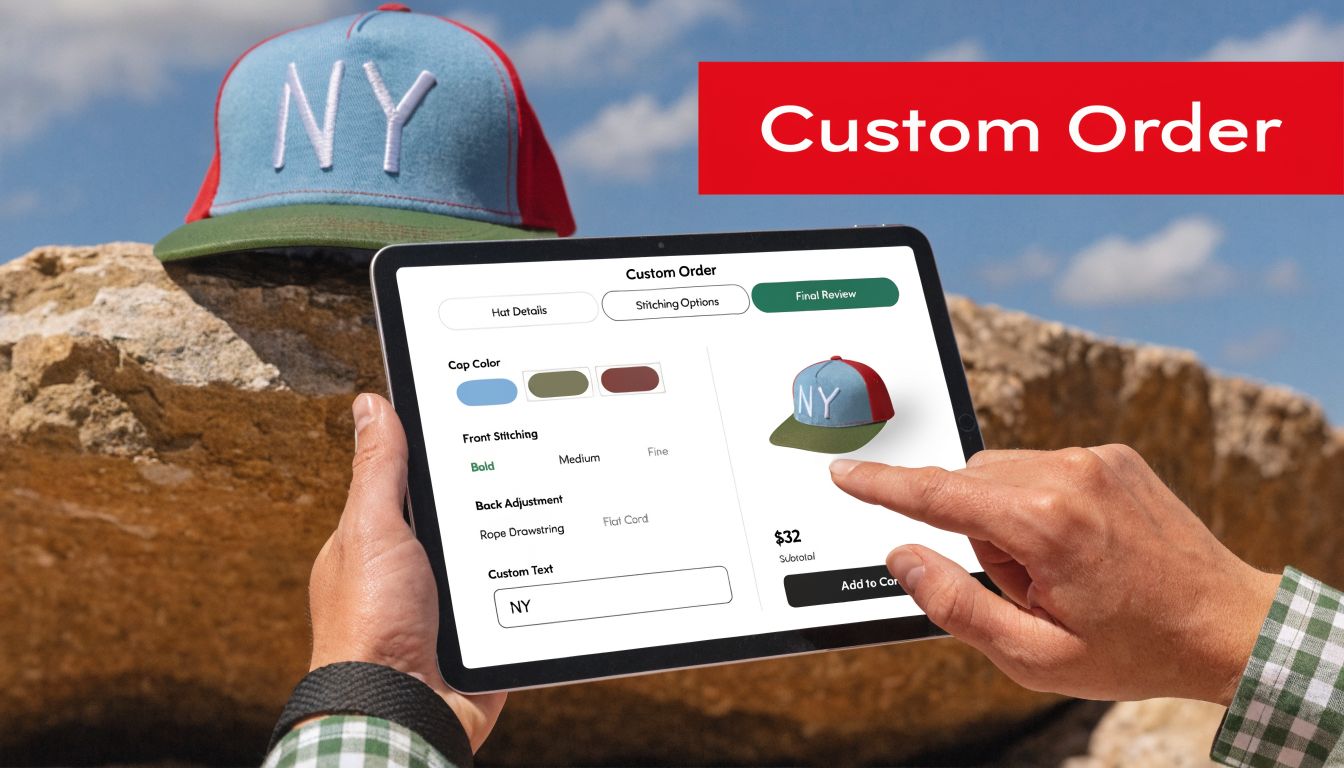
The order process feels simple once you know what to watch. Most stress comes from approving too fast, asking for too much detail on the wrong blank, or waiting too long to place the order.
What affects price first
Blank choice matters. Decoration method matters. Quantity matters. So does the complexity of the logo.
If you’re buying at larger volume, custom headwear scales well. Marketplace data cited earlier shows Alibaba B2B sellers handling 20 to 60 weekly OEM orders for custom caps at $6 to $14 per unit on 100+ piece quantities, a useful benchmark from the source already referenced in the opening section.
That doesn’t mean every order should be huge. It means headwear is one of those categories that can start small and still support bigger repeat runs later.
The proof stage is where smart buyers slow down
Most mistakes happen after the quote and before production. This is the point where buyers feel eager to move, so they glance at the mockup, check the color, and approve. That’s how misspellings, odd placement, and bad scale sneak through.
When you review a proof, check these items in order:
- Spelling and punctuation. Especially for team slogans and event names.
- Logo size. A logo can be technically centered and still look too small.
- Placement. Front-center, side, back, and underbill all read differently.
- Thread color contrast. A subtle tone-on-tone design may look elegant or invisible.
- Hat color accuracy. Black, charcoal, navy, and dark heather can change the feel of the same logo.
Approve the proof as if you’re the one receiving every hat personally. That mindset catches details.
Keep your first run practical
For a first big order, don’t build the world’s most complicated hat. Choose one strong blank, one front decoration, and a clear logo. Add side or back embroidery only if it serves a purpose.
A simple launch order does three useful things:
- It shows you how the audience responds.
- It gives you a baseline for reorders.
- It reveals whether your logo needs refinement for headwear.
If the hats are for a season, launch, or event, leave room for revisions and shipping. The best custom hat jobs are rarely the fastest approved. They’re the ones with a buyer who took the proof seriously.
Pro Tips for Optimizing Cost and Quality
The cheapest hat isn’t always the best value. The most expensive one isn’t automatically the right one either. Good buying comes from knowing where quality shows and where it doesn’t.
Spend where people notice
People notice the fit, crown shape, front embroidery, and overall feel first. They usually don’t notice whether your logo had one extra thread color or whether the side hit was overly elaborate.
If budget is tight, protect these elements:
- A blank that fits your audience
- A front logo with strong contrast
- A decoration method that suits the art
Cut complexity before you cut the core experience.
Simplify the art before you downgrade the hat
A busy logo costs more to sew and often looks worse on a cap. Clean logos generally outperform fussy ones on headwear.
That means:
- remove micro text
- reduce color changes
- avoid oversized stitch-heavy fills
- use one strong mark rather than several small competing elements
A simpler design often looks more premium, even when the budget is modest.
Budget blanks have a place
Premium brands get a lot of attention, but they’re not the answer for every project. Budget-friendly blanks from brands like Otto can offer 30 to 40% lower unit pricing with comparable embroidery durability, according to LogoSportswear’s flat bill category reference.
That makes them a practical choice for:
- nonprofits
- school events
- large volunteer groups
- promotional runs
- online sellers testing a new design
If you’re building a retail brand, premium blanks may still be worth it. If you’re outfitting a large one-time event, a solid budget blank can be the smarter move.
One small upgrade that pays off
Add one thoughtful touch instead of several random ones. A clean side hit, a back wordmark, or a contrasting underbill can enhance the project. Three extra ideas at once usually clutter it.
The best custom flat bill hats look edited. Not overloaded.
Launch Your Custom Headwear Program
At this point, the process is a lot less mysterious. You know the blank affects the result. You know the decoration method has to match the artwork. You know flat bills reward clean design and punish overcrowded embroidery.
That’s the difference between buying hats and building a headwear program. A good program is repeatable. You can reorder it. Staff will wear it. Customers will buy it. Teams will ask for it again next season.
If you’re putting this into a broader brand rollout, it helps to think beyond the hat itself. These small business branding tips are a useful reminder that consistency across merch, signage, packaging, and event materials makes every branded item work harder.
The smartest first order is usually not the flashiest one. It’s the one with the right blank, a logo built for thread, and a proof approved carefully. Start there, then expand into alternate colors, patches, seasonal drops, or premium versions once you know what your audience responds to.
Custom flat bills can absolutely become the item people remember your brand by. But the win comes from good decisions, not just a good logo.
If you’re ready to turn your idea into a clean, wearable custom hat, Dirt Cheap Headwear makes it easy to start with the right blank, the right decoration method, and low-minimum custom embroidery. Whether you need a small test run or a larger wholesale order, their team can help you get hats that look right before you commit to production.