You’re probably here because you’ve seen another brand, team, brewery, gym, or local business wearing sharp custom snapbacks and thought, “We need that.” Not generic promo hats. Not a one-off print-on-demand sample that looks decent on a screen and underwhelms in hand. Actual flat bill hats people want to wear.
That’s the right instinct. A well-made flat bill doesn’t behave like throwaway merch. It acts more like a uniform piece, a retail item, or a visible brand marker your crew keeps in rotation. For a startup or small team, that matters. You don’t need a massive order to make a strong impression. You need the right blank, the right decoration method, and a proof that won’t surprise you when the box arrives.
From Idea to Iconic Headwear
A common first project starts the same way. A coach wants hats for assistant staff and captains. A small coffee shop wants something the owner can wear behind the counter and also sell near the register. A startup wants six to twelve hats for a launch event without sinking money into a huge run before anyone has tested the look.
That’s where flat bills make sense. They already carry cultural weight, so your logo starts on a product people recognize as current rather than disposable. The broader demand backs that up. The custom headwear market reached a global value of over $3.5 billion by 2022, and flat bill styles gained traction around 2010 through hip-hop culture and streetwear. By 2015, they accounted for approximately 25% of the total baseball cap market in the U.S. according to LogoSportswear’s flat bill category overview.
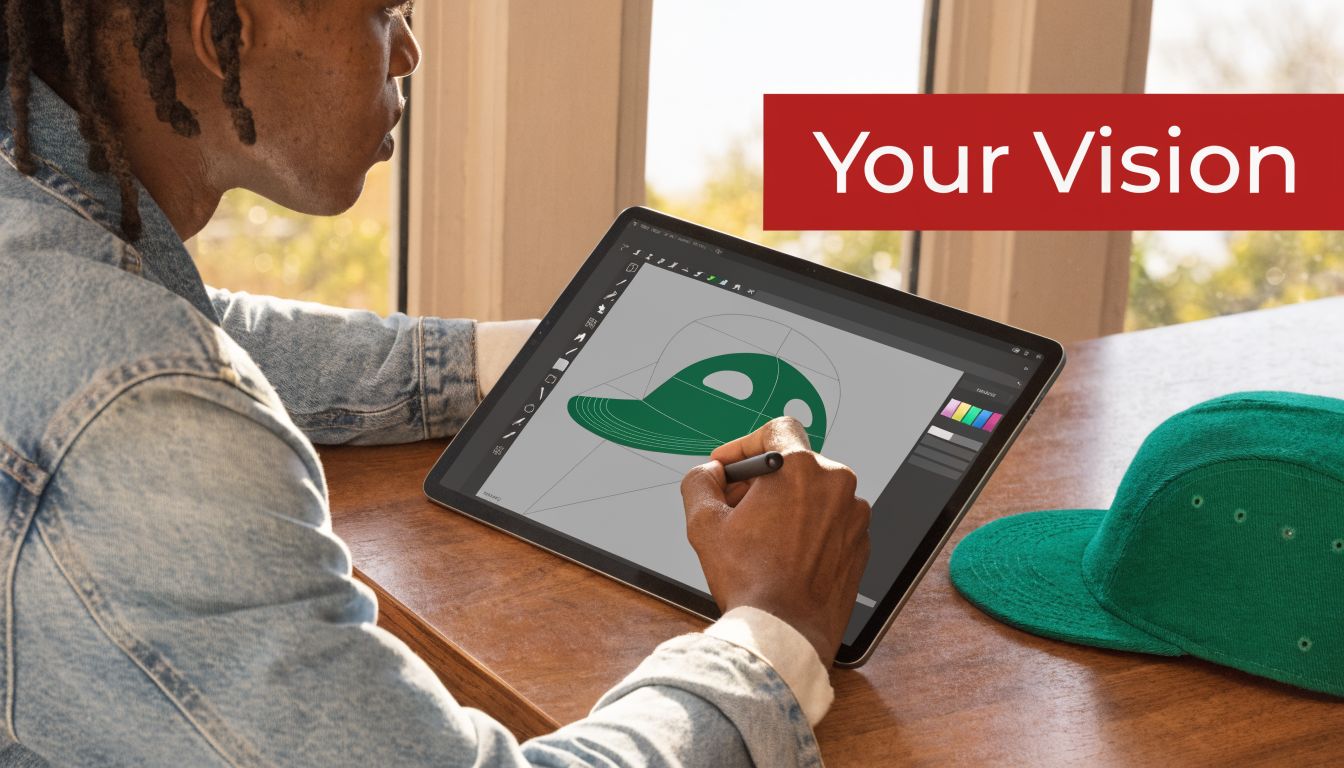
That doesn’t mean every logo belongs on every flat bill. Some designs look clean and premium with direct embroidery. Some need the extra edge of a patch. Some should never be stitched without simplification first. The smart move is to treat the project like product development, even if you’re only ordering six hats.
What small-batch buyers usually need
Small businesses and teams rarely need endless options. They need fewer mistakes.
Most first-time buyers are trying to answer a short list of practical questions:
- Which blank fits our audience: streetwear snapback, team cap, or workwear-style structured hat?
- Which decoration method suits our logo: standard embroidery, 3D puff, or patch?
- How do we avoid proof mistakes: wrong thread color, undersized logo, awkward placement?
- Can we test before scaling: start small, then reorder if the hat lands well?
A six-piece run can tell you more than a giant order ever will. You find out if people actually wear the hat, how the logo reads at a distance, and whether the style fits your audience.
When people say they want to customize flat bill hats, they’re usually not asking about the hat alone. They’re trying to turn a logo into something wearable and credible. That process starts with the foundation.
Choosing the Right Hat Foundation
A first-time buyer usually notices the logo first. The person wearing the hat notices the blank. If the crown feels awkward, sits too high, or collapses in the wrong place, the design never gets a fair shot.
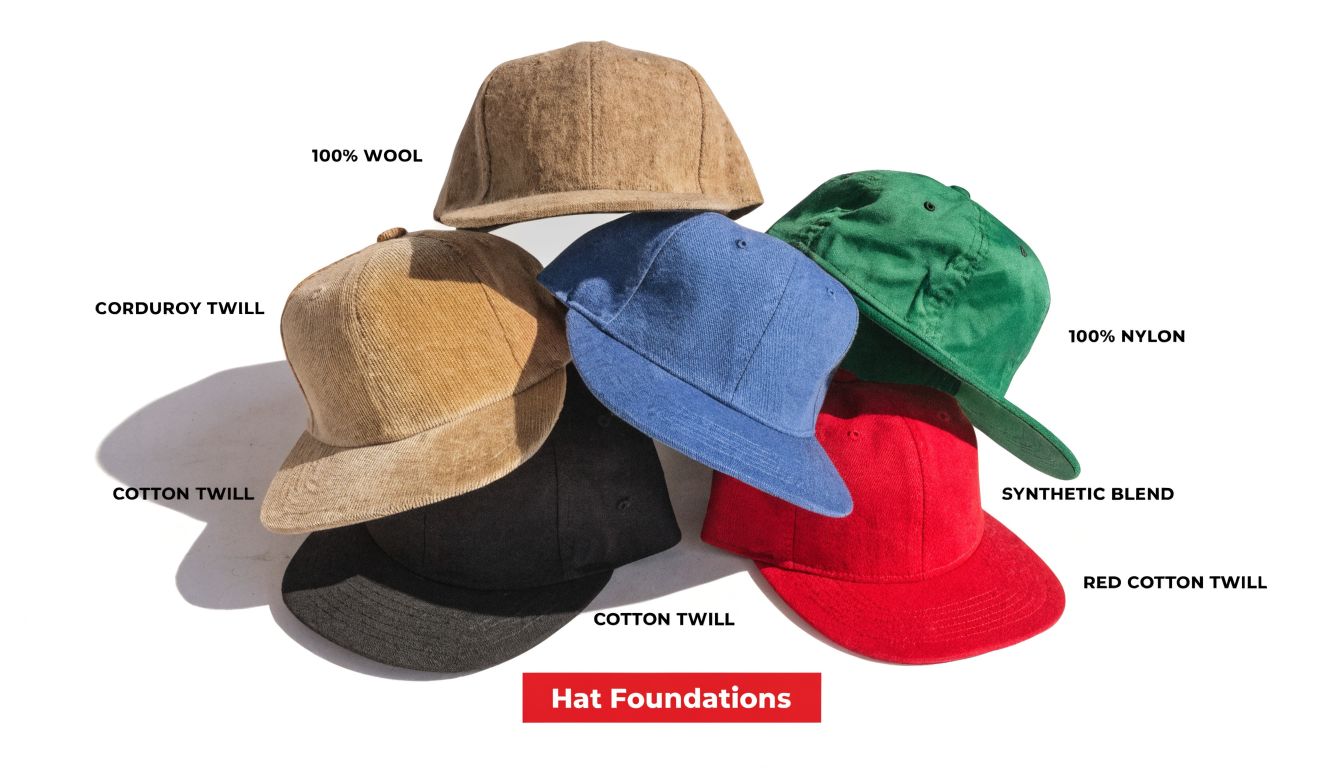
For small runs, the blank matters even more. A startup ordering 6 to 24 hats usually cannot hide a bad choice inside a huge batch. Every piece gets inspected, worn, and judged up close. Start with a hat that fits the job, then build the decoration around it.
Start with panel count
The first decision is simple. Do you want a 5-panel or 6-panel flat bill?
A 5-panel hat gives you one clean front surface. That makes life easier for wide logos, badge shapes, and patches because there is no center seam cutting through the design. If the mark needs a tidy, retail-style presentation, 5-panel blanks are often the safer pick.
A 6-panel hat has the classic snapback look many teams and brands want. It also brings a center seam, which can affect fine detail right down the middle. That is not a deal-breaker. It just means the artwork needs to respect the structure of the hat.
Here is the practical filter I use:
- Choose 5-panel for wide logos, rectangular patches, and designs with important center detail.
- Choose 6-panel for a traditional structured profile and artwork that can tolerate the front seam.
- Order a sample first if your logo has thin script, a tiny icon in the middle, or a narrow border.
That last point saves money. For a six-piece test run, one sample or one stitched proof is cheaper than redoing a full batch that never looked right on the crown.
Structured vs unstructured changes the whole presentation
For flat bill projects, a structured crown is the safer choice for small businesses, staff uniforms, startup merch, and team orders. It holds shape on the shelf, looks cleaner in photos, and gives embroidery a stable surface.
An unstructured crown feels softer and more relaxed. That can work well for casual brands, coffee shops, creative teams, or vintage-inspired merch. But soft crowns ask more from the logo. A bold front graphic can lose impact if the front panel folds or dips when worn.
If this is the first order, I usually recommend staying conservative. Pick the structured option unless the relaxed fit is part of the brand identity. New buyers often choose the softer hat because it feels nice in hand, then realize the finished logo does not present as cleanly as expected.
Pick fabric for use, not just appearance
Fabric affects decoration, comfort, and how the hat ages after repeated wear.
Cotton twill
Cotton twill is the easiest starting point for many small-batch orders. It embroiders well, feels familiar, and works across retail merch, staff hats, school groups, and local event projects. If the goal is a dependable first run, cotton twill rarely causes problems.
Wool blend
Wool blend has more body and a slightly richer hand feel. It works well for structured snapbacks, sports-inspired designs, and logos that need a little more presence. The trade-off is cost and seasonality. Some buyers love the premium feel. Others find it too warm for all-day staff use.
Polyester
Polyester suits active use, outdoor wear, and projects where heat, sweat, or lighter weight matter. It is common for team hats and event caps. It can look very clean, but some polyester blanks show needle marks or fabric sheen more clearly, so artwork and thread choice matter.
A landscaping crew, brewery staff, and streetwear startup might all use flat bills. They should not all use the same fabric.
Brand examples buyers recognize
Certain wholesale brands keep showing up because they are consistent and easy to reorder.
Richardson is a common choice for structured profiles and team-friendly fits. YP Classics and Flexfit cover a wide range of snapback and fitted-style options with reliable shape. New Era is often picked when the blank brand matters to the buyer or the audience. Valucap is useful when the budget is tighter and the project needs a straightforward blank that decorates cleanly.
If you like to prototype or sew custom variations in-house before placing a bigger decorated order, specialty pattern tools can also help. For example, the Accuquilt Quilted Trucker Hat Die is a useful reference for anyone exploring hat construction and panel layout from a maker’s perspective.
A quick visual walkthrough helps if you’re still comparing crown shapes and front panels:
How to narrow your blank choice fast
If you are comparing too many options, reduce the decision to four factors.
- Brand fit: Premium streetwear usually calls for a higher-profile structured shape with a cleaner silhouette.
- Wear environment: Staff hats need comfort, durability, and easy replacement more than novelty.
- Logo behavior: Wide art, center detail, and patch shapes often point to specific panel layouts.
- Reorder potential: For small-batch testing, choose a blank you can get again if the first 6 to 24 hats sell or get adopted internally.
If you want a broader sense of which blanks handle logos cleanly, this guide to hats for embroidery logos is a practical starting point.
Selecting Your Custom Decoration Method
A lot of first-time hat projects fall apart here. The blank is chosen, the deadline is real, and then the logo gets assigned to the wrong decoration method. For small runs of 6 to 24 flat bill hats, that mistake is expensive because there is less room to hide a weak sample inside a big order.
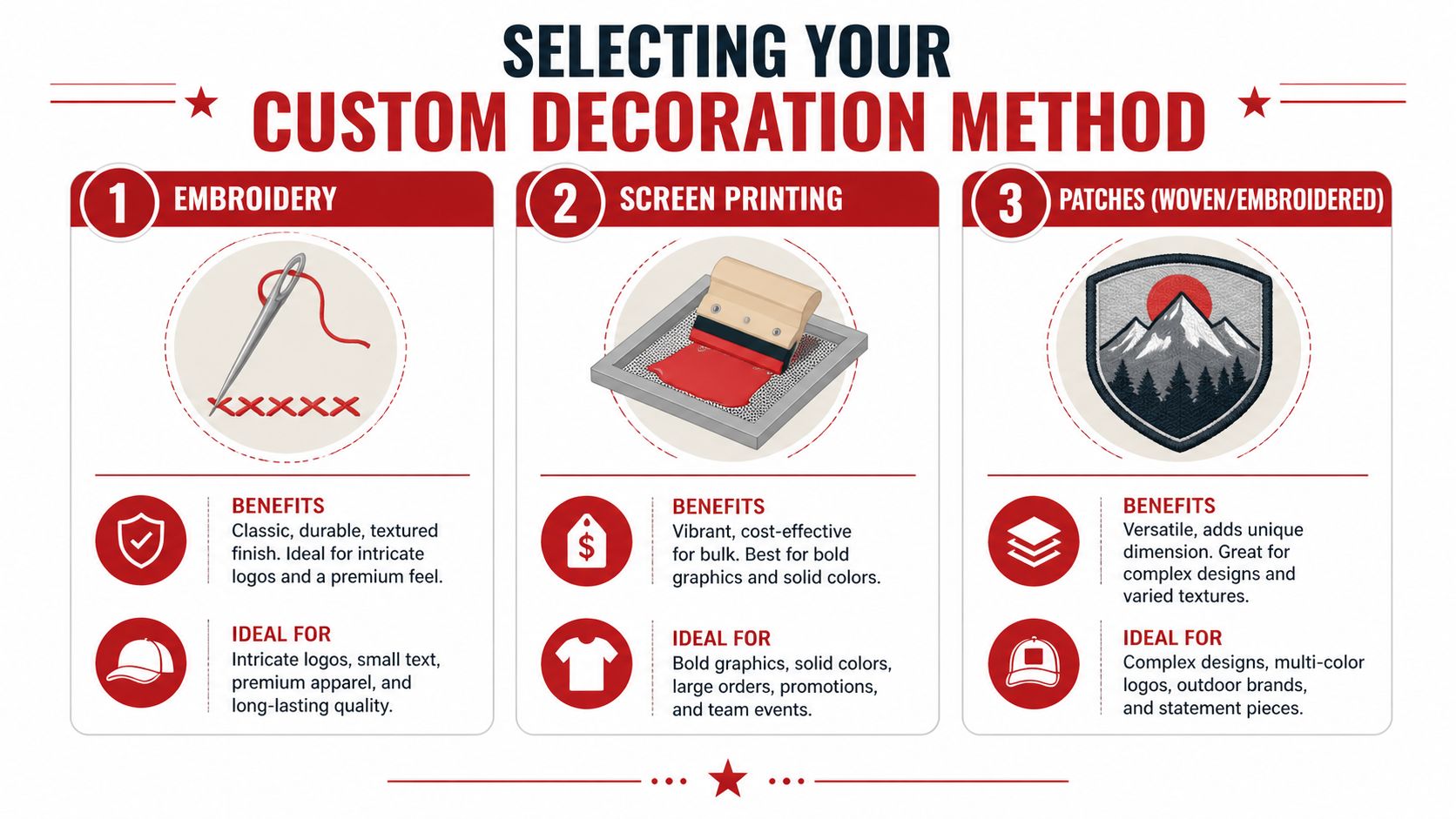
The practical question is simple. What method makes your artwork look intentional on a curved, structured front panel without forcing a redesign after approval?
Decoration Method Comparison
| Method | Best For | Detail Level | Cost Factor |
|---|---|---|---|
| Standard embroidery | Clean logos, text, team marks, business branding | Moderate to strong detail when simplified | Moderate |
| 3D puff embroidery | Bold initials, simple icons, high-impact front logos | Lower tolerance for fine detail | Moderate to higher |
| Patches | Complex art, badge shapes, retail-style looks | High, especially for woven patch designs | Moderate to higher depending on patch type |
Standard embroidery is still the safest starting point
For many startups, staff teams, and event groups, standard embroidery is the lowest-risk choice. It wears well, fits the look of a flat bill cap, and usually reorders cleanly if your first batch works and you need another 12 or 24 pieces later.
It also forces discipline, which is usually a good thing on hats. Clean outlines, solid fills, and readable text stitch well. Fine textures, tiny legal copy, gradients, and crowded illustrations do not.
Front logos on structured flat bills also have limited real estate. A design can look balanced on a screen and still stitch too tall, too wide, or too busy once it hits the crown. If the art has to be explained, simplify it before production.
Use standard embroidery when your logo has:
- solid shapes
- clear borders
- enough spacing between elements
- text that stays readable at hat size
3D puff looks strong, but only on the right artwork
Puff embroidery gets attention fast. It works well for single letters, athletic marks, simple icons, and short wordmarks with thick strokes.
It is less forgiving than standard embroidery. Foam under the stitching adds height, but it also softens fine edges and closes up small spaces inside letters. That is why puff logos that looked sharp in the original file can turn muddy on the finished cap.
I usually steer small-batch buyers toward puff only when the art is already bold. If you have a new brand and this is your first test run, ask a harder question before approving it. Will the logo still read from six feet away, on a curved front panel, with fewer details than your digital version?
Good puff candidates are usually:
- one letter
- one compact symbol
- one short word with thick strokes
If your logo depends on thin outlines or small internal details, stick with flat embroidery or switch to a patch.
Patches give you more freedom
Patches solve problems that direct embroidery cannot solve cleanly. They hold border shapes better, preserve small details more consistently, and let you use artwork that would feel cramped if stitched straight into the cap.
That flexibility matters for small businesses ordering 6+ pieces. A patch can let you keep your current logo instead of paying for a full redraw just to make embroidery behave.
The patch type matters.
- Woven patches hold finer detail and cleaner small text.
- Embroidered patches give a classic raised texture and a more traditional badge look.
- Leather-look and specialty patches create a branded retail feel, but the artwork usually needs to stay simple.
Patches also help when you want the same identity across different hat styles. A logo that is difficult on one crown shape can often stay consistent if the patch shape stays consistent.
If you want a closer look at thread-based decoration choices before deciding, this guide to custom stitching on hats is a useful reference.
Printing has a place, but it is not the default for flat bills
Printing can work, especially for graphic-driven designs or specific fashion looks. On structured flat bill hats for company merch, team wear, and small promotional runs, it is usually not the first method I recommend.
The reason is practical. Embroidery and patches tend to look more natural on this hat style, and they usually hold their perceived value better over time. If the goal is a hat that feels like part of a brand uniform or a retail-ready small batch, stitched decoration usually wins.
Use this decision filter before you approve anything
For a first order, speed matters. So does avoiding a remake.
- Choose standard embroidery if the logo is clean, simple, and meant to feel classic.
- Choose 3D puff if the design is bold enough to lose some edge definition and still read clearly.
- Choose a patch if the artwork has small details, a badge shape, or a stronger retail look.
A good decoration method does not rescue weak art. It matches the art you have, the budget you are working with, and the size of the run you are testing. For small-batch custom flat bill hats, that match matters more than chasing the trendiest finish.
Preparing Your Artwork for Production
A strong hat project can still stall out at the artwork stage. Buyers lose time here by sending the wrong file type, leaving fonts live, or trying to force shirt graphics into embroidery.
Vector first, always
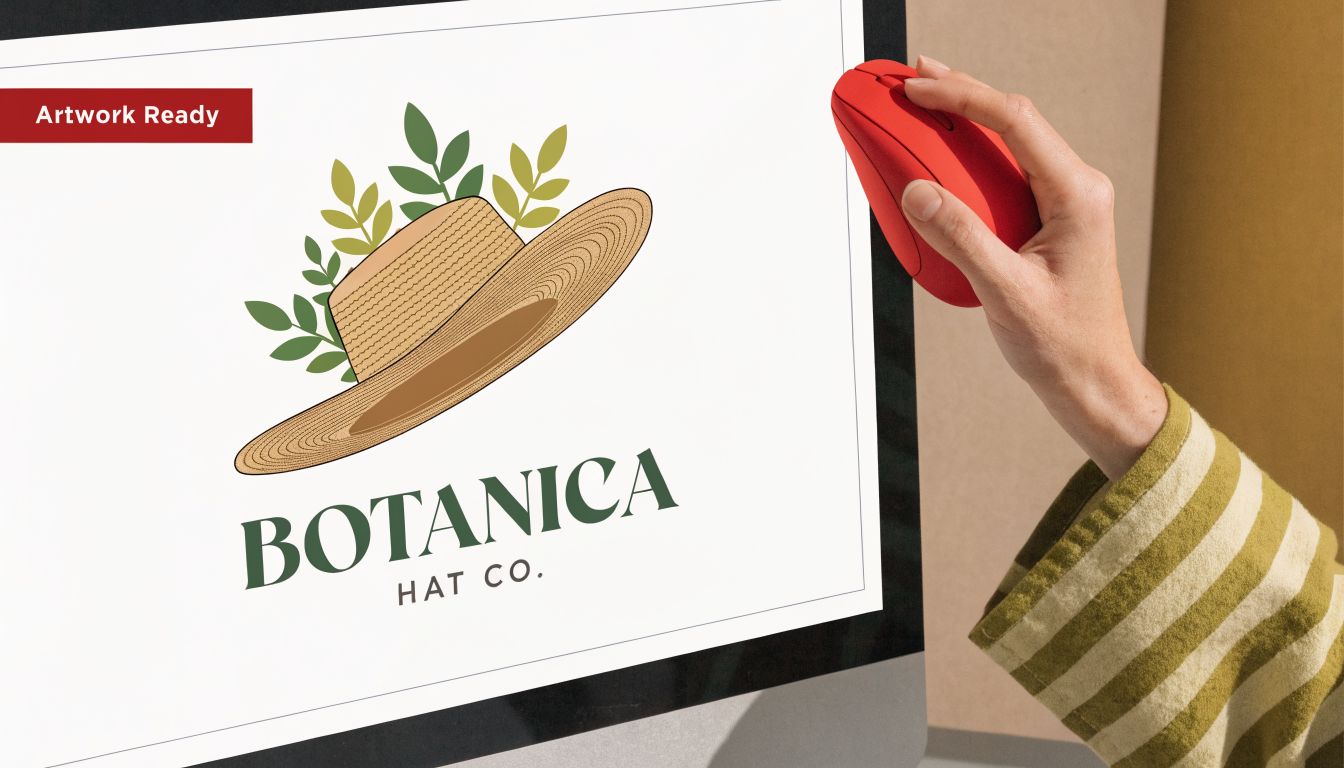
For embroidery production, vector artwork is the cleanest starting point. AI and EPS files are the standard because they scale cleanly and give the digitizer clear edges to interpret. If you only have a PNG or JPEG, the project can still move forward in some cases, but cleanup usually takes longer and leaves more room for interpretation.
The production side also gets smoother when fonts are outlined before submission. That prevents font substitution and removes any question about how your text should render.
If your current file needs work before production, this guide on how to digitize a logo for embroidery helps clarify what shops need and what buyers should prepare before sending art.
Good hat art vs bad hat art
A hat is a small, curved canvas. Artwork that works on a website header or poster often falls apart when reduced to front-panel scale.
Good hat art usually has:
- one clear focal point
- limited text
- enough spacing between elements
- solid color areas instead of fades
Bad hat art usually includes:
- tiny subtext
- delicate script
- gradients
- stacked details squeezed into a badge that’s too small to breathe
One of the easiest mistakes is adding too much copy. A front hat logo doesn’t need to say everything your business does. It only needs to be recognizable.
The cleanest embroidered hat designs usually feel slightly simpler than the version people first submit. That’s not a downgrade. It’s good translation.
Placement and proof discipline
Front-center is still the safest starting point for flat bills, especially on structured crowns. It’s readable, balanced, and expected. Side embroidery and back hits can work, but they should support the main mark rather than compete with it.
When you review a proof, slow down and check these details in order:
Logo size
Is it scaled to the front panel without looking lost or overfilled?Thread color match
Are the colors close to your brand system, and do they still read well against the hat color?Line thickness
Did any small outlines get thickened or merged in a way that changes the logo?Text legibility
Can you read the smallest text at a glance, not just when zoomed in on screen?Placement
Is the design visually centered for that specific panel construction?
Simplify before production, not after disappointment
The easiest way to customize flat bill hats successfully is to submit artwork that already respects the medium. Don’t wait for the machine to tell you your design is too delicate. A simple revision before digitizing saves time, rework, and frustration.
If your logo has a gradient, a micro-detail illustration, or very thin type, separate the “brand logo” from the “hat logo.” Many successful brands do exactly that. The version on the cap is often cleaner, bolder, and more wearable than the full lockup in their brand guide.
Placing Your Order and Finalizing Your Project
A startup orders eight flat bills for a launch event. The logo looked sharp on screen, the colors felt right, and the budget made sense. Then the hats arrive, and one issue becomes obvious right away. The front logo is too small for the crown, so the whole piece reads weaker in person than it did in the mockup.
That is why the order stage matters so much on a 6, 8, or 12-piece run. Small batches are not throwaway tests. They are low-risk production runs that need to answer real business questions before you commit to a larger reorder.
Why six-piece runs make sense
The custom hat market often pushes buyers toward one-off print-on-demand samples or large wholesale volumes. Small businesses, startups, school groups, and local teams usually need something in between. Six to twelve hats is often the right range for that first decision.
That size gives you useful feedback without tying up too much cash or leaving you with boxes of hats nobody wants to wear.
A short run helps you verify things that are hard to judge on a screen:
- which colorway gets picked up first
- whether the logo has enough presence on the crown
- how the chosen hat shape fits different people on your staff or team
- whether your first method choice should stay the same on the reorder
For a coffee shop, that can mean testing staff wear before outfitting both locations. For a startup, it can mean checking whether the hat has resale potential at pop-ups. For a coach or rec program, it can mean confirming the cap looks right on actual players before placing a larger roster order.
What a good proof should show
The proof is your last clean chance to catch preventable problems.
A usable proof should clearly show:
- the exact blank hat brand and model
- the decoration method and placement
- the design size on the panel
- thread, patch, or material colors
- any special treatment such as 3D puff, a merrowed edge, or back embroidery
If any of that is missing, ask for clarification before approval. Small-order buyers get hurt most by vague proofs because there is less room to absorb mistakes. One wrong detail on a 6-piece order can wipe out the value of the entire test run.
Approve the proof the same way you would approve retail packaging. Many problems buyers call production errors started at proof approval.
How pricing gets built
Hat pricing is rarely just the blank plus a logo. The final number usually reflects several parts of the job:
- the blank hat brand and model
- the decoration method
- stitch count or patch construction
- the number of pieces
- extra locations such as side or back decoration
That is why the lowest-cost blank is not always the cheapest choice in practice. If the crown shape fights the artwork or the hat feels weak in hand, the order stops working for merch, uniforms, or team wear. A better blank can cost more up front and still produce a stronger result per hat worn.
For buyers who want low-minimum custom runs with in-house decoration, Dirt Cheap Headwear is one option that offers custom embroidery starting at six pieces per logo along with wholesale blank brands such as Richardson, YP Classics/Flexfit, New Era, and Valucap.
Before you submit the order
Run a final check before payment and approval:
- Confirm the use case: staff uniform, resale item, team issue, or event giveaway
- Approve the exact blank: avoid substitutions unless you have signed off on them
- Match the decoration to the goal: puff, flat embroidery, and patches each solve different problems
- Check all text one more time: taglines, city names, initials, and date references are common failure points
- Ask about reorder stability: make sure the blank and decoration method can be sourced again if the first run succeeds
- Confirm production timing: include event dates, shipping method, and any deadline that cannot move
One more practical note. New buyers often try to pack too many ideas into the first order. Keep the first run focused. One hat style, one core logo treatment, one audience. If the test works, scaling gets much easier.
Protecting Your Investment with Proper Care
Custom hats last longer when people treat them like decorated products, not gym laundry.
What to do
- Spot clean first: Use a damp cloth, mild soap, and light pressure on sweat marks or dirt.
- Air dry naturally: Let the hat dry on its own so the crown keeps its shape.
- Store with support: Keep hats on a shelf, hook, or in a way that doesn’t crush the front panel or bend the bill.
- Handle patches and puff embroidery gently: Both look great, but rough scrubbing can wear the surface faster.
What to avoid
- Don’t machine wash embroidered hats: Agitation can distort the crown and stress the stitching.
- Don’t soak the hat: Too much water can weaken shape retention.
- Don’t throw it in a hot dryer: Heat can warp the bill and alter the fit.
- Don’t stack heavy items on top: Flat bills lose their clean profile when they’re crushed in storage.
A custom flat bill is part brand asset, part wearable product. If the hat keeps its shape, your logo keeps its presence.
Frequently Asked Questions About Custom Hats
Can I mix hat colors in one small order
Usually, yes, but keep the decoration in mind. If the logo thread or patch colors only work on one hat color, the order can become inconsistent fast. For a first run, I’d keep the logo treatment the same and limit the blank colors to options that support it cleanly.
What’s the difference between a snapback and a fitted flat bill
A snapback uses an adjustable plastic closure at the back. That makes it easier for teams, events, and small businesses because one size can cover more people. A fitted hat has no snap closure and is made in fixed sizes, so it feels more form-fitting but requires size planning.
If you’re new to custom hats, snapbacks are usually the safer first order.
How should resellers price custom flat bill hats
Start with your full landed cost, not just the blank. Include the hat, decoration, setup-related charges if any, packaging, and your margin target. Then compare that total to how the hat will be perceived.
A simple embroidered staff hat and a retail-focused patch snapback shouldn’t be priced the same way. If the product feels like merch, buyers expect a branded presentation. If it feels like a uniform item, durability and consistency matter more than story.
The easiest pricing mistake is underestimating the value of a good blank and clean decoration. If the hat looks right and fits well, people notice.
If you’re ready to customize flat bill hats without jumping into a huge order, Dirt Cheap Headwear offers wholesale blanks and decorated headwear with low minimums, in-house embroidery, and options for small test runs as well as larger reorders.
Pingback: What File Type for Embroidery Logo? | Dirt Cheap Headwear