A logo that looks great on a trucker can fall apart on a beanie. A left-side hit that works for a brewery staff cap might feel too subtle for event merch. If you’re figuring out how to choose hat embroidery placement, the real question is not just where the design goes. It’s where it will look clean, fit the hat’s shape, and still make sense for the way you’re buying and using the order.
For most bulk buyers, placement decisions come down to three things: visibility, stitchability, and consistency. You want the logo seen. You need it to sew well on the specific hat style. And if you’re ordering for a team, store, or promotion, you need every piece to come back looking repeatable. That’s where placement matters more than people expect.
How to choose hat embroidery placement by use case
Start with the job the hat needs to do. If the hats are for uniforms, front placement usually wins because it reads fast and looks standard across crews, retail staff, restaurant teams, and contractors. If the hats are for brand merch, side or rear embroidery can add value without crowding the front. If the order is for an event, the right choice depends on whether the logo needs to be seen across a room or just feel like a polished takeaway.
That use case changes everything. A construction company may want a centered front logo for maximum visibility on-site. A golf outing might use front embroidery for the event mark and back embroidery for a sponsor name. A streetwear brand may prefer a small side hit or tonal rear logo because subtle branding fits the sell-through better than a large front design.
The best placement is the one that matches the outcome. High visibility is not always the same as best-looking. And the most fashionable placement is not always the safest choice for bulk uniform orders.
Front embroidery is the default for a reason
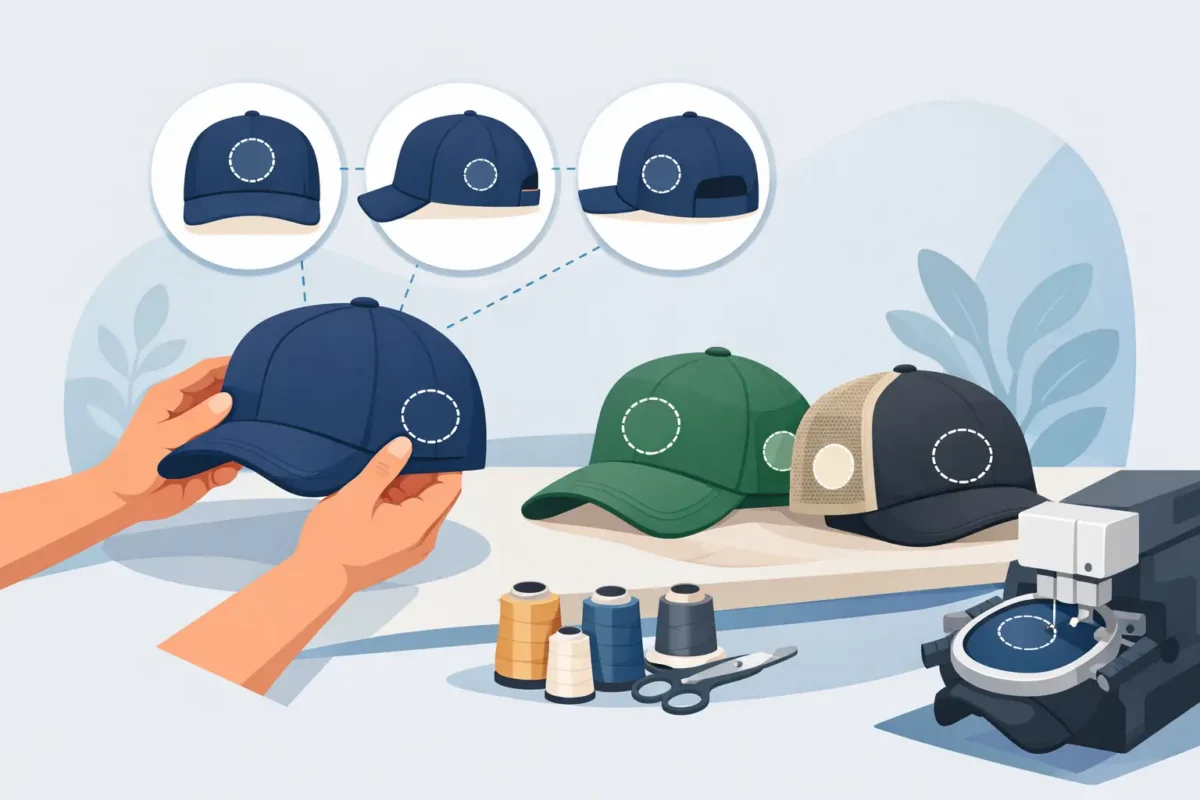
Front center embroidery is the most common placement because it works. It gives you the largest usable area on most hats, it faces forward in photos, and it creates the clearest brand recognition. If you’re ordering your first custom run, this is usually the safest place to start.
That said, front placement is not one-size-fits-all. Structured hats, like many truckers, snapbacks, and fitteds, generally support bold front logos better because the crown holds shape. Unstructured dad hats and softer caps can still take front embroidery, but fine details may distort more easily depending on the fabric and the logo size.
Front placement also forces a decision about scale. A wide logo may need to be simplified to fit cleanly. Small text under a logo may disappear when stitched. If the front panel has a center seam, that can affect designs with tight detail or tiny lettering placed dead center.
If your logo is simple, bold, and built for recognition, front center is usually the best value. It delivers visibility without needing extra explanation.
Side and back placement work best when they have a purpose
Side embroidery is often used for secondary branding. Think flag marks, short words, date stamps, social handles, sponsor names, or small icons. It can look premium, especially on retail-style hats, but it is not ideal if the main goal is immediate logo recognition.
Back embroidery is common for team names, websites, short slogans, or a small secondary mark above the closure. It works well when the front is already carrying the primary logo. On adjustable hats, though, closure type matters. A snapback, buckle, or hook-and-loop strap reduces the available embroidery area, so the design usually needs to stay compact.
The trade-off is simple. Side and back placements can make the hat feel more finished, but they are supporting placements, not always lead placements. For many buyers, they make sense as add-ons, not replacements.
Hat style changes what placement will actually work
This is where many first-time buyers get stuck. They choose placement based on a mockup, not on the hat itself.
A trucker hat has a taller front panel and often takes larger front embroidery well. A low-profile dad hat has less vertical space and a softer shape, so oversized logos can feel cramped or distorted. Beanies usually call for a cuff placement, not a standard cap front placement. Visors remove the crown entirely, which limits embroidery to the band area. Bucket hats can take front decoration, but curved surfaces and seams may affect how the design reads.
Rope hats add another variable because the rope visually cuts the front panel. Some logos look great above it. Others feel boxed in. Youth hats also need special attention because the embroidery area is smaller, and shrinking an adult logo down is not always clean.
If you’re buying in bulk across multiple hat styles, placement should be chosen with the least forgiving style in mind. A design that fits a structured snapback may not translate well to an unstructured cap in the same order. Consistency beats forcing one oversized setup onto every profile.
Your logo matters as much as the hat
Knowing how to choose hat embroidery placement means being honest about what embroidery can and cannot do. Embroidery is not print. Tiny gradients, ultra-thin outlines, and packed-in small text usually need adjustment before they sew well.
A simple icon or bold wordmark gives you more freedom. It can often go front and center, side, or back without much trouble. A detailed logo with multiple lines of text may need the largest and flattest possible stitch area, which usually pushes you toward the front of a structured cap.
This is also where embroidery type matters. Standard flat embroidery handles many logos well. Puff embroidery needs enough space and bold enough shapes to rise cleanly. Patches can solve some detail limitations, but they create a different look and may shift what placement feels most balanced.
Good placement does not rescue a bad file. It just gives a good design the right stage.
Think about viewing distance, not just decoration area
A lot of buyers approve placement based on what looks good on screen at zoom level 200%. Real life is different.
If the hat is for staff uniforms, people need to read it quickly from several feet away. That usually favors front placement with simplified embroidery. If the hats are sold as merch, the buyer is often looking at them up close, so smaller side or back details can add perceived quality even if they are less visible from a distance.
This is why event hats often benefit from bolder placement than fashion hats. A giveaway hat has to work fast. A retail hat can be more restrained. Neither is better. They are solving different problems.
Cost and production should be part of the decision
Placement affects production more than some buyers realize. A straightforward front logo is usually the easiest setup to repeat cleanly at scale. Specialty placements, multiple locations, or logos that need extra adjustment can add complexity.
That doesn’t mean you should avoid them. It means you should choose them on purpose. If your order needs speed, consistency, and simple reorder potential, a standard front placement often makes the most operational sense. If the hats are a higher-end merch item with stronger margins, adding side or back embroidery may be worth it.
For smaller bulk runs, keeping the placement practical can help protect budget and turnaround. For repeat programs, consistency matters even more. Once a placement is dialed in and sewn in-house, reordering becomes more predictable.
How to choose hat embroidery placement without overthinking it
If the logo is the brand, put it on the front. If the front already has enough going on, use the side or back for supporting details. If the hat style is soft, low-profile, or small, simplify the design before forcing a larger placement. And if you’re ordering for a mixed group of hat styles, choose the placement that will produce the most consistent result across the full run.
When buyers get the best results, they usually make the decision in this order: hat style first, logo complexity second, placement third. Not the other way around. The hat tells you how much room you have. The logo tells you how much detail can survive. Then placement becomes a practical choice instead of a guess.
For businesses ordering branded hats in bulk, the safest answer is often also the strongest one: a clean front logo on the right hat style. From there, add side or back embroidery only when it improves the finished product instead of cluttering it.
If you’re unsure, the right move is not to choose the flashiest placement. It’s to choose the one that will still look right on every hat when the boxes show up.
Pingback: How to Embroider a Name: A Complete Guide | Dirt Cheap Headwear
Pingback: How to Put a Patch on a Hat: A Pro's Guide for 2026 | Dirt Cheap Headwear
Pingback: Contractor Logo Hats Bulk for Work Crews | Dirt Cheap Headwear