
Custom Printed Hard Hats: Safety & Branding Guide
You've probably been handed a simple-sounding task that isn't simple at all. Order hard hats with the company logo. It sounds like the same process as ordering polos or event tees until the first quote comes back asking about ANSI type, electrical class, print method, artwork size, proof approval, and case-pack quantities.
That's the point where most first-time buyers realize custom printed hard hats are PPE first and branded gear second. A nice logo matters. It helps crews look organized, supports site identification, and gives visitors and clients a polished impression. But if the shell, rating, or decoration method is wrong, the good-looking part stops mattering fast.
I've seen buyers focus too early on color matching and logo placement, then get stuck later when they learn the artwork won't fit the imprint area or the site requires a different class of helmet than the one they priced first. Hard hats don't forgive guesswork the way a cotton cap does.
The better way to buy them is practical. Start with the hazard. Confirm the compliant shell. Choose a decoration method that will hold up on a real jobsite. Then make the artwork work within the space you have, not the space you wish you had.
Practical rule: If you choose the shell for the logo and not for the worksite, you're doing the order backward.
More Than Just a Logo Your Intro to Custom Hard Hats
A construction supervisor replacing site PPE has one set of priorities. An event team outfitting staff for a public activation has another. Both can end up ordering custom printed hard hats, but neither should treat them like novelty items.
In the United States, OSHA requires head protection where workers may face falling or flying objects, electrical hazards, or impact risks. Modern hard hats are designed to absorb shock, resist penetration, and provide electrical protection, as outlined in OSHA hard hat requirements and safety rules. That history matters because customization has to sit on top of real safety performance, not replace it.
Why buyers get tripped up
Most first orders go sideways in one of three ways:
- The wrong starting point: The buyer chooses a style based on appearance before confirming what protection level the site requires.
- The wrong decoration choice: A logo application looks fine in a mockup but doesn't hold up to rough handling, weather, storage, or daily wear.
- The wrong artwork expectations: The original logo was built for a website header or business card, not a small curved helmet panel.
That's why the best custom hard hat programs don't begin in the art department. They begin with procurement, safety, and operations agreeing on what the helmet needs to do.
What a good order looks like
A strong order usually has a clear chain of decisions:
- Match the hard hat to the hazard
- Use an approved decoration method
- Simplify the logo for the available print area
- Review proofs like safety documents, not just design mockups
- Order enough units to cover crews, spares, and future adds
If you approach it that way, the logo usually turns out better too. Good branding on PPE comes from working inside the actual limits of the product.
Hard Hat Compliance Before You Customize
Before anybody talks about logo size, talk about the shell rating. That's the essential part.
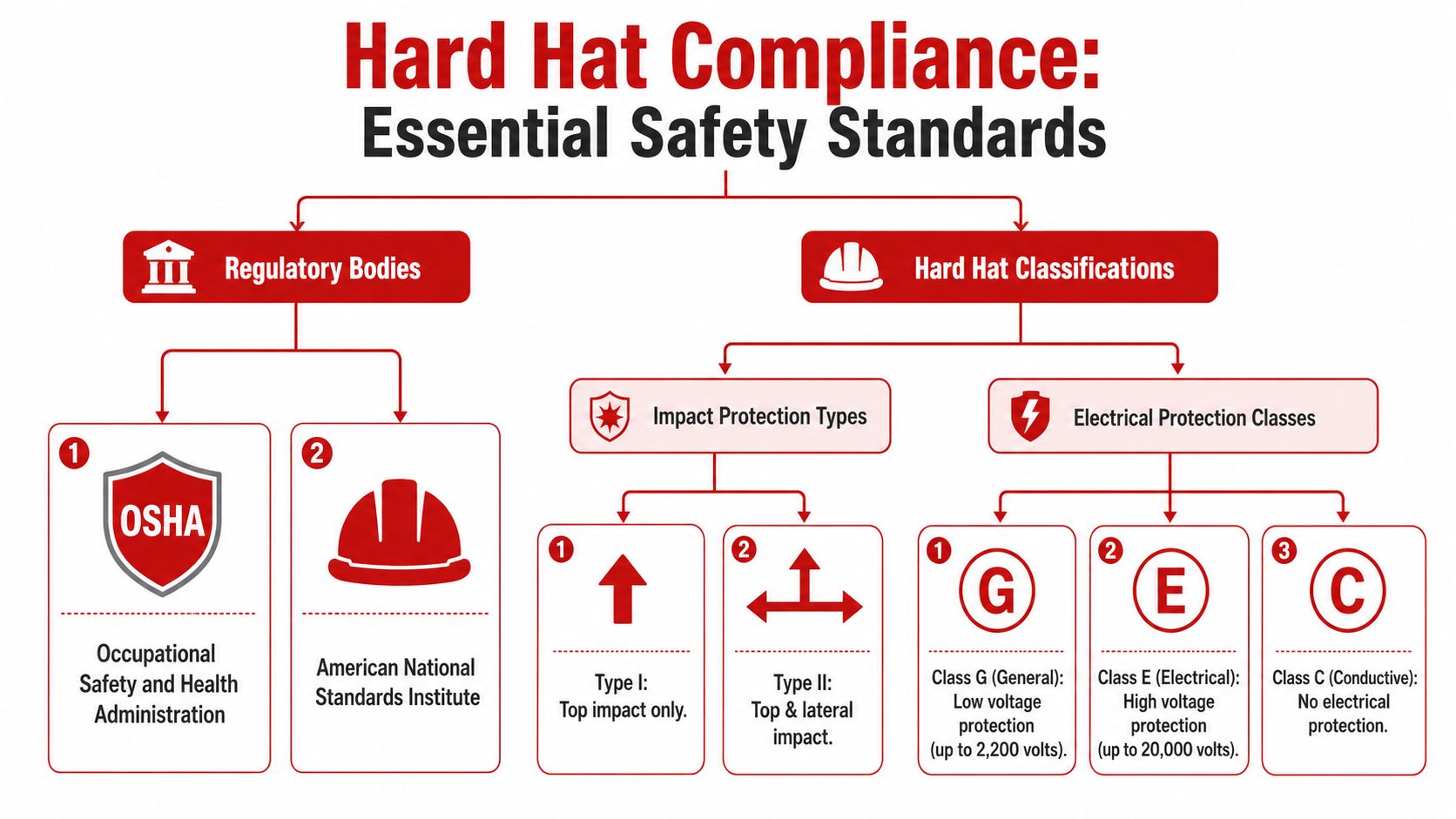
Safety Gear's custom catalog is organized around ANSI Z89.1 classifications, including Type 1, Class C, and Class E models, which is a useful reminder that the buyer has to match the hard hat's protection level to the work hazard first. The same catalog also notes that a correctly decorated hard hat can still meet ANSI safety standards when approved customization methods are used, as shown in Safety Gear's custom logo hard hat lineup.
Start with type
Think of hard hat type like choosing tires for the conditions you drive in. You don't pick off-road tires because they look rugged, and you don't pick a shell because it has the nicest profile for a logo.
Here's the basic split:
- Type I: Protects the top of the head.
- Type II: Protects the top and the sides of the head.
If your environment calls for more than overhead impact protection, that choice needs to be made before customization enters the conversation.
Then check electrical class
Electrical class is where many first-time buyers hesitate. They see different class letters on a product page and assume they're just product variations. They're not. They're part of the protection decision.
A simple way to handle it is this:
- Class E: Consider this when electrical protection requirements are part of the job.
- Class C: Don't assume it's interchangeable with electrically protective models.
- Ask safety leadership first: If the site safety manager or compliance lead already has a required spec, follow that spec instead of shopping by appearance.
For buyers outside the U.S. or teams working across multiple regions, it also helps to review important safety guidelines for UK employers so purchasing decisions align with broader workplace obligations, not just branding requests.
A custom logo never upgrades a hard hat. It only decorates the model you already chose.
Compliance questions to ask before requesting a quote
Use these with any supplier:
- What hazard is this for: Construction, utility, industrial maintenance, plant operations, or visitor use all create different selection standards.
- What type and class is required: Don't rely on memory. Confirm the exact requirement internally.
- Is the decoration method approved for that shell: Here, compliance and customization meet.
- Will accessories affect the order: Chin straps, reflective elements, or other add-ons can change the final setup.
A buyer who answers those questions first usually avoids the expensive mistake of ordering the wrong shell and trying to “fix” it with customization later.
Choosing Your Decoration Method Pad Print Decal and More
Most buyers' initial focus tends to be on this, which often results in their most expensive mistake. The best-looking sample isn't always the best jobsite choice.
Bullard states that pad-printed logos are permanent and will not peel, crack, or fade like a decal, which is one of the clearest manufacturer-level distinctions buyers get when comparing methods. You can review that guidance in Bullard's article on how to customize your hard hat.
What each method is really like on site
The three methods buyers usually compare are pad printing, decals, and transfer-style applications. Suppliers may use slightly different shop language, but the trade-offs stay pretty consistent.
| Method | Durability | Best For | Compliance Notes |
|---|---|---|---|
| Pad print | Strong choice for harsh use | Daily field wear, fleet consistency, long-term use | Verify the method is approved for the shell |
| Decal | More vulnerable to edge wear and lifting | Short-term programs, lighter-duty use, simpler rollout | Confirm the decal is acceptable for the specific helmet model |
| Heat transfer or similar applied graphic | Appearance can be attractive, but suitability depends on shell and process | Projects that need more graphic flexibility | Approval matters more than appearance |
Pad print usually wins for working crews
If these hard hats are going into construction, utilities, manufacturing, or industrial environments, pad print is usually the first method I'd look at. The reason is simple. It's less about showroom appeal and more about what happens after the hat gets thrown in a truck, stacked in gang boxes, exposed to weather, and worn every day.
Pad print also tends to handle routine abrasion better than buyers expect. That matters if your crew doesn't baby their PPE, which is most crews.
Field advice: If replacement costs and rework are a concern, choose the method that asks the least from the user. Hard hats get used hard.
Decals still have a place
That doesn't mean decals are always wrong. They can make sense when you need flexibility, when artwork changes often, or when the use case is lighter and more controlled. Visitor programs, short-run identification, or situations where the helmets won't take sustained abuse can all make decals workable.
But buyers should be honest about environment. A decal that looks crisp on delivery can disappoint quickly if the shell spends its life in dust, rain, sun, and friction.
Don't ignore the print shop process
The decoration method is only half the issue. The supplier's process matters too. Ask how the art is applied, what proofing looks like, and whether the shop has a standard approval workflow for decorated headwear. If you want a broader look at decoration options in branded headwear, this overview of screen printing methods helps explain how process choice changes the final result across products.
For hard hats specifically, the safest buying habit is simple: choose the shell for protection, then choose the decoration method that stays compliant and survives the jobsite.
Prepping Artwork and Logos for a Flawless Print
A lot of logo problems start long before printing. They start when the buyer sends over the wrong file or expects a detailed brand mark to fit on a very small curved panel.
Hard hats have tight imprint limits. Bullhead Safety's imprint guide lists a front panel area of 2.5 in × 1.75 in for full-brim hard hats and side panels of 2 in × 1 in. On climbing-style helmets, the front can be 2.5 in × 1.25 in, the back 2.4 in × 1 in, and the sides 2 in × 0.65 in, according to the Bullhead hard hat imprinting guide. That's not much room, especially once curvature and margins are factored in.
Why vector art matters
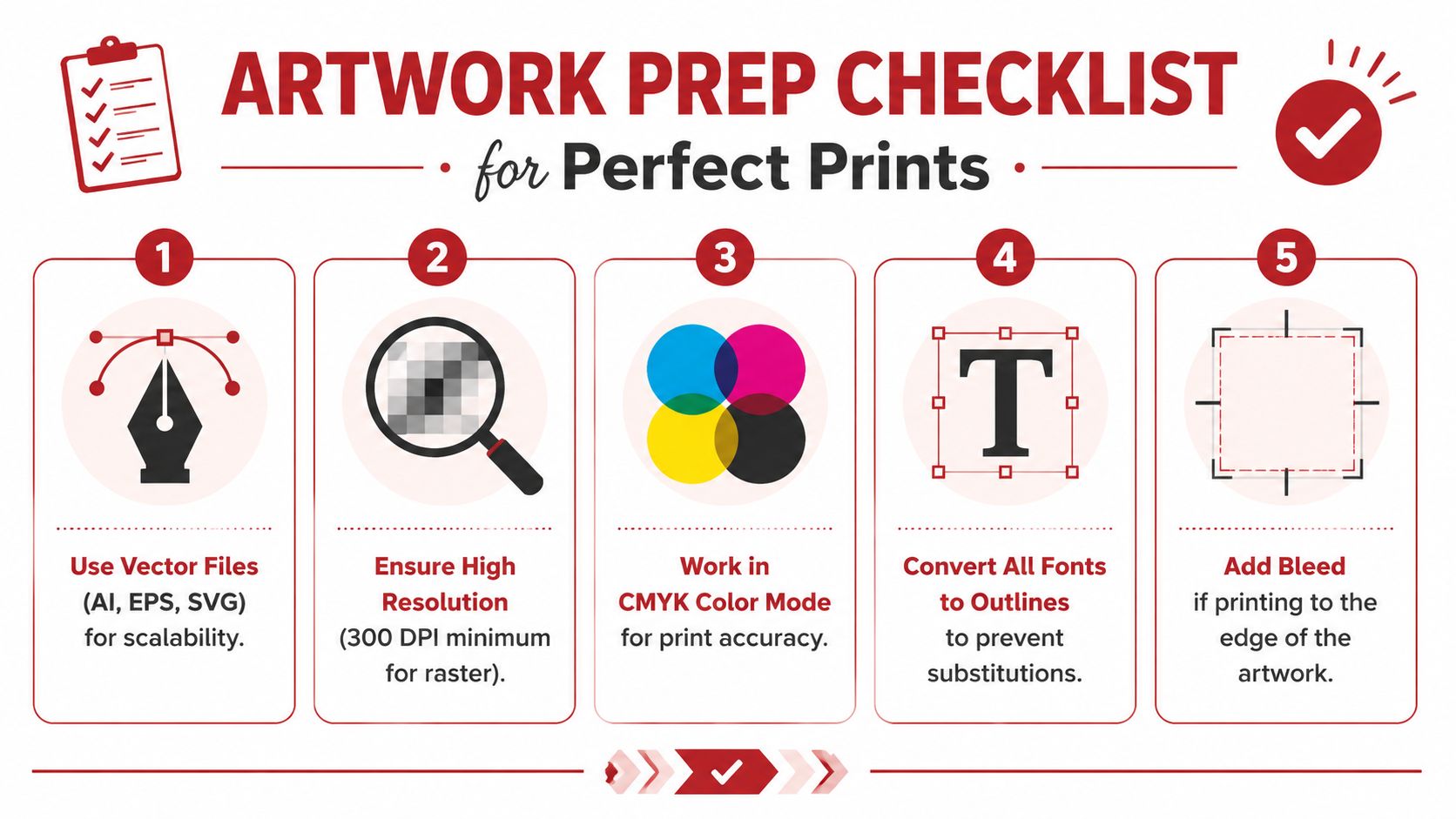
If a printer asks for AI, EPS, or SVG, they're not being difficult. They're trying to avoid a weak print.
A simple way to think about it is this. A vector file is the recipe. A JPG is a picture of the finished cake. The recipe lets the printer rebuild the design cleanly at the exact size needed. The photo just shows what it looked like once.
If your team isn't sure what file to send, this guide to hat logo file requirements is a useful plain-English reference.
What usually fails on a hard hat
The designs that struggle most often have the same issues:
- Tiny text: Department names, taglines, and web addresses usually become unreadable fast.
- Thin strokes: Fine outlines disappear or break up when printed small.
- Too many colors or details: Small gradients, interior textures, and layered effects don't translate well.
- Wide horizontal logos: A long logo can feel squeezed on the front panel and awkward on the side.
A hard hat logo needs to be blunt, clear, and easy to recognize at a glance.
How to improve the art before approval
If the original logo is complex, don't force the full brand system onto the helmet. Build a hard-hat version of the logo instead.
Try these moves:
- Use the brand mark alone: An icon often works better than a full lockup.
- Increase stroke weight: Thin lines should be thickened before production.
- Drop the slogan: Taglines are usually the first thing to cut.
- Choose high contrast: Dark on light or light on dark wins over subtle combinations.
Small imprint areas reward bold logos. They punish elegant details.
Ask for a proof that shows actual placement and approximate scale on the shell. Not just a floating logo on a blank page. On PPE, context matters.
Beyond the Logo Using Customization for Enhanced Safety
The smartest hard hat programs don't stop at branding. They use customization to make the site easier to read.
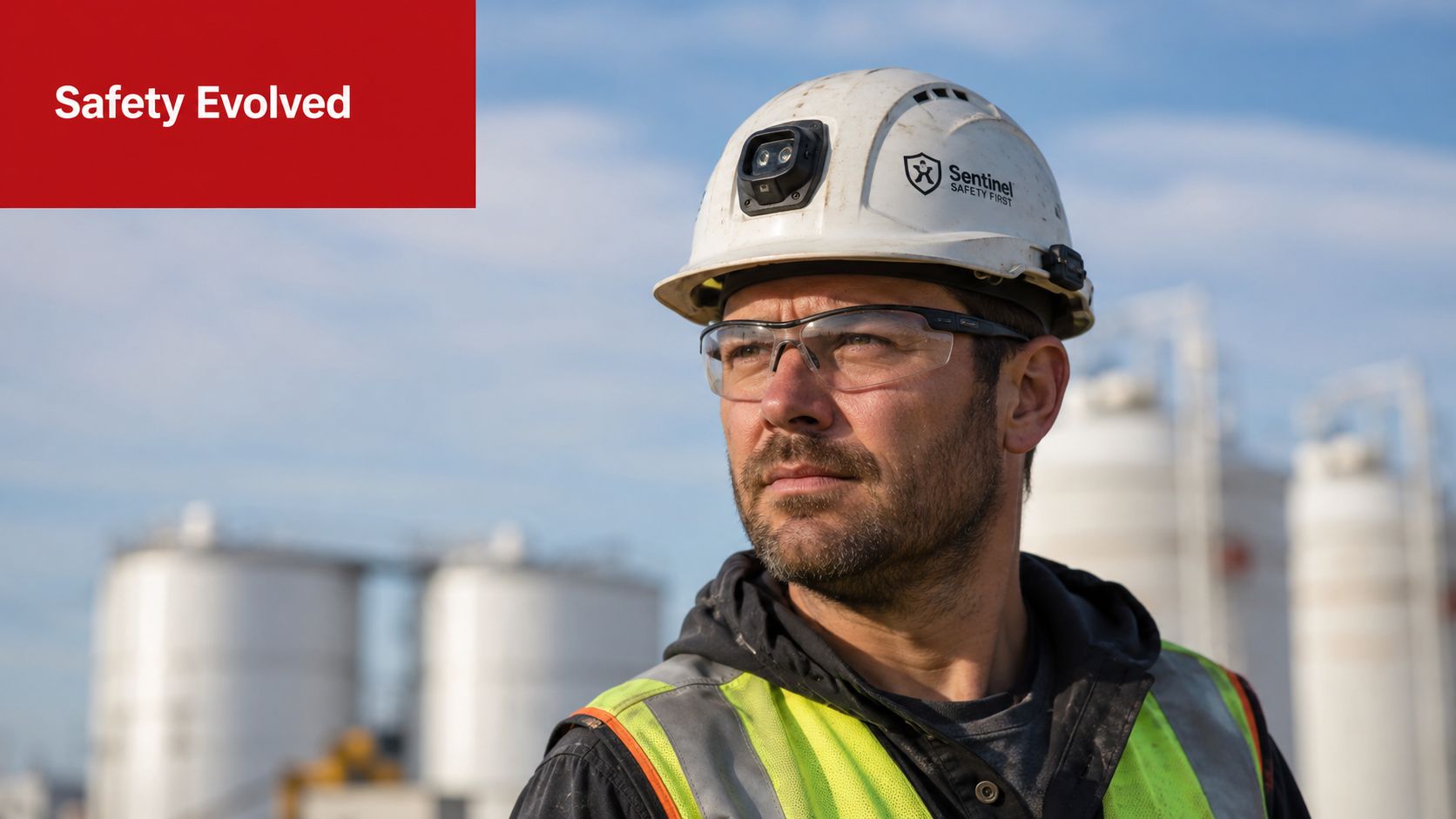
3M's custom-logo hard hat program pairs logos with reflective striping to improve worker visibility, which is a strong example of customization being used as part of a safety system rather than just decoration. You can see that approach in 3M's custom logo hard hat program.
The hard hat can do more than show a brand
On a busy site, identification speed matters. Supervisors need to spot roles quickly. Crews need to know who belongs to which contractor. Visitors need to know who to ask for help.
That's where customization gets more useful. A logo can be part of a broader visual system that includes:
- Role marking: Supervisor, visitor, safety lead, or trade identifiers
- Department separation: Different teams can use distinct visual cues
- Visibility support: Reflective striping helps the helmet do more in low-light or high-traffic settings
- Clear ownership: Company branding can reduce mix-ups on mixed crews
What works in practice
The most effective setups are usually the simplest. A clean front logo, a role indicator on the side or rear, and reflective features where allowed often produce a better field result than a flashy graphic concept.
This is also where buyers should be realistic about priorities. If a decoration choice improves visibility and durability, that usually beats a more detailed art treatment that looks better in a proof but performs worse in use.
Good PPE branding helps a worker get identified faster, not just photographed better.
A custom printed hard hat should contribute to order on site. If it helps crews see each other, identify each other, and stay visible, it's doing more than marketing ever could.
Placing Your Order Minimums Lead Times and Pricing
The ordering stage gets easier once the shell, print method, and artwork are settled. The remaining issues are mostly logistics. Quantity, production timing, proof approvals, and shipping details.
Custom hard hats often reflect their industrial roots in how they're sold. Suppliers frequently package them in case-count increments of 20, 40, or 60 units, rather than as single pieces, according to Safety by Design's hard hat overview. That's why first-time buyers are often surprised when a quote feels more like an equipment purchase than a retail order.
Why minimums exist
Minimums usually come from setup time, case-pack requirements, and the production workflow for decorated PPE. The supplier has to prepare artwork, set up the print process, run proofs, and often align with manufacturer-approved decoration standards.
If you're new to bulk headwear ordering in general, this guide to minimum order requirements for custom hats gives a good baseline for how minimums work across decorated products.
What changes the quote
You don't need a complicated pricing model to understand a custom hard hat quote. Usually the biggest variables are:
- The shell itself: Different protection levels and helmet styles change the base cost.
- Decoration method: Some applications require more setup or specialized handling.
- Number of print locations: Front only is different from front plus side or rear.
- Artwork complexity: Cleaner logos are easier to reproduce consistently.
- Order size: Larger runs often fit supplier packaging and production more efficiently.
Lead time mistakes to avoid
The biggest planning mistake is treating production time and transit time like the same thing. They aren't.
Production starts after the proof is approved, not when the first email goes out. Shipping starts after production is complete, not when the order is invoiced. If your event, mobilization date, or crew rollout is fixed, work backward from the date you need helmets in hand.
A safe ordering routine looks like this:
- Confirm shell spec internally
- Request quote with quantity and print locations
- Submit usable artwork
- Review proof carefully
- Approve only after checking placement, colors, and copy
- Leave room for production and freight
One more practical point. Don't order to the exact headcount if your crews fluctuate. Most buyers are glad they built in spares once add-ons, replacements, and new hires start showing up.
Your Final Custom Hard Hat Ordering Checklist
A good custom hard hat order doesn't come from one smart decision. It comes from a chain of solid decisions that support each other. Safety first. Then durability. Then artwork. Then logistics.
If you keep that order straight, the buying process gets a lot less stressful. You stop treating the hard hat like a promo item and start treating it like what it is: protective equipment that also carries your brand.
Use this before you approve the order
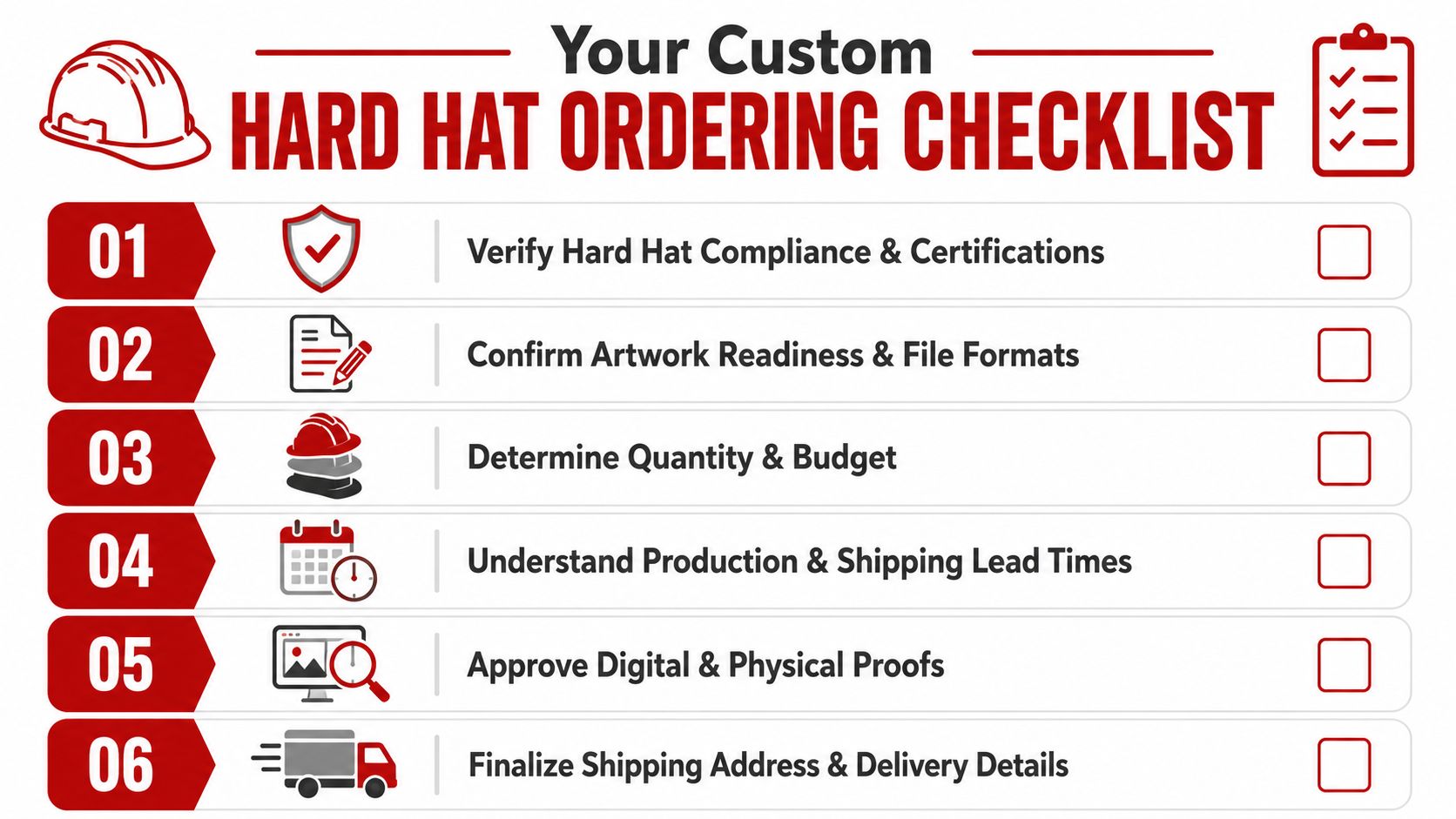
- Verify the required protection level: Confirm the correct type and class for the actual work environment before discussing decoration.
- Choose a compliant decoration method: Don't assume every print method is equally suitable for every shell.
- Simplify the logo for the space: Hard hats have limited imprint areas, so clean artwork wins.
- Send production-ready files: Vector art and proof-ready branding save time and avoid rework.
- Inspect the proof closely: Check placement, scale, orientation, and any role-based markings.
- Plan quantity with extras: Include spares for turnover, visitors, damage, and late additions.
- Build in time: Approval delays are common. Production doesn't begin until the proof is signed off.
The final buying mindset
The best custom printed hard hats don't happen when a buyer asks, “How do I get my full logo on this shell?”
They happen when the buyer asks, “What helmet does my crew need, what decoration method will hold up, and what logo version will stay readable?”
That shift solves most problems before they start.
If you also order branded caps, beanies, truckers, or promo headwear for staff and events, Dirt Cheap Headwear is a practical place to source wholesale blanks and decorated headwear without overcomplicating the process. Their team handles small runs and bulk orders, which is useful when your PPE program and your branded apparel program need to stay visually consistent.
Pingback: Security Guard Uniform Guide: 7 Essentials For 2026