
Screen Printing Methods: A Guide for Custom Headwear
You’re probably trying to decide between a few decoration options right now. Maybe you’ve got a staff uniform order, a team hat, a promo giveaway, or the first drop for a new brand, and every printer seems to throw around terms like spot color, mesh count, underbase, plastisol, water-based, and simulated process as if everyone already knows what they mean.
For hats, that gets confusing fast. A print that looks easy on a flat tee can fall apart on a curved trucker front, blur on soft twill, or fight you on foam. Good screen printing methods don’t just depend on the artwork. They depend on the surface, the ink, the mesh, the setup, and whether the hat itself wants to cooperate.
That’s why headwear needs its own conversation. Shirts are forgiving. Hats usually aren’t.
The Fundamentals of Screen Printing
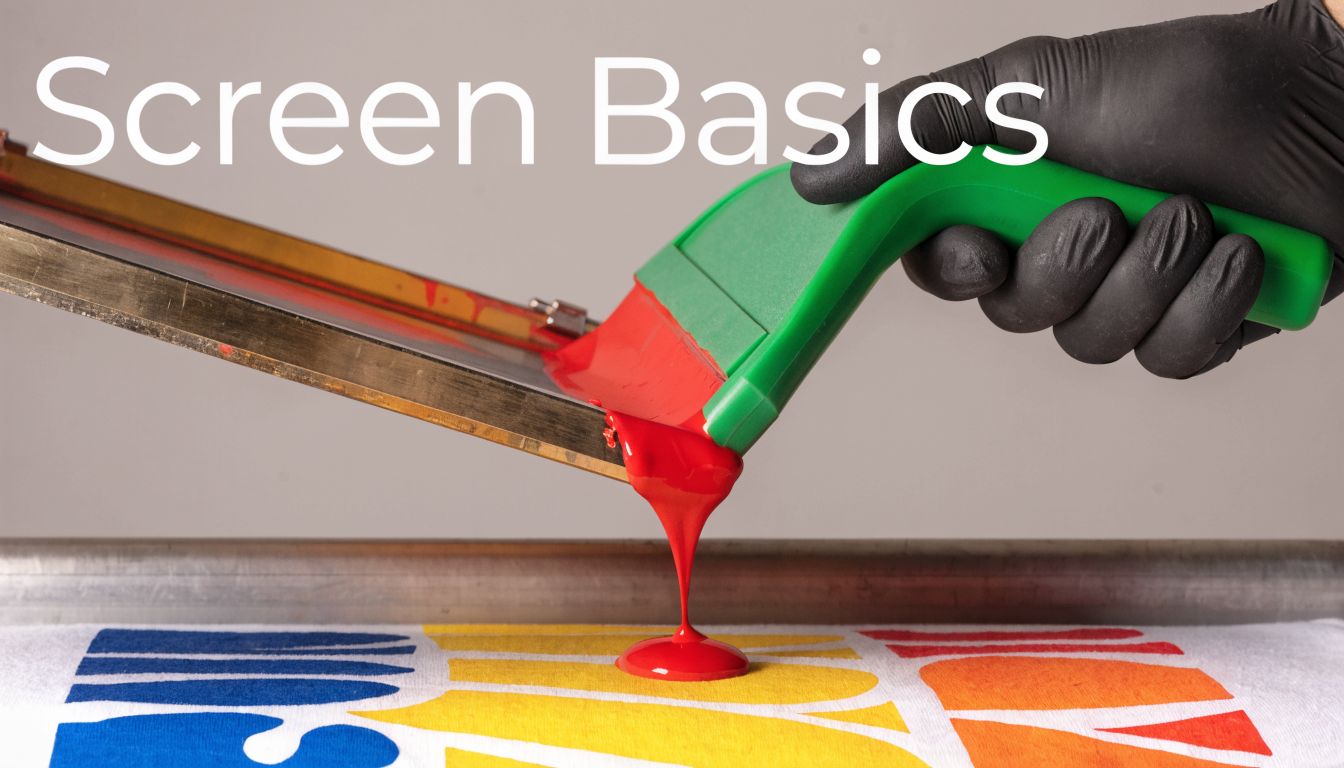
Screen printing is basically a more precise version of stenciling. You have a mesh screen stretched tight over a frame, a stencil that blocks off the parts that shouldn’t print, ink sitting on top of the screen, and a squeegee that pushes that ink through the open mesh onto the item below.
If you understand that one mechanic, most of the rest starts to make sense. Every screen printing method is really just a different way of controlling where the ink goes, how much ink goes down, and how many layers it takes to build the final image.
What each part actually does
A beginner usually hears “screen printing” and thinks the screen is the whole process. It’s only one part.
Here’s the job of each component:
- The screen holds the mesh that meters the ink. Different mesh counts change how much ink passes through and how sharp the print can be.
- The stencil decides the image. In shop terms, this is often emulsion burned with artwork so some parts wash out and others stay blocked.
- The ink creates the look and feel. Thick ink can make a bold graphic pop. Softer ink can sink into the surface more.
- The squeegee applies pressure and angle. That sounds minor until you see how much print quality changes when pressure is too hard, too soft, too upright, or too flat.
The simplest way to picture it is this. The stencil says “print here.” The mesh says “this much ink.” The squeegee says “right now.”
How the print gets made
A lot of clients assume the printer just places a hat under a screen and swipes once. Sometimes that’s close. Often it isn’t.
A standard print cycle usually looks like this:
- Artwork gets separated into printable layers.
- A screen is prepared for each needed color or effect.
- The item is loaded onto the correct platen or hold-down.
- Ink is flooded and printed through the screen with the squeegee.
- Each layer is flashed or cured as needed so the print stays put and survives wear.
For a one-color team logo, this can be straightforward. For a detailed graphic with highlights, fades, or realistic shading, the setup gets more technical fast.
Practical rule: If the art has clean shapes and solid colors, screen printing gets easier. If it has fades, tiny textures, and photo detail, the method choice matters a lot more.
Why mesh and deposit matter so much
The biggest concept new buyers miss is ink deposit. That’s the amount of ink the screen allows onto the surface.
More deposit usually means stronger opacity and bolder color, but it can also mean thicker feel, longer cure, and less fine detail. Less deposit can sharpen detail and feel cleaner, but it may not cover dark material well.
That trade-off is one reason screen printing methods vary so much. There isn’t one “best” setup. There’s the best setup for the art, the substrate, and the expected look.
On hats, that becomes even more important because the surface isn’t flat. A curved crown can exaggerate small setup issues that a shirt would hide.
A craft with a long track record
This isn’t some trendy decoration trick. Screen printing originated in ancient China during the Song Dynasty (960–1279 CE), making it one of the oldest known printing techniques still in commercial use today. The technique’s transformation from a luxury craft to an industrial process took approximately 950 years from its Chinese origins to its Western mechanization, as outlined in this history of screen printing.
That long history matters because the process is proven. It has survived because it works. The materials have changed. The precision has improved. The presses are better. But the core idea is still the same old principle of controlled ink transfer through a stencil.
Why this matters more on hats than shirts
A shirt gives you room. A hat gives you restrictions.
You’re dealing with a smaller print zone, seam interruptions, crown structure, and often a more stubborn substrate. That means the fundamentals aren’t just background knowledge. They’re what determine whether a logo prints crisp or ends up looking squeezed, flooded, or slightly off-center.
If a shop understands those fundamentals well, they can usually tell you early whether your design belongs in spot color, simulated process, embroidery, or another decoration method. That honesty saves time, screens, and frustration.
Plastisol vs Water-Based Inks The Great Debate
The first real decision in most screen printing jobs isn’t the press. It’s the ink.
If you’re ordering custom hats, this choice changes how the print feels, how it sits on the material, and how forgiving the job will be during production. Two designs can use the same art and same screen printing method but feel completely different because the ink family changed.

Why plastisol is still the workhorse
Plastisol is the ink frequently seen in apparel printing, even if its name is unknown. It tends to sit more on top of the material, which gives it strong opacity and a bold, graphic look.
That matters on hats because many headwear styles need coverage more than softness. A trucker cap front, a structured twill panel, or promotional foam hat usually responds well to an ink that stays visible and doesn’t disappear into the surface.
Plastisol is usually the safe answer when a client says:
- I need bright color on a dark hat
- The logo has strong spot colors
- I want the print to read from a distance
- I’d rather have dependable coverage than the softest possible feel
It’s also more forgiving in production. On headwear, forgiveness is valuable. Curves, seams, and panel tension already give printers enough to fight.
Where water-based inks win
Water-based ink behaves differently. Instead of building more of a layer on top, it tends to soak into the fibers more, which usually creates a softer hand-feel.
That can look great on the right blank. If you’ve got a soft cotton cap, a washed dad hat, or a fashion-oriented piece where the print shouldn’t feel heavy, water-based ink can give the result a more worn-in, less plasticky finish.
The catch is simple. Hats are not all soft, thirsty surfaces.
Foam fronts, coated synthetics, and tightly woven structured panels don’t always reward that softer approach. Water-based jobs can also be less forgiving if the press operator lets the ink dry where it shouldn’t. On a flat tee, there’s more room to manage. On a hat setup, that tighter work area can make things fussier.
The nicest water-based print on paper doesn’t always become the nicest water-based print on a cap.
Hand-feel versus visual impact
Clients sometimes talk past the printer, asking for the “best” ink when they’re really asking for one of two things.
They either want:
- A premium soft feel that blends into the fabric
- A bold visual hit that stays opaque and crisp
If your job is event merchandise, team gear, promotional trucker hats, or anything meant to be seen quickly, plastisol often makes more sense. If the goal is a softer boutique look on a garment-dyed or washed cap, water-based can be the better fit.
Neither answer is automatically premium. Premium depends on matching the ink to the product.
The specialized option called discharge
Discharge sits in the water-based family, but it deserves its own mention because clients hear the term and assume it’s magic. It isn’t.
Discharge works by removing or replacing dye in suitable fabrics rather than just layering color on top the same way a standard opaque print does. When it works, it can feel very soft and look integrated into the material. When the substrate isn’t right, results can be inconsistent.
For hats, that inconsistency is exactly why discharge isn’t a blanket recommendation. Headwear materials vary too much. The same order might include twill, blends, foam, mesh back panels, and different dye behaviors.
Here’s a good visual reference if you want to see ink handling in motion before choosing a route:
The trade-off chart clients actually need
| Ink type | Usually best for | Strength | Weak spot on hats |
|---|---|---|---|
| Plastisol | Bold logos, dark blanks, promo headwear | Strong opacity and dependable coverage | Can feel heavier |
| Water-based | Soft cotton caps, fashion prints, softer hand-feel | More natural feel | Less forgiving on difficult headwear surfaces |
| Discharge | Suitable dyed fabrics where soft finish matters most | Very soft result when the blank cooperates | Not every hat material is a good candidate |
What I’d tell a new client in plain English
If your art is simple, your hat is structured, and you care most about clarity, start by asking about plastisol.
If your brand aesthetic leans vintage, washed, or premium casual, ask whether the actual blank you chose is a good fit for water-based or discharge. Don’t start with the ink and force the hat to match. Start with the hat, then choose the ink that behaves well on it.
That one decision prevents a lot of disappointing proofs.
Exploring Common Screen Printing Methods
Once the ink family is settled, the next question is how the image gets built. At this point, clients usually hear several screen printing methods at once and assume they’re interchangeable. They’re not.
A clean two-color logo, a realistic mascot head, a faded sunset, and a raised retro graphic may all be “screen printed,” but they use very different setups and create different results.
Spot color printing
Spot color is the standard method often recommended for new users. Each color in the design gets its own screen, and each screen prints a solid area of ink.
If you’ve got a team logo, company name, school mark, or bold brand icon, spot color usually does the job cleanly. It’s direct, readable, and easier to control than more advanced separations.
A few things make spot color especially useful on hats:
- Simple shapes print better on small curved areas
- Solid colors stay readable on trucker and snapback fronts
- Setup is easier to manage than photo-style artwork
- Registration is usually less stressful than highly detailed multicolor work
For headwear, this is often the sweet spot. Most hat graphics don’t need to behave like posters. They need to be legible at a glance.
Simulated process printing
This is the method people usually want when they say, “Can you print this full-color artwork on a dark hat?” Sometimes the answer is yes. Sometimes the answer is yes, but only if the artwork and blank justify the complexity.
Simulated process screen printing enables photorealistic, multi-color images on dark garments using 8-12 custom screens. On black 100% cotton, a white underbase adds 85% color fidelity vs. 50% without. This method achieves 250-350 DPI effective resolution and is durable for over 75 washes, according to this simulated process guide.
That’s powerful, but it comes with trade-offs. More screens mean more setup, tighter registration demands, and less tolerance for sloppy artwork. On hats, where the print area is smaller and the surface curves, the method can work beautifully for the right job, but it’s not the default answer for every logo.
Shop-floor reality: Simulated process is impressive when the art earns it. It’s overkill when a clean spot-color version would read better on the crown.
CMYK process printing
CMYK uses cyan, magenta, yellow, and black to build a full-color image through halftones. On paper, that’s familiar. On textiles and headwear, it’s more limited.
The method can work when the art is designed for it and the substrate cooperates, but it’s often less forgiving on dark materials and textured surfaces. Many hat jobs that look like they should be CMYK candidates often perform better with simulated process or a simplified spot-color redraw.
Why? Because hats don’t give you a large, flat, forgiving billboard. They give you a smaller, more distorted canvas. Fine dot patterns and subtle transitions can suffer if the surface shifts or the setup isn’t exact.
Puff and high-density effects
Some designs don’t need more colors. They need more texture.
Puff ink expands during curing and creates a raised look. High-density printing builds a more sculpted effect with thicker deposits and sharper dimensional edges. Both methods can turn a basic logo into something that feels more custom.
These are popular when the goal is style rather than realism. A vintage sports mark, streetwear wordmark, or simple icon can benefit from a tactile finish that catches light and gives the hat more presence.
Best use cases include:
- Retro wordmarks on foam truckers
- Simple streetwear logos on structured fronts
- Monograms or icons where the raised effect is part of the design
What doesn’t work well is combining a busy design with a texture-heavy effect and expecting it to stay readable. Puff loves bold shapes. It doesn’t love tiny details.
Metallic, glitter, and specialty inks
Specialty inks can be fun, but they’re usually strongest as accents, not as a rescue plan for weak artwork.
Metallics and glitter need room to show themselves. On hats, that usually means larger solid areas and enough contrast around the effect. If the art already feels cramped, adding a novelty ink can push it into clutter.
This is also where mesh choice starts to matter in a practical way. Specialty inks often need a setup that lets larger particles or heavier deposits pass through. If the design also demands fine detail, those goals can conflict.
Method choice by artwork type
Here’s the version clients usually need at quote time:
| Artwork type | Best starting method | Why |
|---|---|---|
| Simple logo with few colors | Spot color | Clean, readable, efficient |
| Detailed mascot or photo-style art | Simulated process | Better tonal range and realism |
| Basic full-color concept from print media | Case by case between CMYK and simulated process | Depends on substrate and detail demands |
| Retro or tactile fashion graphic | Puff or high-density | Texture becomes part of the design |
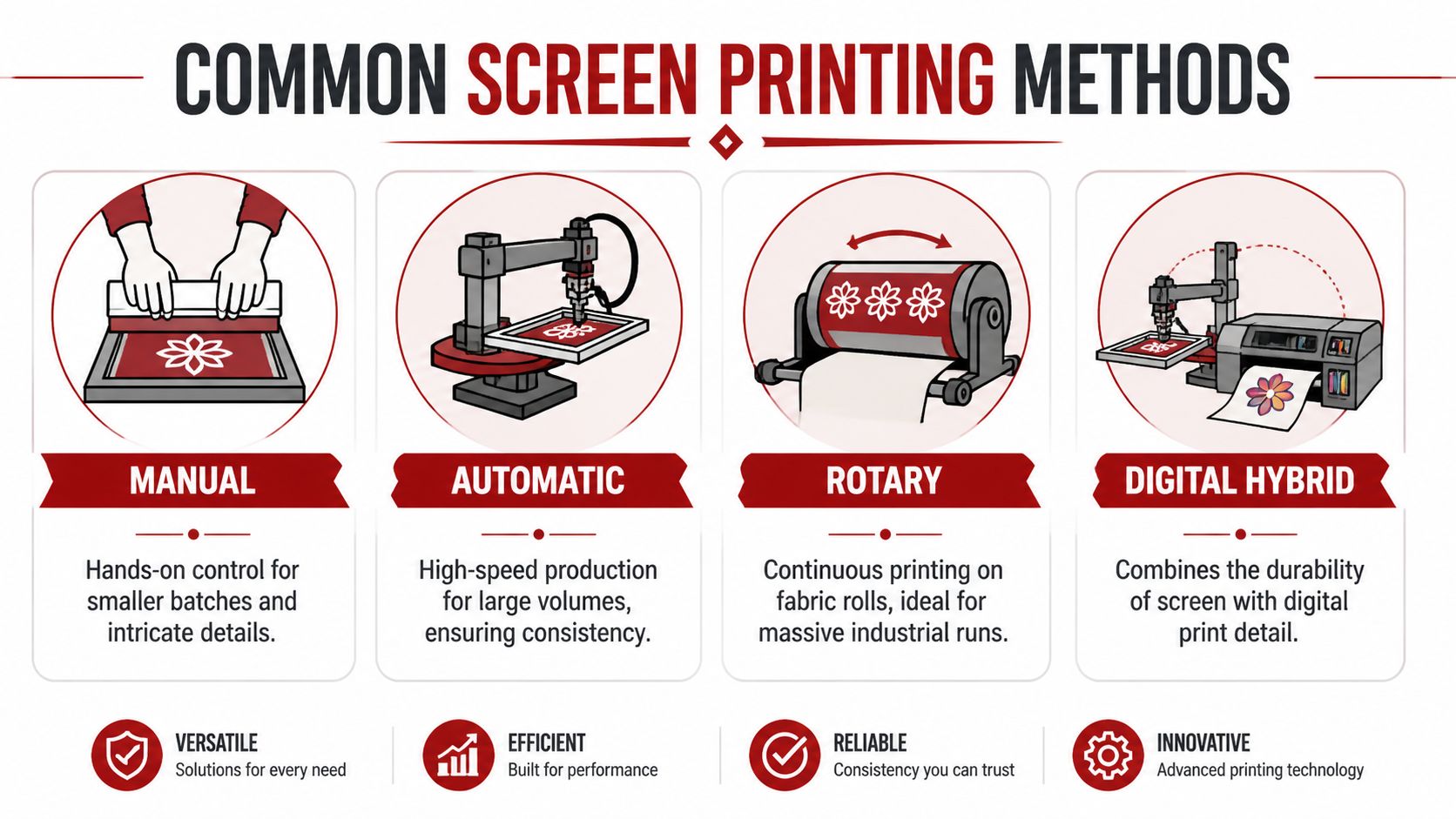
Manual, automatic, rotary, and hybrid production
People also use “screen printing methods” to describe how the job runs through equipment, not just how the image is separated.
That matters mostly for production style:
- Manual printing gives more hands-on control and is often useful for shorter runs or jobs needing close operator attention.
- Automatic presses help with consistency when the order is larger and repeatability matters.
- Rotary printing belongs more to continuous industrial fabric production than typical custom headwear work.
- Digital hybrid setups combine screen and digital approaches where detail and production efficiency need to meet in the middle.
A new client doesn’t need to obsess over the machine type first. The art method and hat style matter more. But the production method can affect speed, consistency, and what a shop is comfortable printing.
Printing on Headwear A Unique Challenge
A shirt lies flat. A hat doesn’t. That changes everything.
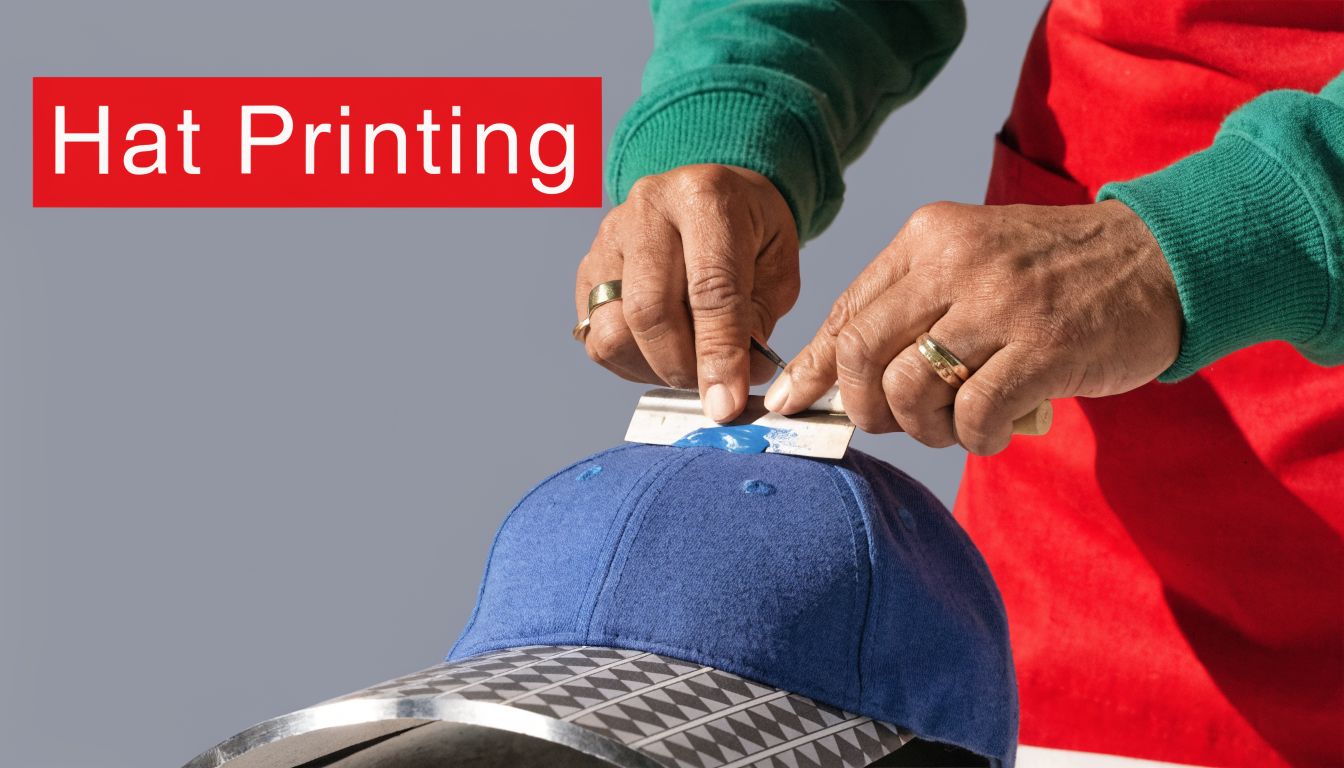
The minute you move from tees to headwear, normal assumptions stop being reliable. The print zone is smaller, the surface curves away from the screen, seams can interrupt the design, and the panel material itself may resist the kind of ink transfer that looked easy on a flat sample.
Curves change how artwork behaves
This is the issue most buyers don’t see until they get a proof or a bad sample. On a hat, the art wraps around a crown that pushes parts of the image toward or away from the screen. What looked balanced on a rectangle can distort once it hits a curved panel.
That’s why fine halftones and tiny type can become risky faster on hats than on shirts. Standard angle advice from flat textile work doesn’t always carry over cleanly. Standard screen angles for flat textiles often fail on hats, causing moiré patterns on curved surfaces. Headwear-specific adjustments, such as increasing halftone angles to 30-45° or using specialized screens, are critical. Forums report that 40% of printers struggle with moiré on curves, a problem that can be reduced by 25% with proper squeegee angle and tension tweaks for hat platens, as noted in this headwear-focused screening discussion.
That’s a technical way of saying this: if someone treats a hat like a tiny t-shirt, the print can go sideways.
Material matters more than most clients expect
“Hat” isn’t one substrate. It’s a category.
A foam-front trucker, a brushed cotton dad hat, a structured twill snapback, and a knit beanie all behave differently. Foam can print boldly but has its own compression and rebound issues. Twill can hold detail but may need a setup tuned for the fabric’s texture. Soft unstructured hats can shift more than clients expect. Beanies introduce stretch and uneven surfaces that change how a graphic reads.
That’s why smart headwear printing usually starts with simplifying the artwork to suit the blank, not forcing the blank to carry every design idea.
Small print areas reward editing. A logo that loses a tiny line or secondary phrase often becomes a better hat graphic, not a worse one.
The print area is smaller, so clarity wins
On a shirt, you can afford extra information. On a cap front, every unnecessary detail steals room from the part people need to see.
These are the elements that usually survive well on hats:
- Bold brand names
- Simple mascots or icons
- Strong contrast between print and blank
- Limited text with clear spacing
These are the elements that often get clients into trouble:
- Tiny taglines
- Dense distress textures
- Complex fades inside very small shapes
- Art that depends on wide layout proportions
A hat front doesn’t just shrink the design. It changes the way the design should be composed.
Setup choices that make or break the result
A lot of headwear quality comes down to setup discipline. The artwork may be solid, but if the hat isn’t held correctly or the print parameters don’t match the surface, the result can still look weak.
For custom headwear, the practical checks usually include:
- Platen fit so the hat sits consistently and doesn’t rock during printing
- Screen tension high enough to keep the stencil stable over repeated impressions
- Squeegee choice matched to the mesh and the crown structure
- Artwork placement adjusted for crown height, seam position, and closure style
- Realistic expectations about how much detail belongs on a curved panel
If you want a good plain-language breakdown of how this process differs from flat garment printing, this overview of the silk screen technique for hats is worth reading before finalizing art.
What works best by hat style
Different headwear styles reward different approaches.
| Hat style | Usually works well | Common problem |
|---|---|---|
| Structured trucker | Bold spot-color logos, retro graphics | Crown curve can distort fine halftones |
| Dad hat | Smaller simple prints, softer-looking art | Unstructured fabric can shift |
| 5-panel cap | Centered graphic work and cleaner layouts | Limited height can crowd tall art |
| Beanie | Minimal marks and simple placements | Stretch and texture fight detail |
What doesn’t work, even when the mockup looks good
Mockups are generous. Presses are honest.
A full-width, photo-heavy graphic with tiny highlights may look sharp on a digital mockup placed on a cap template. In production, that same concept can run into seams, curve distortion, under-inking on textured areas, or visual clutter once it’s reduced to actual size.
That doesn’t mean hats are a bad canvas. It means they reward restraint. The best headwear prints usually look intentional, not squeezed in.
Cost and Run Size Decoding Your Order
Screen printing prices make more sense once you separate setup cost from per-piece cost. That’s the part many first-time buyers miss.
A printer doesn’t only charge for the hat getting ink on it. There’s also the prep work behind it. Screens have to be made, artwork has to be separated, colors have to be planned, the press has to be dialed in, and the hat setup has to be tested so the print lands cleanly on a curved surface.
Why small runs feel expensive
If you order a short run, you’re asking the shop to do most of the same preparation it would do for a larger run, just spread across fewer pieces. That’s why small custom hat orders often look expensive per item even when the design seems simple.
For startups and events, the goal isn’t always to find the absolute cheapest route. It’s to avoid paying for complexity you don’t need.
That’s one reason underbase strategy matters. Using a colored underbase that matches the design can cut the number of screens needed by 20-30%, which data shows can increase profit margins by up to 35% on orders under 50 pieces, according to this underbase printing analysis. On smaller headwear runs, reducing screens can make a real difference.
Fewer screens usually means less setup, fewer registration points to manage, and a cleaner path to a reasonable quote.
When bulk starts to make more sense
Screen printing usually gets more attractive as the quantity rises because the setup gets spread across more pieces. The art doesn’t need to be rebuilt for every hat. Once the press is running correctly, each additional piece is mainly a production cost.
That doesn’t mean bulk is always the smartest first move. If you’re launching a brand or testing a team design, a modest run can still be the right call because it lets you prove the concept before tying up money in inventory.
That same thinking is one reason why print on demand athletic apparel works for some organizations. The article is about sportswear, but the logic applies here too. Validation matters. Ordering strategy should match how certain you are about demand.
The cheapest quote can still be the wrong buy
A low quote can hide trade-offs. Maybe the art was simplified too aggressively. Maybe the print method doesn’t really suit the hat. Maybe the cheapest path uses a setup that won’t give the finish you want.
A better way to judge value is to ask:
- How many screens are being used, and why
- Whether the art is being adapted for headwear or just shrunk
- If a simpler print method could get the same visual result
- Whether the chosen underbase and ink strategy fit the run size
If you’re comparing quotes and want a baseline for how shops think about setup and pricing, this breakdown of screen printing cost factors is useful.
A practical ordering mindset
For first runs, keep the design clean, limit unnecessary colors, and choose a hat style that supports the artwork instead of fighting it. If the design proves itself, scale the next order with confidence.
That approach usually beats overbuilding the first batch.
Screen Printing vs Embroidery and Heat Transfer
Screen printing isn’t always the right call for hats. Sometimes embroidery is the smarter move. Sometimes heat transfer solves a problem screen printing would only complicate.
The right decoration method depends on the logo, the quantity, the hat style, and the finish you want people to notice first.
When screen printing wins
Screen printing works well when the graphic has more fill, more shape, or more color movement than embroidery can handle gracefully. It’s also a strong option when you want a flatter finish instead of thread texture.
On headwear, mesh and deposit become part of that decision. For headwear, mesh count is critical for balancing detail and ink coverage on curved surfaces. While a 110-160 mesh is standard for spot colors on trucker caps, achieving photorealistic detail on a 5-panel hat requires a 230-305 mesh count. Using a higher mesh count can reduce ink consumption by 15-25% and decrease drying time, but requires a softer squeegee to ensure proper ink deposit on structured twill, based on this mesh count guide for screen printing.
That tells you something important. Screen printing can go from bold and simple to highly detailed, but only when the setup is matched to the hat.
When embroidery is the better answer
Embroidery usually wins when the logo needs a classic, durable, stitched look. Corporate marks, golf hats, team identity caps, and retail headwear often benefit from thread because it reads as premium and intentional on headwear.
If your logo was designed for print first, though, it may need cleanup before stitching. Fine lines, tiny text, and subtle shading don’t always convert well to thread. If you’re moving toward embroidery, this guide on how to digitize a logo for embroidery helps clarify what needs to change.
Where heat transfer fits
Heat transfer is useful when you need short-run flexibility, names and numbers, or image placement that doesn’t justify full screen setup. It can also make sense for one-off personalization or highly variable orders.
The trade-off is that the finish and feel are different. On hats, transfers can be handy, but they don’t automatically outperform a well-matched screen print or embroidery job. They solve a different problem.
The simple decision test
Use this quick filter:
- Choose screen printing for bold graphics, larger filled shapes, and art that needs a printed look.
- Choose embroidery for a classic logo treatment, textured finish, and traditional cap presentation.
- Choose heat transfer for short-run personalization or variable graphics that would be inefficient to screen print.
The best decoration choice isn’t the one with the most technical range. It’s the one that suits the artwork and the hat without forcing either one.
If you need blank hats, decorated headwear, or help figuring out which method fits your artwork, Dirt Cheap Headwear makes the process easier. You can source wholesale styles, request custom decoration, and get guidance on what will work on your chosen cap before you commit to a full order.
Pingback: Screen Printing for Artists: A Beginner's How-To Guide | Dirt Cheap Headwear
Pingback: What is Direct to Film Printing? A Guide for Custom Hats | Dirt Cheap Headwear
Pingback: Custom Printed Hard Hats: Safety & Branding Guide | Dirt Cheap Headwear
Pingback: Photoshop Screen Printing Workflow for Hat Artwork | Dirt Cheap Headwear
Pingback: Screen Printing Services Explained for Hats and Apparel | Dirt Cheap Headwear