
Buying Bulk Beanies Hats: A Complete Guide for 2026
You've got a winter event, a new staff uniform, or a small merch launch coming up, and you need headwear that looks branded without creating a warehouse full of risky inventory. You're comparing colors, materials, decoration methods, and minimum order quantities, while wondering whether the fashionable oversized beanie will work better than the dependable cuffed style.
Buying bulk beanies hats gets easier when you treat the order as a business decision rather than a simple apparel purchase. The right combination of silhouette, knit, logo placement, and order size depends on who'll wear the beanie and what you need it to accomplish.
Why Branded Beanies Are a Smart Move
A branded beanie earns its place in a merchandise program because it solves a practical problem first. People wear it for warmth, then your logo travels with them to commutes, games, outdoor jobs, and everyday errands. That gives a small business a useful product instead of another disposable giveaway.
Suppose you run a coffee shop and want something for winter staff. A soft cuffed beanie in a neutral color can create a consistent uniform without making employees look over-dressed. A brewery, ski club, nonprofit, or local retailer can use the same basic product for event merchandise, customer gifts, or a small resale collection.
Practical rule: Choose a beanie people would wear without your logo. Branding should improve the item, not rescue an uncomfortable or awkward product.
Beanies also have staying power. Their documented history reaches back to 12th-century Wales, where an early close-fitting cap associated with the Monmouth cap is described as a precursor to the modern beanie. Similar beanie-style hats were traced in Britain by the 15th century, alongside the spread of knitting, so bulk beanies belong to a centuries-old headwear category rather than a short-lived trend. The history of the beanie provides useful context for why this simple shape keeps returning.
The commercial opportunity is broad as well. One market estimate valued the global headwear market at USD 30.33 billion in 2024 and projected it to reach USD 55.81 billion by 2034, with a 6.3% CAGR. The same market source says caps and hats represented 60.70% of global headwear sales in 2025, placing knit hats inside a substantial, globally distributed accessory category. Mordor Intelligence's headwear market overview offers the wider category perspective.
For a new brand, the useful lesson is simple. Beanies can support staff apparel, fan merchandise, promotional gifting, and retail resale without requiring an unfamiliar product category. If you're building a broader direct-to-consumer plan around branded merchandise, you can also discover DTC growth tactics that connect product selection with customer acquisition and repeat sales.
Choosing Your Go-To Beanie Style
Start with the silhouette, because the shape affects fit, decoration space, perceived value, and audience appeal. Material and logo details matter, but they can't fix a style that doesn't suit the people receiving or buying it.
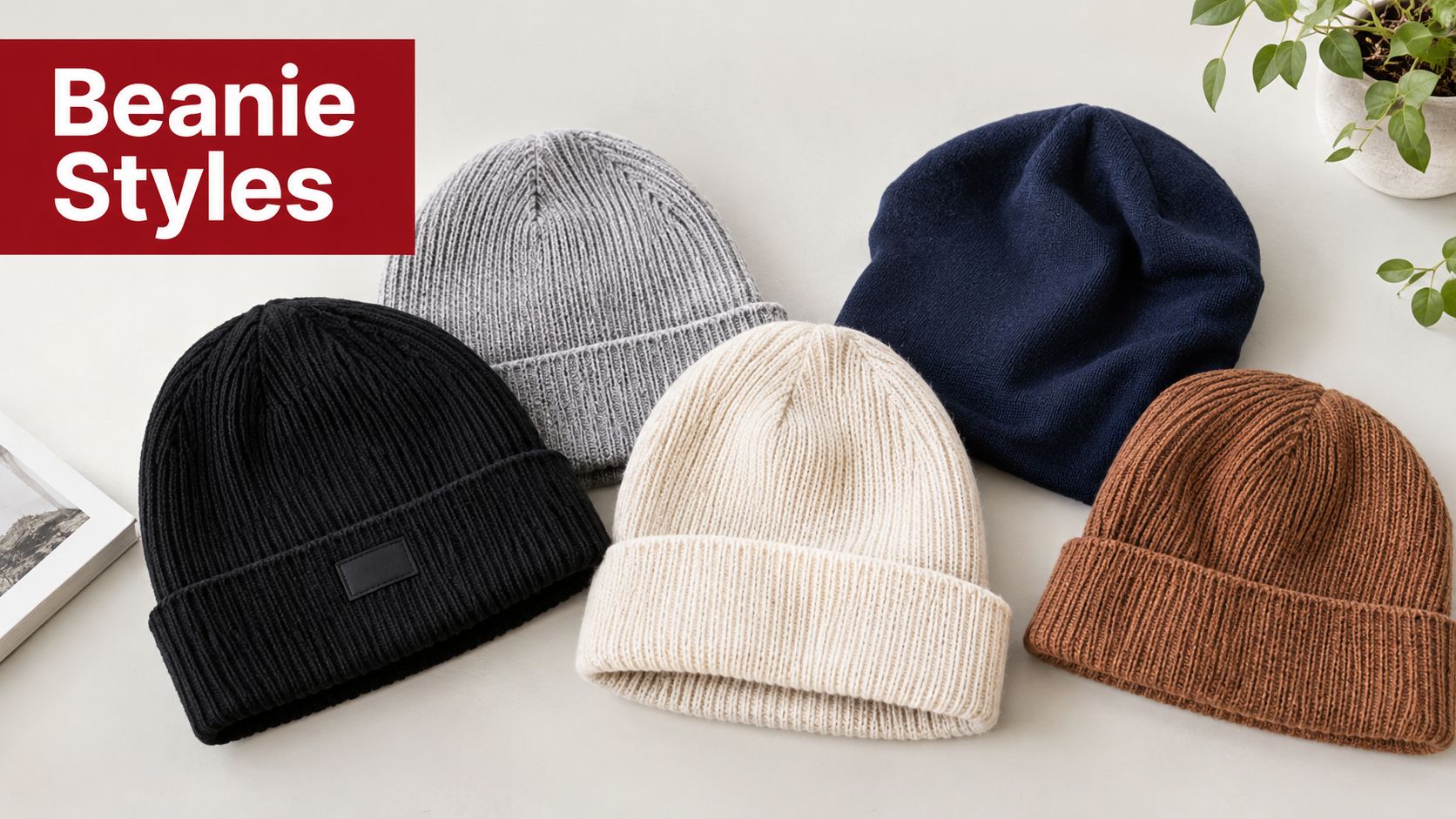
The main silhouettes
Classic cuffed beanie: The folded cuff creates a clear branding panel and gives the hat a familiar winter profile. It's usually the safest choice for employee uniforms, broad giveaways, school groups, and first-time retail tests because the shape feels recognizable across different audiences.
Slouchy beanie: A longer body produces a relaxed, oversized look. It suits lifestyle brands, streetwear collections, music merchandise, and audiences that follow fashion-led styling. The extra fabric can look appealing on a product page, but the looser profile may feel less uniform across wearers.
Fisherman beanie: This shorter style sits higher on the head, often above or close to the ears. It has a stronger streetwear identity and can give a small logo a deliberate, fashion-conscious setting. It isn't the best universal winter option if your audience expects full ear coverage.
Pom-pom beanie: The top detail adds personality and works especially well for family retail, seasonal gifting, school spirit, and playful event merchandise. It can be harder to position for a restrained corporate uniform, where a clean cuffed profile usually looks more consistent.
Match the style to the job
Recent 2026 trend coverage identifies oversized and slouchy beanies as a dominant style direction, alongside growing interest in minimalist embroidered logos and neutral or earthy colors. That creates a real choice for bulk buyers, not a reason to select the trendiest shape automatically. The 2026 beanie trend coverage is useful for spotting direction, but your use case should decide the order.
- Staff uniforms: Choose a cuffed beanie with a compact logo and a color that works with existing outerwear. Consistency matters more than runway appeal.
- Fan merchandise: Consider a split assortment. Use the classic cuffed style as the dependable base, then add a slouchy or fisherman option for customers who want a more distinctive look.
- Event giveaways: Prioritize comfort, broad fit, and easy decoration. A cuffed acrylic knit usually creates fewer objections than a highly specialized silhouette.
- Fashion resale: Test textured, oversized, or earthy-color options in a controlled run before committing to deep inventory. Trend-led products can create excitement, but they also narrow your audience.
The safest buying strategy is often a core-and-test mix. Keep a classic style for broad wearability, then use a smaller fashion-oriented selection to learn what your audience purchases.
Picking the Perfect Beanie Material
Material affects the customer's first impression, the hat's warmth, the way it stretches, and the price you can support. For large programs, consistency matters just as much as premium feel. If one batch feels noticeably different from the next, customers and staff will notice.
Acrylic is the standard workhorse for many bulk orders. Acrylic fibers trap air and provide thermal insulation while staying lighter and softer than wool. A material guide summarizes acrylic as providing roughly 85–90% of wool's warmth, making it a cost-effective baseline for cold-weather programs where you need consistent handfeel and warmth across many units. This acrylic beanie material guide explains the reasoning behind that choice.
Wool brings a premium natural feel and strong warmth. It can make sense for a higher-priced retail line, an outdoor brand, or a customer base that values natural fibers. The trade-off is a higher unit cost and the possibility that some wearers find the fiber itchy.
Cotton feels soft and breathable, which can suit milder climates, indoor events, and lightweight lifestyle merchandise. It isn't the obvious pick for maximum winter insulation, so don't select it solely because the natural-fiber label sounds appealing.
Blends let you balance characteristics. A wool-acrylic blend may soften the feel while keeping the program more manageable, while cotton blends can alter breathability and stretch. Ask for the exact fiber composition rather than relying on a broad label such as “knit.”
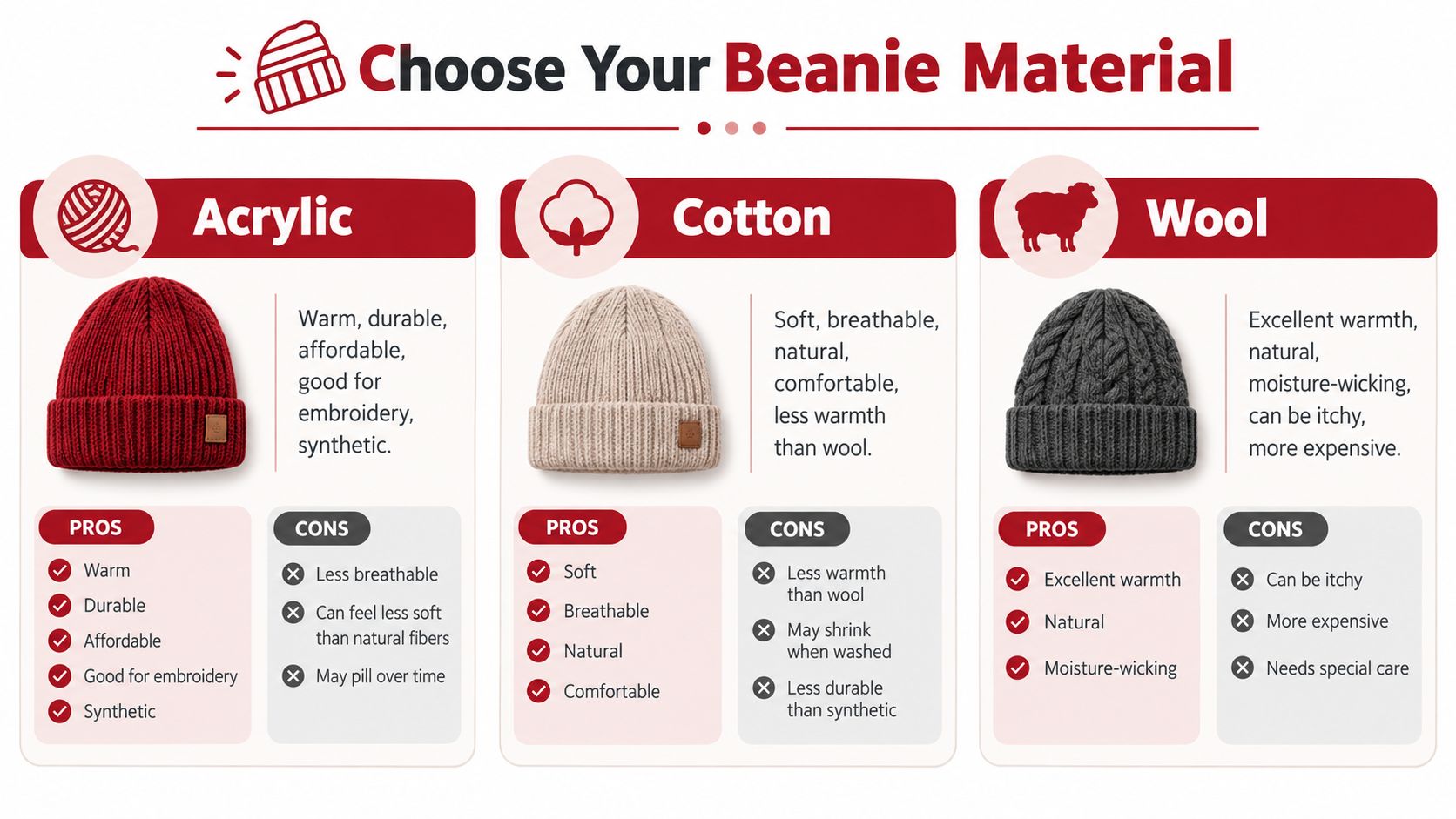
Beanie Material Comparison
| Material | Warmth | Feel | Average Cost | Best For |
|---|---|---|---|---|
| Acrylic | Strong everyday warmth | Light and soft | Cost-conscious | Promotional programs, staff orders, broad winter use |
| Wool | Excellent warmth | Natural, sometimes itchy | Premium | Outdoor brands, premium retail, cold-weather audiences |
| Cotton | Moderate warmth | Soft and breathable | Moderate | Mild climates, indoor events, lifestyle collections |
| Blends | Depends on the fiber mix | Balanced | Varies | Buyers who want a specific mix of comfort, warmth, and price |
Acrylic isn't automatically the right answer. It works when you need reliable warmth, repeatable color, and a price structure that supports bulk distribution. Wool or cotton may be better when the product story, climate, or retail positioning justifies the difference.
If you're comparing natural-fiber options, review wool knit beanies alongside acrylic blanks and judge the actual handfeel, cuff construction, and decoration area before placing the full order.
Getting the Sizing and Fit Right
Most knit beanies use a one-size-fits-most approach because the fabric stretches around the head. That doesn't mean every beanie fits everyone identically. Rib structure, knit density, body length, and cuff depth all influence whether the hat feels secure, loose, shallow, or overly bulky.
A tight rib-knit usually gives a familiar combination of stretch and recovery. It can work well for staff groups and giveaways because the hat adapts to different wearers while retaining a structured appearance. A looser waffle knit may provide more texture and visual interest, but its stretch and drape can feel different from a smooth ribbed style.
Check these fit details before ordering
- Measure the usable cuff. The folded cuff is usually the most practical decoration zone. Ask how much flat area remains after the cuff is folded, rather than assuming the full hat body is available.
- Decide how the hat should be worn. A cuffed beanie can sit close to the head for warmth or be styled with a more relaxed profile. A slouchy body depends more heavily on drape and personal preference.
- Review stretch and recovery. Stretch helps the beanie accommodate different head sizes, while recovery determines whether it keeps its shape after repeated wear.
- Test the logo position. A design that looks centered on a flat product photograph may shift when the cuff curves around the head. Request a decorated sample or digital proof that shows the logo on the actual panel.
For a team uniform, prioritize a predictable fit over unusual proportions. For fashion resale, a distinctive profile can be part of the product's appeal, but describe the fit clearly so customers know whether the beanie is shallow, standard, or intentionally oversized.
Ask your supplier for fabric composition, dimensions, cuff details, and care instructions. Those answers will tell you more than a generic “one-size” label.
Customizing Your Bulk Beanies
Decoration turns a plain knit into a branded product, but beanies demand more technical control than a rigid cap. The knit stretches, the cuff curves, and dense stitching can pull the fabric out of shape if the setup isn't right.
Choose the decoration method
Flat embroidery is the practical default for most logos. It creates a clean, durable mark and works especially well for bold lettering, simple icons, team marks, and minimalist branding. Keep fine details under control, because tiny text and delicate lines can lose clarity when translated into stitches.
3D puff embroidery adds raised dimension and a stronger streetwear feel. It can suit a short wordmark or uncomplicated emblem, but the design needs enough separation and structure for the foam-backed stitches to read clearly. It isn't ideal for intricate artwork packed with small details.
Woven patches preserve fine lines and small lettering better than dense embroidery in some designs. They can create a polished label effect and work well for fashion collections or illustrated marks.
Embroidered patches provide a textured, traditional appearance and can be applied as a separate branded element. Leather or faux-leather patches create a rugged, premium look that suits outdoor, workwear, and heritage-inspired brands.
Protect the knit during embroidery
For decorated beanies, quality depends heavily on stretch control. Technical guidance recommends using cutaway stabilizer behind the cuff so the stitches remain dense and flat while the knit retains its elasticity. A ballpoint needle around size 75/11 and a slower machine speed can help reduce fiber damage and stitch distortion on knitted construction. This beanie embroidery guidance covers the setup details that affect the finished result.
Decoration check: Ask whether the supplier has tested the logo on the specific knit, not just on a similar-looking sample.
A supplier's machine capability matters, but so does its proofing process. The artwork should show thread colors, approximate placement, and the way the logo sits on the cuff. If the design includes a long phrase, ask whether shortening the wording or switching to a patch would improve readability.
You can review wholesale custom embroidered beanies when comparing decorated options, but evaluate every quote against the same questions: blank quality, decoration method, proof approval, minimum quantity, and delivery expectations.
This video gives buyers a visual reference for how custom headwear production can be approached:
Navigating the Wholesale Ordering Process
A smooth bulk order starts with a clear product brief. Before contacting suppliers, write down the intended use, audience, preferred silhouette, material, color family, logo file, decoration method, delivery location, and required arrival date. This prevents a quote from comparing unlike products.
Understand the commercial terms
Minimum order quantity, or MOQ: This is the smallest quantity a supplier will accept for a particular blank, color, decoration, or logo setup. A low MOQ helps a small business test demand, while a higher MOQ may make sense for a planned retail launch or a large event.
Price breaks: Suppliers may offer better unit pricing as quantity rises, but a lower per-unit price doesn't automatically mean a better order. Extra inventory ties up cash and creates storage, color, and style risk. Buy the quantity you can reasonably distribute or sell.
Lead time: Ask for separate estimates for proof approval, production, quality checking, and shipping. A supplier can't control every carrier delay, so leave room between the promised arrival window and your event date.
Proofing: Don't approve artwork from memory. Check logo scale, placement, thread colors, spelling, contrast, cuff height, and the exact blank style shown in the proof.

Build a supplier conversation that gets useful answers
Send one concise request rather than a vague message asking for “cheap custom beanies.” Include your target quantity, desired delivery date, logo format, color preferences, and whether you're open to substitutions. Ask for a decorated sample, a digital proof, shipping terms, and the conditions that could change the quoted price.
For a small test, Dirt Cheap Headwear states that its in-house embroidery service supports low minimums starting at six pieces per logo, according to the publisher information supplied for this guide. You can submit specifications through the custom order form when you're ready to request a custom quote.
Storage planning is easy to overlook when you're focused on product selection. If your operation also needs protective packing or shipment organization, resources such as Storage & Removal Boxes bulk foam can help you think through packaging materials separately from the headwear order.
Keep all approvals in writing. Save the final proof, product code, color name, quantity, shipping address, and delivery commitment so everyone is working from the same version.
Your Next Steps for Ordering
A profitable beanie order usually comes down to three decisions: style, material, and decoration. Make them in that order, because each choice narrows the next one.
Use this buying checklist
- Style: Is the order for staff, a broad giveaway, fan merchandise, or retail resale? Start with a cuffed beanie for universal wearability, or choose a slouchy, fisherman, or pom-pom shape when the audience and brand identity support it.
- Material: Do you need dependable cold-weather warmth at a controlled cost, a premium natural-fiber feel, or breathable comfort for a milder setting? Acrylic is the practical baseline for many large programs, while wool, cotton, and blends serve more specific positioning.
- Decoration: Does the logo need a clean embroidered finish, raised 3D texture, or a patch that preserves fine detail? Match the method to the artwork and the knit rather than choosing by appearance alone.
- Fit: Will the cuff provide enough room for the mark? Does the body offer the stretch and length your audience expects?
- Order size: Can you distribute or sell the full quantity? A smaller test can reveal preferred colors, silhouettes, and logo placement before you commit to a larger inventory position.
- Approval: Have you checked the proof for size, color, spelling, and placement on the actual beanie?
The most reliable first order is usually not the most adventurous one. It's a product your audience can wear comfortably, recognize immediately, and connect with your brand. Once sales or team feedback gives you evidence, add trend-led styles with more confidence.
A supplier should make the process understandable from blank selection through proof approval and shipping. If you have unanswered questions about knit, cuff space, decoration, or quantity, pause before paying. Clear answers now are cheaper than correcting an unsuitable order later.
Dirt Cheap Headwear offers wholesale blank beanies, custom embroidery, patches, and an order process suited to both small tests and larger branded programs. Visit Dirt Cheap Headwear to compare beanie options, submit your specifications, and request a quote for your next bulk order.