
Nylon 5 Panel Hat Guide for Style and Performance
You're packing for a trail race, filling a weekend duffel, or ordering caps for an outdoor event, and you want one hat to handle sweat, light weather, travel, and a visible logo. A nylon 5-panel hat often looks like the obvious answer, but the right choice depends on more than a technical fabric label. Crown depth, front-panel backing, closure style, decoration method, and the feel of the shell all affect whether the hat works in real life.
The useful question isn't whether nylon is durable. It's whether its lightweight, quick-drying, water-resistant, and packable qualities match the activity, climate, and branding job you have in mind. This guide breaks down the construction, compares nylon with cotton, polyester, and mesh, and shows when another material may serve you better.
What Makes a Nylon 5 Panel Hat Distinctive
A 5-panel cap gets its name from the five fabric pieces stitched into the crown. Unlike a traditional 6-panel cap, it usually has one large front panel instead of two front pieces divided by a center seam. That creates a flatter, cleaner face for a logo, patch, or graphic, while the low-profile crown gives the hat a compact shape.
You can see the basic silhouette explained in this guide to what a 5-panel hat is. Add nylon to that construction and the wearing experience changes. Nylon is valued in hat manufacturing for durability, water resistance, and quick-drying performance (Printful's comparison of 5-panel and 6-panel hats discusses its common use in this format).
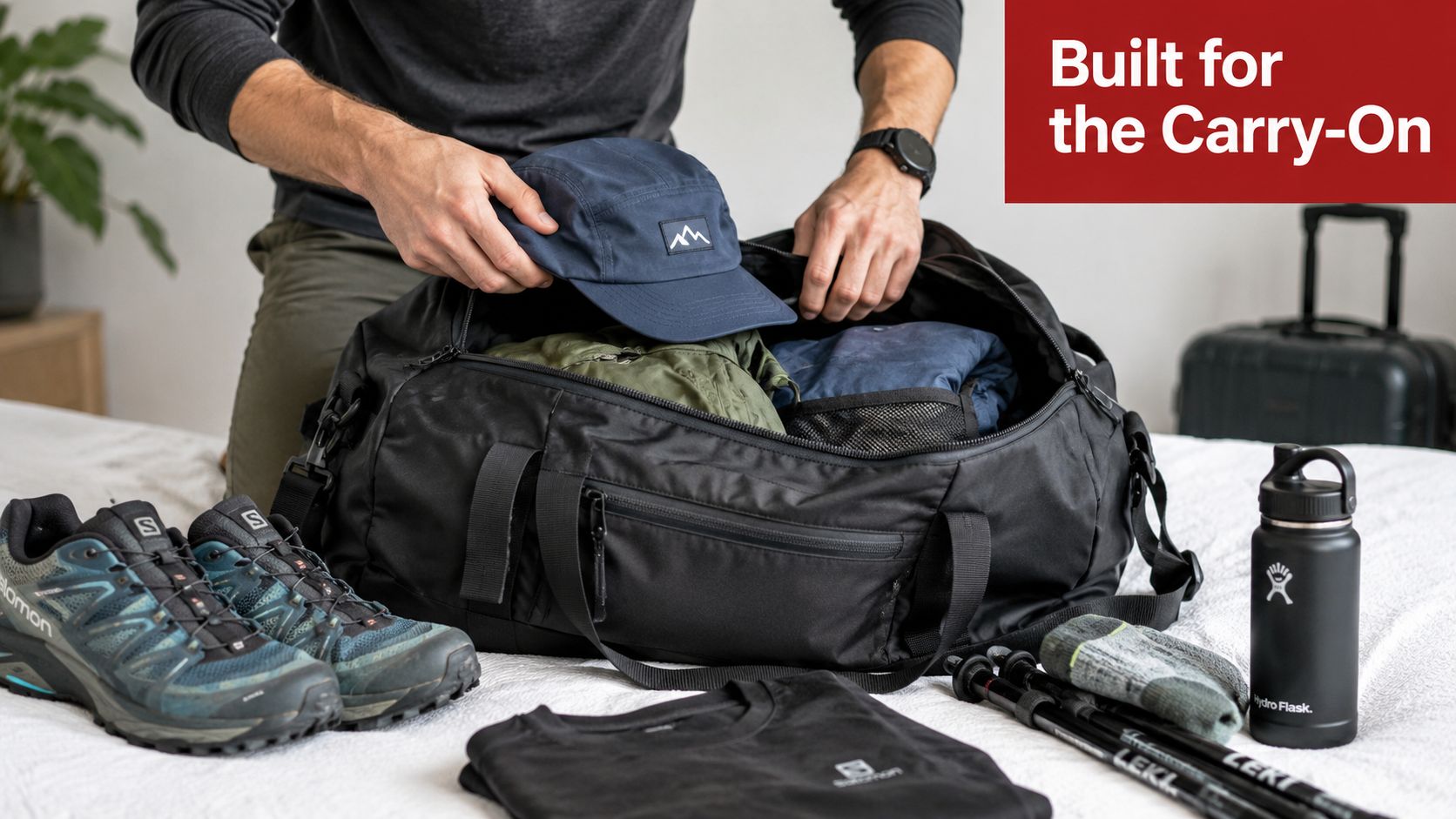
That combination makes the nylon 5-panel hat useful in situations where a cotton cap can become inconvenient. You can fold or flatten an unstructured version into a trail pack, take it through a damp morning, and expect it to dry more readily than absorbent cotton. Nylon may have a subtle sheen or a technical matte finish, depending on its weave and coating, so it often looks more performance-oriented than a soft cotton twill cap.
Practical rule: Choose nylon when weather, sweat, packing, or repeated outdoor use matters. Choose cotton when hand feel and a relaxed everyday appearance matter more.
The flat front is just as important as the material. A single broad panel gives a brand more usable visual space without a center seam interrupting the artwork. That's why this silhouette works for outdoor companies, running groups, event teams, and streetwear labels that want a logo to remain clearly visible.
Cotton still has a strong case. It tends to feel softer and less slick against the skin, and its matte surface can suit heritage branding or casual uniforms. The distinctive quality of nylon comes from the intersection of five-panel geometry, low crown height, and technical fabric, not from nylon alone.
How the 5 Panel Silhouette Evolved
A cap designed for quick movement can later become a recognizable style. The modern 5-panel silhouette has a longer utility history than its current fashion image suggests. Sources place its resurgence in the 1980s and 1990s, following earlier use by courier workers and streetwear communities in the early twentieth century. Team Sunday's 5-panel cap history outlines this progression, while Printful's 5-panel comparison frames the form's shift between practical headwear and visual culture.
Athletic users valued the compact crown and broad, uncomplicated front. Cycling teams and other sports groups could display numbers, sponsor marks, or team identity on that surface, while the shorter profile stayed relatively unobtrusive during movement. Fewer crown pieces also produced a seam layout unlike a rounded baseball cap, giving the style its recognizable flat-front appearance.
The 1980s and 1990s brought stronger crossover into skate, surf, and streetwear communities. Its boxier lines looked less formal than a traditional athletic baseball cap, and the uninterrupted front panel gave designers room for bold graphics. A logo could read clearly from a distance, while the soft, foldable construction suited travel and everyday wear.
Material choices broadened as technical fabrics entered the category. Nylon became common alongside cotton and polyester because it offers high durability, water resistance, and fast drying. That combination matters for a runner packing a cap into a bag, a cycling team working through changing weather, or an outdoor brand that needs decoration on a broad, flat panel. Cotton remains a better fit for softer hand feel and relaxed heritage styling, while polyester or mesh may suit breathable uniforms and high-sweat use.
Outdoor and running brands helped reinforce the technical direction. The Patagonia Duckbill Cap is described as an early “O.G.” five-panel for outdoorsy users, and Ciele's lightweight, durable, UPF-protective five-panels added momentum to the running category.
Today, a nylon 5-panel can signal sport, travel, outdoor utility, or streetwear through its color and decoration. Its lasting appeal comes from practical construction and a useful branding surface developing together.
Understanding Construction and Fit
A nylon 5-panel hat can look simple in a product photo, yet its performance depends on how the crown, seams, brim, sweatband, and closure work together. The five panels establish the profile. Their support and finishing determine whether the cap holds its shape, packs flat, and stays comfortable through repeated wear.
Start with the crown. The front panel should sit evenly between the side seams, without twisting or puckering. Its broad, flat surface gives a logo clear visibility, but dense embroidery can distort lightweight nylon. Buckram or another stiff front backing helps preserve the panel's geometry and gives the needlework a steadier base. The backing must suit the fabric, since excessive stiffness can make a packable cap feel less relaxed. This relationship is explained in the 5-panel cap design guide.
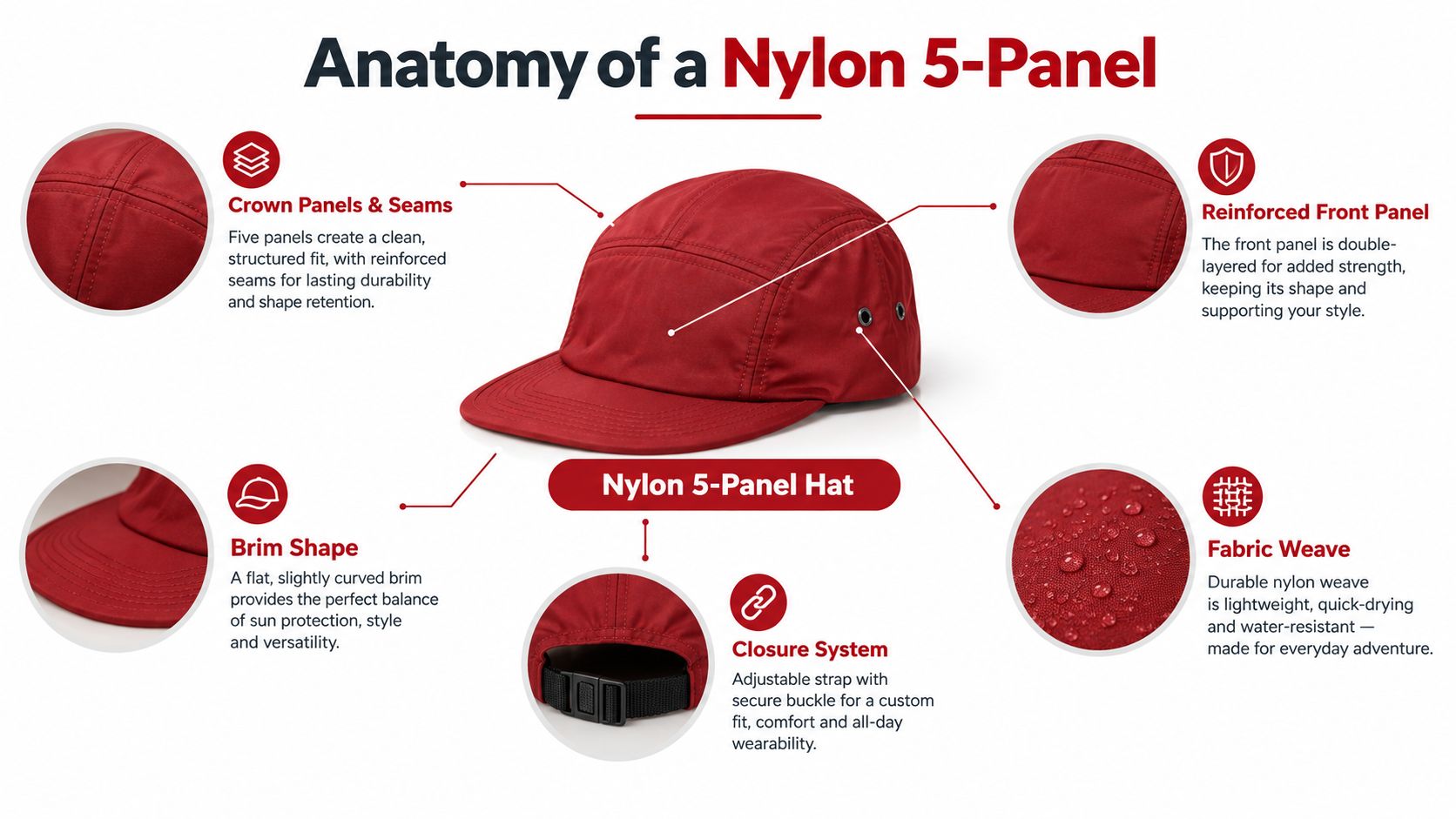
Inspect the crown and front panel
Run your fingers along each seam. Even stitching, tidy seam allowances, and secured thread ends suggest controlled production. Check the points where the closure attaches and where the crown bears tension. Bartacks or reinforced stitching in these areas matter for caps that will be adjusted often or packed into bags.
Front panels usually fall into three groups: unstructured, lightly supported, or firmly structured. An unstructured crown folds most easily and has a softer, casual feel, but dense decoration may cause it to collapse or ripple. A structured front keeps a cleaner outline and offers a more stable decoration area, although it feels less flexible. For a travel or running cap, lighter support often balances packability and logo clarity. For a crisp promotional display, firmer support may be the safer choice.
Check the brim and interior
The brim can use a buckram or plastic insert, depending on the design. Its edge stitching should follow the curve evenly, without loose loops or skipped sections. A flat brim creates a sharper streetwear appearance. A curved brim can reduce glare and feel more natural during running, hiking, or outdoor event work.
Inside, inspect the sweatband and seam taping. A smooth sweatband limits forehead irritation, while taping covers rough edges. Nylon's moisture behavior varies by construction. Standard-conditioned nylon has a moisture regain of roughly 4.0–4.5% as a general fiber-property reference, while coatings or laminations can restrict moisture vapor transmission. A water-resistant finish may help in light rain, but the added barrier can make the cap feel warmer.
Match the closure to the wearer
- Snapback: Easy to adjust and practical for shared event inventory, though the rear hardware may be noticeable during long wear.
- Strapback or D-ring: Provides fine adjustment and a cleaner appearance, making it suitable for branded merchandise and travel caps.
- Elastic or fitted construction: Feels secure during movement, but requires more accurate sizing because adjustment is limited.
Crown depth changes the fit as much as head circumference. A low-profile cap sits close to the head, while a deeper crown gives taller or wider head shapes more room. Check where the side seams sit in relation to the ears. If they press directly over the ears or the crown pulls upward, the hat may become uncomfortable during a full day.
The construction details become easier to assess when the components are viewed together:
Comparing Nylon With Other Hat Materials
Nylon is a strong all-purpose option, but it isn't automatically the most comfortable fabric for every wearer. Cotton, polyester, and mesh each solve a different problem, and the best material depends on climate, decoration, storage, and the look you want.
| Material | Water Resistance | Drying Time | Breathability | Packability | Typical Use |
|---|---|---|---|---|---|
| Nylon | Good for light moisture, especially when treated | Fast | Moderate, depending on weave or coating | Excellent in unstructured styles | Running, travel, outdoor promotions |
| Cotton | Low unless treated | Slow when saturated | Comfortable in mild conditions | Moderate, with more shape retention | Everyday wear, heritage branding |
| Polyester | Good in performance constructions | Fast | Moderate to good, depending on fabric | Good | Teamwear, sports, general active use |
| Mesh | Limited on solid fabric sections, open areas improve airflow | Fast | Highest airflow | Good, though structure varies | Hot-weather events, casual outdoor wear |
Nylon's tight weave can shed light rain and dry faster than cotton. It also has a low specific gravity of about 1.14, while maintaining high tensile strength, abrasion resistance, and elastic recovery, properties that help it tolerate repeated packing and unpacking (Textile Chem's nylon properties reference). For a carry-on, race bag, or promotional shipment, that resilience can be more useful than a softer hand feel.
Cotton feels more natural and usually has a quieter matte appearance. It absorbs moisture, so it can become heavy and slow to dry after substantial sweating or rain. That isn't a problem for a short city walk, but it matters more during a humid outdoor event.
Polyester often delivers similar quick-drying behavior and can hold color well. Depending on its construction, it may feel stiffer or less supple than nylon. It's a practical choice for team uniforms where consistent performance and easy care matter, especially when the cap will be ordered alongside polyester apparel.
Mesh wins on airflow. A mesh-back 5-panel can feel cooler during hot-weather lounging or an outdoor festival, but the open construction changes the visual balance and may offer less protection from wind and light rain. It also creates a different decoration plan because the strongest branding area may remain the solid front panel.
For buyers comparing options, nylon baseball hats from Dirt Cheap Headwear can serve as a useful reference point while you assess available silhouettes and fabric choices. Don't choose by fabric name alone. Ask how the weave, coating, backing, sweatband, and brim work together.
Nylon is the better travel fabric when you need a cap to recover after being compressed. Cotton is the better comfort fabric when the hat will mostly be worn casually in dry conditions.
Matching Performance to Real Activities
A trail runner finishing a humid morning route needs a cap that dries quickly and does not take much room in a pack. In that situation, a nylon 5-panel hat can outperform heavier, absorbent fabric. During hiking or a paddle trip, its light water resistance and packable construction also reduce the need to carry a spare.
The flat front panel matters for more than appearance. At a festival or outdoor promotion, it gives a logo a broad, uninterrupted area that stays readable at close range. An unstructured nylon crown can compress into a carry-on or trail pack, while a rigid structured cap takes more space. The trade-off is a less formal shape and less support for large, dimensional decoration.
Where nylon makes the strongest case
- Trail running: Choose a curved brim for glare control and a closure that stays secure without pressing one spot on the head.
- Hiking and travel: Prioritize quick drying, resistance to crushing, and a crown that packs without setting permanent creases.
- Paddling: Look for fabric that sheds light weather and a secure rear adjustment. Water resistance does not make the cap waterproof.
- Promotional gifting: Use the uninterrupted front panel for a compact logo with clear lettering and simple shapes.
Nylon can suit sweat-heavy activities, but the fiber alone does not guarantee active moisture management. The shell, sweatband, ventilation, and fit work together. A coated or laminated fabric may block more weather while letting less vapor escape. That construction principle matters on a damp hike, but less so for a short commute.
When another fabric is smarter
Cotton twill may be the better choice for everyday streetwear, café visits, commuting, or relaxed brand uniforms. Its softer hand and quieter matte surface can make the cap feel more familiar. Mesh is often more comfortable for hot-weather lounging or a festival where airflow matters more than wind protection. Polyester suits team programs that need coordinated performance fabric and straightforward care. Recycled polyester can fit a sustainability-focused brief when the supplier can verify the material and documentation.
Consider the wearer's actual routine. A cap compressed in luggage, exposed to light rain, and worn between activities benefits from nylon's packable construction. A cap worn mainly for casual comfort may be better in cotton, while a hot outdoor event may justify mesh. The slick hand feel of nylon can feel too technical for some buyers, so match the material and flat branding area to the way people will use the cap, not only to the activity named in the campaign brief.
Finding the Right Size and Style
Start with head circumference. Use a flexible tape around the widest part of the head, keeping it level above the ears and across the forehead. If you're ordering for a group, collect measurements where possible instead of assuming one adjustable cap will suit everyone equally.
Closure choice changes the fit experience:
- Snapback closures offer quick, repeatable adjustments and work well for event inventory shared among multiple people.
- Strapback closures create a quieter rear profile and let the wearer make smaller adjustments.
- D-ring closures can give a technical appearance that fits nylon particularly well.
- Elastic or fitted versions reduce hardware, but they require more confidence in the size range.
Crown depth affects the way the front panel meets the forehead. A low-profile five-panel cap can create a crisp, close-fitting look, but wider heads may experience pressure near the temples or a front edge that sits too low. Check seam placement above the ears, then adjust the closure while moving your head. A hat that feels fine while standing still may shift during a run or travel day.
Brim shape should follow the task. A curved brim is practical for sun protection and glare management. A flatter brim emphasizes the streetwear side of the silhouette and gives the front panel a more graphic presentation.
Color coordination can make a technical cap feel intentional rather than overly sporty. Match the shell with outerwear for a quiet uniform look, use a contrasting underbill for visual interest, or repeat the logo thread color in the closure and brim details. The front panel should also be evaluated before decoration. A flat, well-tensioned surface gives an embroiderer better control than a crown that collapses under the needle.
Fit check: Wear the sample for long enough to notice forehead pressure, seam contact, closure tension, and brim movement. A product photo can't reveal those problems.
Choosing Embroidery or Patches
The clean front panel is the main branding advantage of the five-panel format, but nylon requires a deliberate decoration plan. Its smooth, sometimes slippery surface can challenge stitch registration, thread tension, and color appearance, especially when the fabric has a water-repellent coating.
Flat embroidery is usually the most direct choice for corporate logos, team marks, and staff caps. It gives the design a durable, professional finish, but the decorator may need a stabilizing backing and careful digitizing to prevent puckering. Dense artwork can make a lightweight crown feel stiff, so simplify small lettering and avoid unnecessary fill.
3D puff embroidery creates height and a stronger streetwear effect. It works best with bold, uncomplicated shapes rather than fine detail. Woven patches offer sharp lettering and intricate artwork without placing as much stitch density directly into the nylon, while PVC patches create a molded, technical appearance that pairs naturally with outdoor styling.
Printed twill, direct print, and heat-transfer methods can support full-color graphics or artwork that embroidery can't reproduce cleanly. Their durability depends on the application, surface preparation, and exposure to sweat, sunlight, abrasion, and washing. A coating that improves water repellency may also influence adhesion, so request a decorated sample before approving a larger run.
| Method | Best For | Durability on Nylon | Cost Tier | Notes |
|---|---|---|---|---|
| Flat embroidery | Corporate logos and team branding | High when properly stabilized | Medium | Works well on a supported front panel |
| 3D puff embroidery | Bold streetwear marks | High with simple artwork | Medium to high | Needs suitable thickness and clean digitizing |
| Woven patch | Fine lettering and limited releases | High when securely attached | Medium | A strong option for detailed designs |
| PVC patch | Outdoor and technical branding | High | Medium to high | Adds a raised, molded finish |
| Printed twill | Full-color team or event graphics | Moderate to high | Medium | Useful when artwork has gradients or fine detail |
| Heat transfer | Short runs and flexible artwork | Varies by application | Low to medium | Test adhesion on coated nylon first |
For a closer look at that patch route, review woven patch hats from Dirt Cheap Headwear. Place the main mark on the front, use a smaller side hit for secondary branding, and reserve the back strap for compact text or a website address.
Ask your decorator about minimum order quantities, lead times, digitizing fees, backing, and proof approval before ordering blanks. Dirt Cheap Headwear offers blank headwear and decoration services including embroidery and patches, with product options such as the Flexfit Five Panel Cap 6560 and YP Classics Five-Panel Retro Trucker Cap 6506 listed in its catalog. Treat those as starting points for sampling, not substitutes for checking the final decorated cap in hand.
Caring for and Buying Your Hat
Nylon is easy to maintain when you avoid aggressive cleaning. Spot-clean sweat marks with mild detergent and a soft cloth, then rinse carefully. If the care label permits hand washing or a gentle machine cycle, protect the brim and avoid mixing the cap with rough garments that can pull at the seams.
Air-dry the hat away from direct heat. High heat can distort the brim, affect adhesives, and change the crown's shape. After washing, reshape the panels by hand and let the cap dry in its natural form. Store it flat or loosely stuffed, rather than compressing it under heavy clothing for long periods.
Harsh chemicals can strip water-repellent finishes and may affect printed or patched decoration. If the hat has a coating, laminated panel, or specialty trim, follow the manufacturer's care instructions instead of assuming all nylon behaves the same way.
Before buying, check:
- Seam quality: Look for even stitching and reinforced stress points.
- Interior finish: Confirm that sweatband and taping feel smooth.
- Closure: Match adjustability to the wearer and distribution plan.
- Front backing: Choose enough support for the intended decoration.
- Brim: Select curved or flat according to glare control and style.
- Material documentation: Ask about coatings, fabric composition, and factory quality controls.
The decision is straightforward. Match the hat to the activity, climate, decoration method, and budget. Choose nylon for packability and weather-friendly performance, cotton for softer daily wear, polyester for coordinated active programs, and mesh when airflow comes first.
For blank nylon 5-panel hats, custom embroidery, patches, and small or bulk headwear orders, visit Dirt Cheap Headwear. Review the available five-panel styles, request a decoration proof, and choose the fabric, closure, and logo method that fit your actual event, team, brand, or travel use.