
Nylon Baseball Hats: A Practical Guide for Wholesale Buyers
You've got a logo, a summer event on the calendar, and a modest first order to place. The question looks simple: should you use the cotton twill your customers already know, or try nylon baseball hats that feel lighter and handle a little weather?
That choice affects more than fabric feel. The shell changes how the cap wears in heat, how long its water-repellent finish lasts, how it reacts to sunlight, and how cleanly your logo stitches. For a wholesale buyer, those details matter because a cap that looks good in a product photo can still disappoint on an embroidery line or after repeated outdoor use.
Why Nylon Baseball Hats Are Everywhere Now
A small surf shop in San Diego ordering 48 caps for a summer giveaway probably doesn't need a laboratory report. It needs headwear that packs easily, survives a beach event, looks good in branded photos, and won't feel heavy when customers wear it in warm weather. Nylon often enters the conversation because it answers several of those needs at once.
The material isn't a novelty reserved for expedition gear. The modern baseball cap traces back to the Brooklyn Excelsiors in 1860, and its construction has continued moving away from heavy natural fibers toward lighter technical materials. Latex and rubber stiffening appeared in the 1940s, while Major League Baseball switched its on-field cap material from wool to a polyester blend in 2007, a clear sign that performance fabrics had become part of mainstream cap design. The baseball cap's material and construction history puts nylon in that broader progression rather than treating it as an isolated trend.
Why buyers choose nylon
Wholesale buyers usually notice four practical benefits first:
- Lightweight handling: Nylon shells can feel less bulky in shipping cartons, on the head, and inside a travel bag.
- Packability: A soft, unstructured nylon cap can recover from being folded or stuffed more easily than a rigid structured style.
- Outdoor practicality: A suitable nylon fabric and finish can shed light rain and dry quickly.
- Visual presentation: Matte nylon often gives logos and product photography a clean, technical look without the heavier texture of twill.
That combination helped nylon move from outdoor and performance categories into event merchandise, promotional headwear, travel collections, and everyday retail. Catalogs now commonly place nylon alongside cotton, wool, and polyester as an established headwear material. Nylon's commercial history supports that shift. It was invented in 1935, introduced at the 1939 World's Fair, and became the first commercially successful thermoplastic polymer, according to the University of Birmingham's history of nylon.
Practical rule: Treat nylon as a performance-oriented wholesale option, not as an automatic upgrade over cotton. The right choice depends on weather, decoration, lining, and how customers will care for the cap.
Before placing the order, ask what “water-resistant” means in the supplier's specification, whether the sweatband is moisture-wicking, and whether the front panel has enough support for your logo. A water-resistant cap can be a strong fit for outdoor promotions, but the finish and interior construction deserve as much attention as the word nylon on the product page.
What Nylon Is and How It Gets Built Into a Hat
Nylon is a synthetic polyamide fiber. Manufacturers begin with polymer material, draw it into continuous filaments, process those filaments into yarn, then weave or knit the yarn into fabric. That process can produce a smooth, crinkled, tightly woven, or ripstop shell.
Headwear specifications may list yarn weight in denier. 70D to 210D is a common range for lightweight headwear fabrics, although denier alone does not predict the finished cap's feel or durability. Weave density, coating, lining, seam construction, and crown structure all change the result. A finer shell may feel lighter, while a denser weave can provide a cleaner decoration surface and better abrasion resistance.
Shell, structure, and interior choices
A woven nylon shell has a crisp, technical hand and can provide a clean base for printing or embroidery when it is supported correctly. A nylon-cotton blend softens the feel and reduces the slickness that can make pure nylon seem less familiar. Ripstop introduces a reinforcing grid that limits tear propagation, but the grid may show through a fine logo if the front panel is thin.
The crown and interior determine how that shell wears:
- Fully fused buckram: Adds firmness to a structured front and supports dense embroidery.
- Soft unstructured crown: Folds more easily and feels more casual, but requires tighter backing control during stitching.
- Mesh lining: Improves airflow inside the cap and changes how perspiration reaches the shell.
- Polyester taffeta lining: Creates a smooth interior with a technical feel.
- Cotton lining or sweatband: Adds softness, but can retain moisture longer than a synthetic wicking component.
Coatings also affect the shell. A DWR finish can help light rain bead on the surface, but repeated washing, abrasion, and sunlight reduce its performance over time. UV exposure can weaken nylon and fade its color, so a cap intended for extended outdoor use needs more than a water-resistant label. Ask whether the supplier specifies the finish, the lining, and the intended use conditions.
Construction finishes the specification. A five-panel trucker or camp cap usually has a broad front panel and center seam. A structured six-panel cap spreads the crown across more seams and often uses a firmer front. Snapbacks, hook-and-loop closures, fitted builds, and strapbacks change adjustability, fit consistency, and the usable decoration area. For a closer look at panel assembly and seam order, see this guide on how to sew a baseball cap.
| Property | Nylon | Polyester | Cotton Twill |
|---|---|---|---|
| Fiber character | Smooth synthetic polyamide, often flexible and lightweight | Synthetic fiber with strong weather and shape-retention characteristics | Natural fiber with a familiar, textured hand |
| Moisture behavior | Sheds water well when finished, dries quickly, but may feel less breathable | Often manages moisture predictably in performance constructions | Absorbs moisture and can feel heavier when wet |
| Surface feel | Can be slick, matte, crisp, or soft depending on finish | Usually smooth, with broad performance-fabric variation | Softens with wear and commonly accepts a traditional twill look |
| Decoration needs | May need careful needle and stabilizer selection | Usually stable, but construction still determines stitch quality | Often forgiving under standard embroidery setups |
| Best construction fit | Outdoor, travel, lightweight, and technical shells | Performance, uniform, athletic, and mesh combinations | Lifestyle, heritage, promotional, and casual caps |
Nylon webbing is a separate material category. Buyers comparing adjacent projects can use best webbing straps for moving to understand how load-bearing webbing differs from lightweight woven cap fabric. A strap is engineered for tensile strength, while a cap shell must balance comfort, flexibility, airflow, and decoration quality.
Performance Trade-offs Buyers Should Know
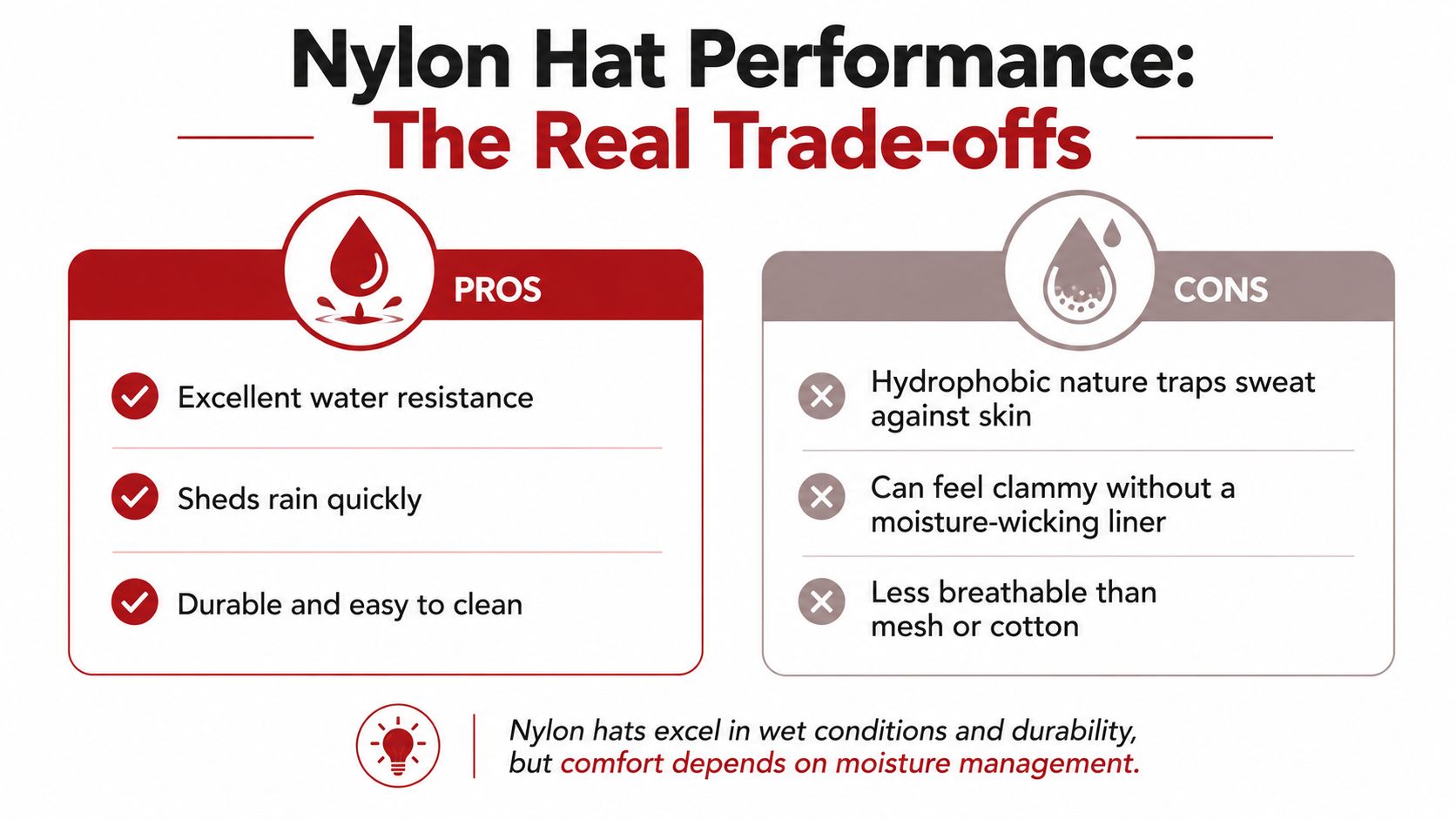
Nylon earns its place in outdoor headwear because it handles moisture and weight well, but the marketing shorthand often leaves out the uncomfortable parts. A nylon baseball hat can shed rain and dry rapidly while still feeling clammy inside if the sweatband and lining don't move moisture away from the forehead.
Nylon is moisture-wicking and quick-drying, but it isn't as naturally breathable as cotton. Performance depends heavily on the sweatband, coating, ventilation panels, and finishing, not just the shell fiber. Water-resistant ripstop nylon with a DWR finish can dry in minutes, while the finish gradually wears with washing and may need re-treatment. Practical guidance on sweat-proof hat materials makes the important distinction between quick drying and comfortable ventilation.
Rain protection has limits
DWR means durable water repellent, not permanently waterproof. The finish encourages droplets to bead on the surface instead of soaking into the crown, which helps the cap dry faster and limits weight gain during light rain or perspiration. It won't turn a sewn cap into sealed technical rainwear, because needle holes, seams, closure openings, and panel joins remain part of the construction.
Ask the supplier whether the claim refers to the fabric, the finished cap, or a tested water column. If the specification only says “water-resistant,” treat it as light-weather protection rather than a promise for prolonged rain.
Sun exposure is the quiet risk
Ultraviolet exposure can trigger photodegradation in nylon. The polymer chains can break, reducing molecular weight and tensile strength while causing discoloration and embrittlement. Textile research identifies nylon as especially susceptible to UV damage, which makes UV stabilization, darker dyes, or UV-absorbing additives relevant for caps intended for repeated high-sun use. Research on UV damage in nylon textiles supports checking those details before choosing nylon for a daily outdoor uniform.
Don't store finished caps on a sunny dashboard or promise indefinite performance for a beach crew without asking about stabilization. A darker color can help, but it doesn't replace a construction and care discussion.
If the product copy says “waterproof,” ask what was tested, how the seams were treated, and how the finish behaves after washing.
For a broader material comparison before you issue a purchase order, use this performance hat fabric guide for bulk buyers. It helps keep the shell, lining, and decoration requirements in the same conversation.
Common Nylon Baseball Hat Styles and Their Best Uses
A wholesale catalog may show several nylon caps that look similar in a thumbnail. The differences become obvious once you compare crown structure, rear ventilation, brim shape, and closure.
A five-panel unstructured runner cap usually has a low-weight shell, a flexible crown, and an adjustable strap or hook-and-loop closure. It suits trail-running giveaways, outdoor clubs, and event swag where packability matters more than a formal front profile. Its broad front panel can look excellent with a simple embroidered mark, but a large dense design may pull the fabric out of shape.
A six-panel structured cap uses firmer front support, often buckram, and a more conventional baseball-cap silhouette. It works for brewery merchandise, retail resale, and staff uniforms where the cap needs to look consistent across different heads. Structure gives the embroiderer a stable platform, although the added components can make the cap feel less flexible.
Match the build to the use case
| Style | Construction | Best Use |
|---|---|---|
| Five-panel runner | Unstructured crown, lightweight woven shell, adjustable closure | Trail events, outdoor giveaways, travel merchandise |
| Six-panel structured cap | Buckram-supported front, curved visor, snapback or strapback | Retail collections, brewery merch, staff uniforms |
| Five-panel camp cap | Soft crown, flat brim, often strapback | Lifestyle brands, festivals, creative merchandise |
| Six-panel trucker | Structured or semi-structured front with mesh rear panels | Brewery promotions, summer events, casual resale |
| Performance shell cap | Lightweight nylon or blend, curved visor, wicking interior | Golf outings, field teams, outdoor crews |
The six-panel trucker deserves a closer look. Full mesh backs maximize airflow, while partial mesh or lighter inserts can preserve more structure and offer a cleaner branded appearance. A trucker can make sense for a warm event, but the mesh may compete visually with a minimal premium brand identity.
A camp cap with a flat brim gives a more fashion-led profile. It works for merch creators and streetwear projects, but buyers should approve a physical sample because brim shape and crown height vary sharply between suppliers.
Decoration and unit economics
Unstructured nylon silhouettes often win when the logo needs to follow a softer crown and look integrated rather than rigid. Structured profiles can be more straightforward for a decoration line because the supported front resists distortion, and some suppliers price them more aggressively depending on available stock and construction.
Don't choose from the front view alone. Check the inside seam, sweatband, rear closure, brim edge, and the actual embroidery zone. A cap that looks ideal in a catalog photo may have a center seam or narrow front that limits the final logo size.
How to Care for Nylon Caps Without Ruining Them
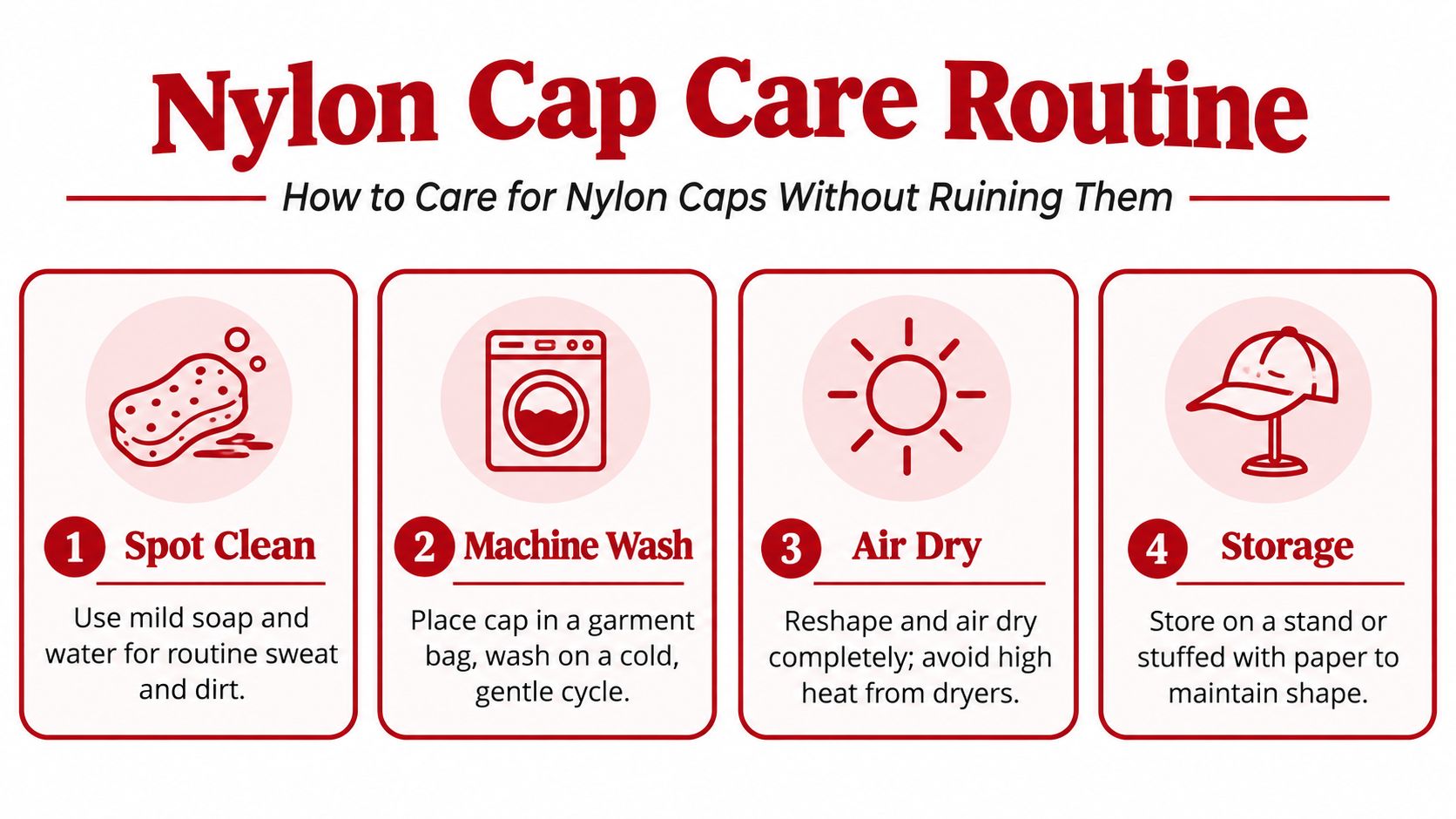
Nylon caps last longer when customers clean the sweatband before the dirt becomes embedded in the shell. For routine wear, use a soft sponge, mild soap, and cool water. Dab rather than scrub aggressively, especially around embroidered areas and coated fabric.
A simple care routine
- Spot clean first: Remove sweat and surface dirt with mild soap and water. This avoids unnecessary full washing.
- Machine wash cautiously: If the care label permits machine washing, place the cap in a garment bag and use a cold, gentle cycle. Avoid top-loading machines with agitators, which can snag the brim and distort the crown.
- Reshape and air dry: Restore the crown by hand and let the cap dry flat away from direct sunlight. High dryer heat can damage the fabric feel and accelerate wear on water-repellent finishes.
- Store with support: Use a hat stand or stuff the crown lightly with clean paper. This helps preserve the shape without compressing the brim.
What not to use
Bleach can damage color and weaken the material. Fabric softener may alter the hand-feel and interfere with finishes, while an iron can flatten or mark synthetic fabric. Don't leave a wet cap crumpled in a gym bag, because trapped moisture and body oils can create odor before the shell has a chance to dry.
DWR coatings naturally lose effectiveness as the cap is washed and handled. If the shell stops beading water, follow the supplier's care instructions for a compatible re-treatment product rather than applying an unknown aerosol.
A care card is a small addition to a wholesale order that can prevent avoidable complaints. Print the four instructions in plain language and include them with staff uniforms, event merchandise, or resale packaging.
For a visual demonstration of basic cap handling and cleaning, watch the embedded care video below.
Embroidery and Decoration on Nylon Shells
Nylon can embroider cleanly, but it doesn't behave like cotton twill under a needle. Its smooth surface and lower friction can let the needle skate, especially on thin, tightly woven, or coated shells. Start with a sharp 75/11 ballpoint or light ballpoint needle, test the actual cap, and adjust only after reviewing the stitches and fabric tension.
The front panel determines how ambitious you can be. A teardrop or rounded structured front with buckram can support dense satin stitches and, when the profile allows it, 3D puff. Ultra-thin ripstop or performance shells are less forgiving. They often need a medium-cutaway stabilizer to keep the fabric from shifting, puckering, or collapsing around the design.
What works on the embroidery line
Use a smaller, well-spaced design before attempting a large filled logo. Heavy stitch density adds weight and tension to a lightweight shell, while a simple satin border, clean lettering, or carefully digitized emblem usually preserves the cap's hand and shape.
The backing should support the fabric without turning a flexible cap into a stiff patch. Test:
- Needle penetration: Look for skipped stitches, pulled threads, and visible needle marks.
- Stabilizer behavior: Check whether the backing prevents distortion without showing through the shell.
- Thread tension: A slick shell can expose loose bobbin thread or create uneven satin columns.
- Center seam placement: Avoid forcing dense details directly across a seam.
- Puff compatibility: Use 3D puff only on a sufficiently stable structured front, and confirm clearance around the design.
Heat transfer may make more sense for a small run or a design with gradients and fine detail. Sublimation suits compatible light-colored synthetic surfaces, but it won't deliver the same raised texture as embroidery and may not work on every finished nylon construction. Ask for a decorated sample, not just a blank sample.
Embroidery-line rule: Approve the decoration on the exact shell, color, backing, and closure combination you plan to buy. Nylon blends can stitch differently even when the catalog calls both products “performance caps.”
Minimum order quantities also deserve early attention. Confirm whether the supplier separates blank-cap minimums from decoration minimums, whether color changes reset the minimum, and whether a custom sample is available before the full production run. Dirt Cheap Headwear offers blank headwear and in-house embroidery, with low minimums starting at six pieces per logo according to the publisher information provided for this guide. That makes a small decorated test order possible before committing to a larger program.
Sustainability, 2026 Trends, and a Wholesale Buying Checklist
Recycled nylon gives buyers a more transparent sustainability question to ask, but it doesn't eliminate the need for material verification. Current product coverage highlights recycled nylon made from sources such as ocean waste, fishing nets, and textile waste, while Prada's Re-Nylon baseball cap product information shows how circular-material messaging has entered headwear.
The useful question isn't “Is this recycled?” Ask what portion of the shell uses recycled content, whether the claim applies to the yarn or the finished cap, and whether certification documents are available. Recycled nylon may feel and decorate similarly to conventional nylon, but the result still depends on yarn quality, weave, coating, lining, and front-panel support.
Construction direction for current buying decisions
Trend coverage points toward lighter builds, simplified paneling, and reduced construction complexity in 2026. That direction can improve fit consistency and reduce unnecessary bulk, but fewer panels may change the embroidery area, center-seam placement, crown behavior, and perceived structure.
Lighter ripstop can suit travel and outdoor merchandise, while a low-panel front may give a modern logo field. Plant-based DWR is worth asking about, but request technical documentation rather than accepting a sustainability phrase without detail. Also ask what happens at end of life, because a cap assembled from mixed fibers, coatings, mesh, thread, and metal components may be difficult to recycle.
Wholesale checklist
- Confirm the fiber content: Request the exact shell, lining, sweatband, and mesh composition.
- Verify recycled claims: Ask for the recycled-content documentation and any applicable certification.
- Test the decoration: Approve embroidery on the finished cap, not only on a fabric swatch.
- Define weather performance: Clarify whether “water-resistant” describes the fabric, coating, or completed cap.
- Ask about UV protection: Check for stabilization, UV absorbers, or care guidance for high-sun use.
- Inspect the interior: Review the sweatband, lining, ventilation, and seam comfort.
- Review the construction: Compare panel count, buckram, brim shape, and closure against the logo.
- Confirm packaging: Ask whether individual packing, recycled packaging, or labeling changes the order requirements.
- Check compliance paperwork: Request the documents your retailer, school, team, or corporate customer requires.
- Get production details: Confirm decoration minimums, sample approval, stock position, and the expected lead time before issuing the purchase order.
Pricing and lead times depend on fabric availability, color, recycled inputs, construction, decoration method, and order size. Eco-focused lines can also carry different minimums from standard stock, so get a written quote and production schedule for the exact specification rather than comparing shell names alone.

If your order is for an outdoor event, start with a physical cap, test the logo, wash one sample, and expose another to the conditions your customers will face. That small validation step tells you more than a generic “performance nylon” label.
Dirt Cheap Headwear supplies blank caps and decorated headwear for businesses, teams, events, and resale programs, with in-house embroidery and low minimums for testing a nylon style before a larger order. Visit Dirt Cheap Headwear to compare nylon-inclusive performance options, request decoration guidance, and build your next wholesale cap order around the actual use case.