
Wholesale Custom Embroidered Beanies: The Complete Buyer’s
You've chosen the logo, approved the brand colors, and found a supplier offering a tempting range of wholesale custom embroidered beanies. Then the first sample arrives. The logo looks soft, the small lettering disappears into the rib knit, and the cuff has pulled enough to make the design look uneven. The beanie seemed simple. The order wasn't.
I've seen buyers make this mistake because they treat knit headwear like a blank T-shirt. Beanies stretch, compress, fold, and rub against hair and outerwear. The knit gauge, thread, artwork, stabilizer, hoop tension, and cuff placement all influence whether the finished logo looks retail-ready or like a rushed giveaway.
This guide gives you the sourcing framework I'd use before approving a wholesale beanie order. You'll learn which blanks handle embroidery, why polyester thread is the practical default, how to judge a proof, and where suppliers create avoidable costs.
Why Wholesale Custom Embroidered Beanies Deserve a Smart Sourcing Strategy
A buyer usually starts with a color chart. Black, navy, charcoal, maybe a seasonal shade. Then comes the logo upload, followed by a digital mockup that looks clean because the screen has no stretch, ribbing, or curved surface. That's where the trouble starts. A beanie that looks perfect in a flat proof can lose definition once the fabric expands over a head.
The first decision isn't the logo. It's the job the beanie must perform. A staff uniform needs comfort, repeatable sizing, and a decoration that survives regular care. A retail product needs a blank that feels substantial and carries the brand without looking promotional. An event giveaway needs controlled cost, dependable availability, and a design people can read quickly.
Buyer's rule: Don't approve a beanie because the mockup looks attractive. Approve it because the blank, decoration, and intended use agree with one another.
Beanies also have less usable decoration space than most buyers expect. A cuff gives you a relatively stable band, but the visible area changes when the wearer folds it, stretches it, or lets it sit higher on the head. A slouch beanie creates a different problem. It offers more fabric, yet the relaxed shape can make a logo drift or lose a consistent viewing angle.
Before requesting a quote, answer five questions:
- Who'll wear it: Employees, athletes, customers, volunteers, or retail shoppers?
- How often will it be used: Occasional events or repeated outdoor work?
- Where will the logo sit: Center cuff, side cuff, patch area, or another placement?
- What must remain readable: A symbol, short wordmark, initials, or detailed illustration?
- What happens after the first order: One event, seasonal replenishment, or a permanent product line?
Buyers managing broader merchandise programs should also separate product sourcing from decoration decisions. These Amazon FBA wholesale sourcing tips offer useful context on supplier evaluation, inventory planning, and fulfillment thinking, all of which matter when a beanie order supports an online store rather than a single event.
The best order is the one recipients continue wearing. That outcome comes from treating the beanie as a technical decorated textile, not merely a cheap blank with a logo added at the end.
Choosing the Right Beanie Material and Style for Embroidery
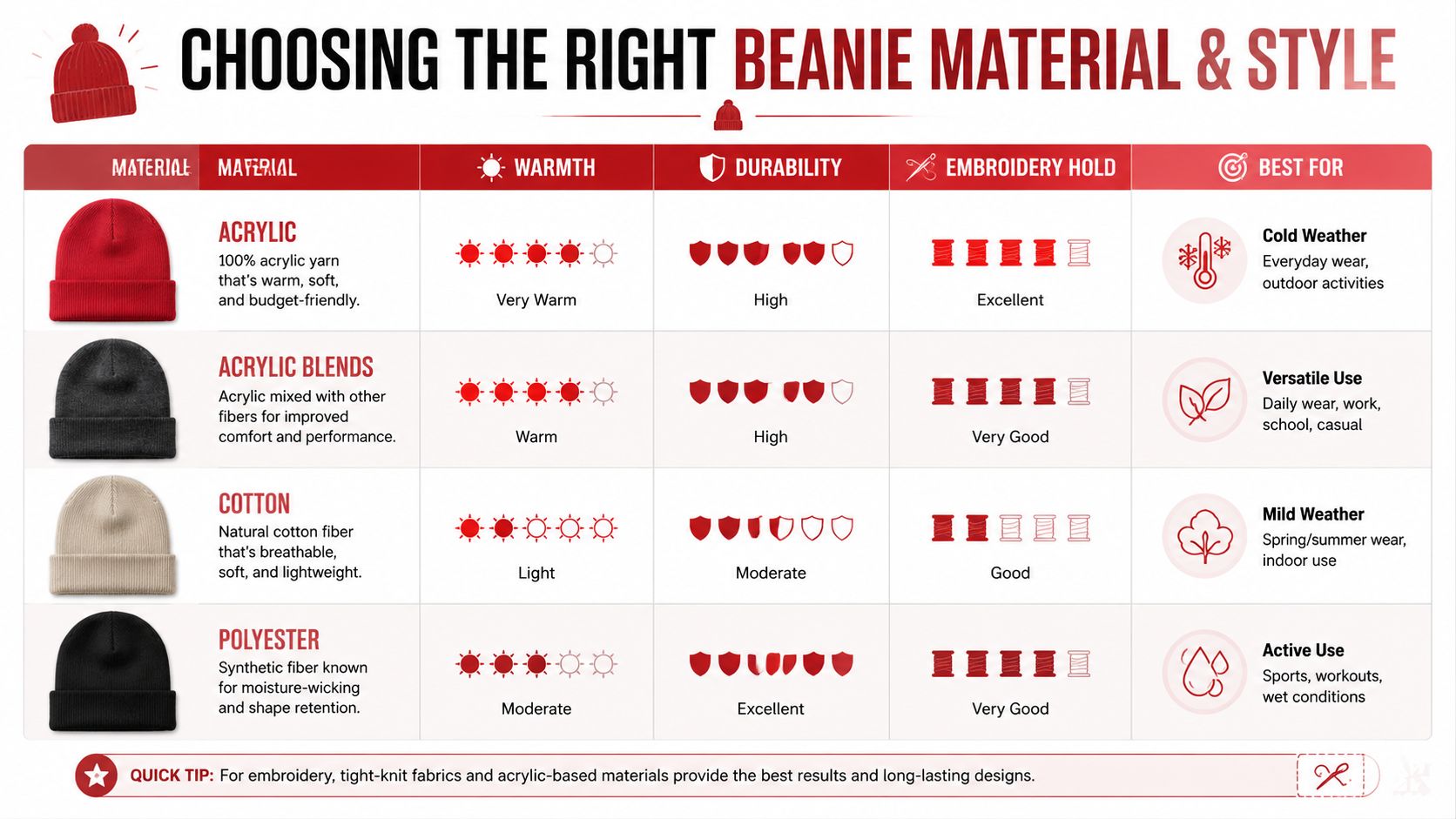
Dense, stable knit fabric is the starting point for clean embroidery. Fine-gauge acrylic and acrylic blends generally give the needle a more controlled surface, while loose knits allow stitches to sink between fibers. Expert guidance on embroidered hats emphasizes measuring stretch before stitching and managing it during hooping, because over-stretching can distort the design after release and under-stabilizing can bury the stitches in the knit (The Wearify's beanie embroidery guidance).
Match the fiber to the workload
Acrylic is the practical wholesale default. It offers a consistent surface, broad color availability, and a feel that works for promotional, team, and retail programs. Acrylic blends can add softness or a different hand feel, but check whether the blend changes the knit's recovery. A comfortable fabric that stays stretched after decoration can make a crisp logo look uneven.
Cotton can feel natural and breathable, but it often needs more careful stabilization because it may respond differently to moisture and repeated handling. Polyester knits can work well where moisture management or synthetic durability matters, although the exact construction still matters more than the fiber label alone. Don't choose a material by fiber name without requesting the actual blank or a sample.
Use style to control visibility
A cuffed beanie is the safest choice for most logo programs. The cuff creates a defined band, gives the embroidery a clear visual boundary, and helps the logo sit near the face. It's the style I'd choose for company uniforms, team orders, and first-time buyers.
A slouch beanie suits lifestyle brands and fashion-led merchandise. Its relaxed shape looks less uniform, but the decoration needs restraint. Large, heavy fills can pull the fabric and make the hat feel stiff. Keep the design compact and test how it reads when the beanie is worn rather than laid flat.
A pom beanie adds personality for winter events, schools, and casual retail. The pom can compete with the logo, so keep the decoration on a stable cuff and avoid placing the design where the fold changes dramatically.
For a dependable blank, compare dense-knit options through a category such as wholesale stocking cap knit styles. Ask for fabric composition, knit construction, available colors, care instructions, and a sample before committing to a large run.
Control stretch before the needle starts
The decorator should hoop the beanie with controlled tension, not pull it flat as if it were woven fabric. Tackdown stitches can anchor the decoration, while a suitable underlay helps prevent the logo from floating or sinking. Dense final satin or fill stitching then needs to be balanced against the knit's recovery. Too little coverage looks weak. Too much can create puckering and an uncomfortable rigid patch.
Embroidery Types and Techniques That Make Logos Pop
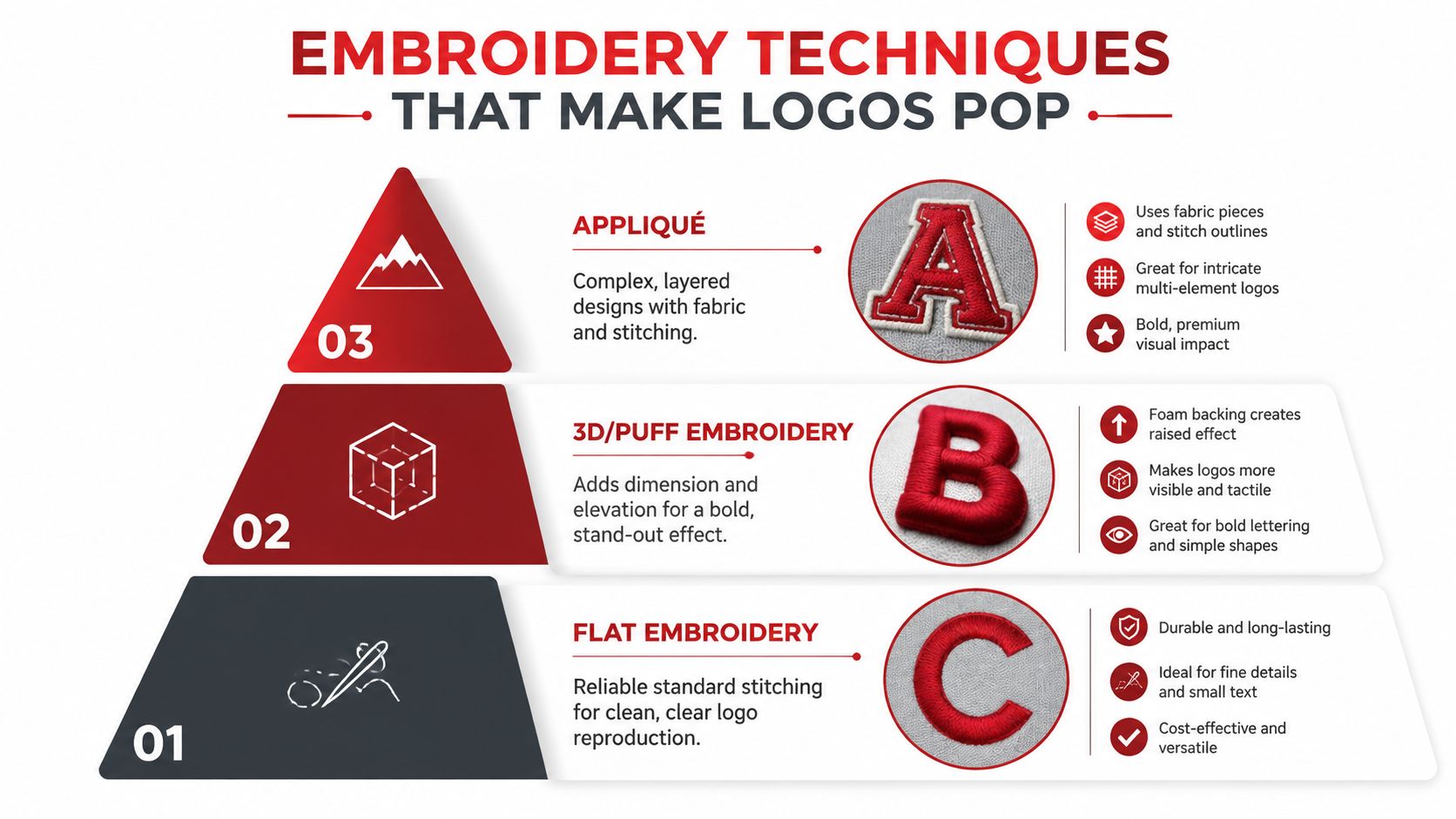
Logo legibility starts with the relationship between stitch style, knit gauge, and decoration zone. Flat embroidery is the default for most wholesale custom embroidered beanies, especially for small icons, initials, short wordmarks, and restrained brand marks. It follows the knit surface more naturally, keeps the hat comfortable, and gives the decorator more control over density.
Flat embroidery gives you control
Flat stitching suits clean icons, initials, and logos that must remain recognizable without added height. Knit gauge affects the result. A tighter, denser knit gives stitches a steadier foundation, while open ribbing can let thin strokes sink between ridges. The decorator should match stitch density to the fabric rather than forcing woven-fabric settings onto a stretchy beanie.
Excessive density can stiffen the cuff, cause puckering, and restrict recovery after wear. Too little coverage leaves the logo weak. Ask for a production sample or sew-out on the selected blank before approving a bulk run.
Small lettering needs close review. Thin strokes can disappear into ribbing when the thread and beanie colors have weak contrast. Simplify the type, open enclosed spaces, and remove a tagline that only works at a larger scale.
Puff embroidery is bold but unforgiving
3D puff embroidery places foam beneath the stitches to create a raised effect. It suits block letters and strong outline designs, giving streetwear or athletic marks more presence. Fine detail is a poor match. Tiny counters, narrow lines, and intricate artwork often become less readable when raised.
Puff also requires a stable decoration zone and careful hoop tension. A dense cuff with controlled stretch supports it better than a loose, soft knit. If you are considering the technique, review 3D embroidery machine information before requesting a quote. The supplier should confirm that the blank, backing, underlay, and artwork can support the effect.
Appliqué belongs on statement pieces
Appliqué adds another material to the design, making it suitable for oversized letters, collegiate treatments, and fashion-led graphics. It creates contrast beyond thread-only embroidery, but it also adds edges, material, and production steps. On a narrow cuff, those layers can crowd the available area and reduce flexibility.
Polyester thread is my choice for serious wholesale programs. A 40-weight polyester thread typically provides about 30% to 50% higher dry tensile strength than comparable rayon, while retaining about 95% of its dry strength when wet, according to the rayon and polyester embroidery thread comparison. That performance matters on knit hats, where stretching, friction, and laundering repeatedly stress the logo.
Current branding favors smaller, lower-profile marks, clean silhouettes, neutral palettes, chunky rib knits, and compact embroidered logos, as shown in wholesale beanie trend coverage. Use that direction selectively. Visibility should come from contrast, spacing, and disciplined stitch planning, not oversized decoration alone.
Trusted Beanie Brands and How to Pick the Right Blank
Brand familiarity helps, but it shouldn't replace a sample. A recognizable label can still be wrong for your audience if the fit is inconsistent, the cuff is too narrow, or the color you need disappears from inventory during production. I judge a blank on four practical points: surface stability, fit consistency, color continuity, and replenishment access.
Richardson is a strong choice for buyers who want familiar outdoor and team-oriented headwear. YP Classics and Flexfit offer broad headwear programs and styles that suit promotional and lifestyle branding. New Era brings a more recognizable sports and retail feel, while Nike generally belongs in premium athletic programs where brand association matters. Valucap targets value-conscious orders, and Legacy works well when you want a more fashion-minded or heritage presentation.
For beanies, don't assume the brand name guarantees embroidery performance. Request the exact style, color, and production sample. A dense cuff from one line may embroider cleanly, while a softer or looser style from the same supplier may need a different backing and design treatment.
Compare the buying position
| Brand | Best For | Price Tier | Embroidery Friendliness |
|---|---|---|---|
| Richardson | Outdoor teams and recognizable casual programs | Mid-range | Strong on stable cuffed knits |
| YP Classics | Promotional orders and modern casual branding | Value to mid-range | Good when the knit is dense |
| Flexfit | Refined fit and coordinated headwear programs | Mid-range to premium | Good, subject to style and stretch |
| New Era | Sports, lifestyle, and retail-ready merchandise | Premium | Strong on structured, stable surfaces |
| Nike | Athletic programs and premium brand presentation | Premium | Good when the design stays simple |
| Valucap | Giveaways and budget-sensitive events | Value | Suitable for uncomplicated logos |
| Legacy | Heritage and fashion-led merchandise | Mid-range to premium | Good on selected dense-knit blanks |
Protect the repeat order
Inventory is part of quality. If the black beanie is available today but the supplier can't confirm the same style for your next run, you may end up with inconsistent cuffs, shades, or proportions. Ask whether the distributor monitors stock and sends notifications when a chosen color becomes unavailable.
For a six-piece test, you can focus on hand feel and logo execution. For a recurring program, also document the exact style number, color name, thread colors, placement, backing, and approved artwork file. That record keeps the next order from becoming a new interpretation.
Dirt Cheap Headwear is one supplier option that combines blank headwear, in-house embroidery, low minimums starting at six pieces per logo, and stock notifications, according to the publisher's service information. Evaluate it alongside other distributors using the same sample and replenishment standards.
Design Tips and the Proofing Process That Prevents Costly Mistakes
A digital proof is not the finished beanie. It shows placement, approximate scale, colors, and the general appearance of the digitized file. It won't fully show how ribbing interrupts a letter, how the cuff expands on a head, or whether a heavy fill makes the fabric feel rigid.
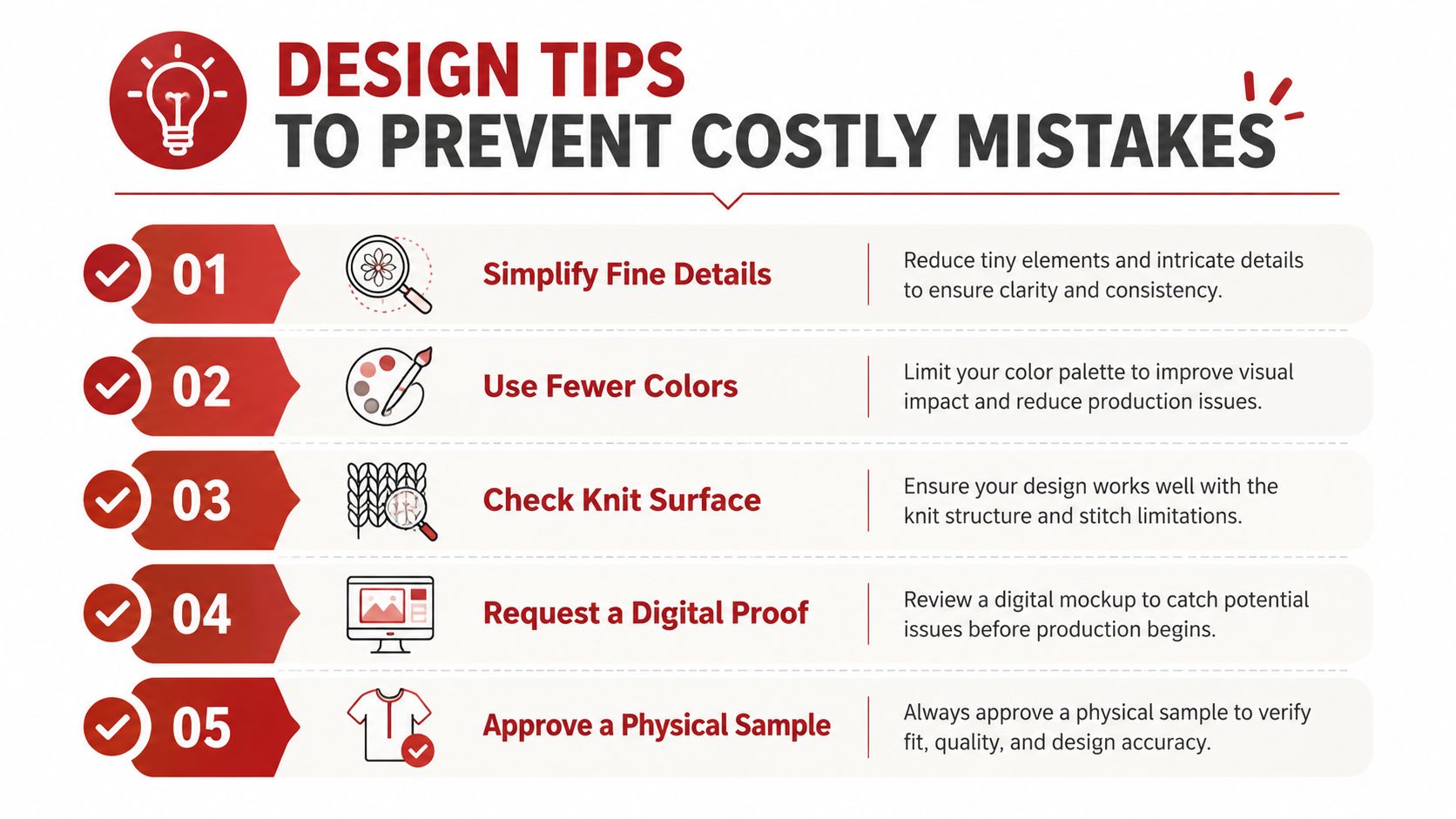
Start with artwork that respects the decoration method. Remove gradients that can't translate cleanly into thread transitions, simplify tiny interior details, and separate shapes with enough contrast to survive the knit's texture. A logo that relies on hairline strokes or miniature text is already a weak candidate for cuff embroidery.
Build the proof around the wearer
Ask the decorator to show the logo at the actual intended placement, not only enlarged on a flat product image. Check whether the cuff fold will cover the lower part of the design. If the logo sits too close to an edge, the wearer's head can stretch the fabric and make the lower stitches look crowded.
Use this approval sequence:
- Confirm the blank: Verify the exact style, material, color, cuff height, and fit.
- Check the placement: View the logo on a worn or realistically shaped beanie, not only a flat template.
- Read the smallest element: Inspect every letter and enclosed shape at normal viewing size.
- Review thread behavior: Ask whether the density and underlay suit the selected knit.
- Approve a stitch-out: For a large, expensive, or recurring order, request a physical sample before production.
Treat stitch count as a design constraint
More stitches don't automatically create a better logo. They can improve coverage, but they can also increase stiffness and pull on stretchy fabric. A skilled digitizer adjusts stitch direction, underlay, density, and sequencing rather than filling every available area.
Color choice matters just as much. Dark thread on a dark rib knit can look polished, but it may lose readability at a distance. A small neutral logo can work beautifully for a fashion label, while a team or safety program usually needs stronger contrast.
Proofing checkpoint: Stretch the sample the way a wearer will. If the logo only looks correct while the fabric is held flat, it isn't ready for approval.
Wash testing should follow the blank's care instructions. Acrylic beanies generally need gentle washing and should be laid flat to dry to help preserve the fabric and embroidery, as noted in buyer guidance on knit-headwear care. Don't promise wash performance from a screen proof. Test the actual decorated sample.
Understanding Pricing, Minimums, and the Full Order Process
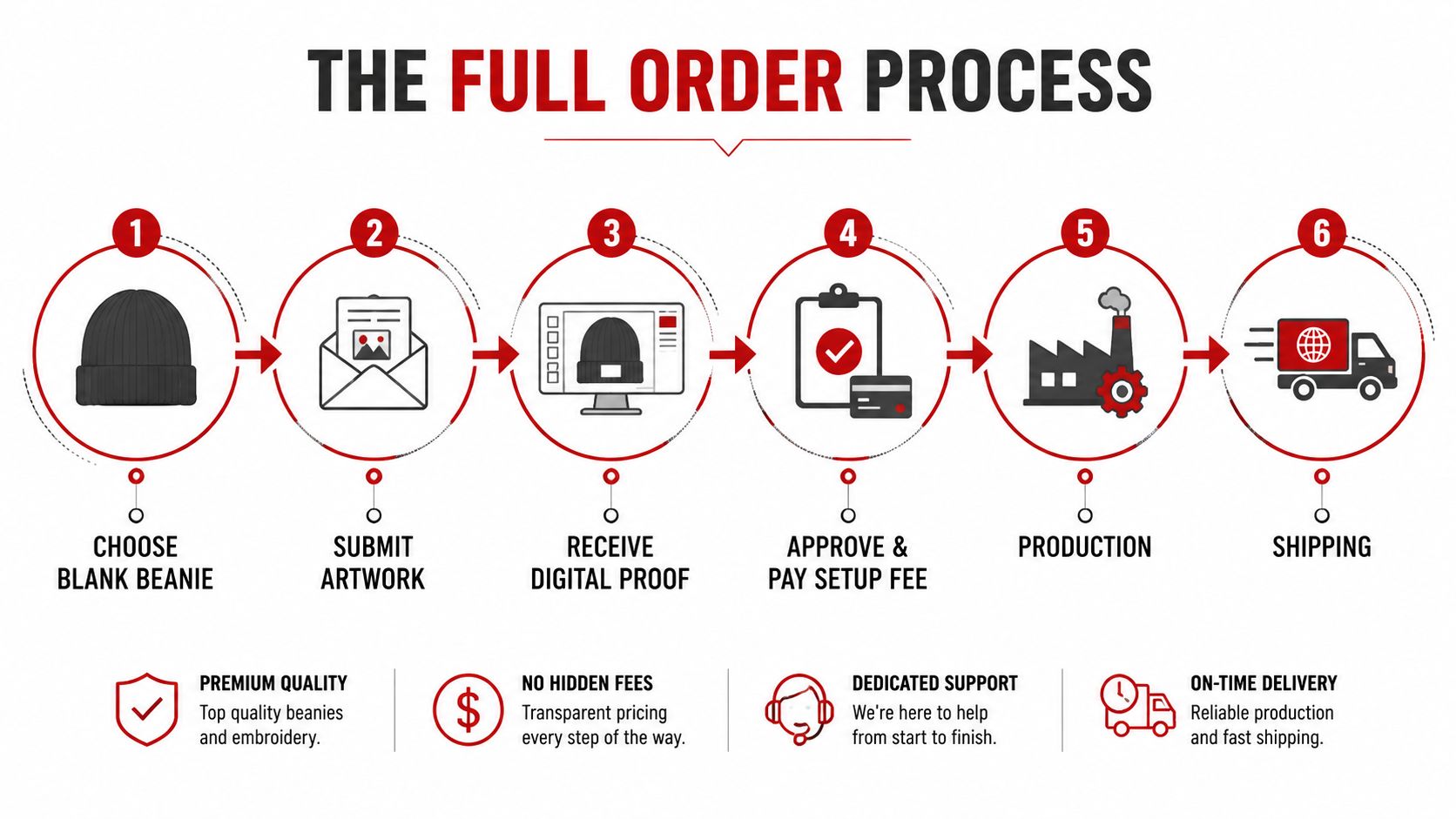
The quote should separate the blank, digitizing, setup, stitching, packing, and shipping. Some suppliers bundle these charges, while others list each item separately. A low blank price can become less attractive once decoration and delivery appear as separate line items, so compare the complete landed order rather than the advertised garment price.
Minimums also shape the right buying strategy. A supplier offering low minimums starting at six pieces per logo can let a small business test a color and design before committing to a larger run. That's useful when you're uncertain about customer response, fit preference, or embroidery scale. It's less useful if the supplier can't preserve the same approved file and blank for replenishment.
Budget the complete sequence
- Select the blank: Confirm style, material, color availability, and sample access.
- Submit artwork: Provide a vector logo when possible, along with brand colors and placement instructions.
- Review the proof: Check scale, cuff position, contrast, and stitch treatment.
- Approve production: Confirm the final quantity, payment terms, and any setup charges.
- Track manufacturing: Ask when production begins and whether the supplier will flag stock issues.
- Plan delivery: Add transit time, receiving, inspection, and redistribution to your event deadline.
Rush production can help, but it shouldn't replace proofing. If the beanies support a fixed event date, schedule the sample and approval early enough to handle a blank substitution or artwork revision. International orders need extra attention to customs and transit uncertainty, while domestic shipments still require a realistic receiving window.
For broader campaign planning, buyers sometimes compare merchandise costs with the cost for TikTok content automation. Keep those budgets separate. Content can drive attention, but the beanie still needs to meet the physical standard promised to the customer or team.
Use machine embroidery pricing guidance to understand what a decorator may include in a quote. Then ask one direct question: “What amount will I pay before the cartons arrive?” That answer should include every required production and shipping charge.
The embedded video below can help buyers visualize the decoration workflow before they request production.
Real-World Use Cases for Businesses, Teams, and Resellers
A small business ordering staff beanies should start with a comfortable cuffed acrylic blank, high contrast, and a simple front mark. Choose a fine or medium knit gauge that gives the needle a stable surface. Dense, even knitting keeps letter edges cleaner, while a loose chunky rib can distort small details. Use polyester thread for regular workwear, and avoid puff embroidery if employees will wear the hats through repeated washing. Flat embroidery stays more flexible and usually feels better against the forehead.
Sports teams need consistency more than novelty. Match the blank to team colors, then check the crest with the cuff worn high and low. Hoop tension matters here. Stretching the beanie too tightly can make the logo look compressed after it comes off the hoop, while insufficient control can create puckering. Avoid decoration that adds unnecessary stiffness. If names or numbers are included, approve them separately because small personalization may require different digitizing decisions from the main crest.
Apparel brands and merch creators should think like retailers. A premium blank with a restrained logo can sell more convincingly than a loud design on a thin promotional hat. Minimal branding, neutral palettes, chunky rib textures, and smaller embroidered marks remain useful directions, but they work only when contrast, spacing, and stitch density protect legibility on the knit. Build the product for everyday wear, not only for a product photograph.
Event planners and nonprofits need broad appeal. Choose a versatile cuffed style, avoid polarizing colors unless the event identity requires them, and spend the decoration budget on a clear symbol rather than a crowded message. A beanie that works for volunteers and attendees delivers more value than one designed only for a stage photo.
Resellers and decorators should prioritize repeatability. Keep a master specification for the blank, knit gauge, thread palette, backing, hooping method, placement, and approved stitch file. Order samples whenever the supplier changes the blank, because similar-looking knits can react differently under the needle and during washing.
Your Next Steps to Launch a Successful Beanie Order
Start with the wearer, then choose the knit. For most programs, I'd test a dense fine-gauge acrylic or acrylic blend in a cuffed style. Keep the logo simple, use polyester thread, and ask the decorator to manage stretch during hooping rather than forcing the beanie flat.
Next, compare the exact blank across available brands. Confirm stock, request a physical sample, and record the style number and color. Approve the digital proof only after checking the logo on the actual cuff, then request a stitch-out when the order is large, expensive, or likely to repeat.
Finally, ask for a complete quote covering decoration, setup, packaging, shipping, and any rush handling. Give the supplier your quantity, deadline, artwork, preferred placement, blank choice, thread colors, and care expectations in one message. A responsive supplier should answer those questions clearly before you pay.
If you're ready to source samples or place a low-minimum run, Dirt Cheap Headwear offers wholesale beanies, in-house embroidery, and custom headwear support for businesses, teams, brands, and events. Visit the site with your logo, preferred blank, quantity, and deadline prepared so you can request an accurate quote instead of guessing from a mockup.