
Machine Embroidery Pricing: Your 2026 Budget Guide
A standard embroidered logo usually lands between $6 and $15 per item. That's a solid starting point, but the final price changes fast once stitch count, setup, hat style, and order size enter the picture.
If you're pricing custom hats right now, you've probably seen one quote that looked reasonable, another that felt oddly high, and a third that barely explained anything. That's normal. Machine embroidery pricing can look confusing until you know what each line item is paying for.
Most of the time, the quote isn't random. It's a mix of machine time, thread, setup, artwork prep, and handling. Small-batch hat orders feel especially tricky because a simple design can still take real setup time, and that setup gets spread across fewer pieces.
The good news is that once you understand the moving parts, you can read a quote like a shop does. You'll know when a price makes sense, when your design is driving the cost up, and what changes lower the bill without hurting the finished look.
Decoding Your First Embroidery Quote
The first embroidery quote often feels like a mechanic's invoice. You recognize a few words, but you're not fully sure what they mean together. Terms like digitizing, stitch count, and setup can make the whole thing seem more mysterious than it is.
What the shop is really doing is translating your logo into production steps. They're figuring out how your artwork becomes a stitch file, how long the machine runs, how much handling the job needs, and whether the item itself is easy or fussy to embroider.
What a quote is really measuring
A machine embroidery quote usually reflects four practical questions:
- How complex is the design? More detail usually means more stitches and more machine time.
- Is the artwork ready for embroidery? If not, it needs digitizing so the machine knows exactly where every stitch goes.
- How many pieces are you ordering? Setup work gets spread out better on larger runs.
- What are we stitching on? Hats, especially structured caps, often need more careful hooping and alignment than flatter items.
A clean quote should make you feel informed, not cornered.
If you're gathering pricing from multiple vendors, using a structured intake form helps a lot. A simple Shopify quote request form template can help you organize logo files, placement notes, quantities, and style choices before you even send your request. That alone cuts down on back-and-forth and makes quotes easier to compare.
Why small hat orders can feel expensive
Many new buyers get stuck. They assume a small order should always be cheap because there are fewer pieces. In production, that isn't always how it works.
A shop still has to review the artwork, prep the file, test placement, load thread, and handle each cap correctly. On a short run, those fixed tasks don't disappear. They just get divided across fewer hats. That's why the per-piece number on a small batch can look higher than you expected, even when the logo itself isn't huge.
The Core Pricing Factor Stitch Count
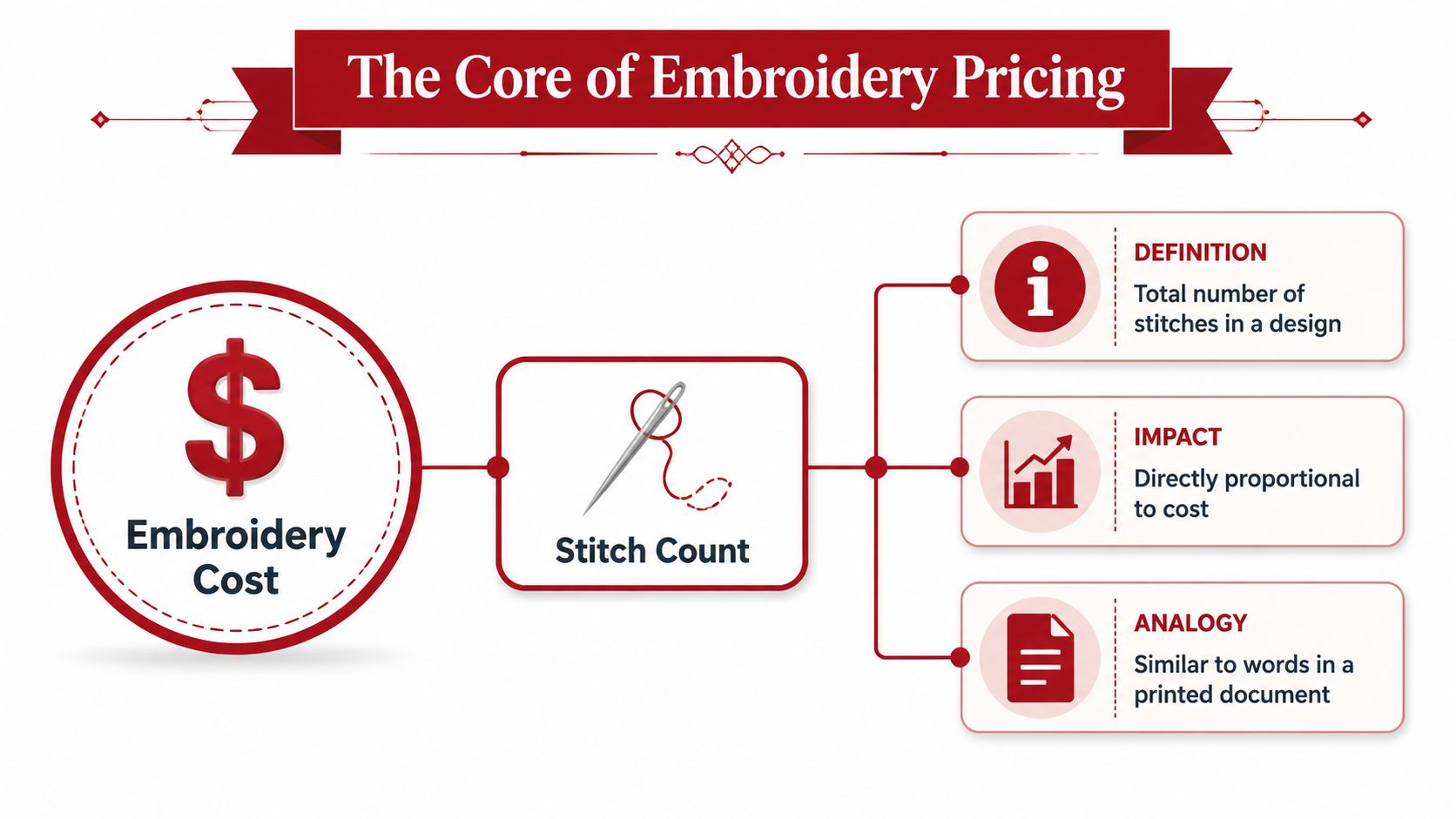
If you only remember one thing about machine embroidery pricing, make it this: stitch count drives the core cost. The machine is being priced by how much sewing it has to do.
Embroidery pricing can be compared to paying to print by the word. A short sentence is quick and cheap. A long, dense page takes more time and ink. Indeed, embroidery works the same way. A basic logo with open shapes may stitch quickly, while a dense badge-style design takes longer and uses more thread.
Why stitch count matters so much
The machine doesn't care whether your logo looks simple on a screen. It cares how many individual penetrations it must make into the fabric. Fine outlines, filled areas, underlay, and small text all add stitches.
A widely used technical baseline is $1 to $3 per 1,000 stitches, with many shops also expressing that as $0.005 to $0.015 per stitch, which puts a 5,000-stitch logo around $5 to $15 before other adjustments according to this embroidery per-stitch pricing guide. That's why stitch count is still the language most shops use when they build a quote.
What clients often miss
Two logos can be the same size on a hat and price differently. Size alone doesn't tell the full story.
A few examples of what increases stitch count:
- Filled backgrounds instead of open linework
- Tiny lettering that needs extra density to stay readable
- Detailed borders and layered shapes
- Heavy satin columns that look bold but add machine time
If you're sending art for quoting, it helps to understand how the file becomes stitches. This short guide on how to digitize a logo for embroidery is useful because it shows why a clean vector-style logo usually behaves better than a busy graphic pulled from social media.
Practical rule: If a design looks packed with texture, outlines, and fills, expect the stitch count to rise before the hat ever hits the machine.
A simple way to think about it
Here's the shop-floor version. More stitches usually means:
- More machine runtime
- More thread consumption
- More chances for thread trims, stops, and monitoring
- More labor if the design is dense or touchy on hats
That's why stitch count sits at the center of machine embroidery pricing. It's the closest thing the industry has to a common measuring stick.
Beyond the Stitches Key Pricing Variables
Stitch count is the backbone of the quote, but it's not the whole quote. The final number also reflects the work around the stitching itself. That's where many buyers see the gap between a rough online estimate and the actual invoice from a shop.
To make that easier to read, break the quote into production buckets instead of treating it like one mystery price.
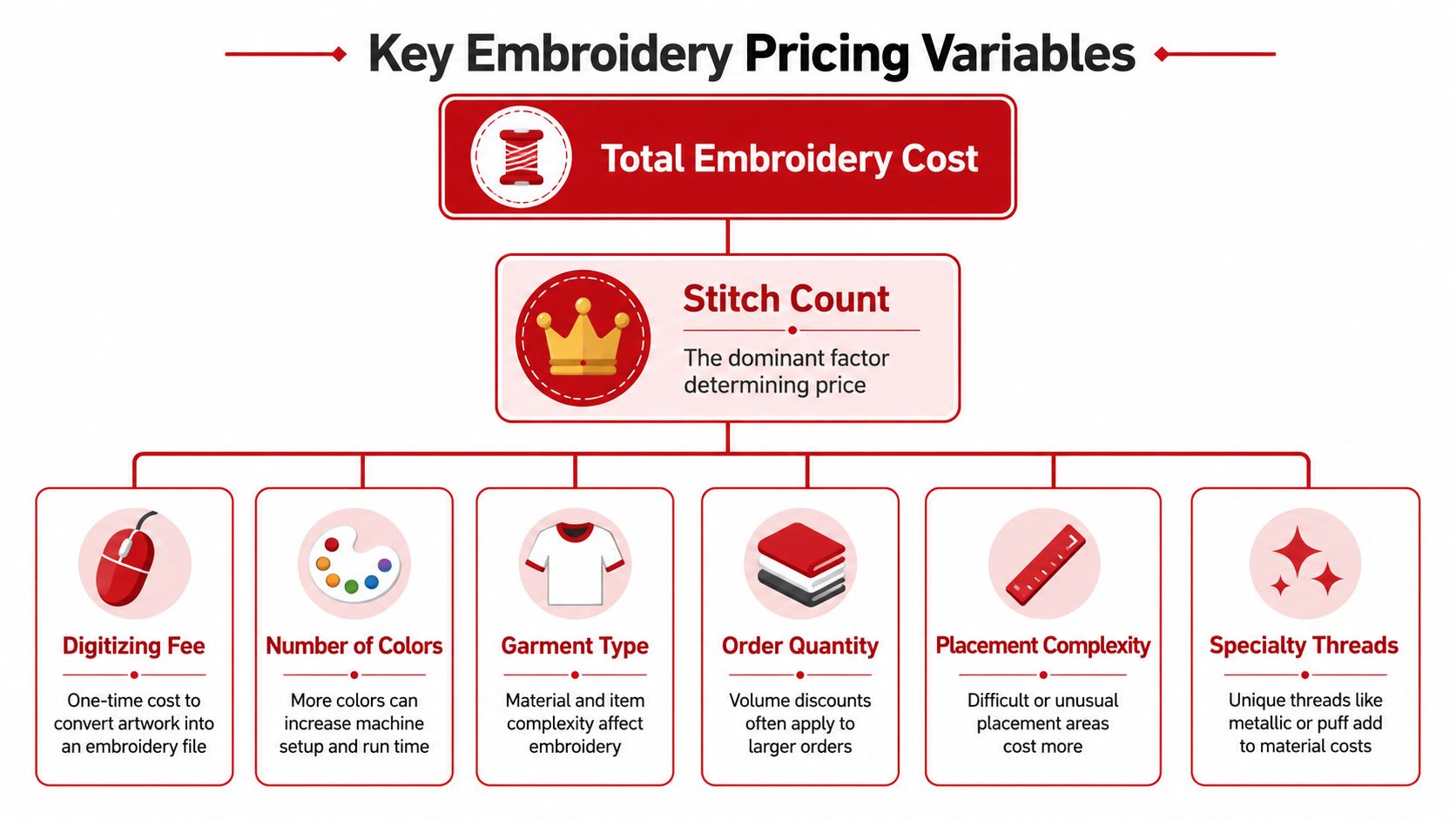
Digitizing and setup
Before embroidery starts, the artwork needs to be converted into a machine-readable file. That process is called digitizing. It tells the machine where to place underlay, how to sequence colors, where trims happen, and how the design should behave on a curved hat panel instead of a flat screen.
This is one reason embroidery pricing often confuses buyers coming from print. In print, your logo file may already be production-ready. In embroidery, the art usually needs interpretation by a digitizer.
Hat setup matters too. A structured cap, a trucker cap, and a soft dad hat don't all run the same way. Some placements are forgiving. Some need more careful alignment so the design doesn't distort around seams or buckram.
Complexity changes the quote
Detailed artwork can move the job out of the “standard logo” category. Designs above 10,000 stitches can trigger a price hike of 25% to 50%, and many wholesale providers include a base stitch count of around 8,000 stitches before they start charging extra, as outlined in this custom embroidery pricing guide.
That's why one logo can look modest to a client but expensive to produce. A jump in stitch count often means more density, more run time, and more opportunities for hats to need hands-on attention.
A few common complexity triggers:
- 3D puff embroidery that needs foam handling and cleaner sequencing
- Dense fills that can run hot on headwear
- Multiple thread changes that slow production
- Tight placement near seams where registration matters more
Later in the production decision, some shops also compare whether a job belongs in-house or should be outsourced based on equipment, turnaround, and complexity. This overview of in-house embroidery vs outsourced is helpful if you're evaluating vendors and wondering why capabilities vary.
Quantity changes the math
Bigger orders usually price better per piece because fixed work gets spread out. The logo file gets built once. Thread gets loaded once. The production rhythm improves once the job is running.
That's not unique to embroidery. The same logic appears in other product pricing strategies, where setup cost and operational efficiency matter just as much as materials.
Here's the plain-language version:
| Variable | Why it affects price |
|---|---|
| Digitizing | One-time artwork prep before production |
| Hat style | Some caps are easier to hoop and run than others |
| Design complexity | Dense or specialty embroidery takes more time |
| Quantity | Larger runs spread setup over more pieces |
| Placement difficulty | Tricky placements demand more precision |
A quote makes more sense when you read it this way. You're not only paying for stitches. You're paying for a production process.
Here's a quick visual on how shops think through those variables during production.
Putting It All Together Worked Pricing Examples
Machine embroidery pricing usually becomes apparent. Once you see a quote built line by line, the numbers stop feeling arbitrary.
I'll use two common hat-order scenarios. The exact totals will still vary by shop, hat brand, and production method, so treat these as planning examples rather than universal rates.
Sample Embroidery Job Cost Breakdown
| Cost Factor | Scenario A: 24 Hats, 4k Stitches | Scenario B: 144 Hats, 9k Stitches + 3D Puff |
|---|---|---|
| Design type | Simple front logo | More complex front logo with specialty treatment |
| Stitch baseline | Falls within the common per-1,000-stitch model discussed earlier | Near or above the kind of stitch level where many shops start adding overage beyond a standard included amount |
| Digitizing | One-time file prep likely applies if artwork is new | One-time file prep likely applies, and specialty sequencing may require more care |
| Setup impact | Higher per piece because the order is small | Lower per piece because setup spreads across many hats |
| Hat handling | Each cap still needs individual hooping and alignment | Production rhythm is smoother on a larger run |
| Likely quote feel | Per-piece price often feels high relative to the logo size | Total order value is larger, but per-piece pricing is usually more efficient |
Scenario A feels expensive for a reason
Take a small business ordering 24 hats with a straightforward chest-style logo adapted for the front of a cap. On paper, a 4,000-stitch design sounds simple. It is simple compared with a dense patch-style graphic.
But the shop still has to digitize the logo if it's new, test placement, set up the cap frame, run approval samples, and handle each hat one by one. The actual stitching may be the easy part. The setup is what pushes the per-piece number up.
Small runs don't remove the fixed work. They expose it.
That's why a buyer can compare a short-run hat quote against an online stitch calculator and think something is off. Usually, nothing is off. The calculator only estimated the sewing portion.
Scenario B often looks better per hat
Now take a merch brand ordering 144 trucker caps with a 9,000-stitch design plus 3D puff. This is a more demanding job. The logo is denser, the production sequence matters more, and specialty embroidery adds handling.
Even so, the larger order often produces a cleaner per-piece number because the setup gets absorbed more efficiently. The machine keeps running. The operator settles into a repeatable process. Purchasing and planning are more predictable.
What doesn't work well is comparing these two jobs by stitch count alone. The second design is more complex, but the larger quantity can offset some of that on a per-item basis. The first design is simpler, but the short run keeps the price from dropping as much as many buyers expect.
The practical takeaway
If you want to sanity-check a quote, ask yourself three questions:
- Is this a new file that needs prep?
- Is this a small run where setup dominates?
- Is this a hat style or design style that needs extra handling?
If the answer is yes to any of those, the quote will usually sit above a bare per-stitch estimate. That's normal shop math.
Your Quick Embroidery Cost Estimator
Most embroidery guides stop at “it depends.” That isn't very useful when you're trying to budget a launch, a staff order, or an event.
A better approach is a back-of-the-napkin estimator. It won't replace a real quote, but it gives you a practical way to think before you submit your order.
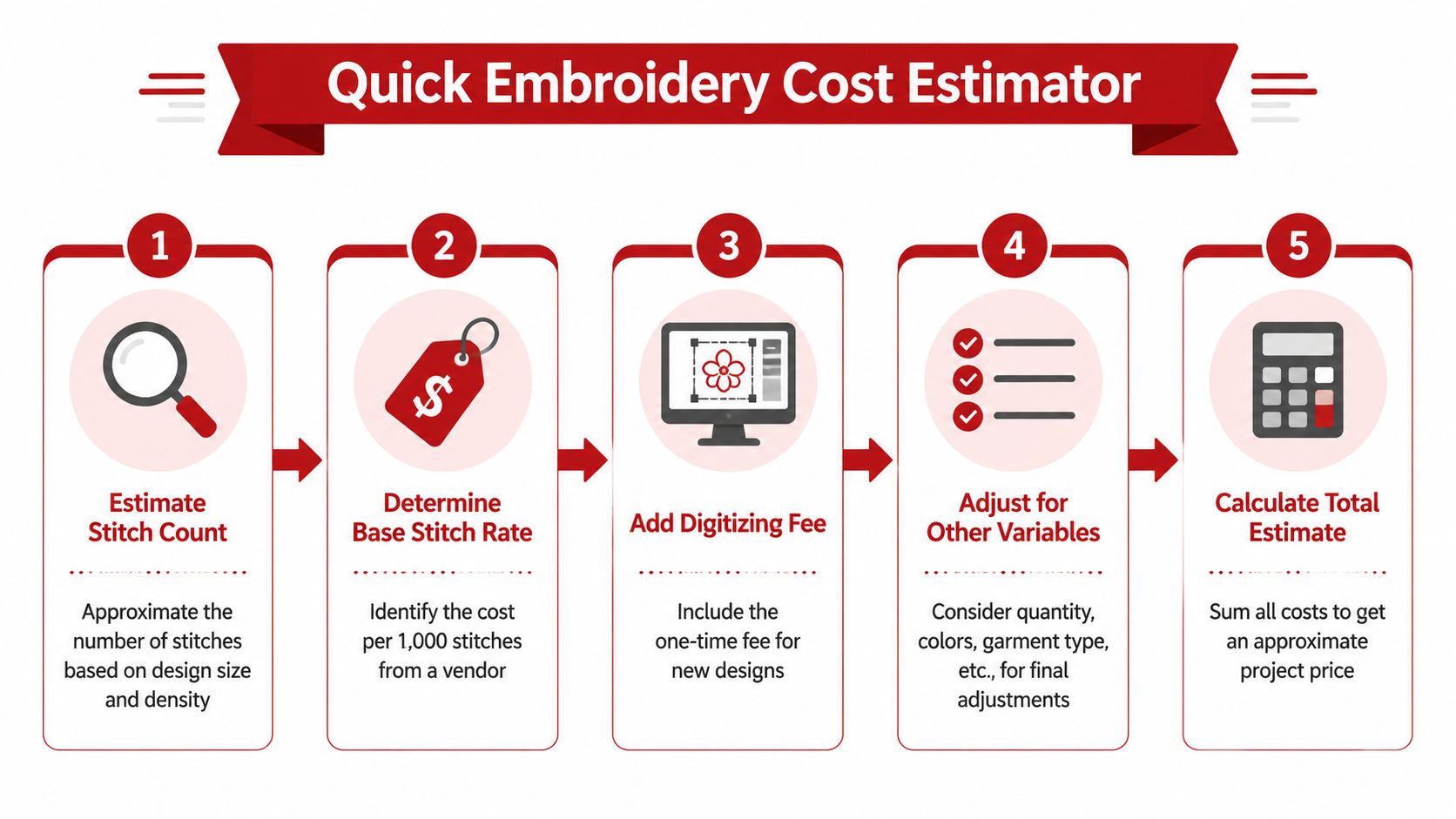
A simple estimating formula
Use this sequence:
Estimate the stitch count
A clean text logo or simple icon will usually sit lower than a filled badge, layered crest, or detailed mascot.Apply a baseline stitch rate
Use the common per-1,000-stitch range already covered earlier in the article as your starting point.Add one-time file prep if the art is new
If the logo hasn't been digitized for embroidery, assume there will be a separate prep charge.Adjust for the item and technique
Hats with difficult structure, puff embroidery, metallic thread, or unusual placement often need extra handling.Check whether the run is short or efficient
Larger orders usually spread setup better. Very small orders usually don't.
The estimate in plain language
If you prefer a sentence instead of a formula, use this:
Estimated project cost = stitch-based embroidery cost + new artwork prep + item-specific handling + quantity effect
That's the underlying logic behind machine embroidery pricing. It's not elegant, but it's honest.
Here's where many buyers get tripped up. On low-volume jobs, stitch count alone is often a poor proxy for cost because a more rigorous profit-based model also accounts for actual labor, overhead, setup, digitizing, and machine utilization, as explained in this formula-based embroidery pricing guide.
When this estimator works well
This rough method is most useful when:
- You're comparing design directions and want to know which one is likely easier to produce
- You're planning a budget before sending files to a shop
- You're deciding on quantity and want to see whether ordering more pieces may improve the math
If a quote for a tiny hat run seems high, the issue usually isn't greed. It's setup, handling, and machine time that don't shrink just because the order is small.
When it breaks down
This estimator gets less accurate when the job includes specialty execution or awkward production variables. Puff embroidery, seam-sensitive placement, heavy density, and mixed garment types all make pricing less “formula only” and more operator-dependent.
That's especially true for hats. Caps aren't just small shirts. They're curved, structured, and less forgiving. A design that runs smoothly on a flat item can become much more demanding on a front panel.
Smart Ways to Lower Your Embroidery Costs
The cheapest embroidery order isn't usually the smartest one. The smart order is the one where the design, hat, and quantity all match the budget without creating production headaches.
If you want to bring your cost down, focus on decisions that reduce friction for the shop. Those decisions tend to improve quality too.
Design choices that usually save money
Start with the logo itself. Busy artwork is expensive artwork.
- Reduce filled areas: Open shapes and cleaner linework often stitch more efficiently than heavy blocks of fill.
- Drop tiny details: Fine text, small outlines, and texture effects can push stitch count up without improving readability on a hat.
- Use fewer specialty effects: Puff, metallic thread, or unusual thread swaps can look great, but they add handling.
- Send cleaner art: A clean vector file or well-prepared logo gives the digitizer a better starting point than a low-resolution screenshot.
A lot of clients try to “get their money's worth” by cramming in detail. On headwear, that usually backfires. Simpler often looks sharper.
Order strategy matters too
Cost control also happens before the machine starts.
| Choice | Typical effect |
|---|---|
| Increase quantity | Spreads setup over more pieces |
| Stick with standard placements | Reduces alignment issues |
| Choose hat-friendly artwork | Lowers production friction |
| Reuse an existing embroidery file | Can simplify repeat ordering |
What works and what doesn't
What works is simplifying with purpose. Keep the strongest part of the logo. Remove details no one will see from a few feet away. Match the art to the hat.
What doesn't work is asking the shop to squeeze a highly detailed brand mark into a small embroidery area and then expecting it to price like a clean two-color text logo. That's where budgets go sideways.
A good cost-saving change removes stitches people won't notice, not the details that make the logo recognizable.
Another smart move is consistency. If you'll be ordering again, keep thread colors, placement, and logo version stable. Repeatable jobs are easier for shops to price and run cleanly.
What to Expect From a Custom Shop Like Dirt Cheap Headwear
A real shop quote makes more sense once you connect it to how the production floor works. Low minimums, proofing, machine capacity, and hat specialization all affect the buying experience even before you see the final invoice.
For example, industrial embroidery equipment is expensive. Industrial-grade machines with multi-head options can cost from $12,000 to over $39,995, and shops have to amortize that investment over thousands of units, as noted in this embroidery machine cost breakdown. That's one reason experienced shops care so much about efficient setups, repeatable files, and production-ready art.
How the process usually feels from the client side
A specialized headwear shop tends to make the order flow clearer because hats are the main event, not an afterthought. You submit the logo, choose the cap style, review the proof, approve placement, and move into production.
That kind of workflow matters on headwear because cap construction changes how the design runs. Structured fronts, trucker mesh, unstructured cotton, rope hats, and beanies all behave differently. A shop that works with those formats every day can usually flag issues before they become expensive mistakes.
If you're ordering hats and want to understand the steps before submitting artwork, this custom hat embroidery ordering guide gives a useful overview of how file review, proof approval, and production usually fit together.
What low minimums really mean
Low minimums are convenient, but they don't magically erase setup. They mean the shop has built a workflow that can handle both test runs and larger volume without forcing every customer into a huge opening order.
That's useful for brand sampling, staff uniforms, event planning, and pilot runs. It also explains why the per-piece cost on a six-piece or twelve-piece order won't look like a big bulk run. The shop is making smaller production possible, not pretending the setup vanished.
Dirt Cheap Headwear offers wholesale blank hats and custom embroidery with low minimums starting at six pieces per logo, along with options like 3D puff and standard front-logo decoration. In practical terms, that makes it one viable option for buyers who need either a short test order or a larger repeatable headwear program without changing vendors midstream.
What a transparent shop should do
A solid embroidery shop should help you answer these questions clearly:
- Is my artwork embroidery-ready, or does it need adjustment?
- Will this logo work well on this specific hat style?
- Is the quote being driven by stitch count, setup, or both?
- Would a small design change lower cost and improve sew quality?
Those are the conversations that make ordering easier. You don't need a lecture. You need a readable quote and honest guidance.
If you're ready to price out custom hats, Dirt Cheap Headwear gives you a straightforward way to request a quote, review your design, and get clear feedback on what will sew well before you place the order.
Pingback: Find Cheap Cowboy Hats: Bulk Buying Guide 2026 | Dirt Cheap Headwear
Pingback: Custom Embroidered Dad Hats No Minimum: Complete Guide 2026 | Dirt Cheap Headwear