
All Mesh Caps: The Ultimate Guide for Brands & Resellers
You're probably looking at hats for a summer crew, a golf outing, a brewery promo, a landscaping team, or a one-day event where people will be outside for hours. The obvious answer seems simple. Get the coolest hat possible, put the logo on it, move on.
That's exactly where all mesh caps get attention.
On paper, they solve the comfort problem fast. They breathe better than heavier caps, they dry quickly, and they feel lighter on the head when the weather turns hot. But once you add decoration, the conversation changes. The same open construction that makes an all-mesh cap comfortable can make your logo harder to execute cleanly, especially if the artwork is detailed or the placement is ambitious.
A lot of buyers only compare price, color, and airflow. That misses the part that usually matters more after delivery. Does the logo still look sharp? Does the hat keep its shape after repeat wear? Does the style fit the image your business wants to project?
Your Guide to Choosing the Right Summer Hat
You place a summer hat order for a crew that will be outside all day. The first request is usually simple. Keep heads cool. The second requirement shows up a little later, after someone asks how the logo will look once the hats are stitched.
That second question is the one that usually decides whether all mesh caps are a smart buy or a headache.
All-mesh styles earn attention for good reason. They feel lighter, vent heat fast, and make sense for outdoor crews, event staff, and giveaway programs in hot weather. They also sit inside a large, established cap category, so buyers are not dealing with a niche product. But comfort alone should not drive the order, especially if the hat needs to represent your brand well after the first wear.
Start with the actual use case
I tell buyers to sort the job first, then the style. A hat for a paving crew has different requirements than a hat for a brewery merch wall or a company golf outing. Heat matters, but branding pressure matters too.
Before you choose a cap, answer these questions:
- Who's wearing it: Staff, customers, fans, or resale buyers all judge hats differently.
- Where it's being worn: Outdoor crews need airflow. Indoor teams may care more about shape and presentation.
- What matters most: Comfort, logo clarity, retail appeal, or the safest decoration setup.
- How long it needs to last: A one-day giveaway and a daily uniform hat should not be ordered the same way.
If you're still comparing options for hot weather, Dirt Cheap Headwear's guide to summer hat styles for hot-weather use helps narrow down which categories fit the job before you commit to mesh.
One rule saves a lot of bad orders. Buy the hat for the finished result, not just for airflow.
That matters most with all-mesh caps because open construction changes how a logo can be applied and how the hat holds up with repeated use. Buyers who skip that step often end up with a cap that feels good in July but does not present the brand cleanly by August.
If the artwork is bold, simple, and built for workwear, an all-mesh cap can do the job well. If the logo needs sharp embroidery, fine detail, or a more polished retail look, slow down and compare the front panel construction before you place the order.
All-Mesh vs Traditional Trucker Caps
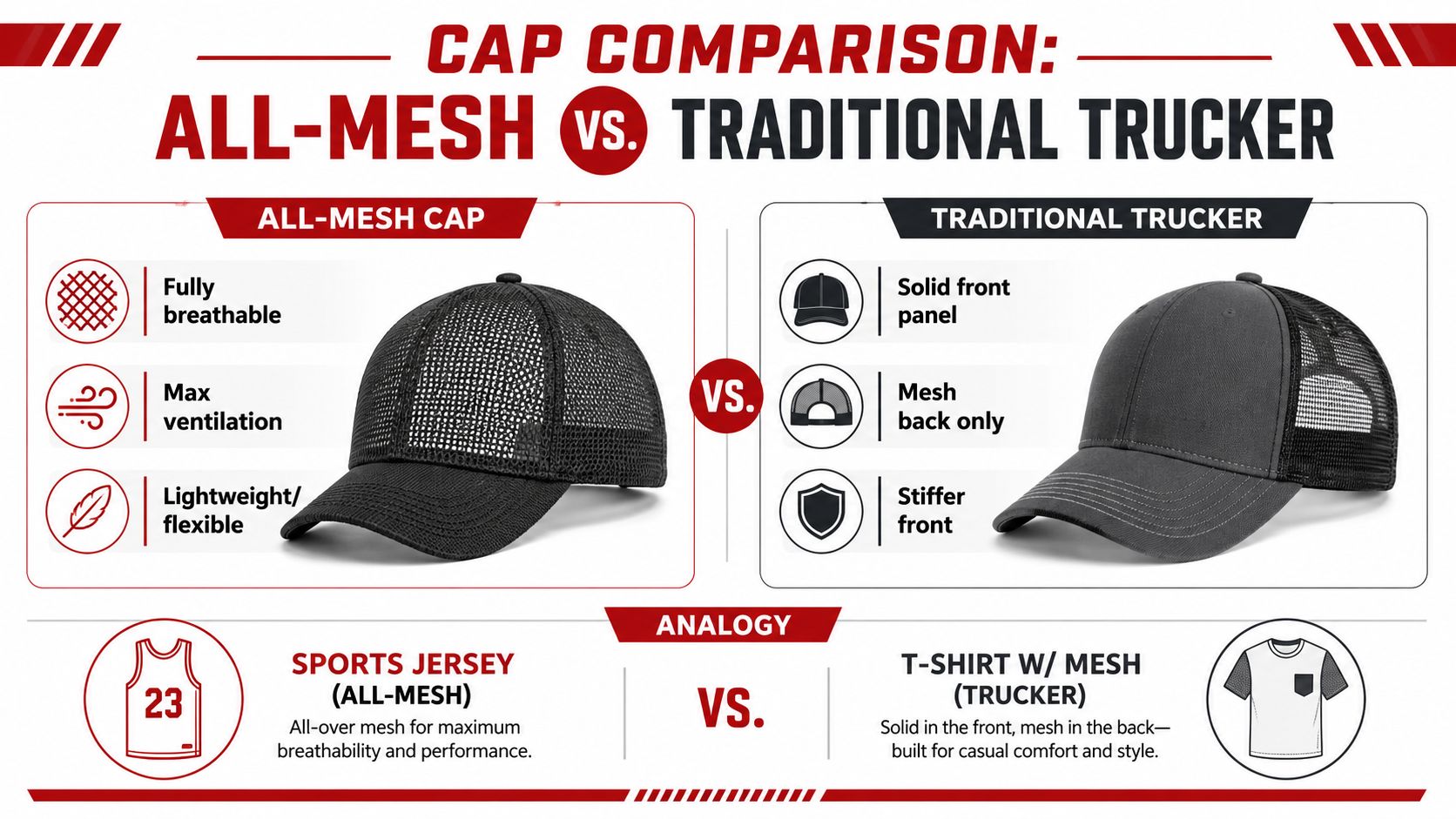
An all-mesh cap and a traditional trucker cap can look similar from a distance. Up close, they behave like two different products.
The easiest way to think about it is this. A traditional trucker is like a solid front door with a screen section behind it. An all-mesh cap is closer to a screen structure across much more of the crown. You still get shape where the cap is built to hold shape, but you're working with a much more open material overall.
What the cap is actually made of
Industry descriptions of mesh cap construction note that all-mesh caps use an open-weave mesh crown or mesh body to increase convective airflow, reducing heat buildup under the crown versus closed-weave fabrics. They're often paired with a polyester or foam front panel to preserve structure while maximizing ventilation, as explained in Merchize's guide to baseball hat types.
A traditional trucker cap usually has:
- A structured front: Often foam or fabric, sometimes stiffer and better for embroidery
- Mesh in the back panels: Good airflow, but not across the entire crown
- More visual body: The front stands up more and hides construction better
An all-mesh cap usually gives you:
- More breathable crown coverage: Air moves through much more of the hat
- A lighter, more flexible feel: Good for heat, less substantial in hand
- Less forgiveness in decoration: Open mesh doesn't behave like solid twill or foam
Why the structure matters
Construction changes more than comfort. It changes how the cap sits, how logos read, and what kind of finish you can realistically expect.
Here's the side-by-side view:
| Feature | All-mesh cap | Traditional trucker |
|---|---|---|
| Crown feel | Lighter, airier, more flexible | More structured in front |
| Airflow | Higher across more of the cap | Concentrated through back panels |
| Logo surface | Less stable overall | Better defined front branding zone |
| Visual impression | Casual, functional, sporty | Broader range from workwear to retail |
A standard trucker cap is usually easier to decorate cleanly because the front panel does more of the heavy lifting. That's where most logos live, and that's the panel your decorator wants to work with when artwork includes small text, outlines, or stacked elements.
If you want the hat itself to disappear and let the logo do the work, a standard trucker often gives you a cleaner canvas.
There's also a historical reason these caps feel familiar. The trucker format developed from utility wear and moved into mainstream fashion, with the mesh back serving a practical purpose in hot conditions. Sources describing trucker caps also note that they're a type of baseball cap, often built with a structured front and mesh back, and that the broader hat market has shown strong growth. One estimate cited by Buffalo Jackson and Rawshot.ai puts the hat market at USD 9.5 billion in 2022 and USD 15.3 billion by 2029, a 7.3% CAGR from 2023 to 2029, as noted in Buffalo Jackson's trucker hat vs baseball cap guide.
For buyers, the practical takeaway is simple. All-mesh is the cooler-wearing option. Traditional trucker is usually the easier-branding option.
The Real Pros and Cons for Your Brand
Comfort sells hats, but branding keeps them on heads.
That's the test. If your logo looks uneven, puckered, or hard to read after decoration, people won't care that the cap breathes well. They'll just think the hat feels cheap.
Where all-mesh caps shine
For the right brand, all-mesh caps solve real problems.
- Outdoor crews stay more comfortable: Landscaping, fishing, event setup, golf staff, and fairground teams usually appreciate lighter headwear.
- Sweat and moisture are less of an issue: Synthetic mesh dries faster than many heavier fabrics.
- The style communicates utility: If your brand leans practical, active, rugged, or warm-weather casual, all-mesh can fit naturally.
These hats also work well when the cap itself is part of the message. If you want something that feels breezy, informal, and built for summer, the material helps tell that story before anyone reads the logo.
Where brands run into trouble
The main drawback isn't fashion. It's decoration control.
Neutral headwear coverage often treats mesh as a comfort feature first, but that leaves out the hard part for wholesale buyers. Mesh is also a design constraint. Fine-detail decoration and some logo placements become less predictable than on solid-crown caps, which is a gap called out in Flexfit's trucker cap guide.
Here's what that means in practice:
- Small text can get muddy
- Dense embroidery can pull the surface
- Logos with thin outlines may lose definition
- Large fills can make the panel look stressed
- Repeat wear may expose weaknesses faster if the decoration was too aggressive for the material
A breathable hat can still be the wrong hat if the logo needs to look crisp from six feet away.
That's why I don't recommend all-mesh caps as the automatic summer option for every buyer. They're great when comfort matters more than decoration complexity. They're weaker when the logo needs to look premium, sharp, and highly controlled.
What works best for different brand goals
If your brand goal is staff comfort, promo giveaways, or a laid-back outdoor retail vibe, all-mesh is often a solid fit.
If your brand goal is one of these, I'd be more careful:
- High-end hospitality
- Corporate merch with fine-line logos
- Fashion-forward collections that depend on shape
- Programs where the hat has to look polished year-round
A standard trucker cap usually wins those jobs because it gives the decorator a better front panel and gives the customer a more structured finished product.
The short version is this. More mesh doesn't automatically mean better branded headwear. It means cooler wear, lighter feel, and more decoration trade-offs.
How to Customize All-Mesh Caps The Right Way
If you're set on all-mesh caps, the smart move is to design for the material instead of forcing the material to behave like solid fabric.
That starts with one decision. Don't begin with your full logo file. Begin with the simplest version of your logo that still looks like your brand.
Start with methods that respect the mesh
The most dependable customization approach is usually one that creates a stable decoration area instead of asking the mesh itself to carry every detail.
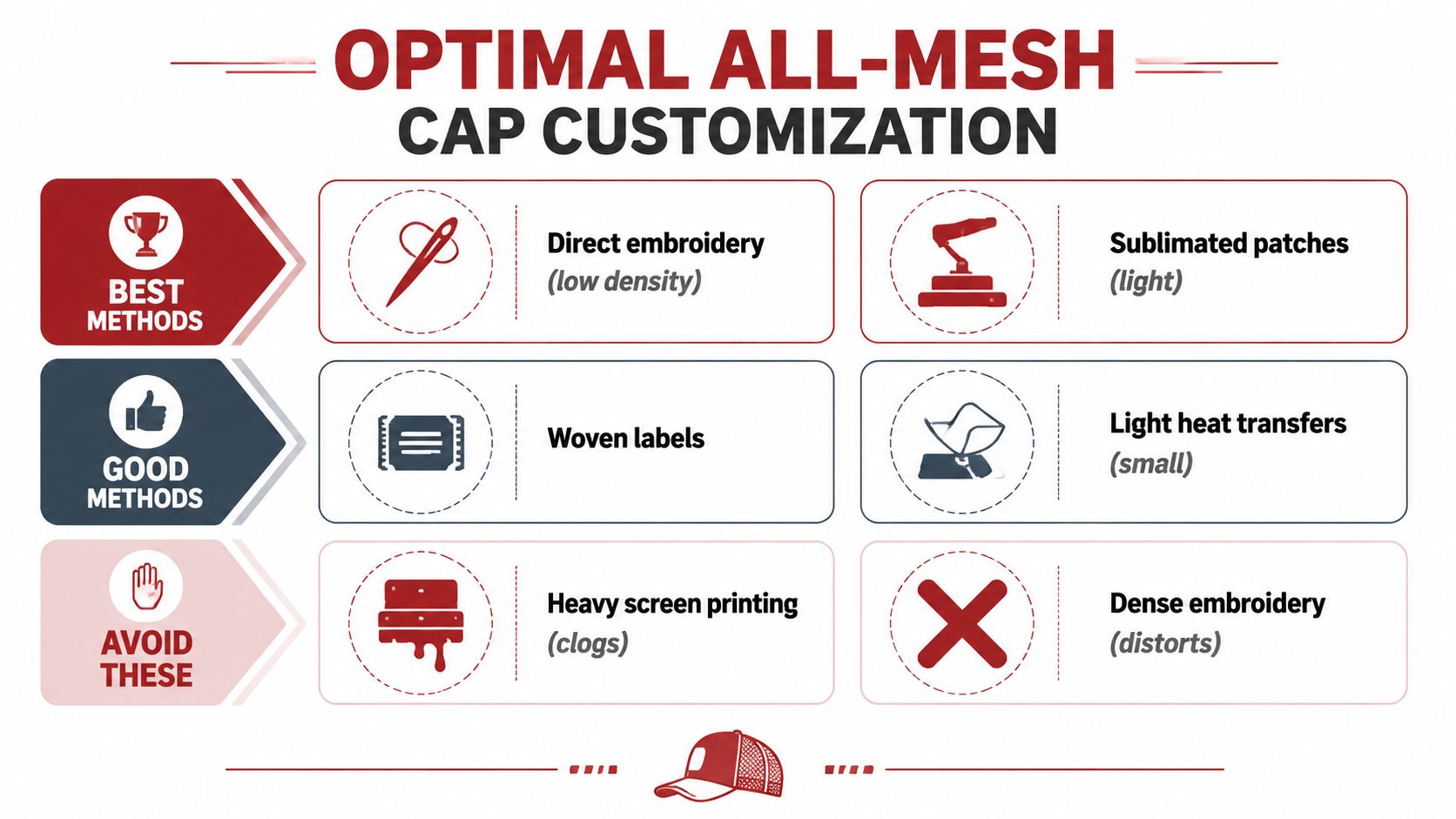
In practical terms, here's how I'd rank common options:
| Method | How it usually performs on all-mesh |
|---|---|
| Patch application | Often the safest route for logo clarity |
| Simple direct embroidery | Works if the design is bold and open |
| Woven label style branding | Can work for smaller, cleaner marks |
| Heavy fill embroidery | Higher risk of distortion |
| Large direct print areas | Usually less appealing on open mesh |
Why patches often make more sense
A patch gives the logo its own defined surface. That matters because the cap doesn't have to support every stitch directly across open holes and flexible mesh.
Good patch candidates include:
- Bold icons
- Block-letter wordmarks
- Simple badge shapes
- Outdoor and workwear branding
- Retail looks that want texture
Leather-style, embroidered, woven, PVC, and sublimated patches all create a buffer between the artwork and the cap body. The exact patch choice depends on your look, but the strategic advantage is the same. You're controlling the logo on a more stable layer.
For businesses comparing decoration routes, Dirt Cheap Headwear's overview of how to customize hats for different materials and logo types is a practical reference.
Decorator's note: If the artwork has tiny text, thin outlines, or intricate interior detail, test a patch first before approving direct embroidery.
If you embroider directly, simplify hard
Direct embroidery can work on all-mesh caps, but it needs restraint.
Use these rules:
- Reduce detail. Drop taglines, thin borders, and tiny secondary text.
- Open up spacing. Letters that look fine on a screen can close up on a cap.
- Avoid oversized fills. Large dense areas can stress the cap face.
- Keep the shape honest. A badge or simple block mark usually performs better than a delicate crest.
Video can help when you're trying to visualize how hat customization choices change the finished product:
Placement matters more than buyers think
On an all-mesh cap, placement isn't just about style. It affects readability and long-term wear.
The safer approach is usually:
- Front-center branding on the most stable panel area
- Smaller artwork instead of oversized chest-logo style treatments
- Avoiding areas where the cap flexes heavily during wear
What tends to go wrong:
- A logo is scaled too large.
- Stitch count gets pushed too far.
- The buyer wants a premium embroidery look from a cap built mainly for airflow.
- Nobody approves a physical sample before the bulk run.
That last point matters most. A sample catches issues your mockup won't show, especially on mesh.
What usually looks best
The strongest all-mesh cap designs are often the simplest:
- One icon
- One short wordmark
- A compact patch
- A clean outdoor brand badge
- A sporty logo with thicker lines
What usually disappoints:
- Fine script
- Detailed seals
- Small stacked copy
- Big fill-heavy logos
- Decoration that tries to mimic a premium structured cap
If you want maximum airflow and still want the branding to look intentional, design down, not up. Simpler art almost always gives a better result on all-mesh.
A Resellers Guide to Wholesale Ordering
When you buy all-mesh caps in bulk, decoration risk matters just as much as unit cost. A hat that looks good blank can still become an expensive mistake if your chosen logo method doesn't suit the material.
That's why wholesale buyers should treat all-mesh as a separate category, not as a standard trucker with a slightly different feel.
What changes at the ordering stage
All-mesh trucker-style caps commonly use polyester mesh and an adjustable snapback closure, and that setup is favored in wholesale because the closure reduces SKU complexity while the synthetic mesh supports durability and moisture management, as noted in Cap America's trucker mesh-back category.
That matters for resellers because adjustable sizing simplifies inventory.
- You stock fewer size variations
- Events move faster at the table
- Staff uniforms are easier to issue
- Reorders are less complicated
If you're new to decorated products and still building your process, this detailed guide for new POD sellers is worth reading because it helps frame margin, fulfillment, and product testing decisions before you scale.
How to lower your risk before a bulk order
A smart wholesale order for all-mesh caps usually looks like this:
- Sample first: Test the exact logo method on the exact cap style.
- Ask for artwork review: A good decorator should flag small text, heavy stitch areas, and weak placements.
- Choose the closure carefully: Snapbacks are easier for broad groups and promo programs.
- Match the style to the sales channel: Outdoor retail and event merch respond differently than boutique apparel.
- Keep alternates ready: Have a standard trucker version available if the all-mesh sample underperforms.
Inventory and assortment choices
If you resell hats online or through in-person events, keep the assortment tight. Too many colorways can create dead stock. Too many decoration variations can create quality inconsistency.
A practical starting assortment often includes:
| Decision area | Safer choice for early orders |
|---|---|
| Sizing | Adjustable snapback |
| Decoration | Patch or simplified embroidery |
| Color selection | Core neutrals plus one seasonal color |
| Branding style | One clean logo treatment |
For style sourcing, a catalog of mesh hat brands and wholesale options can help you compare blanks before you commit to a full run.
The short wholesale answer is this. All-mesh caps can be efficient to stock, but only if you test decoration early and keep the design simple enough for the material.
Ideal Use Cases and Simple Care Instructions
A crew shows up for a July install job, and by noon every hat is soaked with sweat. In that setting, an all-mesh cap earns its keep. The airflow helps, the lighter feel matters, and the casual look fits the job.

The better question is not whether all-mesh caps work in summer. It is whether they work for your logo, your customer, and the way the hat will be worn. I see all-mesh caps perform best where comfort matters more than a crisp, structured front panel.
Where all-mesh caps fit naturally
Landscaping crews, fishing charters, golf outings, marina shops, campground stores, and summer promo events are all good candidates. These are use cases where people expect a lighter hat and where branding usually succeeds with a patch, bold lettering, or a simple mark.
They also make sense for businesses that burn through uniforms fast. If the hat is part of daily outdoor use and gets replaced on a regular cycle, the lighter build is less of a drawback.
For e-commerce sellers, all-mesh caps usually convert better when the audience already buys for heat, sun, or outdoor activity. If you are running seasonal product campaigns, AdCrafty's platform for e-commerce ads can help match the creative to the right buyer, because these hats sell best when the setting is obvious in the ad.
Where I'd pause before ordering
All-mesh caps are a weaker choice for restaurants with polished uniforms, retail staff who need a cleaner look, or brands selling a more premium image. The cap can feel too casual, and the front often does not present a detailed logo as cleanly as a standard trucker.
I would also pause if your artwork depends on fine embroidery, small text, or a sharp retail silhouette. In those cases, the comfort benefit is real, but the branding trade-off is real too.
That same concern comes up in this YouTube discussion on when mesh caps are the wrong choice. Breathability helps in hot weather, but it does not solve structure, logo clarity, or perceived quality.
All-mesh caps work best when the job is hot, the wear is casual, and the logo can stay bold and simple.
Care instructions that help the hat last
All-mesh caps need lighter handling than a heavier structured cap. The mesh can snag, the crown can lose shape, and decorated areas can start to look rough if they get scrubbed hard or cooked in high heat.
Use simple care instructions with every order:
- Spot clean first: Mild soap and cool water are safer than machine washing.
- Skip high heat: Hot dryers and hot car dashboards can distort the cap and stress decoration.
- Air dry only: Let the hat dry on its own with the crown supported.
- Do not crush the cap: Store it where the front panel and mesh are not pinned under tools, boxes, or gear.
- Clean around patches and stitching carefully: Aggressive brushing can lift edges and fuzz the thread.
These steps help the hat keep its shape longer, but they do not change the basic trade-off. An all-mesh cap is still a lighter, more casual product. If your customer needs maximum logo sharpness and longer-term structure, a standard trucker is usually the safer buy.
Frequently Asked Questions from Business Owners
Can you put a leather patch on an all-mesh cap
Yes, if the cap has a stable enough front area for the patch application and the patch size is sensible. In most cases, a patch is a safer branding move than detailed direct embroidery because it gives the logo its own surface. The main question isn't whether a leather-style patch is possible. It's whether the front panel can support the look cleanly without becoming overloaded.
Do all-mesh caps feel different from regular truckers
Yes. They usually feel lighter, airier, and less substantial on the head. Some buyers love that in hot weather. Others interpret it as less premium, especially if they're used to a trucker with a firmer front and more visible structure.
When is a standard trucker the better choice, even in summer
A standard trucker is usually better when your logo needs sharp embroidery, when you want a cleaner retail look, or when the hat has to bridge seasons and settings. The open feel of mesh is useful, but it can reduce warmth, structure, and year-round versatility, which makes it less ideal for colder climates, indoor uniforms, or premium brand positioning.
Are all-mesh caps good for e-commerce brands
They can be, but only for the right audience. Outdoor, fishing, golf, workwear, and casual summer brands often have an easier time with them than high-end lifestyle brands do. If you're selling online, your product photos and ad creative need to make the use case obvious. If you're building campaigns around merch drops, a tool like AdCrafty's platform for e-commerce ads can help you turn product angles into usable ad concepts faster.
What's the safest first order
Start small, use simplified artwork, and sample the exact cap before approving a larger run. If the logo looks borderline on the proof, it usually won't improve on the finished hat.
If you're ordering branded hats and want a practical read on what will decorate well, Dirt Cheap Headwear offers wholesale blanks plus custom embroidery and patch-based options, which makes it easier to test whether an all-mesh cap or a standard trucker is the better fit for your logo before you commit to a larger run.