
Breathable Mesh Cap Guide: Types, Uses, and Bulk Buying
A breathable mesh cap isn't automatically cool, comfortable, or suitable for sun-heavy work. "Mesh" describes a construction, not a performance guarantee. The useful buying question is whether the cap balances airflow, fit, decoration, durability, and protection for the people who'll wear it.
That distinction matters in wholesale orders. A cap can look perfect in a product photo and still fail on a hot sideline, under dense embroidery, or during long event shifts. Treat the purchase as a procurement decision, not a logo purchase, and you'll choose a style that gets worn instead of abandoned in a gear closet.
Why the Breathable Mesh Cap Is More Than a Logo Surface
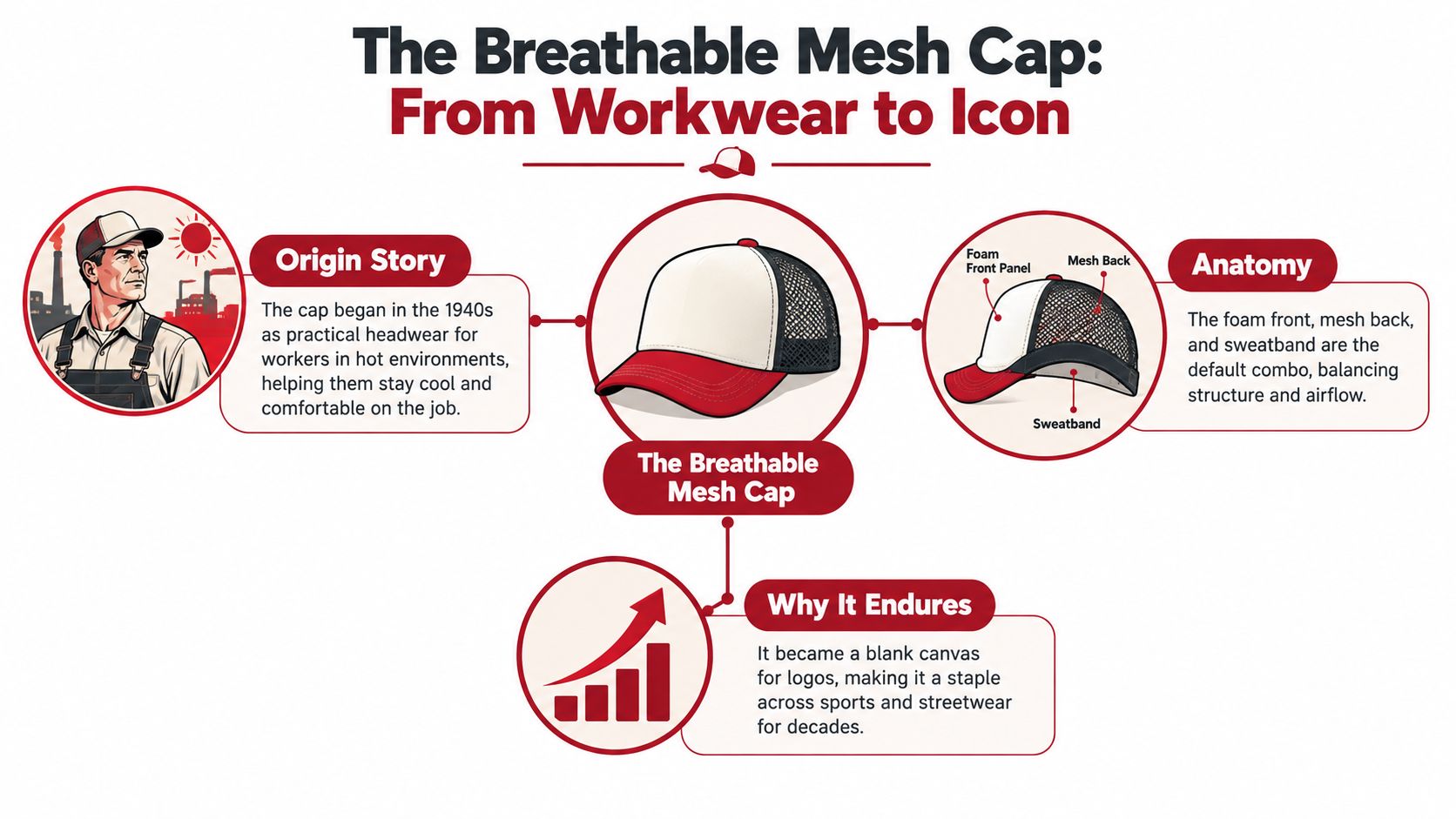
All mesh caps don't ventilate equally. The classic trucker format explains why: a solid front panel carries the decoration, while an open rear allows air to circulate. That split was practical from the start, but it doesn't mean every fabric, panel layout, or decoration choice delivers the same result.
The style emerged in the 1960s as the American promotional “trucker hat,” also called a “gimme cap” or “feed cap.” Agricultural suppliers, tractor manufacturers, feed distributors, and trucking businesses gave inexpensive caps to farmers, drivers, and rural workers. The broad foam front created a clean surface for screen-printed logos, while the plastic mesh reduced material and manufacturing costs and let air pass through during outdoor work. FreightWaves' history of the trucker hat documents how companies such as John Deere helped turn that giveaway format into recognizable workwear and mobile advertising.
Read the silhouette as a specification
A traditional breathable mesh cap usually combines a tall structured front, ventilated side and rear panels, a curved or flat bill, and an adjustable snap closure. The front gives a logo room stability. The rear contributes airflow and lets one style serve a broad range of wearers without producing several fitted sizes.
That construction still makes sense for teams, festivals, construction crews, and promotional campaigns. You get a recognizable profile, a large branding area, and fewer fit complications than with fitted headwear. The trade-off is that a foam front can retain more heat than the open rear, and a dense decoration can make part of the cap less breathable.
Practical rule: Buy the cap as a system. Front material, mesh geometry, closure, crown height, decoration, and intended exposure all affect whether it performs.
Club organizers choosing apparel for mixed groups can also use insights for club administrators to think through roster needs, staff roles, and practical wear conditions. The same logic applies to branded caps. A style that suits a coach may not suit younger players, volunteers, or event staff who wear it for longer stretches.
Mesh Types and How Airflow Is Actually Measured
“Open mesh,” “performance mesh,” and “breathable polyester” are useful shopping labels, but they aren't measurements. Two caps can both claim ventilation while using different yarns, openings, weights, and panel coverage. For a bulk buyer, the construction matters more than the marketing adjective.
Three constructions worth separating
Open plastic mesh is the familiar trucker-style option. Its visible apertures create a strong airflow effect and give the cap its classic look. It works well for low-cost promotions and warm outdoor programs, but large openings may offer less stability and less room for decoration.
Polyester knit mesh can provide a softer hand and more flexible fit. The actual airflow depends on knit geometry, yarn density, fabric mass, and thickness. “Polyester” alone doesn't tell you whether the cap will feel airy or close to a solid fabric.
Performance athletic mesh usually aims to balance ventilation with moisture movement and stretch. That can make it more suitable for active teams or staff who wear the cap for long periods, but buyers should still request fabric specifications and a sample.
Use ASTM D737 instead of guessing
ASTM D737 measures air passing perpendicularly through a textile under a defined pressure differential. It gives suppliers and buyers a repeatable comparison rather than relying on someone describing a cap as “high airflow.”
Published textile testing recorded 622 cm³/cm²/s for cotton mesh, 471 cm³/cm²/s for lyocell mesh, and 229 cm³/cm²/s for polyester rib under ASTM D737 testing, as reported in the textile air-permeability study. Those results show why “mesh” isn't a sufficient specification. Fiber type and construction can materially change ventilation.
Ask every supplier for:
- Test method: Confirm whether ASTM D737 was used.
- Pressure differential: A result without the testing condition is hard to compare.
- Fabric mass and thickness: These influence both airflow and heat retention.
- Test direction: Confirm how the fabric was positioned and measured.
- Mesh-zone coverage: A highly breathable fabric won't help much if the ventilated area is limited.
For buyers comparing all-mesh caps, the sensible process is to compare the test details, inspect the opening size, and wear a sample before placing the full order. Air permeability is valuable, but it should sit beside durability, decoration space, and fit rather than replace them.
Fit, Closure, and the Comfort Variables Buyers Overlook
A cool cap that doesn't fit will end up in a drawer. Wholesale buyers often focus on color and logo area first, then discover that the crown sits too high, the snap feels awkward, or the brim doesn't suit the group.
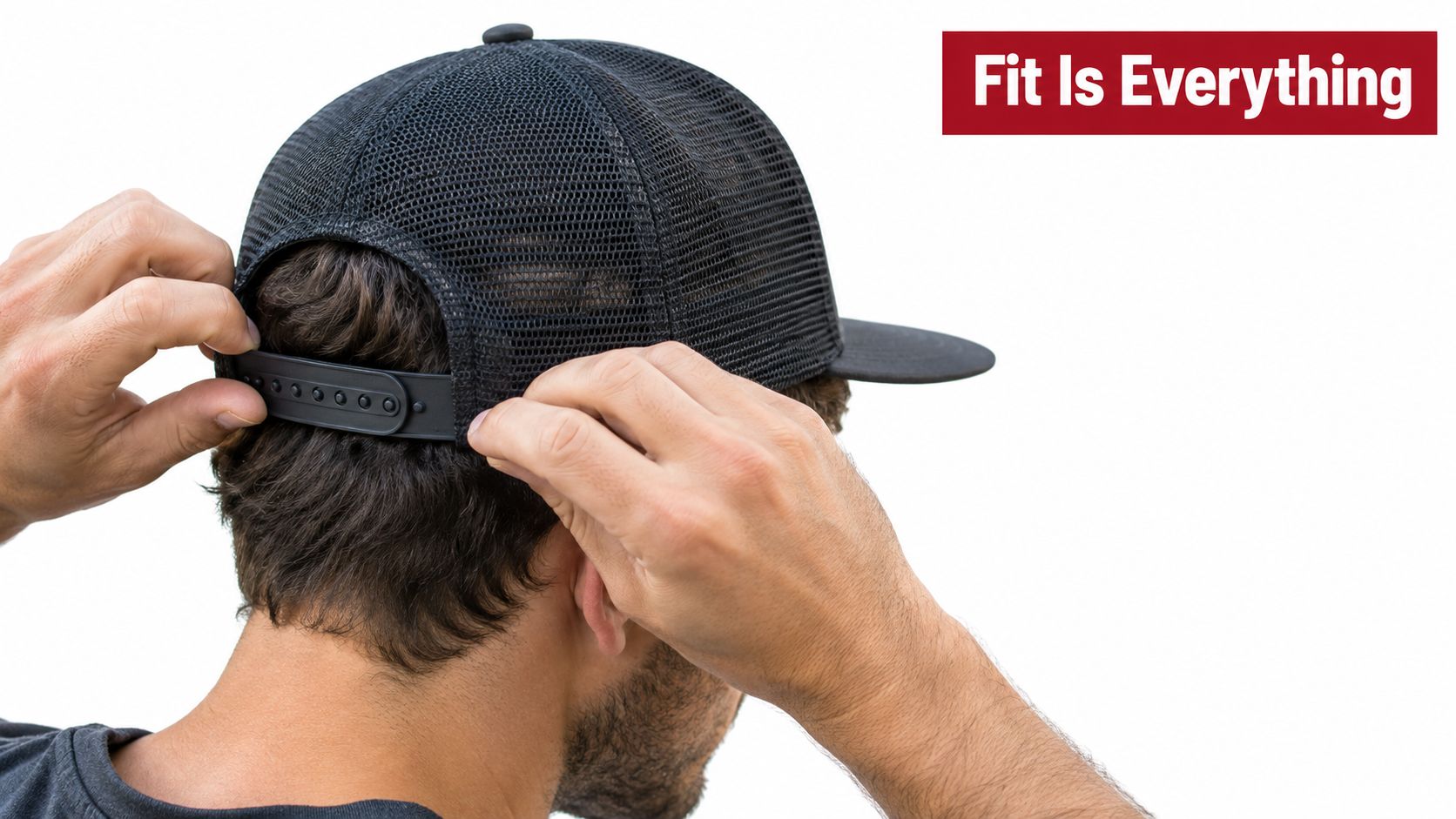
Start with the closure. A plastic snapback is usually the safest choice for teams, events, and promotional distribution because one cap can accommodate a broad range of head sizes. Fitted flex styles can feel cleaner and more athletic, but they require better size forecasting and can create avoidable inventory problems.
Match the crown to the wearer
A structured foam front holds a taller profile and presents a stable decoration surface. It suits bold logos, team marks, and promotional graphics that need to read from a distance. An unstructured crown feels softer and less rigid, which can work better for casual brands or wearers who dislike a firm cap shape.
Panel count and crown height also change the experience. More panels can alter the fit across the forehead and affect how a logo sits. A taller crown creates a stronger trucker profile, while a lower crown looks more understated and may suit customers who prefer a closer fit.
Check these points on a physical sample:
- Front pressure: Does the structured panel feel comfortable after extended wear?
- Snap range: Can smaller and larger wearers adjust it without excess strap hanging awkwardly?
- Bill shape: Does the curve block vision or sit naturally?
- Sweatband contact: Does the interior feel smooth against the forehead?
- Rear tension: Does the mesh flex without collapsing or pulling the crown out of shape?
The video below shows the basic adjustment action buyers should test before approving a snapback style.
For a mixed roster, staff group, or public event, adjustable snapback usually reduces risk. For a tightly defined athletic audience, a flex style may deliver a more finished fit. Don't choose based on the product photo alone. Put the sample on the person most likely to reject it.
Best Use Cases and When a Mesh Cap Is the Wrong Pick
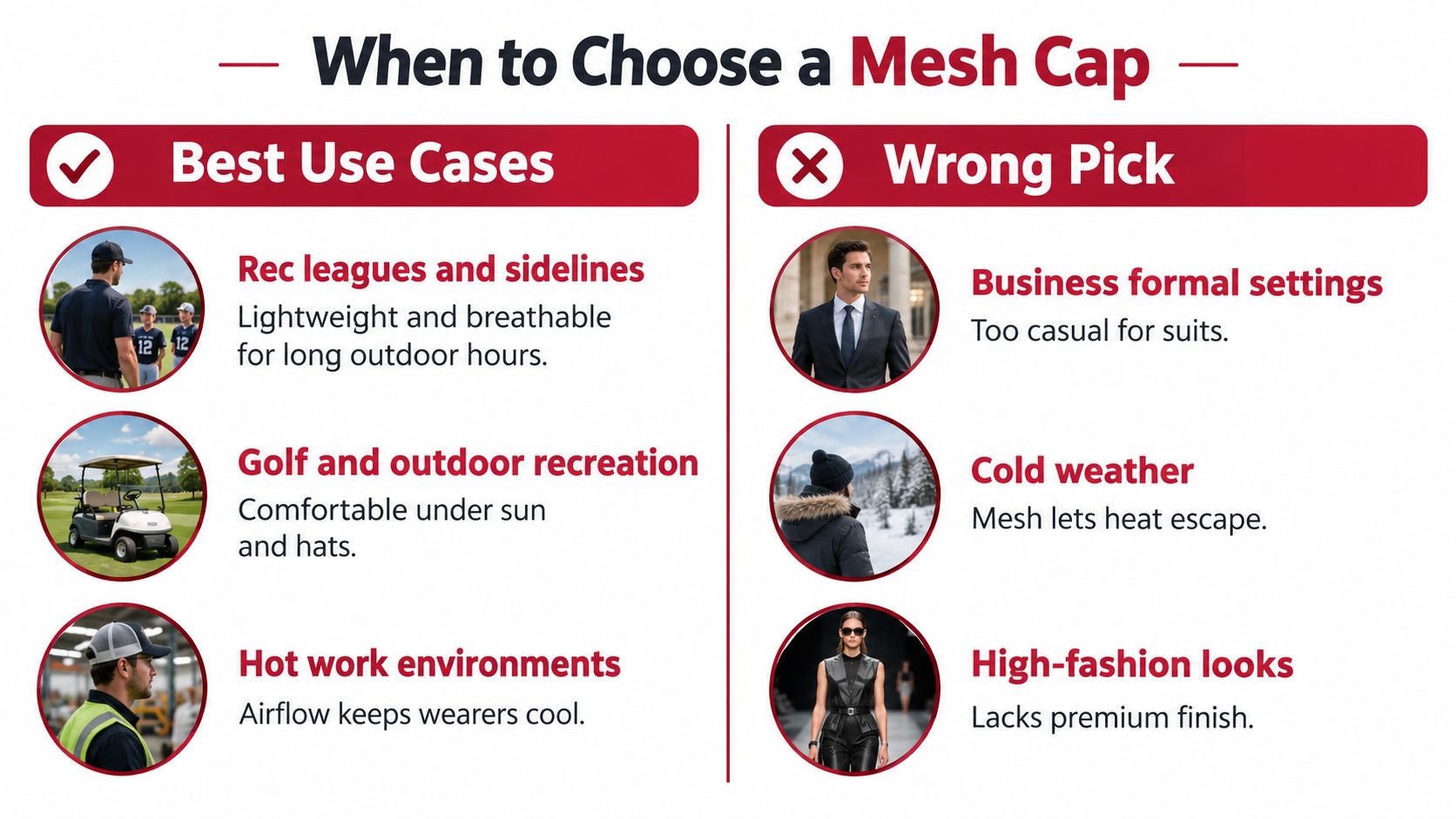
A breathable mesh cap works best when people need casual branding and ventilation at the same time. It suits environments where wearers move between sun, heat, and activity, and where a visible logo matters. It isn't a universal replacement for every cap style.
Match the build to the job
| Use Case | Front Panel | Structure | Recommended Closure |
|---|---|---|---|
| Youth sports sidelines | Foam or performance fabric | Structured | Plastic snap |
| Golf and outdoor recreation | Twill or performance fabric | Structured or lightly structured | Plastic snap or flex |
| Festivals and fundraisers | Foam for bold graphics | Structured | Plastic snap |
| Construction and landscaping crews | Durable fabric front | Structured | Plastic snap |
| Brand activations | Foam or twill, based on artwork | Structured | Plastic snap |
| Casual staff wear | Cotton twill or soft performance front | Unstructured or lightly structured | Snap or hook-and-loop |
The strongest applications are rec leagues, outdoor events, landscaping, construction support roles, golf, tennis, festivals, and summer promotions. These settings benefit from an adjustable fit, a visible logo area, and rear ventilation. A team can also distribute the same cap across players, coaches, volunteers, and staff without creating a complicated size matrix.
Know when to choose something else
A mesh cap is a poor choice for business-formal settings, cold-weather wear, or roles that require hard-hat compatibility. It also may not be the right answer for a premium fashion collection where the foam-and-plastic construction conflicts with the desired finish.
Open rear panels can let heat escape, which is useful in warm conditions but undesirable in cold wind. The casual silhouette can also undermine a formal uniform. For hard-hat users, the cap must be assessed separately for compatibility. Don't assume a low-profile crown or adjustable closure will work beneath protective equipment.
Choose the cap for the environment first, then add the logo. A strong decoration cannot rescue the wrong construction.
Decoration Strategy for the Front Panel and Logo Placement
The solid front is where the decoration belongs. The ventilated rear exists to move air, and dense embroidery can block pores, add weight, and reduce the cooling benefit in the exact area where airflow matters most.
Research on athlete wear found that polyester mesh garments produced lower microclimate humidity and temperature when high air permeability was paired with low thermal resistance. The same evidence supports a practical cap decision: keep substantial stitch fields on the stable front instead of covering the most open panels. The peer-reviewed textile research also supports treating airflow and moisture management as connected, not interchangeable, concerns.
Pick decoration by artwork
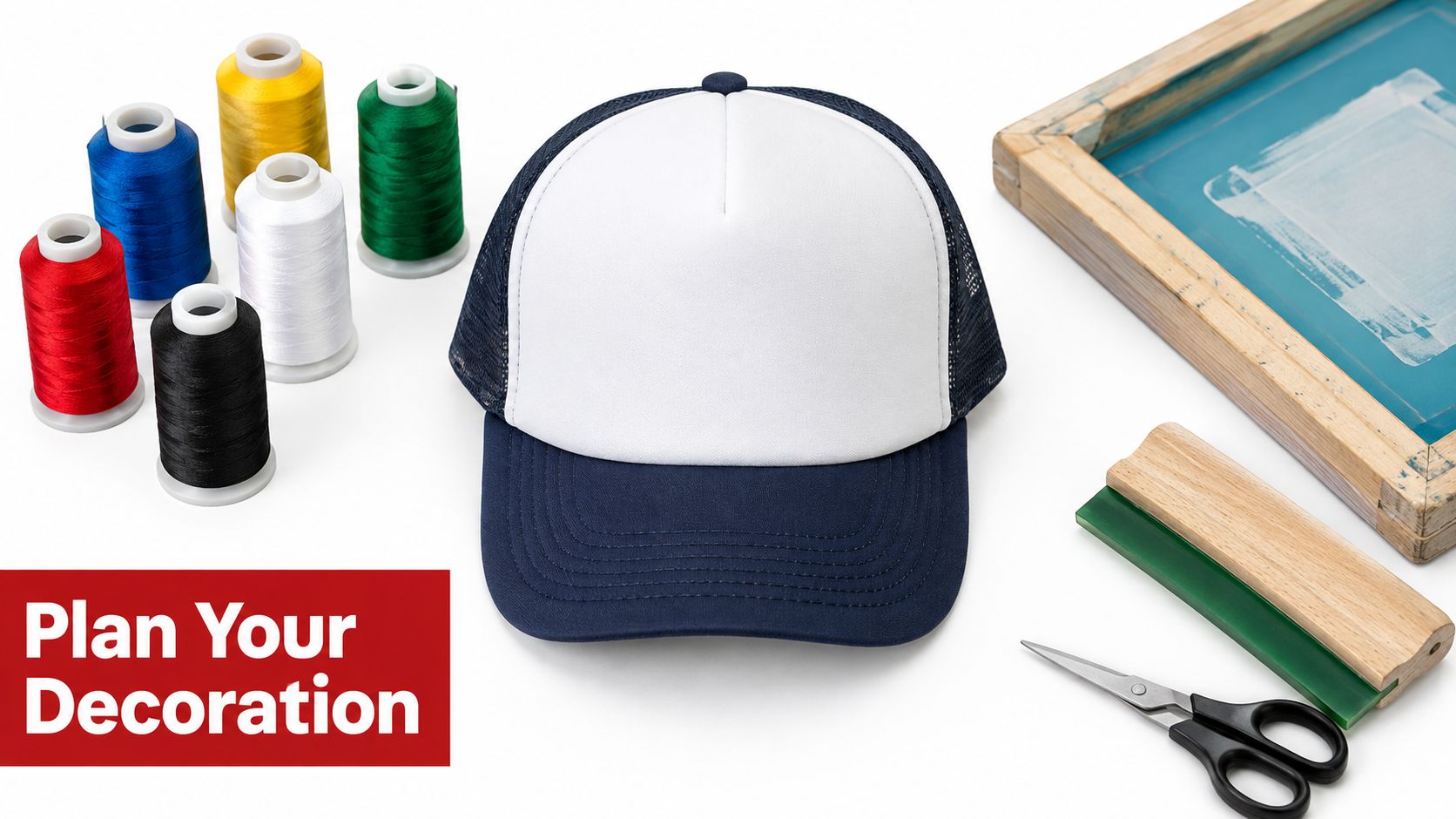
Flat embroidery is the dependable default for team names, logos, and marks with clear shapes. It gives the front a durable, established look, but tiny lettering and intricate details need careful digitizing.
3D puff embroidery adds height and works best with bold, uncomplicated lettering or symbols. It needs enough separation between elements, and fine details can collapse when the foam underlay competes with narrow strokes.
Screen printing suits broad, graphic artwork on a smooth foam front. It can preserve small visual details better than bulky stitching, but the print needs to follow the front panel's curve and should be checked for distortion.
Woven patches are useful when the artwork has fine detail, multiple colors, or a shape that would be difficult to embroider directly. The patch adds another layer, so confirm its size, edge finish, and attachment method before approving the production sample.
Use a placement guide such as how Klap guides logo placement to check scale, clear space, and visual balance before the decorator creates the proof. For additional production-specific reference, review this embroidery placement guide before locking the art.
Protect the breathable zones
Keep large stitch fields away from the mesh. Use the front's stable area for the main mark, and avoid pushing artwork so low that it collides with the brim curve. A tall crown offers more visual room, while a low crown can force the logo into a cramped shape.
Ask for a digital proof that shows the actual cap profile, decoration method, thread colors, and placement. Then approve a physical sample if the order is important. The cheapest production mistake is the one caught before the full run.
The Sun Protection Trade-Off Most Buyers Miss
A breathable mesh cap is a heat-management product, not automatically a sun-protective garment. Cooling and ultraviolet protection are separate specifications, and buyers who combine them without testing can give outdoor teams a false sense of coverage.
Open mesh ventilation panels may allow substantial ultraviolet transmission unless the fabric and construction carry a recognized UPF rating. Properly designed sun-protective clothing can block up to 98% of UV radiation, as described in this sun-protection guidance. That figure applies to properly designed protective clothing, not to every mesh cap.
Separate airflow from coverage
A cap can feel cooler while leaving parts of the scalp exposed through open mesh. Color, weave openness, fiber composition, brim width, and lining all affect the result. Darker fabric may change the visual experience, but it isn't a substitute for a tested UPF rating.
If sun exposure is the primary concern, specify:
- Recognized UPF testing: Ask for the rating and the fabric it applies to.
- A wider pre-curved brim: More brim coverage generally gives the face better shade than a narrow bill.
- Solid high-exposure panels: Use solid fabric where coverage matters most.
- A suitable crown layout: Keep ventilation where it helps without assuming every open area protects skin.
- Clear wearer guidance: Tell teams that a cap doesn't cover the neck, ears, or all facial surfaces.
For a summer tournament, a ventilated crown may be the right comfort choice. For outdoor labor in intense sun, a tested UPF fabric and greater coverage deserve priority. Don't let the word “breathable” do the work of a protection specification.
Bulk Ordering Workflow for Teams and Promotions
Bulk buying gets easier when you separate the decision into product, decoration, approval, and care. Start with the wearer group, not the catalog. A 48-piece team order, a staff program, and a public giveaway have different tolerance for fit variation, decoration complexity, and replacement needs.
Use a repeatable approval process
- Define the group. Identify who will wear the caps, how long they'll wear them, and whether one adjustable size can serve the group.
- Choose the construction. Decide between foam, twill, performance fabric, structured, unstructured, snapback, or flex.
- Request a quote. Ask for blank pricing, decoration pricing, setup charges, minimums, available colors, shipping, and lead time in the same document.
- Approve the proof. Check the logo scale, thread colors, print coverage, patch dimensions, and placement on the actual crown.
- Test one sample. Give it to the hottest-running or most demanding wearer, not just the person approving the artwork.
- Lock the production details. Confirm quantities, color breakdown, delivery address, approval date, and what happens if stock changes.
- Document care. Keep washing instructions with the order so staff and athletes don't destroy the shape or decoration.
For a 48-piece order, don't assume the quote is “48 caps times the blank price.” Ask whether the decorator's minimum applies per logo or per style, whether setup is included, and whether splitting colors changes the production cost. Confirm whether the supplier can deliver the full quantity from one production run and whether the stated lead time begins after artwork approval.
You can compare a suitable mesh trucker hat against other constructions before choosing the blank. The right quote should make the trade-offs visible rather than hiding them inside one total.
Wash polyester mesh with more care
Polyester mesh is often durable and quick-drying, but easy care doesn't mean no environmental cost. A 2025 textile study found microfiber release from polyester knit fleece rose through roughly the third to fifth wash before stabilizing, while a separate review reported 161 ± 173 mg per wash for knitted fleece and jersey compared with 27 ± 14 mg for woven polyester. Those findings concern textile categories that aren't identical to cap mesh, but they show why washing advice should address fiber shedding, not just shape.
Prefer hand washing when practical. If a machine is necessary, use a laundry bag or a microfiber filter, avoid high-heat drying, and keep structured caps away from harsh agitation. Embroidery, adhesives, foam fronts, and patches may each need gentler handling than the mesh alone.
Quick Reference Checklist Before You Place the Order
Use this list before approving the quote:
- Airflow: Request ASTM D737 details, including pressure differential, fabric mass, and test direction.
- Construction: Confirm whether the cap uses open plastic mesh, polyester knit mesh, or a performance mesh.
- Fit: Choose snapback for broad groups unless a defined audience justifies fitted sizing.
- Decoration: Keep dense embroidery on the stable front panel, not the ventilated rear.
- Artwork: Approve a digital proof and verify thread, print, or patch colors against the actual cap.
- Sun protection: Treat UPF as a separate specification. Mesh alone isn't a protection rating.
- Use case: Reject the style for formal indoor wear, cold conditions, or unverified hard-hat compatibility.
- Care: Provide washing instructions, avoid high heat, and consider a laundry bag or microfiber filter.
- Order terms: Confirm minimums, stock, production timing, shipping, and replacement procedures.
- Related equipment: If the campaign includes coordinated music or event branding, you can also browse custom drum head options as part of the wider merchandise plan.
Order one decorated sample and give it to your most demanding team member before committing to the full bulk run.
Dirt Cheap Headwear supplies blank and decorated mesh caps for teams, businesses, events, and promotional programs, with in-house embroidery, custom patches, printing, low minimums, and worldwide shipping options. Compare the construction and decoration choices, request a proof, and visit Dirt Cheap Headwear to start a practical custom headwear order.