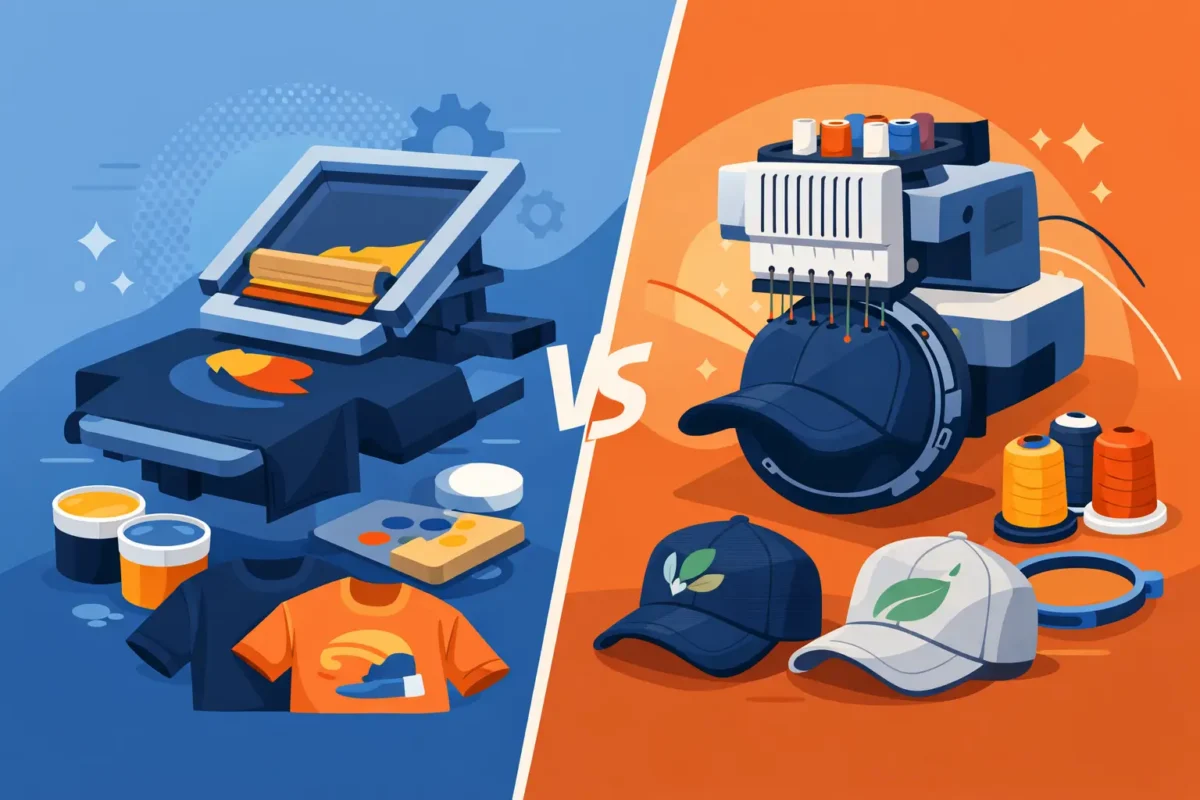
A contractor ordering 24 work hats, a brewery launching branded truckers, and an event planner buying 300 giveaway caps may all start with the same question: screen printing versus hat embroidery. The right answer is not about which method is universally better. It comes down to your hat style, logo artwork, budget, order quantity, and what the hats need to do after they leave the box.
For most business uniforms, resale headwear, and long-term branded gear, embroidery is the standard because it holds up, looks dimensional, and works naturally with caps, beanies, visors, and structured profiles. Printing can be the smarter route when the artwork is highly detailed, uses gradients or many colors, or needs a flatter finish. Choosing before you buy blanks prevents avoidable cost and production issues.
Screen Printing Versus Hat Embroidery: The Real Difference
Embroidery uses thread stitched directly into the hat or into a patch that is later applied to the hat. It creates texture and a raised, finished look that customers associate with quality branded headwear. Standard flat embroidery handles most logos, while puff or 3D embroidery can make bold lettering and simple shapes stand out on structured caps.
Screen printing pushes ink through a mesh screen to transfer a design onto a surface. It is a proven decoration method for shirts and other flat apparel, but hats introduce complications. Curved crowns, center seams, panels, and stiff buckram can make direct screen printing less practical than it is on a T-shirt. For headwear, printed graphics may instead be applied through a heat transfer or printed patch process, depending on the blank and design.
That distinction matters when you are sourcing hats in bulk. A method that is inexpensive on flat garments may not provide the same placement, finish, or durability on a curved six-panel cap.
When Hat Embroidery Is the Better Buy
Embroidery is usually the first choice for a clean company logo, a simple brand mark, team name, or short line of text. It works especially well when the design has solid shapes, limited fine detail, and colors that can be matched with thread.
The biggest advantage is durability. A properly embroidered logo becomes part of the hat rather than sitting on top of the fabric. It stands up well to repeated wear, which makes it a strong fit for field crews, restaurant teams, landscaping companies, golf outings, gyms, and retail merchandise. If you expect the hat to be worn for a year rather than handed out for one afternoon, embroidery often earns its higher setup and stitch cost.
It also gives buyers more options across headwear categories. Embroidery can be used on dad hats, structured snapbacks, trucker hats, fitted caps, beanies, visors, rope hats, youth hats, and many other blank styles. The final result will vary by construction. A structured cap provides a firm, polished surface for a front logo, while an unstructured dad hat gives a more casual result. Beanies and soft knit hats may need a different placement or a patch to keep the design readable.
Embroidery has limits. Tiny text, very thin lines, photographic artwork, and detailed illustrations can lose clarity when converted to thread. The artwork may need to be simplified, enlarged, or adjusted before production. That is not a flaw in the process. It is the practical reality of placing thread on a small, curved decoration area.
Puff embroidery needs simple artwork
Puff embroidery is popular for bold streetwear, sports branding, and strong letter-based logos. Foam beneath the stitching creates a raised effect, but it is not suited for small details, narrow gaps, or complex artwork. Think block letters, clean outlines, and simple icons. A detailed logo that looks sharp in flat print may become crowded in 3D thread.
When Printing Makes More Sense for Hats
Printing is worth considering when your artwork cannot be simplified without losing its point. Multi-color illustrations, gradients, photos, fine line art, and intricate graphics are difficult or impossible to reproduce with standard embroidery. A printed treatment can preserve those details more accurately.
It can also be useful for promotional orders where the hat is one part of a larger campaign and the design needs to match printed shirts, banners, packaging, or event materials. If your logo includes multiple colors and fine artwork, a printed patch or other print-based decoration may offer a closer match than thread.
Cost depends on the specific process, color count, number of locations, blank hat, and quantity. Printing may be more economical for certain large, simple runs, while embroidery can be a better value for small-bulk orders with a straightforward logo. Do not assume one method always costs less. Ask for pricing based on the actual artwork and hat style you want.
The trade-off is wear. A quality printed decoration can perform well, but it does not have the same stitched-in construction as embroidery. Hats that will see hard daily use may favor embroidery. Hats for a one-time event, seasonal promotion, or graphic-forward launch may favor print.
Start With the Hat, Not Just the Logo
The blank cap affects the decision as much as the artwork. A front-panel print needs a reasonably smooth area. A center seam can interrupt a design, and curved panels can distort fine lines. Structured truckers and snapbacks are often excellent embroidery candidates because the front panel supports clean stitching. Mesh-back hats need the decoration on the solid front panel, usually with embroidery or a patch.
For low-profile dad hats and washed cotton caps, embroidery remains popular, but very dense designs can cause puckering or pull on softer fabric. A lighter stitch count, a patch, or a simplified logo can improve the final look. Beanies present another decision: direct embroidery can work, but a patch often offers better visibility and a more consistent presentation across stretchy knit material.
Before committing to a large order, confirm the placement. Front center is the usual choice, but side embroidery, back embroidery, and patch placement can change both the cost and the design requirements. A logo that is too wide for a front panel may work better as a side hit or a patch on a different hat profile.
Compare the Artwork Before You Compare Prices
Send your actual logo file before selecting a decoration method. A production team needs to see the line thickness, text size, colors, and intended dimensions. A clean vector file is ideal for evaluating artwork, but a clear high-resolution image can help start the conversation.
For embroidery, the logo must be digitized into stitch instructions. This is different from simply uploading a file. The digitizing process determines stitch direction, density, underlay, thread changes, and how the design behaves on the chosen blank. Good digitizing is one reason an embroidered logo can look sharp on one cap and messy on another.
For printing, the team will evaluate whether the design can be placed directly on the hat or whether a patch or transfer is the more reliable option. That production call should be made before the order is finalized, not after 200 blank caps have been purchased.
A Practical Choice by Order Type
For uniforms and service businesses, embroidery is typically the safest choice. It looks professional, holds up to regular use, and makes a simple logo easy to recognize from a distance. For apparel brands, the decision depends on the collection. Embroidery fits premium basics, heritage looks, and bold logo caps. Printed graphics and patches work well for art-heavy or limited-run designs.
For events, consider the lifespan of the item. If the goal is a durable takeaway that people will keep wearing, embroidery provides stronger perceived value. If the hat supports a colorful campaign graphic or a short-term promotion, printing may better serve the design and budget.
Dirt Cheap Headwear keeps embroidery work in house, which gives buyers a more direct path from logo review to finished order. The six-piece minimum per logo also makes it practical to test a staff order, small merch release, or event sample run without committing to hundreds of pieces.
Make the Decision That Protects Your Budget
The cheapest decorated hat is not always the lowest-cost purchase. If fine text becomes unreadable, if a print cracks after regular wear, or if the blank does not support the chosen placement, the order costs more in replacements and lost brand credibility.
Start with the purpose of the hat. Choose embroidery when you need a durable, classic logo treatment and the artwork is clean enough for thread. Choose print-based decoration when artwork detail, color variation, or graphic accuracy matters more than stitch texture. Then match that method to a blank hat built for the placement.
A good custom hat order is simple: the blank fits the wearer, the logo fits the decoration area, and the finished piece looks worth wearing again. Get those three parts right before production starts, and your bulk order has a better chance of becoming gear people keep instead of giveaways they forget.