
Bulk Blank Snapback Hats: The Ultimate Wholesale Guide
You're staring at a supplier tab explosion, three quote emails, and a half-finished logo proof, trying to figure out which hat won't turn into dead stock. That's the bulk blank snapback hats problem, not “what color should I pick,” but which construction will embroider cleanly and still resell well.
The market is big enough to matter. The global blank hats wholesale market reached $2.3 billion in 2024, and it grew at a 5.2% compound annual growth rate over the prior three years, which tells you bulk headwear is still a serious B2B channel, not a side hustle category (Alibaba SmartBuy analysis). Snapbacks are a major part of that because they show 3,584 monthly units in snapback sales, account for 32% of wholesale transactions, and sit in a pricing spread from $0.96 to $3.33 wholesale and $8.53 to $79.00 retail when branding enters the picture (Alibaba SmartBuy analysis).
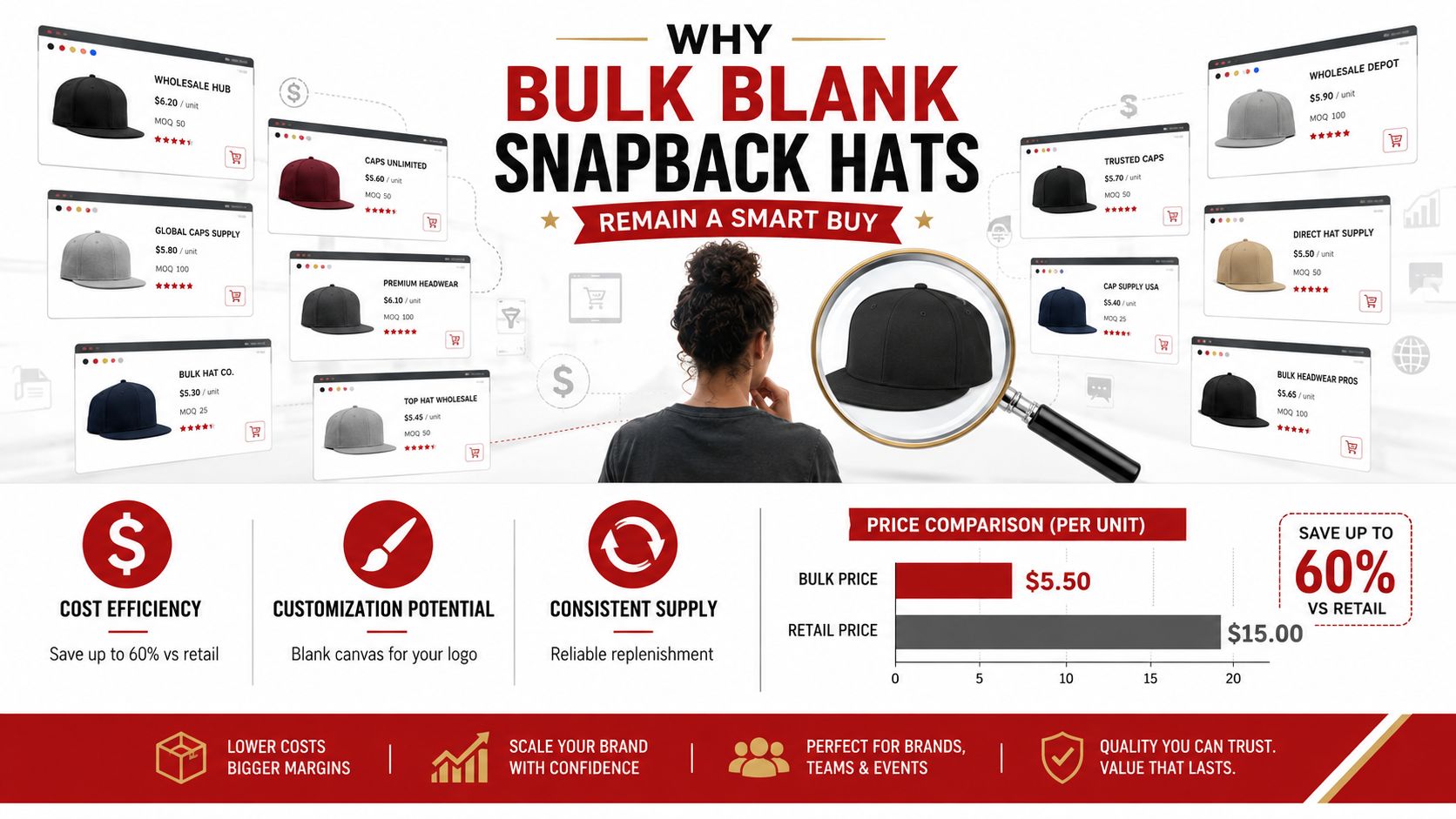
Why Bulk Blank Snapback Hats Remain a Smart Buy
The buyer I keep seeing is the same one every season. It's the small brand owner with a logo already approved, the coach ordering team gear before the first game, or the event planner trying to get something wearable that doesn't look cheap in photos. They open a dozen tabs, see endless “blank bulk hats” listings, and still don't know which one gives them the least risk.
Snapbacks win because they solve the annoying parts of headwear buying. The adjustable plastic snap closure makes sizing easy, the crown gives you a bold branding surface, and the one-size-fits-most format keeps inventory simple. Wholesale search behavior backs that up, with one major marketplace showing over 7,000 results for “blank bulk hats,” which tells you how deep the category runs (CapBargain).
The other reason they stay central is decoration value. In the wholesale blank hat market, customization services account for 68% of total sector revenue, so most buyers aren't just purchasing empty caps, they're buying production input for embroidery, patches, and resale (Alibaba SmartBuy analysis). That's why the best snapback order isn't the prettiest listing, it's the one that gives your decorator the cleanest front panel and your customer the strongest retail look.
A lot of pages try to sell you on price alone. That's a mistake. If your hat doesn't hold stitching, doesn't sit right, or doesn't feel retail-ready, the savings disappear fast.
Practical rule: buy the snapback that gives your logo room to breathe, then worry about color second.
A 12-pack snapback format has been around long enough to prove the model works, and current wholesale listings still show low entry pricing around $3.11 to $3.85 per unit with low or no minimum ordering models in the market (CapBargain). That combination, easy sizing, durable structure, and bulk-friendly order options, is exactly why snapbacks remain the backbone of many headwear programs.
Understanding Snapback Construction and Panel Options
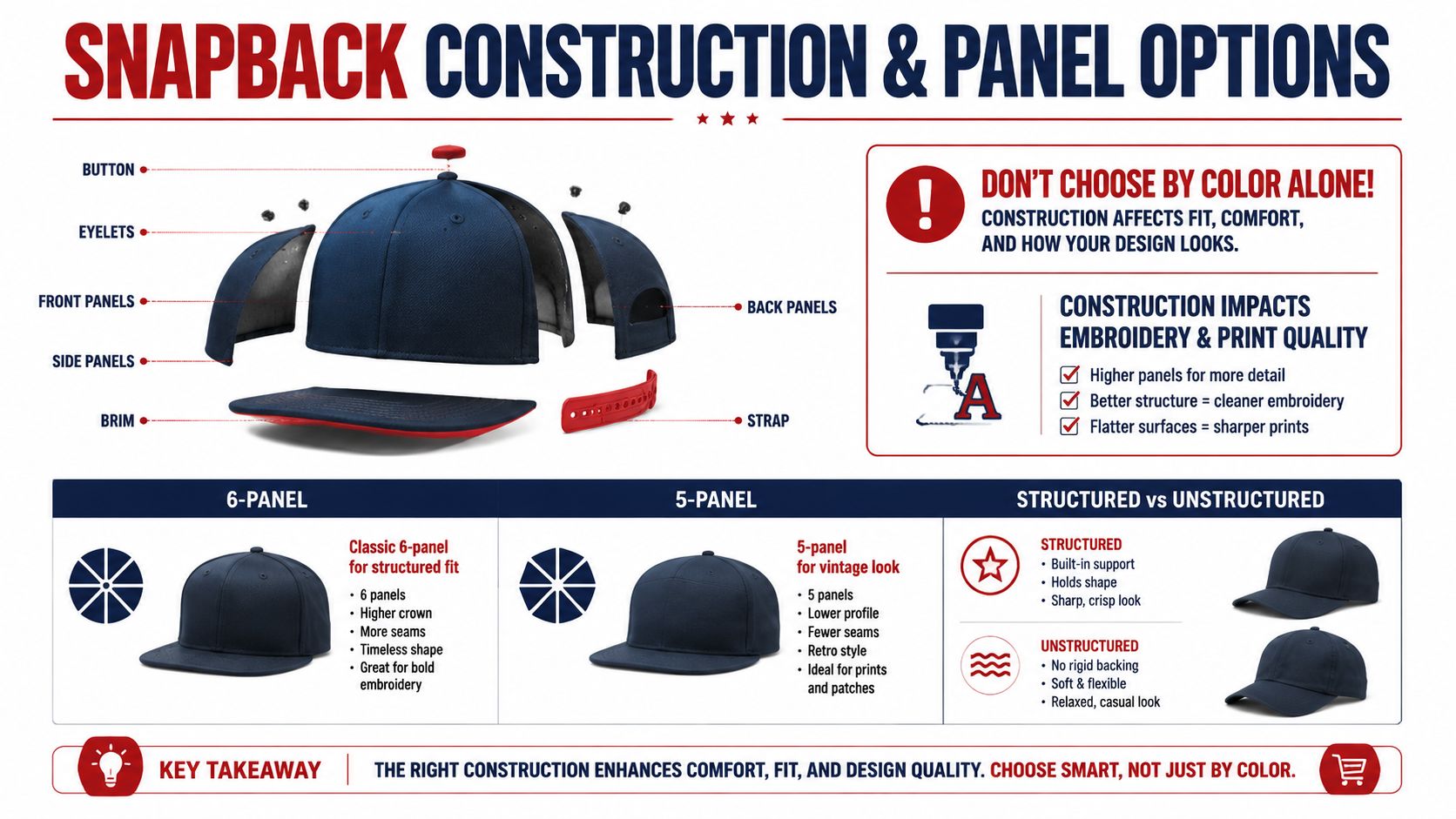
Most buyers pick a hat by color and regret it after the logo arrives. That's backwards. Construction controls decoration quality, and if the crown collapses or the front panel fights the thread, the final piece looks cheaper than it should.
Structured crowns and panel count
A structured crown keeps shape because the front panel has support. For bulk blank snapback hats, that matters more than almost anything else, because embroidery pulls on the fabric as it stitches. A structured 6-panel crown with a stiff front panel behaves like a stretched canvas, it stays flat enough for clean logos and doesn't cave in under thread tension. An unstructured cap is softer and more relaxed, but it's less forgiving when you want crisp decoration.
Panel count changes the front real estate too. A 5-panel snapback usually gives you a cleaner, more uniform front area, which is why it's a strong option for larger graphics and patch work. A 6-panel build is the classic choice when you want a familiar fit and reliable embroidery placement.
Profile and bill shape
Profile changes how the hat sits on the head. Mid-profile caps feel more balanced and easier to sell to mixed audiences, while high-profile caps read more aggressively and trend-forward. Bill shape matters too. Flat-bill styles lean streetwear, while curved bills soften the look and can broaden appeal for teams and mainstream merch.
One representative performance snapback spec lists a 6-panel build, a 58 to 62 cm fit range, a curved visor with 8 rows of stitching, and decoration limits of about 4.8 in × 2 in on the front, with minimum readable text height of 1.5 to 2 mm and minimum line thickness of 4 to 5 mm (Foremost Hat). That tells you exactly where buyers go wrong, thin lettering, tiny details, and overcomplicated artwork don't survive hat decoration as well as they do on flat goods.
Don't force tiny typography onto a hat just because it looked good on screen. Hats punish weak design.
For a cleaner comparison of common panel setups, the simplest rule is this, use 5-panel when the logo needs uninterrupted space, and use 6-panel structured when you want safe, repeatable embroidery results.
The difference between a hat that looks “custom” and one that looks “cheap” often comes down to whether the front panel supports the art. If you're still choosing between a 5-panel and a 6-panel build, the side-by-side breakdown at this 5-panel versus 6-panel guide is worth a look before you place a big order.
Trusted Wholesale Snapback Brands Compared
The brand on the inside label matters because it shapes expectation before anyone even touches the hat. Some buyers want a safe, middle-ground blank that decorators know well. Others want a premium retail name because the brand itself adds perceived value when the hat gets resold.
| Wholesale Snapback Brand Comparison | ||||
|---|---|---|---|---|
| Brand | Price Tier | Best For | Panel Options | Decoration Strength |
| Richardson | Mid-range | Team programs, resale, reliable stock | Structured builds, common wholesale silhouettes | Strong front panels and consistent shape |
| YP Classics / Flexfit | Mid-range | Volume buyers who want dependable blanks | Broad wholesale assortment | Good for repeat embroidery runs |
| New Era | Premium | Merch brands and premium retail positioning | Branded snapback styles | High perceived value, strong retail recognition |
| Nike | Premium | Corporate and sports-facing orders | Select wholesale cap styles | Clean presentation and brand trust |
| Valucap | Budget to mid-range | Schools, events, cost-sensitive bulk orders | Practical wholesale options | Solid for simple logos and volume buys |
| Legacy | Mid-range | Lifestyle brands and resale programs | Varies by style | Good balance of price and retail appeal |
Richardson is the safest answer when you want fewer surprises. It's the kind of brand decorators already know how to handle, and that consistency matters when you're ordering multiple colors or restocking a style. YP Classics and Flexfit sit in a similar practical lane, reliable enough for bulk work without pushing you into premium pricing.
New Era changes the resale equation because buyers recognize the name immediately. If your business model depends on perceived retail value, New Era can justify a higher sticker price better than a generic blank. Nike works for a different kind of buyer, the one who wants the logo association to carry weight in a team or corporate setting.
Valucap and Legacy fill the bulk gap. They're useful when your priority is affordable decoration, not luxury positioning. If the plan is to embroider simple front logos, pack hats into event kits, or stock an e-commerce test run, those brands can make sense fast.
The wrong move is mixing brand tiers inside one line without a reason. A premium brand on one colorway and a budget blank on another can confuse buyers unless the difference is intentional.
Buyers who resell should think in perception, not just unit cost. A customer won't care that you saved money if the cap looks underbuilt or generic on arrival.
Dirt Cheap Headwear fits into that market as a wholesale distributor and custom embroidery shop, which matters if you want blank sourcing and decoration under one roof. For buyers who want to compare blanks, decorate them, and keep the process simple, that combination is more useful than jumping between separate vendors.
Wholesale Pricing and Order Minimums Explained
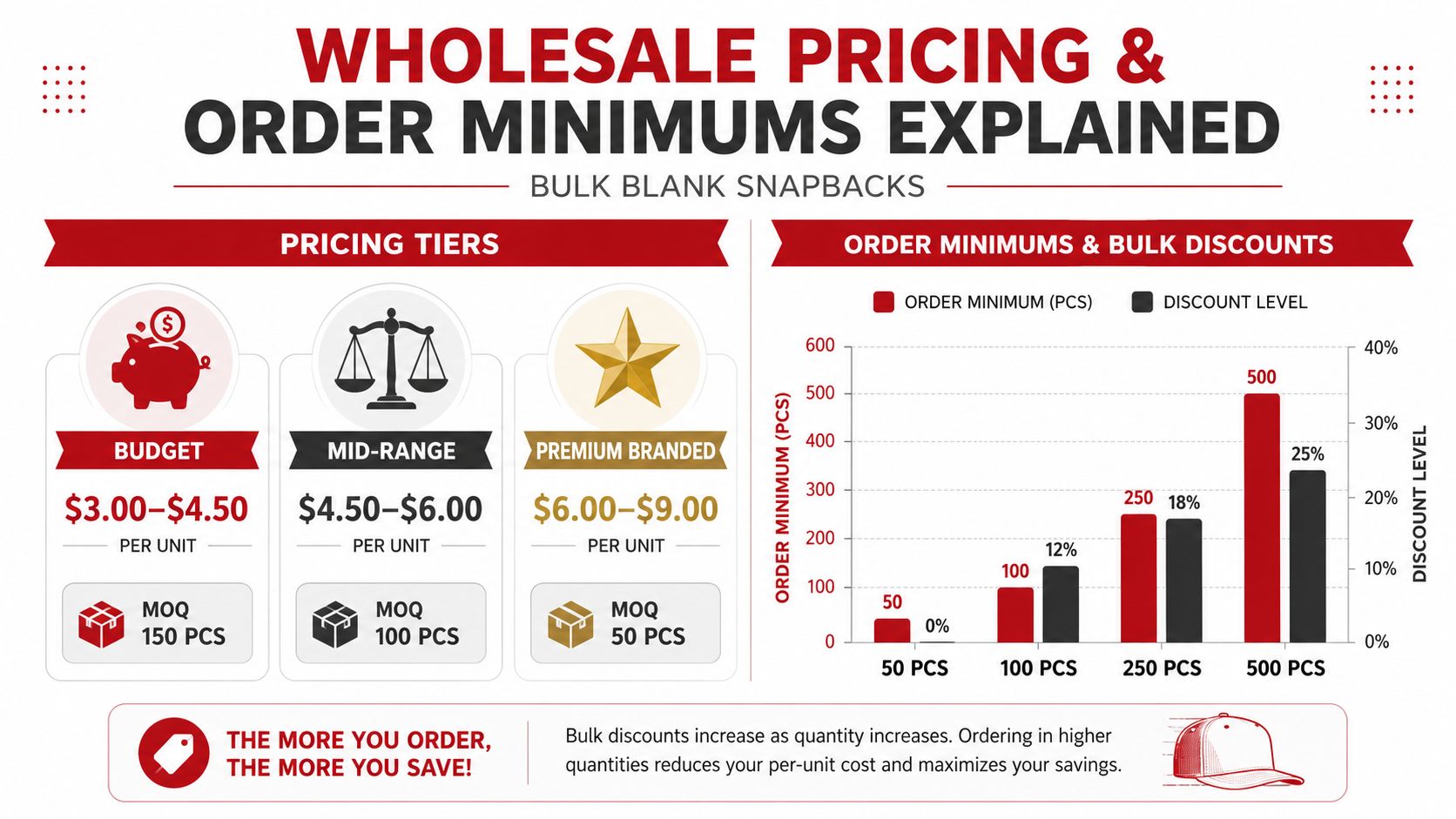
A buyer comparing blank snapbacks has to look past the first quote. Wholesale pricing on these hats usually starts in a low unit-cost range for basic stock, while premium branded options sit higher because the name, presentation, and shelf appeal do part of the selling for you. CapBargain
What order minimums really mean
The market now supports both no-minimum and low-minimum buying, and that helps when you are testing a new cap line. A small run lets you see how the hat wears, how it photographs, and whether the decoration holds up before you commit to a larger stack of inventory. The trade-off is simple, smaller orders leave less room to spread out shipping, decoration, and setup costs.
A lot of buyers get pulled in by a cheap unit price and miss the risk of buying the wrong style in volume. A small test order makes more sense when you are launching a new design, especially if you still need to find out whether the look fits streetwear, team merch, or a short trend cycle. Bulk only works after the style has already shown it can move.
How to think about value
A hat with strong decoration potential can move from blank to branded fast. Your margin depends on more than the blank cost, decoration quality and retail presentation also influence what buyers will pay. Alibaba SmartBuy analysis backs that up by showing how finish, branding, and presentation affect the way wholesale hats perform in the market.
Here is the read I use on every quote. If the supplier gives you low minimums, clear stock visibility, and a proof process that does not create confusion, it is worth testing. If the unit price looks great but the style is inconsistent or the communication is messy, the discount is not real.
- Test first: Order a small batch when you are unsure about fit, finish, or demand.
- Scale second: Move to bulk when sell-through is steady and the style is proven.
- Protect margin: Do not let shipping or remake risk erase the savings on cheap blanks.
Use the custom order form to submit quantities, artwork details, and decoration requirements before you request a quote.
Wholesale snapbacks work because they can serve both ends of the market. A six-piece test can be smart, and a larger restock can be smart too. The bad move is buying deep before you know whether the hat matches your audience.
Decoration Options and What Works Best on Snapbacks
A blank snapback is just inventory until you decide how to finish it. The decoration method should match the cap's structure, the artwork, and the retail price you want to hit. If you pick the wrong method, even a good hat looks underwhelming.
Embroidery and 3D puff
Flat embroidery is the safest default. It works best on structured fronts, especially when the logo has clean outlines and a limited number of colors. Keep text above the minimum readable height, and don't cram ultra-thin strokes into a small area, because thread fills in details fast.
3D puff embroidery gives a raised, premium look, but it needs simpler shapes and thicker line weights. It looks strongest on a structured front panel with enough room for the foam to build volume. If the logo has too much tiny text or sharp detail, puff embroidery starts working against you.
Practical rule: if you need tiny lettering to explain the design, the design is already too complicated for a hat.
Patches, print, and sublimation
Custom patches are the most flexible choice because they can be sewn or heat-pressed onto many hat styles. They're especially useful when the front panel isn't ideal for dense stitching or when you want a more fashion-forward texture. For brands chasing a retail feel, patches often give you more visual impact than simple thread alone.
Screen printing can work for flatter, simpler artwork, but it's not as forgiving as embroidery on textured headwear. Sublimation belongs on blanks made for that process, especially when you need all-over graphics or specific performance-fabric applications. It's a tool for the right blank, not a universal solution.
The construction you chose earlier matters here. A structured 6-panel snapback supports embroidery well, while a 5-panel front can be better when you want a large patch or a cleaner print zone. That's why buyers who skip construction details usually spend more fixing decoration problems later.
If you want a practical reference for stitch setup, logo limits, and hat embroidery workflow, the snapback embroidery guide is the sort of checklist I'd use before approving artwork. It's the same logic every time, simplify the art, respect the fabric, and choose the decoration method the cap can carry.
How to Evaluate Suppliers and Place Confident Orders
The supplier matters more than the photo grid. A perfect cap from a slow or sloppy vendor is still a bad purchase, because wholesale headwear lives or dies on proof accuracy, stock reliability, and communication speed. I'd take a decent hat from a responsive supplier over a great-looking listing from someone who ghosts after the quote.
Start with samples and proofs
Order samples first if the style is new to you. That's the fastest way to check crown shape, panel feel, snap quality, and whether the front panel takes decoration cleanly. Then ask for a digital proof before production, because most mistakes on hats start with artwork placement, not fabric choice.
Check the boring stuff that saves money
Stock notifications matter when you need repeatability. If a supplier can't tell you when a colorway is back in inventory, they're not ready for serious reorders. Reviews and photo galleries help too, but I care more about whether the seller answers clearly during business hours than whether the website looks polished.
Low minimums are a useful risk filter. If a supplier lets you test with a small logo run, you can compare quality before committing to a larger restock. That's the point, reduce the chance of ending up with boxes of hats you won't use.
Use this checklist before you approve any order:
- Verify reliability: Check reviews, response quality, and how clearly the supplier explains lead times.
- Request samples: Judge fit, structure, and decoration behavior in hand.
- Compare pricing: Look at the full landed cost, not just the headline unit price.
- Check communication: See whether they answer fast and make corrections without confusion.
- Review contracts: Watch for hidden fees, unclear minimums, and vague shipping terms.
The safest suppliers give you a clean path from quote to proof to production. If the process feels chaotic before you've paid, it'll feel worse after.
Recommended Snapback Styles by Use Case
Sports teams need a different hat than streetwear brands, and event planners need a different order structure than resellers. Matching the style to the job is how you avoid paying premium money for the wrong silhouette.
For sports teams and leagues, I'd stick with a structured 6-panel snapback in team colors. Richardson or YP Classics work well here because they're dependable wholesale choices, and a straightforward embroidered logo keeps the look clean. Order enough to cover players, coaches, and a few extras, then decorate with flat embroidery.
For apparel brands and merch creators, go with a 5-panel or structured premium snapback if the front graphic is the hero. New Era gives you stronger perceived retail value, while Legacy can work when you want a more accessible wholesale path. Use patches or 3D puff when you want the cap to feel like a product, not just a giveaway.
For event planners, schools, and nonprofits, the right answer is usually a budget-to-mid-range structured snapback from Valucap or YP Classics. These projects care about consistency, not hype. Keep the art simple, use flat embroidery, and avoid overcomplicated front designs that slow production.
For resellers and decorators, I'd buy the style that photographs well, holds embroidery cleanly, and restocks reliably. That usually means a structured blank with a mid profile and a front panel that doesn't fight decoration. If you're testing a new color or trend, start small, then scale only after you see repeat demand.
The best bulk order is the one that matches how the hat will be sold, worn, and reordered, not just how it looks in the supplier's thumbnail.
If you need blank sourcing plus decoration in one place, Dirt Cheap Headwear handles wholesale headwear, embroidery, low minimums, and custom order intake without making you chase five different vendors. If you're ready to compare options and place an order that fits your use case, visit Dirt Cheap Headwear and start with the styles that make sense for your logo, your budget, and the way you plan to sell the finished hats.