
Cost Per Unit Calculation: A Guide for Custom Headwear
You get a quote for custom hats, divide it by the quantity, and think you've got your number. Then you sell a small run, reorder a bigger batch later, and realize the margins made no sense on the first order.
That's the trap.
In custom headwear, especially embroidered work, the invoice price per piece and your real cost per unit are often two different numbers. The gap gets wider on low-minimum orders. A six-piece run, a twelve-piece test drop, and a five-hundred-piece reorder can all use the same hat and the same logo, but the economics are completely different because setup gets spread across a very different number of units.
A lot of generic guides miss that. They give you the formula, but they treat decoration like a flat add-on. In a real shop, machine prep, file setup, thread changes, proofing, packing, and rework don't care whether you ordered a handful of hats or a pallet. Those costs show up either way. If you don't amortize them correctly, you underprice small runs and misread what your profitable volume is.
Why Your Price Per Hat Is Not Your True Cost
You quote 12 hats for a test drop, divide the invoice by 12, and the margin looks fine. Then the reorder comes in at 500 pieces and the economics look completely different, even though the logo, the hat, and the decoration method stayed the same. That gap usually comes from setup costs that were sitting in the job the whole time.
Cost per unit calculation still starts with a simple formula: Total production cost / Total units produced. The formula is not the problem. The mistake is treating setup, prep, and waste like they belong outside the job just because they are harder to assign.
In a headwear shop, the quoted price per hat is usually a vendor number. Your true unit cost is an operations number. It needs to include every cost required to get from blank cap to sellable finished piece.
Practical rule: If the order required work before the first approved hat was produced, include that work in unit cost.
That matters most on small runs. A six-piece minimum, a 12-piece sample order, and a 500-piece production order can all use the same blank and the same logo, but the fixed setup gets spread very differently. On the six-piece order, digitizing, machine prep, thread loading, test stitching, and inspection can distort your per-unit cost fast. If you are still sourcing blanks, buying blank hats in bulk can improve your numbers, but it does not remove the setup burden on decorated small batches.
Here is the simple version I use in the shop. If setup on a logo costs $60 and the blank plus run cost is $8 per hat, a 12-piece order lands at ($60 + $96) / 12 = $13 per hat. The same job at 500 pieces lands at ($60 + $4,000) / 500 = $8.12 per hat. The hat did not get cheaper to embroider one piece at a time. You just amortized the fixed work across more units.
A common mistake is treating setup as a one-time admin fee instead of part of cost of goods sold. That usually leads to underpricing test runs, misreading break-even, and setting a markup that only works on larger reorders. Wall Street Prep explains the average cost logic clearly in its average cost discussion. The same logic applies directly to decorated headwear.
The other trap is assuming the invoice shows every production cost clearly. It usually does not. Rejects, extra packing time, thread changes, proof revisions, and small-run handling often sit outside the clean per-piece number. Shops that get better at optimizing your cost structure usually start by separating fixed setup from variable per-unit production instead of blending everything into one vague hat price.
If you skip that step, small-batch orders look healthier than they are. That is where profit leaks out first.
The Anatomy of Your Headwear Costs
A 6-piece order and a 500-piece order can use the same logo, the same machine, and the same shop. They do not carry the same cost per hat. Small batches get distorted because the setup work barely changes, but you have far fewer units to spread it across.
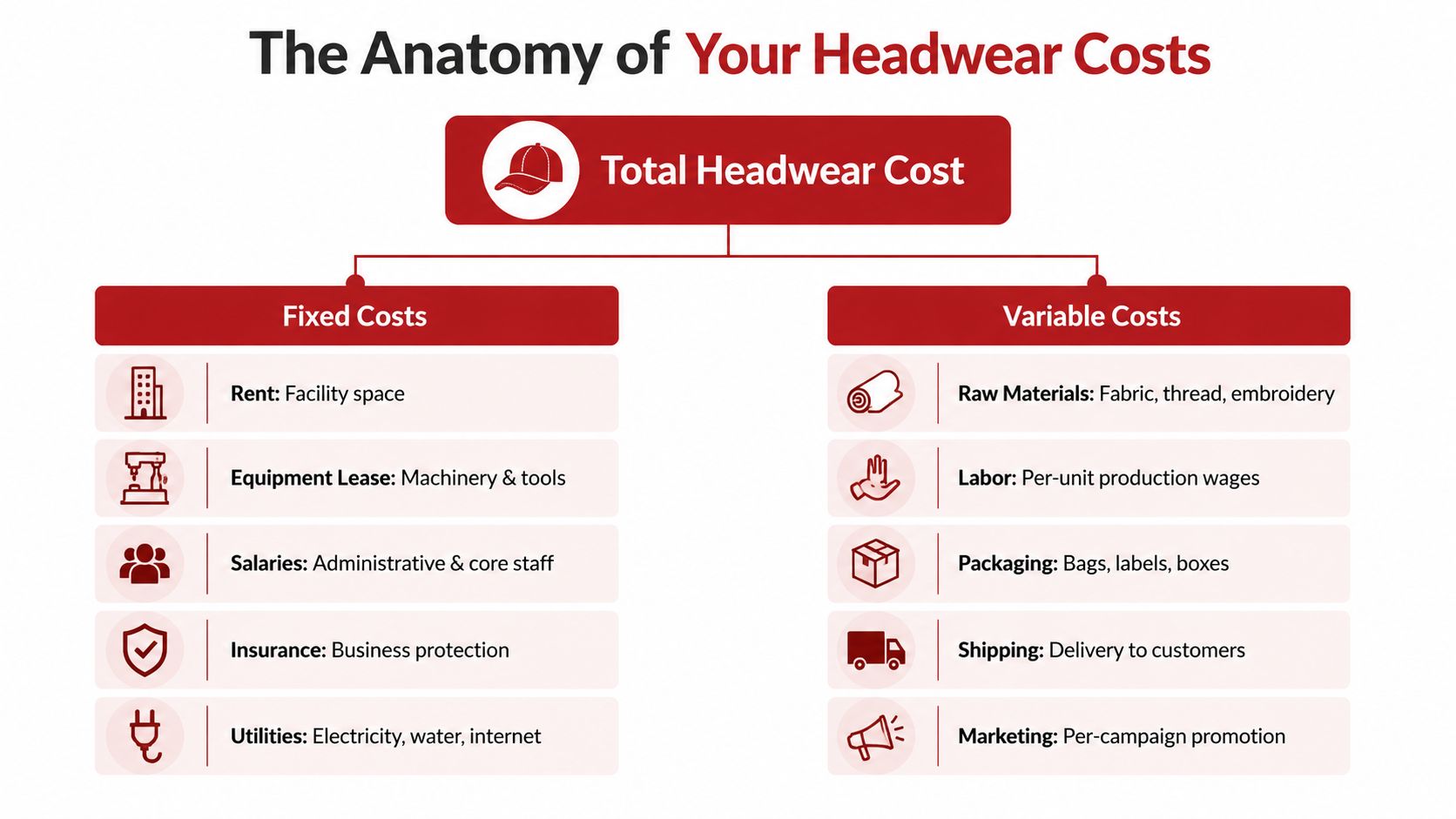
That is why I split every headwear job into two buckets before I quote it. Fixed costs sit at the job level. Variable costs rise with each hat. If those get blended into one vague line item, low-minimum orders look healthier than they are.
Fixed costs that hit the job before the first finished hat
Fixed costs do not disappear just because the customer only wants a dozen caps.
In a headwear shop, that usually includes:
Digitizing and art prep
A logo has to be cleaned up and converted for embroidery before production starts.Machine setup
Hoop selection, thread loading, needle checks, placement testing, and first-run adjustments all take time whether the order is 6 pieces or 500.Order handling
Proofs, approvals, job tickets, and customer communication are paid labor. Shops often forget to assign that time to the order.Allocated overhead
Rent, software, equipment payments, insurance, maintenance, and salaried support labor still have to be covered. If you need a clearer way to separate those expenses, this guide to optimizing your cost structure is useful.
The practical point is simple. A small run does not get a small setup. It gets the same setup spread across fewer hats.
Variable costs that rise with quantity
Variable costs move with the unit count, so they are easier to spot on a worksheet or supplier invoice.
| Cost type | What to include |
|---|---|
| Blank headwear | The cap, beanie, visor, or bucket hat |
| Decoration materials | Thread, backing, patches, labels |
| Direct labor | Running the job, trimming, finishing, packing |
| Packaging | Poly bags, size stickers, inserts, cartons |
| Unit-level freight | Inbound freight on blanks and any fulfillment cost assigned per hat |
If you buy better blanks, your per-unit cost changes immediately. If you buy smarter, it can improve margin without touching your decoration price. This guide on buying blank hats in bulk helps with that side of the equation.
Packaging and waste belong here too. Apparel costing guidance from Sewport's clothing cost breakdown makes the same point you see in headwear every day. Small line items add up fast when the order is short.
The cost category new brands miss first
Indirect production costs are where profit usually leaks out on small batches.
Electricity, machine maintenance, shop supplies, bobbins, backing waste, extra handling, and support labor rarely show up as clean per-piece charges. They still support the job. If you leave them out, your quote can win the order and still underperform.
Keep fixed setup separate from per-unit production. That one habit gives you a much cleaner view of what a 12-piece run costs versus a 500-piece reorder.
The Simple Formula for Cost Per Unit Calculation
Here's the formula most shops need:
Cost per unit = (Total fixed costs + Total variable costs) / Total units produced
That's it. The value comes from using it correctly.
What each part means
Total fixed costs are the one-time or recurring costs that don't change much with order size. In headwear, think setup, prep, and overhead allocation.
Total variable costs are the costs that rise with each hat. Blanks, thread, direct labor, packaging, and unit-level freight usually land here.
Total units produced means the actual number of units carrying those costs. If scrap or rework eats pieces, your good units have to absorb the wasted spend. Tractian notes that scraps and rework raise final unit cost because they increase total manufacturing cost without increasing quality output in the denominator in its average manufacturing cost explanation.
Why this formula matters on embroidery work
The formula forces you to amortize setup correctly. That's the part generic calculators gloss over.
A setup-heavy order can look expensive until you spread those fixed costs across more units. The reverse is also true. A small run can look cheap until you stop hiding setup inside a vague “shop charge” and assign it per hat.
If you can't explain where setup went, it probably disappeared into your margin.
For pricing later, you'll also want your COGS method to stay consistent across reorders. If you need a plain-English refresher on inventory methods for COGS, review that before you start comparing old jobs to new ones.
Cost Per Unit in Action Worked Examples
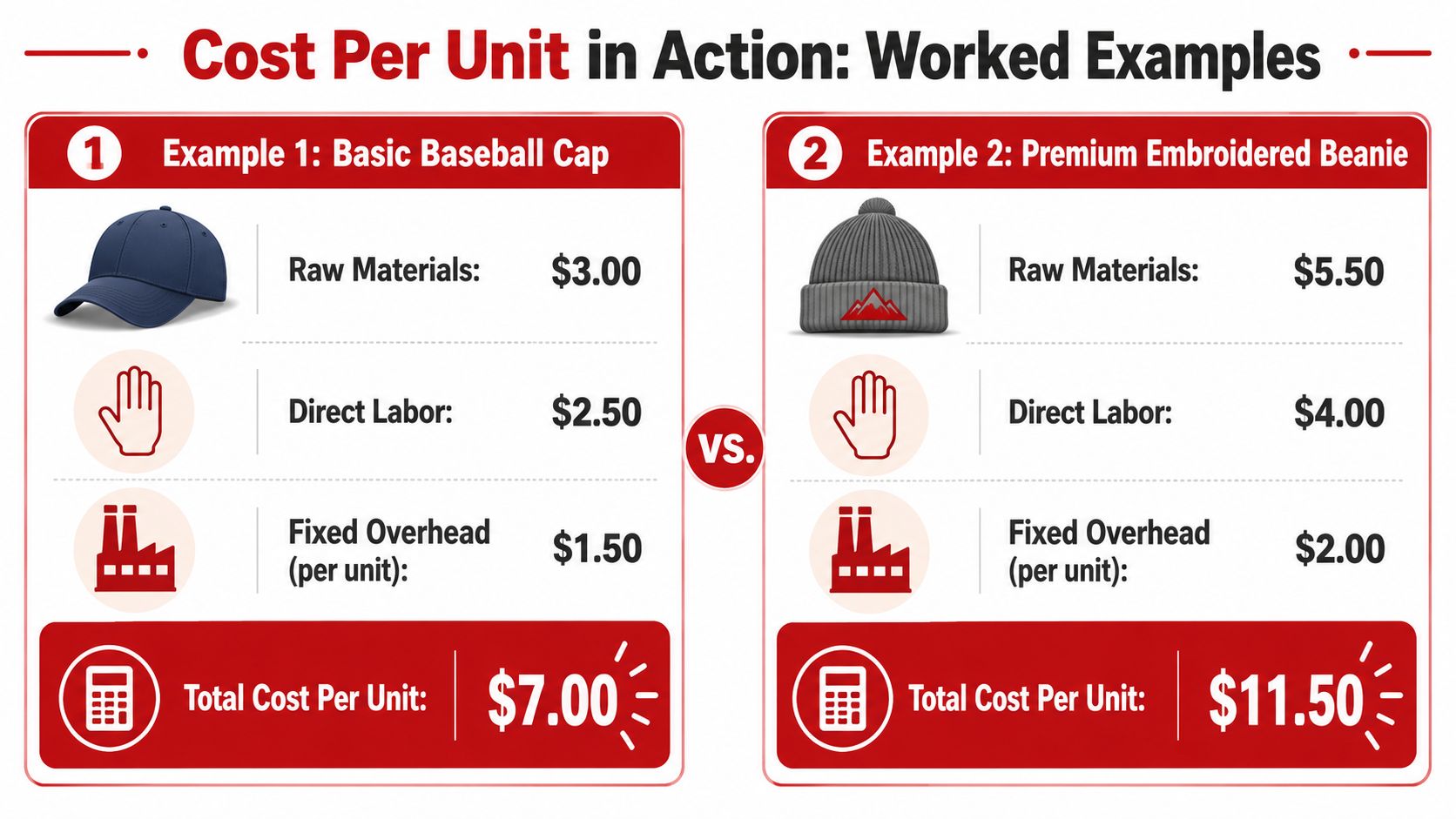
A 12-piece test run and a 500-piece order can use the same hat, the same logo, and the same machine, yet produce two very different unit costs. That gap trips up new brands all the time.
The reason is simple. Small batches carry setup badly.
Example one with a small run
Say a brand orders 12 embroidered trucker caps to test a design.
Here is a realistic job-cost breakdown:
| Cost component | 12-piece run |
|---|---|
| Digitizing and art prep | $35 |
| Machine setup and test sew-out | $25 |
| Hat blanks at $6.00 each | $72 |
| Thread, backing, and direct run labor at $2.50 each | $30 |
| Packing and order handling | $18 |
| Total job cost | $180 |
| Cost per unit | $15.00 |
The blank only costs $6.00, so a new brand may expect the finished hat to land somewhere around $8 to $10. That is where small-batch distortion shows up. The one-time work takes $78 before the order is even properly running. On a 12-piece job, that setup burden adds $6.50 per hat by itself.
That is why a low-minimum order, especially one close to Dirt Cheap Headwear's six-piece minimum, needs to be quoted as a setup-heavy job instead of a scaled-down bulk order.
If one cap gets damaged during production and only 11 good units ship, the math gets worse:
- Total job cost stays $180
- Good units shipped drop to 11
- True cost per shipped hat becomes $16.36
That is the part generic unit-cost guides usually skip. In a small run, one mistake has teeth.
Example two with a larger order
Now run the same logo on 500 caps.
The setup steps are still there. The machine still needs to be prepped. The design still needs to be loaded and tested. But those costs get spread across many more hats.
A simple example looks like this:
| Cost component | 500-piece run |
|---|---|
| Digitizing and art prep | $35 |
| Machine setup and test sew-out | $25 |
| Hat blanks at $4.60 each | $2,300 |
| Thread, backing, and direct run labor at $1.80 each | $900 |
| Packing and order handling | $250 |
| Total job cost | $3,510 |
| Cost per unit | $7.02 |
Same decoration style. Very different economics.
On the 500-piece order, the same $60 in prep and setup adds only $0.12 per hat. On the 12-piece order, it added $5.00 per hat before digitizing. That is the distortion.
A manufacturer cost accounting overview from AccountingTools on average cost per unit explains the same principle in plain terms. Fixed costs become less significant per unit as volume rises. In embroidery, that principle shows up fast because setup happens before the first sellable hat is produced.
Large orders do not remove setup cost. They spread it thin enough that it stops dominating the quote.
Here is the side-by-side takeaway:
- 12-piece run: setup and handling are a large share of unit cost
- 500-piece run: blanks and run labor matter more than setup
- Result: unit cost drops because fixed prep is amortized across more good units
A video walkthrough can help if you prefer seeing the thinking in action.
What shops should do with this information
I quote small orders by asking one question first. How much non-repeatable work is this order forcing each hat to carry?
That changes the number fast.
A 12-piece order usually has more approval risk, more handling time per unit, and less room to absorb spoilage than a 500-piece order. If a brand wants low minimums, that can make sense. It is a useful way to test demand. But the unit cost will look high unless setup is allocated accurately.
If you want a practical benchmark for quoting stitched caps, this guide to machine embroidery pricing pairs well with your own costing sheet.
The lesson behind both examples
The formula stays the same. The order size changes how hard setup hits each unit.
That is why brands often hate the margin on a first 12-piece run, then like the numbers on a reorder. The design did not suddenly become profitable. The fixed prep finally had enough units to sit on.
From Cost to Price Setting Your Markup for Profit
A lot of new brands get tripped up here. They finally calculate a unit cost, add a standard markup, and assume the quote is safe. On hats, that can still leave you underpriced, especially on a 6-piece or 12-piece order where setup time is carrying too much weight per unit.

Price has to cover more than the stitched hat. It has to cover quoting time, approvals, production risk, overhead, payment fees, and enough profit to make the job worth running.
That matters more on small batches.
If a 12-piece order costs you $14 per hat and you sell it for $18, the math may look fine at first glance. Then a revision email, one spoiled cap, and a few dollars in packaging or freight wipe out the margin. On a 500-piece order, those same fixed headaches get spread across enough units that your markup goes further.
Start with cost-plus, then stress-test it
Cost-plus is a solid starting point. It gives a floor.
But I would not use one blanket multiplier for every headwear job. A clean front logo on a stock cap is one kind of work. A rush order with puff embroidery, side hit placement, and hand trimming is another. If both get the same markup, the harder job usually steals your profit.
A better habit is to ask two questions before setting price:
- How much fixed setup is each hat carrying?
- How much extra production time does this decoration add?
Those two numbers explain why a low-minimum order often needs a higher markup than a larger reorder of the same design.
Small-batch orders need a different markup logic
Generic pricing advice usually misses this. It treats markup like a flat rule.
In a shop, small-batch pricing works differently because fixed setup does not shrink just because the customer ordered fewer hats. Digitizing, machine setup, test sew-out, thread changes, art approvals, and operator handling still happen. Dirt Cheap Headwear's 6-piece minimum is a good example of where brands need to be realistic. The order is possible, but each unit has to carry a heavier share of setup.
Here is the practical trade-off:
- First small run often needs a stronger markup because setup is expensive per unit
- Repeat order can often take a lower markup because the artwork, approvals, and machine prep are easier to reuse
- Large batch may support a more competitive per-unit price because fixed cost is spread across many more sellable hats
That is how you protect margin without overpricing every job the same way.
Add time-based pricing where the stitch work gets harder
Some jobs should be priced by effort, not just by blank cost plus a standard margin.
If the logo runs clean and fast, standard costing is usually enough. If the design slows the machine down or adds handling steps, build that time into the price. Otherwise the customer pays for a simple hat while you produce a difficult one.
Use time-based pricing when you see work like this:
Front flat embroidery with one thread color
Usually easy to quote with standard unit costing3D puff embroidery
Slower run speed, more cleanup, more chance of adjustmentPatch application or multi-location decoration
More touches, more alignment time, more labor risk
I have seen plenty of shops make money on the blank and lose it on the labor because they priced the decoration like it was routine.
Price the delivered order, not just the hat
Freight and fulfillment can turn an acceptable margin into a thin one fast. That is why delivered pricing matters, especially on small runs where shipping can add a noticeable amount to each unit.
Build packaging and freight into the quote early. If you need a planning reference, use a guide for shipping cost estimation before you lock in final pricing.
A practical way to set markup
Set your markup after you answer these four questions:
- Is this a first run with full setup burden, or a reorder with lower prep cost?
- Is the decoration routine, or does it add real machine time and handling?
- How much spoilage or approval risk is reasonable on this job?
- Does the customer's market support the final selling price?
A school fundraiser, a streetwear drop, and a corporate promo order can use the same cap and still justify very different pricing.
Good markup is not about copying a standard multiple. It is about charging enough to cover the specific job in front of you, with special attention to how badly small-batch setup can distort unit economics.
Common Mistakes That Inflate Your Hat Costs
Bad headwear pricing usually comes from omission, not bad math. Shops get in trouble when they quote a 12-piece run like a 500-piece order and spread setup too thin.
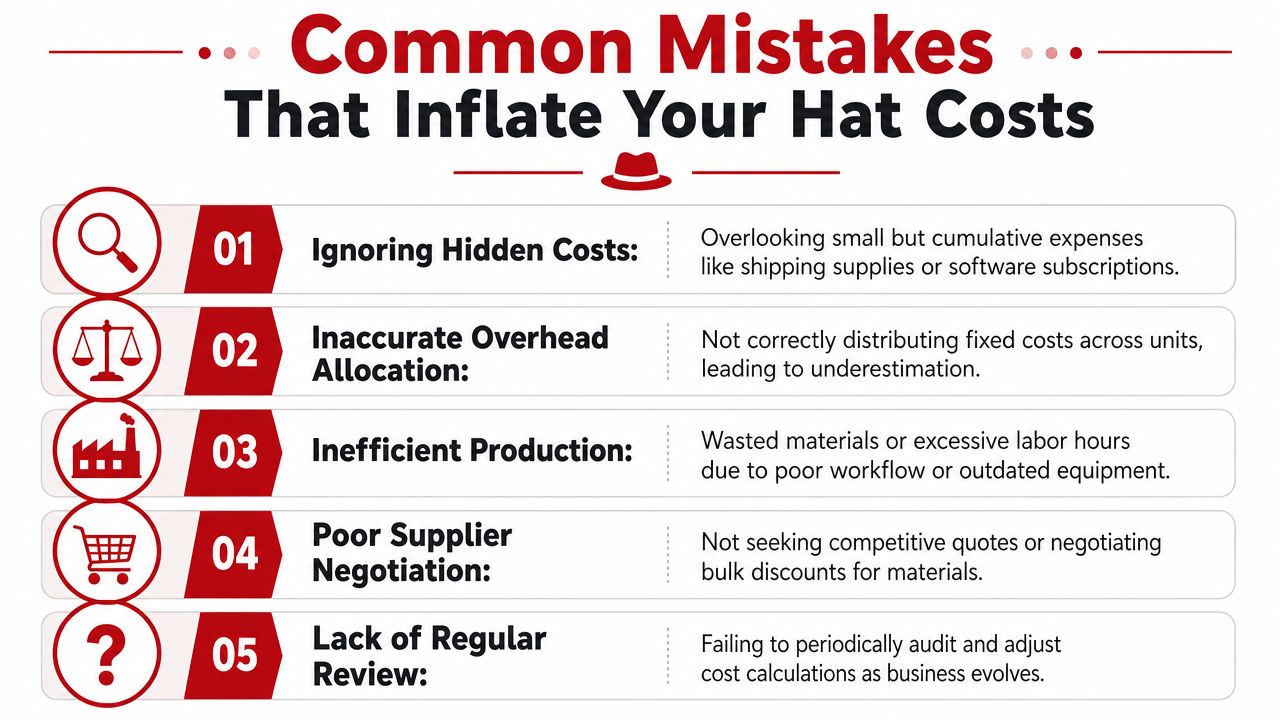
A small batch exposes every shortcut in your costing. Digitizing, machine setup, proofing, thread changes, hooping, and cleanup still happen whether you run 6 hats or 600. On a low-minimum order, those fixed costs are doing the heavy lifting. If you fail to amortize them across the actual quantity, the quote looks competitive and the job underpays the shop.
Mistakes that show up all the time
Ignoring overhead on decorated jobs
Rent, admin time, machine maintenance, software, utilities, and supervision do not disappear because the order is small. If the job ties up a machine, someone has to pay for that time.Treating setup like a courtesy instead of a cost
Setup is real work. A six-piece order with one logo can carry almost the same prep burden as a 48-piece order. If you waive setup without building it into the unit price or charging it separately, the small batch gets distorted fast.Using one template for first runs and reorders
A first run often includes approval time, file prep, test stitching, and more communication. A reorder usually does not. If both quotes use the same assumptions, one of them is wrong.Forgetting inbound and outbound shipping
Blank hats have to get to your shop. Finished hats have to get to the customer. On a larger order, freight gets spread across more units. On a short run, it can add a noticeable amount per hat.Leaving out spoilage and rework
Caps get mis-stitched. Placements need adjustment. A patch can go on crooked. Good units end up carrying the cost of the bad ones.
What works better is simple. Track fixed setup, variable unit cost, labor, packaging, and overhead on separate lines. Then divide fixed costs by the actual order quantity, not the quantity you hope the customer will order later.
I also recommend keeping small-batch quotes and volume quotes in different templates. A 12-piece test run, a 72-piece team order, and a 500-piece reorder should not be forced through the same logic. They do not behave the same way.
The cleanest pricing systems are the ones that make you count every touch on the job.
Review estimates after production. If the order took more approvals, more machine time, or more hand packing than planned, update the numbers before the next quote.
One rule matters more than the spreadsheet. Do not chase a low per-piece number on a small batch if the total job dollars are weak. That is how a shop stays busy and still loses margin.
If you need blank hats, low-minimum custom embroidery, or help pricing a small test run versus a larger reorder, Dirt Cheap Headwear makes the process easier. You can source wholesale blanks, decorate as few as six pieces per logo, and get consistent support whether you're launching a brand, outfitting a team, or scaling an existing headwear program.