
You quote a hat order, pack it, print the label, and feel good about the margin. Then the carrier invoice lands a few days later and the math changes. The box was bigger than your estimate, a residential surcharge got added, and the shipment rated on dimensional weight instead of what the scale showed.
That cycle is common in headwear. Hats don't weigh much, but they eat up space fast. A carton full of caps can look harmless on a scale and still bill like a much heavier shipment because the carrier is charging for the room that box takes up in the truck.
That's why shipping cost estimation matters so much in this business. If you sell tees, mugs, or flat goods, you still need solid shipping logic. If you sell hats, you need it even more. The shape, crown height, brim protection, and packaging method all change your billed weight, your damage risk, and your margin.
Why Shipping Costs Can Make or Break Your Hat Business
A lot of hat businesses learn the same lesson the hard way. The first bulk order feels profitable on paper. The products are sourced correctly, decoration is dialed in, and the customer is happy. Then shipping wipes out the cushion you thought you had.
That happens because hats sit in an awkward category. They're usually lightweight but bulky, especially structured caps, truckers, and anything packed to hold shape. Generic calculators tend to reward people who think in pounds only. Carriers don't.
Hats create expensive empty space
A carton of headwear often ships more air than weight. You're paying to move volume, not just product mass. That makes casual quoting dangerous.
If you guess from memory, you usually miss in one of two directions:
- Too low: you win the order, then lose margin when the invoice rates higher than expected.
- Too high: you protect margin, but your quote looks inflated next to a competitor who's using better packaging rules.
- Too simple: you use one flat shipping number for every hat style, even though a floppy dad hat and a structured trucker cap don't pack the same way.
Practical rule: If your product can crush, deform, or require void fill to protect its shape, your shipping estimate needs to be built around package dimensions first.
Shipping also stopped being a quiet back-office line item a while ago. Global logistics swings now reach all the way into pricing and demand. The CEPR analysis of shipping costs and inflation found that the doubling of global shipping costs during 2021 translated into roughly a 0.7 percentage-point increase in headline CPI inflation worldwide, and the actual spike added approximately 2 percentage points to global inflation in 2022 alone.
Pricing breaks when shipping is treated as an afterthought
That matters for hat sellers because freight volatility doesn't stay in the freight department. It affects product pricing, minimums, wholesale terms, and which jobs are worth taking. If your pricing model assumes shipping is stable, your margin can disappear without any obvious production mistake.
A lot of owners spend hours tuning decoration pricing and almost no time tuning outbound freight logic. That's backwards. Good margin protection usually starts with packaging rules, billed weight rules, and a clear customer-facing shipping model. If you're revisiting your broader markup structure, these effective product pricing strategies are a useful companion to freight planning because product price and shipping policy have to work together.
The blunt version is this. In headwear, bad shipping cost estimation doesn't just create occasional mistakes. It trains you to quote the wrong jobs, undercharge the wrong customers, and trust numbers that won't hold once invoices close.
Mastering Measurement and Dimensional Weight
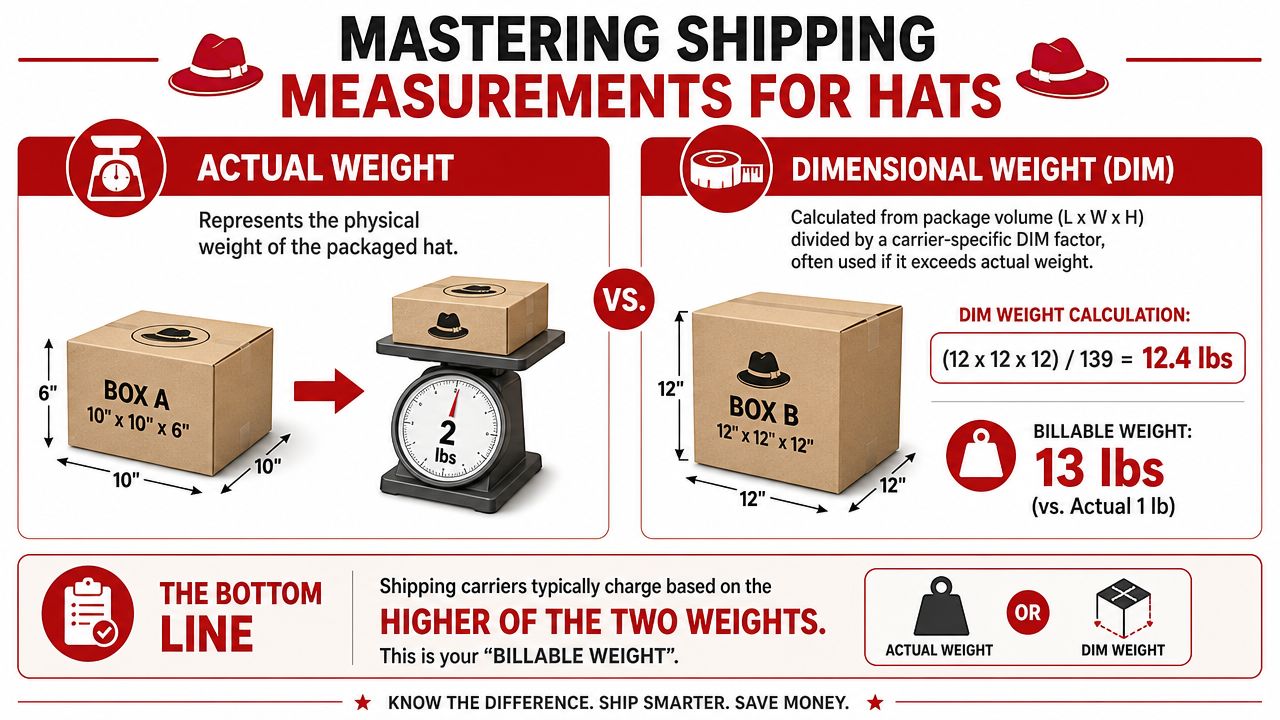
If you sell hats and you don't know your billed weight, you're guessing. That's the number the carrier charges on. For parcel shipments, billed weight is typically the higher of actual weight or dimensional weight.
Actual weight versus dimensional weight
Actual weight is easy. Put the sealed package on a scale and read the number.
Dimensional weight is where hat sellers get burned. Carriers generally calculate it as:
length × width × height ÷ divisor
The divisor varies by carrier. The verified benchmark used in parcel operations is 139 for USPS commercial historically and 166 for many FedEx and UPS standard accounts, as outlined in this Sendcloud guide to estimating shipping costs.
Consider it this way:
- A box of bricks is heavy for its size.
- A box of hats is often the opposite.
- The hat box may cost more to move than you'd expect because it occupies more cubic space in the network.
How to measure a hat carton correctly
Most mistakes start before anyone touches a rate table. People measure the product, not the packed carton. Carriers bill the carton.
Use a simple process:
Pack the order the way you'll ship it
Include tissue, inserts, poly bags, dividers, patch protection, and tape. A “close enough” mock-up creates bad rate logic.Measure the outside of the sealed box
Record length, width, and height at the longest points. If the box bulges, measure the bulge.Round according to carrier practice
Carriers don't reward wishful fractions. Use the dimensions you'd be comfortable defending on an audit.Weigh the full package
Don't forget the box itself. Headwear shipments can swing meaningfully once corrugate and packing material are included.Calculate DIM weight and compare it to scale weight
The higher number is your likely billed weight.
A hat shipment that “only weighs a couple pounds” can still rate much higher if the carton is oversized.
Why this matters so much in headwear
Structured caps, rope hats, foam truckers, and multi-style mixed orders rarely pack into neat, dense cubes. That's why headwear sellers can't rely on SKU weight alone.
The same Sendcloud benchmark notes that when vendors use only actual weight and ignore DIM rules, 18 to 22% of parcels are under-priced at checkout, leading to average margin erosion of 9 to 14% on low-density items like apparel and headwear in the cited data. That's not a rounding issue. That's a pricing system problem.
A better working method looks like this:
- Map your common box sizes instead of improvising every order
- Assign likely box size by order type such as single hats, small logo runs, and full-case replenishment
- Calculate billed weight by lane rather than using one national average
- Review invoices against quotes so your rules improve over time
Once you know how the carton will bill, your shipping cost estimation stops being guesswork and starts becoming repeatable.
Sample Shipping Calculations for Hat Orders
The math becomes practical. Headwear businesses don't need abstract advice. They need a repeatable way to estimate what a likely order will bill at before the order ships.
The three examples below use common hat-order patterns: a small decorated test run, a standard business order, and a larger event order. These are illustrative examples meant to show the method, not carrier quotes. The point is to calculate billed weight, then use that number in your own carrier tables or software.
Example one with a small custom run
A customer orders 12 embroidered hats. You want the crowns protected, so you use a compact carton instead of a mailer.
Let's say the packed box measures 16 × 12 × 10 and the actual packed weight is 4 lbs.
Using a divisor of 139:
- DIM weight = 16 × 12 × 10 ÷ 139
- DIM weight = 1920 ÷ 139
- DIM weight = 13.8 lbs
The billed weight is the higher number, so you'd rate this shipment at 14 lbs if your carrier rounds up.
That's the kind of order people routinely underquote when they only look at the scale.
Example two with a standard wholesale case
A local company orders 72 trucker hats. These take up more room because of crown shape and brims, so the carton gets bigger fast.
Assume a box size of 24 × 20 × 16 with an actual weight of 18 lbs.
- DIM weight = 24 × 20 × 16 ÷ 139
- DIM weight = 7680 ÷ 139
- DIM weight = 55.3 lbs
Your billed weight becomes 56 lbs.
That gap is why bulky item logic matters so much. If you want a broader consumer-friendly breakdown of packaging effects, these tips for bulky item delivery charges are worth reading. For wholesale buyers planning bigger orders, it also helps to understand how case quantities affect sourcing and packing, especially when you buy blank hats in bulk.
Example three with a larger event order
Now take 288 beanies for an event. Beanies are softer and generally pack denser than structured caps, so the relationship between actual and dimensional weight changes.
Say you split the shipment into a larger carton with dimensions 24 × 24 × 20 and the packed actual weight is 30 lbs.
- DIM weight = 24 × 24 × 20 ÷ 139
- DIM weight = 11520 ÷ 139
- DIM weight = 82.9 lbs
The billed weight becomes 83 lbs.
Even with a denser item like beanies, carton size still drives the number.
Sample billed weight calculations for hat orders
| Order Size (Hats) | Box Dimensions (in) | Actual Weight (lbs) | Dimensional Weight (lbs) | Billed Weight (lbs) |
|---|---|---|---|---|
| 12 | 16 × 12 × 10 | 4 | 13.8 | 14 |
| 72 | 24 × 20 × 16 | 18 | 55.3 | 56 |
| 288 | 24 × 24 × 20 | 30 | 82.9 | 83 |
What these examples tell you
The key lesson isn't that every 72-hat order bills the same way. It won't. Hat style, insert use, decoration method, and carton choice all matter.
The lesson is that you need a house method. Build sample packs for your top order sizes. Measure them once. Save those profiles. Then quote from those profiles instead of rebuilding your estimate from scratch every time.
The fastest way to lose money on hats is to price shipping by memory. The second fastest is to use actual weight without checking dimensional weight.
Comparing Carrier Services and Pricing Models
Once you know billed weight, the next decision is carrier choice. Many sellers still oversimplify this decision. The cheapest base rate on screen doesn't always become the cheapest invoice.

The real comparison is rule sets, not logos
For headwear, the best carrier usually depends on four things:
Carton shape
Hats often trigger dimensional pricing before they trigger heavy-package logic.Destination type
Residential drops, rural routes, and harder-to-serve addresses can change the final total.Service promise
A rush event order and a replenishment order shouldn't be forced through the same shipping policy.Damage tolerance
Some shipments can go in softer packaging. Others need rigid boxes because the customer cares about presentation or resale condition.
If your store publishes fulfillment terms, make sure those expectations line up with actual service choices. A clear shipping policy for headwear orders reduces surprises for both you and the buyer.
How I'd evaluate the major carriers for hats
Here's the practical lens.
| Carrier type | Usually works well for | Watch-outs for headwear |
|---|---|---|
| Postal-style services | Smaller, lighter, less time-sensitive shipments | DIM and service limits can still make a “light” hat box expensive |
| Ground parcel networks | Standard B2B and residential shipments with tracking | Surcharges can erase a low headline rate |
| Premium courier services | Urgent or more controlled deliveries | Faster service can be hard to justify on lower-margin orders |
This is why one-carrier loyalty often hurts smaller sellers. A single rate card can't be optimal for every mix of carton size, service level, and zone.
Last-mile costs change the math
The final handoff is expensive. According to the logistics figures summarized by OpenSend, last-mile delivery now accounts for about 53% of total shipping costs, and each failed delivery attempt costs retailers an average of $17.78 when redelivery, labor, and customer service are included in the estimate, as shown in these shipping cost statistics on last-mile delivery.
That matters for headwear sellers because a lot of shipments go to homes, small offices, event venues, and temporary destinations. Those are exactly the deliveries where poor address quality or missed handoffs create extra cost.
What works better than chasing the lowest displayed rate
Rate shopping still matters. It just can't be your only method.
A better carrier decision process looks like this:
Use billed weight first
Compare services only after you know the likely chargeable weight.Separate business addresses from residential shipments
They behave differently on the invoice.Track cartons that repeatedly trigger overages
One box style can undermine a whole shipping program.Match service level to order value and deadline
A low-margin reorder doesn't need the same shipping promise as a launch-day merch drop.
Carrier selection for hats is rarely about brand preference. It's about which network punishes your package profile the least.
Smart Ways to Reduce Your Headwear Shipping Costs
Most businesses start with better estimates. The money shows up when they change the system behind those estimates.

Fix the packaging before you argue with the carrier
A lot of hat sellers try to solve shipping by hunting for better rates. Sometimes the better answer is a different carton.
For single unstructured hats, softer packaging can work if presentation and crush protection aren't critical. For structured caps, truckers, and premium decorated pieces, rigid packaging usually protects the product better, but the wrong box size can wreck your margins.
What works:
Right-size cartons for each hat family
Don't use one “universal” cap box for everything.Build packaging rules around shape retention
Trucker caps, high-profile structured hats, and rope hats don't pack like slouch beanies.Reduce dead space
Every extra inch can push DIM higher.Train packers to use the intended box
The best carton plan fails if the floor grabs whatever is closest.
If you're working on presentation and protection at the same time, it helps to understand practical packing methods for different crown and brim styles. This guide on how to wrap a hat for shipping and storage is useful because packaging quality and shipping cost are tied together.
Audit invoices because quotes lie by omission
This is the least glamorous habit and one of the most profitable. The quote screen often isn't the final number.
A 2025 industry analysis cited by ShipStation found that 27% of SMB invoices included at least one additional surcharge such as fuel, residential, or remote fees that wasn't visible in the initial quote, according to this small-parcel shipping rate calculator discussion.
That means a business can feel disciplined, compare rates carefully, and still lose money because the invoice carried charges the screen didn't show.
Check your invoices for:
- Residential adjustments
- Remote-area charges
- Fuel-related add-ons
- Address correction fees
- Packaging choices that trigger avoidable surcharges
If the same box style keeps producing surprise fees, stop debating rates and redesign the packaging rule.
Consolidation beats heroic quote tweaking
Small orders shipped separately are expensive. If a buyer places repeat replenishment orders close together, ask whether a consolidated shipment would serve them better. This works especially well with B2B clients, school orders, and event programs with flexible delivery windows.
The same logic applies inside your own operation. Split shipments can be necessary, but they should be the exception, not the default.
Use software for consistency, not just discounts
Shipping platforms can help with rate comparison, but their bigger value is operational discipline. They make it easier to save package presets, apply service rules, and standardize how the team rates the same kind of order.
That consistency matters more than people think. Two employees should not produce two very different shipping estimates for the same carton.
A quick walkthrough like the one below is useful if you're tightening up process and tools:
Don't chase perfect precision on every order
For many small hat businesses, trying to quote every order to the penny creates more friction than value. A practical model is to define an acceptable internal variance band, then build that into product pricing or shipping policy.
That approach usually works better than endless manual recalculation because hats produce enough packaging variation to make “perfect” quoting expensive to maintain. What matters is staying consistently close, auditing often, and fixing the patterns that keep costing you money.
Navigating International Shipping for Hats
International hat shipping is where weak process gets exposed fast. Domestic mistakes are annoying. Cross-border mistakes can stall a shipment, confuse the customer, and turn a profitable order into a support problem.

The estimate has to include more than freight
International shipping cost estimation for hats needs three layers:
- Transportation cost
- Customs data
- Customer communication about duties and taxes
A lot of sellers only focus on layer one. That's why customers get blindsided.
A Shopify-supported report summarized by Shipware found that 68% of small-to-medium businesses reported shipping variability as a top margin surprise, yet fewer than one-third had a documented method for setting internal shipping bands or communicating them to buyers, as noted in this small-business shipping cost guide. International orders magnify that problem because the customer sees more moving parts and has less patience for vague answers.
Use the right customs description and code
For headwear, you need accurate product descriptions and the correct Harmonized System code for the item being shipped. The exact code depends on the product type and material, so it's worth verifying before you ship. If you use the wrong classification, customs can delay the package or reclassify it in a way that creates avoidable friction.
Good customs entries are boring on purpose. Keep them clear, specific, and truthful.
Use descriptions like:
- embroidered cotton cap
- knitted beanie
- polyester trucker hat
Avoid vague labels like “merch” or “apparel item.”
Set expectations before the order leaves
International buyers usually don't get upset because a shipment crosses a border. They get upset because nobody explained what they'd be responsible for.
State these points plainly:
- Who pays duties and taxes
- Whether transit times are estimates or guaranteed
- What happens if customs requests additional information
- Which service level fits the order's urgency
International shipping goes smoother when the customer knows the landed-cost risk before checkout, not after the box clears export.
For lower-value, less urgent orders, postal options can make sense. For time-sensitive or higher-touch shipments, a courier with stronger customs handling can be worth the extra cost. The right choice depends on the order, the destination, and how much delay risk the customer will tolerate.
The practical takeaway is simple. Domestic shipping can survive rough systems for a while. International shipping usually can't.
If you need blank hats, embroidered orders, or bulk headwear backed by a team that understands the packaging and freight side of the business, take a look at Dirt Cheap Headwear. It's a solid option for brands, teams, events, and resellers that want dependable sourcing, decoration, and shipping support without overcomplicating the order process.