
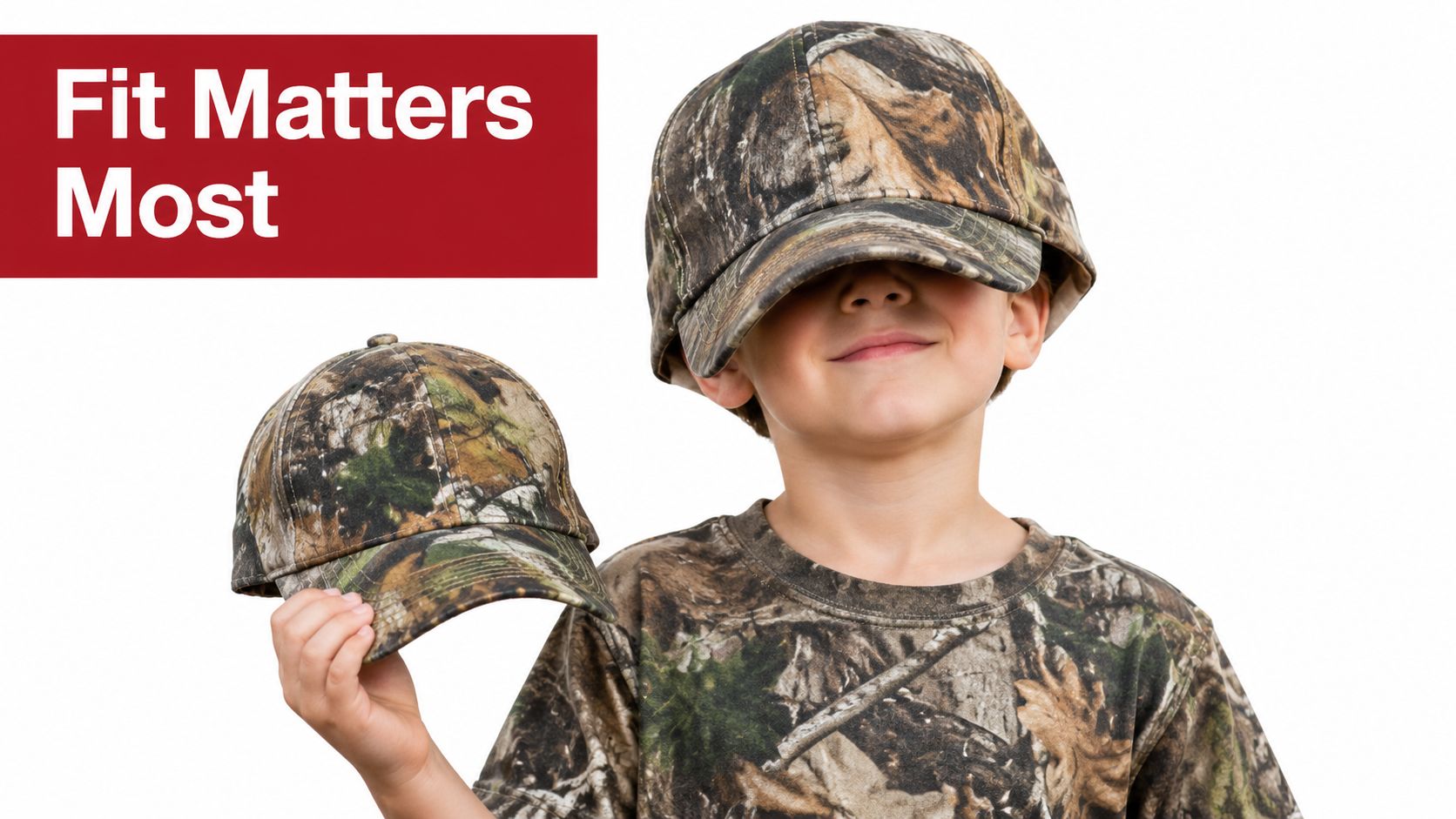
You order a box of youth camo hats for a team or school event, expecting a simple win. Then the kids try them on. One cap slides over a child's eyebrows, another pinches at the temples, and the “youth one size fits most” label suddenly feels less useful than it sounded online. The problem usually isn't the camouflage. It's the assumption that a smaller-looking adult hat will fit every young wearer.
Youth headwear works best when you treat fit as a measurement problem, not an age-label problem. In this guide, you'll learn how to measure a child's head, compare that measurement with youth ranges, choose the right closure, separate hunting function from everyday style, and select construction details that support comfort and decoration.
Introduction to Youth Camo Hats and Why Fit Matters More
A school orders youth camo hats for an outdoor day, and the problems appear during the first fitting. One child pulls the cap below the eyebrows, another keeps adjusting a tight band, and a third finds that the brim hides the activity ahead. The camouflage may look right, yet the hat fails because a youth label does not describe every child's head.
A useful starting range for young wearers is 50–56 cm, or approximately 19.7–22.0 inches. Age can offer a rough reference, with ages 3–6 around 52 cm and ages 7–10 around 54 cm, but children of the same age can differ noticeably (Buff Caps youth sizing guide). Measure the actual wearer whenever possible. Age is a signpost, not a fitting measurement.
Practical rule: For a group purchase, measure a representative range of heads before selecting a fitted style.
The decision becomes clearer when buyers separate two purposes. A hunting hat needs practical coverage, secure wear, and a pattern suited to outdoor surroundings. A fashion or team hat may focus more on appearance, identity, and easy matching. Some groups need both, so check performance first, then choose the visual direction.
For schools, camps, teams, and fundraisers, a broad “youth” label can cover a small child and a larger child. Adjustable closures help accommodate different circumferences, much like loosening a belt, but they cannot correct a crown that sits too low or a brim that dominates a small face. A sample worn by a real child gives a more reliable answer than a product photograph.
Use a simple buying sequence: measure head size, define the hat's purpose, then review the pattern, construction, closure, fabric, and decoration method. This process helps a school avoid ordering a fashion-focused cap for a demanding outdoor activity, while a brand can choose a comfortable base that also supports its design.
Camouflage has served both practical and visual roles for generations. Its history includes formal military development in France by 1914, the civilian Dazzle Ball in London by 1919, and Realtree's commercialization as a hunting pattern in 1986, as summarized by Foremost Hat's camouflage history guide. That background explains why youth camo hats can suit a hunting trip, playground clothing, or team merchandise, depending on the buyer's purpose.
What Makes a Youth Camo Hat Different
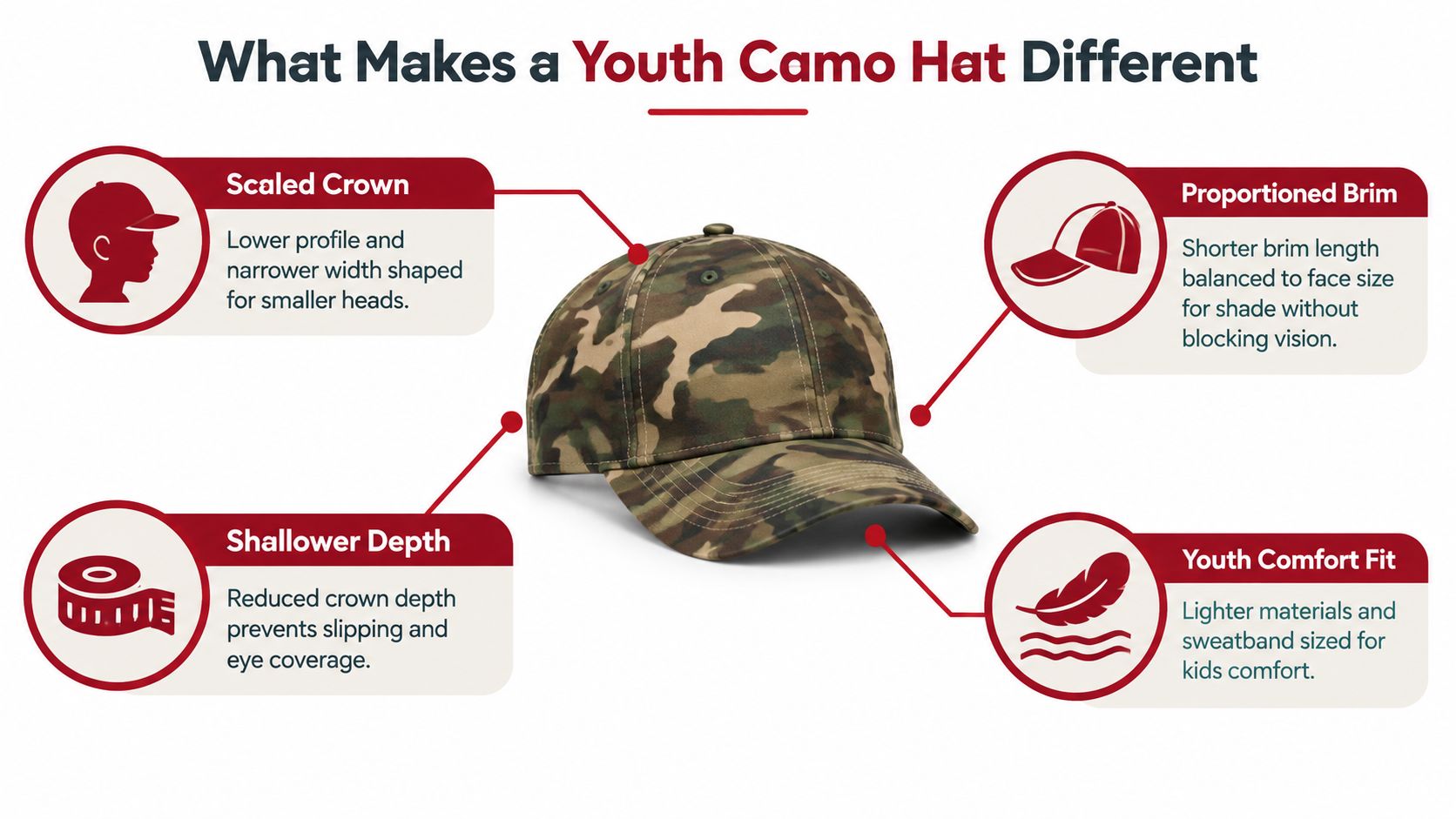
The easiest way to understand youth headwear is to compare it with children's clothing. A youth T-shirt isn't just an adult T-shirt made shorter. Its shoulder width, sleeve length, neckline, and overall proportions are adjusted for a smaller body. Youth hats follow the same principle, with changes to crown width, crown depth, brim length, and the comfort band.
Crown and brim proportions
The crown is the part that sits over the head. On a youth cap, it should wrap the head without creating a tall, empty pocket above it. A crown that's too large can slide forward, cover the eyes, or make the child tighten the closure until the hat feels uncomfortable.
The brim needs similar balance. A full adult brim may project too far across a young face, especially when the child looks down or moves quickly. A youth-proportioned brim offers shade while preserving a clear view of the ground, teammates, and activity around them.
The depth of the hat matters as much as circumference. Think of circumference as the belt around the hat and depth as the height of the room inside it. A cap can have the right belt measurement but still feel wrong if the room is too tall.
Two purposes, one visual language
Camo also operates in two different worlds. In hunting and outdoor settings, buyers may care about terrain, concealment, sun protection, and weather resistance. In school, team, and streetwear settings, the pattern is usually a visual choice. The wearer wants the familiar camo look, but not necessarily a hat designed for field concealment.
That distinction affects your shortlist. A lightweight brush print may feel natural for a field day or casual outfit, while a licensed hunting pattern can look more specialized. A muted abstract camo may coordinate more easily with a school logo or brand palette.
Youth camo hats have also moved beyond traditional hunting caps into style-led formats such as rope hats, vintage washes, and straw hats, according to current youth headwear listings from Mossy Oak. The important lesson is that “camo” describes the visual language, not one fixed construction or one buyer type.
How to Find the Right Size for Every Age
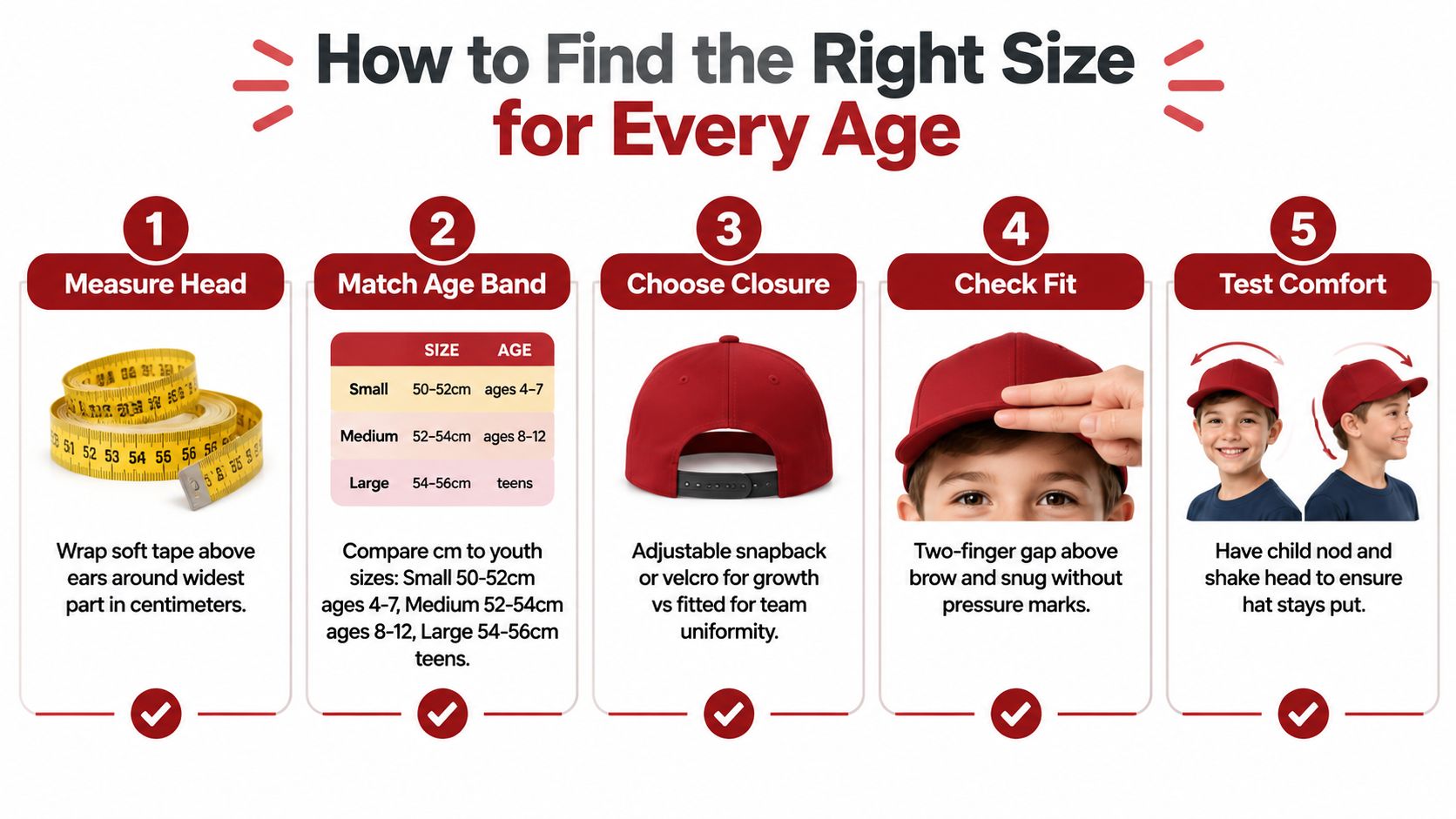
A youth camo hat should begin with the child's head measurement, not the word “youth” in a product title. Wrap a soft measuring tape around the widest part of the head, above the ears and across the forehead. Keep it level and comfortably snug, then record the result in centimeters, the unit used by many youth size charts.
A simple measuring process
-
Measure twice. Hair, braids, or a loose tape can affect the result. Repeat the measurement before choosing a size.
-
Use age as a guide, not a guarantee. Youth charts often place ages 3–6 near 52 cm and ages 7–10 near 54 cm, according to Buff Caps size guidance. Head circumference remains the better starting point because children of the same age can need different fits.
-
Check the product's actual range. Retailers use “youth” differently. Listings may describe caps for 3–8 years with a 50–52 cm fit, while other products target younger children or offer only an adjustable youth one-size design. Read the measurements and closure details rather than relying on the label.
-
Check crown depth. Circumference is the loop around the head, while crown depth is the room above it. A cap can fit the loop but sit too low over the eyes if its crown is too deep. For a smaller head, look for a youth-shaped, shallower crown.
-
Test movement. Have the child nod, look down, and gently shake their head. The hat should stay put without sliding, pinching, or leaving pressure marks.
Use this hat sizing chart to organize measurements before comparing styles or preparing a group order. Treat it as a reference, then confirm the specific cap's construction, size range, and closure.
Choosing the closure
An adjustable snapback, hook-and-loop strap, or fabric back closure accommodates modest growth and small differences between wearers. That makes adjustable youth camo hats practical for camps, mixed-age teams, and school or promotional orders.
Stretch-fit caps look tidy and feel smooth, but they require a narrower, more accurate size range. Fitted caps create a consistent team appearance, yet offer less tolerance for measuring mistakes. For a shared style across several ages, adjustable is usually the safer starting point.
Avoid sizing up only because the child may grow. Extra circumference can make the hat slide, and excess crown depth can block the eyes. Choose a little room only when the closure and crown shape keep the cap stable now.
Popular Camo Patterns and When to Choose Each One
Pattern choice should follow the setting. A hunting family may look for a terrain-specific print, while a school or apparel brand may want a camo that supports a logo and works with everyday clothing. Asking “Will this hide the wearer?” and “Will this look good in photos?” leads to very different answers.
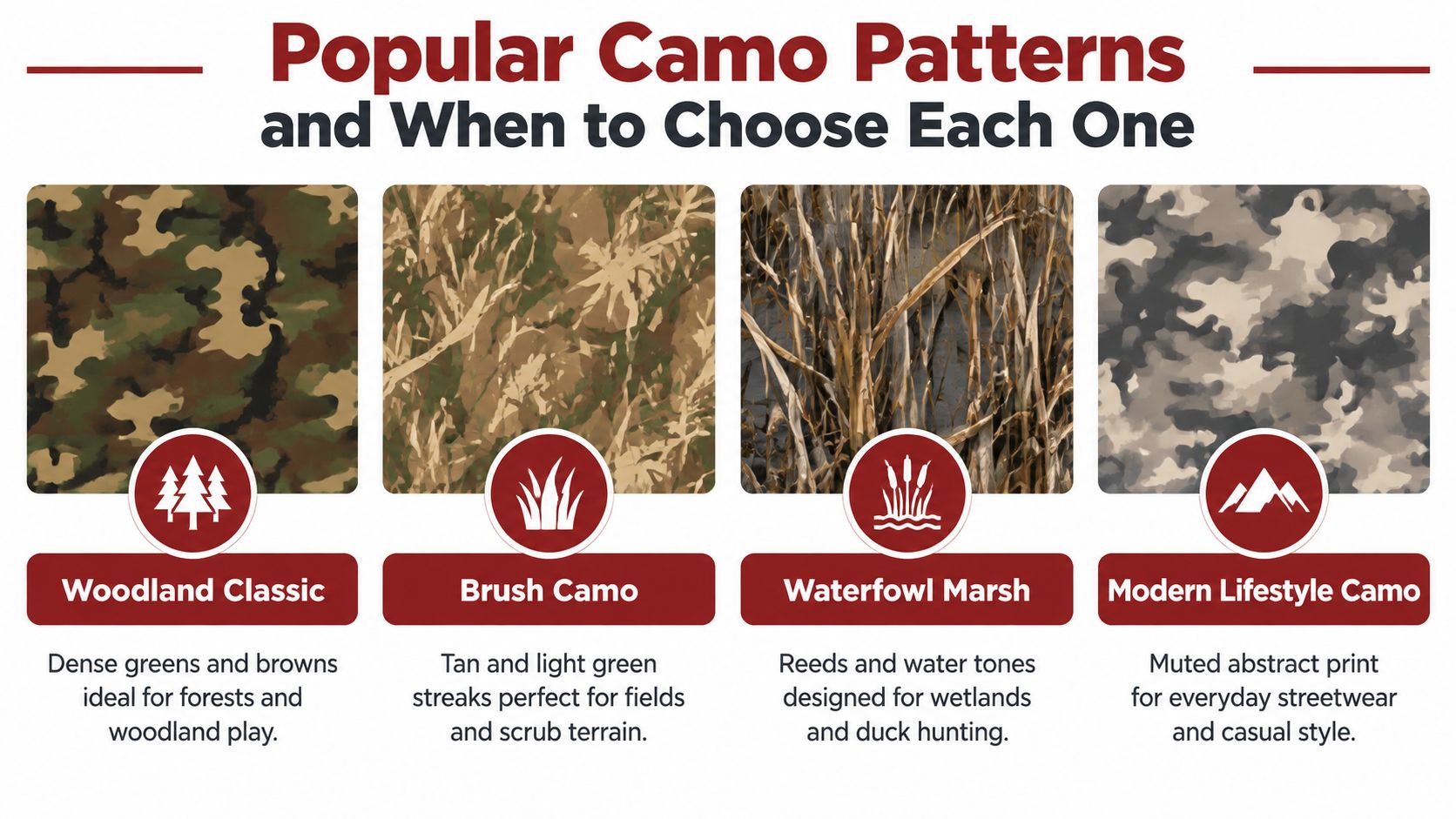
Woodland classic
Woodland prints typically use greens, browns, and irregular shapes inspired by trees, leaves, and forest cover. They have a familiar outdoor identity and often feel appropriate for camping, scouting, hunting-related events, or nature programs.
For a school or team, woodland works best when the group wants an unmistakably outdoorsy look. Dark green, black, white, or tan decoration can coordinate with it, but the busy background may compete with small lettering.
Brush and field patterns
Brush camo uses lighter tan, grass, and streak-like shapes. It can feel less heavy than dense woodland and may suit fields, scrub terrain, sports events, and casual warm-weather outfits.
A brush pattern can also photograph more softly than a very dark forest print. If the hat needs a cheerful, approachable look for a youth fundraiser, this family may be easier to style.
Waterfowl marsh
Waterfowl patterns often use reeds, grasses, and water-toned colors. They signal a specific outdoor activity more strongly than a general lifestyle camouflage. Choose this direction when the audience understands the hunting or wetlands connection.
For a general school order, consider whether that specialized message fits the group. Buyers who want a camo appearance without hunting associations may prefer a less literal design.
Modern lifestyle camo
Modern lifestyle camo uses muted, abstract, or simplified shapes. It keeps the recognizable camo idea while fitting more easily into streetwear, school merchandise, and brand collections.
A useful comparison is available through a camo bucket hat collection, especially when you're considering whether a camo look needs to stay in a traditional baseball cap. Rope hats, bucket hats, vintage washes, and straw formats broaden the style conversation beyond hunting.
For schools and teams: Choose the pattern for the audience's daily use, not only for the activity that inspired the purchase.
The commercial market reflects this split between purpose and appearance. The camouflage clothing market was valued at about $1.33 billion in 2026 and is projected to reach nearly $2.0 billion by 2032, with a projected compound annual growth rate described as roughly 6.08% to 7.1% in Accio's 2026 camo market overview. Youth camo hats sit inside that wider fashion, outdoor, and lifestyle demand, so buyers shouldn't assume every camo customer is a hunter.
Construction Choices That Affect Comfort and Customization
Two caps can share the same camouflage print and feel completely different on a child's head. The difference usually comes from the crown design, fabric, sweatband, closure, and brim.
Five-panel and six-panel crowns
A five-panel cap often has a broad front panel with fewer seams across the face of the hat. That gives decorators a clean area for a logo, especially when the design needs a wide horizontal layout. The shape can feel contemporary and works well for simple text or a centered patch.
A six-panel cap divides the crown into more sections, usually with a center seam or structured front made from paired panels. This familiar baseball-cap format can provide a traditional fit and a stable front for embroidery.
Panel count doesn't determine fit by itself. Two five-panel hats may have different depths, while two six-panel hats may use different closure systems. Use panel count to understand decoration and silhouette, then verify the measurements.
Structured versus unstructured
Structured fronts use an internal support material that helps the crown hold its shape. Think of the front as a small framed backpack. It looks crisp and presents a consistent embroidery surface, but a stiff build may feel less forgiving on a child's head.
Unstructured fronts behave more like a soft beanie. They follow the head more naturally, pack easily, and often feel relaxed for everyday wear. The trade-off is that the front may crease or collapse, which can affect small lettering and detailed logos.
Fabric, sweatbands, and sun exposure
For outdoor use, look for fabric information rather than relying on the camo print. One independently listed kids' camo sun hat uses 90% REPREVE polyester and 10% recycled polyester, and it advertises UPF 50+ protection plus an adjustable fit (Farmers Defense kids camo sun hat). That example shows how fiber content, knit density, and adjustability can work together, but product claims still need to be checked individually.
A lighter material may feel better in warm weather, while a denser fabric can provide a more substantial surface for decoration and sun coverage. The sweatband should sit smoothly against the forehead without a rough seam. For active children, moisture management and a secure closure often matter more than a rigid front.
Choose construction by priority:
- Comfort first: Unstructured crown, soft sweatband, and a flexible adjustable closure.
- Uniform appearance: Structured front, consistent panel shape, and matching closures.
- Decoration first: A stable front panel with enough contrast between fabric and thread.
- Sun protection first: A brim with useful coverage and a fabric that clearly states its UV rating.
Decorating and Ordering Youth Camo Hats in Bulk
A school team chooses a youth camo hat for two different reasons. It may need to support outdoor work, hunting, or recreation, or it may want a rugged pattern for team identity and fashion. That purpose should guide the decoration, fit check, and order plan. A hunting-focused hat may prioritize practical coverage, while a brand or fundraiser may care more about a clean logo and consistent appearance.
Match the decoration to the surface
Camouflage already contains several shapes and tones, so thin lettering can disappear when thread color is too close to the fabric. Use strong contrast, simplified artwork, and letterforms large enough to read at a glance. The logo should work with the pattern, like a road sign designed for a busy background.
Flat embroidery suits names, team marks, and logos because it follows the crown without adding much height. Puff embroidery gives bold, simple lettering more presence, but it needs room and does not suit tiny internal details.
Patches create a clear boundary between the artwork and the camo. They often improve readability on a complex print and give the hat a distinct merchandise appearance. Direct embroidery keeps the decoration lighter and more integrated with the cap.
Request a digital proof before production. Review thread colors against the actual camo colorway, not only a plain white mockup. If the order matters to a school, team, or brand, decorate one sample and have a child wear it during normal movement before approving the full run.
A practical small-order workflow
Start with the intended group and its purpose. A team may test one sample in person, while a school or fundraiser should collect head measurements before choosing fitted caps. Adjustable styles reduce sizing risk, but the crown still needs enough depth for the wearer.
Confirm the decoration area next. A logo sized for a structured six-panel cap may sit differently on a low-profile five-panel style. Ask whether the supplier can decorate the front, side, patch area, or another available location.
Then verify the production details:
- Sample approval: Check fit, brim position, closure comfort, and logo scale.
- Artwork review: Confirm that small text remains readable over the camo.
- Quantity planning: Order for the intended group and define how replacements will be handled.
- Stock confirmation: Verify the selected colorway and youth size before approving proofs.
A buyer comparing wholesale options should compare construction, youth sizing, decoration, and intended use rather than treating every camo hat as interchangeable. The guide to buying youth hats wholesale in bulk can help organize those questions before requesting a quote.
For broader custom-catalog planning, SelfServe's Infinite Options review provides context for presenting product customization choices online. Use that perspective to keep school, team, or brand selections clear instead of offering options without a defined purpose.
Final Checklist for Choosing Youth Camo Hats With Confidence
A good youth camo hat order starts with a child's actual measurement and ends with a real-world wear test. Don't let a broad age label make the decision for you.
Use this final checklist:
- Measure the head: Record circumference in centimeters above the ears and around the widest point.
- Review the range: Compare the measurement with the specific product chart, including crown depth.
- Choose the closure: Use adjustable closures for mixed groups and growth flexibility. Choose fitted styles only when measurements are reliable and uniformity matters.
- Match the pattern: Pick woodland, brush, marsh, or lifestyle camo based on whether the hat serves hunting, outdoor recreation, school wear, team identity, or fashion.
- Inspect the construction: Decide whether a structured or unstructured crown better suits comfort, shape, and decoration.
- Plan the logo: Use contrast, readable scale, and a decoration method that suits the panel.
- Approve a sample: Have a child nod, look down, and move around while wearing it.
- Confirm the order: Check stock, size mix, artwork proof, delivery timing, and replacement needs before production.
The safest buyer isn't the person who chooses the most specialized pattern. It's the person who matches fit, function, audience, and decoration before placing the order. That approach gives children hats they'll wear and gives schools, teams, and brands fewer avoidable fit problems.
Dirt Cheap Headwear offers wholesale blank hats, youth-fit options, camo styles, custom embroidery, patches, and low-minimum custom ordering for teams, schools, brands, and events. Visit Dirt Cheap Headwear to compare youth headwear, review decoration options, and start with a sample before committing to a larger order.