
Wholesale Golf Hats: The Complete Buyer’s Guide
You've got a tournament coming up, the pro shop wants fresh resale stock, and someone has suggested ordering one “premium” golf cap for everyone. That sounds tidy until the embroidery bill arrives, the giveaway budget disappears, and players complain that the same heavy structured hat feels wrong in a hot climate.
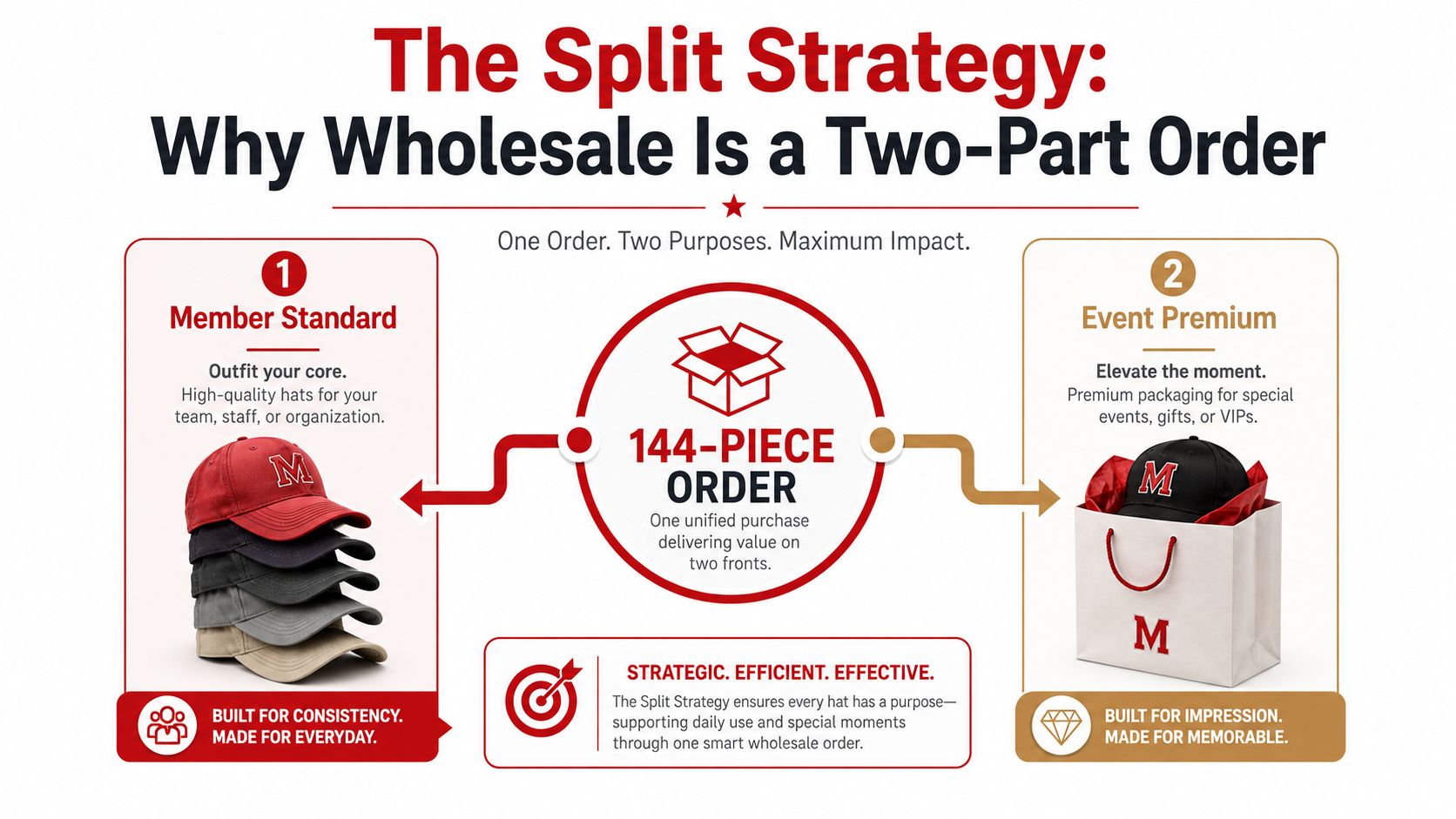
Wholesale golf hats work better as a planned assortment, not a single-size-fits-all purchase. Buy affordable technical blanks for teams, staff, and event distribution, then reserve a smaller premium group for club shops, VIP gifts, and resale. The right split protects your margin while giving each buyer a hat that makes sense on the course.
Why Buying Wholesale Golf Hats Is a Split Strategy
A mid-sized country club ordering 144 caps for members and tournament gift bags isn't making one purchase. It's making two purchases under one purchase order.
The first group needs to be cost-controlled. Use structured snapbacks, lightweight performance caps, or visors from dependable mid-tier lines such as Otto, Pacific Headwear, or Yupoong equivalents. These blanks need to accept embroidery cleanly while leaving room for setup costs and giveaway pricing. A basic polyester cap with a sensible front panel can do that job without pretending to be a luxury product.
The second group should feel different. A smaller premium capsule can include Titleist, Peter Millar, or Melin-style fits for the club shop, pro shop displays, member resale, and VIP gifting. Those hats earn their place through hand feel, finish, fit, and brand recognition, not because every tournament attendee needs one.
Let the climate decide the mix
Hot, humid regions should lean toward moisture-wicking polyester, poly-spandex stretch, curved bills, and breathable side or rear panels. Polyester remains the strongest all-around technical choice because it dries quickly, holds color, and keeps its shape during active use, as explained in this golf hat materials guide.
Temperate markets need a broader seasonal mix. Brushed cotton-twill structured caps suit cooler rounds and lifestyle wear, while fleece-lined beanies and heavier crowns cover cold shoulder seasons. Rain-focused assortments should use water-resistant ripstop nylon with a DWR coating rather than cotton, which absorbs moisture and dries slowly, according to this technical custom golf hat construction guide.
Practical rule: Don't put your most expensive hat on the largest quantity line. Put your most functional hat there.
Buyers who ignore this split either overpay for giveaways or under-deliver on retail. It also helps to pair the headwear order with practical course equipment. A useful wholesale golf cart gear guide can help you build a more complete tournament or pro-shop merchandise plan.
Golf Hat Styles and What Each One Is Built For
The structured six-panel cap is still the workhorse. Its stable front panel supports team names, club crests, and corporate logos, while a mid-profile crown looks polished without the overly casual attitude of a flat-bill snapback. It also gives decorators a predictable surface for flat embroidery and modest 3D puff.
A low-profile dad cap has a relaxed look, but its soft front can distort detailed logos. A flat-bill snapback suits streetwear-led brands more than traditional clubhouses. For a dependable starting blank, compare the construction and panel shape of the YP Classics classic poplin golf cap.
Match silhouette to use case
The performance cap is the right pick for sun-heavy rounds. Stretch polyester, perforated panels, a curved bill, and a comfortable sweatband keep it focused on movement and heat management. Use flat embroidery for compact logos, or a restrained transfer when a large lightweight graphic matters more than texture.
The visor wins in very hot weather and during range sessions. It leaves the crown open, maximizes airflow, and still provides a clean front band for a club mark or sponsor name. It's especially useful for buyers who know their customers dislike full crowns.
The bucket hat belongs in resort courses, junior programs, casual club merchandise, and lifestyle resale. Its unstructured crown feels less formal, so patches and simple embroidery usually outperform dense crest work.
Winter beanies should use restrained decoration, normally a woven label, small embroidery, or a sewn patch. Rain hats need a clean, compact mark that won't interfere with the coated shell.
| Style | Best For | Primary Buyer | Decoration Match |
|---|---|---|---|
| Structured six-panel | Teams and club branding | Leagues, clubs, corporations | Flat embroidery or light 3D puff |
| Performance cap | Hot, active rounds | Tournament buyers and teams | Flat embroidery or transfer |
| Visor | Maximum airflow | Players, ranges, events | Small embroidery or woven label |
| Bucket hat | Resort and lifestyle wear | Pro shops and resellers | Patch or simple embroidery |
| Winter beanie | Cold-season play | Clubs and outdoor programs | Woven label or small embroidery |
| Rain-resistant cap | Wet shoulder seasons | Clubs and event organizers | Compact embroidery or patch |
There isn't one universal wholesale golf hat style. The front-panel shape, crown firmness, and customer expectation should determine the decoration, not the other way around.
Fabrics, Construction, and Performance Features That Actually Matter
Start with the fiber, but don't stop there. Polyester and poly-spandex blends dominate performance caps because they wick moisture, recover their shape, and work well for sublimation or controlled embroidery. Industry guidance places polyester performance hats in the UPF 30–50+ range, depending on the fabric and construction, as outlined in this golf hat material breakdown.
Brushed cotton-twill still has a legitimate role. It feels familiar, decorates easily, and suits structured lifestyle caps or cooler-weather builds. Wool and wool-blend meltons belong in winter assortments and premium pro-shop capsules, not in a hot-weather team order.
Separate useful claims from marketing fluff
A UPF rating matters only when the fabric is tightly woven or knitted and the finished hat covers the intended area. Moisture-wicking finishes work better when paired with a structured sweatband that moves perspiration away from the forehead instead of absorbing it.
DWR coatings help rain hats shed water, but repeated washing can reduce that treatment. A supplier who advertises “waterproof” should explain the fabric, seam treatment, coating, and care instructions. A vague performance label isn't a specification.
Construction details reveal the difference between a low-cost blank and a premium cap:
- Crown height: Mid-profile crowns usually balance decoration space with a conventional golf fit.
- Panel structure: Six-panel fronts offer familiar branding space, while five-panel builds create a cleaner uninterrupted face.
- Buckram stiffness: Firmer buckram supports crisp embroidery but can feel rigid if poorly finished.
- Visor stitching: Eight rows create a simpler look, while sixteen rows add a more detailed premium finish.
- Under-visor contrast: Contrast can improve visual character, but it's a style choice, not a performance feature.
| Fabric or Feature | Performance | Durability | Decoration Fit | Price Tier |
|---|---|---|---|---|
| Polyester | Fast drying and shape stable | Strong for active use | Embroidery and sublimation | Value to premium |
| Poly-spandex | Stretch and recovery | Depends on blend quality | Light embroidery or transfer | Mid-tier |
| Cotton-twill | Comfortable lifestyle feel | Can absorb moisture | Excellent for embroidery | Value to mid-tier |
| Ripstop nylon with DWR | Rain and abrasion resistance | Coating needs care | Compact embroidery or patch | Mid-tier to premium |
| Wool blend | Warm, refined hand feel | Suited to cool seasons | Patch or restrained embroidery | Premium |
| Structured buckram | Supports front-panel decoration | Holds crown shape | Flat embroidery and puff | Across tiers |
For a fuller buyer-focused material comparison, use this bulk performance hat fabric guide before requesting quotes. Then test the actual sample. Check stretch recovery, seam alignment, sweatband comfort, crown balance, and whether the front panel accepts a 3D puff without puckering.
Trusted Wholesale Brands Worth Stocking
Brand selection should follow the job. Richardson and Otto Cap are dependable starting points for embroidery-heavy team, corporate, and event orders. Their broad blank assortments make it easier to build a value half around structured caps, trucker shapes, and adjustable fits.
Under Armour and Nike Golf belong in the performance tier. Their appeal comes from recognizable branding and technical fabrics, but the buyer needs to confirm decoration permissions, available colors, and the exact customization route before promising a decorated program.
PING, Titleist, and TaylorMade carry strong pro-shop credibility. They make sense in a premium capsule where customers are buying the label and finish as much as the logo. Their resale programs can involve stricter MAP policies and narrower customization windows, so they're poor choices for a buyer who needs unrestricted decoration or aggressive discounting.
Use factory-direct supply carefully
Direct-from-factory blanks in Asia can offer aggressive pricing and private-label flexibility. They also require stronger quality control, clearer material specifications, reliable samples, and a realistic shipping plan. A low quote isn't useful if the crown shape changes between samples and production.
| Brand | Best For | Fabric Profile | Decoration Compatibility | Price Tier |
|---|---|---|---|---|
| Richardson | Team and tournament programs | Cotton, poly blends, mesh | Strong embroidery options | Value to mid-tier |
| Otto Cap | Budget-conscious decorated orders | Broad blank assortment | Good for standard embroidery | Value |
| Under Armour | Performance-led programs | Technical stretch fabrics | Confirm decoration limits | Premium |
| Nike Golf | Branded performance resale | Technical performance fabrics | Confirm approved customization | Premium |
| PING | Pro-shop credibility | Golf-specific performance and lifestyle | Often restricted | Premium |
| Titleist | Club retail and gifting | Performance and structured builds | Limited customization windows | Premium |
| TaylorMade | Golf brand resale | Technical and lifestyle profiles | Confirm program rules | Premium |
| Asia factory-direct | Private label and aggressive cost | Custom specification | Flexible, but sample-dependent | Value to mid-tier |
My stocking recommendation is simple. Choose two value brands for the bulk side of the order and one premium label for the capsule. Don't build the entire assortment around a brand whose resale rules leave you unable to control margin or decoration.
Decoration Methods That Hold Up On and Off the Course
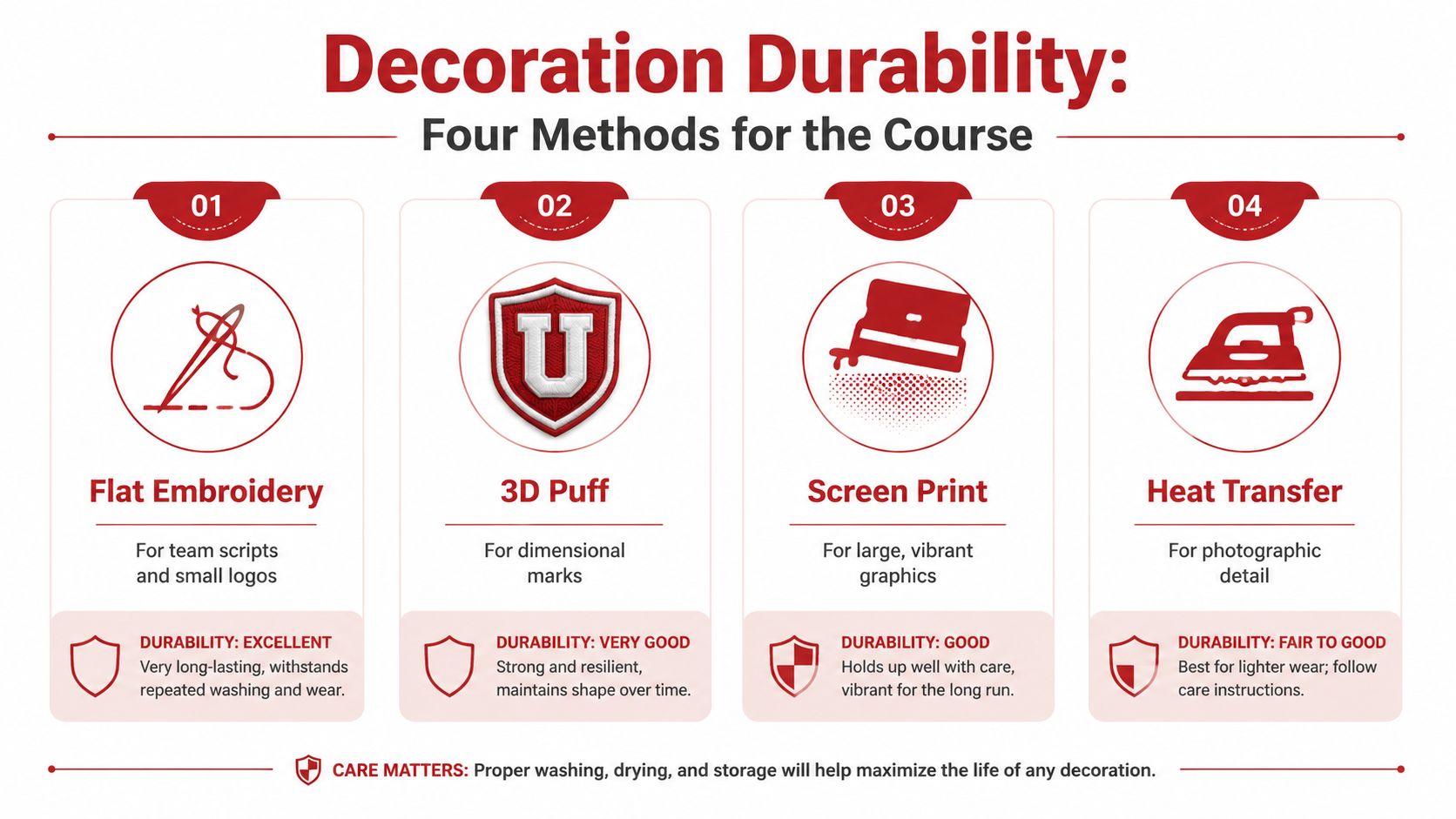
Decoration fails when the method ignores the hat. Flat embroidery is the default for most team scripts, club names, and compact corporate marks because it handles regular wear and gives structured fronts a clean finish. Standard 40-weight thread works for general lettering, while 30-weight thread helps with finer detail when the fabric and machine settings support it.
3D puff embroidery adds height to bold crests and short marks. It needs a stable front panel, enough logo height, and a design without tiny internal details. Don't put heavy puff on an unstructured twill visor. The fabric won't give it the support it needs.
Patches deliver a premium club-shop look without forcing dense stitching into technical fabric. Embroidered patches feel traditional, while leather-style patches suit rope hats, lifestyle caps, and small capsule collections. Sublimation and heat transfer work where breathability, color range, or photographic detail matters more than a crisp raised edge.
Build the decoration around the logo
Performance polyester can accept sublimation well, but it may resist dense thread work that traps texture and changes the hand feel. Unstructured caps need lighter decoration, and coated rain shells need compact marks that don't compromise the surface.
A decorator should also confirm the artwork's minimum logo height, stitch count, thread colors, and placement. Many suppliers reject details that are technically visible on screen but collapse during production. Logo placement too close to the bill or side seam creates avoidable distortion.
The decoration quote should appear as its own per-hat line item. Separate the blank, digitizing, setup, thread, patch, print, and rush charges so you can compare suppliers accurately. A cheaper cap with complicated decoration may cost more landed than a better blank with a simpler stitch file.
For production examples and decoration options, review this printing and embroidery service guide. Ask for a proof on the actual hat color, not just a digital mock-up on a generic white cap.
Matching the Right Hat to Teams, Brands, Events, and Resellers
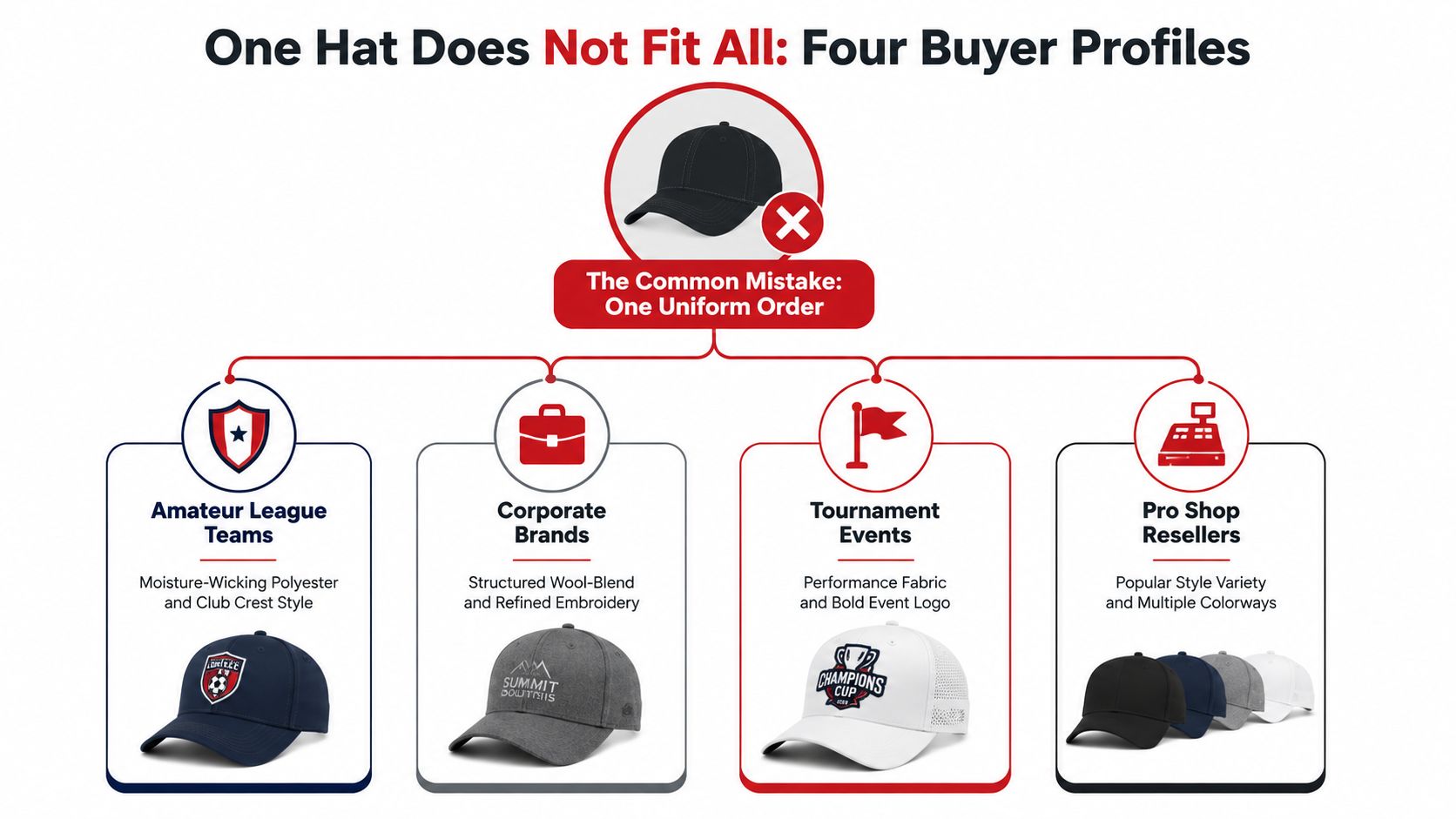
One uniform wholesale order is the most common assortment mistake. A recreational league, a charity tournament, a resort pro shop, and an online reseller have different reasons for buying headwear, so they shouldn't receive the same fabric, fit, or decoration.
Build around the buyer
Amateur league teams should use the value half of the split. Structured cotton-twill or poly-blend snapbacks keep the unit cost manageable, and a club crest or team mark in flat embroidery gives players a consistent look without overbuilding the product.
Corporate outings and charity tournaments deserve a mid-tier performance cap. Use a curved bill, moisture-wicking sweatband, and flat embroidery. Sponsors usually need clarity and visibility, not a complicated raised design that makes the cap uncomfortable.
Resort and club pro shops should carry the premium capsule. PING or Titleist-style profiles, tonal stitching, refined colorways, and leather-style patches give the assortment a retail reason to exist. The product should look appropriate beside polos and outerwear, not like leftover event merchandise.
Resellers need controlled variety. Start with one dependable bestseller blank, then add seasonal colorways and a premium option only after the core style proves it can move. MAP-restricted labels can create unnecessary margin pressure, especially when the seller has limited control over pricing.
| Buyer | Core Hat | Decoration | Buying Priority |
|---|---|---|---|
| Amateur league | Value structured cap | Crest embroidery | Consistency and cost |
| Corporate event | Mid-tier performance cap | Flat logo embroidery | Comfort and brand clarity |
| Resort pro shop | Premium golf profile | Patch or tonal embroidery | Retail finish |
| Reseller | Core blank plus seasonal options | Flexible decoration | Repeatability and margin |
Climate should shape the final allocation. Hot, humid buyers need breathable technical builds. Coastal buyers should consider quick-drying fabrics and corrosion-resistant hardware. Four-season markets need a core performance cap plus cooler-weather cotton, wool blend, or beanie options. The assortment should reflect how customers play, not just what looks good in a catalog.
MOQ, Pricing, Samples, Lead Times, and Shipping
Wholesale ordering becomes manageable when every supplier quote follows the same format. Ask for the blank cost, decoration cost, digitizing or setup charges, sample fees, packaging, freight, duties, and delivery terms in separate lines. If a vendor combines everything into one unexplained number, you can't compare the proposal or protect your margin.
The provided ordering brief includes common planning benchmarks of 12–24 pieces for decorated orders, 48–144 for blanks, and 144 or more for overseas production. Treat these as planning ranges, not universal rules. The supplier, brand, decoration method, and customization level can change the actual minimum.
Hold the supplier to visible checkpoints
Start with a digital mock-up, but don't approve a full run from artwork alone. Request a physical sample or pre-production sample in the exact blank, color, decoration method, and thread combination. A sample exposes crown distortion, incorrect logo scale, weak stitching, uncomfortable sweatbands, and color mismatches before those problems reach the full order.
The same brief uses one to two weeks for stocked blanks plus decoration and four to six weeks for custom overseas production as realistic planning ranges. Build extra calendar room around tournament dates, seasonal launches, customs clearance, and approval delays.
| Order Type | Typical MOQ | Per-Unit Price (USD) | Decoration Lead Time | Production Lead Time |
|---|---|---|---|---|
| Decorated stocked blanks | 12–24 | Request supplier quote | Confirm with decorator | Often one to two weeks |
| Blank wholesale order | 48–144 | Request supplier quote | Not applicable | Confirm stock position |
| Custom overseas production | 144+ | Request factory quote | Confirm after sample approval | Often four to six weeks |
| Premium branded capsule | Supplier-specific | Request authorized quote | Confirm brand program | Confirm inventory and rules |
Shipping terms matter as much as the product quote. FOB usually places more freight responsibility with the buyer after the goods leave the origin, while DDP gives a more consolidated landed-cost view when the supplier includes delivery duties and taxes. Air freight is faster and more expensive; sea freight is slower and can make sense for larger production runs.
Ask how many cartons the order uses, how structured caps are protected, which duties apply, and whether the ship-by date means warehouse departure or final delivery. Those definitions prevent unpleasant surprises.
Your Wholesale Golf Hat Ordering Checklist
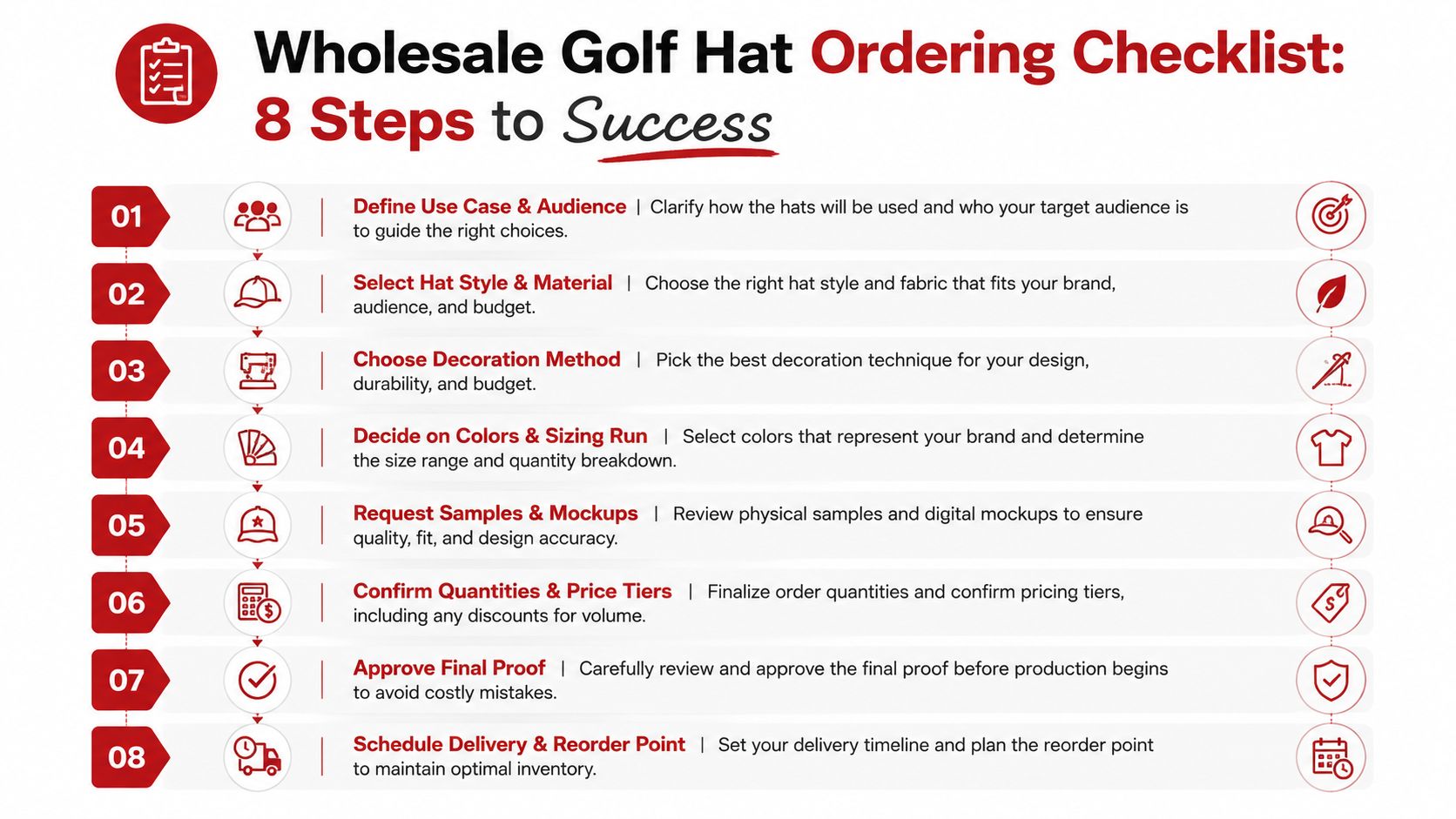
Use a repeatable workflow instead of relying on a supplier's catalog language. The buyer's job is to define the use case first, then force the product, decoration, and shipping details to match it.
Eight checks before you release the purchase order
- Define the audience: Separate teams, giveaways, staff, club retail, VIP gifting, and resale customers.
- Set the budget: Decide the acceptable landed cost per hat before choosing a brand or fabric.
- Choose samples: Request two or three silhouettes, such as a structured cap, performance cap, and visor.
- Mock up the artwork: Show the preferred logo, colorway, placement, and decoration method on the actual style.
- Approve the physical sample: Check fit, crown shape, seam alignment, sweatband comfort, and logo execution.
- Confirm decoration specifications: Document stitch count, thread colors, logo dimensions, placement, patch material, and any puff requirements.
- Lock the purchase order: Include quantities, color split, size run, payment terms, packaging expectations, and ship-by date.
- Schedule the review: Set a reorder checkpoint based on sell-through, team feedback, event response, or seasonal demand.
A supplier should answer basic operational questions without resistance. Ask who manufactures the blank, whether the same style will remain available, what happens when a decorated item arrives defective, and which approval controls apply before production.
Watch for red flags:
- No sample access: A vendor who refuses a sample is asking you to accept untested risk.
- Unclear payment terms: Full payment upfront without documented protections deserves scrutiny.
- Unknown blank manufacturer: You need the actual brand or factory specification, not a vague “premium quality” label.
- No written ship-by date: A delivery promise without a defined date is difficult to enforce.
- Unexplained decoration charges: Separate digitizing, setup, stitching, patch, and rush costs before approval.
The strongest wholesale golf hat programs keep the value basics replenishable and the premium capsule selective. That gives teams reliable function, gives retailers something worth displaying, and lets resellers test demand without tying every dollar to one expensive style.
Dirt Cheap Headwear offers blank golf-friendly caps, perforated performance styles, rope hats, visors, and custom embroidery with low minimums starting at six pieces per logo. Visit Dirt Cheap Headwear to compare wholesale styles, request decorated options, and build a split order that fits your audience, climate, and budget.