
What Is a Beanie Hat? a Sourcing Guide
A beanie hat is a close-fitting, brimless knit cap made for warmth and easy wear. The tricky part is that “beanie” means slightly different styles in different countries, so the hat you picture in the U.S. might not be the exact same silhouette a buyer in the U.K., Canada, or Australia expects.
If you're staring at a headwear catalog and wondering which knit cap counts as the beanie, you're not alone. The name sounds simple, but in sourcing, the details matter, because a “beanie” can be a fashion piece, a work cap, a winter layer, or a decorated blank depending on the market and the finish.
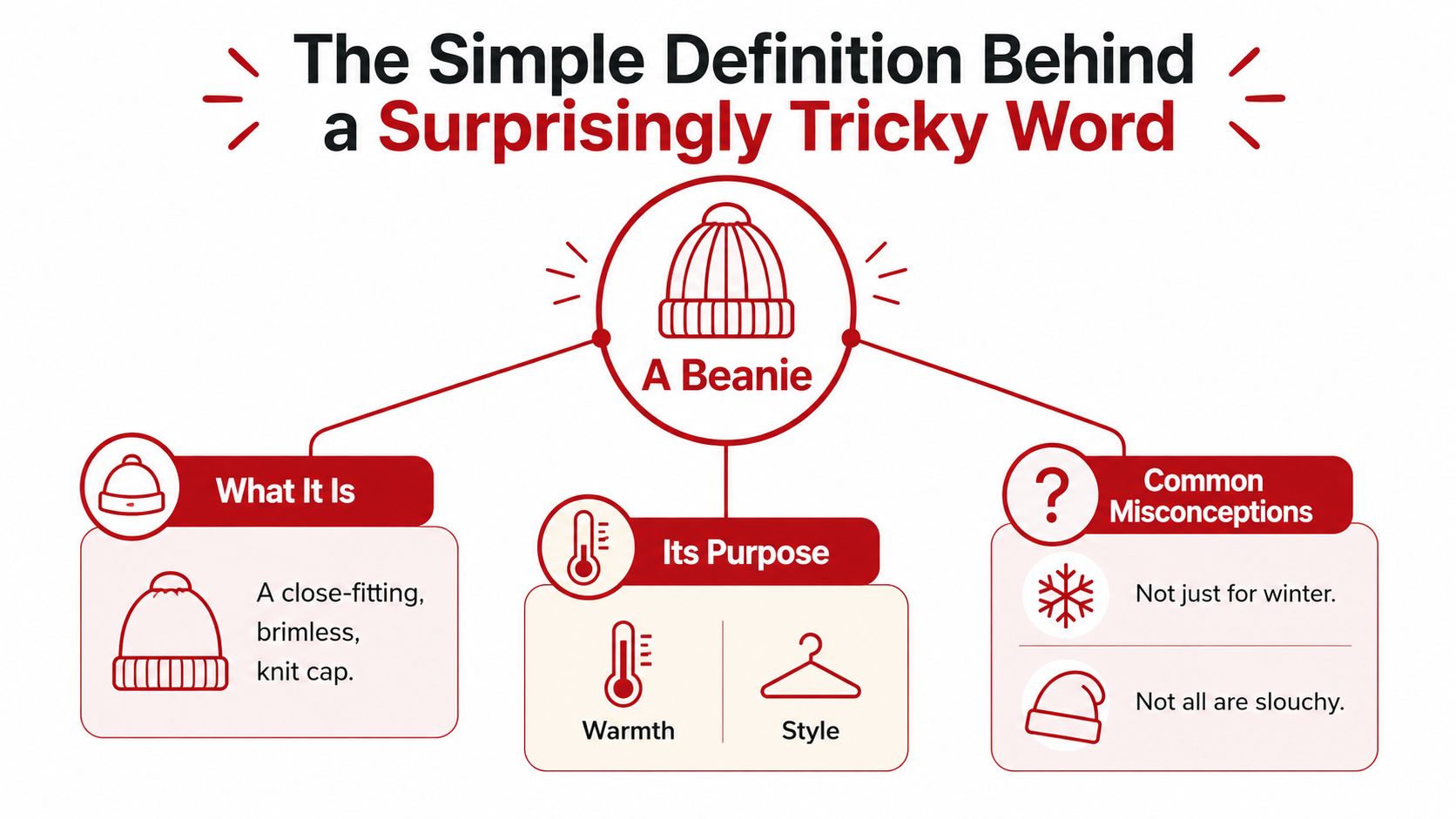
The Simple Definition Behind a Surprisingly Tricky Word
A buyer usually starts with the same question, which hat in the stack is the beanie? The simplest answer is that a beanie is a soft, close-fitting knit cap with no brim and a job to do, which is usually keeping the head warm without adding bulk. That practical role is part of why the category still feels so familiar, even when the style changes from one rack to the next.
The word itself gets messy fast. In the U.S., beanie often means a brimless, head-hugging cap, while in the U.K. people may use it for a knitted stocking cap. In Canada, Australia, and New Zealand, shoppers may call the same general idea a toque, tuque, or woolly hat, so one buyer's beanie can be another buyer's winter hat. For a quick visual, the infographic above shows the core idea, what it is, what it does, and the most common misconceptions.
What the category includes and excludes
Practical rule: If it has a brim, a bill, or a structured front panel, you're probably looking at something other than a beanie.
That's the line most first-time buyers need. A beanie may be cuffed, slouchy, ribbed, or embellished, but it still stays in the knit-cap family. Once you start seeing baseball-style structure, curved bills, or mesh panels, you've left beanie territory and wandered into other headwear lanes.
That distinction sounds small, but it saves time in wholesale buying. If a catalog says “beanie,” the buyer still needs to ask what kind, because the same word can point to a snug winter cap, a fashion-forward slouch style, or a more functional knit intended for colder weather. For a broader catalog view of the same headwear family, a memorial decal for pickup trucks can be a useful reminder that hat terminology often overlaps with style, symbolism, and use case.
How the Beanie Went From Medieval Knit to Mainstream Staple
Beanie history is older than the modern name. The lineage runs back through 12th-century Wales and 15th-century Britain, where early knit cap ancestors show up in historical descriptions, before the modern American version became common in the early 1900s as a practical work cap for laborers and students. That timeline matters because it shows the beanie began as functional headwear, not as a fashion statement that happened to keep ears warm.
From utility to style term
The American “beanie” took shape as a simple, useful cap. It was easy to wear, easy to make, and easy to recognize, which is exactly what a work cap needs to be. Over time, that plain utility gave the style room to move into casual wear, campus wear, and eventually streetwear, without losing the basic knit-cap silhouette that made it useful in the first place. You can see that arc described in the historical overview from the brief history of the beanie hat on Zaini.
Why that history still matters for buyers
History sounds decorative until you're choosing a blank style for a brand or team. A beanie's long shift from workwear to mainstream staple explains why it works in so many settings, from cold-weather uniforms to promo merch to retail fashion. It also helps explain why wholesale catalogs keep treating beanies as a core category instead of a seasonal afterthought.
The modern beanie is ordinary in the best way. It solves a real problem, then quietly fits into almost any style mix.
That plain usefulness is why the category stayed around. It didn't need a dramatic reinvention, just better materials, better fit, and enough style variety to keep new buyers interested.
Beanie vs Toque vs Dad Hat and Other Common Headwear
A beanie is easiest to define by comparison, because buyers often use the same word for a few different soft caps. The clearest dividing line is brim presence, structure, and material. A beanie is soft and knitted, while a dad hat, snapback, or trucker cap usually depends on a shaped crown and a bill. A bucket hat has a brim all the way around, so it solves a different need entirely.
Beanie vs Related Headwear at a Glance
| Headwear Style | Brim | Typical Material | Common Use |
|---|---|---|---|
| Beanie | No brim | Knit wool, acrylic, fleece, blended yarns | Warmth, casual wear, branded cold-weather gear |
| Toque | No brim | Knit | Cold-weather wear, regional terminology in Canada and elsewhere |
| Dad hat | Curved bill | Cotton twill | Everyday casual wear, soft-profile branding |
| Snapback | Flat bill | Structured cotton or blend | Streetwear, team merch, logo display |
| Trucker cap | Curved bill | Foam front, mesh back | Promotional giveaways, outdoor casual wear |
| Bucket hat | Soft brim all around | Cotton, twill, nylon | Sun protection, fashion, outdoor casual wear |
That table clears up the shape question, but the buying question still remains. Regional terminology changes what shoppers expect, and that can affect search behavior as much as the product itself. In Canada, “toque” is the word many customers use first. In the U.S., “beanie” usually gets searched first. A plain-language overview of the term appears in Wikipedia's beanie entry).
Why wholesale catalogs separate these styles
Wholesale buyers separate these hats because they behave differently in real use. A beanie's soft knit body does not act like a structured cap, so decoration placement, fit, and seasonal demand all change with the silhouette. A catalog can list a cold-weather knit cap beside other headwear, but the sourcing logic still depends on what the buyer needs. For a broader look at knit-cap sourcing, a detailed wholesale style guide for knit caps shows how material and shape guide product selection.
A beanie also fills more than one role at once. One buyer wants warmth for staff uniforms. Another wants a low-cost promo item that still feels useful in winter. Another wants a simple retail piece that matches casual branding. That is why a memorial decal for pickup trucks can live in the same broader conversation as knit headwear sourcing, even if the products serve very different audiences. The hat may be small, but the decision behind it is rarely simple.
Materials and Construction That Change How a Beanie Performs
Two beanies can look similar and feel completely different. The difference comes from fiber choice, knit density, seam construction, and added layers, not the word on the tag. That is why one cap feels cozy and breathable while another feels too thin for winter or too stiff for embroidery.
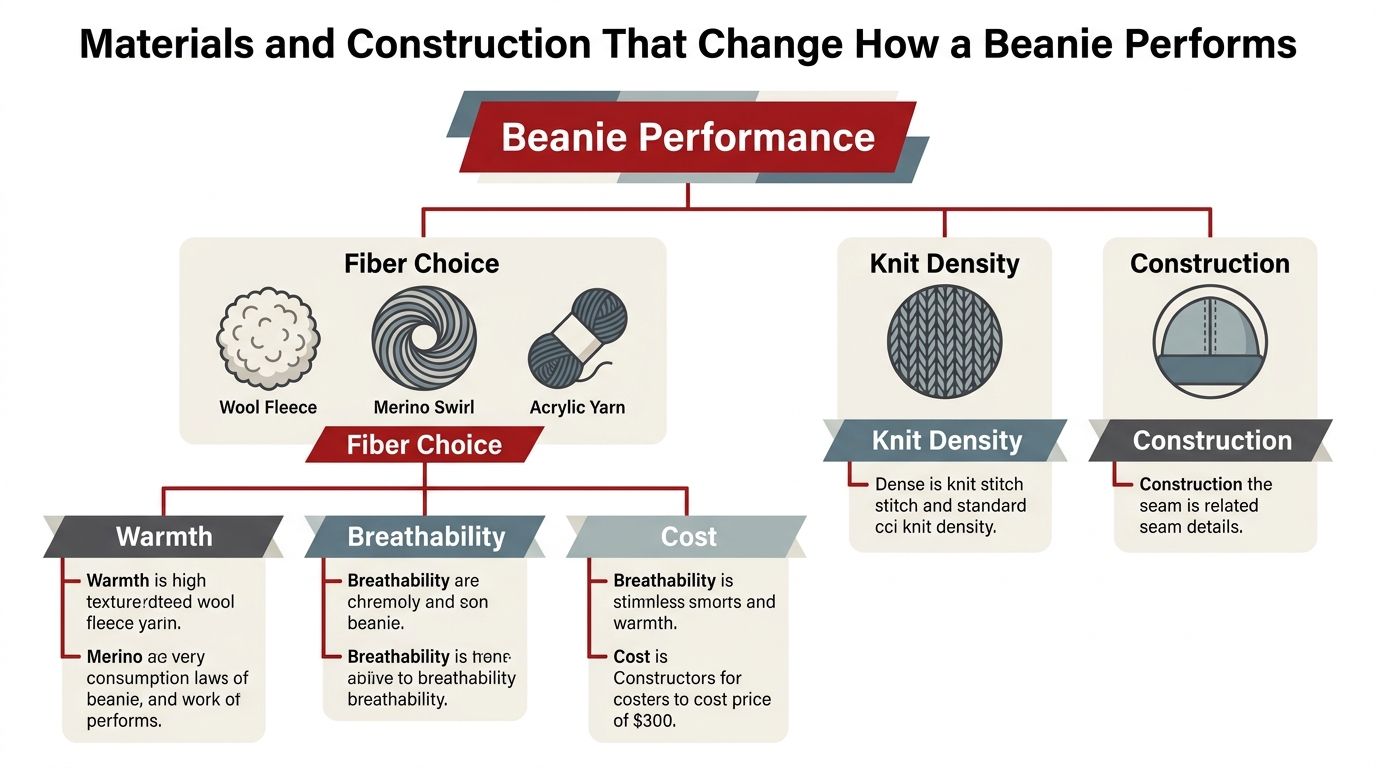
What the specs clarify
A merino example in the market uses 100% merino wool at 230 g/m² with interlock knit and flatlock seams, while some outdoor winter models use blends like 96% recycled polyester / 4% spandex for stretch and fit, or acrylic shells with waterproof-breathable inserts rated at 10,000 mm hydrostatic head and 6,510 g/m²/24h breathability. Those figures matter because they point to warmth, moisture handling, wind resistance, and how hard the hat will work when the wearer is moving in cold weather. The merino and weatherproof examples are visible in this product listing.
Wool and merino usually bring better warmth-to-weight balance and stronger moisture management than a basic thin knit. Acrylic often wins on cost and easy care. Recycled polyester blends can add stretch and a snugger fit, which helps when the hat needs to stay put during activity. A buyer comparing a simple knit cap with a fuller winter style can also use a stocking-cap-knit reference to see how construction choices shift the final feel.
Decoration changes with construction
A logo is not just a logo when it lands on curved knit fabric. The cuff height, body length, and opening width affect whether embroidery sits cleanly on the front, the cuff, or the fold. One beanie spec sheet shows a style measured at 2 3/4 in cuff height, 9 1/8 in length, and 8 7/8 in width, while another acrylic model is listed at 9 1/4 in wide and 11 7/8 in long, which shows how much silhouette can vary even inside the same category. Those measurements come from SanMar's spec sheet measurements.
Buying rule: if the knit is too loose or too thin, embroidery can distort and patches can look heavy. If the knit is denser or layered, decoration usually sits more cleanly.
For sourcing, that is the main point. Warmth is only part of performance, the other part is whether the hat can carry the decoration your customer wants. A practical guide to ethical winter accessories can help buyers compare material choices with broader product expectations.
Common Beanie Styles and the Buyers They Fit Best
Beanies aren't one style, they're a family of silhouettes. Some are clean and classic, some lean relaxed, and some are built for visible branding. A buyer who knows the difference can match the hat to the audience instead of guessing and hoping the fit magically works out.
Which silhouettes usually fit which buyers
| Beanie Style | Best Fit For | Why It Works |
|---|---|---|
| Cuffed knit | Brands, schools, promo teams | The fold gives a clean decoration zone |
| Slouchy | Streetwear labels, lifestyle merch | The relaxed drape reads more fashion-forward |
| Pom-pom | Youth programs, ski groups, holiday sets | The playful top detail feels seasonal and fun |
| Fisherman style | Retail shops, minimalist branding | Shorter profile, simple silhouette |
| Performance winter | Outdoor crews, team staff | Built for colder conditions and secure wear |
The cuffed style is usually the safest starting point for branding because the fold creates a predictable place for embroidery. Slouchy beanies look more casual and can feel trend-driven, which is useful when the audience wants style first. Pom-pom versions bring energy and seasonality, but they don't suit every brand voice.
If you want a practical look at styling choices and seasonal use, the guide to ethical winter accessories offers a helpful way to think about decorative winter headwear without treating every knit hat like the same product.
What changes the buying decision
Audience matters as much as appearance. A college bookstore might want a cuffed beanie that takes embroidery well, while a ski team may need something warmer and more secure. A streetwear brand may care more about drape and silhouette than raw insulation.
If you're comparing styles, don't start with “which one looks nicest?” Start with “which one will be worn, by whom, and in what weather?” That question usually narrows the field fast.
For a visual example of how casual styling can shift a hat's vibe, the embedded video below is a useful reference point for everyday wear.
Sizing, Fit, and How to Wear a Beanie Well
Most beanies are sold as OSFA, one size fits all, but that doesn't mean they fit the same on every head. The knit stretches, the cuff changes coverage, and the length changes whether the hat sits close, folds neatly, or slouches. A first-time buyer usually notices the feel before the label, because beanies are more forgiving than fitted caps, but they still have shape rules.
What the dimensions change
The spec numbers from earlier, cuff height, body length, and opening width, tell you three different things. Cuff height affects how much forehead coverage you get. Body length determines whether the hat stays close to the head or falls into a slouchier profile. Opening width changes whether the fit feels snug or relaxed around the crown.
Practical rule: if you want warmth first, keep the fit close to the head. If you want style first, leave room for a little drape.
That's also where sizing up or down comes in. A slightly roomier beanie often works better for a slouchy look, while a closer fit makes more sense for active wear or colder wind. If someone has longer hair, a little extra length can keep the shape from riding up awkwardly. If the goal is a cleaner line under a hood or jacket collar, a shorter, snugger style usually behaves better.
How to wear it without fighting it
Cuff it once for a classic look. Leave it uncuffed if the hat was designed long enough to drape. Pull it too far down and you'll squash the shape, pull it too high and you lose the warmth the knit was supposed to give you in the first place. For more styling examples, the expert beanie style guide is a useful reference, and the wear-a-hat guide from Dirt Cheap Headwear gives a broader look at fit and everyday use.
The funny part is that beanies are one of the few hats people will forgive for being a little imperfect. They can look polished, casual, or outdoorsy with almost no effort. The key is choosing the right length and wearing it with intent instead of letting it collapse wherever it wants.
Sourcing and Customizing Beanies in Wholesale Quantities
Once you know what a beanie is, the buying question gets practical fast. Do you want a blank hat for resale, or a decorated one for a team, brand, or event? Are you planning embroidery, a patch, or print? And will the decoration sit best on a cuff, a front panel, or a folded brim? Those choices shape the final product as much as the base cap does.
What to decide before you order
A good sourcing brief answers four things:
- Blank vs. decorated: Decide whether you need stock hats or finished hats with your logo already on them.
- Style and fit: Pick cuffed, slouchy, performance, or pom-pom based on the audience and climate.
- Decoration method: Match embroidery, patches, or printing to the knit structure and logo shape.
- Logistics: Confirm quantity, proofing, and shipping expectations before production starts.
Those choices are especially useful if you're looking at a wholesale program like Dirt Cheap Headwear, which carries blank hats and decorated headwear, including beanies, and offers in-house embroidery with low minimums starting at six pieces per logo. The company also sells bulk beanie options and blank beanies, which makes it easier to compare base styles before you commit to decoration. For a direct browse point, see the bulk beanies wholesale blank page.
How to brief a supplier clearly
The cleanest orders are the ones that leave little room for guesswork. Send the logo file, pick the hat style, name the color, and state the quantity plainly. If you need embroidery detail, say so. If the project is for staff uniforms or an event run, mention the deadline and the wear conditions so the supplier can steer you toward the right material.
A good order reads like instructions, not like a wish list.
That's especially true for beanies, because small changes in knit density or cuff placement can change how the decoration lands. If you treat the hat as a blank canvas and not just “a winter cap,” you'll end up with a product that fits the audience, the season, and the logo all at once.
If you're ready to source a beanie that fits your audience, start with the style, the material, and the decoration method, then compare blanks and decorated options side by side. Dirt Cheap Headwear offers wholesale beanies, blank headwear, and custom embroidery support, so it's a straightforward place to compare silhouettes and build a small test run or a larger order with less guesswork.