
Trucker Hat vs Snapback: Which Is Best for Your Brand?
You're probably in the same spot a lot of first-time merch buyers hit. You need custom hats for your staff, customers, event table, or online store, and the shortlist keeps coming back to two styles: trucker hats and snapbacks.
On the surface, the choice looks simple. One has mesh. One has a flat bill. But when you're the one paying for blanks, approving proofs, and hoping your logo still looks clean after months of wear, the main question isn't fashion. It's which hat gives your brand the better result.
That's where most buying guides fall short. They talk about vibe, maybe fit, and stop there. A business owner needs more than that. You need to know what the front panel does to embroidery, what style usually costs less to buy in quantity, which one reads as premium, and which one makes sense for the people who'll wear it.
Choosing the Right Canvas for Your Brand
A lot of hat orders start with a logo file and a deadline. A brewery wants staff hats before patio season. A landscaping company needs something employees can wear outdoors. A startup wants merch that doesn't look cheap when it lands in a client gift box. The style decision usually gets framed as personal taste, but in practice it's a branding decision with production consequences.
Trucker hats were built for function first. They were originally engineered in the 1960s as promotional gear for farm supply companies, using a foam front and breathable mesh back to keep workers cool. Later, the same style crossed into fashion and streetwear around the year 2000, which is why it now feels equally at home at a jobsite, a concert, or a retail rack, as noted in Jacksons Western's cap breakdown.
That history matters because it still shapes expectations. A trucker often feels casual, rugged, outdoor-ready, and approachable. A snapback usually feels more deliberate and more polished. Neither is automatically better. The right pick depends on what your logo needs and how you want people to read your brand the second they see the hat.
If you're still comparing styles beyond these two, T-Shirt Envy's custom hat guide is a useful outside reference because it helps narrow the field before you commit to a sample run. For a more style-focused walkthrough of profiles and use cases, this hat style guide is also worth reviewing before you place an order.
The blank isn't just a hat. It's the surface your logo has to live on.
What business owners usually miss
The biggest mistake is treating all decorated hats like they'll perform the same once the logo goes on. They won't. A foam-front trucker and a fabric-front snapback can produce very different embroidery results, even when the artwork file is identical.
That's why the trucker hat vs snapback decision should happen before finalizing decoration specs. If you choose the hat first with no regard for stitch detail, front-panel stability, or wear conditions, you can end up paying for a style that fights your design.
| Factor | Trucker Hat | Snapback |
|---|---|---|
| Core identity | Mesh-backed promotional workwear turned casual fashion | Structured cap style defined by snap closure and strong silhouette |
| Front panel | Commonly foam or foam-like single front | Structured fabric panels, often cotton twill or buckram-backed |
| Usual look | Relaxed, rugged, outdoorsy | Clean, bold, retail-ready |
| Best logo fit | Large, simple, bold marks | Fine-detail embroidery and sharper linework |
| Typical price position | Often more budget-friendly at the blank level | Usually starts higher for basic blanks |
| Brand impression | Friendly, casual, practical | Premium, urban, team-oriented, polished |
Anatomy of a Hat Construction and Materials
A buyer approves a sample on the screen, then gets the finished hats and wonders why the logo already looks softer on one style than the other. In production, that usually traces back to the front panel. Foam and fabric do not behave the same under embroidery, heat, storage, or daily wear.
A trucker hat and a snapback can share the same plastic snap closure, but they are built on very different shells. Trucker hats usually pair a foam or foam-backed front with mesh side and back panels. Snapbacks are more often full-fabric caps with structured front panels supported by buckram. That difference changes how the hat feels in hand, how it carries a logo, and how well that logo holds its shape after months of use.

How the shell affects performance
RushOrderTees' comparison of trucker hats and baseball caps describes the standard trucker build as a foam front with mesh panels, while baseball-style structured caps use solid fabric panels that create a firmer crown. That construction gap matters more than many first-time buyers expect.
Foam fronts are light, inexpensive, and great for bold art. They are also easier to crease, easier to dent in transit, and less forgiving with detailed embroidery. Once the foam starts to break down or ripple, the stitches on top can lose their clean edge.
Fabric fronts with buckram support hold tension better. Needle penetration stays more consistent, small lettering has a better chance of reading cleanly, and the crown keeps a sharper face on display racks and on the customer's head. For a business investing in repeat uniform orders or resale merchandise, that usually translates into a more stable finished product.
Crown shape, brim, and profile
Profile changes how a hat presents your brand before anyone reads the logo.
Trucker crowns are often tall in front with a broad decoration area and a pre-curved brim. That gives them an easy, casual look that works well for outdoor brands, service crews, breweries, feed stores, and promo-heavy events.
Snapbacks usually have a firmer, more angular crown with a flatter brim and a stronger front face. They tend to look cleaner on a retail wall and hold that shape longer in storage. If you are comparing crown behavior, this guide to structured vs unstructured hats gives a good breakdown of why some caps stay upright and others relax over time.
Material differences buyers notice after the box arrives
The first thing buyers notice is weight and airflow. The second is surface quality.
| Build detail | Trucker | Snapback |
|---|---|---|
| Back panels | Mesh | Full fabric |
| Front panel material | Foam or foam-backed front | Fabric front, often twill with buckram support |
| Surface behavior under embroidery | Better for larger, simpler logos | Better for finer detail and cleaner edges |
| Overall feel | Lighter and more ventilated | Denser and more substantial |
| Shelf appearance over time | More casual, can show dents sooner | Cleaner silhouette, usually holds shape longer |
That front-panel material is the part many buyers skip past, and it is often the part that decides whether a hat still looks good after a season of wear. If the goal is a relaxed promotional cap at a lower blank cost, foam-front truckers do that job well. If the goal is a sharper branded piece that keeps the logo looking crisp longer, a structured fabric-front snapback usually gives you a better base.
The Logo Test Decoration and Customization Suitability
This is the part that should drive the decision for most businesses.
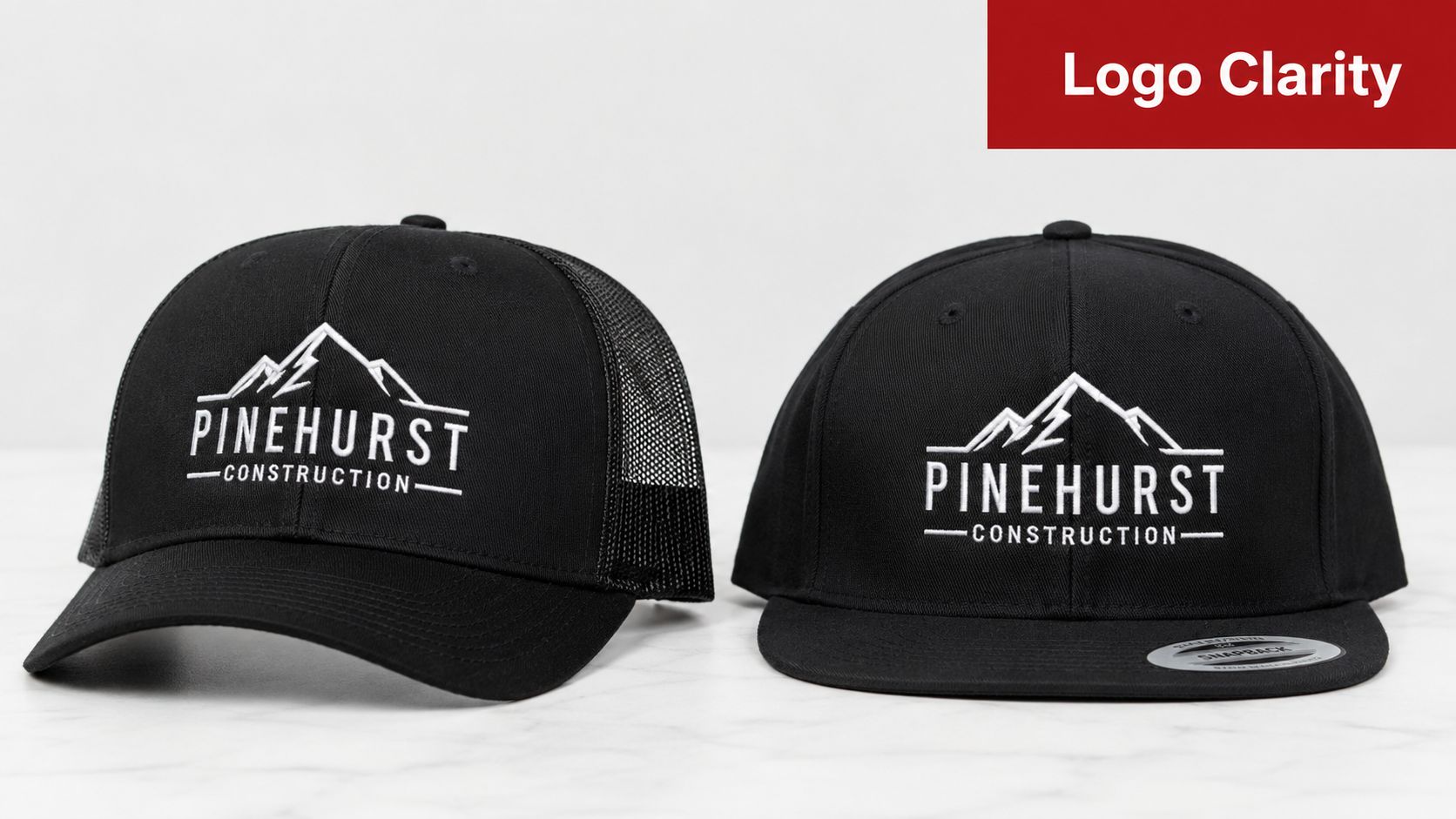
If your logo has tiny text, thin outlines, layered stitch paths, or fine internal detail, the trucker hat vs snapback question stops being aesthetic and becomes technical. The front panel determines how clean the embroidery looks on day one and how well that look holds up after use.
Where snapbacks usually win
The strongest practical argument for snapbacks is logo sharpness.
Purnaa's comparison of custom trucker hats and snapback hats notes that trucker foam fronts work well for large logos, but the foam can degrade under high heat from embroidery presses over time. Snapbacks use stiff cotton or buckram that stabilizes detailed stitching better, which supports sharper lines and helps preserve embroidery quality after repeated washes.
That aligns with what decorators see in real production. A stable fabric front tends to hold registration better on detailed art. Needle penetration is more predictable. The hat doesn't fight the design as much.
Choose a snapback first when your artwork includes:
- Small lettering: Company names under the main logo often stay cleaner on structured fabric.
- Thin borders: Outlines hold their shape better when the panel doesn't compress as easily.
- Layered embroidery: Multi-part designs benefit from a front panel that stays firm during stitching.
- Retail presentation: If the hat needs to look crisp on display, the snapback usually gives a cleaner face.
Where truckers shine
Trucker hats still have a real advantage. They give decorators a broad, simple canvas that works especially well for bold branding.
That makes them a strong fit for:
- Large logos with simple shapes
- Big text across the front
- Badge-style artwork
- Patches
- 3D puff embroidery when the design is chunky and clean
Foam fronts tend to be forgiving with bold art because the logo doesn't need fine precision to look good. In fact, some oversized designs look better on a trucker because the style already leans casual and graphic.
Shop-floor rule: The more detailed the logo, the less forgiving foam becomes.
Matching decoration method to the hat
Not every logo should go straight to direct embroidery.
If you're trying to decorate either style well, think in methods:
- Direct embroidery works best on snapbacks when precision matters.
- Large-format embroidery often suits truckers better than tiny, technical stitching.
- Woven or PVC patches can level the playing field if your art is too complex for either panel to render cleanly in thread.
- Printed transfers or specialty applications can make sense on selected trucker fronts, depending on the blank and finish.
If you're weighing thread, patch, and print options, this guide to hat printing and embroidery methods is useful because decoration choice changes the outcome as much as the hat itself.
The mistake I'd avoid is forcing a highly detailed logo onto a foam trucker just because the blank is cheaper. Saving money on the blank doesn't help if the finished hat makes your branding look soft or crowded.
Fit Feel and Function for Different Audiences
Once the logo question is settled, the next issue is wearability. A hat can decorate well and still miss the mark if it doesn't fit your audience, your environment, or the image your business wants to project.

Who usually wears what
A trucker hat tends to land well with brands that want to look approachable and active. Think breweries, landscaping companies, bait and tackle shops, motorsports vendors, outdoor festivals, and work crews. The mesh back and curved profile signal utility first, even when the hat is sold as merch.
A snapback usually fits brands that want more edge or more structure. Streetwear labels, team merchandise, gyms, creative agencies, and startup merch programs often prefer the cleaner silhouette. It feels more intentional, and the full-fabric build reads better in polished product photography.
Here's the simple way to understand it:
| Audience or use case | Better fit |
|---|---|
| Outdoor crews and hot-weather casual wear | Trucker hat |
| Retail merch with a sharper look | Snapback |
| Bold giveaway hat for events | Trucker hat |
| Premium-feeling branded headwear | Snapback |
The climate question isn't as simple as people think
A lot of buyers assume truckers are automatically the best hot-weather option because of the mesh back. That's partly true, but it's incomplete.
The bigger point is this: airflow isn't the same thing as total performance. Mesh vents heat, but it also leaves the back of the head more exposed. And as noted in this discussion of performance snapback trends and trucker trade-offs, trucker mesh offers airflow but zero UV protection, while newer performance-oriented snapbacks use moisture-wicking blends and perforated panels that can rival trucker ventilation while offering better sun blocking and sweat management.
That doesn't mean every snapback beats every trucker in the heat. It means you shouldn't decide based on “mesh equals cooler” alone.
If the hat is for all-day outdoor wear, ask two questions: how it breathes, and how it handles sun and sweat.
Brand image matters more than trend chasing
A lot of small businesses buy the wrong hat because they chase what's popular instead of what fits their customer.
- Choose truckers if your brand feels hands-on, local, rugged, or easygoing.
- Choose snapbacks if your brand needs cleaner lines and stronger shelf presence.
- Test both if you sell to mixed audiences and want one casual option plus one more retail-ready option.
The best wholesale programs often carry both styles for that reason. Staff uniforms and promotional giveaways may lean trucker, while customer-facing merch and limited runs often perform better as snapbacks.
Cost and Bulk Ordering A Look at Your Bottom Line
You approve 250 hats because the trucker quote looks cheaper. Then the sew-out comes back soft around the edges, the front panel puckers, and now you are paying for patches, a digitizing revision, or a different blank. That is how a low unit cost turns into an expensive order.
Truckers usually win on entry price. Snapbacks usually cost more up front. For bulk buyers, that gap matters, especially on giveaways, staff issue, and event merch where every dollar per unit affects the full run.
What gets missed is decoration yield. In my shop, the front panel changes the math as much as the blank price.
A foam-front trucker can be a good value for bold artwork, large shapes, and simple brand marks. It keeps the initial spend down and works well when the goal is reach, not polish. But foam is less forgiving over time. Fine embroidery can sink, shift, or lose edge definition faster as the panel takes wear. If your logo has small text, sharp corners, or tight satin borders, the cheaper blank can create more rejects and more customer complaints later.
A fabric-front snapback usually costs more, but it gives decorators a more stable surface for clean embroidery. That matters in two places:
- At production: cleaner registration, better stitch control, fewer compromises on detailed logos
- After sale or distribution: the logo tends to hold its shape better as the hat gets worn, stacked, and transported
That second point affects real margin. A hat that still looks sharp after a season does more for your brand than a cheaper hat that starts looking tired early.
Here is where bulk buyers usually see the difference most clearly:
- Promotional handouts: truckers often make sense if the logo is simple and the goal is maximum unit count
- Staff uniforms: choose based on wear conditions and logo complexity, not blank cost alone
- Retail merch: snapbacks often justify the higher cost because the finish looks cleaner on the shelf and the decoration holds up better
- Detailed brand marks: budget for a fabric front, a patch, or both
Patches can help close the gap. If you want the trucker price point but your logo is too detailed for a foam front to carry well, a woven or embroidered patch often gives a cleaner result than forcing direct embroidery onto the wrong panel.
My rule for first orders is simple:
- Price the blank.
- Price the decoration on that specific front panel.
- Review a sew-out or sample.
- Count the cost of remakes, not just the invoice.
Buyers who skip step three usually spend more.
If the hat is meant to be cheap and wide-reaching, a trucker is often the right call. If the hat needs to look crisp, hold logo detail, and support a stronger brand image over time, the higher snapback cost is often the better buy.
Care Durability and Lifespan
A custom hat isn't done costing you once it ships. If it loses shape, stains easily, or the logo starts looking rough too soon, the value drops fast.
The first rule is simple. Treat decorated hats like branded gear, not laundry-bin basics. Machine washing and high heat are hard on almost every custom cap, but they're especially risky when the front panel has less structural stability.
What usually ages better
Snapbacks generally handle long-term shape retention better because the front is built on firmer fabric structure. That matters when hats get tossed in a truck seat, packed into event bins, or worn over and over by staff.
Trucker hats can stay perfectly serviceable for a long time, but the foam front needs more respect. Creasing, compression, and rough heat exposure tend to show faster there than on a structured fabric snapback. And if your logo depends on crisp embroidery detail, that front-panel difference becomes more visible over time.
Store decorated hats upright whenever possible. Crushing the crown is one of the fastest ways to make good embroidery look sloppy.
Simple care steps worth giving customers or staff
If you're distributing branded hats, include a basic care note. It prevents avoidable damage.
- Spot clean first: Use a soft cloth, mild soap, and light pressure.
- Skip high heat: Don't use hot dryers or aggressive heat near embroidered fronts.
- Air dry only: Let the hat dry in shape, ideally on a clean towel or hat form.
- Don't fold the crown: Especially important for truckers with foam fronts.
- Handle sweat early: Salt and oils are easier to remove before they set.
Protecting the logo, not just the hat
The logo is a key asset. That's why durability isn't just about the shell material. It's about whether the decorated area stays clean, legible, and presentable.
For brands that need embroidery to stay sharp through repeated wear, the safer long-term bet is often the structured fabric front. For brands using bold, less intricate graphics in a more casual lane, truckers still hold up well if users treat them properly.
Final Verdict Which Hat Should Your Business Choose
Most buyers don't need a universal winner. They need the right tool for the job.
If I'm advising a new business owner on the trucker hat vs snapback decision, I look at four things in this order: logo detail, audience, price sensitivity, and the image the brand wants to put into the world. Once those are clear, the choice usually gets easier.
Choose a trucker hat if
- Your logo is large, bold, and simple
- Your brand leans outdoor, rugged, casual, or promotional
- You want a blank that's often more budget-friendly
- The hats are for events, crews, giveaways, or broad distribution
- A mesh-back look fits your customer better than a full-fabric cap
Truckers work especially well when the hat needs to feel easy to wear and easy to hand out. They also make sense when your customers already associate your category with practical gear instead of polished merch.
Choose a snapback if
- Your logo includes fine detail or small text
- You want sharper embroidery lines and a more stable front panel
- The product needs a cleaner, more premium look
- You're building retail merch, team gear, or polished brand apparel
- You want a hat that usually holds its structured appearance better over time
Snapbacks are usually the safer play when decoration quality is the top priority. They cost more up front in many cases, but that extra spend can pay off if the hat is meant to represent your brand at a higher level.
My practical recommendation
If you can only test one style and your logo has detail, start with a snapback.
If your artwork is bold and your budget matters more, start with a trucker.
If you're building a real merch program, sample both. One may become your event and staff hat. The other may become your better-margin retail piece. That split is often smarter than trying to make one hat do every job.
If you're ready to compare blanks, test embroidery, or price out a small run before committing to bulk, Dirt Cheap Headwear makes that process a lot easier. You can browse wholesale styles, request custom decoration, and get help matching your logo to the right hat so you don't waste money on the wrong canvas.