
Fitted Hat Sizing Guide: Get the Perfect Fit Every Time
You've got logos approved, colors picked, and a deadline coming fast. The hats are the last thing standing between your team and a clean launch, event, or merch drop. Then the sizing question lands on your desk, and that's where a lot of bulk orders go sideways.
A fitted hat is less forgiving than a snapback or hook-and-loop cap. If the size is off, there's no easy rescue after the boxes arrive. That matters when you're ordering for staff, a baseball program, a retail shelf, or a customer giveaway. One bad size mix can leave you with hats nobody wants to wear, plus decoration dollars tied up in inventory you can't easily repurpose.
A good fitted hat sizing guide isn't just about comfort. For B2B buyers, it's a way to control waste, avoid reorders, and keep the final product looking intentional across a mixed group of wearers.
Why Nailing Your Hat Size Matters More Than You Think
Bulk hat orders usually don't fail because the embroidery file was bad. They fail because the fit felt wrong the second people tried them on.
That shows up in a few predictable ways. Staff members grab one, put it on, and gently set it back down. Team parents ask if there's an adjustable version. Your event crew wears the hat for photos, then switches back to their own cap an hour later. The logo may look sharp, but the order still misses the mark if the hat doesn't stay on heads.
What a sizing mistake costs in real life
For a single buyer, the wrong fitted size is annoying. For a business, school, or brand, it creates extra decisions you didn't plan for.
- Unwearable decorated inventory: Once a fitted hat is embroidered, you can't swap sizes the way you might with blank stock.
- Brand inconsistency: When some people can wear the official hat and others can't, the program starts looking pieced together.
- Last-minute substitutions: Buyers often end up mixing in snapbacks or stretch-fit styles after the fact just to cover the gap.
- Morale issues: If your branded gear feels like an afterthought, people notice.
Why fitted hats need a tighter process
A fitted cap asks for precision. There's no plastic snap, buckle, or strap to hide a rough estimate. The size needs to be close, and the style needs to match the wearer.
That matters even more when you're buying for a group with different head shapes, hairstyles, and fit preferences. One person may like a rigid, pro-style crown. Another may only tolerate a stretch blend. If you order by guesswork, you'll usually overbuy the middle and under-serve everyone on the edges.
A fitted order works best when you treat sizing as part of the decoration plan, not an afterthought after the logo is approved.
That's the shift most new buyers miss. Size is not just a warehouse detail. It affects wear rate, presentation, and whether the hats get used after delivery.
How to Measure Your Head Like a Pro in Under a Minute
A team order usually starts the same way. One person says they wear a large, someone else reads an old hat tag, and three employees send numbers that were measured at different spots on the head. That is how fitted orders drift off course before the artwork is even approved.
The right starting point is simple. Measure head circumference at the line where the hat sits.

Use a soft tape and wrap it about 1 inch above the eyebrows and just above the ears, keeping it level all the way around, as shown in this hat measurement guide.
For bulk orders, consistency matters as much as accuracy. If ten people measure at ten different heights, the numbers will look precise on paper and still produce the wrong size mix.
Method one with a soft tape measure
A sewing tape gives the cleanest reading and is the easiest method to repeat across a staff, team, or event group.
Start at the forehead
Place the tape about 1 inch above the eyebrows, where the front of the fitted cap will rest.Run it above the ears
Keep the tape on the natural hat line. If it creeps upward, the reading gets smaller than the person needs.Keep it level around the back
Check the mirror or have another person confirm the tape is flat and even.Pull snug, not tight
The tape should touch the head without squeezing. A compressed reading is one of the fastest ways to order hats that come in too tight.Write down the circumference
Record the number in inches. For a company or school order, collect every measurement in one shared sheet with names, style, and any fit notes.
Method two with string and a ruler
String is fine if that is what people have on hand. It just needs a little more care.
- Wrap the string around the same measuring line, about 1 inch above the eyebrows and above the ears.
- Mark the meeting point with a pen or by pinching the spot.
- Lay it flat against a ruler and read the full length.
- Measure twice if the result seems off or lands between common sizes.
I use this method as a backup, not a first choice, especially for decorated bulk orders where size mistakes are expensive to fix.
The mistakes that throw the number off
Bad readings usually come from placement, not conversion.
- Tape too high: The customer ends up ordered into a smaller fitted size.
- Tape too tight: Common with self-measuring and mirror checks.
- Tape out of level: One side rides up, and the number looks smaller than it should.
- Using an old hat tag: Different brands, crown shapes, and fabrics fit differently. A worn cap also stretches over time.
- Collecting guessed sizes instead of measurements: This is a common problem on team orders, especially when one buyer is gathering responses from a large group.
If part of your order includes stretch-fit options, compare the circumference against a brand-specific chart like the Flexfit hat size chart for group size planning. That helps when you are splitting wearers into S/M and L/XL while keeping the overall program visually consistent.
A quick visual can help if you're collecting measurements from several people and want everyone following the same process.
A practical move for team orders
Ask for the measurement, not the opinion.
Instead of asking, “What fitted size do you wear?”, send one short instruction to every person in the order: measure at the natural hat line, use a soft tape or string, record the number in inches, and send it back exactly as measured. That gives you cleaner data for assigning sizes, checking style compatibility, and avoiding decoration waste on hats your group will not wear.
From Inches to Hat Size A Simple Conversion Guide
Once you have the circumference, the next job is converting that number into a standard U.S. fitted size. While many buyers hesitate here, the system is straightforward once you see the pattern.

Universal charts use size 7 as 22 inches (56 cm), and sizes move upward in 1/8-inch increments up to size 8 at 25 1/8 inches (64 cm). When a measurement lands between sizes, the standard advice is to round up to the nearest 1/8 inch so the hat doesn't press uncomfortably, as shown in this hat fit guide and sizing chart.
Quick conversion examples
Here's a simple reference set for commonly ordered fitted sizes:
| Head circumference | U.S. fitted size |
|---|---|
| 21 5/8 inches | 6 7/8 |
| 22 inches | 7 |
| 22 3/8 inches | 7 1/8 |
| 22 3/4 inches | 7 1/4 |
| 23 1/8 inches | 7 3/8 |
| 23 1/2 inches | 7 1/2 |
| 23 7/8 inches | 7 5/8 |
| 24 1/4 inches | 7 3/4 |
If you want a full reference before assigning sizes to a mixed order, use this hat sizing chart.
What to do when the measurement lands in between
This is the part buyers overcomplicate. If someone measures between two fitted sizes, round up.
If the tape lands between marks, the larger fitted size is usually the safer call for comfort.
That's especially important on rigid fitted styles. A hat that starts slightly roomy can often feel fine after normal wear. A hat that starts too tight usually stays in the box.
How stretch-fit sizing changes the decision
Stretch-fit hats use grouped sizes like S/M and L/XL, so you don't get the same granularity as a true fitted cap. That can make life easier when you're ordering for a broad team, but it also means you're balancing range rather than picking an exact fraction.
A practical way to handle that in group orders is to separate people into three buckets:
- Clearly in the smaller range
- Clearly in the larger range
- Borderline measurements that need a style decision
For that third group, the hat material matters. Some styles forgive a close call. Others don't. That's where size conversion stops being purely mechanical and starts becoming a product choice.
Not All Fitted Hats Are Created Equal Brand and Material Fit
Two hats can show the same labeled size and still feel different on the head. Buyers run into this all the time when they assume a fitted wool cap and a stretch-fit polyester blend will behave the same way. They won't.
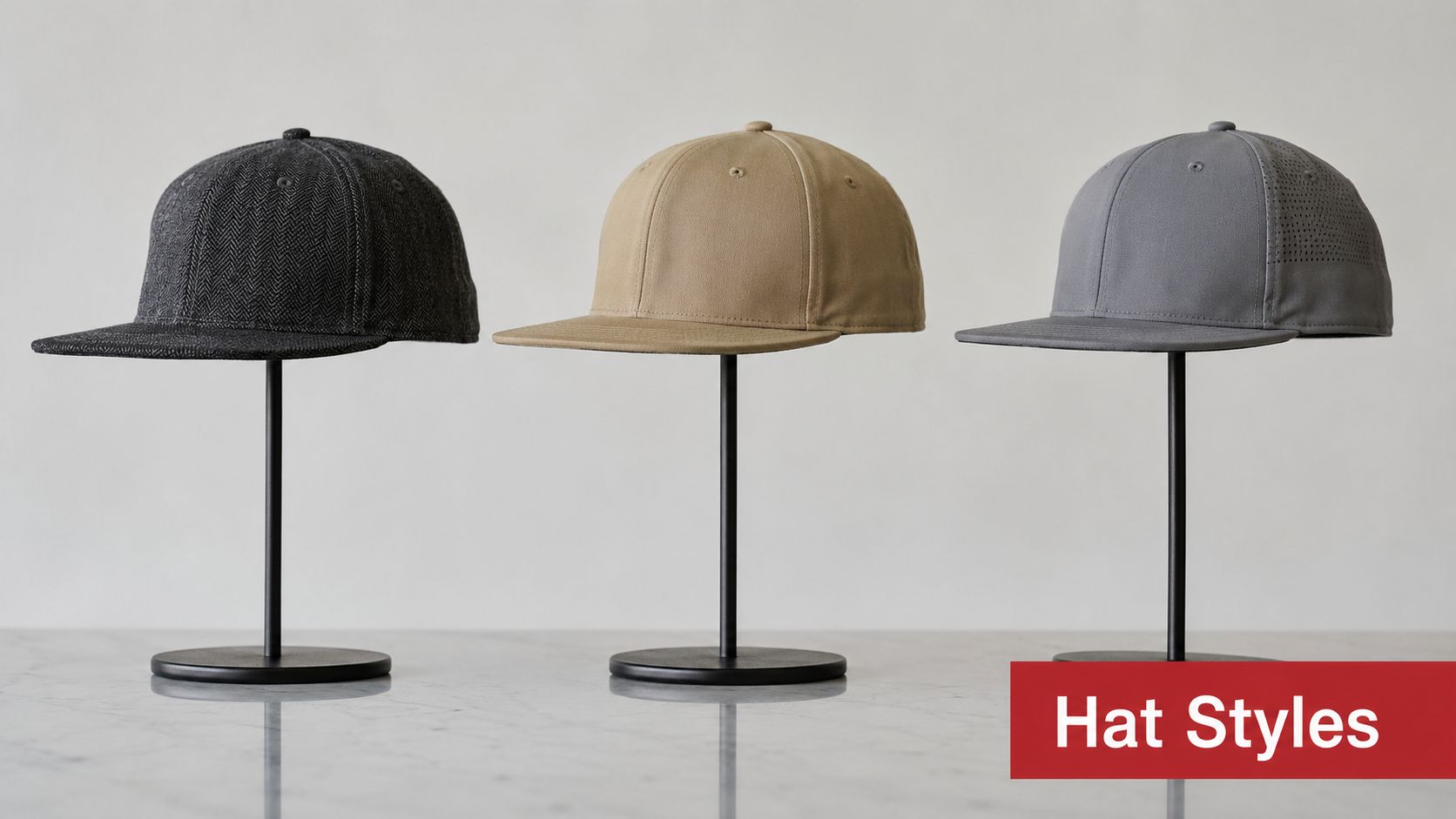
The big divider is material stretch and construction. A structured fitted cap with a firm body tends to hold its shape and fit more rigidly. A stretch-fit style gives you more tolerance around borderline measurements.
Rigid fitted versus stretch-fit
For stiff wool or cotton caps like the New Era 59FIFTY, there's minimal stretch, so even a small underestimate can create painful pressure. Polyester-blend options like Flexfit can stretch 5 to 8%, which makes a slightly smaller size more workable. If you're unsure on a non-stretch hat, sizing up is the safer move, according to this brand and material fit guide.
That one point changes how I'd build a bulk order.
- Use rigid fitted styles when you want a classic, exact, pro-style look and you trust the measurements.
- Use stretch-fit styles when the group is diverse and you need more forgiveness.
- Avoid mixing assumptions across brands. The same nominal size doesn't guarantee the same feel.
Crown shape also changes the experience
Fit isn't only about circumference. Crown profile affects both comfort and appearance.
A high-profile structured cap gives you a taller front panel and more visual presence. That works well for bold embroidery and streetwear-style branding. A mid-profile option is easier for general-purpose team wear. A low-profile fit can feel cleaner on some head shapes, but it offers a different silhouette and less front-panel presence.
If you're comparing shape as well as fit, this guide on structured vs unstructured hats helps clarify how construction changes the way a cap sits.
What this means for group orders
A company ordering hats for office staff may want broad wearability. A baseball organization may want a more traditional on-field look. A retail brand may care most about silhouette consistency for resale.
Those aren't the same order, even if the logo is identical.
A size chart tells you what might fit. The hat's material and build tell you how it will feel after an hour on someone's head.
For mixed groups, the safest path is usually to choose one lane on purpose. Either commit to a true fitted style and collect precise measurements, or use a stretch-fit option that can absorb some variation. Trouble starts when buyers want rigid fitted aesthetics but gather sizes with stretch-fit assumptions.
Pro Tips to Avoid Common Sizing Disasters
Most measuring guides stop too early. They tell people where to place the tape, then act like the job is done. In bulk ordering, a few smaller factors can still wreck an otherwise careful size plan.
The biggest one is timing.
Measure when the head is closest to real wear conditions
Human head size can increase by 0.1 to 0.3 inches (2.5 to 7.6 mm) from morning to evening because of natural fluid retention, and that shift matters with fitted caps that have no adjustability, as noted in this hat sizing article on daily fluctuation.
That doesn't mean everyone needs a lab-grade protocol. It means you shouldn't collect bulk measurements with zero context.
A practical rule is to have people measure at a normal point in the day when they'd wear the hat, not right after waking up. If the hats are for work crews, game-day staff, or long events, midday or later often gives a more realistic reading than an early-morning measurement.
Hair changes the fit more than people admit
Hair volume can turn a “close enough” fitted size into a return problem. This shows up with curls, braids, locs, thick hair worn down, or anyone who switches between flat and fuller styles.
Use these checks before you finalize a size list:
- Measure with your usual hairstyle: If the hat will be worn over styled hair, measure that way.
- Don't flatten everything just to get a smaller number: That only produces a tighter hat later.
- Flag inconsistent wearers: If someone alternates between very different hairstyles, a stretch-fit option may be the smarter call.
Get cleaner data from the group
The quality of a bulk order depends on the quality of the size collection. Casual text replies like “medium probably” or “same as New Era” create noise fast.
Try a simple intake sheet with these fields:
| What to collect | Why it matters |
|---|---|
| Head circumference in inches | Gives you a standard measurement to convert |
| Preferred hat style | Helps separate rigid fitted from stretch-fit needs |
| Hair considerations | Catches fit issues before ordering |
| Known comfort preference | Some people hate tight hats and should not be sized aggressively |
Don't let one person measure everyone loosely
This is common with schools and team managers. One volunteer measures twenty people in a rush, pulls the tape tight, and suddenly your whole order trends small.
Shop-floor advice: Recheck any cluster of measurements that all look nearly identical. Real groups usually show more spread than you expect.
Another mistake is using a one-style solution for every wearer. If your group has a wide range of preferences, you may be better off splitting the order by style family instead of forcing every person into one rigid fitted cap. That keeps the branding consistent while giving the group a better chance of wearing what you ordered.
Placing Your Dirt Cheap Headwear Custom Order with Confidence
By the time you're ready to buy, sizing should already be tied to style, wear conditions, and decoration. That's what separates a smooth custom order from a pile of guesswork.
Match the logo plan to the hat plan
Smaller fitted sizes can change how a logo reads on the front panel, especially on structured caps with less forgiving proportions. High-crown styles usually give embroidery more room to breathe. Lower-profile shapes can still look excellent, but the art often needs to be scaled and positioned with more care.
That matters when brand consistency is the goal. A logo that looks balanced on one crown style may feel oversized or cramped on another. If you're ordering across multiple sizes, it helps to think about decoration and fit as one decision instead of two separate approvals.
Use a test-first mindset when the group is mixed
Low minimums make it easier to test a style before committing to a larger run. Dirt Cheap Headwear offers custom orders starting at six pieces per logo, which gives buyers a practical way to sample a size mix, verify the crown shape, and check embroidery placement before scaling the order.
That's especially useful for startups, team stores, and internal staff programs where you're still learning what people will wear. A short trial run often reveals things a size chart can't, like whether your group prefers stretch-fit comfort over a rigid on-field feel.
Keep your workflow simple
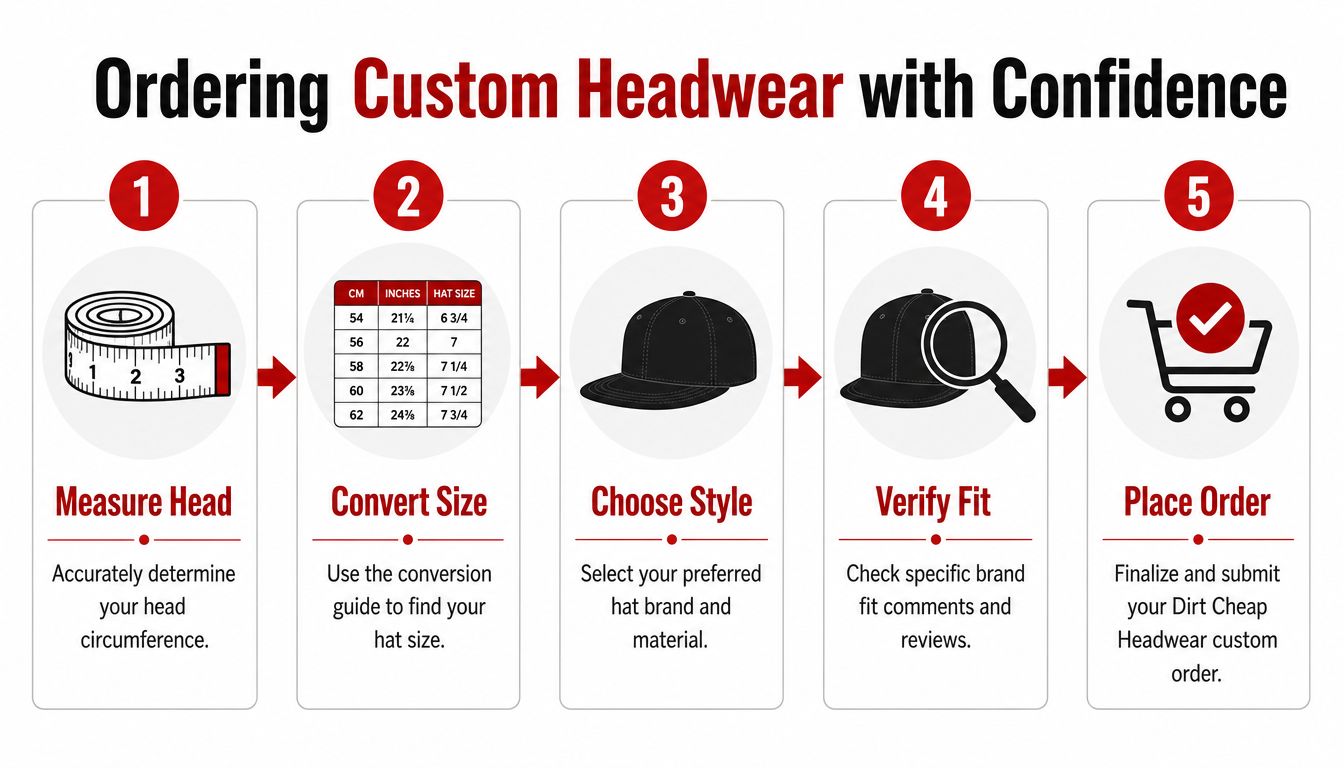
A clean ordering process usually looks like this:
- Collect head measurements first
- Convert those measurements into fitted or grouped sizes
- Choose the brand and material based on tolerance for fit variation
- Review logo size against crown shape
- Place the production order only after those pieces line up
If you're still narrowing down concepts before production, it can help to review outside inspiration and design personalized hats so your style direction is settled before you commit to a specific silhouette and size spread.
The point isn't to make ordering complicated. It's to remove the expensive surprises. When the fit strategy matches the hat style and the logo treatment, custom headwear gets a lot easier to buy with confidence.
If you're ready to turn measurements into a real order, Dirt Cheap Headwear gives you a practical place to do it, whether you need a small test run or a larger custom batch with embroidery. Start with the style you want, collect clean measurements, and build the order around fit instead of guesswork.