
Snapback Hats in Bulk: The Smart Buyer’s Playbook
You're staring at a quote for 1,000 snapbacks, and the number still feels fake. The blank looks cheap, the decoration line item looks fuzzy, and freight is the part nobody wants to explain. That's normal. Most first-time buyers ask the wrong question, which is, “What's the price per hat?” The better question is, “What does each finished hat cost once it lands, gets decorated, and survives reorder time?”
Why Bulk Snapbacks Are Worth a Real Plan
Bulk snapbacks make sense when you're buying for a team, a merch drop, an event giveaway, or a retail restock, because the economics change fast once you move from a single sample to a production run. The market is still large enough to matter, too. One market analysis projects the global hats and caps market at $35 billion by 2034 with a 6.3% CAGR, and that same analysis says snapbacks represent 32% of wholesale transactions with monthly sales volume of 3,584 units in the wholesale blanks space. Accio's snapback market analysis shows why bulk buyers keep coming back to this category.
If you've only bought retail hats before, stop thinking like a shopper. Bulk buying is a sequence of decisions, not a browse-and-checkout moment. You need to lock down style, brand, decoration method, quantity, budget, and delivery timing in that order, because each one affects the next quote.
Practical rule: don't ask for a “cheap snapback,” ask for a finished program with a target landed cost.
That distinction matters when you're also planning storage, packing, or staged rollout. If your order needs cartons, bins, or warehouse shelving, wholesale packaging for storage facilities is the kind of reference buyers use to think beyond the hat itself and plan where the product goes after it lands. The right workflow is simple. Pick the blank, choose the decoration, confirm the minimum, request proofing, approve sample or pre-production, and only then compare final landed cost.
Snapback Anatomy Every Buyer Should Know
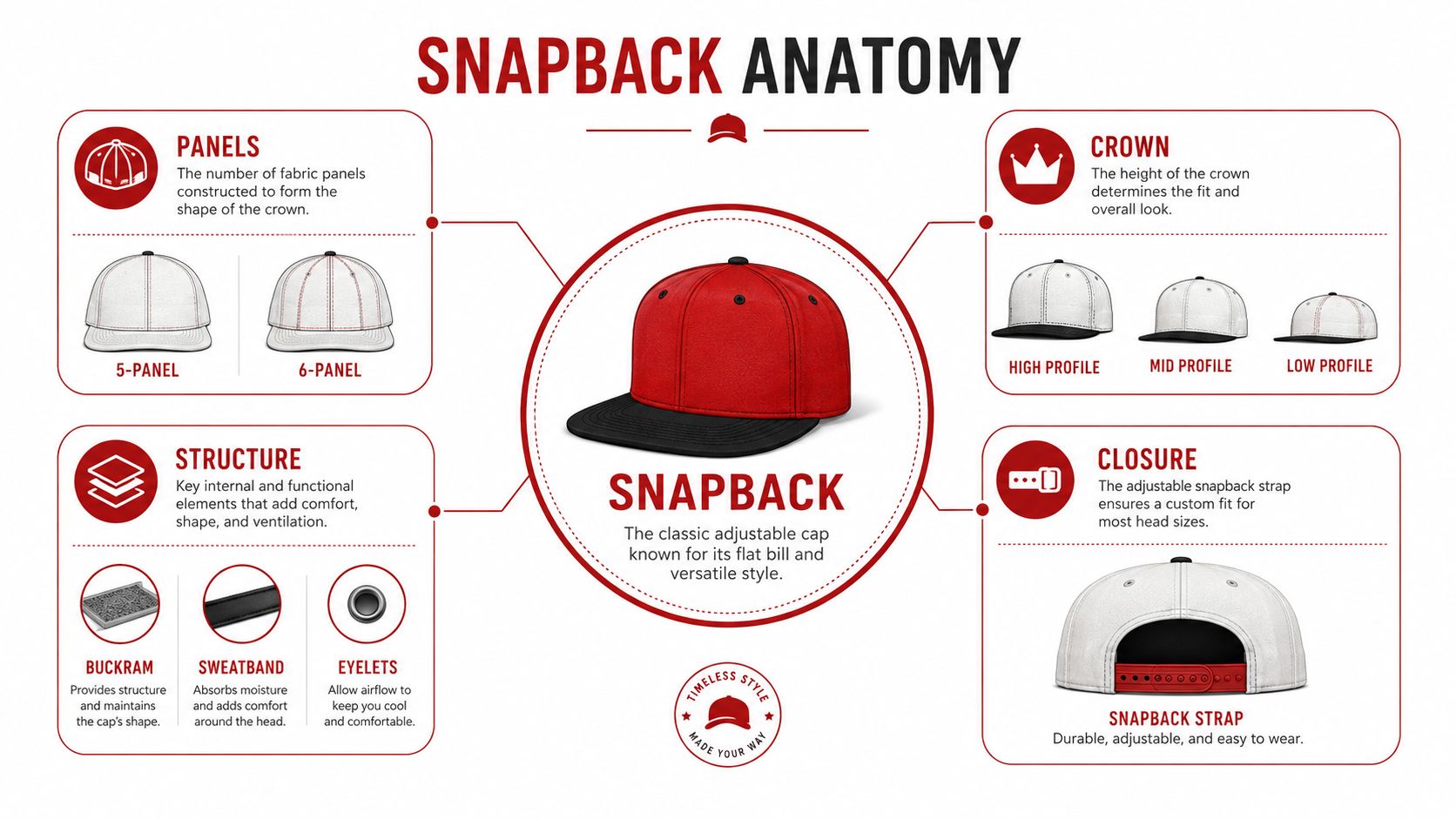
A snapback looks simple until you read a spec sheet and realize every word changes how the hat feels, holds shape, and takes decoration. The basic parts are easy once you translate the jargon. This snapback cap guide is a useful companion if you want a quick visual reference before you quote a supplier.
Panels, crown, and structure
A 6-panel cap is the classic setup, like a standard baseball cap built from six fabric slices that meet at the top. A 5-panel cap feels more modern and promotional because the front is less divided and gives graphics a flatter landing zone. In practice, 6-panel usually reads more retail, while 5-panel feels more like campaign merch.
Crown profile is just height. A high crown sits taller on the head, a mid crown feels balanced, and a low crown hugs the head more tightly. If you want the classic streetwear look, high crown plus a flat brim is the familiar silhouette.
Structured means the front holds its shape, usually with internal support. Unstructured means the front collapses softer and wears more like casual lifestyle headwear. For snapbacks in bulk, structured is usually the safer choice because logos sit cleaner and the hat keeps its retail shape longer.
Brim and closure
A flat brim gives you the true snapback profile. A curved brim softens the look and pushes it toward dad-hat territory. If your brand wants a sharper, newer retail feel, don't overthink it, keep the brim flat.
The closure is the small part buyers ignore until it fails. A snap closure is the plastic tab strip commonly associated with the snapback style. Velcro and strapback closures exist, but they change the product into a different category, and they usually change the feel of the whole program.
If a spec sheet says 80/20 acrylic-wool, full buckram, 90° plastic-stiffened brim, you're looking at a firm, retail-style cap with a structured front and a flat bill that holds its shape.
That line sounds technical, but the picture is plain. It's the hat version of a stiff jacket versus a soft hoodie.
Trusted Wholesale Brands and What Each One Is Good For
The brand name on the invoice matters less than the role the hat has to play. A buyer who needs a staff uniform should not shop the same way as a brand launching premium merch. Wholesale catalogs usually sort by style number, color, and panel count, so once you know the use case, the navigation gets much easier.
Match the blank to the job
Richardson is the workhorse choice when you want a dependable, mid-tier blank that holds up well under embroidery and patches. It's the kind of cap buyers pick when they need consistency more than hype.
YP Classics/Flexfit gives you a broad catalog with a lot of reliable blank options. If you're comparing several snapback hats in bulk across colors and shapes, many buyers start here because the catalog breadth makes side-by-side quoting easier.
New Era sits in the premium lane, especially for licensed or sports-facing programs. If the audience expects a recognizable sports brand and you can support the higher look and feel, it belongs on the shortlist.
Nike tends to work better for athletic and corporate orders than for streetwear drops. The name carries weight in settings where the hat is part of a larger uniform or event package.
Valucap is the entry-level promotional pick. Use it when the goal is volume and the wearer won't treat the cap like a premium fashion item.
Legacy is the boutique-style option for buyers who want a more polished structured look without chasing a sports-first identity.
Shortlist two or three brands, not six. That's how you keep quotes comparable instead of turning the buying process into a mess.
If you're looking at a supplier like Dirt Cheap Headwear, use the catalog the way a buyer would, by comparing style number, structure, and panel count first, then color second. That keeps you from paying for a brand story you don't need.
Choosing the Right Decoration Method
A blank snapback becomes a branded product through decoration, and bad buying decisions get expensive here. The right method depends on logo shape, color contrast, feel, and how much detail you're trying to cram onto a curved front panel. If you pick the wrong decoration for the artwork, the hat can look cheap even if the blank is solid.
Embroidery, puff, patches, and print
Flat embroidery is the default for most logos. It's clean, durable, and works well for text, simple icons, and most front-chest style branding translated onto a hat.
3D puff embroidery gives the raised, premium look people associate with streetwear and sports caps. Use it for short text or bold shapes, not tiny details. If your logo has lots of thin lines, puff embroidery will fight you.
Patches are the safest choice when your art has more detail than thread wants to handle. Leather, woven, or PVC patches can be sewn or applied in other ways, and they're useful when you want texture or a more premium front panel.
Printing works when the art is more graphic than logo-like, especially if you need larger front-panel coverage or more image detail. It's the least “hat-native” look, but it's the right answer for certain designs.
The decoration method also changes the order workflow. A clean logo might move fast with embroidery, while a patch program can add extra steps for artwork approval and production setup. If you want a supplier-side explanation of those options, this print and embroidery page is useful because it shows how the decoration method changes the final look before you commit.
My rule: if the logo is simple, embroider it. If it's complex, patch it. If it's mostly visual art, print it.
That's the fastest way to avoid paying for a decoration style that works against your artwork instead of with it.
Minimums, Pricing, and the True Landed Cost
Sticker price is the trap. A blank that looks cheap can stop being cheap the moment you add embroidery, sampling, freight, and duties. That's why smart buyers track landed cost, not just the blank price. Independent market data shows the global headwear market at about $26.2 billion in 2024 and projected to reach $40.5 billion by 2034, which is another reason cost control matters as programs get larger. Buck Wholesale's snapback overview makes the basic point clearly, most buyers only see the blank until the final bill arrives.
One sourcing guide puts wholesale snapback pricing at $0.96–$3.33 for blanks and $8.53–$79.00 for retail, with wholesale FOB pricing at $3.80–$5.60 per cap for runs of 1,000–5,000 pieces. Crowns Forge's snapback sourcing guide is a good reminder that structure and fabric choice directly affect unit economics. For bulk buyers, that spread is the whole game.
Build the quote the right way
Use this table as your own quote checklist.
| Cost Component | What It Covers | Typical Trigger |
|---|---|---|
| Blank cap | The undecorated snapback | Every order |
| Decoration setup | Digitizing, screen setup, patch prep | New artwork or new method |
| Per-piece decoration | Thread, print, patch application | Each finished unit |
| Sampling | Pre-production test or review piece | First order, new supplier, new artwork |
| Freight | Carton transport to your location | Most bulk shipments |
| Duties and cross-border fees | Import charges on international orders | Buying outside your home market |
| Packaging | Polybags, cartons, inner boxes | Retail or warehouse handling |
| Reorder savings | Lower setup cost on repeat runs | Same art, same blank, same method |
The hidden cost is usually not the hat itself, it's the work around the hat. If you want a simple way to estimate this before you quote, this cost-per-unit calculator page is the kind of internal reference buyers use to avoid underpricing a program.
For margin planning, it helps to look at spend the way a buyer or reseller would. Market Edge's sourcing cost savings guide is worth reading if you're comparing suppliers, because the savings usually come from lower rework, fewer sampling mistakes, and better freight planning, not from shaving pennies off the blank.
The cheap quote is often the one that forgets sampling, freight, and reorders.
That's why a $2 blank can become a much more expensive finished hat once the order is built correctly.
Lead Times, Shipping, and the Order Workflow
The order should move in a straight line: quote, proof, sample, production, shipping, delivery. If a supplier can't show you that path, the order is already messy. Blank sourcing also matters, because in-stock blanks move faster than factory-order blanks, and your target delivery date should be part of the quote from the beginning.
A sample run often takes 5–10 business days after art approval, and the main production run for decorated caps is often 10–20 business days. Those are the planning numbers you should build around when a launch, league season, or event date is fixed. If you need the order faster, you're no longer buying normally, you're paying for priority handling somewhere in the chain.
What you control and what the supplier controls
You control the artwork, the proof approval, the delivery address, and the timing of your response. The supplier controls the production queue, decoration scheduling, and freight booking. If you slow proof approval by a day, the schedule moves. If the carrier misses a freight window, the schedule moves too.
Shipping method should match the order type. Ground makes sense for domestic bulk, air helps when the deadline is tight, and ocean is the normal lever for international bulk where time can stretch. For larger orders, build in enough cushion that one late step doesn't blow the whole rollout.
The safest habit is to ask for a target delivery date and a plan for proof sign-off in the same conversation. Buyers who skip that step end up comparing quotes that aren't comparable.
Quality Checks and Common Ordering Mistakes
The first carton tells you almost everything. Open it, don't just glance at it. A good bulk order should feel consistent from cap to cap, with straight panel alignment, even stitching, a clean brim shape, and a closure that doesn't feel flimsy in the hand.
Closure quality is the one place I look first. In bulk snapbacks, the plastic snap tab is often the first part to fail under repeated wear, so if it feels brittle or loose, that's not a small issue. Check the crown shape next, then the stitching, then the color match across the lot.
First-carton checklist
- Closure durability: Tug the snap tab gently and confirm it doesn't feel soft or underbuilt.
- Stitching integrity: Look for skipped stitches, loose thread ends, or uneven seam lines.
- Crown shape: Compare the front panel shape across several hats, not just one.
- Color accuracy: Match the received shade against the approved sample or proof.
- Packaging condition: Check whether cartons were crushed, wet, or packed too loosely.
The common mistakes are predictable. Buyers chase the lowest blank without checking decoration minimums, skip the sample run, approve proofs too fast, and forget to budget for reorders. Those errors usually cost more than choosing a slightly better blank up front.
If the first carton fails, document it with clear photos of the front panel, the closure, the seam, and the carton label. That's enough for a supplier to fix a real issue without turning the job into a total return.
Treat the sample like a contract preview, not a formality. That one habit saves more money than any marginal price discount.
Putting It All Together
Pick the blank first, then the decoration, then the quantity that clears the minimum and gets you into a better price tier. Request the proof or sample before production, lock the delivery date into the quote, and inspect the first carton before you release the rest of the order. That's the whole playbook.
The best wholesale relationships don't come from a single purchase. They come from two or three clean reorders, where the supplier learns your standards and you learn how they ship.
If you want a straight answer on blanks, decoration, and low-minimum custom runs, Dirt Cheap Headwear handles wholesale snapbacks, embroidery, patches, and other headwear programs in one place. Visit Dirt Cheap Headwear to compare options, request a quote, and build a bulk order that matches your budget before you place the next run.