
Satisfaction Assurance for Wholesale Headwear Buyers
You know the moment. The hats are supposed to land this week, the logo proof looked fine on the screen, and now you're wondering what happens if the embroidery is off, the colors look wrong in daylight, or half the order shows up late. That's where satisfaction assurance stops being a nice-sounding promise and becomes a real buying tool.
For wholesale headwear, vague reassurance doesn't calm anyone down. Buyers need rules that answer practical questions, like who signs off on the proof, what counts as a defect, how long they have to claim an issue, and whether the supplier fixes, replaces, or refunds. A strong policy gives you those answers before the first stitch is made.
The business case is simple. Customer satisfaction is measurable, not fuzzy, and the American Society for Quality treats it as a measurement of how happy customers are with a company's products, services, and capabilities, while ISO 10004:2018 frames customer satisfaction monitoring as a formal quality-management process tied to corrective action and continuous improvement (MIT Sloan Management Review, ISO 10004 guidance). In headwear, that means the policy has to cover the full path from proof to delivery, because the failure usually happens somewhere specific, not everywhere at once.
What Buyers Actually Worry About
The fear isn't that a supplier will be rude. It's that the box arrives and the hats are wrong. Wrong logo placement, loose thread, a bad color match, a missed size or style detail, or an order that shows up after the event date all turn a purchase into a headache.
The problems that actually trigger panic
Decorated headwear has a few predictable failure points. Proofs can be approved too quickly, decoration can drift off-center, and low-minimum orders can make a small miss feel bigger because there's less room to absorb defects. A buyer ordering for a team, brand drop, or fundraiser doesn't care about vague promises. They care about whether the final hats match the approved art and the promised timeline.
Practical rule: if a supplier can't tell you how proof approval, decoration tolerance, and claim windows work in writing, the policy is too loose to trust.
That's why satisfaction assurance matters. It gives you a structure for handling the exact issues that show up in wholesale orders, instead of hoping friendly communication will cover a production error after the fact. It also forces the conversation away from emotion and into evidence, which is the only way to handle disputes without wasting days back and forth.
What a buyer should expect from the policy
A real policy should answer five things before you place the order. What gets approved, what happens if the product misses the approved spec, how shipping damage is handled, how long you have to report a problem, and whether the remedy is rework, replacement, or refund.
That's especially important in wholesale headwear because the buyer often can't inspect every piece before resale or distribution. If you're ordering for a league, event, or retail drop, you need a paper trail that protects the money already spent and the timeline you're trying to hit. Satisfaction assurance is the structure behind that protection, not a slogan.
What Satisfaction Assurance Really Means
A buyer places a bulk decorated-headwear order, approves the proof, and expects the hats that arrive to match that approval. If the logo shifts, the stitch quality slips, or the shipment lands late enough to break the event schedule, satisfaction assurance is the written process that decides what happens next. It spells out the seller's promise, the buyer's confirmation duty, and the remedy if the order misses the agreed standard.
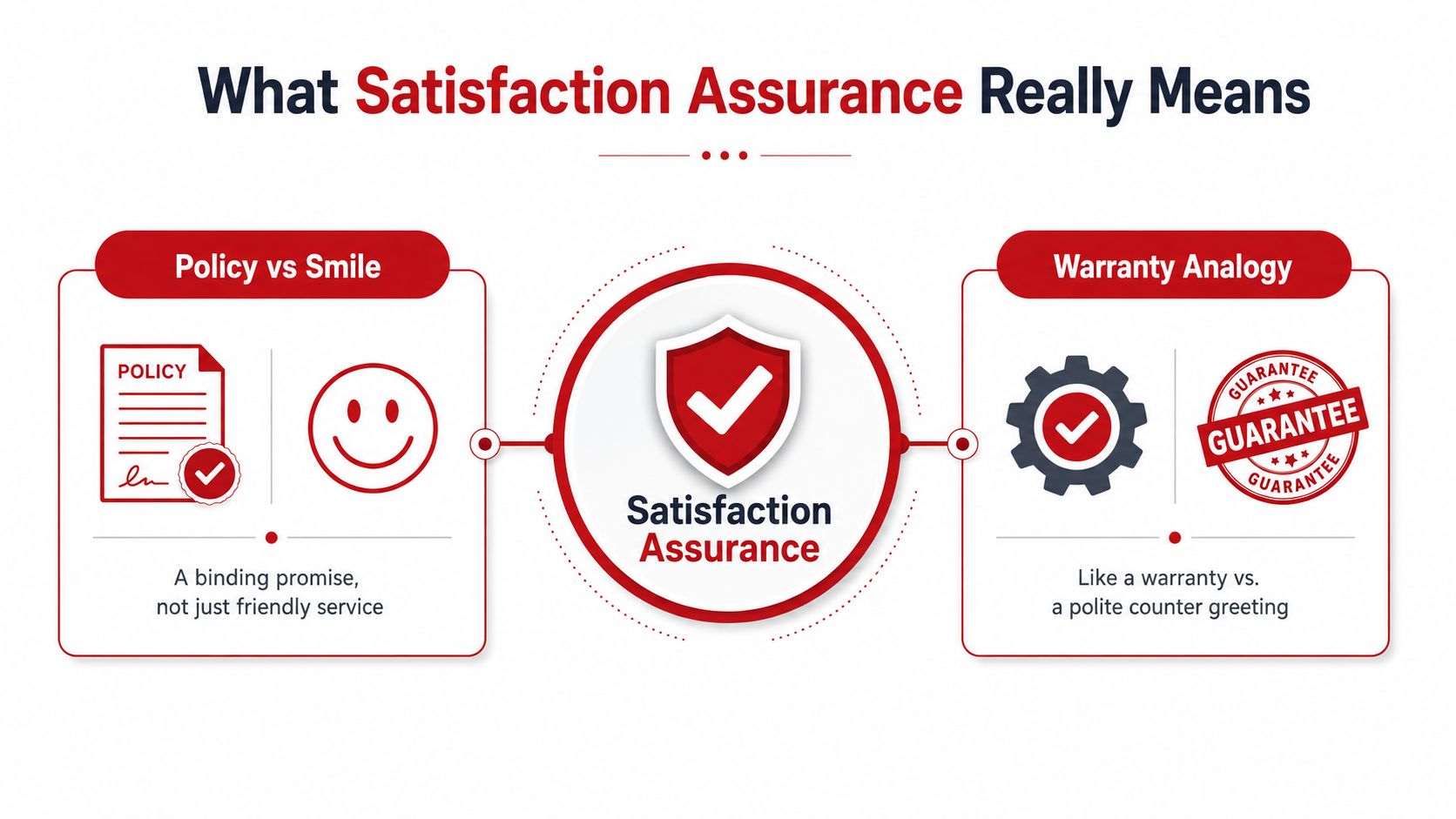
Policy versus friendly service
Friendly service is useful. It still does not protect a buyer if the policy is vague. A rep can answer quickly, sound helpful, and still leave the order exposed unless the approval steps, defect rules, and claim path are written down.
Assurance is contractual and operational, which means it has to tell the team how proof approval works, what counts as a defect, what evidence the buyer must submit, and who reviews the claim. ISO 10004 guidance on customer satisfaction monitoring points toward corrective action and continuous improvement, so the policy should help the supplier spot process failures and fix them, not just apologize after delivery (ISO 10004 guidance). In plain terms, satisfaction assurance turns trust into enforceable steps.
A working definition you can use
Use this sentence with a co-owner or supplier: satisfaction assurance is the documented promise that the order will match the approved proof, meet agreed production standards, and include a clear remedy if it does not. That language fits wholesale headwear because it covers embroidery, printing, patches, packaging, and shipping without drifting into vague customer-service talk.
The same standard has to hold across chat, self-serve, and automation. The AI agent for ecommerce piece from Zinc is useful here because it shows why the promise has to stay consistent even when the order flow is handled through different channels.
Core Components Every Policy Should Cover
A buyer signs off on a proof, the hats go into production, and then the order arrives with the logo shifted, the thread color off, or the packaging damaged in transit. A real satisfaction assurance policy spells out what happens next before that order is ever placed. In decorated headwear, that clarity is the difference between a clean resolution and a messy back-and-forth.
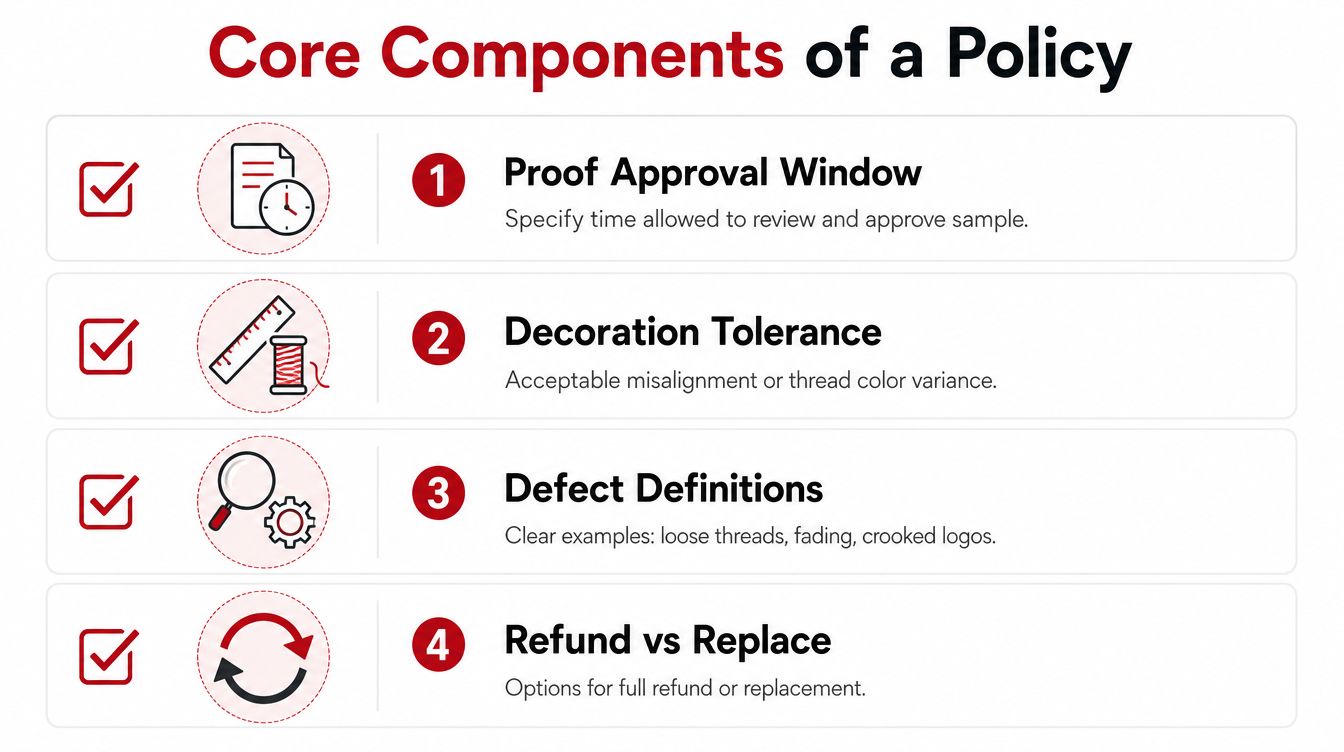
The Essential Components
Proof approval window. The policy should state how long the buyer has to review the proof and what counts as approval. That matters because once embroidery or printing starts, changes consume time and money. If the customer wants a revision, the policy should say production pauses until the revised proof is approved.
Decoration tolerance. Small variation is normal, but the policy has to draw the line. Without a tolerance standard, a supplier can call a crooked logo acceptable and a buyer can call it a failure. The rule should cover placement, thread color, print registration, and any finish visible from a normal viewing distance.
Defect definitions. Loose threads, broken stitching, fading, misprints, and decoration placed in the wrong spot should be named directly. If the examples stay vague, disputes get messy fast. Specific definitions reduce arguments because both sides know what qualifies as a claim.
Refund versus replace. Buyers need to know whether the supplier will rework, replace, refund, or offer a partial remedy. The answer can vary by defect type, but the choice has to be stated in advance. That avoids the common trap where the supplier offers store credit for a problem that should have triggered a replacement.
Shipping damage rules. Damage in transit belongs in its own bucket. The policy should say whether buyers must note damage with the carrier, keep the packaging, and submit photos before replacement is considered. That keeps warehouse defects and shipping damage from being treated as the same issue.
Checklist for reviewing a supplier policy
| Policy Component | What It Should Specify | Why It Matters |
|---|---|---|
| Proof approval window | How many hours or business days the buyer has to approve | Prevents production from starting before the buyer is ready |
| Decoration tolerance | Acceptable placement, color, and finish variation | Reduces arguments over minor versus real defects |
| Defect definitions | Clear examples of what counts as a failure | Makes claims easier to evaluate consistently |
| Refund vs replace | The exact remedy for each type of issue | Stops disputes over the fix after delivery |
The logic here is operational. For headwear, every stage should map to a requirement that can be checked against the proof, the production record, and the delivery condition before the box leaves the building. If the policy cannot be tested against those three points, it is too vague to protect either side.
Sample Policy Clauses You Can Adapt
Weak policy language sounds pleasant, but it leaves too much room for interpretation. Strong policy language is less charming and far more useful. If you're buying decorated hats in volume, ask for the second version every time.
For general legal structure ideas, you can also browse Genpire's legal terms at Genpire's legal terms and compare how precise wording handles scope and remedies. That kind of reading helps when you're pressure-testing your own order terms.
Vague wording versus enforceable wording
Scope
- Weak: “We stand behind our products.”
- Strong: “This policy applies to custom-decorated and bulk headwear orders that are produced from buyer-approved proofs.”
- Why it works: it says exactly which orders are covered.
Proof lock
- Weak: “Please review the proof carefully.”
- Strong: “Buyer approval of the final proof authorizes production. Changes requested after approval may require a revised timeline and additional charges.”
- Why it works: it ties approval to production start.
Defect window
- Weak: “Contact us if there is a problem.”
- Strong: “Buyer must report visible defects within the stated claim period after delivery and include photos of the issue and packaging.”
- Why it works: it sets a reporting rule and an evidence rule.
Shipping damage
- Weak: “We're not responsible for carrier issues.”
- Strong: “Claims for shipping damage require photos of the damaged outer carton, inner packaging, and affected items, plus the tracking reference.”
- Why it works: it creates a clear proof trail.
Resolution options
- Weak: “We'll try to help.”
- Strong: “If a validated defect is confirmed, the seller will rework, replace, or refund the affected items based on defect type and production feasibility.”
- Why it works: it names the possible outcomes.
The point is not to make the supplier sound legalistic. The point is to remove the gray area before money is spent. In custom headwear, gray area is where most disputes hide.
How to File a Claim Step by Step
A strong claim isn't emotional, it's documented. The buyer who wins a dispute is usually the one who can show exactly what was approved, what was delivered, and where the mismatch happened. That's why the claim process should start the moment the box is opened.
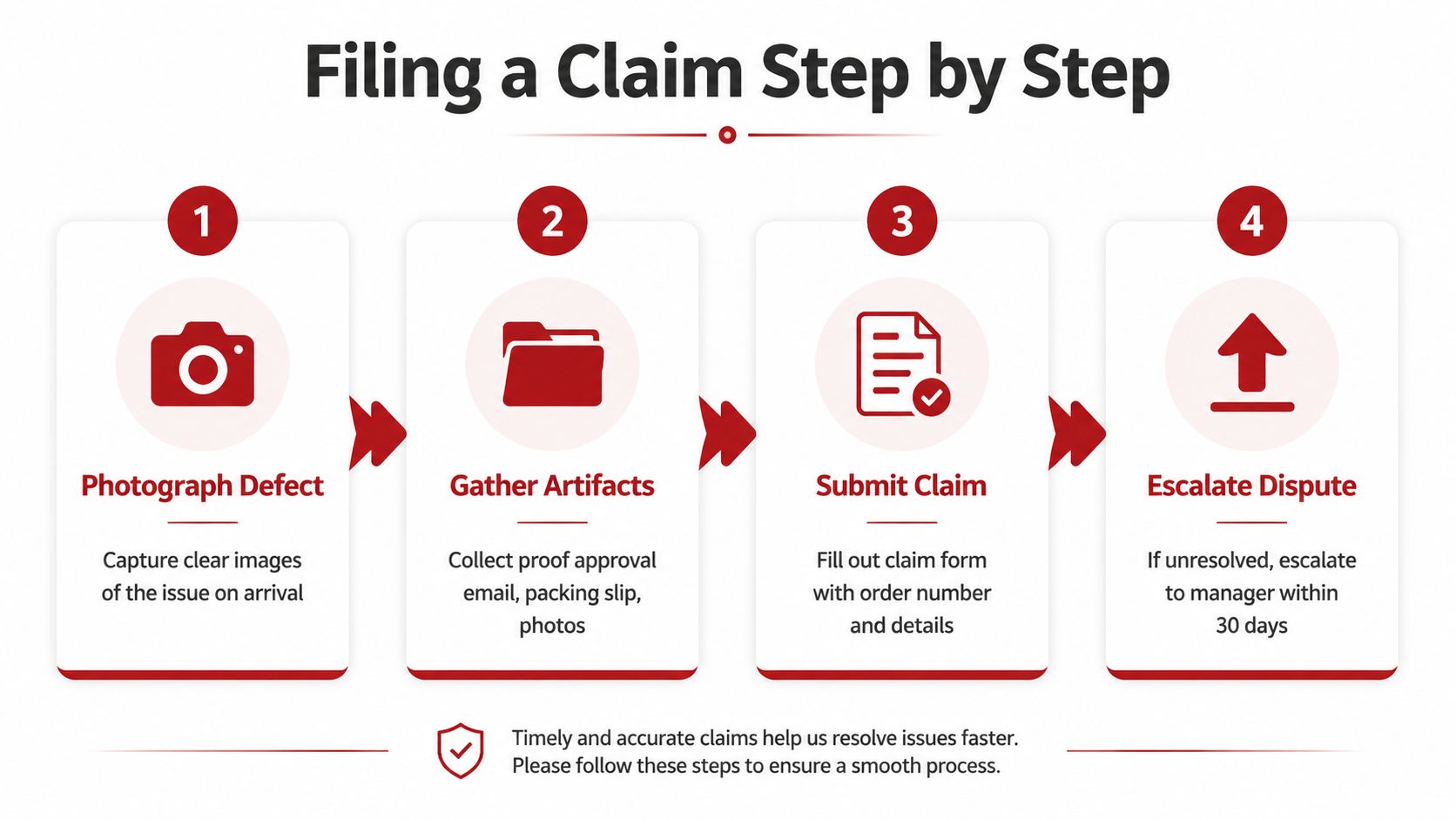
Start with evidence, not opinion
Photograph the defect right away. Capture the front, back, close-ups, packaging, and any shipping damage. If the issue is decoration-related, make sure the image shows the whole hat and the part that's wrong.
Keep the proof approval email, packing slip, and delivery record together in one folder. If those documents are scattered, the claim slows down and the supplier has room to argue over what was actually ordered.
Then submit the claim in writing with the order number, the batch or item count if relevant, and a short description of the issue. Don't bury the lead. Say what's wrong, where it appears, and whether you want rework, replacement, or refund based on the policy terms. If you need a model for what a straightforward return path looks like after a problem order, the returns page shows the kind of post-purchase structure buyers should look for.
What a fair response looks like
A fair supplier response is written acknowledgment, a clear review of the evidence, and a decision. The reply should say whether the issue is accepted, what remedy is being offered, and what happens next. A vague “we're looking into it” message that never gets followed by a decision is a stall tactic, not a resolution.
If the issue stays open, escalate it with the same documentation instead of restarting the story from scratch. Keep every message, because the record matters more than the tone. For a process comparison on service response handling, the internal guidance at customer service response time is a useful reference point for how quickly a team should move when buyers are waiting on an answer.
Where disputes break down
Most claim fights break down in three places. The buyer approved too fast, the evidence is incomplete, or the policy never defined the remedy. If those three holes are closed, the process gets a lot cleaner.
How Dirt Cheap Headwear Handles It in Practice
The cleanest way to reduce claims is to catch issues before production starts. That means an accurate proof, a real conversation during the proof stage, and a team that can check whether the order still matches the buyer's intent before decoration begins. Dirt Cheap Headwear's model, with in-house embroidery, low minimums starting at six pieces per logo, and responsive weekday communication from Mon–Fri, 9am–5pm EST, is built for that kind of front-loaded review.
Short scenarios buyers recognize
A brand orders snapbacks with a 3D puff logo. The proof comes back with the patch sitting a little high, so the buyer flags it before production starts. That's the right move, because once stitching begins, the correction gets more expensive and the order timeline gets tighter.
A sports league orders bulk beanies for a season launch. The buyer wants the stock confirmed before approving the artwork, because a mismatch between inventory and timing can sink a whole team order. That's where stock reliability and proof review need to work together, not separately.
An apparel brand tests a low-minimum run on a new design. Small runs are useful, but they also make every defect more visible because there's less buffer in the order. A quick proof review and a direct line to the team help keep the run from becoming a rework.
For teams that want a more automated buying workflow, the Halo AI for product leaders page is a good reference for how product-facing teams think about reducing order friction across touchpoints. In practice, though, the basics still matter most, clear proof approval, accurate decoration, and a real person who can answer before production starts.
If the buyer spots a concern during the proof stage, the safest move is to contact the team before the order moves forward. That avoids the classic mistake of approving quickly and hoping the issue can be fixed later. In decorated headwear, later usually costs more.
Buyer Tips to Prevent Disputes Before They Start
Don't wait for a bad box to think about assurance. The strongest buyer habit is to verify the policy before you approve the artwork and send the order into production. That means checking stock, decoration terms, and who pays for any rework before money changes hands.
What to confirm every time
- Stock first: confirm availability before proof approval so you don't approve art for items that aren't ready to ship.
- Tolerance terms: read how the supplier defines acceptable variation in placement, thread, and finish.
- Return responsibility: ask who covers shipping on rework or replacement.
- Document everything: save the proof email, final approval, packing slip, and delivery confirmation in one place.
Use the custom order form to lock in the details you want confirmed in writing. A form is only useful if the team's answers are specific enough to stand behind later.
The contrarian truth is that high satisfaction scores can hide weak assurance when buyers have low expectations or no clear claim path. That's why your own documentation matters. A five-star review doesn't protect you the way clear policy language and saved approvals do.
If you want a supplier that treats proofing, decoration, and post-order resolution as part of the same process, visit Dirt Cheap Headwear. Their custom embroidery, wholesale headwear options, and clear proof workflow give buyers a more practical way to manage satisfaction assurance on bulk and decorated orders.