
10 Quality Assurance Tips for Decorated Headwear
A shipment of decorated caps arrives the morning before an event. The logo sits slightly too high, the thread color looks different from the approved proof, and several pieces still have loose threads around the lettering. None of those errors seemed expensive while the order was moving through production. Together, they can create rush rework, customer complaints, missed deadlines, and a replacement shipment that costs far more than a careful inspection would have.
Reliable quality assurance doesn't begin at the packing table. It starts with the artwork, the blank hat, and the production decisions that determine how a design will behave on a curved or textured surface. It continues through digitization, decoration, customer approval, finishing, documentation, and shipping.
The most useful quality assurance tips are practical checkpoints that fit the order in front of you. A small team doesn't need an elaborate factory system to protect a six-piece test run, a bulk team order, or a repeat reseller program. It needs clear standards, named owners, useful records, and a way to learn from exceptions instead of repeating them.
1. Implement Detailed Pre-Production Proofs
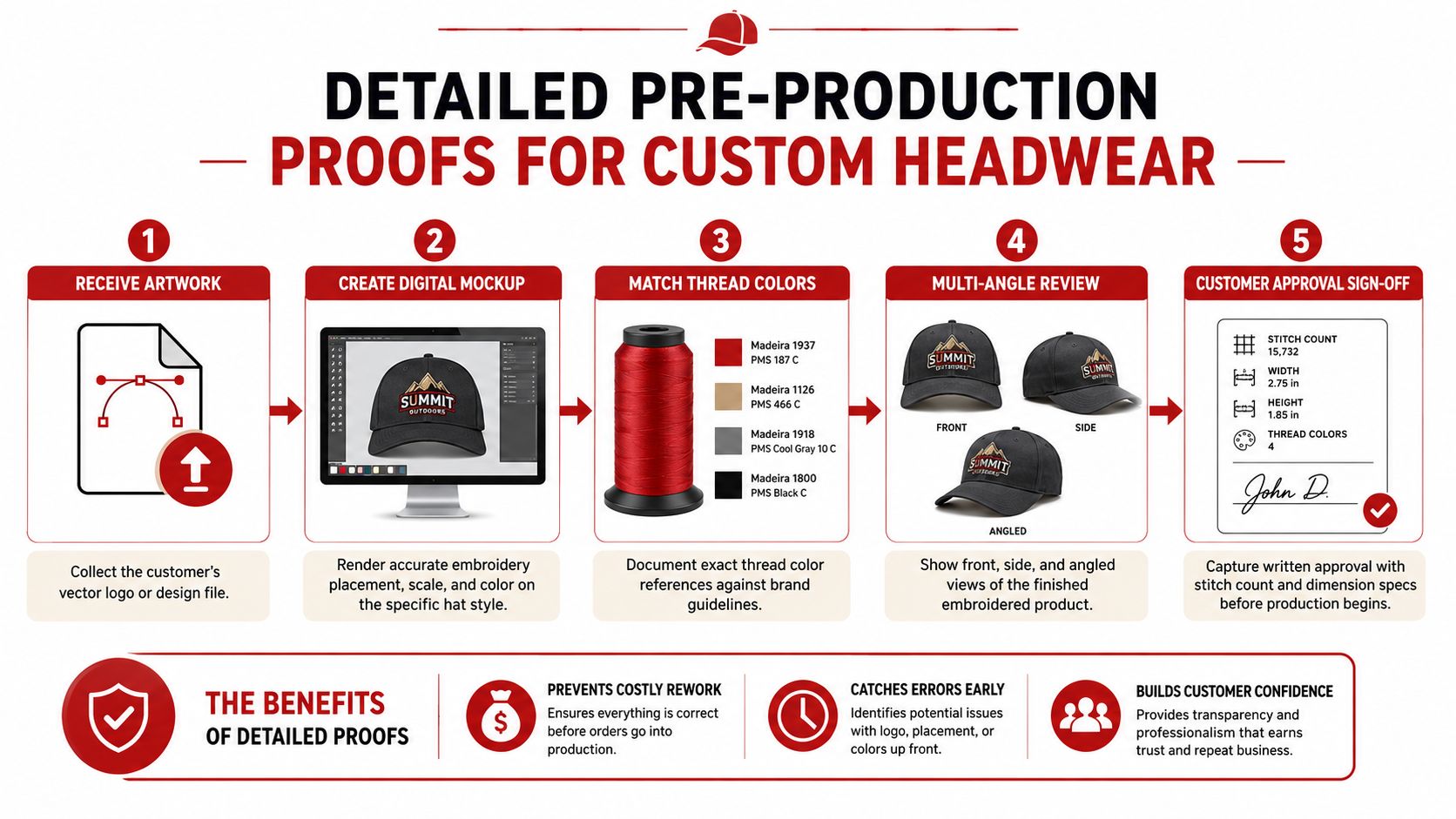
A proof should answer the questions that cause the most expensive misunderstandings later. Show the artwork on the actual hat style whenever possible, not just on a blank digital canvas. The customer should be able to evaluate placement, scale, thread colors, decoration method, and overall balance before production begins.
A sports team may want its logo centered differently on a structured Richardson trucker cap than on an unstructured dad hat. A corporate buyer may need thread colors checked against brand guidelines. An event planner may care less about a tiny visual adjustment than whether the organization name remains readable on a visor. The proof gives each customer a clear decision point.
Use a numbered approval record. Mark reference points such as the center seam, visor edge, side panel, or measured distance from the bottom of the crown. Write the placement measurement in inches or centimeters, identify the thread colors, and note whether the design uses standard embroidery, 3D puff, a patch, or another decoration method.
Make approval useful for repeat orders
Request a proof even for a small run, including orders starting at six pieces per logo. A small order can expose the same artwork or placement problem that would affect a much larger replenishment. Send a clear deadline for approval, ideally within the customer's required production schedule, and keep the approved file with the order record.
For a practical approval record, include:
- Artwork version: Name the exact file used for production.
- Hat specification: Record brand, style, color, panel configuration, and structure.
- Placement reference: Note the measurement and the physical reference points.
- Decoration details: List thread colors, stitch style, and any special treatment.
- Customer approval: Save the date, approver, and written comments.
Customers ordering custom headwear can review the artwork approval process to understand why a documented proof matters. A signed-off proof won't prevent every production issue, but it sharply reduces avoidable disagreement about what was requested.
2. Establish Quality Control Checkpoints at Each Production Stage
A final visual check is necessary, but it comes too late to protect time and materials from every kind of defect. Inspect the blank hats when they arrive, verify the prepared design before stitching, check the first decorated pieces, monitor production, and inspect finished goods before packing.
Each checkpoint should have a specific question. Receiving staff should look for construction defects, stains, incorrect colors, and quantity discrepancies. The digitization review should confirm that the file matches the approved artwork and the selected hat. During embroidery, the operator should watch thread tension, registration, puckering, thread breaks, and placement. Finishing staff should trim loose threads and check the back of the decoration. Packing staff should verify style, color, size, quantity, and shipping details.
Assign ownership at every handoff
A small operation can use one shared production sheet, but each checkpoint still needs a named person and a clear pass or hold decision. Photograph a recurring defect, attach the image to the order record, and separate questionable goods from approved goods so they don't get packed by accident.
Practical rule: Stop the process when a defect points to a setup problem. Rechecking finished hats won't fix a placement file, tension setting, or wrong blank.
Use spot checks during a bulk run rather than waiting for the last piece. The sampling method should reflect the risk of the order. A highly visible corporate logo, a rush event order, or a repeat program with strict brand requirements deserves closer attention than a low-risk internal sample. The point isn't to inspect blindly. It's to catch a pattern while correction is still affordable.
3. Maintain Strict Thread and Material Inventory Standards
Thread and blanks are production inputs, not background supplies. A logo can be perfectly digitized and correctly placed yet still look inconsistent if the thread color changes, the material has faded, or the hat body varies from the approved sample.
Keep a master thread swatch with the order record. Compare the spool to the swatch under consistent lighting, especially when a customer has supplied brand colors. Record the thread brand, color identifier, and any approved substitution. Don't rely on memory or a screen preview to settle a color question.
Store thread away from direct sunlight, moisture, and unnecessary heat. Rotate stock so older material gets used appropriately, and inspect spools for signs of brittleness, fuzzing, or fading. The same discipline applies to blank hats. Check cartons for crushed crowns, stains, uneven construction, incorrect colors, and style substitutions before they reach the machine.
Control substitutions before they reach production
Trusted suppliers and familiar brands such as Richardson, YP Classics/Flexfit, New Era, Nike, Valucap, and Legacy can simplify repeat ordering, but brand familiarity doesn't remove the need for receiving inspection. A specific style may change in availability, color, or construction, so a substitute should never enter production without a documented decision.
Build a simple material record with:
- Approved reference: Keep a physical swatch or approved blank sample.
- Inventory identity: Record supplier, brand, style, color, and purchase date.
- Storage note: Identify where the material is kept and any handling concern.
- Substitution status: Mark whether an alternate requires customer approval.
- Repeat-order note: Preserve the material choice for future replenishment.
If a reseller orders the same branded cap repeatedly, this record protects consistency across separate production runs. It also gives the team a defensible answer when a customer asks why two orders look different.
4. Use Standardized Embroidery Digitization Processes
Digitization converts a visual design into instructions that an embroidery machine can execute. The original logo may look clean as a vector or raster image, but embroidery has physical limits. Stitch direction, density, underlay, pull compensation, lettering size, and fabric behavior all affect the finished cap.
Start with vector artwork such as an AI or EPS file when the customer has one. A low-resolution JPEG may still help identify the design, but it can leave the digitizer guessing about edges, small gaps, and exact color boundaries. The team should clarify which details must remain visible and which can be simplified for the selected hat size.
A structured cap, an unstructured cotton hat, a visor, and a bucket hat won't necessarily need the same settings. Fine lettering that works on a larger front panel may close up on a small decoration area. 3D puff requires different planning from standard flat embroidery, and a curved surface can expose distortion that wasn't visible on a flat screen.
For a deeper production reference, see this guide on how to digitize a logo for embroidery.
Test the file before committing the run
Maintain a library of approved repeat designs, but don't reuse an old file automatically when the hat style or decoration size changes. Test the digitized file on comparable scrap material or a sample blank. Check legibility, registration, density, thread breaks, and how the design sits across the crown.
The operator should record the file version and any style-specific adjustment. Train more than one person on the digitization standards so the outcome doesn't depend on a single employee's memory.
This short embroidery overview can help teams visualize how design preparation connects to the finished result.
5. Create Product-Specific Quality Standards and Specifications
A single placement rule for every hat style creates avoidable mistakes. A front logo on a structured six-panel cap behaves differently from decoration on an unstructured dad hat, a five-panel rope hat, a visor, or a bucket hat. The shape, seam position, fabric weight, available decoration area, and intended viewing angle all change the inspection standard.
Write a reference sheet for each major product family. Include a photograph or diagram of acceptable placement, the decoration area, thread or patch requirements, and the defects that require a hold. A ponytail hat may need a different back-of-head position from a standard cap. A curved bucket-hat surface may require a different density and inspection angle than a relatively flat front panel.
Define acceptable variation before production
Quality standards work best when they describe what staff should do, not just what they should avoid. For example, a guide can tell an operator where to measure from, which seam to use as a reference, how to orient the hat for inspection, and when small lettering needs customer review.
Build product-specific standards around:
- Construction: Note structured, unstructured, five-panel, six-panel, and specialty configurations.
- Decoration area: Identify safe placement zones and seam restrictions.
- Material behavior: Record how cotton, polyester, blends, mesh, and stretch fabrics affect stitching.
- Inspection view: Check the hat from the front, side, underside, and interior where relevant.
- Approval exception: Flag any design that needs a special proof or sample.
Post the current reference sheet at the relevant production station. Update it when customer feedback identifies a repeat misunderstanding. The best manual stays short enough to use during a busy shift and specific enough to settle a real decision.
6. Conduct Regular Supplier and Material Quality Audits
Supplier quality affects every later checkpoint. If blank hats arrive with inconsistent panels, weak closures, stains, construction defects, or a color that doesn't match the order, embroidery staff are forced to work around a problem they didn't create.
Inspect incoming goods against the purchase record and the approved product specification. Look at crown shape, seam quality, visor construction, closure function, fabric condition, logo placement on branded blanks, and color consistency. For a new product or supplier, inspect the incoming sample carefully before releasing the material to production. For an established supplier, continue recording exceptions rather than assuming each shipment will be identical.
A supplier scorecard can remain simple. Track the style, shipment date, defect type, quantity affected, response time, replacement outcome, and whether the issue delayed production. That record gives purchasing staff a better basis for decisions than a vague impression that a supplier has been reliable or unreliable.
Make supplier conversations specific
When reporting a problem, send photographs, the purchase reference, the affected style and color, and a description of the production impact. Ask whether the issue is isolated, expected within the product's tolerance, or connected to a change in manufacturing or availability.
Maintain an alternate sourcing plan for critical colors and recurring programs, but don't switch products casually. A replacement blank may have a different crown profile, fabric feel, or decoration behavior. Any material change should trigger a new proof or sample review when it could alter the finished appearance.
The practical target is not to eliminate every supplier variation. It's to detect variation before it reaches decoration, document the decision, and prevent an unapproved substitute from becoming the customer's problem.
7. Establish Clear Communication Protocols with Customers
Many quality failures begin before production, with a request that sounds clear but leaves several decisions unstated. “Use the usual blue,” “put it on the front,” or “match the last order” can mean different things to a customer, decorator, reseller, and shipping coordinator.
Use the custom order form to capture the exact hat style, color, quantity, decoration type, artwork version, placement, thread references, delivery requirement, and substitution instructions. Follow up on anything that could change the finished product. A customer who needs a logo centered relative to the crown may not mean centered relative to the front seam, and that distinction matters.
Put decisions in writing
Send proof reminders before the production deadline. Record approvals, revisions, customer-supplied color references, stock notifications, and any agreed substitution in the order file. If a customer approves a change by phone, summarize it by email and ask for confirmation. Written communication protects both sides when a busy project involves several people.
For responsive order handling, publish the support hours and provide a consistent route for questions. Dirt Cheap Headwear's customer communication is available during business hours, Monday through Friday, 9 a.m. to 5 p.m. EST, as stated in the publisher information. A clear channel helps teams resolve an approval or stock question before it becomes a production hold.
Customers should receive tracking details and a realistic delivery estimate once the shipment is ready. That information won't correct an embroidery defect, but it reduces confusion around the final handoff and gives the buyer a chance to plan receiving, counting, and inspection.
8. Implement Staff Training and Certification Programs
A written standard only works when staff can apply it to real materials. Operators need to understand how structured and unstructured hats respond to hooping, how tension affects different fabrics, how to inspect a finished design, and when to stop a run for review.
Train by role, then reinforce the shared points. A digitizer needs to recognize when small text or fine detail won't translate cleanly. An embroidery operator needs to identify thread breaks, puckering, registration problems, and material movement. A finishing or packing employee needs to spot loose threads, mismatched pieces, incorrect quantities, and damage that occurred after stitching.
Use demonstrations, not just documents
Pair new staff with an experienced operator for hands-on practice. Have the trainee compare an approved sample with intentionally flawed examples, then explain the decision to pass, rework, or hold the piece. Certification can be practical. The employee demonstrates correct setup, inspection, documentation, and escalation rather than only signing that a manual was read.
Useful training topics include:
- Material setup: Match stabilizer, hooping, and tension choices to the hat construction.
- Decoration methods: Explain the differences between flat embroidery, 3D puff, and patches.
- Placement control: Use the approved proof and physical reference points.
- Exception handling: Stop and escalate unclear artwork, substitutions, and repeat defects.
- Handoff records: Complete the production and inspection fields before moving the order.
Hold recurring quality meetings to review photographs, customer feedback, and corrective actions. Recognize employees who identify a problem early or suggest a useful process improvement. That builds ownership without encouraging staff to hide defects to protect output numbers.
9. Document and Analyze Production Data for Continuous Improvement
A production log turns isolated complaints into patterns. Record the order, hat style, decoration type, operator or machine, defect category, rework reason, customer issue, and resolution. Add turnaround and shipping notes when timing problems affect the customer experience.
A spreadsheet is enough for many small operations. Use consistent labels so “puckering,” “fabric distortion,” and “stitch lift” don't become three unrelated categories unless they require different corrective actions. Attach photographs when the visual difference matters, and preserve the approved proof alongside the final inspection record.
Measure the work that changes decisions
Don't track every possible field just because software makes it easy. Choose information that helps answer practical questions:
- Which styles create repeated rework?
- Which machines or setups appear in the same defect records?
- Which artwork types need more proof clarification?
- Which supplier or material changes coincide with holds?
- Which customer complaints indicate a standard is unclear?
Review the log on a regular schedule with the people who perform the work. A manager may see a rising rework category, while an operator recognizes that the problem appears only on one fabric or decoration size. For teams improving their records, this resource on how to avoid production data errors offers a useful starting point for cleaner production documentation.
The value isn't in producing a polished dashboard. It's in making the next production decision better than the last one.
10. Implement a Comprehensive Quality Issue Tracking and Corrective Action System
Finding a defective hat is only the first response. A stronger system asks why the defect happened, whether other orders may be affected, what changed, who owns the correction, and how the team will verify that the fix worked.
Create one issue record for every meaningful complaint or internal hold. Include the order number, product and decoration details, proof version, defect description, photographs, suspected cause, immediate containment action, assigned owner, corrective change, and follow-up result. This structure keeps a rushed replacement from becoming the only response.
Suppose embroidery puckers on an unstructured hat. The corrective action may involve a different stabilizer protocol, a setup adjustment, or a revised style-specific standard. If thread breaks appear on one machine, inspect tension, needles, maintenance history, and the digitized file rather than blaming the operator without evidence. If an order ships in the wrong color because the request was vague, require written color approval before production.
Close the loop with the customer and team
Separate correction from prevention. Replacing an incorrect hat corrects the immediate order. Updating the proof form, color approval rule, supplier note, or machine maintenance schedule helps prevent the same error elsewhere.
Review open and recurring issues during quality meetings. Share the approved corrective action with every employee who handles that product or process. Dirt Cheap Headwear's Satisfaction Assurance for Wholesale Headwear Buyers also emphasizes practical records such as proofs, packing slips, and delivery confirmation, which help establish what was ordered, what was shipped, and what the customer received.
A closed issue should mean more than “the customer was contacted.” It should mean the team changed the process or confirmed that no process change was needed.
10-Point Quality Assurance Comparison
| Title | Implementation complexity 🔄 | Resource requirements ⚡ | Expected outcomes 📊 | Ideal use cases 💡 | Key advantages ⭐ |
|---|---|---|---|---|---|
| Implement Detailed Pre-Production Proofs | Medium 🔄🔄, iterative review & approval | Medium ⚡⚡, design time, proofing tools, small cost | Fewer production errors; higher approval accuracy | 3D puff, fine-detail stitching, brand-critical orders | Prevents rework; sets clear expectations |
| Establish Quality Control Checkpoints at Each Production Stage | High 🔄🔄🔄, multiple SOPs & inspections | High ⚡⚡⚡, trained QA staff, inspection time, documentation | Consistent quality; reduced waste & returns | Large/bulk orders, in-house production lines | Catches issues early; creates accountability |
| Maintain Strict Thread and Material Inventory Standards | Medium 🔄🔄, organized storage & audits | Medium ⚡⚡, climate control, shelving, premium thread cost | Color consistency; fewer material defects | Repeat corporate orders; premium blanks | Consistent appearance; less material waste |
| Use Standardized Embroidery Digitization Processes | Medium-High 🔄🔄🔄, skilled digitizers & guidelines | Medium ⚡⚡, software licenses, training, testing samples | Accurate reproductions; fewer stitch errors | Fine-detail logos, small text, varied file types | Improves stitch quality; speeds processing |
| Create Product-Specific Quality Standards and Specifications | Medium 🔄🔄, documentation per style | Low-Medium ⚡⚡, time to document, visual samples | Measurable consistency across styles | Diverse hat catalogs; multi-style orders | Eliminates ambiguity; improves training |
| Conduct Regular Supplier and Material Quality Audits | Medium 🔄🔄, periodic inspections & scorecards | Medium ⚡⚡, inspection time, sample testing resources | Fewer defective blanks; stronger supplier relations | Businesses sourcing external blanks | Protects brand reputation; reduces rework |
| Establish Clear Communication Protocols with Customers | Low-Medium 🔄🔄, defined channels & SLAs | Low ⚡, customer service availability, documentation | Fewer misorders; improved satisfaction | Custom orders, event timelines, resellers | Prevents misunderstandings; documents approvals |
| Implement Staff Training and Certification Programs | Medium 🔄🔄, ongoing training & mentorship | Medium ⚡⚡, trainer time, curriculum, production downtime | Reduced human error; more consistent output | Small teams; advanced techniques (3D puff) | Improves skills; increases ownership and morale |
| Document and Analyze Production Data for Continuous Improvement | Medium 🔄🔄, consistent logging & review | Medium ⚡⚡, data tools, analyst time, discipline | Identify trends; prioritize process fixes | Scaling operations; recurring quality issues | Data-driven decisions; measurable improvements |
| Implement Quality Issue Tracking & Corrective Action System | High 🔄🔄🔄, formal RCA and follow-up process | Medium-High ⚡⚡⚡, management time, tracking system | Prevents recurrence; systemic process fixes | Organizations pursuing continuous improvement | Stops repeat issues; demonstrates continuous improvement |
Turn Every Order Into a Repeatable Quality System
The strongest headwear programs don't depend on one exceptionally careful employee catching everything at the end. They make the correct decision easier at each handoff. The artwork record tells the digitizer what matters. The approved proof tells production what to make. The product-specific standard tells inspectors what acceptable looks like. The issue log tells the team what needs to change.
A practical sequence starts before the blank hats reach the machine. Define the product standard, including the hat style, panel configuration, decoration method, placement, thread colors, and acceptable finish. Approve the proof against those details. Inspect the incoming blanks, confirm the inventory identity, and hold any substitution until someone with authority reviews it.
Next, verify the digitized file against the approved artwork. Pay close attention to small lettering, fine detail, stitch density, and the way the design will behave on the selected material. Run a sample or test section when the design, style, or decoration method introduces uncertainty. A little controlled testing is usually easier to manage than discovering a file problem after a full run.
During production, check the first decorated pieces before releasing the order to continuous stitching. Monitor the machine and material rather than treating the first approval as a guarantee that every later piece will match. For a bulk order, use planned spot checks and record the result. If a defect appears, separate affected goods, identify the likely cause, and decide whether production should pause.
Finishing and shipping deserve their own release check. Inspect the front and back of the decoration, trim loose threads, verify the hat style and color, count the pieces, compare the contents with the packing slip, and confirm the shipping label and delivery details. A beautiful embroidered cap sent in the wrong assortment is still a failed order.
Small businesses, teams, and resellers can start with two documents: one approved proof record and one inspection sheet. Add a supplier log, production data, and corrective-action review as order volume and repeat programs grow. You don't need to measure everything. Track the exceptions that affect customer trust, rework, delivery, stock substitutions, and brand consistency.
Quality assurance has also changed beyond the old idea of final-product inspection. The international quality movement became more standardized in 1979, when ISO formed Technical Committee 176 to develop a universal quality standard. That work led to the first ISO 9000 family publication in 1987, a framework that emphasized process-based control across design, production, assembly, and customer service. DQS Global's history of ISO 9001 explains that evolution.
The ISO family was overhauled in 2000, when the earlier 9001, 9002, and 9003 split was merged into a single ISO 9001 standard. Later updates in 2015 placed greater emphasis on risk-based thinking and process monitoring, as described in this overview of the ISO 9000 and ISO 9001 changes. You don't need certification to apply the lesson. Prevent defects early, document decisions, monitor the process, and improve the system when evidence shows a weakness.
The same principle applies when technology enters the artwork or proofing workflow. AI-assisted design tools can introduce variation, exceptions, and outputs that need human approval. Guidance on AI quality assurance and probabilistic testing recommends separating deterministic checks from model outputs, using evaluation sets, repeating prompts, and scoring responses rather than expecting identical results every time. For decorated headwear, that translates into a review threshold for generated artwork, proof variations, and unusual design details.
Risk-based QA is especially useful for small teams. You don't have to test every possible scenario with equal effort. Prioritize the customer journeys where failure costs the most, such as proof accuracy, brand color consistency, stock substitutions, rush fulfillment, and shipment completeness. Recent QA guidance on risk-based quality operations connects quality work with customer journeys, incident cost, defect escape, and change failure. The headwear version is straightforward: spend the most attention where an error would be hardest to explain or replace.
Dirt Cheap Headwear can support that operating sequence with blank hats, fully decorated headwear, in-house embroidery, custom patches, low minimums starting at six pieces per logo, and order communication during business hours. Whether you're testing a staff cap, outfitting a team, replenishing a reseller program, or preparing an event shipment, the supplier should fit the quality system you want to run, not force you to rebuild it around avoidable uncertainty.
Dirt Cheap Headwear offers wholesale blank hats and decorated headwear across styles including Richardson, YP Classics/Flexfit, New Era, Nike, Valucap, and Legacy, along with in-house embroidery, custom patches, and low minimums starting at six pieces per logo. Visit Dirt Cheap Headwear to review available styles and build your next order around clear proofs, consistent materials, and documented quality checks.