
Inexpensive Straw Hats That Actually Last
The popular advice is simple: pick the cheapest straw hat that looks good and buy a few extras. That works for a one-day costume. It fails for a beach crew, event merch table, garden staff, or wholesale order where damaged brims, weak decoration, and missed summer demand turn a low unit price into expensive replacement stock.
Inexpensive straw hats aren't one product. A tightly woven paper braid, an airy raffia sun hat, a palm-leaf shape, and a synthetic braid may all be sold as “straw,” but they behave differently in heat, sunlight, shipping, decoration, and repeated wear. The right purchase starts with use case, not color.
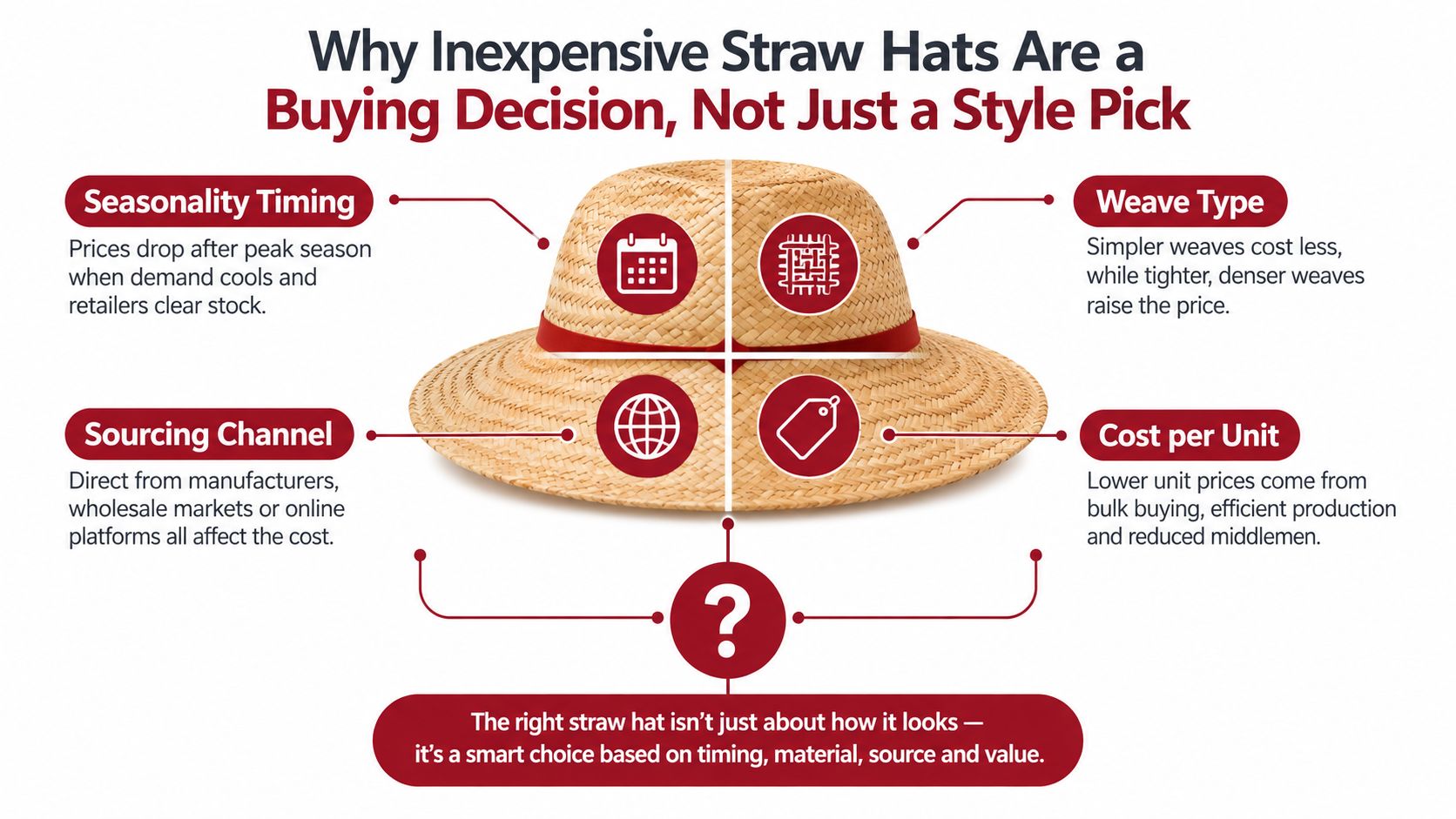
Why Inexpensive Straw Hats Are a Buying Decision, Not Just a Style Pick
The cheapest straw hat is often the most expensive order to manage. A low unit price means little if the shipment arrives late, the weave fails in sunlight, or rough edges force you to reject decorated pieces. For events, teams, and merch brands, straw hats are sourcing decisions before they are style decisions.
Straw hats began as practical workwear, not luxury accessories. They were widely used across Africa, Asia, and Europe by the Middle Ages, became common in European fields by the 17th century, and were standard for farmers and laborers by the 19th century, according to the history of straw hats. That background still matters. Function should set the buying brief.
The United States later attached social rules to seasonal headwear. Straw Hat Day was traditionally May 15, and Felt Hat Day was September 15. The New York Public Library account of the Straw Hat Riots describes how men and boys fought in the 1920s over straw hats worn outside the accepted season. A hat that began as workwear had become part of urban etiquette.
For a current order, I check four purchasing risks:
- Timing: Can the supplier deliver before summer demand tightens?
- Weave: Does the construction provide the needed airflow, coverage, and appearance? A dense weave can improve coverage, but it does not replace proper sun protection.
- Sourcing: Can the vendor hold sizes, colors, and construction consistent across the lot?
- Total cost: Will decoration, freight damage, repairs, and replacements erase the apparent saving?
Use case comes before silhouette
An open weave works for short promotional wear because it feels cooler and delivers a relaxed summer look. Outdoor labor and extended beach exposure call for more crown coverage and a stable brim. Rough, flexible braid can look good on a rack while undermining fine logo work, so decoration limits belong in the first sourcing conversation.
If the hat sits within a wider seasonal assortment, review a guide to profitable Etsy product ideas for seasonal accessories before committing inventory to one accessory.
Buyer's rule: Choose the job, then the material, then the decoration, and only then the color.
The Materials Behind Cheap Straw Hats
Budget hats use several materials that shoppers often group under the single word “straw.” That shortcut causes avoidable mistakes. The fiber determines how the hat bends, how the edge behaves, how much texture appears in a logo area, and how well the crown recovers after shipping.
Paper braid
Paper braid is made from woven paper yarn. It's lightweight, inexpensive, and often easy to pack, which makes it common in seasonal programs and promotional headwear. The surface can look surprisingly clean when the braid is tight, but repeated use tends to expose weak edge binding and fraying.
A tightly woven paper braid is my practical choice for a short retail run or branded event where appearance matters more than years of service. A loose paper weave is better treated as disposable seasonal stock. Before ordering, compare construction details with this hat fabric and material guide.
Raffia
Raffia comes from palm leaves and has a softer, more irregular appearance. It creates the casual, handmade texture buyers associate with resort and festival hats. That texture is useful stylistically, but it makes precise decoration harder and can allow the brim to soften or distort with handling.
Raffia suits beach boutiques, hospitality giveaways, and relaxed events where variation is part of the look. It isn't my first choice for a uniform program that needs every hat to match.
Palm leaf
Palm-leaf hats use broader natural strips that can produce a firm crown and a visibly organic finish. They often feel more substantial than thin paper braid, but natural variation is normal. Inspect the edge treatment carefully. A strong bound edge can preserve the shape, while an unfinished edge can split under routine handling.
Seagrass and wheat straw
Seagrass gives budget hats a coarse, textured surface and a natural color range. Wheat straw can look cleaner and more uniform when processed into a consistent braid. Both are useful when the buyer wants a natural appearance, but neither should be judged by material name alone. The actual braid tightness, crown structure, stitching, and brim finish decide whether the hat survives.
Synthetic blends
Some hats marketed as straw use synthetic paper-poly blends. These can offer more consistent color and shape than natural fibers, and they may travel better through a fulfillment operation. They can also feel less breathable and less authentic. For branded programs, consistency can outweigh the natural look.
| Material | Source | Typical Look | Durability | Best For |
|---|---|---|---|---|
| Paper braid | Woven paper yarn | Clean or lightly textured | Moderate, edges may fray | Seasonal promotions and short retail runs |
| Raffia | Palm leaf fiber | Soft, irregular, handmade | Light to moderate | Beach, resort, and festival wear |
| Palm leaf | Broad natural leaf strips | Organic and structured | Moderate to strong when well bound | Outdoor events and natural-style programs |
| Seagrass | Dried grass fiber | Coarse, earthy texture | Moderate | Casual retail and destination events |
| Wheat straw | Processed cereal straw | Cleaner natural braid | Moderate | Classic summer styling |
| Synthetic blend | Manufactured fibers | Consistent and uniform | Variable, often shape-stable | Merch programs needing repeatable stock |
Short verdict: Pick tight paper braid for clean, short-term branding. Pick raffia for relaxed visual texture. Pick palm leaf or a firm natural braid when the hat must hold its shape through more handling.
The Real Trade-Off for the Lower Price
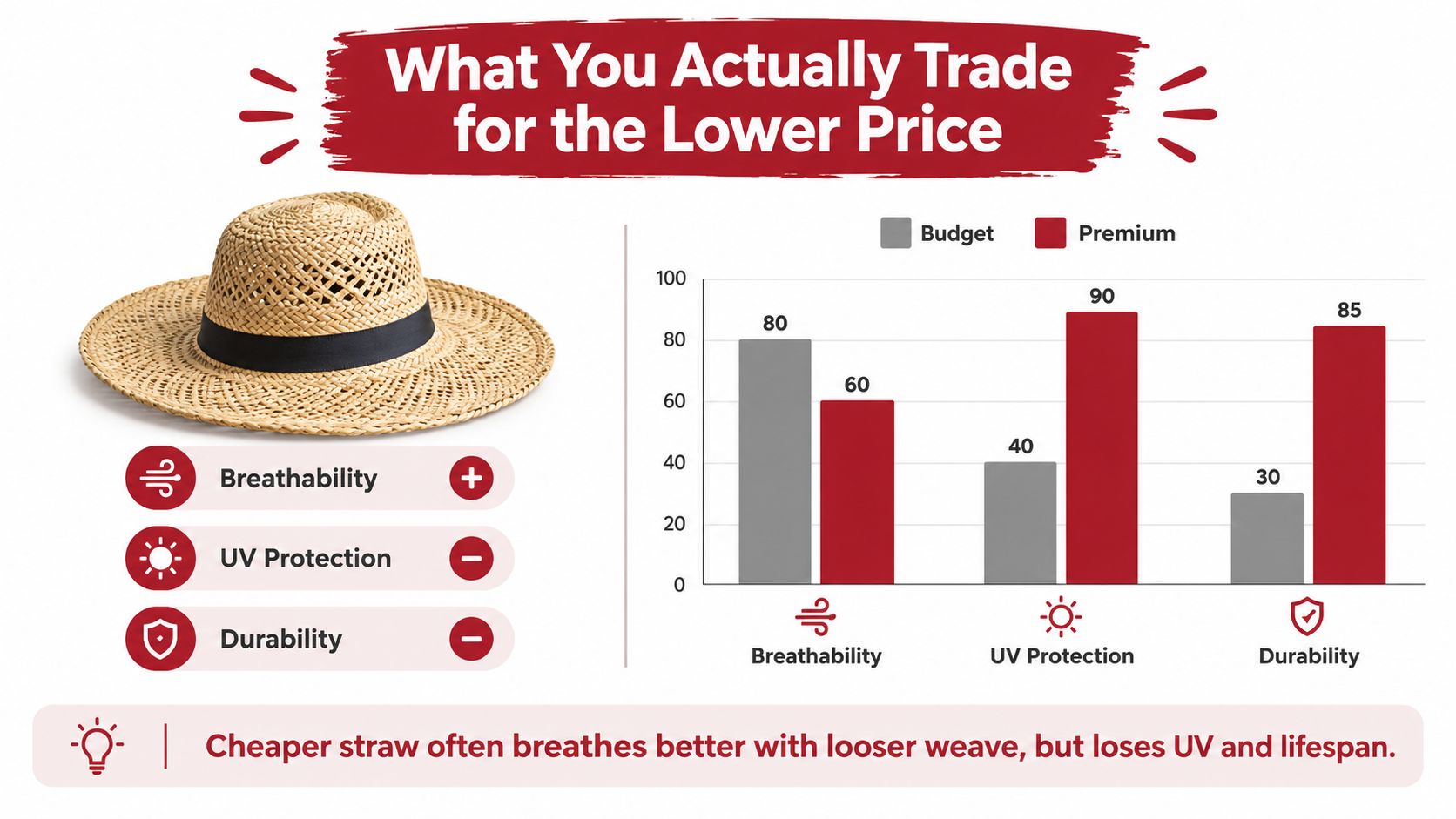
The low quote usually buys airflow and simplicity, not balanced performance. For wholesale buyers, that distinction matters. Open or loosely woven construction keeps heat moving and reduces packing weight, but the same gaps expose more surface area to sunlight and give the fibers more room to weaken.
Breathability is the clear advantage
An open weave moves air across the scalp. For a hot festival, outdoor service shift, or casual beach day, that comfort can justify choosing a less dense hat body. It also makes cartons lighter and packing easier, useful advantages when an order must reach multiple event locations.
The trade-off is built into the weave. Airflow comes from gaps, and those gaps reduce coverage. As natural fibers dry, bend, or split, they can widen, turning a comfortable seasonal hat into a poor long-term buy.
UV protection follows weave density
The word “straw” says little about ultraviolet protection. Tight weaves with little or no visible light transmission provide materially better UV screening, while loose weaves can allow substantial UV through. A certified UPF 50 hat blocks about 98% of UV radiation, but an inexpensive straw hat without certification may perform far below that, depending on its construction, as explained in guidance on UPF 50 straw hats.
Brim coverage also affects the result. A Drexel study summary recommends examining crown coverage and a brim of at least 2.75 inches, rather than trusting marketing language alone, in its discussion of hat UV protection claims. No hat style delivers complete protection. Wide brims reduce facial UV more than smaller brims, while reflected or diffuse UV can still reach areas around the hat.
Cheap construction can raise total cost
Lightweight paper braid packs well and suits one-off promotions, but repeated handling often frays its edges. Open natural weaves can also wear faster because deterioration enlarges the gaps, according to practical straw-hat sun protection guidance.
For a single event, that compromise may be acceptable. For team uniforms or resale stock, price the replacement units, customer complaints, and redecoration before approving the lowest quote. Rough straw can also limit decoration options, so confirm the surface will accept the planned patch, print, or band before production.
Sizing, Fit, and Styling Without the Guesswork
A hat that doesn't fit won't sell well, won't stay comfortable, and won't protect the intended area consistently. Start with a soft measuring tape. Wrap it around the head above the ears and across the brow, keep the tape level, and record the circumference where the hat will sit.
Wholesale vendors don't use one universal size chart, so always compare the supplier's measurement range with your own sample. A practical internal chart can look like this:
| Head Circumference | Hat Size | Festival Brim | Beach Brim | Garden Event Brim |
|---|---|---|---|---|
| Smaller range | Small | Narrow to medium | Medium | Medium |
| Midrange | Medium | Medium | Wide | Medium to wide |
| Larger range | Large | Medium | Wide with chin cord | Medium to wide |
These labels are directional, not a substitute for the vendor's actual measurements. A drawcord, elastic sweatband, or internal sizing band can rescue a near miss. A rigid one-size hat can't. For bulk orders, inspect the inner band for stitching that lies flat and doesn't twist when the crown flexes.
Crown shape changes the look
A short crown can visually flatten a rounder face. A taller crown can balance a longer face and create a more vertical profile. Don't choose a crown only from a product photograph. Ask for side and front views, because crown height and taper can look very different at eye level.
Brim width is a fit and function decision. A 3- to 4-inch brim is a useful practical range for buyers who want meaningful coverage without making the hat feel theatrical or excessively vulnerable to wind. That range isn't a guarantee of UV performance. Weave density and coverage still decide how much protection the hat provides.
Match the hat to the occasion
For festivals, choose a medium brim, a stable crown, and a secure band or cord if the venue is exposed. Festival buyers often value decoration and comfort more than maximum coverage.
For beach days, prioritize a wider brim, dense crown coverage, and a chin cord when wind is likely. For garden events, a medium-to-wide brim with a cleaner braid and restrained band usually looks more intentional than an extremely floppy shape.
Decorating and Branding Budget Straw Hats
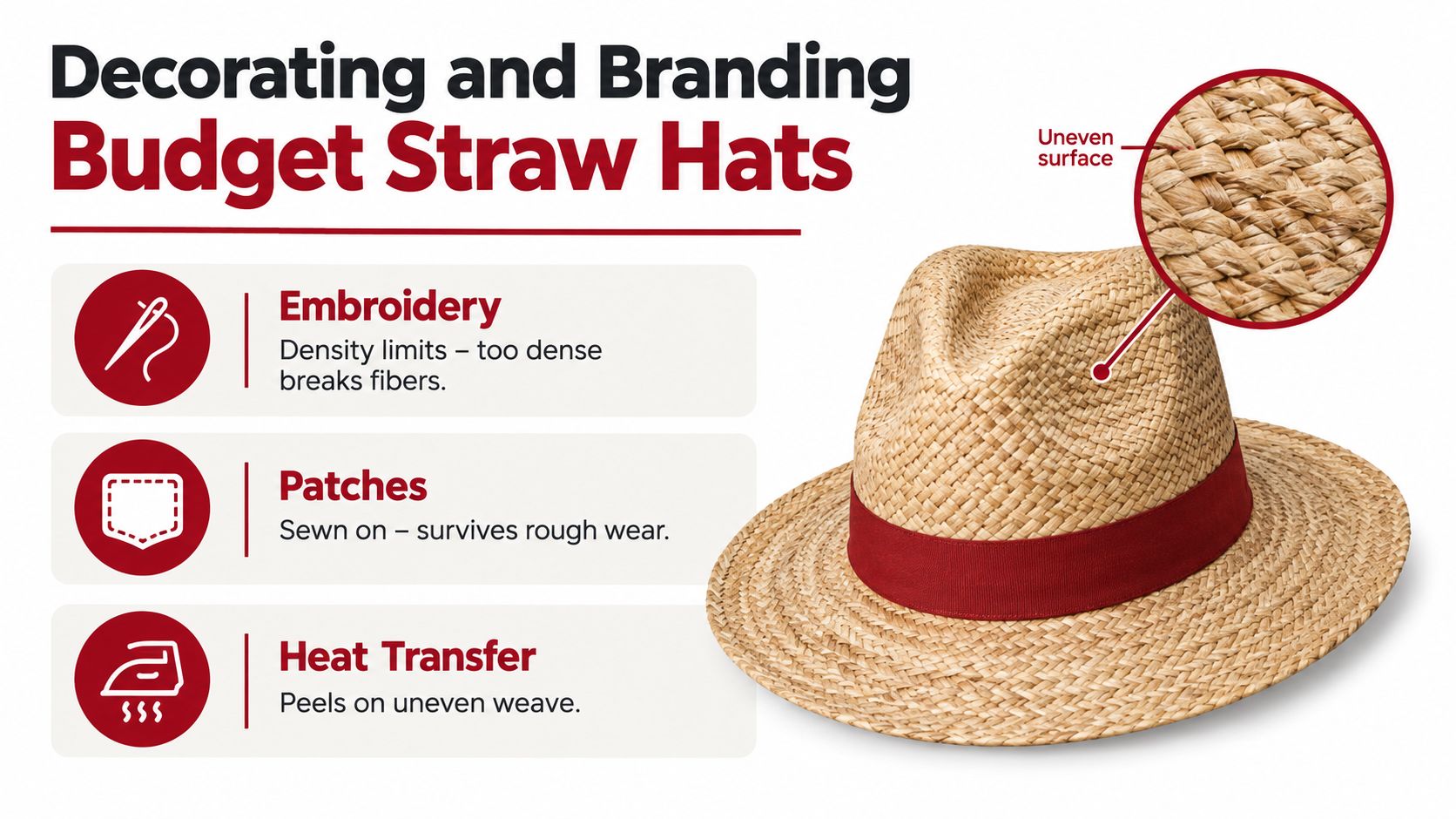
Cheap straw is a difficult decoration surface because it isn't flat, smooth, or perfectly uniform. Fine details disappear into the braid, dense stitching can stress fibers, and adhesive decoration may lift when the crown flexes. Approve the decoration method only after checking the actual hat sample.
Embroidery
Direct embroidery works best when the crown has a stable, reasonably tight surface. Keep the design bold and uncomplicated. Fine lettering, thin outlines, and dense fills are poor matches for rough braid. Too many needle penetrations can break fibers or pull the crown out of shape.
If the logo needs small text, simplify it before digitizing. A strong icon or short wordmark usually survives better than a detailed badge.
Patches and bands
Patches are the safer choice for rough straw. A sewn patch can bridge an uneven surface, while a fabric band or leatherette tag adds branding without forcing a dense logo into the fibers. Place the mark on the front crown, side area, or hatband rather than directly on the floppy edge.
Under-brim branding can work for a premium-feeling detail, but inspect whether the underside is smooth enough for the selected method. The very edge of a flexible brim is a bad location. It bends, catches, and exposes adhesive or thread to abrasion.
Heat transfer and sublimation
Heat transfer can peel on an uneven weave, especially where the surface flexes. Sublimation makes more sense on a compatible synthetic panel or printed fabric component than on raw natural straw. Don't pay for a decoration process just because it works on cotton or polyester blanks.
Use this proof checklist before production:
- Scale: Can the logo remain legible at the actual decoration size?
- Contrast: Does it separate from the natural braid color?
- Placement: Is it on a stable front panel, band, or patch?
- Texture: Has the decorator shown the mark over a real hat photo?
- Stress: What happens when the crown bends during packing and wear?
Production rule: A simple patch that stays attached beats a detailed logo that looks impressive only in the digital proof.
Ask the decorator for the minimum order, setup charge, sample process, and production window. Those details vary by supplier and method, so don't assume a small run will receive the same treatment as a large apparel order.
Buying in Bulk for Events, Teams, and Merch
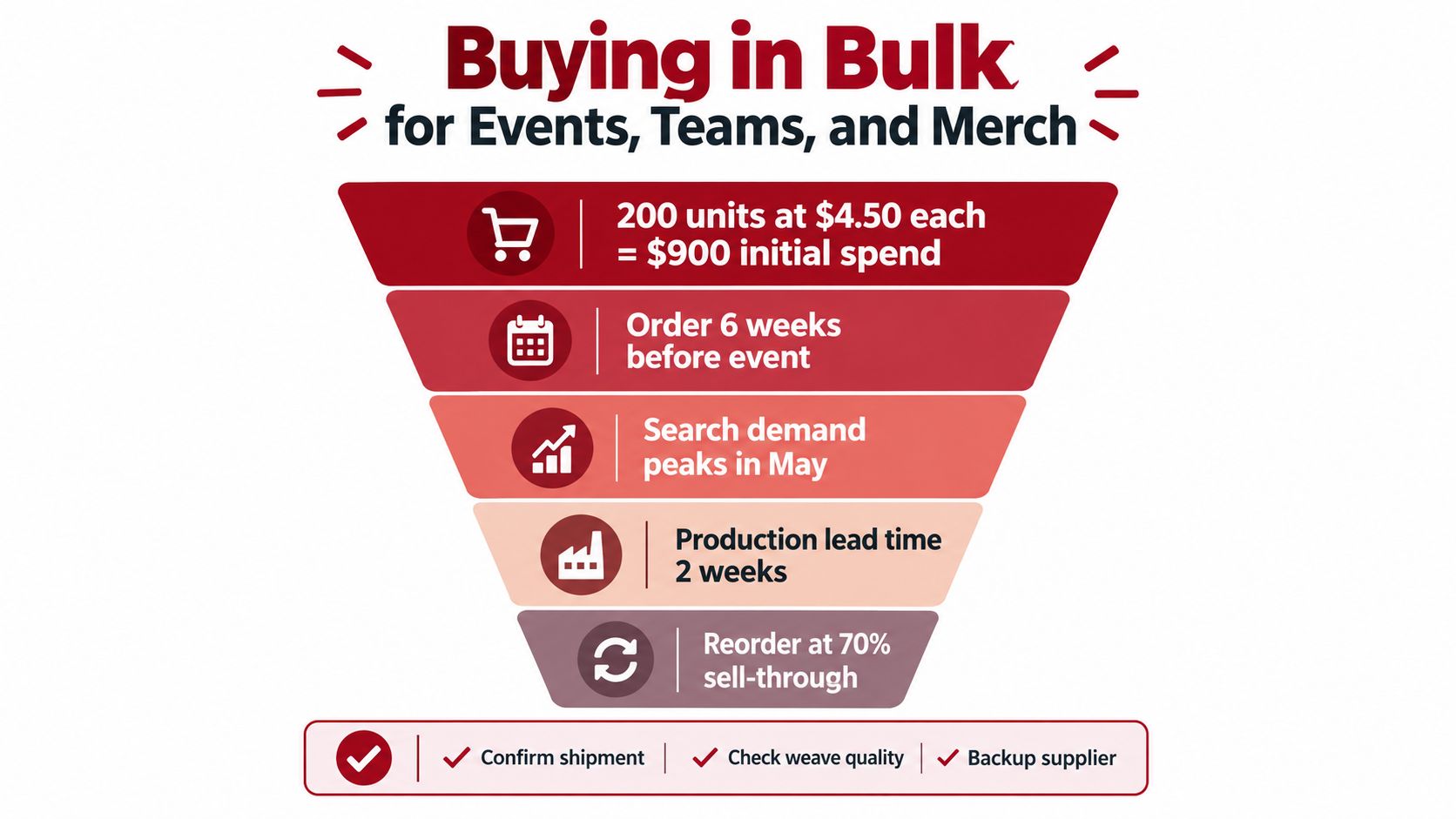
Suppose an event team needs 200 hats for a summer festival. The first mistake is waiting until the event date is close because the product looks simple. Straw hats move in a concentrated seasonal window. One market-trend report says search interest rose 281% over six months, about 35% versus two years, and peaks in June, as reported in straw-hat trend data. A separate 2026 trend summary describes an early-year search surge, with some terms reaching normalized peaks in February 2026. Treat those findings as planning signals, not as a promise that every style will sell.
Build the order around the deadline
For a summer event, I'd request samples, approve the weave, and confirm decoration well before the selling window. A late order limits color choice, size availability, and replacement options. It can also leave you accepting a different braid than the one shown in the original sample.
The purchase price is only one line in the calculation. Add inbound freight, cartons, breakage, inspection time, decoration, storage, and the cost of unusable leftovers. If a supplier offers a low unit price but can't replace crushed or mismatched stock, the quote isn't comparable.
Choose the sourcing route
A domestic distributor is usually easier for smaller orders and urgent replenishment. A factory-direct supplier may provide more control over material, shape, and private-label details, but communication, inspection, freight, and timing require more active management. Print-on-demand blank programs can reduce stored inventory, though they may not suit unusual straw shapes or complex finishing.
Use a structured guide to buying blank hats in bulk when comparing vendors, and apply the same discipline to straw: confirm samples, packaging, stock status, replacement policy, and decoration approval before placing the full order.
Events also need operational fit. If the hats support a volunteer group or fundraising activity, resources on finding the right charity team building program can help organizers think through the wider program rather than treating the hats as an isolated purchase.
Order rule: The more painful a late shipment would be, the more valuable supplier communication and backup stock become.
Care, Storage, and End-of-Sseason Checklist
Inexpensive straw hats fail early when buyers treat them as indestructible. Sweat, rain, crushing, direct sunlight, humidity swings, and overheated storage all work against the braid. Basic handling won't turn a budget hat into a premium one, but it can keep usable stock in service longer.
Let a damp hat air-dry naturally. Don't seal it in a plastic bag while moisture remains inside. If the crown loses shape, use gentle steam to soften it and reshape it by hand. Avoid crushing the crown flat unless the supplier specifically identifies the hat as packable.
Store hats with the crown supported, ideally in a box or on a form that prevents the brim from carrying the weight. Keep them away from direct sun and hot attic spaces. End-of-season storage is when many inexpensive hats deteriorate without anyone noticing. Heat and changing humidity can stiffen fibers, loosen bindings, and distort the shape before the next order is opened.
Repair or retire
Repair a loose hatband, replace a small piece of binding, or restitch a detached trim when the braid remains sound. Retire the hat when the crown has collapsed, the brim edge keeps unraveling, or gaps have opened across the main coverage area. A cosmetic repair can't restore missing material or reliable structure.
Use a practical inspection routine:
- Dry the stock: Air out hats after events, rain, and heavy wear.
- Check the structure: Look at crown recovery, brim balance, and inner-band stitching.
- Inspect the weave: Find loose strands, widening gaps, and edge separation.
- Review the decoration: Test patches, bands, and logos for lifting or pulled fibers.
- Make the next buying decision: Reorder the proven style, repair serviceable stock, and remove unstable units before the next season.
For general cleaning methods that won't punish natural or paper-based materials, use these hat cleaning tips. The best replacement decision comes from condition and use case, not from a calendar alone.
Dirt Cheap Headwear supplies blank hats and decorated headwear for businesses, teams, events, and merch programs, with custom embroidery, patches, printing, and wholesale ordering options. Visit Dirt Cheap Headwear to compare suitable summer headwear, request decoration support, and plan a small test run or larger replenishment order before seasonal stock tightens.