
How Much Is Embroidery Real Pricing for Hats in 2026
At commercial rates, embroidery typically runs about $1 to $3 per 1,000 stitches, plus a one-time digitizing setup fee. A finished embroidered hat can land around $5 to $15, but premium blanks, small orders, multiple placements, and specialty decoration push the total higher.
That's the answer most shops give, then they hand you a quote that hides the actual math. I quote custom headwear every day, and the hat itself is only one line on the bill. The actual price comes from the machine file, stitch count, color changes, decoration method, specialty effects, blank quality, and order size.
The global embroidery market is estimated at USD 3.27 billion in 2025, with a projection of USD 5.95 billion by 2033, while another estimate places it at USD 3.3 billion in 2025 and projects USD 8.0 billion by 2034. Those forecasts point to a mature category with steady demand from branded apparel, sportswear, corporate goods, and personalized merchandise, not a fading craft. You can review the broader market context in this embroidery market estimate.
What Embroidery Actually Costs in 2026
The working benchmark is straightforward: commercial shops commonly charge $1 to $3 per 1,000 stitches, or $0.001 to $0.003 per stitch, before setup and other additions. A 10,000-stitch logo therefore works out to roughly $10 for the embroidery portion at the benchmark rate, before digitizing, minimums, or the hat itself, as explained in this stitch-based embroidery pricing guide.
Most shops also charge a one-time digitizing fee, commonly $20 to $60, to convert your artwork into a machine-readable embroidery file. That fee should generally apply to the design, not every reorder. If a shop charges it repeatedly for the same approved file, ask why.
A standard embroidered hat on a wholesale blank usually falls around $5 to $15, though the number climbs for premium caps, multiple logo locations, dense artwork, or a very small order. The point of a useful quote isn't to hide inside that range. It's to show how each line gets there.
| Cost Component | Typical Range | When It Applies |
|---|---|---|
| Digitizing | $20 to $60 one time | A new logo needs a machine file |
| Stitching | $1 to $3 per 1,000 stitches | Every design, based on stitch volume |
| Standard hat | Varies by blank | Every finished order |
| Extra colors | Varies by shop | When color changes add setup or run time |
| 3D puff | Varies by design | Raised foam decoration |
| Metallic thread | Varies by design | Specialty thread is requested |
| Patch application | Varies by method | A patch replaces direct stitching |
Direct embroidery works especially well for logos that need a durable, professional finish, while screen printing and other methods may suit larger artwork or soft garments. This streetwear decoration comparison from DM-Flexwear.com is useful when you're deciding whether embroidery is the right method before requesting quotes.
I'll break down each cost driver, including when a patch beats direct embroidery and when a quantity break changes the entire bill.
Why Stitch Count Drives the Price
Think of embroidery as construction with thread. A small line-art logo needs a few passes, while a filled design needs layer after layer of needlework. The machine doesn't care whether the artwork looks simple to you. It cares how many needle penetrations the digitized file contains.
A 5,000-stitch logo at the benchmark rate produces an embroidery line of roughly $5 to $15 per hat, while a 15,000-stitch design scales to roughly $15 to $45 per hat, before other charges. The comparison follows directly from the published rate of $1 to $3 per 1,000 stitches. A denser design uses more thread, takes longer to run, and consumes more production capacity.
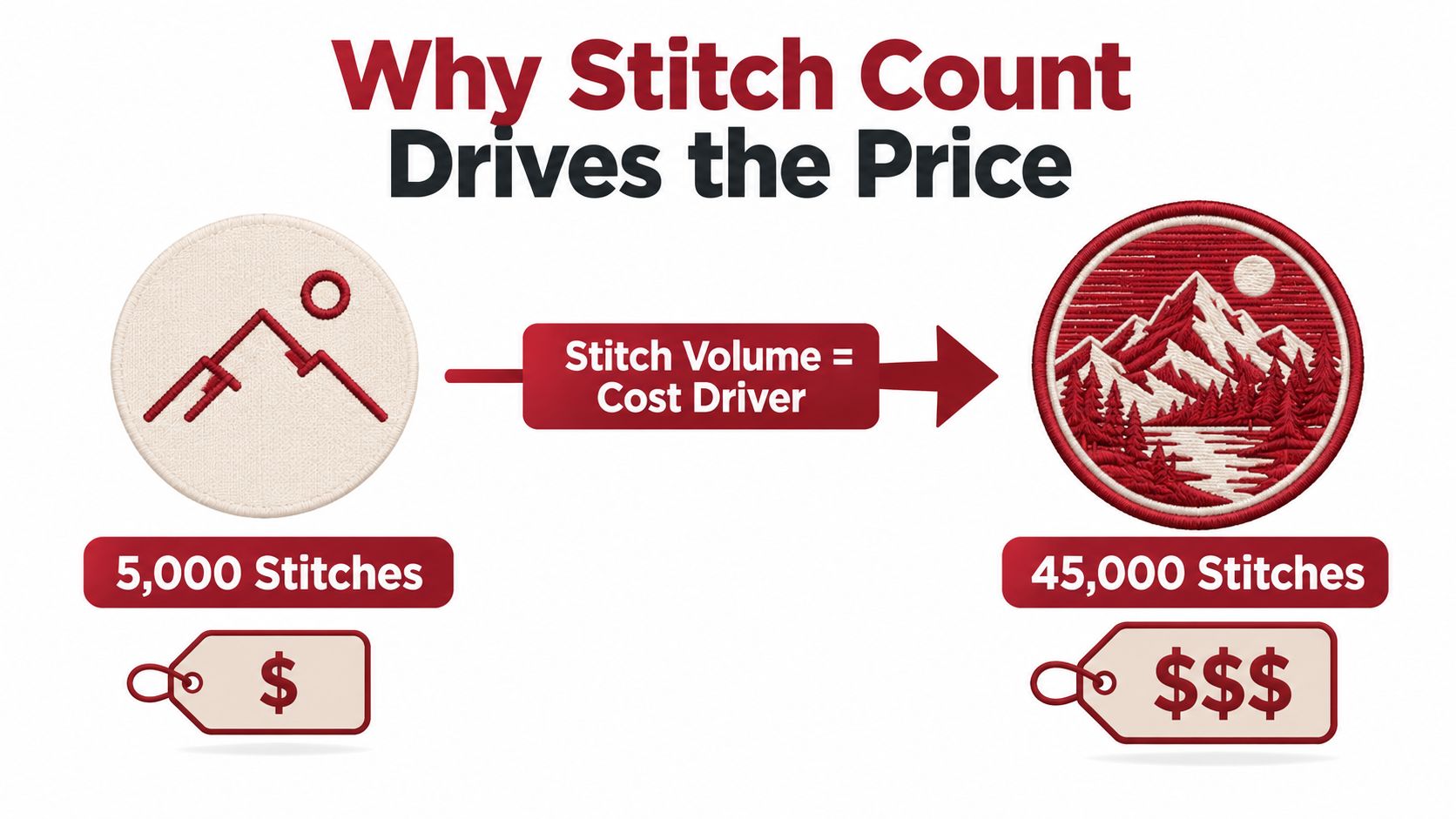
Read the stitch file, not just the artwork
Digitizers decide how satin stitches, fills, underlay, trims, and borders will be built. Each decision affects the final count. Fine lettering may look modest on a screen but require careful stitching, while a bold simplified mark can cover more area with fewer efficient passes.
Machine-based embroidery became commercially viable after mechanization in the 19th century, and computerized equipment later made the process repeatable for uniforms, hats, promotional products, and team gear. The modern industry still depends on that same basic production logic: more stitches mean more work. The expanding embroidery machine market reflects that industrial role, with one estimate projecting growth from USD 1.27 billion in 2026 to USD 1.7 billion by 2031, as detailed by Mordor Intelligence's embroidery machine market overview.
Pricing rule: Ask for the stitch count before approving the quote. If the shop won't disclose it, you can't compare the embroidery line fairly.
As a practical design screen, I treat under 6,000 stitches as light, 6,000 to 10,000 as standard, and anything above 12,000 as something that needs a reason. If your logo is dense, the guide to digitizing a logo for embroidery can help you understand what must change before production.
Setup Fees Thread Colors and 3D Puff
A new logo starts with digitizing. The shop converts a flat image into a file that tells the embroidery machine where to stitch, which direction each section should run, when to trim, and how to build the design. The typical one-time setup range is $20 to $60, according to the pricing data above.
That fee is worth paying when it produces a clean, reusable file. It isn't worth paying again for an unchanged reorder. Ask whether the file remains on record and whether future orders use the approved version.
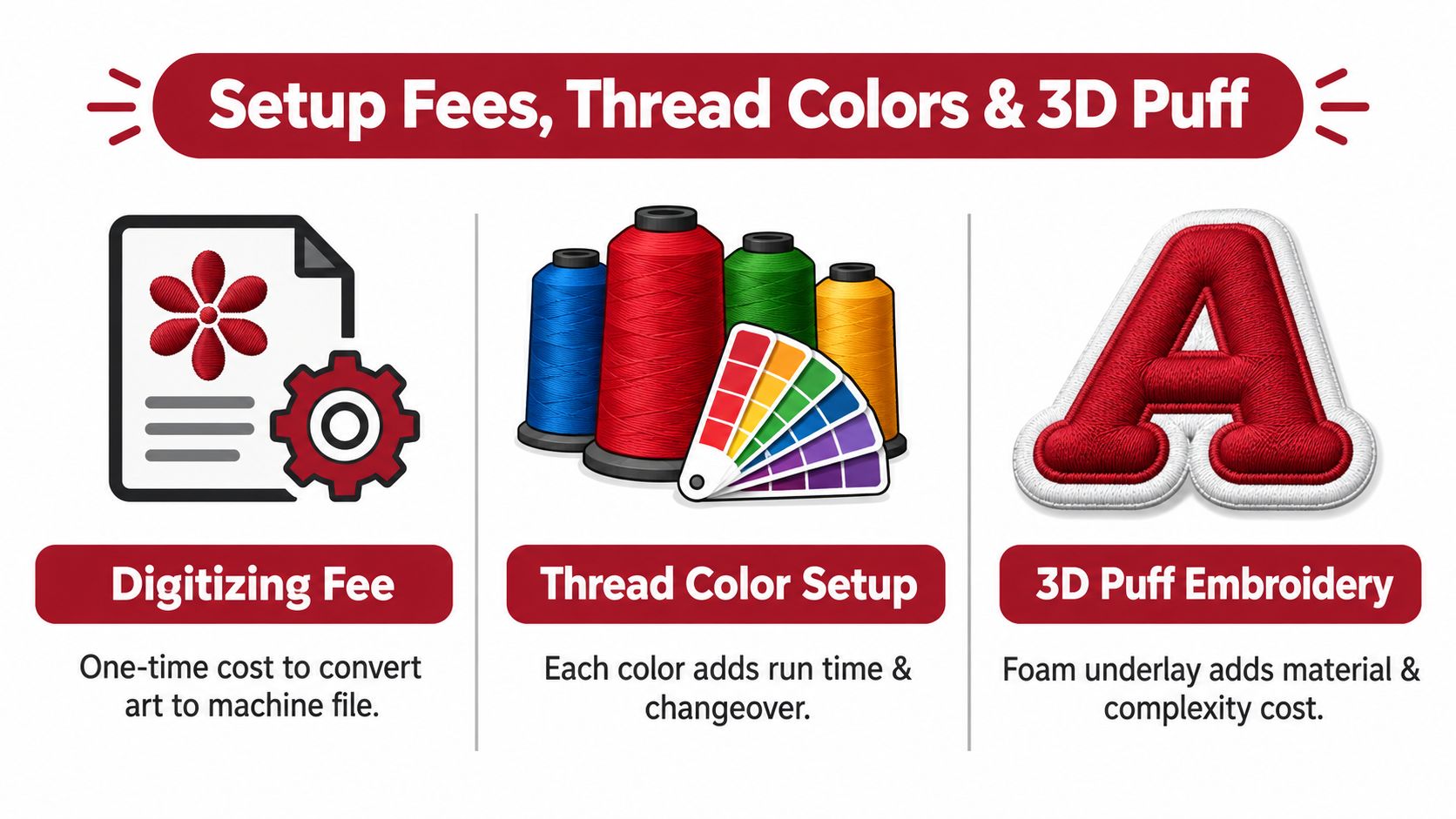
Color changes add handling
Thread color count affects production because the operator or machine must manage additional thread changes and trims. A two-color logo is usually simpler than a design that uses a different thread for every small detail. Ask whether color changes are included in the base quote or itemized separately.
The decision is simple. Keep colors that define the brand, remove colors that only add visual noise at cap size. If the design still reads clearly with fewer colors, the savings are usually more sensible than paying for subtle distinctions customers won't notice.
Raised and specialty effects
3D puff embroidery uses foam under the stitches to raise the design. It works best for bold lettering and uncomplicated shapes with enough width to cover the foam cleanly. Thin outlines and tiny details usually don't benefit from the effect.
Metallic and specialty threads can add visual contrast, but they also require more careful handling and may carry an additional per-hat charge. Use metallic thread when shine is central to the design, not because the option exists.
You can see how specialty decoration fits into a broader machine setup by reviewing this 3D embroidery machine resource. For buyers choosing a neutral base fabric or garment color, The Fabric Company's dressmaker beige offers a useful reference point for how color affects contrast and thread selection.
Patches vs Direct Embroidery on Hats
Direct embroidery puts thread straight into the hat. It gives structured caps, dad hats, and many five-panel styles a clean, integrated finish, but the price follows the design's stitch count and the difficulty of hooping the specific blank.
A patch changes the production sequence. The artwork gets embroidered or woven onto a separate backing, then the finished patch gets sewn or heat-applied to the hat. That separates the artwork from the cap's surface, which can solve problems that direct stitching can't.
Direct embroidery makes sense when
Choose direct stitching when the logo is bold, the hat supports stable hooping, and you want the decoration to feel built into the crown. It's a strong fit for a consistent front logo on structured snapbacks and similar caps.
Direct embroidery also makes sense when you expect to reorder the same design. Once the digitized file exists, the setup burden doesn't need to be recreated for every run. The design still needs to be tested for size, density, and placement, but the process becomes repeatable.
A patch can be the cheaper answer
Patches deserve serious consideration for small orders, beanies, unstructured crowns, and designs with fine detail, gradients, or photographic elements. A woven patch can replace a large amount of direct stitch time with a flat application step.
For a short run between 6 and 24 pieces, an embroidered patch can often land cheaper per hat than direct embroidery, especially when a new digitized file would otherwise be spread across very few units. Beanies and soft, unstable crowns are another clear patch use case because hooping can distort the material.
| Factor | Direct Embroidery | Custom Patch |
|---|---|---|
| Surface | Thread enters the hat | Patch is made separately |
| Best for | Bold logos on stable caps | Small orders and difficult surfaces |
| Detail handling | Works best with clean, simplified art | Woven patches handle fine visual detail |
| Reorders | Reuses the embroidery file | Reuses patch artwork and application process |
| Finish | Integrated, premium stitch appearance | Separate sewn or applied decoration |
| Main cost pressure | Stitch count and placement | Patch production and application |
My recommendation is practical. Use direct embroidery for a clean, durable cap logo. Use a patch when the order is small, the hat is difficult to hoop, or the artwork needs a surface that can reproduce detail more reliably.
Quantity Breaks and Low Minimum Orders
Embroidery quotes don't move in a straight line. A one-time setup cost gets spread across the order, while machine time, color changes, finishing, and blank hats still apply to each unit. That's why a small run can feel expensive even when the design itself is uncomplicated.
Recent pricing guidance puts a single embroidered hat around $25 to $35, a 50-piece order around $12 to $16 per hat, and orders of 200 or more around $8 to $12 per hat, depending on the blank, design, and provider. Those ranges come from this 2026 embroidered hat pricing guide, and they show why quantity is often more important than buyers expect.
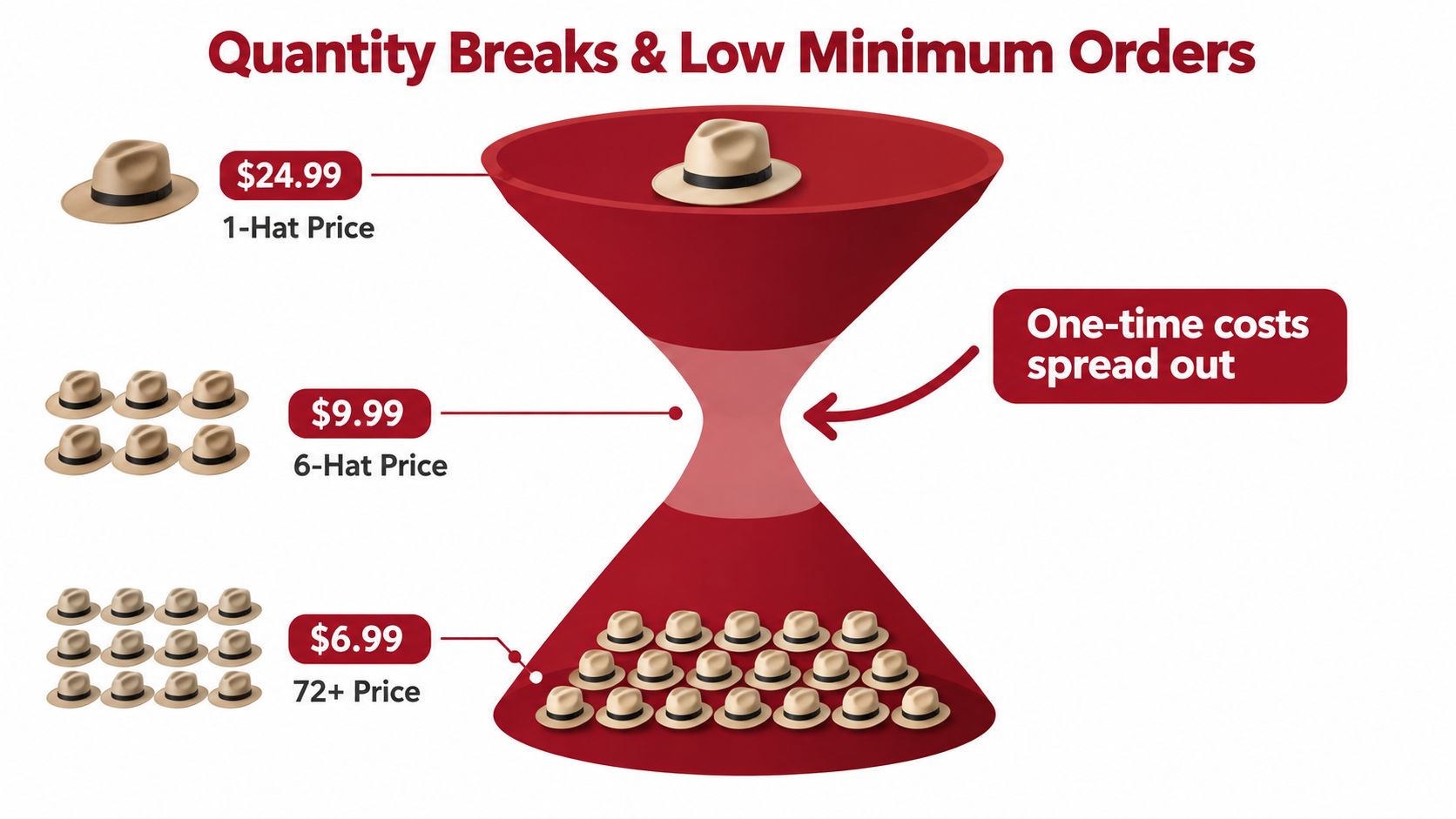
The minimum matters
Retail shops often set minimums because a small order may not cover file preparation, machine loading, proofing, and handling. A low minimum gives a small business or team a way to test the design without committing to a large inventory purchase.
Dirt Cheap Headwear accepts custom embroidery orders starting at six pieces per logo, according to the company information provided for this article. That makes a small test run possible, but the lowest minimum isn't automatically the lowest per-hat cost. If you already know you'll need more hats, combining the order usually gives the setup cost more units over which to spread.
Plan reorders before you run out
A rushed reorder often costs more because you buy fewer blanks, repeat handling, and lose the opportunity to consolidate sizes or colors. Keep the approved file, proof, thread specifications, and blank style in your records.
The general rule is simple:
- Testing a design: Use the lowest practical minimum and protect cash flow.
- Ordering for a known event: Consolidate units before production starts.
- Building ongoing merch: Standardize the blank and logo placement so reorders stay comparable.
A Sample Hat Quote From Dirt Cheap Headwear
Let's make the bill tangible with a 24-piece structured snapback carrying one front logo. The figures below are a worked pricing example using the ranges supplied in the brief, not a guaranteed quote for every artwork file or hat style.
The blank hat is estimated at roughly $4 to $6 each, putting the 24-piece blank total at about $96 to $144. For a simple logo under 5,000 stitches, digitizing is estimated at $40 to $60 one time, and that file can be reused for future orders if the artwork doesn't change.
The base embroidery rate is about $1 to $3 per 1,000 stitches. At 5,000 stitches, that creates an embroidery line of approximately $5 to $15 per hat, or $120 to $360 for 24 hats.
Adding the requested decoration
Assume the logo uses three colors and includes front 3D puff. The supplied scenario estimates the extra color charge at $0.50 to $1.50 per hat, producing $12 to $36 across the run. The 3D puff addition is estimated at $2 to $4 per hat, or $48 to $96 for 24 pieces.
Using the exact scenario range supplied, the complete order lands around $352 to $648, or roughly $14.60 to $27 per finished hat. The spread is wide because blank quality, stitch pricing, setup, color handling, and puff treatment all move independently.
| Line Item | Dirt Cheap Headwear (24 pcs) | Typical Retail Shop (24 pcs) |
|---|---|---|
| Blank hats | $96 to $144 | Included in higher retail-markup quote |
| Digitizing | $40 to $60 one time | Often included or separately charged |
| Base embroidery | $120 to $360 | Usually bundled into per-hat pricing |
| Extra color handling | $12 to $36 | May be bundled or itemized |
| 3D puff | $48 to $96 | May carry a higher specialty charge |
| Finished order example | $352 to $648 | Commonly $20 to $35 per hat |
A typical retail shop may quote $20 to $35 per hat for the same 24-piece type of run once its blank markup, minimum structure, handling, and turnaround are included. That doesn't automatically make the retail shop unfair. It does mean you should ask whether you're comparing the same hat, stitch count, thread specification, logo location, puff treatment, and setup policy.
Quote discipline: Never compare one bundled per-hat number with another until both shops show the blank, digitizing, embroidery, and finishing assumptions.
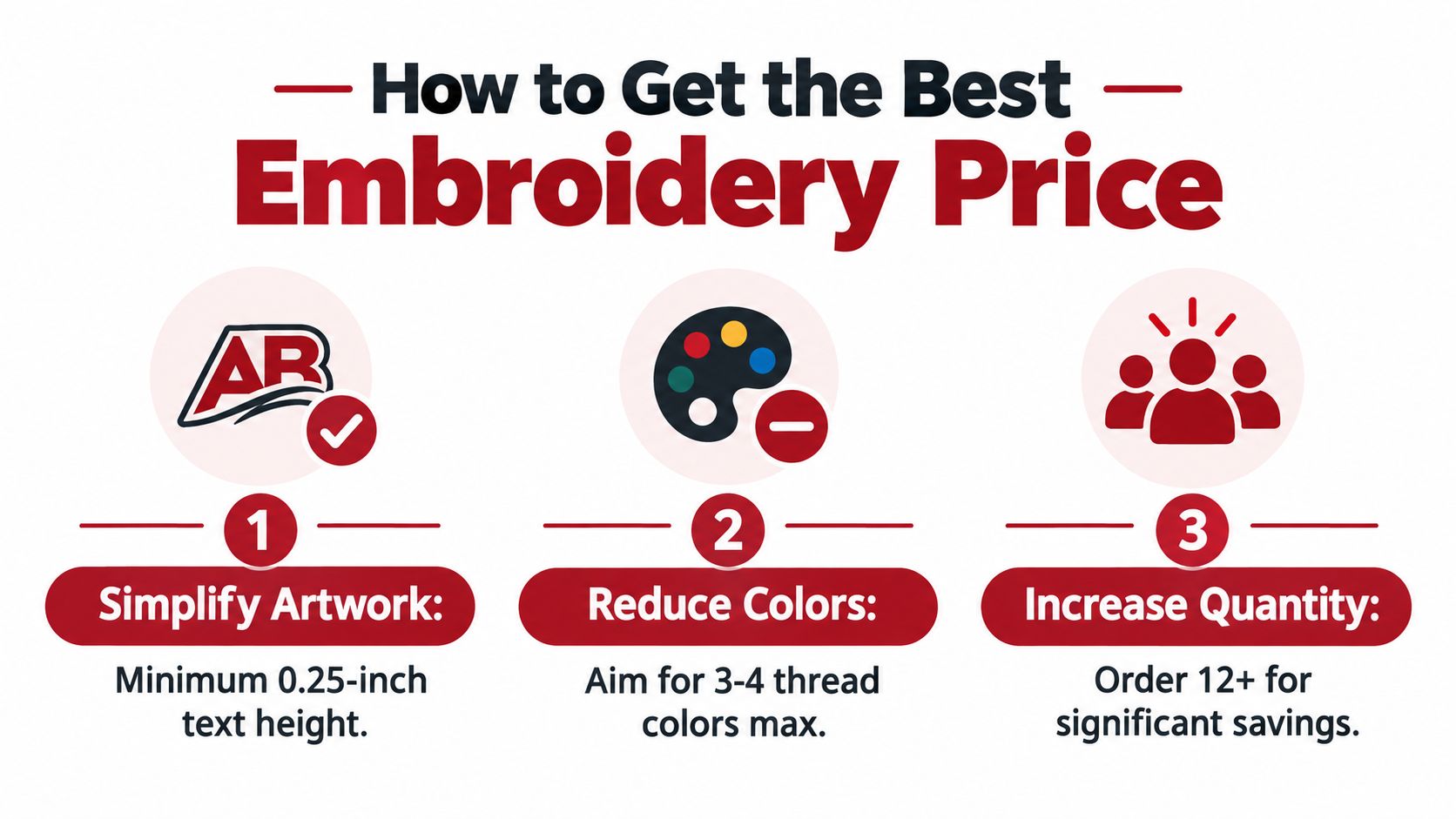
How to Get the Best Embroidery Price
You control the artwork, the color count, and the quantity. Those are the levers that matter most. The shop controls machine capacity, labor, blank sourcing, and overhead, so your job is to send a production-ready brief and compare equivalent quotes.
Start with the logo. Remove gradients, simplify tiny interior details, and check whether small text will remain readable after stitching. Fine lettering should be treated carefully, with the supplied buying guidance recommending a minimum 0.25-inch text height for embroidery artwork.
Make the design easier to stitch
A clean logo usually costs less than a detailed one because it needs fewer stitches and fewer corrections. Ask for a stitch count before approving the production file, and request a proof or sample stitch-out when the design includes small lettering, thin outlines, or complicated fills.
The Dirt Cheap Headwear cost-per-unit calculation resource can help you organize the full landed cost instead of looking only at the decoration line.
Keep the quote apples to apples
Send every shop the same information:
- Stitch count: Get the final or estimated count in writing.
- Digitizing: Confirm whether the charge is one time and reusable for reorders.
- Thread specification: State whether standard, metallic, or specialty thread is required.
- Puff treatment: Confirm whether 3D puff includes foam, setup, and cleanup.
- Logo location: A front placement isn't automatically equivalent to a side or back placement.
- Blank details: Match brand, style, material, structure, and color.
- Finishing: Ask whether trimming, patch application, packaging, or other handling is included.
The cheapest quote isn't always the lowest-cost decision. A low number attached to a poor blank, vague stitch count, or repeated digitizing fee can become expensive after rework. I prefer itemized quotes because they show exactly where negotiation is possible and make future reorders easier.
Dirt Cheap Headwear combines wholesale blank headwear with in-house embroidery, custom patches, and options such as 3D puff and fine-detail stitching, with custom orders starting at six pieces per logo. If you need a small test run or a larger branded order, visit Dirt Cheap Headwear, upload the logo, and request a line-by-line quote that separates the blank, setup, stitching, and finishing.