
Finding a Headwear Shop Near Me: The 2026 Buyer’s Guide
You're probably trying to solve a simple problem that turns weirdly complicated fast. You need hats for a staff team, a softball league, a merch drop, a school event, or a small business launch. So you search for headwear shop near me, expecting custom embroidery options, blank hat inventory, and someone who can tell you what will stitch cleanly in practice.
Instead, you get mall stores, fashion retail listings, hours of operation, and a map full of places that sell hats one at a time.
That mismatch is real. It also causes a lot of first-time buyers to waste time calling the wrong businesses, comparing quotes that aren't comparable, or approving artwork that was never going to sew well on a cap in the first place.
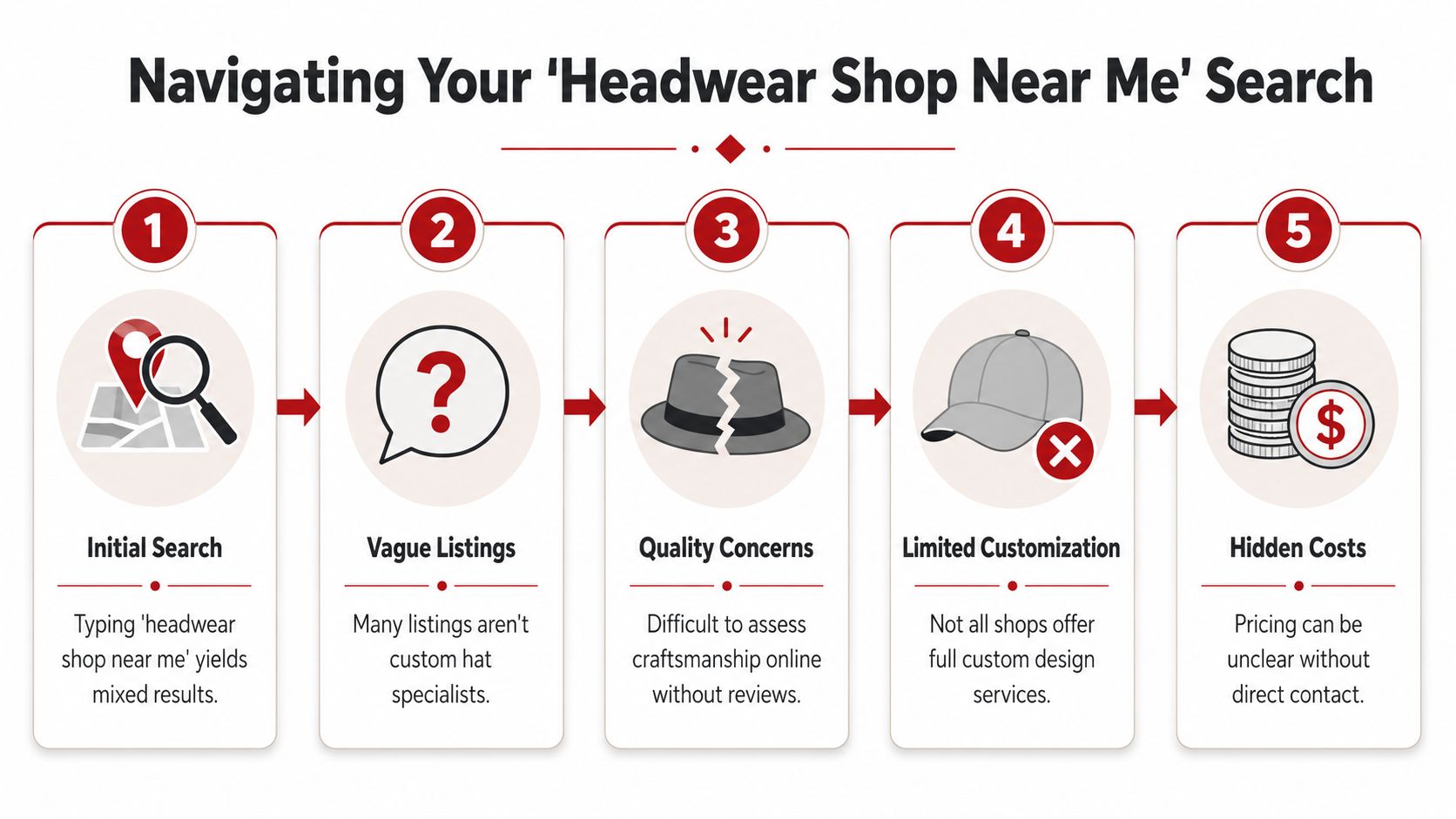
Why Headwear Shop Near Me Can Be a Tricky Search
If your search results feel off, they probably are. A common gap in headwear shop near me results is that they skew toward retail storefronts and miss what many buyers need: blank inventory, low-minimum customization, and quick replenishment for teams, events, or resale, as noted in this local intent mismatch example.
That's the core issue. Google often treats “headwear shop” like a consumer shopping query, while many real buyers are making a B2B purchase.
Retail store versus decorator
A retail hat store usually sells finished products. A custom decorator helps you choose blank hats, match decoration methods to fabric and panel structure, build a quote, prep artwork, send a proof, and produce a repeatable result.
Those are very different jobs.
If you need one fashion cap today, a retail listing is useful. If you need twelve staff hats with a left chest shirt add-on next month, it's the wrong search result.
Practical rule: Don't judge a shop by the category name alone. Judge it by whether it shows blank brands, embroidery samples, proofing language, and bulk ordering workflow.
Why local listings can still help
Even when search results are messy, local listings still tell you something useful. They show whether a business maintains current hours, photos, reviews, and a complete business profile. If you want a quick refresher on what a well-built listing should include, Polaris Marketing Solutions' GBP guide is a useful reference.
A strong listing doesn't guarantee a good hat order. But a weak listing often signals weak process.
What actually matters
When buyers search for a headwear shop near them, they usually need five things:
- A real custom workflow that includes quoting, proofing, and reorder support
- Hat-specific experience instead of generic T-shirt printing
- Low enough minimums to test a small run before committing
- Brand access to styles that fit the project
- Clear turnaround communication so the order lands when it's needed
If you filter every shop through those five points, the search gets much easier.
Your Local Search Strategy for Custom Headwear
A better search starts with better wording. If you only search headwear shop near me, you'll keep seeing stores built for walk-in shoppers. You need search terms that signal decoration, wholesale, and business ordering.
Search like a buyer, not a browser
Try combinations like these:
- Custom hat embroidery near me
- Hat decorator near me
- Promotional products supplier hats
- Embroidery shop hats
- Wholesale blank hats near me
- Apparel decorator hats
- Custom snapbacks local
- Corporate hats embroidery
These phrases do a better job of pulling in embroidery shops, promotional product companies, and apparel decorators instead of fashion retailers.
What to look for in results
A real custom headwear supplier usually shows different visual cues than a store selling finished hats.
Look for:
- Production photos showing embroidery machines, hoops, thread racks, or stacked cartons of blank caps
- Brand names such as Richardson, YP Classics/Flexfit, New Era, Nike, Legacy, or Valucap
- Service language like digitizing, proofs, puff embroidery, patch hats, bulk ordering, or reorder support
- Project photos with logos on fronts, sides, or back arches instead of lifestyle photos only
If every image looks like a retail shelf or a mall display, you're probably not looking at a true decorator.
Go beyond Google Maps
Some solid vendors won't rank first in map results. Check local business directories, chamber listings, Instagram, and Facebook pages. Instagram is especially useful because decorators tend to post close-up stitch samples, cap styles, and current jobs.
A local business that understands search usually also understands how buyers find them. That doesn't prove they're good at embroidery, but it's still a helpful signal. For a practical way to review what a visible local business should have in place, Bare Digital's essential local SEO checklist is worth scanning.
Good local decorators usually make it easy to answer one question fast: “Can you show me what kind of hat work you actually do?”
Build a short list, not a giant one
You don't need twenty options. You need three to five that clearly handle hats, answer quickly, and show relevant work.
A short list works better if it includes a mix:
- One embroidery-first local shop
- One promotional products company with headwear capability
- One online specialist for comparison
That mix tells you what local service looks like, what bundled promo buying looks like, and what a headwear-focused workflow looks like.
How to Vet a Local Hat Decorator
A buyer searches “headwear shop near me,” picks a place with good reviews, and gets a clean quote. Then the problems start. The shop turns out to be a retail store, or a general print shop that only does hats occasionally, or a decorator that takes the order locally but sends the work somewhere else. The result is usually the same. Slow answers, weak proofing, and a hat that looked better in the mockup than it does in hand.
That gap is why vetting matters. Hat embroidery has less margin for error than many first-time buyers expect. Crown shape, front seam position, fabric, backing, and logo proportions all affect the finished piece.
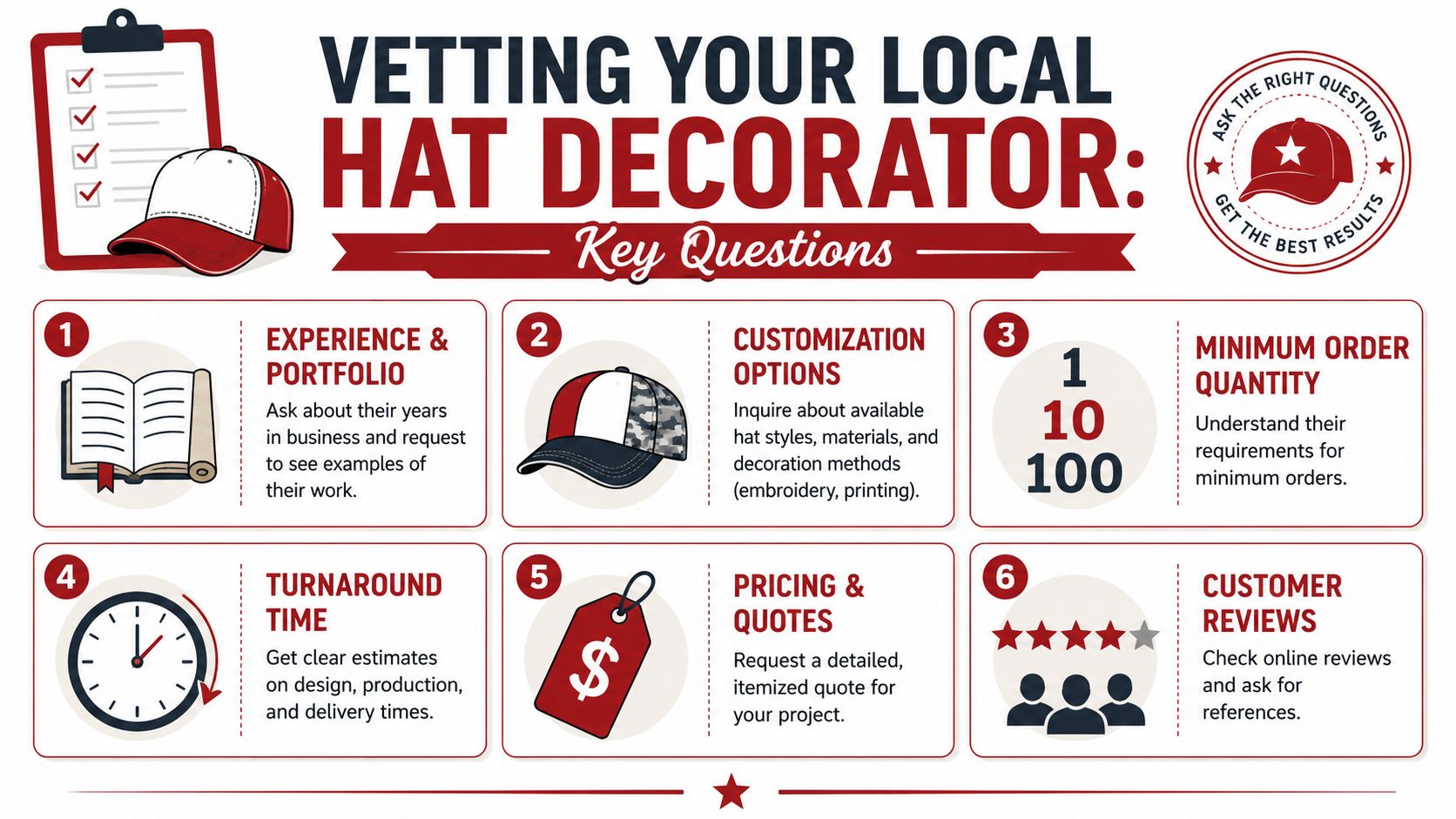
Start with production questions, not style questions
Before discussing thread colors or cap models, confirm how the shop runs orders.
| Question | Why it matters |
|---|---|
| What's your minimum order? | This shows whether they welcome small test runs or prefer larger production jobs. |
| What's your current turnaround? | You need a real production window with approval time built in. A quick read on how hat embroidery turnaround usually works helps you spot vague answers fast. |
| Which hat brands do you stock or source most often? | Shops that decorate hats regularly usually answer this immediately and can explain fit, structure, and availability. |
| How do you handle production scheduling? | This reveals whether your order goes straight into their workflow or gets delayed by outside handoffs. |
A solid shop answers these without hesitation. If the response is fuzzy, the process usually is too.
Ask how they proof hats, not just how they quote them
A quote tells you price. A proofing process tells you whether the shop knows how to protect the order.
Ask direct questions:
- Can I review a sew-out or production proof before full run approval?
- Will you recommend changes if the logo is too small for this hat style?
- What backing are you planning to use for this fabric and crown type?
- How are you placing the design around seams, rope details, or curved fronts?
A capable decorator should be able to explain those answers in plain language. The local hat shop workflow guide gives a useful reference point for what that conversation should cover.
One sentence can tell you a lot. If a shop says, “We can stitch anything exactly as sent,” that is usually a warning, not reassurance. Good decorators flag small text, narrow outlines, and crowded layouts before production starts.
Test whether they understand hat structure
Hat work is not one-size-fits-all. A structured trucker, a foam-front cap, and an unstructured dad hat each behave differently under the needle.
Ask for recommendations tied to your actual logo and hat style. Look for answers like these:
- Flat embroidery will hold detail better than puff for this artwork
- The center seam may interfere with a small circular logo
- Side embroidery has tighter usable space than many mockups suggest
- A rope hat needs placement adjusted so the design does not fight the rope line
- A soft, low-profile cap may need a simpler layout than a tall front panel
Those are practical answers. They show the shop is solving for your result, not just taking the order.
Review portfolio samples that match your job
“Can I see some hat work?” is too broad. Ask for samples close to your project.
Examples that help:
- A left-front logo on an unstructured cap
- A centered logo on a structured trucker
- Black thread on black fabric
- Fine text on a smaller front panel
- Patch placement on a mid-profile cap
Look closely at spacing, edge definition, center alignment, and whether the stitching sits cleanly on the cap without pulling or rippling. Sharp art alone does not prove good execution. Control does.
Red flags that usually cost time or money
- No clear answer on turnaround or approval timing
- Only digital mockups, no real stitched photos
- No questions about your artwork
- No discussion of cap style, panel structure, or seam placement
- A quote that treats every hat the same
- Big promises with no production detail behind them
The best local decorators are easy to talk to, but they are not casual about the process. They ask questions, set limits, and explain trade-offs early. That is how good hat orders stay good from proof to delivery.
Getting Your Artwork Ready for Perfect Stitches
Most first-time buyers think the hard part is choosing the hat. It usually isn't. The hard part is making sure the logo fits the medium.
Embroidery turns artwork into stitches, not ink. That means clean shapes win. Tiny details lose.
What works well on hats
Good embroidery art usually has:
- Clear shape separation
- Limited tiny text
- Solid color areas
- Strong outlines where needed
- Enough spacing between elements
Embroidery is akin to building with thread. Each stitch needs physical space. If the artwork relies on subtle gradients, hairline borders, or miniature lettering, the machine has to simplify it anyway.
What causes trouble
These files tend to create delays or revisions:
- Low-resolution screenshots
- Website logos pulled from social media
- Busy seal-style logos with lots of small words
- Fine script fonts
- Gradient-heavy graphics
- Thin outlines around every element
A common problem is a logo that looks balanced on a website header but becomes cramped on the front of a cap. The hat doesn't give you a flat billboard. It gives you a curved, stitched surface with seams and tension.
Artwork shortcut: If someone can't read the key word in your logo from a few feet away, it probably needs to be simplified before embroidery.
The file-prep checklist
Send the cleanest file you have. If possible, provide vector art such as AI, EPS, or PDF. If you only have a PNG, send the largest version available and expect some cleanup.
Before you approve anything, make sure you've covered:
- The exact logo version you want used
- Thread color direction if brand colors matter
- Preferred placement such as front, side, or back arch
- Hat style choice because shape affects decoration
- Whether text can be enlarged or reduced if readability becomes an issue
If you want a plain-English breakdown of what the shop is doing behind the scenes, this guide on how to digitize a logo for embroidery helps you understand why some files stitch cleanly and others need to be rebuilt.
Keep one version just for hats
This helps more than people expect. Your website logo, your packaging logo, and your embroidered logo don't always need to be identical. They need to feel consistent.
A hat-friendly version often means:
- slightly thicker text
- fewer small details
- cleaner spacing
- stronger contrast
That's not compromising the brand. That's adapting it to the product.
Local vs Online Which Headwear Shop Is Right for You
You search “headwear shop near me,” drive to a nearby store, and find racks of finished caps. What you need is a shop that can source blank hats, decorate them well, and repeat the order later without changing the result. That gap is why this decision trips up first-time buyers.
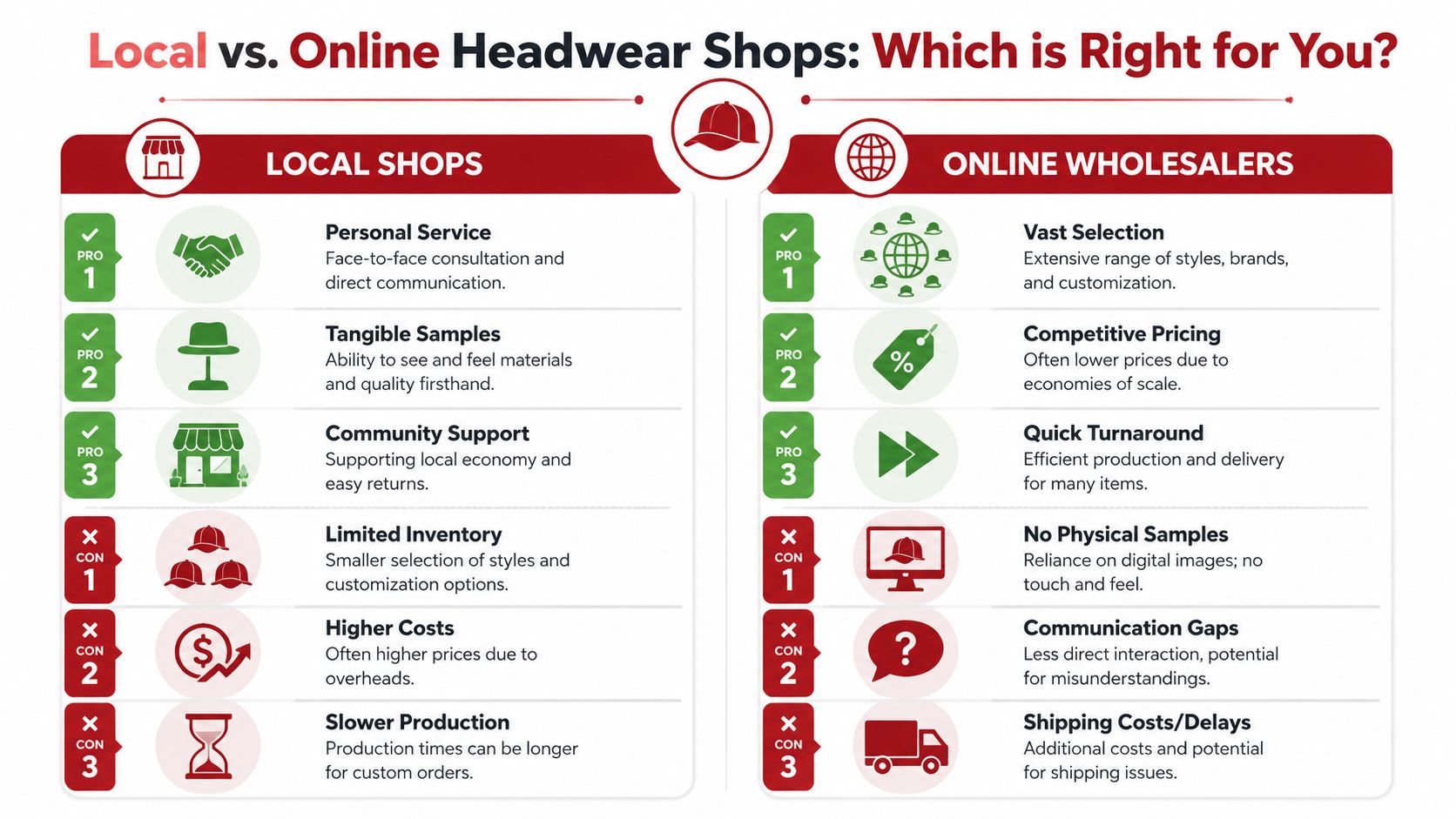
Geography matters less than process. The better choice usually comes down to three things: whether you need to handle samples in person, how specific your hat style is, and how much consistency matters on reorders.
When local makes sense
A local shop earns its keep when the order is still fuzzy. If you are unsure whether you want a structured trucker, a garment-washed dad hat, or a performance cap, seeing a few shapes on the counter can save a lot of back-and-forth.
Local also helps when pickup is part of the plan, or when the buyer wants one point of contact they can walk in and talk to. I usually recommend local first for school groups, restaurants, event staff, and buyers working against a fixed date with no room for shipping delays.
That said, “local” and “custom headwear specialist” are not the same thing. Some nearby shops are retail stores first and decorators second.
When online makes more sense
Online specialists usually have the advantage when the spec is already clear. If you know the brand, profile, closure type, color, and logo placement, an online shop can be faster and more consistent because the workflow is built around quoting, proofing, and production instead of storefront traffic.
Selection is often better too. That matters when the local options mostly show basic promo caps but you need a specific silhouette or brand for a merch line, staff uniform, or resale program.
Online is also a strong fit for repeatable ordering. Once the art, placement, and cap style are locked in, a good system makes reorders much easier.
A practical side-by-side view
| If you care most about | Local shop | Online specialist |
|---|---|---|
| Feeling samples before ordering | Strong fit | Limited unless samples are sent |
| Quick in-person conversation | Strong fit | Usually handled by email or phone |
| Broad brand and style selection | May be limited | Usually stronger |
| Reordering the same style later | Depends on stock habits | Often easier if inventory systems are built for it |
| Small custom test runs | Varies a lot | Often more flexible |
| Complex hat-specific embroidery | Depends on shop skill | Better if headwear is a core focus |
One useful filter is whether decoration is handled on site or passed to another vendor. That affects lead time, proofing speed, and who is accountable if the first sew-out misses the mark. Dirt Cheap Headwear, for example, explains its in-house embroidery versus outsourced production process in plain terms, which is the kind of clarity buyers should look for from any supplier.
Use the order type to decide
Choose local when the project still needs hands-on help. Choose online when the project needs range, repeatability, or a specific cap that local shops do not stock.
For a first order, I like a simple test. Ask one local shop and one online specialist to quote the exact same job: same hat, same quantity, same logo size, same placement, same due date. Then compare more than price. Compare how clearly they answer questions, how they handle proofs, and whether they sound confident about the actual hat you want.
A cheap quote is easy to get. A clean, repeatable result is harder. That is usually the difference between a retail “headwear shop near me” result and a true custom decorator.
From Plan to Product Placing Your Headwear Order
A first-time buyer usually loses time here, not in the search. The shop looked right, the quote seemed clear, and then production starts on the wrong cap color, the wrong logo file, or a front placement that sits too high on the crown.
The fix is simple. Turn the quote into a clean approval record before a machine runs.
Ask for one final order summary that shows:
- Exact hat style, color, and size mix if applicable
- Decoration method and placement
- Final artwork version
- Thread colors or print colors
- Proof approval
- Production timeline, ship date, or pickup date
- Any notes for repeat orders
That last point matters more than new buyers expect. If this order may turn into uniforms, merch restocks, or event repeats, ask how the shop will document the stitch file, hat style, and placement notes so the second order matches the first.

Small test runs are much easier to buy than they used to be, which is why I usually recommend a sample order when the logo is new to headwear or the cap style has not been worn by your group before. A short run gives you a real check on fit, thread coverage, and how the design sits on the actual panel shape.
Handle approvals differently depending on who you hire. With a local decorator, get the final details in writing even if you discussed everything at the counter. With an online specialist, fill out the order form carefully, upload the cleanest vector or high-resolution file you have, and read the proof line by line. In both cases, the proof is the order. If the proof is vague, the result usually is too.
If your search for a "headwear shop near me" started with retail stores, this is the point where the difference becomes obvious. A store can sell a hat today. A custom decorator needs enough information to make the same hat correctly, again and again.
If you need blank hats, low-minimum custom embroidery, or a repeatable ordering process for staff, events, teams, or resale, Dirt Cheap Headwear is one option to compare against local shops. Review the styles, submit your artwork through the custom order process, and make sure the proof matches exactly what you want before production starts.
Pingback: Hat Embroidery Chicago: A Complete 2026 Buyer Guide | Dirt Cheap Headwear