If you're shopping for a used hat embroidery machine right now, there's a good chance you're already feeling the pain that pushed you here. You send logos out, wait on proofs, chase updates, and pay someone else every time a customer wants a fresh run of caps. Then a rush order hits, or the stitch quality comes back just a little off, and you start doing the math on bringing hats in-house.
That instinct isn't wrong. A smart used purchase can change how a small shop, merch brand, or team supplier operates. It can give you control over timing, cleaner sample approval, and a better handle on which hats run well with your logo. But used embroidery equipment can also fool people. A machine can power on, sew a flat sample, and still be a terrible hat machine in real production.
That's the part most buying guides skip. They talk about needle count and brand names. They don't spend enough time on the parts that wear out in ways that matter specifically on caps.
Is a Used Embroidery Machine Your Next Best Move
A shop usually reaches this point after one bad cap order too many. The customer needs a clean front logo, the deadline is tight, the contract decorator is backed up, and the sample that comes back looks fine from six feet away but not in your hand. That is often when buying used starts to look less like a shortcut and more like a serious operations decision.
For hat work, that can be the right call.
A used machine earns its keep when caps are already a repeat category, not a guess. If you are regularly selling team hats, company uniforms, event merch, or retail runs, owning the machine gives you control over sample timing, stitch placement, and reorders. If you are still deciding whether embroidered caps belong in your mix, keep your cash and validate demand first. This comparison of in-house embroidery vs outsourced production helps frame that decision in practical terms.
The biggest mistake I see is treating a used embroidery machine like a used printer. If it powers on and stitches a flat test, buyers assume it is ready for caps. Hat production does not work that way. A machine can be mechanically alive and still be operationally weak where caps stress it.
That is why the best used purchase is not always the cheapest machine or the one with the highest needle count. It is the machine whose cap driver still holds registration, whose hoop system locks down cleanly, and whose wear points have not been ignored for years. Those are the details that decide whether you can run hats profitably or spend your week chasing thread breaks, crooked runs, and inconsistent placement.
When outsourcing starts costing more than it saves
Outsourcing is a sensible way to start. It keeps overhead down and lets a small shop sell decorated goods before taking on equipment, training, maintenance, and floor space.
The math changes once hat orders become routine.
At that point, every outside order adds scheduling risk. Rush jobs get harder to promise. Sample revisions slow down. Testing different cap styles costs time and setup money. Margin gets squeezed, and you still do not control the result. Buying used can fix that, but only if you are prepared to own the machine like a production asset, not a side tool.
A simple rule helps. Buy used when hat embroidery already has a place in your workflow and you have enough volume to justify setup, maintenance, and operator time. Pass when the purchase is being driven by a cheap listing alone.
Why a used hat machine can be a smart buy or a costly one
Caps expose wear fast. The parts that matter most are not always obvious in a listing photo, and sellers often describe a machine as "running great" when they really mean it can still sew a name on a flat.
For hat work, the operational reality matters more than the spec sheet. A tired cap driver, loose hooping hardware, worn mounts, or inconsistent frame engagement can turn a technically functional machine into one that wastes blanks and operator hours. That is the gap many first-time buyers miss.
A good used machine can still be a strong earner. Many shops upgrade, close, or shift production while their equipment still has years of useful work left. The opportunity is real. The discipline is in knowing what kind of wear is acceptable and what kind of wear will follow you into every cap order.
Understanding Embroidery Machine Types
Before you judge any listing, filter the market correctly. Most used machines for sale are not serious hat machines, even if the seller says they “do caps.”
Single-needle versus multi-needle
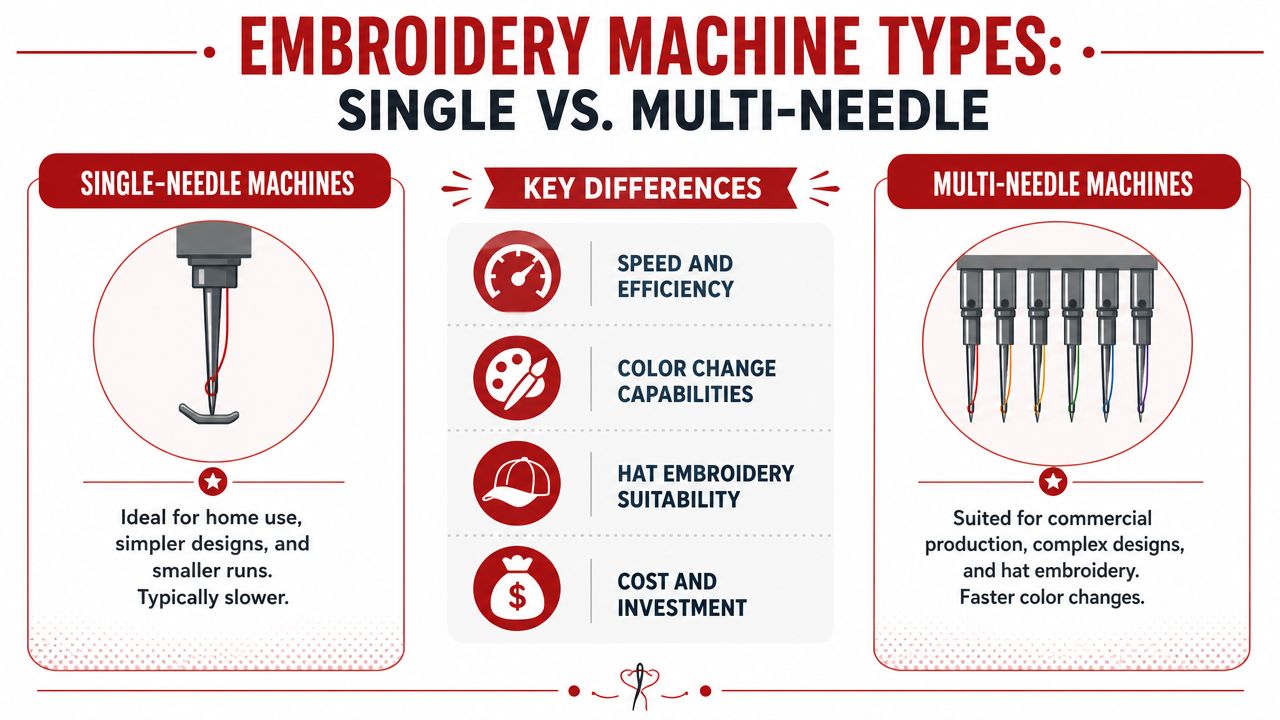
If you're buying for a business, multi-needle is usually the category that deserves your attention. Single-needle machines can produce embroidery, but they slow you down every time a design needs color changes, testing, or repeat production. Hats magnify that problem because setup already takes patience.
A multi-needle machine is built more like a production tool. That doesn't automatically make every used multi-needle machine a good buy, but it does eliminate one of the biggest workflow headaches right away. If your normal work includes logos, left chest designs, and caps, a multi-needle setup gives you a more realistic path to repeatable output. This guide to an embroidery machine for logos pairs well with that decision because logo production and cap production overlap more than people think.
Home machine versus commercial machine
Here, many newcomers waste money.
A home or prosumer embroidery machine is like a pickup truck. It can haul some weight, and for the right owner it may do useful work. A true commercial hat-capable machine is more like a delivery truck built to run routes every day. Both move product. Only one is built for constant starts, stops, setup changes, and real headwear production.
Use this quick filter when scanning listings:
| Machine type | Good for | Weak point on hats |
|---|---|---|
| Single-needle home machine | Hobby work, occasional pieces | Slow workflow, limited cap practicality |
| Prosumer multi-needle | Small runs, light business use | Can still struggle with sustained cap work |
| Commercial multi-needle | Repeat logo orders, structured hats, ongoing shop production | Higher purchase risk if worn or poorly maintained |
What “hat capable” should mean
Don't accept “comes with cap frame” as proof.
A machine is only hat-capable in practice if the cap driver, frame system, and trace behavior work together correctly. Plenty of machines include hat accessories that have seen hard use, poor storage, or mismatched replacement parts. On paper, that machine can embroider hats. In production, it may fight every structured front panel you load.
The used machine that looks complete in photos can still be missing the one thing you actually need, which is dependable cap performance.
That's why the listing title matters less than the test you run when you inspect it.
Key Features for Hat Embroidery
Hat embroidery exposes wear faster than flat work. A used machine can sew left-chest samples all day and still turn into a headache on structured caps if the cap setup is loose, the driver is worn, or the machine loses its trace on a curved run.
Cap frame system and sewing field
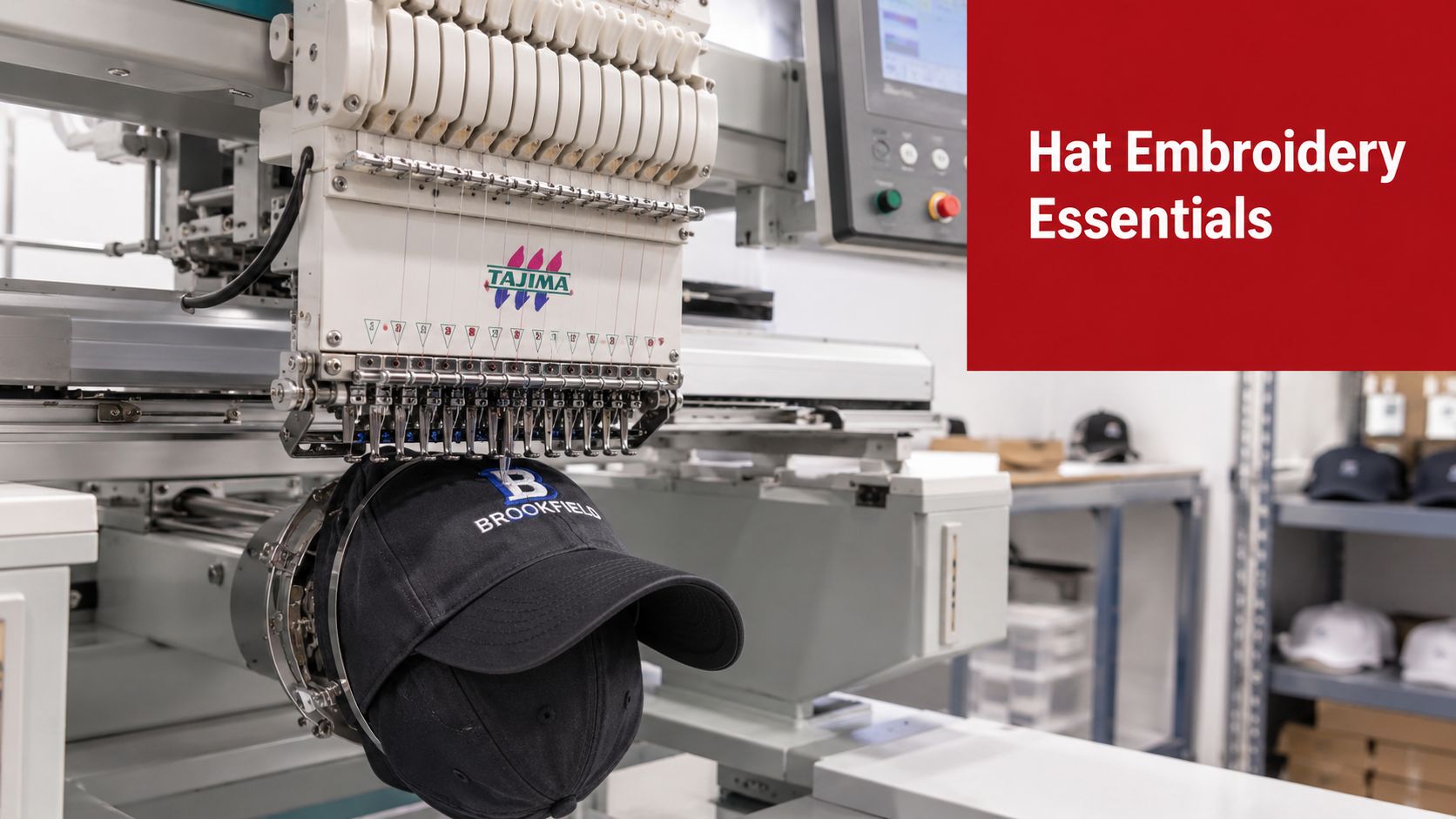
For hats, the cap frame system matters more than a long feature list. The frame, ring, mounts, and cap driver have to work together without play. If the frame flexes or the driver has slop in it, the machine may still run, but registration drifts, outlines get uneven, and structured fronts start fighting back.
Check how the hat loads, how firmly it locks in, and whether the frame seats the same way every time. Used cap systems often look complete in photos but have bent brackets, worn contact points, or replacement parts from a different setup. That kind of mismatch shows up in production, not in the listing.
The sewing field matters for the work you plan to sell. Front-center logos are the easy test. Side placements and back hits tell you more about whether the machine can earn money on hats instead of limiting your menu.
120-degree versus 270-degree cap range
A lot of buyers focus on brand first and cap range second. In a shop, that order should be reversed.
If your orders stay front-center, a narrower cap range may be fine. If customers ask for side logos, wide-set patches, or back names, cap range and clearance start deciding what jobs you can take without constant rehooping and trial runs. A good demonstration of that difference appears in this used cap machine demonstration.
What matters is not the brochure term. What matters is whether the machine tracks cleanly through the positions you plan to sell.
Match the machine to the work
- Front logos only: A basic cap setup can serve a narrow product line.
- Front and side placements: You need cleaner trace behavior and better clearance.
- Front, side, and back work: The cap driver, frame alignment, and hoop geometry need to be in good shape, or setup time climbs fast.
Speed control, tension stability, and cap behavior
Hat work punishes machines that only look good at top speed. A healthier used machine is one that runs cleanly at sensible cap speeds, holds tension consistently, and stays predictable on curved panels.
That matters even more on foam, thick seams, and structured fronts. The hat embroidery setup guide notes that cap work often benefits from moderated speed, careful tension settings, and the right needle choice for denser materials. In day-to-day production, that means fewer broken threads, fewer chewed-up blanks, and less babysitting at the machine.
I would rather buy a used machine that runs caps smoothly at controlled speed than one that boasts high speed but rattles through every test sew.
Good hat production comes from repeatable control, stable tension, and a cap system that stays put under load.
Your Pre-Purchase Inspection Checklist
Most buying mistakes happen because the buyer inspects the machine like a general appliance instead of a hat production tool. You're not checking whether it turns on. You're checking whether it can earn its keep on curved headwear without wasting blanks.
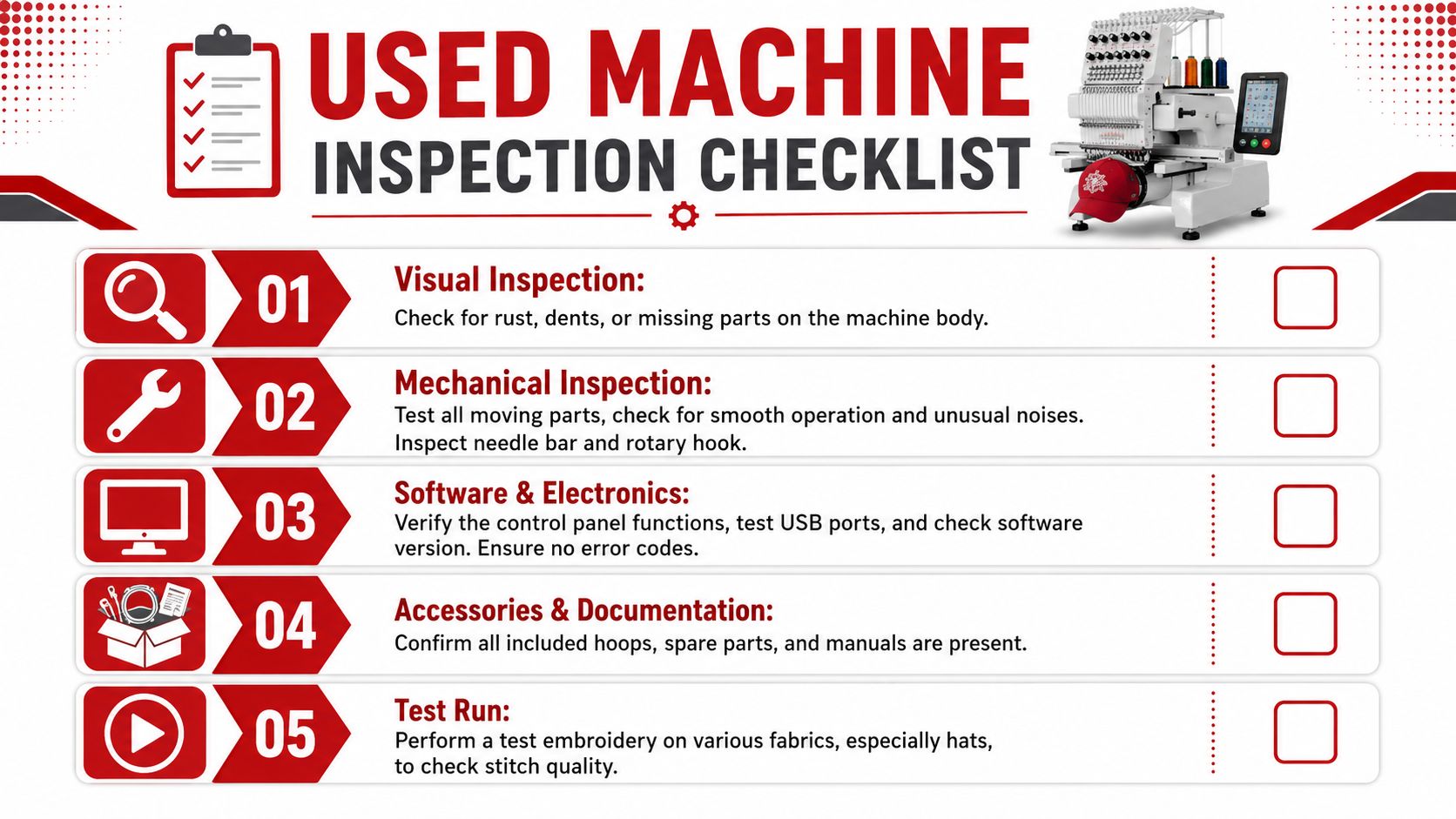
Start with the walk-around
Before any stitch test, do a slow visual inspection.
- Machine body: Look for rust, dents, cracked covers, bent guards, or missing screws. Cosmetic wear alone isn't fatal, but neglected machines often show it first on the outside.
- Cap accessories: Inspect the cap frame, cap ring, driver, mounts, and any related brackets. These parts take abuse.
- Cables and ports: Frayed wiring, loose connections, or damaged ports can turn a cheap machine into a long repair project.
- Hoop system fit: Put the hat setup on and off. It should seat positively, not vaguely.
A used seller may describe the machine as “working great” because it stitched a name on a towel last week. That tells you almost nothing about its cap readiness.
Listen before you trust
Run the machine and pay attention to sound. Healthy commercial equipment has a rhythm. Worn equipment often tells on itself through chatter, grinding, rattling, or rough transitions when the head changes direction.
Use a simple sequence:
- Idle test: Power it on and listen for abnormal startup noise.
- Movement test: Jog the machine through its axis motions and watch for hesitation.
- Cap attachment test: Mount the cap driver and confirm the machine moves smoothly with the hat hardware installed.
If the machine sounds strained only when the cap system is attached, take that seriously. That's often where hidden wear shows up.
Demand a real hat stitch-out
An essential part of any inspection is a test on an actual hat, not just flat fabric.
Ask the seller to run a simple logo or lettering sample on a structured cap. Watch the trace first. Then watch the stitch formation. You're looking for clean registration, consistent fill, stable outlines, and no visible struggle as the design crosses the cap curve.
Red flags include:
| Warning sign | What it may indicate |
|---|---|
| Thread breaks on a simple sample | Tension issues, wear, poor setup, or cap instability |
| Puckering around the logo | Weak stabilization or poor frame hold |
| Needle strikes or close clearance scares | Cap driver or geometry problems |
| Inconsistent placement | Slop in the frame system or poor trace accuracy |
| Bird's nests underneath | Tension or hook-related issues |
Bring the kind of hat you actually plan to sell. A machine that behaves on a soft sample cap may still struggle on the structured styles your customers want.
Check the ownership story
Ask direct questions and pay attention to whether the answers line up.
- Why are they selling it?
- Who maintained it?
- Was it used mostly for flats or caps?
- Are the original hat accessories included, or are these mixed from another machine?
- Can they demonstrate every control needed for production?
The goal isn't to catch someone in a lie. It's to uncover whether the machine had a working life that matches your use case.
Decoding Used Machine Prices and Value
A used listing only makes sense when you know what new machines cost. Otherwise, you're negotiating in the dark and reacting to sticker shock instead of value.
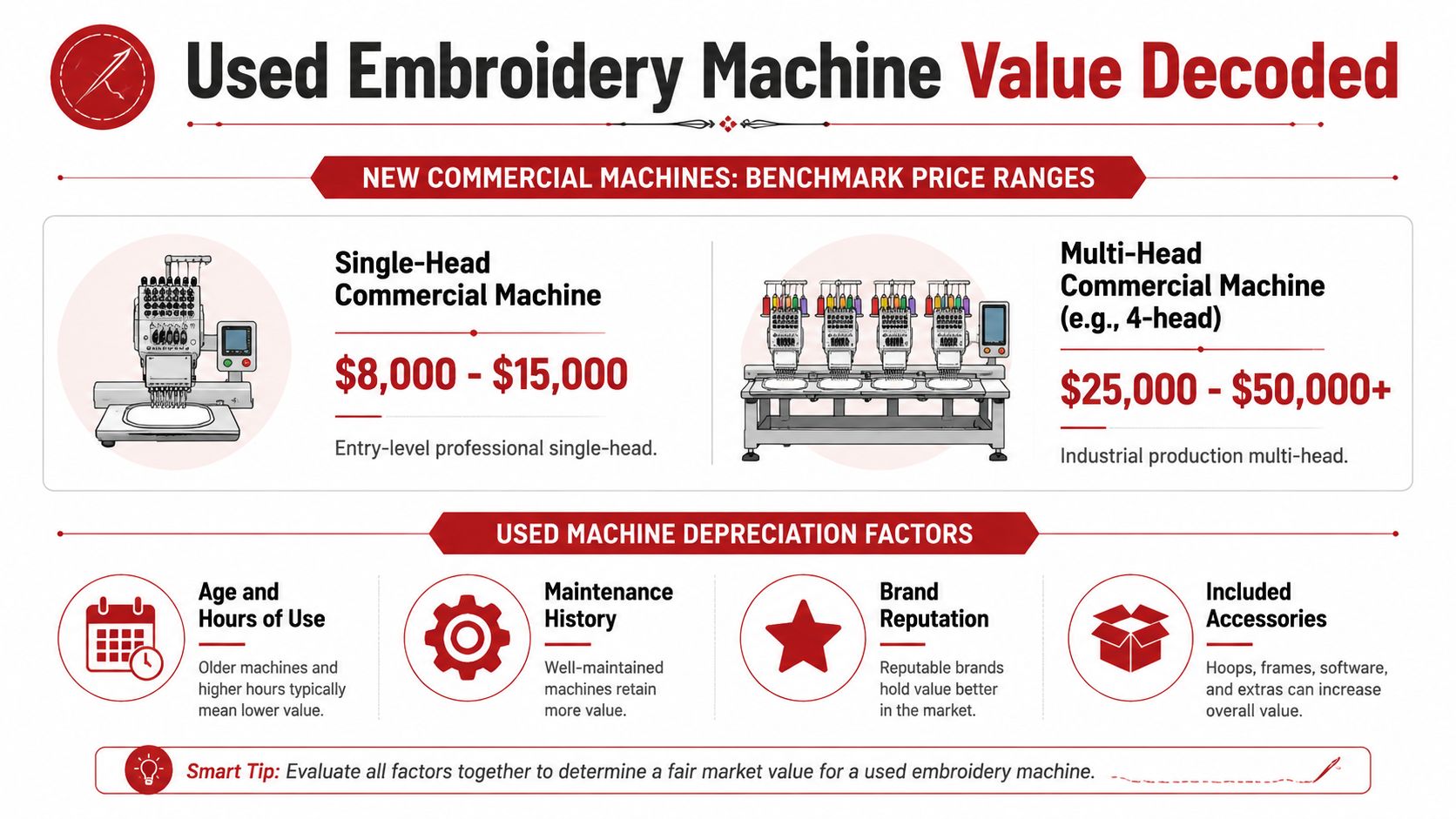
Use new prices as your anchor
The commercial market has clear pricing tiers for new machines. Independent machine guides place entry-level systems at about $1,000 to $5,000, mid-range units at $5,000 to $10,000, and high-end commercial models at $10,000 to $20,000 and beyond. Specific examples include the Janome MB-7e at roughly $6,000 to $8,000, the Brother PR1055X at about $12,000 to $15,000, the Barudan BEKT-S901CAⅡ at $12,000 to $18,000, the Tajima TMBP2-SC at $14,000 to $18,000, and the Melco EMT16X at $15,000 to $20,000+, according to this hat embroidery machine pricing guide.
That doesn't tell you what any used machine should cost by itself. It gives you context. It helps you judge whether a seller is offering a real discount or just hoping you don't know the current market. If you want a broader budgeting frame, this page on embroidery machine price is useful for comparing purchase paths.
What actually adds value in a used machine
Used value isn't just about age. It's about operational usefulness.
A higher-priced listing can still be the better buy if it includes the parts and condition that save you from immediate downtime. On cap machines, that often means the hat accessories matter almost as much as the head itself.
Look at value through these lenses:
- Cap driver condition: If this is worn, your “deal” may be useless for hats.
- Accessory completeness: Frames, hoops, mounts, manuals, and software access all affect real cost.
- Maintenance history: Clean ownership beats vague promises.
- Test performance: A machine that stitches a clean hat sample earns more trust than a pretty listing.
Cheap versus valuable
Here's the mistake I see often. A buyer chooses the lowest listed price, then spends time and money chasing missing parts, setup quirks, and unreliable cap runs. The machine wasn't affordable. It was incomplete.
A valuable used hat embroidery machine is one you can put into service with confidence. If a seller can prove cap function, include the right accessories, and show a credible maintenance story, paying more upfront can be the smarter move.
Sourcing Negotiation and Post-Purchase Care
Where you buy matters almost as much as what you buy. A used machine from a careful shop owner can be a solid find. A used machine from a flipper who doesn't know cap embroidery can waste months.
Where to look
Private sellers, embroidery groups, equipment dealers, and local shop liquidations all show up in the market. Each source has trade-offs.
Private sales often offer the best price, but they also demand the strongest inspection discipline. Dealers may ask more, yet some at least understand what accessories belong with the machine and how to demonstrate them. Local sourcing has one huge advantage. You can usually inspect the machine in person and avoid guessing from photos.
If you're not ready to own a machine yet, another practical option is outsourcing to a shop that already specializes in hats while you learn what your volume and design mix really look like. For example, Dirt Cheap Headwear offers custom hat embroidery and logo upload ordering, which can help some businesses validate demand before committing to equipment.
How to negotiate without getting sloppy
Negotiation works best when you stay specific. Don't just say the price feels high. Point to missing cap accessories, poor stitch samples, unclear maintenance records, or electronics you couldn't verify.
A few tactics that help:
- Ask for a complete demo: If the seller won't run a hat sample, lower your trust immediately.
- Price the missing pieces mentally: Every absent frame or questionable part is future cost.
- Keep transport in mind: Moving commercial equipment badly can create a new repair problem before day one.
- Get the included list in writing: Even a simple message thread helps avoid disputes later.
A used machine deal isn't done when money changes hands. It's done when the machine arrives, powers up, and repeats the same cap result in your shop.
What to do after you buy it
Post-purchase care separates a lucky buy from a durable one.
First, have the machine cleaned, checked, and adjusted by a qualified technician if you can. Even a machine that stitches well in the seller's shop may need tension review, timing inspection, or hat setup correction after transport. Second, buy the basic consumables and spares you'll use constantly, especially needles, bobbins, and any cap-specific wear parts your model needs. Third, run controlled practice before you promise big production.
Use your first week to test:
- Structured hats
- Unstructured hats
- Any side placements you plan to sell
- Foam or raised embroidery if that's part of your offer
Treat that first week like commissioning a press, not unpacking an office printer.
Alternatives Refurbished Rental or New
A used machine can pencil out on day one and still become the expensive option six months later. I have seen that happen when the head sews flat goods fine, but the cap setup is tired enough to turn every hat order into a slow fight with registration, hoop slip, and inconsistent sewouts.
Refurbished if you want someone else to absorb part of the risk
Refurbished makes sense for buyers who want a machine that has already been cleaned up, adjusted, and checked under load. You will usually pay more than you would in a private sale, but that extra money often buys something practical. Better odds that the cap driver is complete, the hooping parts are not mismatched, and the machine has been run recently by someone who knows what bad hat performance looks like.
That does not mean every refurbished unit is equal. Ask what was done. A real refurbishment should involve more than wiping the machine down and oiling it. Ask whether the cap system was tested, whether worn consumable parts were replaced, and whether you get any short warranty or setup support after delivery.
Rental or borrowed access if you are still learning the work
Rental, lease-to-own, or borrowed production time can be the smarter move if hats are still a side offer and not a steady category yet. That route gives you a lower-cost way to learn the bottlenecks. Hooping speed, cap style compatibility, design limitations, and how often customers ask for left panel or side placements.
It also answers a question many buyers skip. Do you need to own a machine right now, or do you need more reps on hats before you commit capital?
That distinction matters. A lot of newcomers blame the machine when the underlying problem is weak cap digitizing or inconsistent hooping technique.
New if uptime matters more than purchase price
New is the expensive choice up front, but it often wins if your schedule is full and missed delivery dates cost you repeat business. The value is not only warranty coverage or a cleaner control panel. It is the operational predictability. Parts are easier to source, support is clearer, and you are less likely to spend your first month chasing small hat-specific problems that never showed up in a seller demo.
For hat work, that stability matters most on jobs that expose wear fast. Structured caps, thicker seams, foam, and placements near the sides all punish a machine with a tired cap drive or loose mounting points. A newer machine usually handles that work with less fuss and more repeatability.
The right option depends on what kind of risk hurts you most.
If cash is tight but you can inspect carefully and handle some setup work, used can still be the strongest value. If you want fewer unknowns around the cap system, refurbished is often the safer middle ground. If downtime would put customer orders at risk, new may be the cheaper decision in the long run.
If you would rather keep hat orders flowing while you decide, Dirt Cheap Headwear is one practical option for blank headwear and custom embroidered hats. That gives you room to keep selling, see which cap styles customers buy, and make an equipment decision based on order patterns instead of guesswork.