
Hat Embroidery Chicago: A Complete 2026 Buyer Guide
Chicago embroidery shops usually price hats by logo size, garment type, and quantity, and some local shops will take as few as 6 pieces per logo. Once the artwork is approved, turnaround usually runs about 7 to 14 business days, so the key is getting the file right before you hit send.
You're probably here because you need hats for a staff event, a team run, a fundraiser, or a brand drop, and you don't want the order to turn into a guessing game. Chicago is a good market for this because it still has deep sewing and embellishment roots, but that doesn't mean every shop handles hats the same way. The difference shows up fast in minimums, proofing, stitch limits, and how much hand-holding you get on artwork.
Why Hat Embroidery in Chicago Feels Different
A buyer in Chicago usually starts with a deadline, a stack of hats, and a simple question that is not simple at all, can you make these look sharp without blowing the budget? That is the normal pressure point for a street festival, a softball team, or a nonprofit volunteer day.
Chicago has depth here, not just storefront decoration. The city's embroidery and headwear history goes back more than a century, with the Chicago Embroidery Company describing itself as the first embroidery company in Chicago and saying it has operated for over 135 years. American Needle adds another layer of proof, with roots dating to 1918 and a Chicago factory staffed by skilled tailors, pattern makers, sewing machine operators, and seamstresses. That matters because hat embroidery in this market sits on top of industrial sewing knowledge, not just retail personalization.
A modern buyer still sees that mix in the city. Bucktown Embroidery runs a Chicago shop at 2114 N. Western Ave. and offers embroidery and screen printing on hats and other apparel, with weekday hours from 12:00 p.m. to 6:00 p.m. and online ordering 24/7. Chicago also keeps the craft side alive, with a 2024 city arts report noting embroidery classes such as a workshop built around eight different stitches and priced at $79 including supplies. That does not mean every shop is the same. It means the buyer pool is broad enough to support both commercial runs and hands-on craft work.
Practical rule: if you need hats for a fixed date, do not shop by price alone. Shop by who can make the artwork sew cleanly, approve it fast, and deliver without drama.
For a local buyer trying to find a shop quickly, this Chicago headwear shop locator is a useful starting point. If you want to see how local shops talk about their work in public, browse our social media blog for a good sense of how decorated apparel brands present proofs, product shots, and finished runs.
How Embroidery on a Hat Actually Works
Think of embroidery as digital sewing. A digitizer takes your art and turns it into a map of needle paths, then the machine follows that map with thread. If the map is bad, the hat will tell on you immediately.
The three terms that control the job
Digitizing is the translation step. A clean logo can still sew badly if the digitizer doesn't simplify shapes, set the right stitch direction, and compensate for pull on a curved cap front. Stitch count is the amount of work the machine has to do, and more stitches usually mean more time and more complexity. A sew-out is the test version, the proof that shows how the thread behaves on material instead of in a mockup.
That's where people get fooled by flat artwork. A logo that looks crisp on a screen can collapse on a hat if the lines are too thin or the details are too tight. For a decorator, the thread path matters more than the pixels.
Flat stitch and 3D puff are not the same choice
Flat embroidery is the safer default because it handles detail better. 3D puff builds foam under the thread and creates height, which looks bold on simple lettering but gets ugly fast when the artwork is crowded. If you want clean edges and a readable logo, flat stitch usually wins. If you want a punchy front panel with big letters, puff can work, but only if the art is built for it.
The hat front is not a billboard. It curves, flexes, and fights back, so the artwork has to respect that shape from the start.
If you're trying to prep art the right way, this logo digitizing guide is worth keeping open while you work with your designer or decorator.
What Drives Cost and Turnaround in Chicago
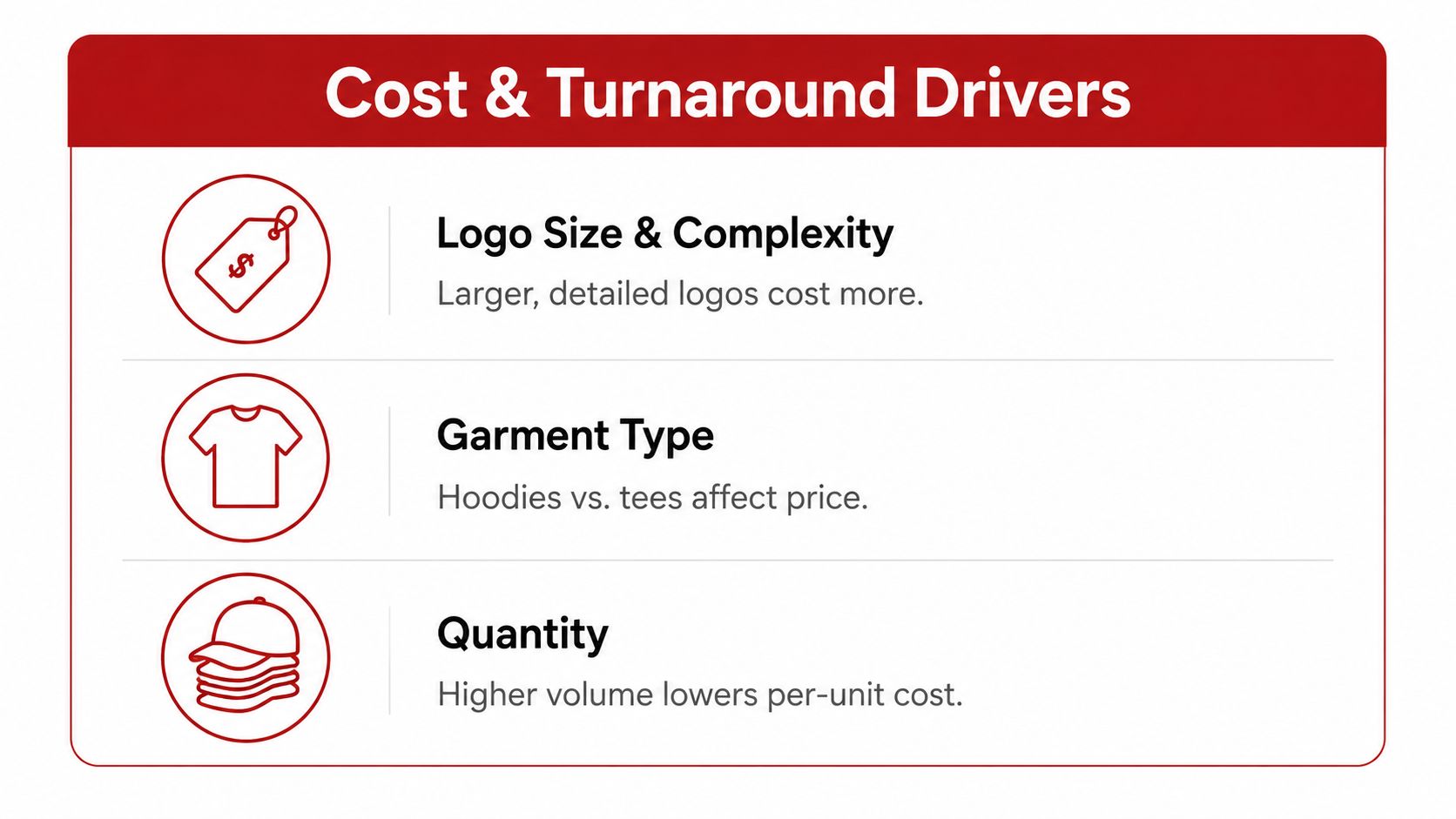
Chicago shops commonly quote hat embroidery by logo size, garment type, and quantity, not by some magic flat rate. That's the right way to think about it, because a tiny front mark and a full, dense design are not the same job. A shop that charges intelligently is usually pricing needle time, setup work, and production risk.
Size and stitch count are the real levers
The cleanest benchmark to keep in mind is a standard embroidery area around 4" × 4", with designs staying under 15,000 stitches, minimum line thickness around 0.05 in (1.3 mm), and uppercase text at least 0.3 in tall, per Fourthwall's embroidery best practices. Those thresholds matter because hats curve, and tiny details don't hold thread well on curved cap fronts. If your design fights those limits, the shop has to slow down or simplify it.
A quote from a Chicago decorator should make sense in plain English. If the artwork is bigger, denser, or more color-changed, expect more labor. If the design is bold and simple, expect fewer headaches.
Minimums and hidden extras
At least one Chicago provider lists a 6-piece minimum order for embroidery, which tells you something important about the local market. Small runs are possible, but shops still need enough volume to cover setup and machine time. For a first-time buyer, the hidden costs are usually the first digitizing pass, color adjustments, and any rush work after proof approval.
Buy this way: simplify the logo first, then choose the hat, then ask for the quote. If you do it backward, you usually pay for avoidable revisions.
For pricing structure examples in the local market, this Chicago custom embroidery page is a useful reference point. If you want a broader pricing starting point from a shop that also handles hats, machine embroidery pricing details can help you compare what complexity does to the quote.
Choosing the Right Hat Style for Clean Embroidery
The hat style changes the embroidery before the first stitch ever lands. A structured front gives the machine a flatter canvas, while a soft, stretchy crown makes the design work harder. That's why a good art file can still look bad on the wrong cap.
Hat Style vs Embroidery Behavior
| Hat Style | Front Surface | Best Embroidery Approach |
|---|---|---|
| Structured dad hat | Firmer, flatter front panel | Clean front logos, moderate detail |
| Snapback | Structured panel with stronger shape | Bold lettering, sharp outlines |
| Trucker cap | Foam or mesh backed front | Simple designs, lighter stitch density |
| Beanie | Stretch knit surface | Large, simple marks with low detail |
| Visor | Open front band, limited space | Small logos or short wordmarks |
| Bucket hat | Soft, sloped surface | Minimal art, usually front-centered |
Structured hats are the easiest place to start because they hold the logo flatter. Snapbacks do well when the design is bold and the front panel is meant to carry the mark. Trucker caps can work, but foam fronts don't love heavy stitch density, so a dense logo can sink or distort.
Beanies are a different animal. The fabric stretches, so tiny text gets punished and tight detail tends to lose shape. Bucket hats and visors are more niche, and the decoration has to respect the shape instead of fighting it.
Cotton twill usually gives a stable, classic feel, while performance fabrics behave differently because they're built to move and resist moisture. The important part is this, pick the hat for the logo, not the other way around. If the design is complicated, choose a cap that can carry it. If the cap is soft or curved, simplify the art.
Getting Your Artwork Embroidery-Ready
The file you send is usually the difference between a clean proof and a long back-and-forth. Most embroidery problems start before production, in the artwork file itself. A decorator doesn't want a poster, they want a logo that can be translated into thread without tiny surprises.
What to send
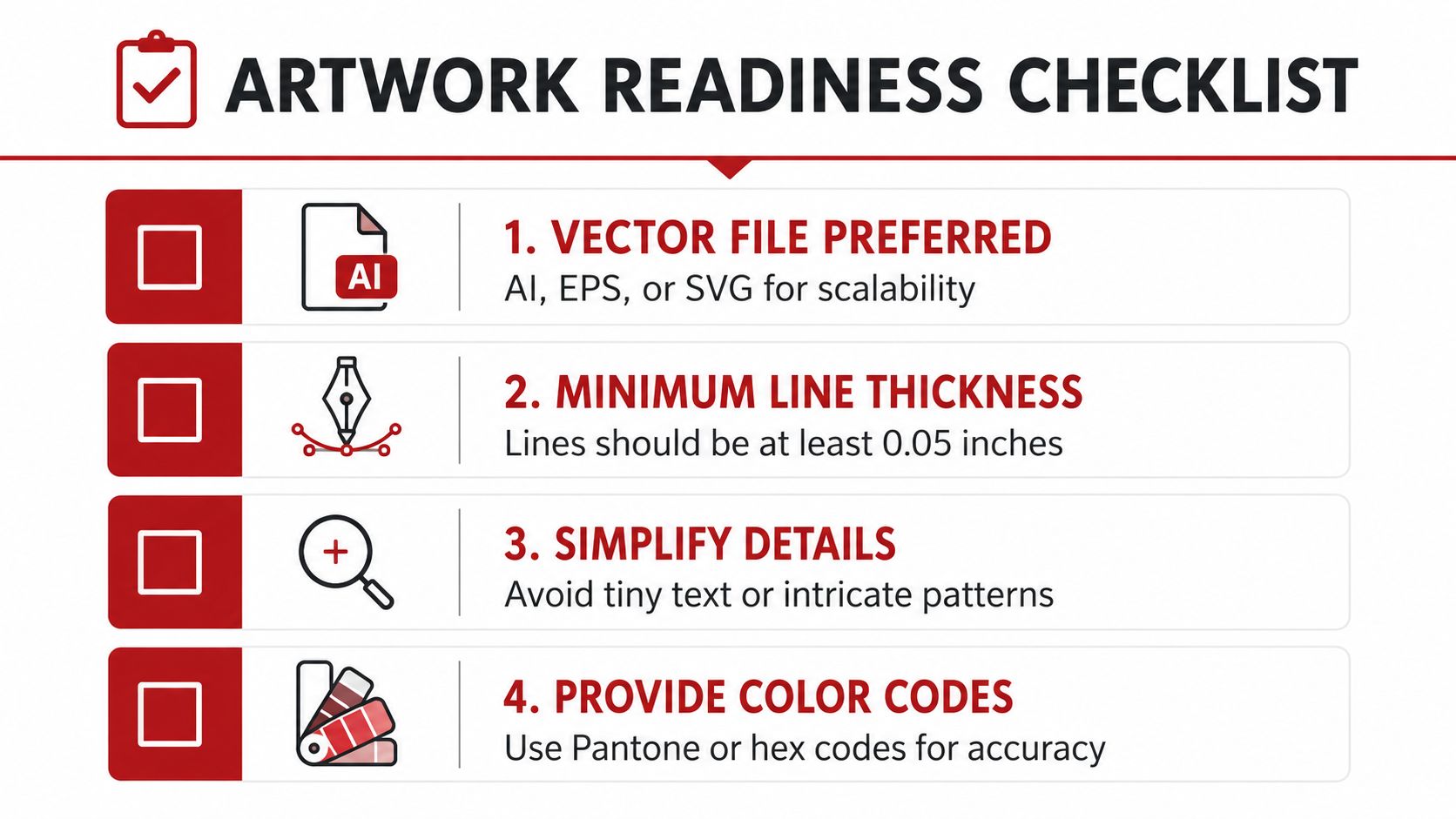
A vector file is the cleanest starting point, usually AI, EPS, or SVG, because it scales without turning blurry. Keep line work at least 0.05 inches thick, and make sure text is large enough to read after digitizing, especially if it's uppercase and meant to sit on a curved front panel. If your design has tiny shapes or fine interior lines, cut them now instead of asking the shop to rescue them later.
Thread color matters too. A decorator can work from Pantone or other color references, but contrast still rules the final look. White thread on a white hat disappears, and dark thread on a dark crown can flatten a logo that should pop.
What a digitizer actually does
A good digitizer simplifies the art, sets the underlay, and controls pull compensation so the stitches land where they should. That's the part buyers don't see, but it's the part that decides whether the logo looks crisp or sloppy. If the stitch path is too complex, the machine wastes effort and the hat pays for it with puckering or lost detail.
Here's the simplest checklist:
- Use vector art when possible.
- Remove tiny text and micro-details.
- Stay inside a stitch-friendly layout.
- Pick thread colors that contrast with the hat.
- Ask for a proof before production starts.
That's the safest way to hand off a Chicago hat order without creating a mess for the decorator. If your logo needs heavy simplification, that's normal. It just means the embroidery version has to be built for thread, not for a screen.
How a Chicago Embroidery Order Actually Flows
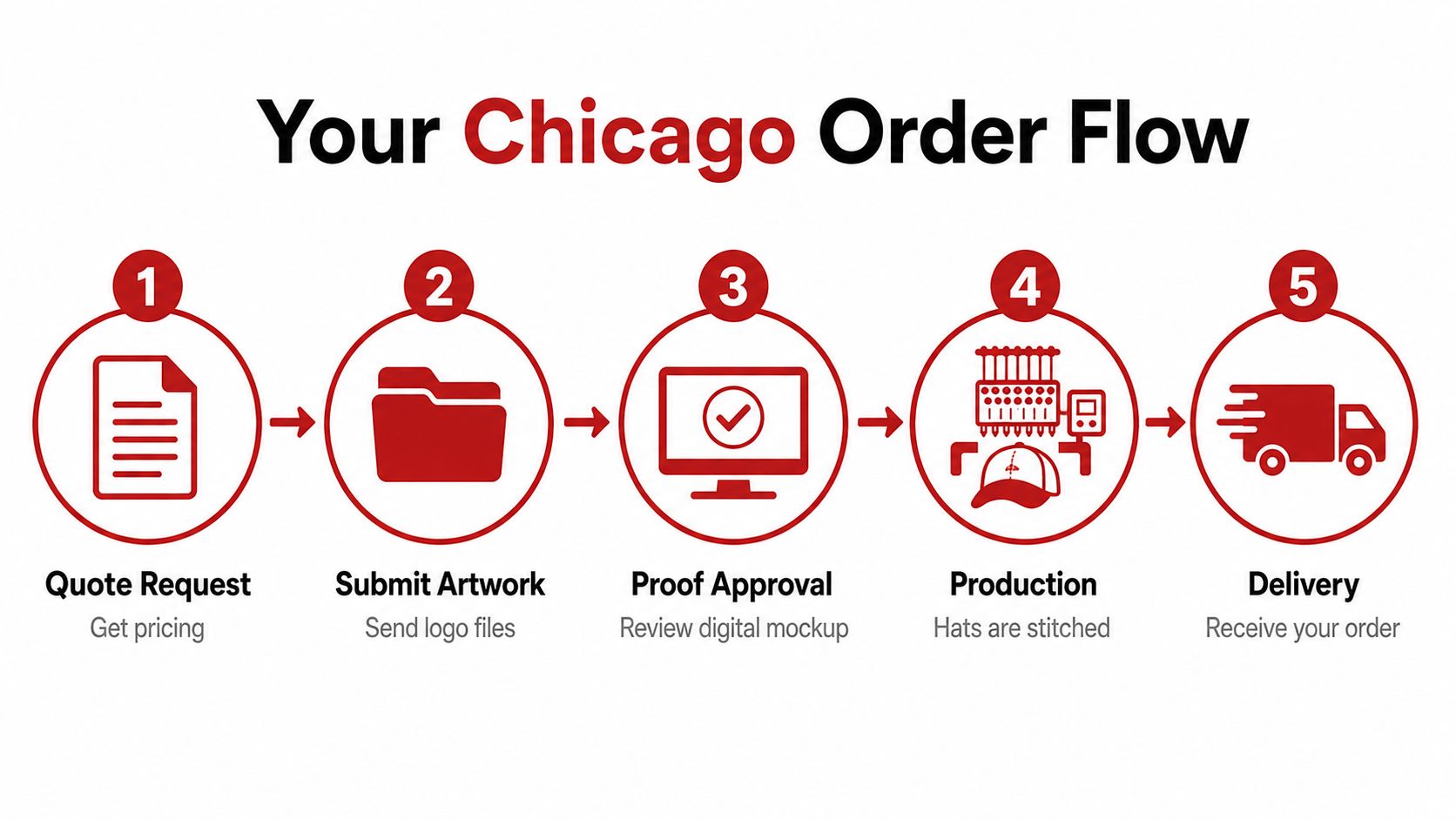
A good order follows a clean sequence. Quote first, artwork second, proof third, production fourth, delivery last. The buyer who stays organized at each step gets a calmer job and fewer surprises.
Where orders usually stall
The first stall point is artwork approval. Buyers get busy, sit on the proof, and then act surprised when production hasn't started. The second stall point is color changes, because a thread choice that looked fine on-screen can look too dull or too loud on a real hat. The third stall point is quantity changes, which matter because shops have already priced the run around the original count.
A physical sample is worth paying for when the design is new, the cap style is tricky, or the order has to be right the first time. A digital proof is enough when the logo is simple and the buyer only needs to confirm placement, color, and scale. Use the sample when risk is high. Skip it when the job is routine.
Practical rule: the faster you approve, the faster the machine runs. Most deadline problems start with a delayed yes.
The cleanest Chicago orders keep one contact person, one logo file, and one clear deadline. That's boring, and boring is good in production.
Why Dirt Cheap Headwear Fits the Chicago Buyer
Chicago buyers who want one vendor for blank hats and decoration should look at a wholesale-plus-embroidery shop, not a patchwork of separate suppliers. That setup matters when you're trying to outfit a team, run a small merch drop, or replace hats quickly without juggling two calendars. It also fits the local market well, because Chicago already rewards practical, production-minded buying.
Dirt Cheap Headwear handles wholesale blank headwear and in-house embroidery, with low minimums starting at just six pieces per logo, plus options like 3D puff and fine-detail stitching. It also carries popular blank styles such as beanies, dad hats, snapbacks, trucker caps, visors, bucket hats, rope hats, and ponytail hats, along with trusted brands like Richardson, YP Classics/Flexfit, New Era, Nike, Valucap, and Legacy. That mix is useful because the hat choice and the embroidery choice can be made together instead of separately.
The other advantage is simple. When the same shop sources the blanks and stitches the logo, there are fewer handoffs, fewer excuses, and fewer mismatches between the sample and the final run. Dirt Cheap Headwear also offers custom patches, printing, apparel catalogs, and an easy custom order form, with business-hour support Monday through Friday, 9am to 5pm EST.
For a first-time buyer, that's the kind of setup that reduces friction. You choose the hat, send the art, approve the proof, and let one shop manage the rest.
Chicago Hat Embroidery Questions Buyers Actually Ask
How long does it take? In Chicago, a normal order usually lands in the 7 to 14 business day window after artwork approval, assuming the proof moves quickly.
What's the smallest run? A 6-piece minimum is common in this market, so small team orders and starter merch runs are realistic.
Can you bring your own hats? Sometimes yes, but don't assume it. Ask the shop first, because blank sourcing affects both quality control and pricing.
How do thread colors get matched? Good shops work from a color reference and then adjust for contrast on the actual hat color. A matching thread on paper can still look wrong on a dark or textured crown.
If you're ready to move, send one clean logo file, pick the hat style that fits the design, and ask for a proof instead of guessing. A shop like Dirt Cheap Headwear can handle the blank hat side and the embroidery side in one place, which is exactly what most first-time buyers need when they want the order done right the first time.
A CTA for Dirt Cheap Headwear.