
You’re probably looking at a hat order right now for one of three reasons. You need branded merch that doesn’t eat your budget, you need a team hat people will want to wear, or you need a blank that decorates cleanly without turning into a production headache.
That’s where the foam trucker hat keeps winning.
It’s easy to dismiss this style as just another promo cap until you’ve had to compare real blanks, logo placement, stitch quality, and minimums. Then the appeal gets obvious fast. A good foam trucker gives you a big, visible front, solid airflow, and a familiar fit that works across events, staff uniforms, resale merch, and team orders.
A lot of articles stop at “foam front, mesh back, snapback.” That’s retail copy. Wholesale buyers need more than that. They need to know which profile works, what decoration method makes sense, what can go wrong in production, and how to place an order without wasting money on the wrong blank.
Your Brand's Next Favorite Hat
If you run a small business, coach a team, or manage event merch, you already know the hard part isn’t finding hats. It’s finding one that checks enough boxes at once. It has to look current, fit a wide range of head sizes, hold a logo well, and still make sense when you’re ordering in bulk.
The foam trucker hat solves that better than most styles.
For a brand, it gives you a large front panel that reads clearly from a distance. For a team, it creates a uniform look without getting too formal. For a merch table, it hits that sweet spot between affordable and easy to wear. People recognize the shape instantly, and that familiarity matters when you’re trying to sell or distribute headwear quickly.
Another reason buyers keep coming back to this style is flexibility. You can push it retro, sporty, outdoorsy, workwear-inspired, or beachy depending on the blank, brim curve, color combo, and decoration method. If you’re comparing silhouettes before placing a bulk order, a roundup of popular trucker cap brands is a good place to narrow your options.
Practical rule: If your logo needs room to breathe, start by looking at foam truckers before you jump to softer, lower-visibility cap styles.
What Exactly Makes a Foam Trucker Hat
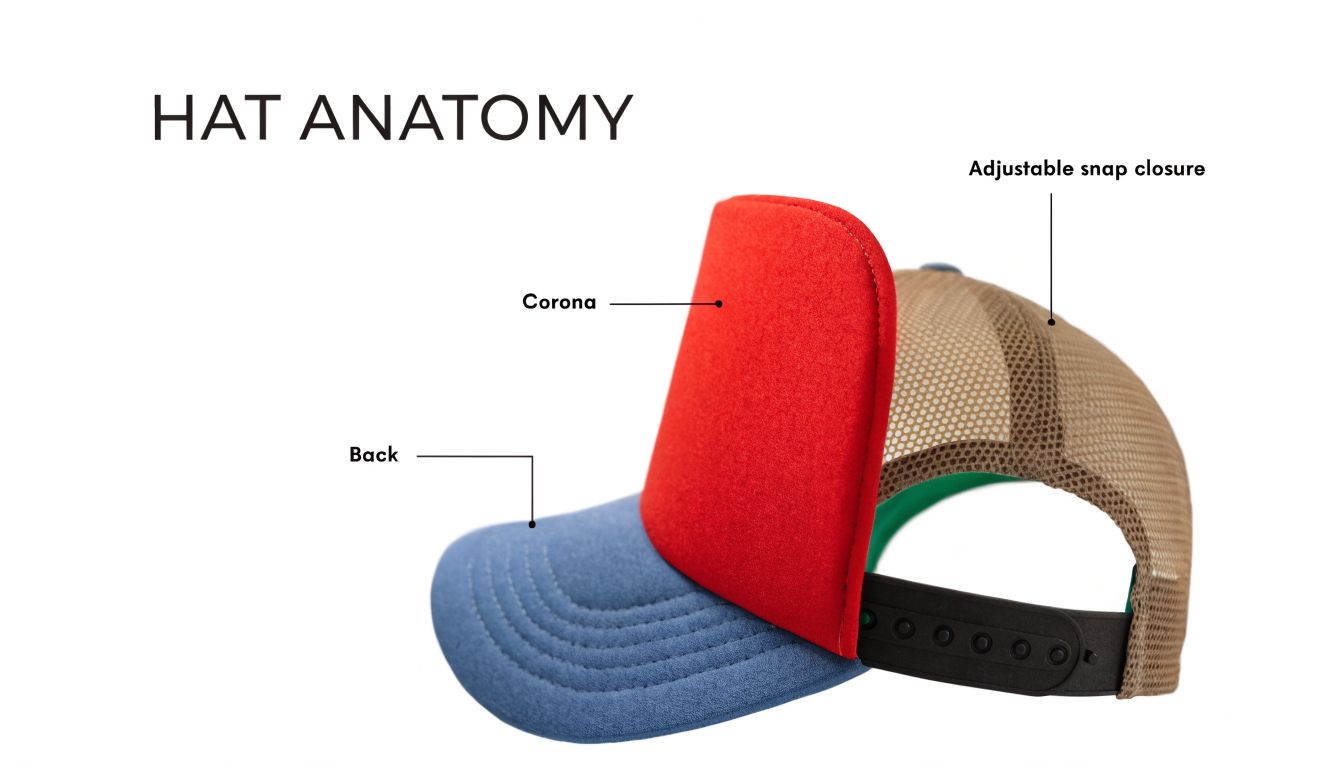
A foam trucker hat is defined by three parts working together. The foam front panel creates the structure and gives decorators a clear branding area. The mesh back keeps the hat airy. The adjustable snapback closure makes sizing simple for group orders.
That foam front is the part most buyers care about, serving as a stretched signboard on the front of a cap. A floppy front panel can swallow a logo. A structured foam front keeps the graphic visible and upright.
The parts that define the style
Here’s the quick breakdown buyers should know:
- Foam front panel gives the hat its tall face and graphic-friendly surface.
- Mesh rear panels make it easier to wear in heat, on job sites, at tournaments, and during long outdoor events.
- Snapback closure helps one style work across a wide range of wearers without custom sizing.
That combination wasn’t created as a fashion statement first. It started as a useful promotional product. Trucker hats with foam front panels and mesh backs began in the United States during the 1960s and 1970s as low-cost giveaways from feed stores, farm equipment companies, and agribusinesses, often aimed at truck drivers, farmers, and rural workers, according to this history of trucker hats. Those early “gimme caps” used a stiff foam crown specifically because it stood upright and made logos easier to screen print and see.
Why the old design still works
A lot of promotional products fade because they solve yesterday’s problem. This one didn’t. The same traits that made the hat useful decades ago still matter now.
Buyers still want hats that do these things well:
- Show the logo clearly
- Stay comfortable in warm conditions
- Fit a broad group without size drama
That’s why the foam trucker hat still crosses over so well from workwear roots into modern merch programs. It was built to be seen, built to be worn, and built to be easy to hand out.
The Anatomy of a Quality Foam Trucker
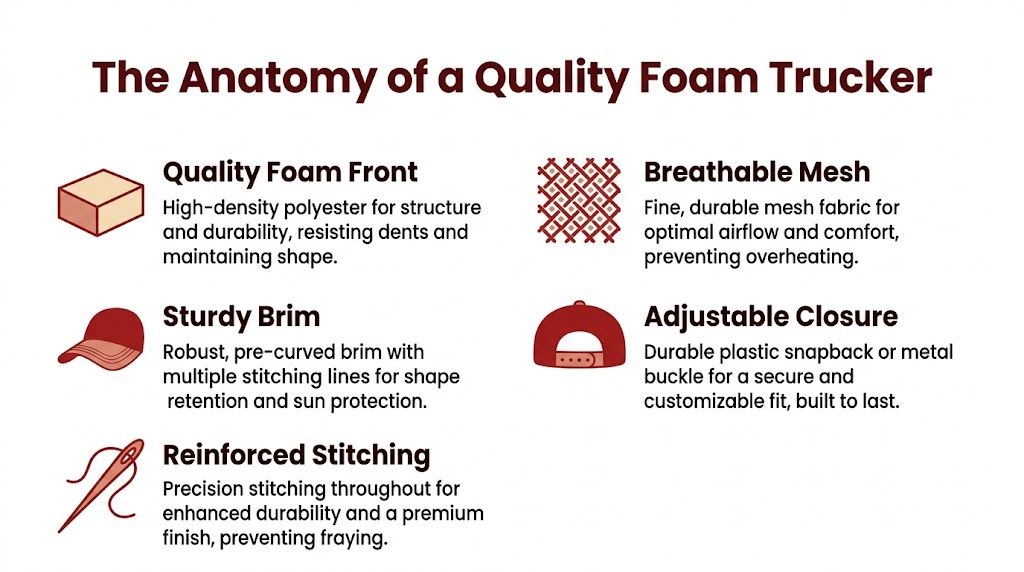
A foam trucker can look solid on a product page and still turn into a problem once you start decorating a few dozen pieces. I see that happen most often with low-grade foam, weak seam work, and mesh that feels fine in the box but wears out fast. For wholesale buyers, the test is simple. The hat needs to hold its shape through stitching, handling, packing, and repeat wear.
The front panel does most of the technical work. Better blanks use laminated polyester foam with enough firmness to keep the crown upright and the print area clean. If the foam is too soft, the front panel wrinkles under embroidery. If it is too hard, the cap can feel cheap and sit awkwardly on the head. Good blanks land in the middle. They stay structured without turning into a board.
The mesh matters for wearability, but it also affects perceived quality. Scratchy mesh, overly shiny mesh, or mesh with loose recovery makes a hat feel lower-end even when the front panel looks good.
What to inspect before you buy
Before you place a case order, check the blank like a decorator would, not like a casual shopper would.
- Front panel firmness. The crown should stand up evenly with no ripples, thin spots, or leaning at the center seam.
- Mesh recovery. Stretch it lightly and see whether it returns cleanly. Cheap mesh can bag out fast.
- Brim shape. Look for a smooth curve and consistent edge tape. A warped brim is hard to hide after decoration.
- Seam finish. Check the sweatband, front seam, and where the mesh joins the crown. Loose stitching usually points to broader quality control issues.
- Snapback feel. The closure should open and close cleanly without brittle tabs or rough flashing.
Why foam density matters for decorators
Foam density affects stitch quality more than many first-time buyers expect. A front panel with decent structure gives the machine a more stable surface, which helps the logo stay centered and reduces puckering around dense fills and bold outlines. It also gives heat-applied patches and transfers a flatter landing area.
If you are comparing blanks for production, this guide on buying bulk blank trucker hats that stitch well covers the details decorators usually check before approving a style for larger runs.
I usually tell buyers to ask one practical question. Will this hat still look right after 48 pieces are stitched, boxed, shipped, and worn? That is a better filter than any catalog description.
Comfort and presentation both matter
A quality foam trucker has to wear well for hours and still present cleanly in photos, on staff, or on a retail wall. That means balancing a structured front with mesh that breathes and a sweatband that does not feel rough by midday. If you plan to sell the hat online, presentation matters too. A solid blank photographs better, especially once the front panel holds its shape consistently. This guide to hat product photography is useful if you are building listings for your own store or marketplace catalog.
For businesses, teams, and resellers, those details affect more than comfort. They affect returns, reorder confidence, and whether a style is worth carrying again.
Why Your Business Needs Foam Trucker Hats
For business use, a hat has one job. It needs to carry your brand clearly and still be wearable enough that people reach for it again. That’s where foam truckers beat a lot of other cap styles.
The front panel does the heavy lifting. It gives your logo more visual presence than many softer hats, which matters at vendor booths, pop-up events, field jobs, school functions, and any place where people see the hat before they see the person wearing it. If your goal is brand recall, visibility matters more than subtlety.
There’s also a practical sales angle. Foam truckers are easy to understand at a glance. Buyers don’t need a long explanation. They see the shape, try it on, and know whether it fits their style.
Best business use cases
Different buyers use this style for different reasons:
- Staff uniforms work well because the hat looks branded without feeling too corporate.
- Event giveaways benefit from the broad fit and clear logo area.
- Retail merch gets a boost because the silhouette is familiar and photo-friendly.
- Team orders are easier when you need one adjustable style for a mixed group.
If you’re selling online, presentation matters almost as much as the blank itself. Clean product images make a basic hat look premium. A practical guide to hat product photography can help if you’re building listings for your own store or marketplace catalog.
Hat Style Showdown Where Foam Truckers Win
| Factor | Foam Trucker Hat | Cotton Dad Hat | Structured Wool Snapback |
|---|---|---|---|
| Front logo visibility | Excellent, especially for bold front-center art | Softer front can make logos feel smaller or less crisp | Strong visibility, but often feels heavier and more formal |
| Warm-weather comfort | Strong because of the mesh back | Comfortable, but less ventilated | Usually the warmest of the three |
| Broad audience fit | Easy to hand out because snapback sizing is familiar | Casual and easygoing, but fit shape is different | Popular for streetwear, but not every audience wants the look |
| Decoration flexibility | Great for embroidery, patches, and printed front graphics | Better for lower-profile decoration styles | Strong for embroidery, less forgiving if the style feels too premium for the use case |
| Best business use | Promo, events, teams, resale merch | Lifestyle brands, soft casual merch | Higher-end streetwear or structured brand collections |
If you need one hat that can serve as promo item, staff gear, and sellable merch, foam truckers usually give you the cleanest overlap.
A Buyer's Guide to Foam Trucker Styles
Choosing a foam trucker hat gets easier when you ignore the marketing labels and focus on three decisions. Profile, panel count, and trim details. Those three choices control most of the final look.
A lot of first-time buyers order the wrong blank because they approve a logo first and think about silhouette later. That usually leads to hats that technically look fine but don’t match the brand personality.
Profile changes the attitude
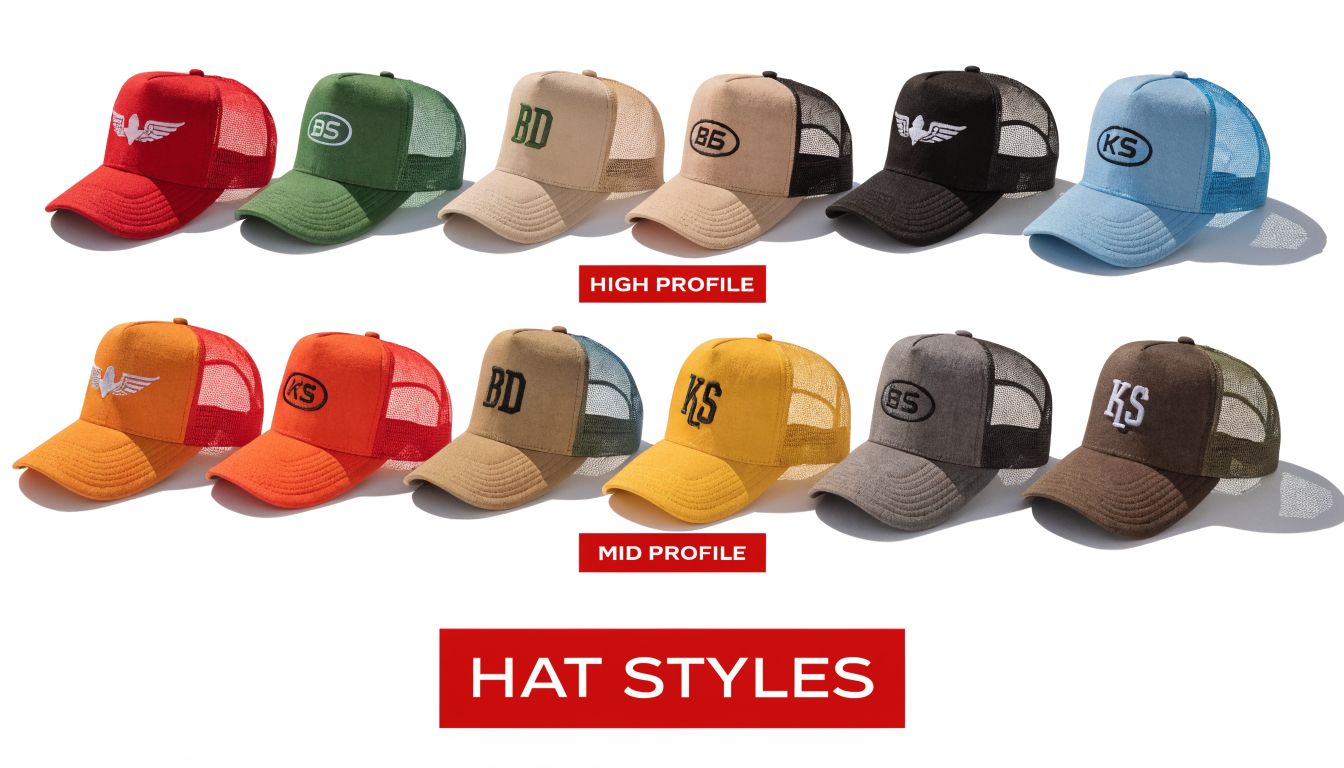
High-profile foam truckers have that taller crown commonly pictured right away. They lean bold, retro, and graphic-forward. If you want a big center logo or a more classic feed-cap feel, this is usually the safest move.
Mid-profile options soften that look a little. They still keep presence on the front but feel less dramatic on the head. For many small brands, mid-profile is the easiest middle ground because it works across more face shapes and style preferences.
Low-profile foam trucker hats use thinner 1-2mm foam inserts and a more compact build, which can reduce seam bulk by 30-40% compared with traditional high-crown versions, creating a smoother fit that sits closer to the head, according to this low-profile foam trucker overview. That makes them useful when your audience likes the mesh-back look but doesn’t want a tall crown.
Five-panel or six-panel
This choice matters more than many buyers expect.
- 5-panel foam trucker. One larger front panel. Best when you want a clean, uninterrupted logo area.
- 6-panel foam trucker. Front seam down the middle. Better if you prefer a more traditional cap shape and your logo can work around the seam.
- Rope variations. Add a vintage sport or golf-inspired touch across the front.
- Contrasting mesh or brim colors. Help push the look more retail or more promo depending on the palette.
How to match style to buyer intent
If you’re ordering for resale, start with the audience first. A surf shop or brewery can often support bolder color blocking and taller crowns. A school fundraiser or contractor uniform order may need a more straightforward color combination and easier fit.
A simple way to decide:
- Choose high-profile 5-panel if logo visibility is your top priority.
- Choose mid-profile if you need a broader style compromise.
- Choose low-profile if your buyers like a closer fit and a cleaner silhouette.
That quick filter prevents a lot of expensive indecision.
Customizing Foam Truckers The Smart Way
A foam trucker can make your logo look sharp, or make it look cheap. The difference usually comes down to one decision. Match the decoration method to the artwork before you place the order.
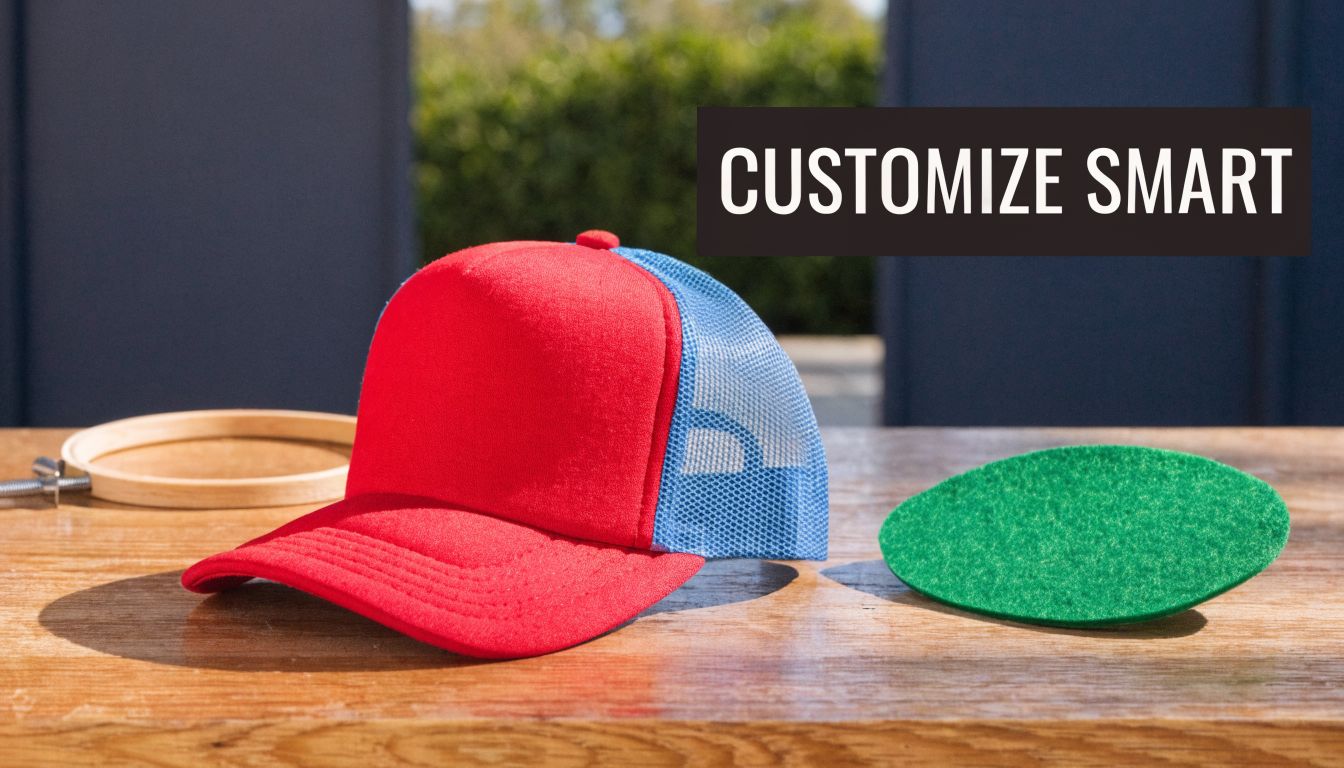
Small brands, team buyers, and resellers run into the same problem. They pick a blank, send over a logo file, and assume any shop can make it work. Production does not work that way. Foam fronts are useful because they give decorators a stable, structured surface, but they still have limits. If you are buying for a business and not just one sample hat, you also need to think about MOQ, repeatability, and whether the design can be decorated the same way across future reorders.
That matters even more if you order through business to business e-commerce platforms, where the product page may show the cap but tell you very little about stitch count limits, patch application, or art cleanup.
Embroidery works best with simple, hat-friendly art
Direct embroidery is still the first choice for many wholesale foam trucker orders because it gives a durable, retail-ready finish. It works best on logos with bold shapes, clean outlines, and lettering that can still read from a few feet away. Fine lines, tiny script, and crowded detail are where buyers get into trouble.
Use these rules before you approve embroidery:
- Reduce small text. If the logo depends on tiny wording, simplify it or move that detail to a side hit or hangtag.
- Favor clear shapes. Foam fronts hold strong fills and defined borders better than fussy artwork.
- Set the art up for a cap front. A file that looks balanced on a screen can stitch awkwardly once it is curved across the crown.
If your art needs prep, this guide on how to digitize a logo for embroidery is a good starting point before you send files to production.
I tell wholesale buyers the same thing all the time. Good embroidery starts in the art file, not at the machine.
Patches and transfers are often the better buy
Some logos should not be stitched into foam. A patch is usually the cleaner option when you want a badge look, layered texture, or a design with details that would get muddy in thread. Embroidered patches suit bold, classic branding. Woven patches hold finer detail. Printed patches can help when color accuracy matters more than stitch texture.
Transfers also have a place, especially for full-color art, gradients, or graphics with too much detail for embroidery. The key trade-off is finish and durability. A transfer can reproduce more detail, but it will not give you the same dimensional look as thread or a stitched patch. On lower-volume promo runs, that can be a fair trade. On resale merchandise, many buyers still prefer embroidery or patches because the hat feels more substantial in hand.
Before approving artwork, it helps to watch how decorators place and scale front graphics on this style:
Where custom foam trucker orders go sideways
The failures are usually predictable.
- The logo has too much detail for the size of the front panel.
- The chosen method does not fit the art.
- The buyer chose the blank on price alone, without checking crown shape, foam firmness, or front-panel finish.
- The proof did not get a real review before production.
- The MOQ did not match the project, so the buyer picked a method that fit the minimum instead of the brand.
The better question is not, "Can this logo go on this hat?" Ask, "What method will make this logo look clean, repeat well, and still make sense at my order quantity?" That is the question that protects your margin and gives you hats people will wear.
Your Wholesale Ordering Workflow
Ordering custom hats shouldn’t feel confusing, but first-time buyers often get stuck on terms like MOQ, proof, or lead time. The process gets much easier when you treat it like a checklist instead of a mystery.
MOQ means the minimum order quantity. Some shops are set up for large runs only. Others can handle smaller decorated orders for test batches, team orders, or startup merch. If you’re comparing suppliers, don’t just ask whether they do custom work. Ask what their minimum is for your decoration method, and whether that minimum changes by logo or colorway.
The cleanest way to place an order
A solid ordering flow usually looks like this:
Choose the blank first
Pick the profile, panel count, and color before finalizing decoration.Submit usable artwork
Vector files are best when available. If not, send the highest-quality file you have and ask whether cleanup is needed.Confirm decoration method
Embroidery, patch, or transfer should be chosen based on the logo, not guesswork.Review the proof carefully
Check placement, size, thread colors, patch border, and spelling. Preventable mistakes are caught during this process.Approve production and timeline
Make sure you understand when the order moves from proofing into production and when it is expected to ship.
Where buyers lose money
Most expensive mistakes happen before the hats are made.
- Rushing the blank choice can lock you into a silhouette your audience doesn’t want.
- Skipping proof details leads to off-size logos or poor color choices.
- Ordering without a test mindset can be risky for new brands trying an unfamiliar style.
If you’re newer to wholesale purchasing in general, it helps to understand how modern business to business e-commerce platforms streamline catalog browsing, approval flow, and repeat ordering. That broader workflow thinking applies to headwear too, especially once you start reordering the same decorated styles.
A first order should answer questions, not create them. If the supplier can’t explain the process clearly, the order usually won’t get easier later.
Frequently Asked Questions About Foam Truckers
Are foam trucker hats good for embroidery
Yes, often very good, especially for bold front logos. The structured laminated front helps the decoration hold cleaner than softer fronts that tend to shift or wrinkle more easily. Simple, high-contrast art usually performs best.
What’s the difference between a 5-panel and 6-panel foam trucker hat
A 5-panel hat gives you one larger uninterrupted front panel, which many buyers prefer for center-front logos. A 6-panel hat has a front seam, so the shape feels more like a traditional cap but the seam can affect logo placement.
How should you clean a foam trucker hat
Go gently. Spot cleaning is usually the safer move. Aggressive washing and heat can shorten the life of the shape, brim, and decoration. If the hat is for resale merch or uniforms, include basic care guidance with the order so customers and staff don’t treat it like a standard laundry item.
What should I expect on bulk custom pricing
Pricing varies by blank, decoration method, logo complexity, and quantity. The right way to compare quotes is by looking at the total package. Blank quality, setup, proofing, and decoration consistency matter just as much as the base price.
Are there sustainable foam trucker hat options
Yes, and interest is growing. Some brands now offer recycled nylon or polyester foam-front options, but there’s still limited comparative data on durability or certification differences versus standard foam, as noted in this overview of recycled foam trucker hat options. If sustainability matters for your project, ask specific questions about materials and available documentation before ordering.
If you're ready to order blanks, test a small custom run, or scale up a full headwear program, Dirt Cheap Headwear makes the process simple with wholesale pricing, low minimums, fast embroidery, and a wide selection of trusted hat brands for businesses, teams, events, and merch sellers.
Pingback: Best Event Hats for Giveaways That Get Worn | Dirt Cheap Headwear