
Custom Visor Hats: A Buyer’s Guide to Styles and Decoration
A Saturday tournament, a farmers market stall, or a charity walk is on the calendar, and last year's caps are still in a box because they cooked everyone's head. Custom visor hats fix a different problem than a full cap. The crown stays open, a ponytail or bun fits, and the bill still knocks glare off the eyes so the mark sits where people look.
I would treat the visor as a fit and coverage decision first and a logo surface second. Most buying guides jump straight to thread colors. Start with who is wearing it, how long they stand in the sun, and whether the decoration still looks right after a wash.
Why Custom Visor Hats Make Sense for Brands
Say a coach needs twenty matching visors for a Saturday tournament, a staff lead needs ten for a farmers market, and an event crew wants branded gear people will put on. A cap holds heat against the scalp. A visor lets heat move off the head, the short bill cuts direct glare, and the logo sits high on the front panel, right above the face.
That shape shows up on tennis courts, golf ranges, running clubs, pickleball nights, hospitality uniforms, charity events, and team kits. Wearers pick it for airflow and hair room as much as for the brand on the front.
Headwear is a large category, not a visor-only one. Grand View Research valued global headwear, including caps, hats, beanies, and visors, at USD 37.0 billion in 2025, with a projection of USD 62.8 billion by 2033, a 6.9% compound annual growth rate from 2026 through 2033. Asia-Pacific accounted for 39.9% of that headwear revenue in 2025, and running and fitness was the largest sports and activity share at 24.8%. Those figures cover the whole headwear market, so they show demand for headwear in general, not a visor share.
Write the spec before you shop. Pick the style, the decoration that can hold the detail, the quantity and the date, then test fit and be honest about sun coverage. What you should have at the end is a written spec you can send to any supplier.
Pick the Visor Style That Fits Your Use
Match the blank to the job before you talk about thread. The front panel and brim decide where a logo can sit and how large it can be.
| Style | Typical fabric | Coverage | Best for |
|---|---|---|---|
| Standard adjustable performance visor | Polyester or poly blend | Open crown, short brim | Running, races, short outdoor shifts |
| Double-layer brim visor | Polyester performance | Extra shade from layered brim | Golf, tennis, long practice days |
| Wide-brim cotton visor | Dense cotton twill or canvas | Larger brim, more face and neck shade | Outdoor crews, all-day events |
| Performance mesh visor | Lightweight polyester with mesh panels | Maximum airflow, least shade | Pickleball, hot-weather teams, fitness classes |
| Structured visor with contrast trim | Cotton twill | Standard brim, firm front panel | Hospitality, retail and promotional uniforms |
A three-line rule
Heat and movement call for an open crown and mesh. A pickleball league or a noon race crew will take the visor off if the sweatband soaks through in the first set.
Long sun calls for a wider brim in dense cotton twill or canvas. The extra shade is the point. Accept that it feels bulkier when someone sprints or swings overhead.
Logo-heavy uniforms call for a structured front. Hospitality and retail staff need a flat panel so a wordmark stays readable from across a counter. A soft, floppy front lets the same mark crease.
Fabric sets the wash and the shape
Cotton twill and canvas hold a crease and take a firm stitch, then they can shrink a little if you skip a pre-wash on the sample. Polyester and nylon dry fast, keep their curve, and suit repeated laundry for teams. Mesh panels buy airflow and give up shade and stitch area. Don't put a wide embroidered crest on a mesh side panel. It puckers, and the holes show through the thread.
Style comes before decoration. If the panel is short and curved, a tall stacked wordmark won't fit no matter how clean the art file is. Measure the usable front, leave a margin off the brim edge, and only then pick the stitch or print.
Decoration Options and What Each Handles Best
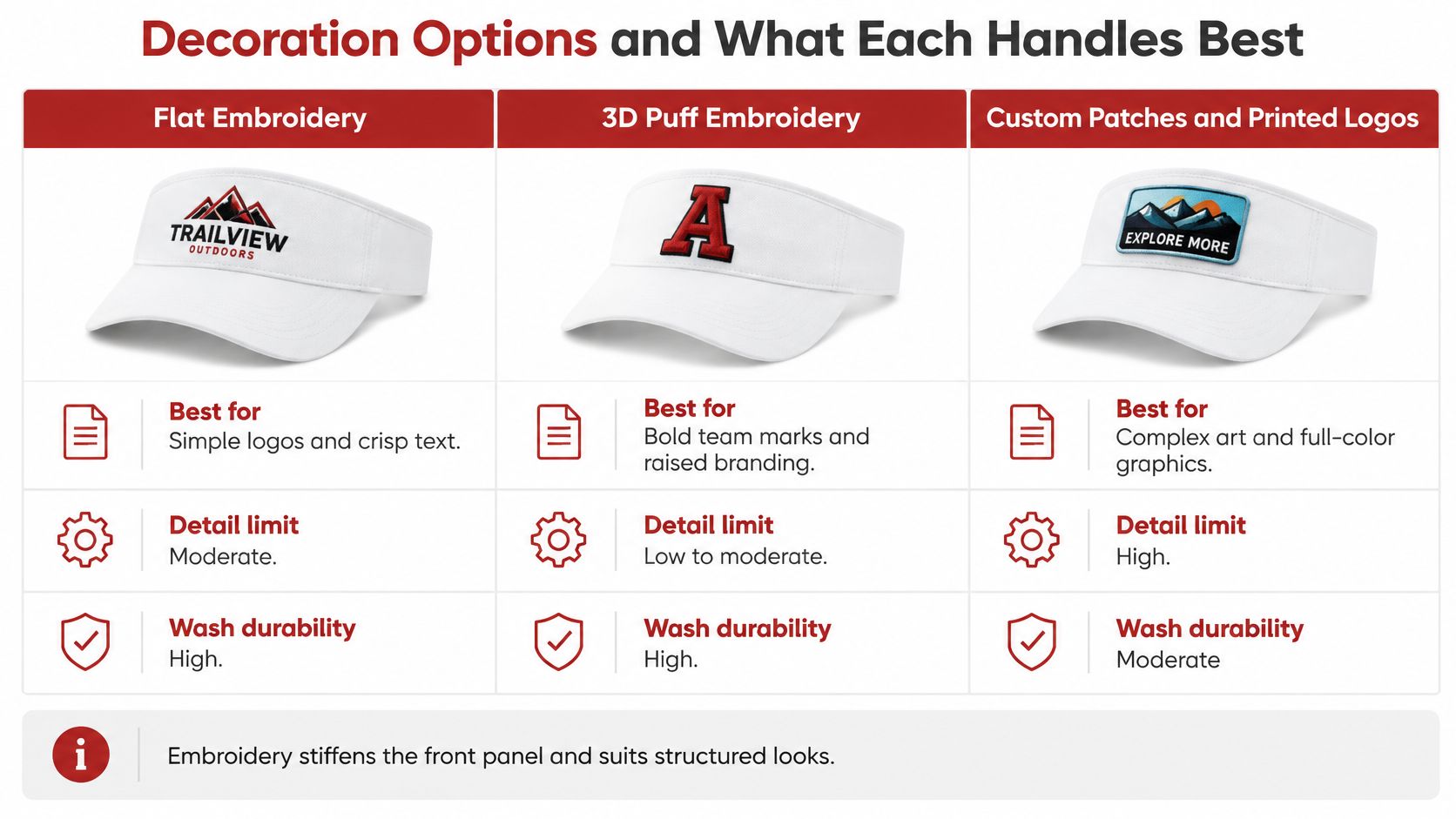
Four methods cover almost every visor order. Pick by the art and the panel. A flat mock-up hides how both behave on a curved crown.
| Method | Best for | Detail limit | Wash durability |
|---|---|---|---|
| Flat embroidery | Logos and text on the front panel | Fine lines and small text stitch cleanly | Holds up well to repeated washing |
| 3D puff embroidery | Bold raised logos, numbers and letters | Simple shapes only, fine detail blurs | Durable, but test a washed sample |
| Custom patches | Multi-color crests, badges and team marks | Good detail inside a stitched border | Sewn on, strong for repeated wear |
| Printed logos | Gradient, photo-style or full-color art | Works on flatter panels, limited on curves | Can crack or fade with heavy washing |
Why dense stitch goes stiff
Embroidery changes how the fabric bends. A textile study in Fashion and Textiles found that adding stitches increases bending stiffness, and stiffness rises as stitch density increases. On a curved, layered visor that flexes every time someone packs it in a bag, a dense logo becomes a rigid patch of its own.
Say a brewery sends a crest with a solid black fill the width of the panel. On a soft performance visor the fill buckles, the brim edge ripples, and the needles chew the poly. The fix is not more stitches. Use a backing matched to the fabric, keep large solid fills off the flexible brim edge, and digitize fine type with controlled underlay instead of burying it in thread. Dirt Cheap Headwear customizes in house, including 3D puff and fine-detail stitching, and its printing and embroidery options begin with a mock-up when a customer asks for one.
Flat embroidery is the default for names, simple marks, and small sponsor lines because fine lines and small text stitch cleanly. 3D puff suits a bold initial or a number; a paragraph of sponsor names blurs into raised shapes. Patches carry multi-color crests that would blow a stitch count. Print handles gradients and photo art on a flatter structured panel, with the trade-off that heavy washing can crack it.
Weekend events stack jobs. A club that will hire an inflatable obstacle course for a fundraiser still needs visors for marshals standing between heats, and those visors take the same laundry as the rest of the kit. Test one decorated sample before you approve the run.
Ask any decorator three things before you pay a setup fee.
- Fabric match: Which method suits this blank, not a generic cap?
- Smallest text: What letter height stays readable in thread on this curve?
- Placement: Where does the mark sit so it does not ride the brim seam?
Sizing and Fit Checks Before a Bulk Run
One size adjustable is a label, not a fit. Head circumference, strap travel, brim length, front-panel height, sweatband pressure, sunglasses, and movement all change whether the visor stays on. A strap that fits the coach can pinch the assistant or slide on a runner.
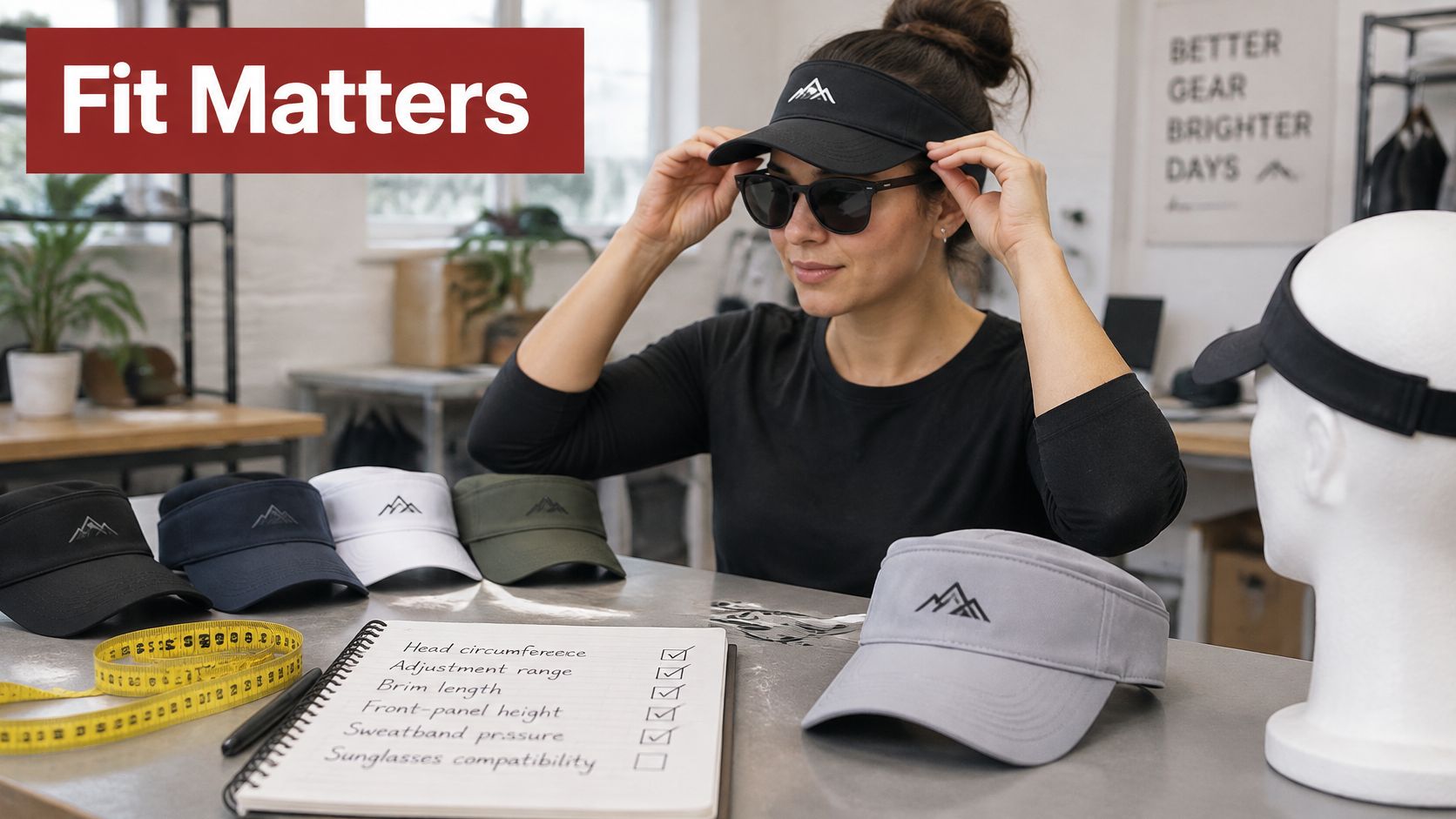
WBOC's 2026 buyer note on sun visor demand is blunt about this. Fit depends on those measurements, and the useful test comes after washing, bending, and prolonged wear, with a check for pressure points, glare, ventilation, colorfastness, and seam quality. Pair that sheet with a hat sizing chart so "medium" means a circumference, not a guess.
| Check | How to test it | Pass signal |
|---|---|---|
| Head circumference | Try samples on several head sizes | Sits without pinching or sliding |
| Adjustment range | Run the strap through its full travel | Stays put at both ends of the range |
| Brim and sunglasses | Wear with sunglasses on | Brim clears the lenses and does not push them down |
| Sweatband pressure | Wear for 30 minutes or more | No headache, red marks or slipping |
| Movement | Run, swing a racket or bend forward | Visor stays on and the brim holds its shape |
| Washing | Wash a decorated sample several times | Logo, color and seams hold up |
What the trade-off actually feels like
A wider brim throws more shade and can bump a racket, a clipboard, or the top of a pair of glasses during a fast sport. An open crown moves air and leaves the scalp, ears, and neck open. Neither failure shows up in a photo of the logo.
Pre-production protocol
Order a few pieces across the adjustment range, not one hero sample in your own size. Wear them with the sunglasses the group uses. Run, swing, or bend the way the shift works. Read the logo from a few steps away on the curve, then wash a decorated piece.
If sample testers report pressure or glare, change the style or the closure before the bulk order. A cheap blank that fits only half the group is the expensive mistake.
Sun Coverage and Where Visors Fall Short
A UPF number on a hangtag describes fabric, not the hat on a head. Brim shape and how the cloth is built matter more than that label.
A Drexel University summary of peer-reviewed hat testing reported that approximately 33% of hats sold online failed criteria for adequate sun protection once material, structure, and design were evaluated. The common U.S. AATCC 183 fabric test does not account for the hat's complete structure or brim coverage. The same analysis recommends tightly woven materials with minimal openings and a circumferential brim of at least 7 cm (2.75 in) for stronger coverage.
A standard athletic visor leaves the crown, the sides, and the back of the head open. Sell it as a face-shading accessory. Don't promise full UV protection unless the finished design, not only the cloth, has been tested. Specify dense cotton twill, canvas, polyester, or nylon, and skip huge mesh gaps when shade is the job.
Short event versus all-day crew
A 5K starter visor is a comfort pick. People are outside for a short window, they want air, and the bill cuts glare at the start line. An all-day grounds crew is a different product. They need a wider brim, and they still need sunscreen on ears, neck, and scalp. If coverage is the requirement, compare a visor with a bucket or a cap on the bucket hat versus baseball cap breakdown before you lock the blank. A visor can feel cooler in heat and still be the weaker choice for a long full-sun shift.
Run this list against the actual event, not against the catalog photo.
- Time outside: Minutes at a booth, or a full shift with no shade tent?
- UV and season: Midday summer, or an evening match under lights?
- Ears and neck: Does the brim reach them, or only the eyes?
- Glare: Does the bill clear sunglasses without tipping them?
- Sweat: Will the band stay tolerable after an hour, or will people take it off?
Practical rule: If you can't point to a tested finished visor, tell wearers to use sunscreen on every exposed patch of skin. The logo doesn't change the physics.
Branding Use Cases From Teams to Events
A sideline visor has to fit the job before it carries the logo. Formula 4 Media, citing the Sports & Fitness Industry Association's Manufacturers Sales by Category Report, put U.S. wholesale sales of hats, caps, and visors at $726.1 million in 2024, up 35.2% from $536.9 million in 2019. Volume is high, so the miss is usually fit and coverage, not the stitch file.
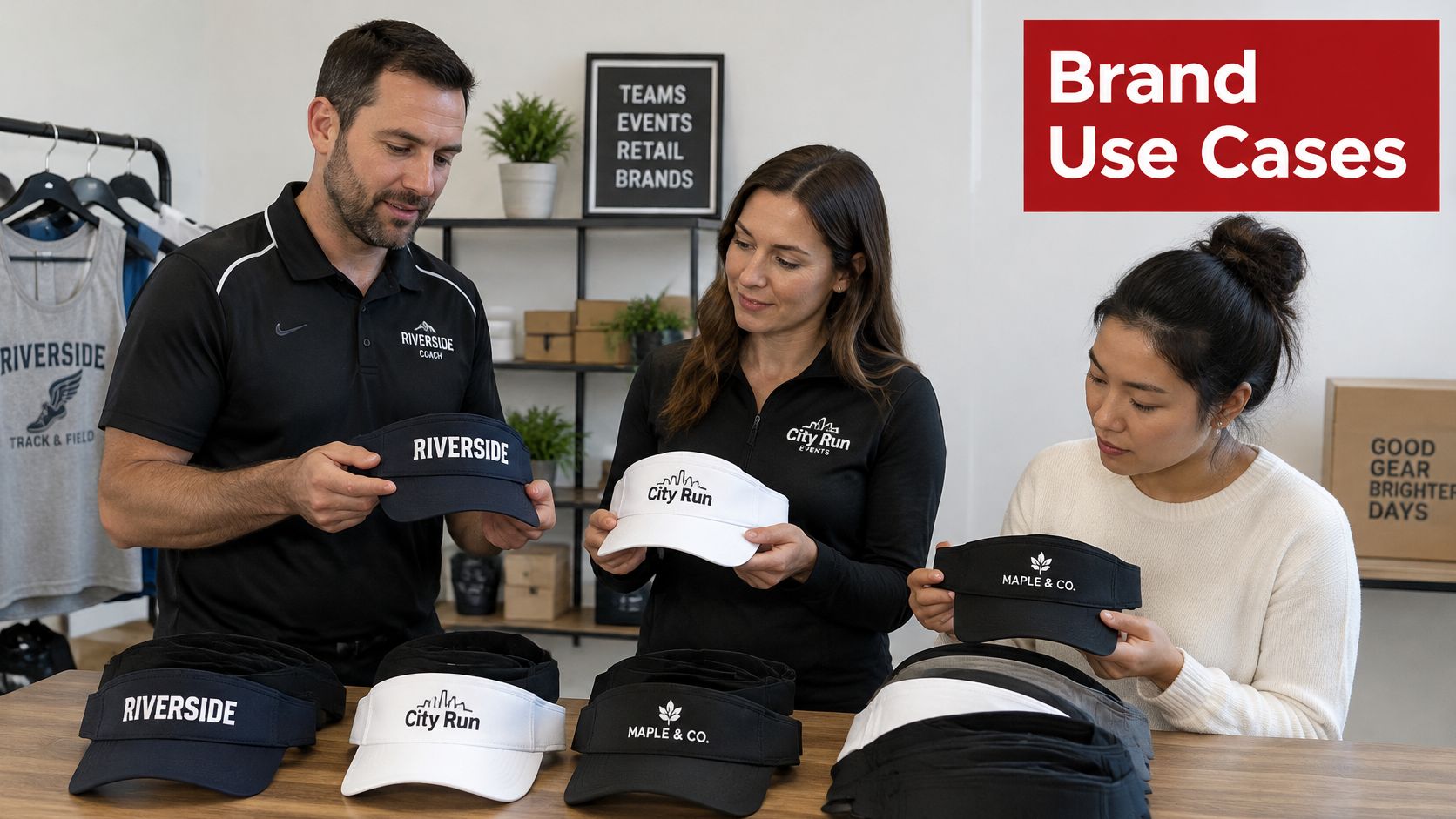
Sports teams and coaches want a light performance visor and a crest or short team name that reads from the sideline. Flat embroidery or a sewn patch on a poly performance blank holds up to weekly washing and keeps small letters legible at distance.
Golf and tennis tournaments stay in the sun longer than a single game. A double layer brim with flat embroidery gives sponsors a clean line. Skip tall puff here. It photographs heavy and fights collared, club ready apparel.
Youth programs are a sizing problem as much as a logo problem, because small heads and grown assistants don't share one strap setting, so order the performance visor and test both ends of the adjustment before you stitch every name. Coaches planning the season can use game-based basketball practice plans for kids for practice structure, then handle visor fit as a separate check with real heads in the room.
Running clubs and race crews live in mesh for airflow. Keep the mark small and high so it clears the curve of the front panel. This is a glare and sweat choice. It will not shade a neck at mile six.
Hospitality and retail need a structured visor and one clean front logo so a guest can spot staff fast. Contrast trim helps visibility. Puff usually adds bulk without adding clarity.
Schools, nonprofits, and fundraisers should buy the cheapest blank that passes the wash test and put one bold shape on it. 3D puff works when the art is a letter or a simple mascot. It fails on a detailed seal with fine lines and small text.
Event sponsors with many colors belong on a patch, with print only if the panel is flat enough to hold a gradient without cracking on the curve. Outdoor crews on all day shifts belong in a wide brim cotton visor with flat embroidery, plus sunscreen on the skin the brim misses.
Mixed head sizes or mixed jobs do not get one hero style. Split the order by use, youth and adult, short shift and full sun, or the people at the edges will leave the visor in the bag.
Ordering Steps From Proof to Delivery
The blank, the art, and the date have to agree. A clean proof on the wrong fabric is still a wrong order. A short run is enough to test a new mark before a season buy, especially when the visor style is new to your group.
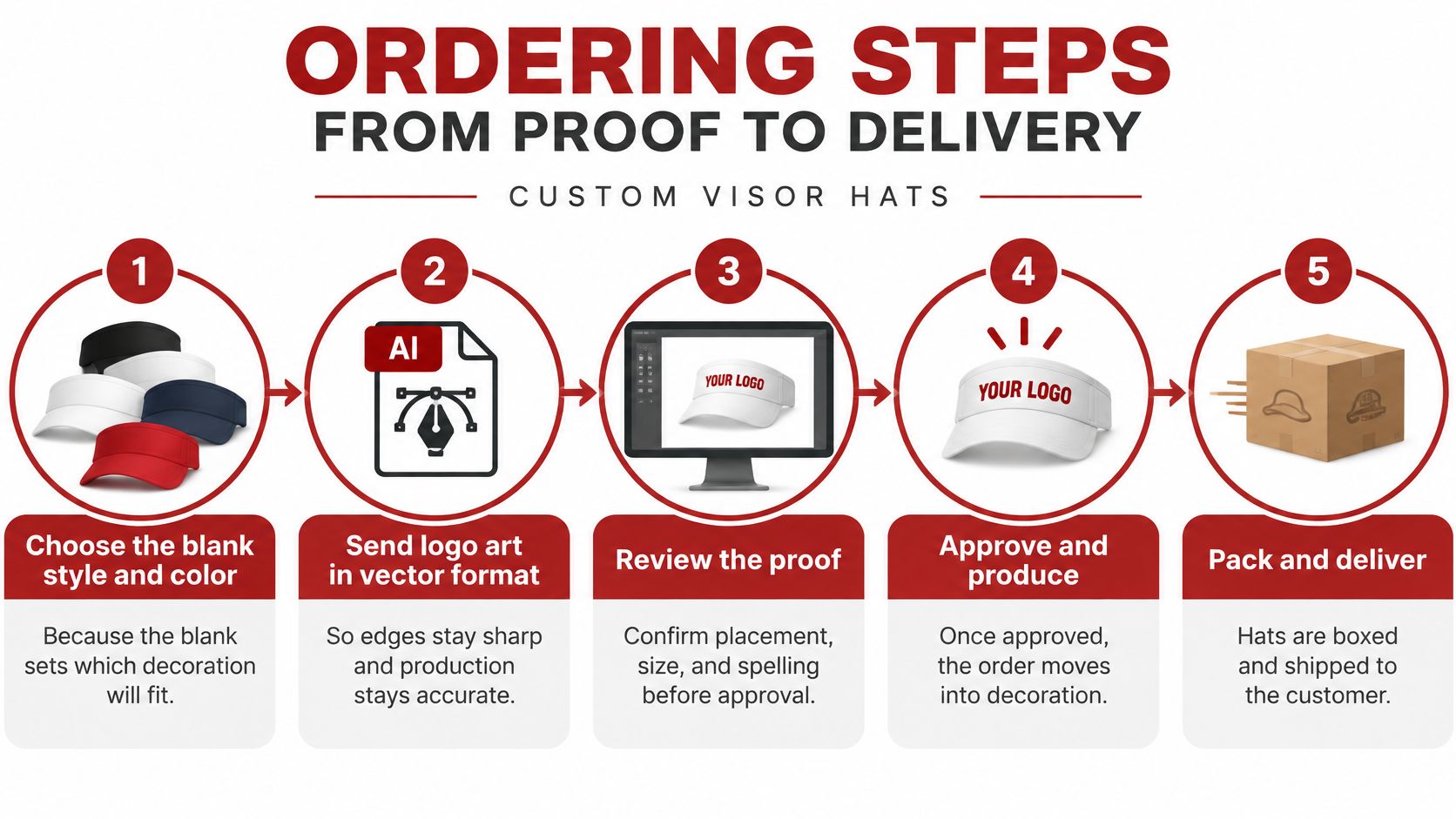
- Choose the blank and the color. Fabric and front shape decide which decoration sits clean. A mesh runner visor and a structured hospitality visor are not interchangeable once the stitch file is built.
- Send vector art and state size and placement. Vector keeps edges sharp. Say "front panel, clear of the brim seam" instead of "make it big."
- Review the proof on the curve. Check placement, spelling, and thread color on the shaped panel, not a flat rectangle. A word that fits a business card can clip the top of a low visor.
- Confirm quantity and the size split. Ask for per-unit pricing at each tier you might buy. Clubs ordering team kit often size each person by real measurements rather than one adult default, and jersey sizing with Villarreal Houston Academy shows how wide a youth fit range can run.
- Approve in writing and lock a production date. Lead time follows the method, the piece count, and whether the blank is in stock. In-stock blanks with one decoration usually move fastest. Get sample and bulk lead times in working days, separately.
- Check the sample or first pieces, then release the ship. Look at seams, color, and the logo after a flex. Don't approve from a photo if the group will sweat in these all season.
Ask for two dates, not one. A quick sample turnaround doesn't mean the bulk run will be quick, especially if the colorway isn't on the shelf.
Hold an approved proof and a dated timeline before anyone sews the rest. If either is missing, you have a conversation, not an order.
Confirm Your Visor Spec Before You Order
Decide sample or bulk before you attach the file. Start with a sample when head sizes are mixed, the blank is new to you, or the event date is tight. Move to bulk only after that sample passes wear and wash. Customers can order a single blank or a bulk run, so a one-off test doesn't require a season quantity.
Send this with the request.
- Art: Vector logo, exact colors, and where it sits on the front panel.
- Counts: Size split, total pieces, and the date you need them in hand.
- Sign-off: An approved proof plus a written production and delivery date before the bulk run starts.
We customize in house, and we make mock-ups when you ask for them, so the proof and the stitching stay with one team. When that spec is ready, start the request on the Custom Order Form on the website.
Dirt Cheap Headwear stocks blank visors and decorates them in house, from flat embroidery and 3D puff to patches and print, with proofs before the run. If you're outfitting a team, a stall, or an event crew, bring the style, the art, and the date and we'll price the spec. Visit Dirt Cheap Headwear and send the order when the sample has already passed on real heads.