
You're probably here because basic promo merch isn't cutting it anymore. The usual tee or cheap giveaway cap may get handed out, but it doesn't always get worn. A custom trucker hat leather patch sits in a better lane. It feels branded without looking overdone, and it gives your logo a cleaner, more finished look than many entry-level decoration methods.
That matters if you're ordering for a brewery, construction crew, outdoor brand, event booth, or online shop. You want something people will keep in rotation. Leather patch trucker hats tend to work because they balance familiar style with a more premium front decoration.
Why Your Brand Needs Leather Patch Trucker Hats
A lot of first-time buyers start with the same goal. They want merch that looks better than a standard screen printed item but still feels practical enough to hand to staff, customers, or wholesale accounts. That's where leather patch trucker hats earn their spot.
The trucker shape is already easy to wear. The patch adds a more polished face to the hat, especially for simple logos, badge marks, and outdoor-style branding. You get a product that can work as staff uniform gear, customer merchandise, or resale inventory without changing the basic formula.
They look premium without getting overly complicated
Leather patches give logos a strong, high-contrast surface. On a trucker hat, that's useful because the front panel becomes the focal point. Instead of relying on thread density or a full-color print, you're building the design around shape, contrast, and texture.
That's also why these hats fit so many categories:
- Retail brands want a product that feels shelf-ready.
- Service businesses need something crews will wear on the job.
- Events and teams want a decorated hat that still feels like real apparel, not just a giveaway.
- Promotional buyers need something recognizable and easy to reorder.
The category itself isn't a flash-in-the-pan item. The global headwear market reached $26.75 billion in 2024 and is projected to reach $37.76 billion by 2032 at a 4.46% CAGR, which supports the idea that decorated hats sit inside a durable and expanding apparel market, not a passing novelty, according to this headwear market summary and custom leather patch trucker listing.
Practical rule: If you want branded merchandise people will wear beyond the event day, start with an item that already fits into everyday clothing. Trucker hats do.
A leather patch also helps when your logo needs to feel more intentional. Fine script, oversized detail, and busy artwork can still create problems, but a strong badge-style mark often looks sharper on a patch than on a rushed embroidery setup.
If you're still narrowing down base styles before you finalize decoration, this guide to trucker cap brands and customization options is a useful starting point.
Understanding the Core Components
A leather patch trucker hat only works if both halves of the product make sense together. Buyers sometimes focus hard on the logo and forget the hat body. Others pick a nice blank cap and treat the patch like an afterthought. That's how you end up with a good idea and a weak finished product.
The trucker hat itself
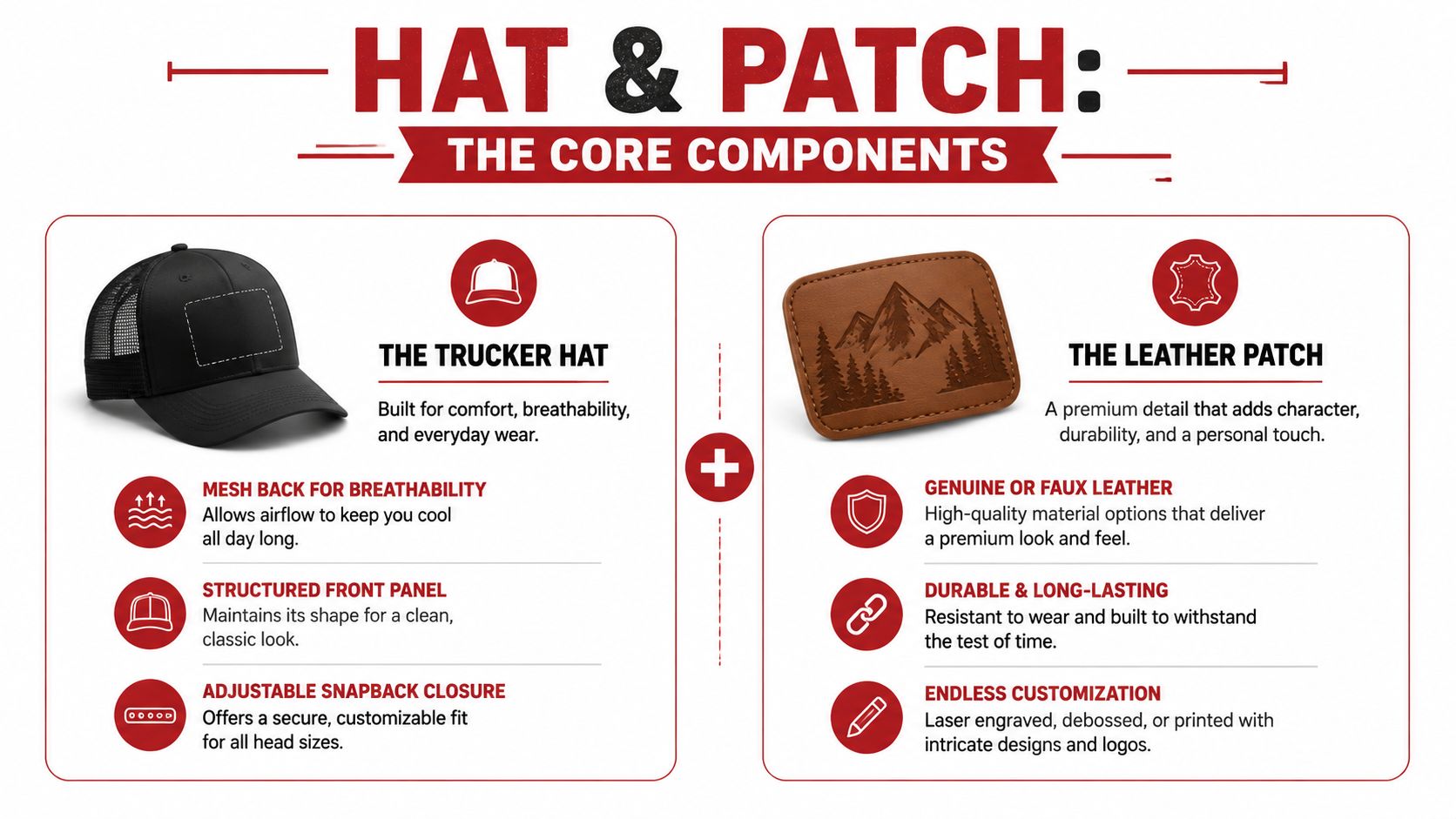
A classic trucker hat usually gives you three important traits. A structured front panel for decoration, a mesh back for airflow, and an adjustable snapback closure that fits a wide range of wearers without custom sizing headaches.
That front panel is the reason trucker hats work so well for patches. It gives the patch a stable face and lets the logo sit upright instead of collapsing into the crown. When the front panel holds its shape, the patch reads better at a glance.
For business buyers, that creates a few practical benefits:
- Staff wearability means one style can fit different people across a team.
- Better logo presentation comes from a front panel that doesn't fold over itself.
- Casual versatility helps the hat move between workwear, merch, and retail.
The patch material matters more than most buyers expect
Many product pages lump everything into one bucket and just say “leather patch.” That's too broad. One of the first real decisions is whether you want genuine leather or faux leather.
The trade-off is straightforward. Genuine leather usually gives a more rustic, natural, premium look. Faux leather usually gives more consistency and can make sense for buyers balancing budget or vegan preferences, as noted in this custom leather patch hat material overview.
Here's the practical comparison:
| Patch material | What it tends to suit |
|---|---|
| Genuine leather | Outdoor brands, heritage looks, premium retail merch, logos that benefit from natural variation |
| Faux leather | Budget-conscious runs, vegan positioning, buyers who want a more uniform finish across all hats |
How to choose between real and faux
Don't make this decision based only on the word “premium.” Make it based on brand fit.
- Choose genuine leather if the brand voice leans rugged, handmade, western, workwear, or outdoors.
- Choose faux leather if consistency is the priority and you need patches to look as uniform as possible across a run.
- Choose faux leather if your customer base cares about avoiding animal products.
- Choose genuine leather if subtle variation helps the brand feel more authentic rather than less controlled.
The patch material should match the story your brand already tells. If the hat says one thing and the rest of your packaging says another, customers notice.
Designing Your Perfect Leather Patch
The strongest patch designs usually look simpler than the buyer first imagined. That's not a limitation. It's good production sense. A hat patch is a small branded surface, not a flyer.
Start with the right artwork file
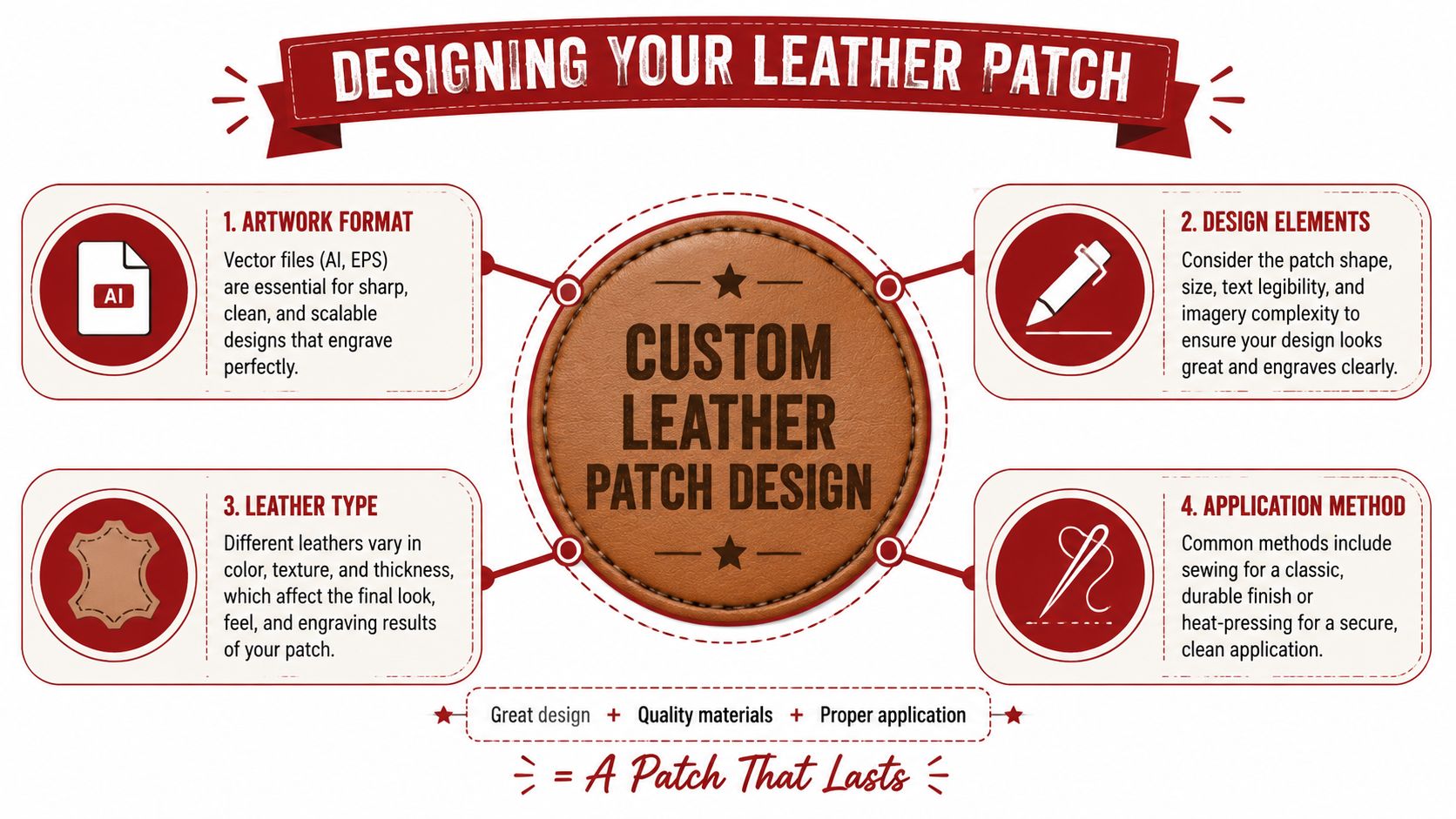
If you only remember one design rule, remember this one. A vector file is the clean blueprint. A random screenshot, social media image, or low-resolution JPG is not.
One retail listing for bulk custom leather patch trucker hats points to a widely cited front patch size of about 2.5 inches tall by 4 inches wide and also requires a black-and-white vector file, which shows how standardized and digital this production workflow has become in modern patch decoration, according to this bulk custom leather patch trucker hat listing.
That standard matters because it forces discipline. Your logo has to read clearly inside a defined front-panel space.
Good patch design usually follows a few rules
Buyers tend to get better results when they treat the patch like a badge, not a brochure.
- Keep text short: A brand name, initials, or tight slogan works better than a paragraph.
- Use bold contrast: Simple linework and clean shapes engrave better than tiny decoration.
- Respect the patch shape: A rectangle, oval, circle, or custom cut should support the logo, not fight it.
- Avoid tiny details: Fine elements that look good on a monitor often disappear or muddy up on the finished hat.
If your brand system is still loose, it helps to review basics like hierarchy and legibility before finalizing artwork. This article on selecting brand fonts for e-commerce is helpful for deciding whether your type choices will still hold up on a small product surface.
Shape and placement affect the vibe
A rectangular patch often feels classic and workwear-driven. Circular patches feel more badge-like and are common for breweries, parks, shops, and lifestyle brands. Custom die-cut shapes can work well, but only when the outline stays clean and the logo remains readable.
Here's a simple decision filter:
| Patch style | Best fit |
|---|---|
| Rectangle | Trades, workwear, outdoor companies, straightforward logos |
| Circle or oval | Lifestyle brands, breweries, badge-style marks |
| Custom shape | Strong icon-based branding with simple edges |
A good supplier should also help you prep the art for production, whether you're ordering direct patches or comparing options for buying custom hat patches wholesale.
If your logo only looks good when it's large, full color, and surrounded by effects, it probably needs to be simplified before it becomes a leather patch.
How Your Patch Is Made and Attached
A lot of first-time buyers approve the patch art, pick a hat color, and assume the hard part is done. Then the sample arrives, and the real quality questions show up. Is the logo clean on the leather. Does the patch sit flat on the crown. Will the edges stay down after real wear.
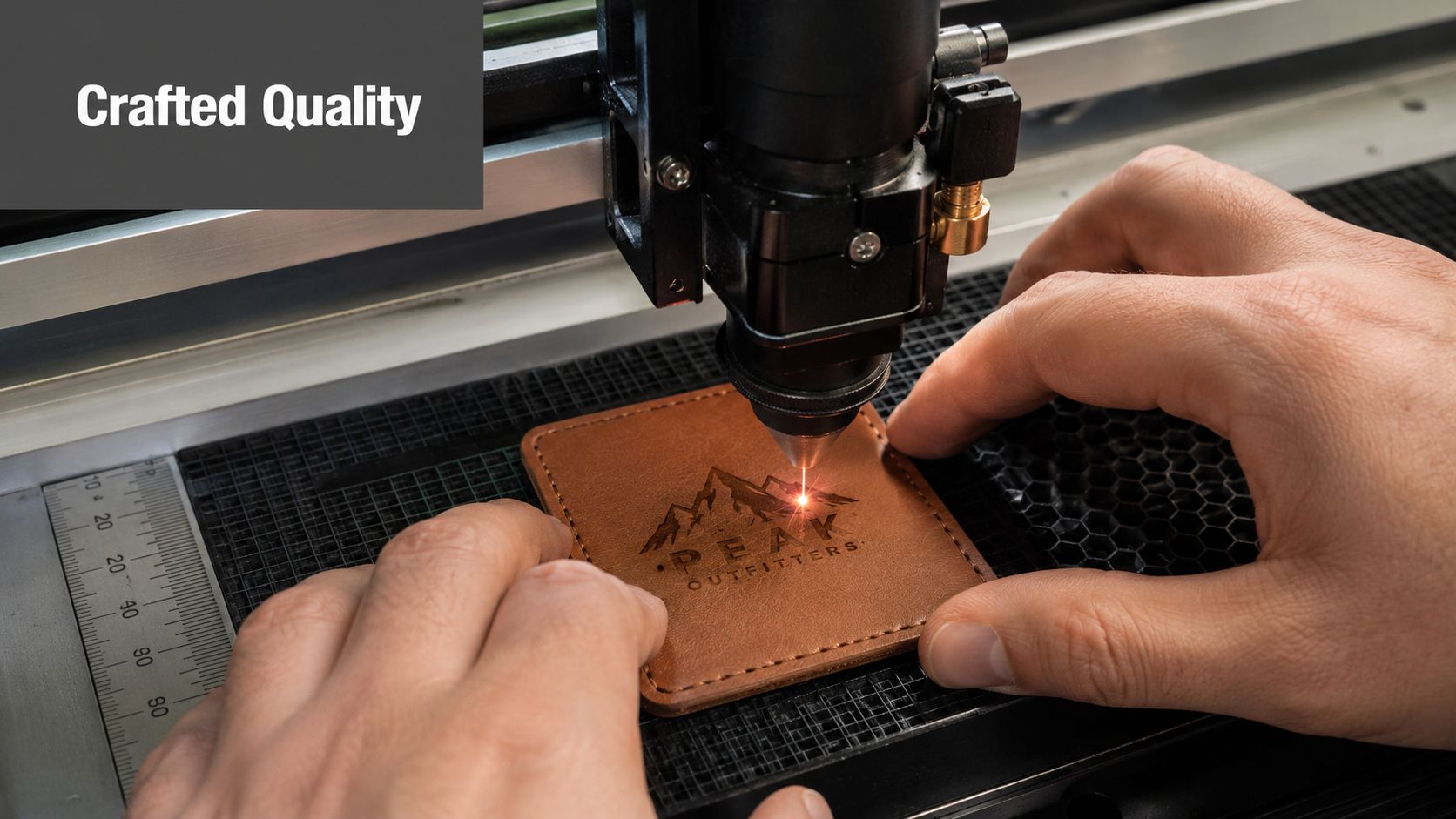
Those questions are tied to production choices, not just design taste. The two that matter most are how the logo is put into the patch and how the patch is fixed to the hat.
How the logo gets onto the patch
Leather patches are usually finished with a laser-engraved or stamped design. For a buyer, the label on the machine matters less than the result. You want sharp edges, readable text, even depth, and consistent color from patch to patch.
Material choice affects that result right away. Real leather tends to give a richer, less uniform finish. That can look premium, especially for outdoor, heritage, and workwear brands. It also means natural variation. Shade, grain, and burn response can shift a bit across a run.
Faux leather is more uniform and often easier to control in production. If your logo needs cleaner repeatability or your order has tight budget limits, faux can be the better fit. The trade-off is feel. It usually looks more consistent, but it does not age the same way and can feel less substantial in hand.
Sew-on versus heat-applied
Attachment method decides a lot of the long-term outcome. In practice, sewn-on patches are the safer choice for durability. Heat-applied patches can still work well, but they depend more heavily on setup, operator skill, patch backing, and crown shape.
A manufacturer guide from Stahls' notes that proper temperature, dwell time, pressure, and substrate compatibility all affect heat-applied results on caps, which is why application errors tend to show up fast on curved surfaces like trucker fronts in this cap heat printing guide from Stahls'.
Here's the practical comparison:
| Method | Strengths | Watch-outs |
|---|---|---|
| Sewn-on patch | Better long-term hold, stronger perceived value, less risk of edge lift | Higher labor cost, visible stitch line, patch shape has to suit the sewing path |
| Heat-applied patch | Cleaner edge appearance, faster production on the right setup, useful for some low-profile looks | More sensitive to heat, pressure, patch backing, front panel shape, and operator consistency |
When sew-on is the better investment
For uniforms, retail merchandise, ranch and outdoor brands, and repeat promo orders, sew-on usually gives the best value over time. It costs more up front, but it reduces the chance of returns, edge peel, and disappointed clients.
It also handles wear better.
If hats are getting tossed into trucks, worn in sun, or used on job sites, I usually steer clients toward sew-on unless there is a strong reason not to. A stitched patch becomes part of the cap build. That matters on orders where replacement cost is higher than the small savings from a faster attachment method.
When heat application makes sense
Heat press attachment is a reasonable choice when the patch material, adhesive, and hat front all work together. It is often chosen for cleaner visual presentation, simpler patch edges, or production workflows where sewing would slow the job too much.
The weak point is consistency. Trucker hats are not flat garments. The crown curve, mesh back, front panel structure, and fabric content all affect how evenly pressure is applied. Too much heat can mark or distort the front panel. Too little pressure can leave partial bond areas that start lifting at the corners.
This walkthrough shows the production mindset behind patch application in motion:
What actually causes peeling
Peeling usually starts with one of four problems. Incomplete adhesive coverage. Poor pressure across the full patch. A crown that was not properly supported during application. A patch material that was never a good match for the hat in the first place.
That last point gets missed all the time. A stiff patch on a front panel with too much curve or flex is more likely to fight the hat and lift at the edge. A supplier who understands headwear production should flag that before you approve the run.
Ask direct questions before ordering:
- Is this patch sewn or heat applied?
- If heat applied, what backing is being used?
- Has this exact patch size been tested on this hat style?
- Will real leather or faux leather give a more consistent result for my logo?
Judge the patch after production the same way your customer will judge it after weeks of wear. Look at edge hold, crown fit, logo clarity, and whether the material choice matches the job.
If your artwork has small detail that leather cannot hold cleanly, a different patch format may be the smarter production choice. It helps to compare other decorated cap options, including a woven patch hat, before you lock in the final spec.
Choosing the Right Trucker Hat Style
The patch may get the attention, but the blank hat controls fit, profile, and how the finished piece sits on someone's head. A great patch on the wrong hat still feels off.
Structured or unstructured
A structured trucker hat has a firmer front and keeps a defined crown shape. That's the safer pick for most leather patch projects because it supports the patch and keeps the front profile looking clean.
An unstructured hat feels softer and more relaxed. That can work for lifestyle brands and casual retail, but it changes how the patch presents. If the front collapses too much, the patch can lose some visual impact.
Here's the quick rule:
- Structured works well for crews, branded merch, outdoor shops, and logos that need a crisp front.
- Unstructured fits brands chasing a softer, broken-in silhouette.
Five-panel or six-panel
Panel construction affects both style and patch placement. A 5-panel hat gives you one uninterrupted front area, which many buyers love for patches because there's no center seam competing with the design. A 6-panel hat has the classic split-front look and is common across many established trucker styles.
Neither is automatically better. It depends on your patch shape and brand mood.
| Hat construction | What it usually does well |
|---|---|
| 5-panel | Cleaner front for patch placement, flatter visual field, more modern streetwear feel |
| 6-panel | Classic trucker profile, familiar fit, broad style availability |
Match the hat to the audience
A lot of ordering mistakes happen because buyers choose what they personally like instead of what their audience will wear. Staff uniform hats, trade-show giveaways, and direct-to-consumer merch don't always need the same base cap.
Think in use cases:
- For work crews: go structured, durable, and easy to reorder.
- For retail merch: pay more attention to silhouette and colorway.
- For events: choose a style broad enough to fit many people comfortably.
- For boutique brands: consider whether a 5-panel profile better fits the brand image.
Richardson, YP Classics/Flexfit, New Era, Nike, Legacy, and Valucap all serve different needs in the blank headwear market. Some buyers want the familiar, traditional trucker look. Others want a softer fit or a budget-friendly option for larger runs. Dirt Cheap Headwear carries those brands in blank and decorated options, which is useful if you need to compare profiles, panel counts, and price levels in one place.
The right blank hat does two jobs at once. It supports the patch, and it fits the person who's going to wear it without thinking twice.
Color choices matter too
The patch doesn't exist in isolation. A tan or brown patch on a black, charcoal, loden, or heather front often reads differently than the same patch on white or bright fashion colors. If the logo contrast is subtle, keep the hat body from competing with it.
For first orders, neutral hat colors usually reduce risk. Once a logo proves it can carry the product, then it makes sense to branch into seasonal or niche colorways.
Navigating Pricing MOQs and Timelines
A common first-order scenario goes like this. A buyer wants 48 hats for an event in three weeks, asks for genuine leather, approves a detailed logo, then gets surprised when the quote and lead time come back higher than expected. The problem is rarely one thing. Cost and timing shift together based on the blank hat, patch material, artwork readiness, attachment method, and run size.
Why quantity changes the quote
Decorated headwear gets more cost-efficient as quantity increases because setup labor gets spread across more units. That matters a lot with leather patch hats, where there are more touchpoints than a simple print job.
I usually tell first-time buyers to decide what kind of order they are placing before they compare prices:
- Test run for samples, owner wear, or internal feedback
- Launch run for an event, retail drop, or staff rollout
- Restock run for a design you expect to repeat
Those order types should not be priced or planned the same way.
A test run gives you flexibility, but the unit cost will be higher. A restock run usually gives you the best value because the patch size, placement, and production approach have already been proven.
What MOQ means in real production
MOQ is the minimum order quantity a shop will accept for a specific setup. That minimum exists because someone still has to prepare the art, make the patch, attach it, and check the finished hats, whether you order 24 pieces or 240.
Lower MOQs help startups and small brands test demand without tying up cash in inventory. Higher MOQs usually improve pricing, but they only make sense if the design is one you plan to reorder.
There is also a practical difference between a low-MOQ shop and a good fit for your project. A shop may accept a small order, then push you toward the fastest method instead of the one that wears best. That trade-off needs to be discussed up front.
Where price and durability connect
This is the part buyers miss most often. Two quotes can look close on paper and produce very different hats.
Real leather usually costs more than faux leather. It also behaves differently in production. Real leather tends to give a better natural grain and a higher-end look, but thickness variation can affect stamping depth and edge consistency. Faux leather is more uniform, often lowers cost, and can be easier to keep consistent across a larger run.
Attachment method matters too. Heat-pressed patches can be the right choice for fashion merch, short-run promotions, or cleaner front presentation when stitching would distract from the design. Sew-on patches usually take more labor, but they tend to be the safer choice for workwear, repeat washing, and rough handling.
That means the best-value order is not always the cheapest one. If the hats are for a contractor crew, outdoor staff, or a brand that cares about long wear, paying more for the right patch material and attachment method can save money on replacements and complaints.
How timelines usually break down
A straightforward order usually moves through four stages:
- Artwork review: vector files, clear sizing, and placement notes
- Proof approval: shape, logo scale, and patch position get confirmed
- Production: patches are made, attached, and checked
- Shipping: completed hats leave after final inspection
The delay usually comes from the buyer side, not the factory side. Low-resolution files, logo revisions after proofing, or uncertainty about patch material can stall a job fast.
If you have a hard in-hands date, build in extra time for proofing and one round of revisions. That is even more important if you are comparing sew-on versus heat press, or genuine versus faux leather, because those decisions can affect sourcing and setup.
For resale brands, planning should go beyond the hat itself. If this order sits inside a wider merchandise strategy, it can help to review other channels where teams source new CPG products while they build out a broader assortment.
The smoothest first order starts with clean art, a realistic quantity, and one clear priority: lower cost, faster turnaround, or longer wear. Pick the priority first, then build the hat around it.
Use Cases Branding and Long-Term Care
The easiest way to choose the right leather patch trucker hat is to picture where it will get worn. Different businesses need different answers.
Three common business fits
A brewery or coffee roaster often does well with a circular or rectangular patch on a structured trucker. The patch gives the merch wall a more retail-ready feel, and staff can wear the same hat behind the bar or at events without looking like they're in generic promo gear.
A construction company or grounds care crew usually benefits from a straightforward logo, structured crown, and a durability-first attachment choice. In that setting, the hat isn't just merch. It's daily workwear. A clean patch with a strong outline tends to hold up visually better than fussy detail.
An e-commerce apparel brand can use leather patch trucker hats as a margin-friendly add-on product, especially when the logo is already badge-shaped. If that brand sells online, product photography and storefront presentation matter a lot. If you're building that side of the catalog, these 2026 Shopify image optimization strategies are worth reviewing so the hat photos load cleanly and still show texture detail.
What branding works best on these hats
Leather patch hats usually reward restraint. The brands that get the strongest result often use one of these approaches:
- Badge logo: compact and centered
- Initial mark: short, bold, easy to read
- Outdoor emblem: icon plus limited text
- Wordmark in a contained shape: best when spacing is clean
What doesn't work as well? Overloaded artwork, tiny text, and logos designed for print but never adapted for product decoration.
A leather patch hat should feel like a product your brand sells on purpose, not a leftover logo placed on whatever blank was available.
Care tips that protect the patch and the hat
Long-term care is simple, but buyers rarely hear it upfront. Leather patch trucker hats generally do better with light handling and spot cleaning than rough wash cycles.
Use these basic rules:
- Spot clean first: A damp cloth and gentle attention usually go farther than soaking the whole hat.
- Avoid aggressive washing: Submerging and scrubbing can stress both the patch and the crown shape.
- Let it air dry: Heat can warp shape and create unnecessary stress on the patch area.
- Don't crush the front panel: Structured truckers look best when the crown keeps its form.
For staff programs or merch drops, it's smart to give customers or employees a short care note with the order. That small step helps the hats stay presentable longer and reduces complaints that are really just maintenance issues.
A good leather patch trucker hat does two jobs. It carries the logo well, and it keeps doing that after real use. If you choose the right blank, the right patch material, and the right attachment method, you avoid most of the problems that make first-time buyers think the category is hit-or-miss.
If you're ready to order custom leather patch trucker hats, Dirt Cheap Headwear offers blank headwear from major brands plus custom decoration with low minimums, which makes it a practical option for test runs, staff gear, events, and wholesale reorders.
Pingback: Best Wholesale Hats for Contractors | Dirt Cheap Headwear