
Custom Bucket Hats No Minimum: Your 2026 Small-Batch Guide
You've got a bucket hat idea, a logo, and maybe a real reason to move fast. Staff gear for a pop-up. A test product for your brand. Team hats for a weekend tournament. Then you start shopping and hit the same wall over and over: minimum order requirements that make no sense when you only need a handful.
That's why so many buyers search for custom bucket hats no minimum. It sounds like the perfect answer. Sometimes it is. But in practice, the best order isn't always the smallest one possible.
For most first-time buyers, the sweet spot is usually a low-minimum order, not a true one-off. You still get flexibility. You can still test a design. But you're more likely to get better decoration, better hat quality, and fewer surprises when it's time to reorder.
What "No Minimum" Really Means for Custom Bucket Hats
You're not wrong for wanting one hat, or six, or twelve. A lot of buyers don't need fifty pieces sitting in a box. They need a sample, a test run, or a small group order that feels manageable.
The market has moved in that direction fast. The global custom bucket hat market has seen 35% year-over-year growth since 2020, driven by low-minimum and no-minimum ordering models that let small businesses launch branded headwear with as few as 6 pieces per logo. That trend is especially visible in the U.S. and Europe, where 72% of apparel brands prefer embroidery shops with low minimums for test runs and micro-inventory launches, according to the Textile and Apparel Market Research Group. More detail is included in this overview of minimum order options for custom hats.
No minimum vs low minimum
These terms sound similar, but they solve different problems.
- No minimum means you can order a single piece.
- Low minimum usually means a small batch, often somewhere around the first practical production break.
- Bulk minimum is the old model. It works for established programs, not for cautious testing.
If you're building a real brand, low minimum often makes more sense than one-off production. You're not just testing the art. You're testing how the design behaves across multiple hats, how the stitching lands, and whether the product still looks right when repeated.
Practical rule: Order one piece when you only need a novelty item. Order a small batch when you need to make a business decision.
Why shops can offer smaller runs now
Older decoration methods made tiny orders inefficient. Setup took time, labor, and material, so shops pushed buyers toward bigger quantities.
That's changed. Digital workflows, faster proofing, and in-house decoration let suppliers process smaller runs without turning every order into a headache. If you're still comparing suppliers, this directory of source small batch manufacturers is a useful place to understand how low-MOQ production works across categories, not just hats.
What matters most is this: small order availability doesn't automatically mean equal quality. A one-piece order is convenient. A six to twelve piece order is often where quality, consistency, and value start to line up.
Decoration Deep Dive Embroidery vs Printing for Small Orders
Once you know your quantity, decoration becomes the next real decision. On bucket hats, the choice usually comes down to embroidery or printing.
Both can work on small runs. Both can look good. But they solve different design problems, and buyers get into trouble when they pick based on price alone.
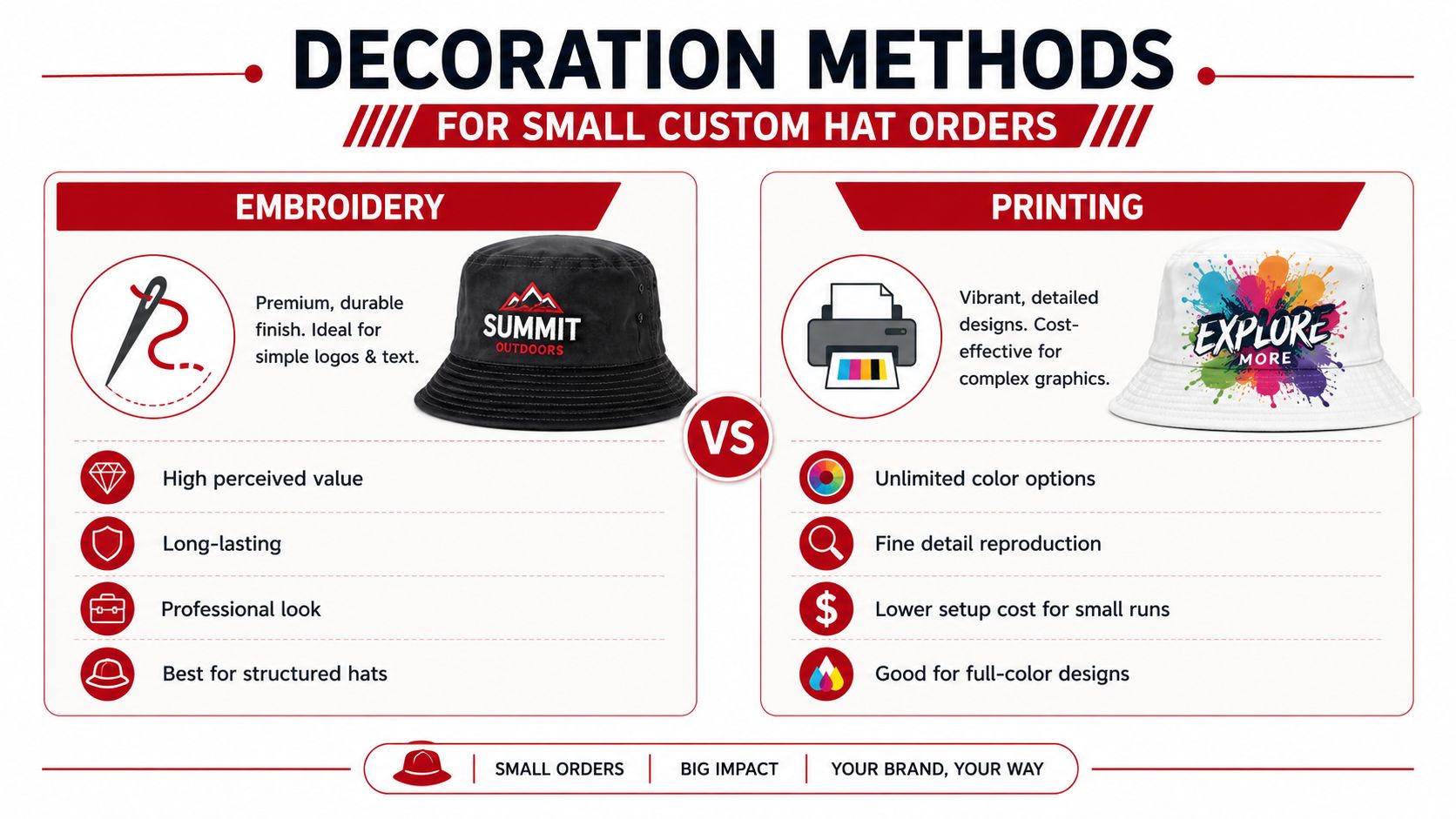
Why small-run pricing changed
No-minimum custom bucket hats now use digital embroidery and DTF printing that remove the need for physical screen setup, which can reduce per-unit production costs by 40 to 60% compared to traditional batch methods, according to Vivipins' explanation of custom bucket hat decoration methods.
That's why a shop can decorate a short run without forcing you into a large order. But lower setup friction doesn't mean both methods are equal for every logo.
Quick comparison
| Method | Best for | Look | Strength | Watch for |
|---|---|---|---|---|
| Embroidery | Simple logos, text, brand marks | Raised, textured, premium | Strong long-term wear feel | Fine detail can get simplified |
| Printing | Full-color artwork, gradients, complex graphics | Flat, vivid, graphic-heavy | Great for visual detail | Can feel less premium on some hat styles |
When embroidery wins
Embroidery is usually the right call when you want the hat to feel branded, not just decorated. A clean stitched logo on the front panel gives bucket hats a more finished retail look.
It also hides a lot of sins. Slight fabric texture variation matters less with embroidery than with some printed applications. That's part of why brands, teams, and event buyers often prefer it for hats.
A few guidelines help:
- Choose embroidery for bold logos. Thick lines, readable text, and simple shapes translate best.
- Use it when perceived value matters. If the hat is merch, staff gear, or a resale item, embroidery usually feels stronger in hand.
- Expect some design editing. Tiny outlines and miniature type often need cleanup before they stitch well.
If you sell online, collecting customization details clearly matters too. For stores that allow buyers to submit names, notes, or placement choices, this guide to Shopify line item properties is useful because it shows how to capture those order details cleanly before production starts.
When printing makes more sense
Printing is the better fit when the artwork itself is the product. If your design uses photo detail, multiple colors, soft shading, or an illustrated style, embroidery may flatten or simplify it too much.
Printing can also help when you're testing a design concept and don't want stitch count or digitizing choices to shape the outcome. For examples of how embroidery differs on this product category, this page on bucket hat embroidery options gives a good baseline for what stitched decoration looks like in practice.
A hat logo and a T-shirt graphic aren't the same thing. The design that looks perfect on a screen can fail fast once it wraps around a curved panel.
The decision most first-time buyers should make
If your logo is simple and you care about long-term brand presentation, choose embroidery. If your design is graphic-heavy and color-rich, choose printing.
What doesn't work well is forcing a detailed artwork file into embroidery just because embroidery sounds more premium. That usually leads to compromised detail and disappointment. Likewise, using print for a basic one-color brand mark can make the hat feel cheaper than it needs to.
The Truth About Quality and Consistency in No-Minimum Hats
This is the part many buyers don't hear until after the first order arrives.
A true no-minimum hat can be excellent for a single promo piece, a gift, or a quick concept sample. But if you're testing a design you might reorder later, consistency matters more than convenience. That's where a lot of one-off suppliers fall short.
The hidden scaling problem
Recent data from Outer Wings for 2026 says 74% of no-minimum hat suppliers do not offer guarantee matching between test runs and bulk orders for color accuracy or embroidery placement, and startups can end up re-ordering full batches at 30% higher cost because the proof and the scaled order don't match. That finding appears in Outer Wings' review of no-minimum custom hat suppliers.
That's the risk. Your sample may look good enough. Then your reorder arrives with a shifted logo, different thread tone, or a changed blank style.
Why low minimum is often the safer move
A low-minimum order gives you a better test.
Instead of asking, “Can this shop make one hat?” you're asking better questions:
- Can they repeat placement across multiple units?
- Does the logo size still look balanced on every piece?
- Does the hat itself feel worth reordering?
- Will the second run match the first without drama?
Those are brand-building questions. They matter if you're selling merch, outfitting staff, or planning repeat events.
If you think you might reorder, your first order isn't just a sample. It's the beginning of a production standard.
What to watch before you approve
Ask for specifics, not broad reassurance.
- Blank hat consistency: Confirm the exact style, panel construction, and fabric.
- Placement approval: Make sure your proof shows logo size and location clearly.
- Reorder policy: Ask whether future runs are matched to the same proof and stitch file.
- Decoration method lock-in: Don't assume your sample method will remain the same on larger runs unless the shop confirms it.
The mistake is assuming “no minimum” means “same service, same quality, just fewer pieces.” Sometimes it does. Often it means the supplier optimized for convenience first.
A Step-by-Step Guide to Ordering Your Custom Hats
The ordering process gets easier once you stop trying to decide everything at once. Start with the hat itself, then move to decoration, then proofing.
The visual below breaks the flow into five simple stages.
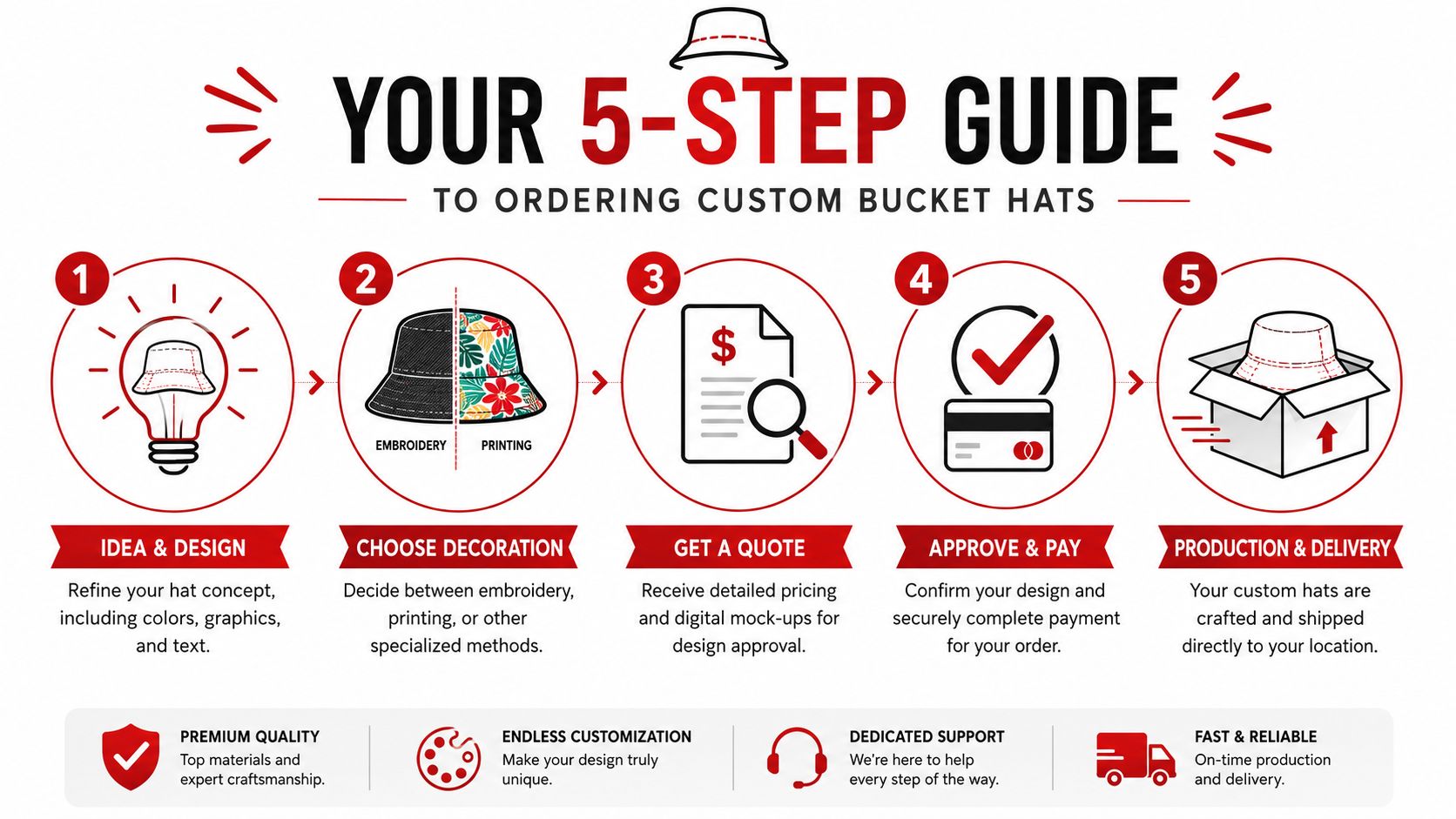
Step 1 Pick the right blank hat
Not all bucket hats wear the same. Some are softer and more relaxed. Others hold shape better and present embroidery more cleanly.
Start by checking:
- Panel structure
- Fabric feel
- Brim shape
- Color availability
- Sizing options
If your logo is front-facing and clean, a more stable hat body usually helps. If the hat is lifestyle merch and softness matters more, a relaxed style may fit better.
Step 2 Match the artwork to the method
Don't send a file and hope the shop figures out the best process without input. Tell them what matters most to you.
If your priority is premium presentation, say that. If your priority is preserving a multi-color graphic, say that too.
A practical buying checklist helps:
- Use a clean logo file. Vector is best when available, but a sharp high-resolution file can still work for many orders.
- Keep text readable. Tiny script and thin outlines often create production issues.
- Name your preferred size. A logo that's too small can disappear on a bucket hat.
The video below gives useful visual context on custom hat production and design thinking.
Step 3 Slow down at proof approval
At this stage, good orders are won or lost.
According to the verified industry data, 94% of leading custom shops use digital mockup approval processes, and that has reduced order errors by 39%. Buyers feel more confident when they can review the artwork before production. For broader planning advice on scaling later, this guide to custom bucket hat bulk order tips is worth reading after you've chosen your first small run.
Order check: If the proof doesn't show size, placement, thread or print treatment, and hat color clearly, ask for a revised mockup before paying.
Step 4 Confirm production details
Before checkout, verify the non-glamorous stuff:
- Hat color and size
- Decoration location
- Quantity per design
- Turnaround expectation
- Shipping destination
This is also the moment to ask about reorders. If the first run works, you want the next one to be easy.
Step 5 Treat the first order like a test
When the hats arrive, inspect them like a buyer, not a fan of your own design.
Look at placement. Check stitch cleanliness or print edges. Put one on. See whether the logo still reads at normal distance. A small batch gives you room to adjust before you commit deeper.
Who Uses Low-Minimum Bucket Hats and Why
Low-minimum bucket hats solve different problems for different buyers. The common thread is simple: they let people order enough to be useful without overcommitting.
Small brands testing real demand
A startup clothing brand usually doesn't need a giant opening order. It needs enough units to photograph, post, wear, and sell without tying up cash.
That's where a short run makes sense. A founder can test one logo on a bucket hat, see whether customers respond, then reorder the winner instead of sitting on slow inventory. If they need cleaner product images before launch, tools covered in WearView reviews AI fashion tools can help turn plain mockups into stronger visuals for online listings.
Coaches and team organizers
Team buyers care less about hype and more about dependability. They want hats that hold up, fit the event, and arrive looking consistent.
Verified technical data notes that low-minimum custom bucket hats rely on precise 5-panel or 6-panel seam alignment and high-strength melange thread (40 wt, 100% polyester) with 18 to 22 lbs tensile strength and shape retention under 30% lateral stress, as described in this technical discussion of bucket hat construction. That matters because teams don't want floppy, misshapen hats after a few wears.
Event planners and nonprofit groups
These buyers often need something that feels better than disposable promo merch but still works in modest quantities.
A bucket hat hits that middle ground well. It's wearable, visible, and useful outdoors. A low minimum lets an organizer create a limited run for volunteers, VIP guests, or a sponsor activation without buying far beyond the guest list.
The best small event merch isn't the cheapest item. It's the one people still wear after the event ends.
Resellers and decorators
Print shops, patch sellers, and niche merch resellers often use low minimums to test combinations. One blank. One patch concept. One embroidery idea. Then a small run once the concept is proven.
That approach works because it keeps experimentation cheap enough to try, while still producing hats that can be sold confidently if the design lands.
Your Custom Bucket Hat Questions Answered
Is one hat always the cheapest way to test?
Not usually. One hat is the lowest commitment, but not always the best value. A small batch often spreads setup, proofing, and production effort more efficiently. If you care about judging consistency, a handful of hats gives you a much better read than a single piece.
How fast can a small order move?
Turnaround depends on the shop, blank availability, and the decoration method. Some suppliers advertise very fast production for low-minimum work, while others need more time for proofing and scheduling. If timing matters, ask when the blank is in stock and when proof approval cuts off production.
Can I mix hat colors with one logo?
Sometimes, yes. It depends on the supplier's workflow and whether they're treating your order as one design across multiple blanks or as separate line items. Always confirm this before approval so you don't assume flexibility that isn't built into the quote.
What file should I send?
A clean vector file is the safest option for logos. If you don't have one, send the sharpest version you have and avoid screenshots pulled from social media. For embroidery, simple art with clear edges almost always performs better than overly detailed files.
What's the smartest first order for a serious brand?
For most buyers, it's a low-minimum embroidered run from a supplier that offers clear proofs and consistent reorders. That gives you enough product to evaluate quality, enough flexibility to test demand, and a better foundation if the design succeeds.
If you're ready to turn a logo into a clean, wearable small-batch order, Dirt Cheap Headwear is a practical place to start. They specialize in blank and custom headwear, offer low minimums starting at six pieces per logo, and handle in-house embroidery with fast turnaround for brands, events, teams, and resellers who want quality without ordering more than they need.