
Cheap Graduation Hats: The Ultimate Buyer’s Guide for 2026
You got handed the graduation order because you're organized, responsive, and probably the only person in the room who replies to emails on time. Now you're staring at a spreadsheet, a ceremony date, and a budget that doesn't leave much room for mistakes. Everyone wants the hats to look right. Nobody wants to pay more than they have to.
That's where cheap graduation hats get misunderstood. Buyers often treat them like a throwaway accessory, something you click into a cart at the last minute. In practice, the hat order affects budget control, delivery timing, distribution on event day, and whether the group gets something that looks unified in photos.
A lot of event categories work this same way. Graduation is the obvious one, but schools, nonprofits, community programs, alumni groups, and branded milestone events all run into the same problem. They need a clean look, enough units for the whole group, and a process that won't create chaos the week before the ceremony.
More Than a Hat It's a Milestone on a Budget
A first-time buyer usually starts with one question. “What's the cheapest option?” That's fair, but it's rarely the only question that matters.
The real pressure shows up in the details. You need the caps to arrive on time. You need them to look consistent across a stage or field. You need enough extras for late adds, damaged boxes, or a few people who didn't RSVP until the last minute. And if this is a school or community event, you may also be balancing parent expectations with a fixed purchasing approval.
The broader market tells the same story. The global hats market, which includes graduation caps, was valued at USD $11.04 billion in 2025 and is projected to reach $18.97 billion by 2034, according to Fortune Business Insights coverage of the hats market. Buyers keep looking for customizable, low-cost headwear because budget discipline matters in real-world event planning.
That doesn't mean “cheap” has to mean sloppy.
Practical rule: The best low-cost graduation cap is the one that arrives on time, fits most of the group, photographs well, and doesn't create extra work on distribution day.
I've seen buyers borrow cost-control habits from other event categories and do much better because of it. If you're managing graduation like a formal event with multiple moving parts, resources like these cost-saving wedding planning tips are useful. The categories are different, but the planning logic is the same. Lock the essentials first, leave room for contingencies, and avoid last-minute upgrades that look small on paper but add up fast.
Cheap graduation hats work best when you buy them as part of a process, not a panic purchase.
Decoding the Mortarboard Hat Types and Materials
Most buyers call the whole thing a graduation cap, but it helps to break the product down into parts. Once you know what you're buying, the quotes make more sense and it gets easier to compare options.
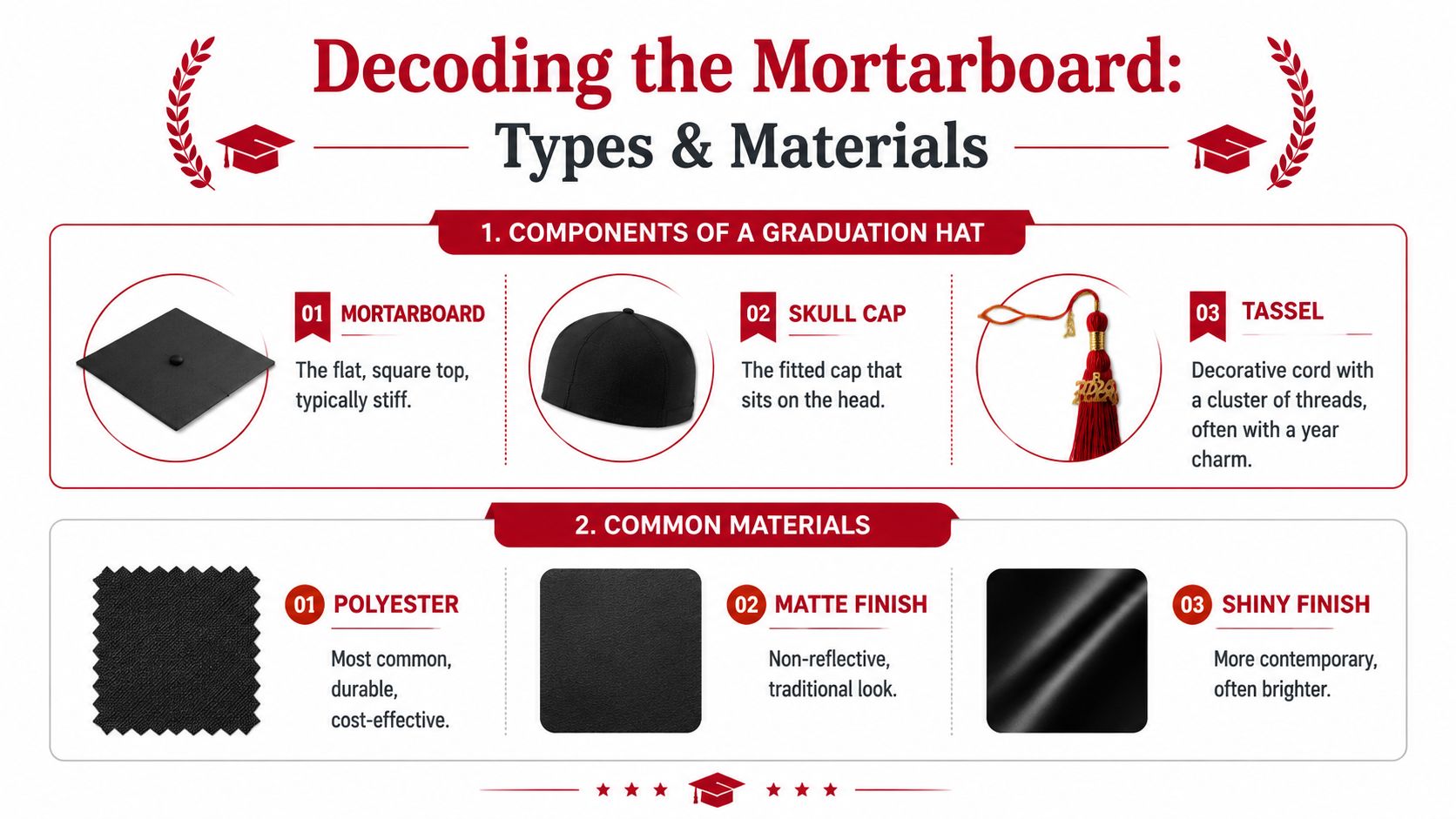
The main parts that matter
A standard graduation hat has three pieces buyers should pay attention to:
- Mortarboard top: The flat square panel people decorate, photograph, and notice first.
- Skull cap: The fitted base that sits on the head.
- Tassel assembly: The decorative cord and button attachment that finish the look.
The tassel details matter more than many people expect. A standard graduation tassel uses a benchmark length of 8.5 inches and mounts on a 2.5-inch wide button base at the exact center of the mortarboard, as shown in this graduation tassel assembly reference video. That centered placement is what gives the cap a balanced, professional look.
If the button is off-center or the tassel feels flimsy, the whole cap reads as lower quality even if the fabric itself is decent.
Material choices buyers actually compare
Most bulk buyers don't need a fashion-grade explanation. They need to know what looks good, what holds up, and what tends to be the better value.
| Material or finish | What it looks like | Where it works well | Trade-off |
|---|---|---|---|
| Matte polyester | Traditional, non-glare finish | School ceremonies, formal photos, larger groups | Usually the safest choice, not the flashiest |
| Shiny polyester | Smoother, brighter, more reflective | Programs that want a slightly more vivid look | Reflections can be harsher in photos |
| Ultra-budget board-based options | Serviceable at a distance | One-time events with very tight budgets | Less durable, less reusable, less premium feel |
What usually works best
For most bulk orders, matte polyester is the practical standard. It photographs more evenly, feels closer to what schools expect, and gives students or attendees a cap they can keep without it looking disposable.
Shiny finishes can still work. Some buyers like them because they read a little brighter in person. The downside is that under direct light, they can look more promotional than academic.
The cheapest board-style alternatives only make sense when the event is single-use and the budget is driving every decision. They save money up front, but they usually disappoint anyone hoping to decorate the cap, keep it as a souvenir, or reuse it later.
Buy for the ceremony first, then for the afterlife of the product. If people want to decorate, save, or repurpose the cap, the absolute cheapest construction usually isn't the best value.
What to Expect for Cheap Graduation Hats
“Cheap” is one of those words that creates more confusion than clarity. Some buyers mean low unit cost. Others mean wholesale. Others just mean they don't want to get trapped into inflated pricing after adding tassels, decoration, and rush shipping.
That's why I always tell new buyers to separate base product cost from order cost. The cap itself may be affordable, but your final number shifts based on timeline, packaging preferences, art setup, and whether you need blanks or decorated pieces.

The wholesale benchmark that protects you
There's one number every buyer should know. Standard academic caps should cost between $10–$25 when purchased wholesale, according to ABC7 reporting on cap and gown scam confusion. That range gives you a reality check when you're comparing vendors or reviewing invoices.
If a seller can't clearly explain why the cap price lands where it does, slow down.
If the quote is vague, the problem usually isn't the hat. It's the process behind the hat.
That benchmark matters because graduation season attracts confusion. Some organizations bundle products in ways that make the cap seem cheaper until fees show up later. Others lean on urgency and assume the buyer won't have time to compare.
What moves the price up or down
Cheap graduation hats usually stay affordable when these factors stay simple:
- Material choice: Matte polyester often strikes the best balance between appearance and price.
- Order size: Larger orders usually create better pricing consistency because production and packing are more efficient.
- Customization level: A blank cap is simpler than a decorated cap with logo work, specialty stitching, or added components.
- Timeline pressure: Rush handling can change the total quickly, even when the base cap price looks fair.
- Packaging requests: Bulk-packed hats are often more economical than individually prepared distribution sets.
What works and what doesn't
What works is asking for a clean quote that separates blanks, decoration, and shipping-related variables. What doesn't work is comparing one all-in number to another without knowing what each supplier included.
A fair low-cost order should feel transparent. You should know what product you're getting, what finish it uses, whether tassels are included, and what happens if your quantity changes before approval.
Cheap graduation hats aren't hard to source. Bad quoting is what makes them hard to buy.
Making It Theirs A Guide to Customization
The biggest shift in this category is simple. Buyers don't always want a generic cap anymore. They want a low-cost base product that still leaves room for identity, school pride, sponsor branding, or personal decoration.
That demand is large enough to show up in market tracking. The personalized graduation apparel market was valued at $1.25 billion in 2025 and is forecasted to nearly double, while top-selling black graduation caps can generate 20,000 monthly units, according to this graduation apparel market report at OpenPR. That lines up with what buyers are asking for on the ground. They want affordability, but they don't want generic.
Start simple before you get fancy
The easiest custom move is the tassel charm or year detail. It keeps the cap recognizable as graduation regalia and adds event specificity without forcing a complex production process.
After that, most group buyers look at a few practical options:
- Side embroidery: Good for school names, program initials, or simple logos.
- Custom patches: Useful when you want a more branded look or need flexibility across different cap styles.
- Decorated blanks for DIY use: A smart route when the organizer wants consistency on the base cap but still wants each participant to personalize the top.
For buyers comparing decoration methods, a detailed custom hat embroidery ordering guide is worth reviewing because the same proofing logic applies. Clean artwork, realistic stitch expectations, and approval discipline matter a lot.
Cheap can still be custom
Many buyers often leave value on the table. They assume low-cost means no customization, or that custom work only makes sense on premium caps. In reality, the right blank cap gives you room to personalize without blowing up the budget.
A good custom order usually follows this rhythm:
- Pick the cap quality first.
- Decide whether the cap needs formal branding or personal decoration.
- Approve artwork before production starts.
- Leave enough time for revisions if the first proof doesn't look right.
Here's a useful look at embroidery in action:
Where buyers get into trouble
The common mistake is overdesigning a low-cost item. Too many colors, too much stitch density, or a logo that's too detailed for the placement can create a result that feels crowded instead of polished.
The better approach is restraint. One clean logo. One clear year marker. One patch application that suits the event.
A graduation cap doesn't need to say everything. It just needs to look intentional.
That's also why blank caps remain so useful. They let schools, artists, student groups, and resellers build something personal on top of a stable, affordable foundation.
Ordering in Bulk Sizing Packing and Logistics
Most bulk graduation orders don't go wrong because of the hat itself. They go wrong because nobody made clear decisions about fit, packing, handout flow, or timing.
Sizing is the first relief point for most buyers. Standard commercial graduation caps use a form-fitting elastic band designed for a head circumference of 19 to 23 inches, which creates a one-size-fits-most setup for large groups, as described on this graduation cap sizing reference. For organizers ordering for older students and adults, that simplifies the buying process a lot.
Fit questions that come up every time
You usually don't need a complicated size run for a standard cap order. That's one reason these products work well for ceremonies and group events.
If you're nervous about fit, check your numbers against a practical hat sizing chart before you approve the order. It helps internal teams feel more confident, especially when several departments are involved in signoff.
A few logistics habits help immediately:
- Add extras thoughtfully: Keep a small cushion for late registrants, damaged units, or misplaced caps during setup.
- Group by program or row: If multiple departments are walking separately, pre-sort before event day.
- Label cartons clearly: A marker and a simple packing list save a lot of stress backstage.

Bulk packed versus handout ready
Buyers often overlook packing style when requesting quotes. That matters because the cheapest shipping setup isn't always the easiest one to distribute on site.
| Packing method | Best for | Upside | Limitation |
|---|---|---|---|
| Bulk packed cartons | Large ceremonies with organized staff | More efficient, often simpler to ship and store | Requires pre-event sorting |
| Individually prepared distribution | Smaller programs or multi-site handouts | Easier for day-of pickup | Can add handling complexity |
Lead time is a planning issue, not a hat issue
Blank orders are usually more straightforward than decorated orders. Once decoration enters the mix, proofing, approval, and production coordination become part of the timeline.
Experienced buyers save themselves trouble by locking the count early, approving artwork decisively, and avoiding style changes after production starts. Last-minute switching from blank caps to customized ones is the kind of move that creates preventable stress.
The smoothest graduation day is usually built weeks earlier, in a calm email thread, not in a panic the night before.
Why a Wholesale Partner Beats a Retail Scramble
Retail shopping feels faster at first. You type in cheap graduation hats, compare a few thumbnails, and assume the lowest listed price wins. That works for a personal purchase. It's a risky way to handle a group order.
Wholesale buying solves the problems retail listings usually ignore. You get cleaner pricing logic, more predictable stock conversations, better control over decoration options, and a real discussion about timing and fulfillment. That matters when your order affects an event, not just a package on a porch.
The difference is even clearer when you're juggling quantity changes, art approvals, or distribution needs. Retail pages rarely help you think through those issues. A wholesale process does.
For buyers who want a broader framework for evaluating blanks, decoration, and purchasing strategy, this wholesale blank hats buying guide is a useful reference point. The same purchasing principles apply. Consistent product, clear communication, and realistic lead times beat bargain hunting every time.
Cheap graduation hats are easy to source when you have a partner who treats the order like an event program, not just a SKU.
Frequently Asked Questions About Graduation Hats
Can I order blank caps first and decorate them later
Yes, and that's often the cleanest route if you're unsure how much customization the group wants. Blank caps let you secure the core product first, then decide whether the hats will stay formal, get embroidered, or become DIY keepsakes.
Should I ask for a sample before placing a big order
If the event matters, yes. A sample helps you verify the finish, color consistency, overall feel, and whether the cap matches the tone of the ceremony. It's especially helpful when several stakeholders need to approve the order.
What's the safest way to compare suppliers
Ask each supplier to break out the quote clearly. You want to know what's included, whether tassels are part of the package, what decoration requires separate approval, and how changes to quantity affect the order. A vague all-in quote is hard to compare and easy to misunderstand.
Are cheap graduation hats good enough for photos and keepsakes
Often, yes. The key is choosing a cap that's economical without dropping too far on construction quality. If attendees want to decorate the cap or save it after the ceremony, it's usually worth avoiding the flimsiest option.
Do I need exact head sizes for a bulk order
Usually not for a standard commercial cap order. These products are designed to simplify group purchasing, which is why they're so widely used for schools and large ceremonies.
What causes the most last-minute problems
Three things come up constantly: delayed approvals, underordering, and assuming customization can be added without affecting timing. Buyers who place early and keep the spec stable have a much easier time.
If you need help sourcing affordable blanks or customized headwear without turning the process into a headache, Dirt Cheap Headwear is built for exactly that. The team handles wholesale orders, low-minimum custom embroidery, and bulk fulfillment with the kind of communication that makes first-time buyers feel like pros.