
Blank Bucket Hats Wholesale: A Buyer’s Guide
The safest first buy in blank bucket hats wholesale is a 260 GSM cotton twill bucket hat with an unstructured crown, because it decorates cleanly, wears well in summer, and sits inside a category projected at USD 400 million in 2025, rising to USD 660 million by 2034. If you're buying your first run, start with that core spec instead of getting clever with novelty fabric or complicated construction.
You're probably sitting on a product spreadsheet right now, comparing caps, tote bags, tees, and one bucket hat option you're not fully sure about. Maybe you've already learned the hard part of headwear buying. The blank matters more than the mockup.
Most guides treat bucket hats like a trend piece. That's backwards. For a wholesale buyer, a bucket hat is a stocking decision first, a decoration surface second, and a style choice third. If the fabric fights embroidery, if the brim shape looks sloppy after shipping, or if the reorder cycle misses summer demand, the hat doesn't work no matter how good the logo is.
Start boring. Boring wins reorders.
Why Bucket Hats Belong in Your Wholesale Mix
A lot of first-time buyers make the same mistake. They treat bucket hats like they have to replace caps. They don't. They fill a different slot in your lineup.
If you're a small brand putting together a first headwear order, the question isn't “Are bucket hats cool again?” The question is whether they can earn shelf space next to dad caps, truckers, and snapbacks without turning into dead stock.
They solve a different buying occasion
Caps are everyday staples. Bucket hats usually get picked for warm weather, outdoor events, festival merch, resort retail, staff uniforms, and promo programs where sun coverage matters. That makes them a clean second SKU, not a duplicate SKU.
A buyer who won't touch a structured cap will still buy a soft bucket hat for a beach event or summer drop. Different fit. Different mood. Different use case.
Four decisions matter before you place the order
Don't overcomplicate your first buy. Judge blank bucket hats wholesale on four things:
- Sell-through: Does the silhouette still move, or are you buying a fad?
- Margin control: Can you decorate it without turning a low-cost blank into an expensive headache?
- Decoration fit: Is there enough usable crown space for your logo to look intentional?
- Reorder speed: Can you get more before the summer window closes?
Practical rule: If a blank fails even one of those four, skip it.
Why first-time buyers should keep the lineup tight
Your first bucket hat order should complement your core hats, not explode your SKU count. One reliable cotton blank in two wearable colors will usually beat a broad test of washed denim, shiny nylon, reversible prints, and “fashion” fabrics that look better in supplier photos than on customers.
That's the practical reason bucket hats belong in your mix. They let you reach a different customer and a different season without rebuilding your whole headwear program.
What the Market Numbers Say About Blank Bucket Hats
The category is bigger than a social trend and steadier than a one-summer gimmick. That matters if you're deciding whether bucket hats deserve real inventory dollars or just a token test run.
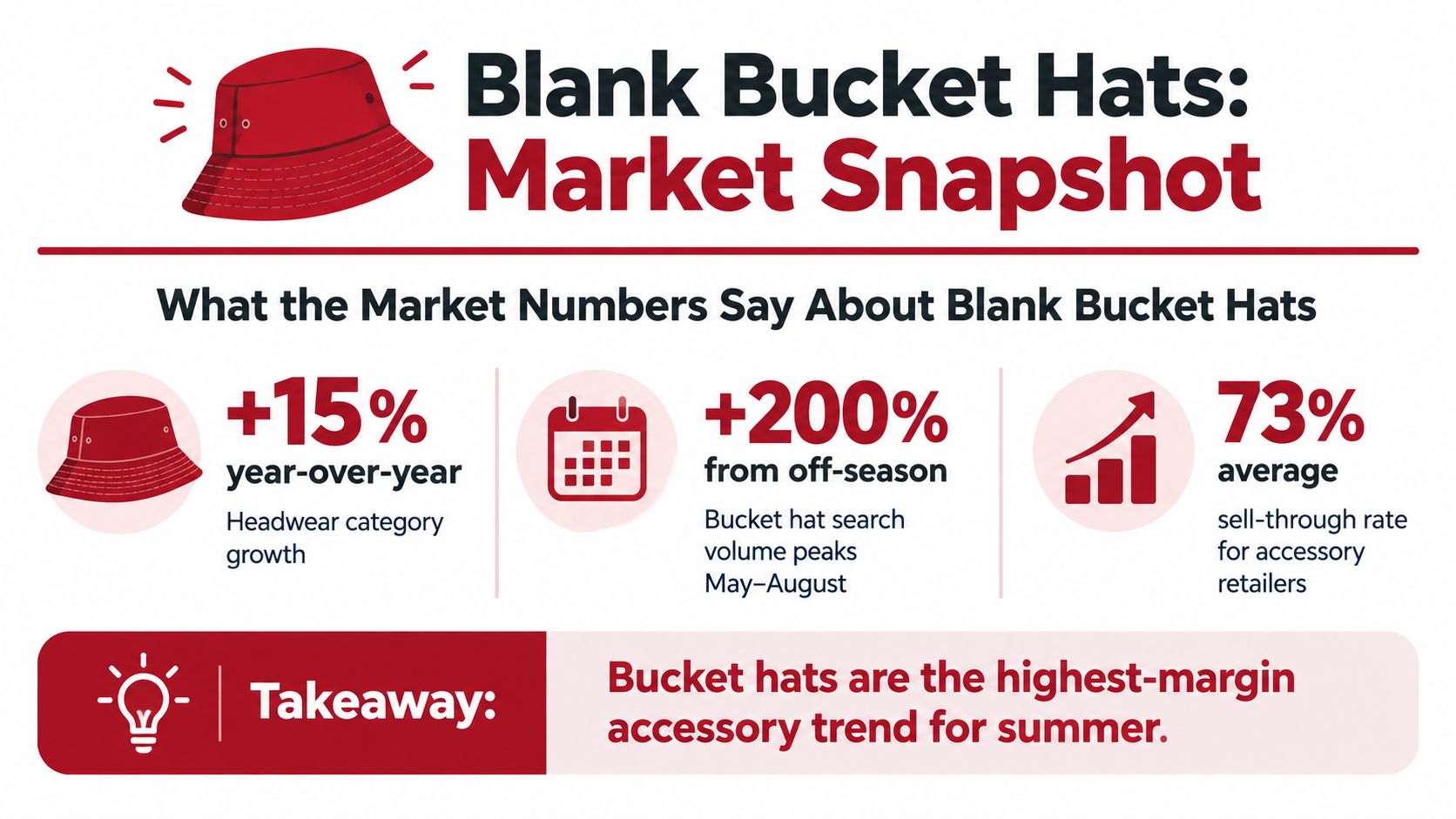
The strongest hard signal is simple. The global bucket hats market was valued at USD 400 million in 2025 and is projected to reach USD 660 million by 2034, with a 5.93% CAGR over the forecast period, and the same market view places 2026 at USD 420 million according to Fortune Business Insights on the bucket hats market. That tells you demand isn't being treated as a one-off spike.
Right near the top of the category, the broader headwear market is also large. Fortune's same market view places headwear at USD 25.3 billion in 2026, projected to reach USD 36.9 billion by 2033 in that same source. Bucket hats aren't floating alone. They sit inside a large headwear business with room for basics, promos, and decorated resale.
A second market view lands even more aggressively. Independent research estimates the global bucket hat market at USD 1.5 billion in 2025, growing to USD 2.8 billion by 2034 at a 7.5% CAGR, while one sports hats and caps analysis in that research notes bucket hats at 11.3% market share in 2025, according to Verified Market Reports on the bucket hat market.
Here's the visual version buyers usually want on one screen:
What that means for a small buyer
The practical takeaway is not “buy every bucket hat you can find.” It's narrower than that.
- The shape has enough scale to justify stock. You're not betting on a fringe item.
- Growth supports reorder thinking. Core blanks make more sense than novelty runs.
- Mainstream share helps decorators. There's enough volume in the silhouette to support repeat logo programs, patches, and private-label use.
Bucket hats earn their spot on volume and versatility. That's why spec discipline matters so much.
Later in the buying process, it helps to see how decorators use the silhouette in the field:
Picking the Right Fabric, Crown, and Brim Style
Buyers either set themselves up for easy reorders or create a decoration problem they didn't need. Don't shop bucket hats by vibe. Shop them by spec.
Fabric decides whether the blank behaves
For most buyers, cotton twill or cotton canvas is the right answer. Dense cotton construction is the workhorse because it holds embroidery better, looks cleaner after handling, and feels familiar at retail. Tightly woven 260 GSM cotton canvas or cotton twill is commonly used for bucket hats, and dense weaves can reach UPF 50+ performance, with some sources reporting 98%+ UVA/UVB blocking in tightly woven canvas and UPF 50+ fabrics blocking about 98% of UV for the material itself, according to this custom bucket hat wholesale fabric guide.
That's why a plain cotton blank keeps winning. It gives you decoration reliability and functional summer appeal in the same SKU.
Polyester and nylon still have a place. They work better when your customer wants a packable outdoor hat, not when they want fine embroidery. Slick synthetics can be useful, but they don't forgive bad digitizing and they don't hide stitch distortion well.
Crown shape changes the whole program
An unstructured crown is the safest buy for blank bucket hats wholesale. It folds easier, ships easier, and fits the way most buyers expect a bucket hat to fit.
Structured crowns look cleaner in product photos, but they can push you into fussier decoration setup and a stiffer final look. That's not always a dealbreaker. It just narrows the audience.
Buy the blank your customer will actually wear twice, not the blank that looked sharpest in a factory catalog.
Brim width is not a minor detail
Brim width decides whether the hat reads fashion, promo, or sun gear.
| Blank Bucket Hat Spec Comparison for Wholesale Buyers | Best For | Avoid If |
|---|---|---|
| Cotton twill, unstructured crown, standard brim | Embroidery programs, merch, staff uniforms, first orders | You want technical packable performance |
| Cotton canvas, unstructured crown, wider brim | Outdoor promotions, resort retail, stronger sun-coverage story | You need the softest drape possible |
| Nylon or polyester, unstructured packable build | Travel retail, active use, light carry | You plan dense embroidery |
| Reversible fashion build | Boutique resale, graphic story collections | You need simple reorders and easy decoration |
| Denim bucket hat | Fashion drops, washed heritage styling | You need low-risk, broad-appeal basics |
For most first orders, I'd call the winner clearly: cotton twill, unstructured crown, standard brim. If you want a broader read on how fabric choice affects headwear performance, this guide on hat fabric material is worth reviewing before you lock samples.
Understanding MOQs, Pricing, and Lead Times
First-time buyers get burned. Not because the math is hard, but because suppliers love giving partial answers.
You ask for price and get a unit number with no packaging, no shipping reality, no decoration assumptions, and no clear split between production time and transit time. That's how “cheap” orders become expensive ones.
Ask for the real buy terms
When you request quotes for blank bucket hats wholesale, get these answers in writing:
- Per-color minimums: Factories often quote a style MOQ that sounds flexible until you learn each color has its own floor.
- Available stock versus made-to-order: Those are different supply chains.
- Production time separate from shipping time: Never let a supplier blend them.
- Carton details: Freight costs get ugly fast when hats ship inefficiently.
- Sample policy: You need to know whether sample cost gets credited later.
If the quote is vague, the problem isn't your spreadsheet. It's the supplier.
Domestic versus import is a speed question first
Import buying can make sense if you know your calendar, your specs, and your reorder rhythm. Domestic distribution makes more sense when you care more about speed and lower risk than shaving every possible cent off the blank.
A useful starting point for first-time buyers is to compare current distributor education with custom factory offers. This overview on wholesale blank hats buying guide gives a practical benchmark for how to think about stock programs before you go deep into custom.
| Blank Bucket Hat Pricing Tiers and Lead Times | Unit Price Range | Production Lead Time | Shipping Window |
|---|---|---|---|
| Small trial run | Varies by supplier and stock position | Usually shortest if in stock domestically | Depends on warehouse location |
| Low MOQ custom run | Varies by fabric, color count, and trim complexity | Usually longer than stock buys | Depends on freight method |
| Mid-volume reorder | Pricing usually improves with quantity | More predictable if spec stays unchanged | Easier to plan if cartons are standardized |
| Large seasonal commitment | Stronger leverage on stable core specs | Needs earlier planning and calendar discipline | Freight timing matters more than unit savings |
My recommendation
For a first order, don't chase the absolute lowest quote. Chase the cleanest repeatable program.
That means one proven spec, a small color range, clear reorder terms, and a supplier who answers operational questions without dodging. Cheap blanks with sloppy timelines cost more than slightly higher-priced blanks that show up right and reorder fast.
What You Need to Know About Decorating Blank Bucket Hats
Bucket hats don't decorate like caps. If you treat them the same, you'll get puckering, cramped logos, and a finished hat that looks like the embroidery won the fight.
The big constraint is usable space. Production guidance for bucket hats typically limits front logos to about 2.5 inches tall and 4 inches wide and recommends medium-weight cutaway stabilizer to reduce puckering and distortion on soft crowns, according to this bucket hat embroidery sizing reference. That's your working limit, not a suggestion.
What decoration method fits the shape
Flat embroidery is still the default for most programs. It's durable, familiar, and works well on cotton blanks if the design is simplified.
3D puff can work, but only when the logo is bold and the crown shape supports it. On soft bucket hats, puff can look forced. I'd skip it unless you've already tested the exact blank.
Screen printing makes sense for graphic-driven fashion runs, especially when embroidery would overcomplicate a small design area. Woven patches are strong when the logo has detail that embroidery can't handle cleanly.
What buyers mess up most often
Here's where orders go sideways:
- They choose a detailed logo built for tees, not hats.
- They ignore crown curvature and place art too close to a seam.
- They test on the wrong fabric weight, then bulk-produce on a softer blank.
- They assume metallic or high-contrast thread will behave without a sew-out.
A bucket hat needs design restraint. Cleaner art almost always wins.
Keep the logo simple enough that someone can read it at arm's length, not just on a digital proof.
My call on decoration-ready blanks
For embroidered blank bucket hats wholesale, stick with medium-to-heavy cotton and a soft crown that still has enough body to support stitching. If you're comparing placement options or trying to figure out whether your artwork is better suited to direct embroidery or a patch, this guide to bucket hat embroidery is a useful checkpoint before you approve production.
Always decorate a sample first. Not a mockup. Not a rendering. A real hat.
How to Source a Wholesale Supplier You Can Trust
Good sourcing is mostly about asking sharper questions than the next buyer. Plenty of suppliers can send a bucket hat. Fewer can send the same bucket hat again, on time, with the same fabric hand and same construction quality.
Start with the supplier type that matches your risk tolerance
If price is your main concern, overseas factory platforms can work. You'll get more spec flexibility, but you need to sample before you trust anything.
If timing matters more, domestic wholesalers are easier to work with. You'll usually pay more per unit, but the lead time risk drops and communication is cleaner. For stocked and decoration-ready options, Dirt Cheap Headwear is one example of a distributor that carries blank bucket hat styles as part of a broader wholesale blank hat catalog.
Trade shows and in-person showrooms still matter because fabric weight and stitch quality are hard to judge from listing photos.
What to ask before you send money

Use a vetting checklist that forces specificity:
- Get the fabric spec: Ask for GSM and fabric composition. “Heavy cotton” means nothing.
- Confirm dye method: Yarn-dyed and piece-dyed won't always age or match the same.
- Request compliance documents: If they claim safety or sustainability, make them prove it.
- Inspect sample consistency: Order multiple samples, not just one hero piece.
- Track communication quality: Slow replies during sampling usually become worse during production.
Build the product before you scale the product
A lot of first-time buyers would benefit from stepping back and reviewing the broader production process before locking a headwear vendor. This walkthrough on how to produce a product is useful because it frames sourcing, prototyping, and fulfillment as one chain instead of isolated decisions.
A supplier isn't trustworthy because the first sample looked good. A supplier is trustworthy when the second and third orders match the first one.
Keep a backup option. If your whole summer program depends on one factory, you're gambling.
Matching Blank Specs to Summer and Festival Demand
Bucket hats separate themselves from other blanks. Summer programs don't just reward a good-looking hat. They reward the hat that survives heat, sweat, packing, and event photography.
Recent category coverage points in the same direction. A wholesale guide for 2026 calls bucket hats the fastest-growing decorator blank for Gen Z retail, festival merch, and warm-weather corporate programs, while separate trend coverage says cotton bucket hats and UV-protective bucket hats are seeing sustained search and sales momentum in 2025, according to KBETHOS wholesale hats buying guidance and Accio's bucket hat fashion trend analysis.
That lines up with what buyers need. Summer demand is functional, not just stylistic.
The spec that usually wins
For festival merch, outdoor promos, beach retail, and warm-weather staff use, I'd stock washed cotton or cotton twill before anything synthetic or shiny. Cotton breathes better, holds color in a familiar way, and handles embroidery patches and direct stitching more naturally than most novelty fabrics.
Light, wearable shades usually give you the broadest appeal. You don't need a rainbow. You need a few colors people will put on.
Match the blank to the job
| Blank Bucket Hat Specs by Summer Use Case | Best Fabric | Crown | Brim Width | Color Priority |
|---|---|---|---|---|
| Festival merch | Cotton twill | Unstructured | Standard | Light neutrals and easy seasonal tones |
| Outdoor corporate event | Cotton canvas | Unstructured | Standard to slightly wide | Clean brand-friendly basics |
| Beach or resort retail | Washed cotton | Soft unstructured | Standard | Sand, bone, faded naturals |
| Pack-and-go travel resale | Nylon or lightweight synthetic | Crushable | Narrow to standard | Simple solids |
| Sun-focused giveaway | Dense cotton canvas | Unstructured | Wider | Light colors for warm-weather use |
If your event team also cares about attendee-generated content, tools for photo sharing for event organizers can help you think through how the hats will appear in real festival photos, not just product shots. That matters more than buyers think.
What to skip
Skip shiny novelty fabric unless your whole brand identity depends on it. Skip too many colorways on the first order. Skip awkwardly wide brims unless the product is explicitly being sold for sun coverage.
Two strong cotton colorways beat a weak ten-color wall every time.
Your Pre-Order Checklist Before You Hit Submit
Before you approve the order, slow down and check the parts suppliers tend to blur. You prevent a workable sample from becoming a disappointing bulk shipment.
Confirm the physical spec, not the sales language
The pre-order standard is simple. You want exact material weight, exact construction details, and a real sample in hand.
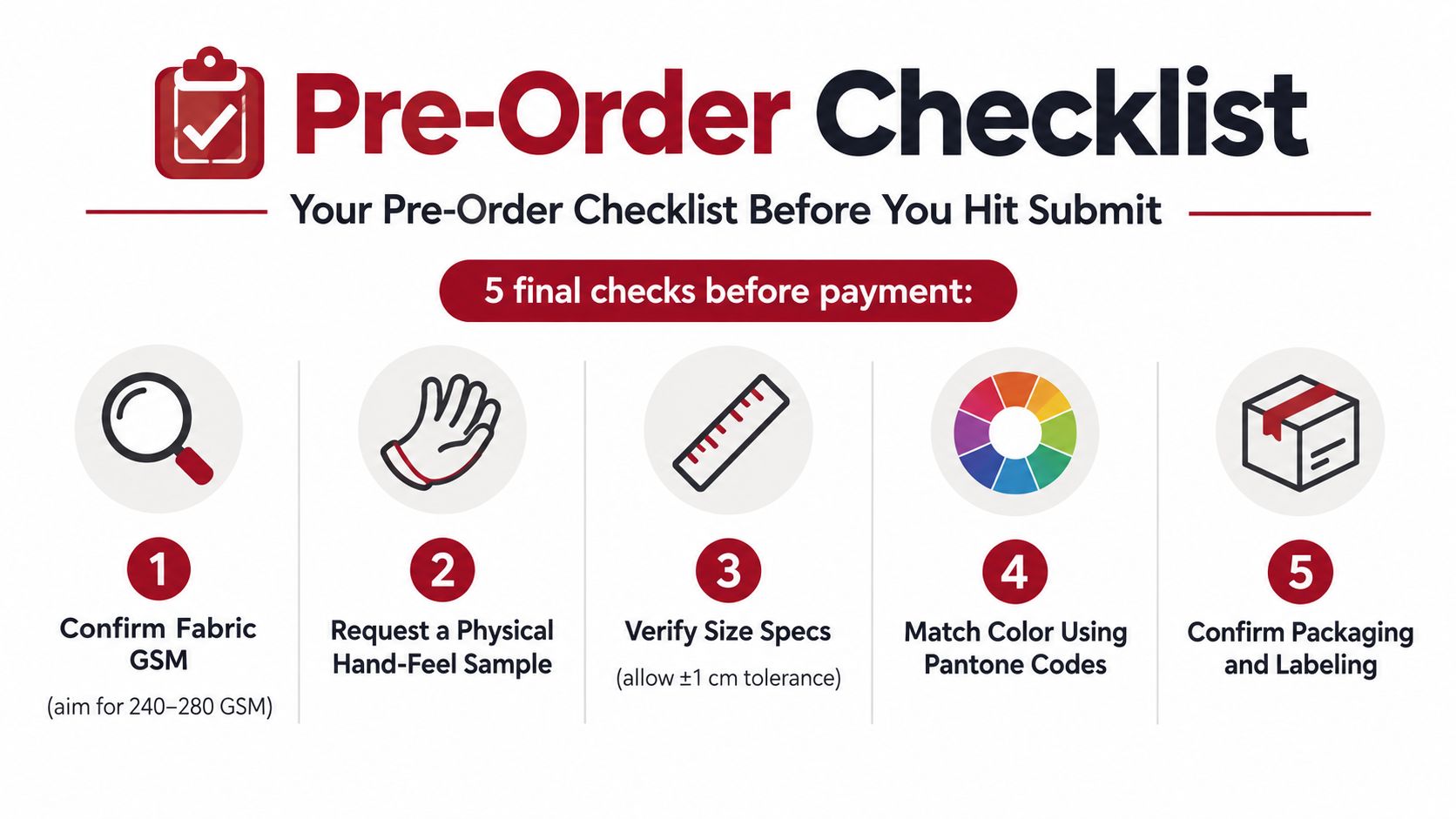
Run through this list:
- Verify GSM: Don't accept “premium cotton” as a spec.
- Check crown feel: The hand-feel tells you more than a web image ever will.
- Inspect brim stitching: Uneven brim rows make a blank look cheap fast.
- Measure decoration area: Your logo needs real-world room, not wishful room.
- Ask about labels and packaging: Retail-ready details affect labor later.
Lock the order terms before payment
You also need clarity on the commercial side:
- MOQ by color and style
- Production lead time separate from transit
- Replacement or defect policy
- Sample credit toward the bulk order
- Carton and packing details
If any of that is hand-wavy, hold the order.
Keep your rollout realistic
If you're using a preorder model to test demand before bringing inventory in, it helps to study how creator-focused programs structure customer expectations and production timing. This pre-order marketplace for creators is useful reference material for seeing how preorder-based selling can support lower-risk launches.
The cleanest first order is not the biggest one. It's the one you can restock confidently.
Your goal is simple. Buy a blank you can decorate, reorder, and explain. If you can't describe the fabric, crown, brim, and intended use in one sentence, you probably haven't narrowed the spec enough.
If you need blank bucket hats wholesale without playing guessing games on decoration and stock, Dirt Cheap Headwear carries blank headwear from established brands and also handles in-house embroidery for low-minimum custom runs. If you're testing your first bucket hat program or tightening up a repeat summer order, it's a practical place to compare blanks, check decoration options, and get the order moving.